Within Haunted Ayrshire
How Burns Made Alloway Ayrshire's Haunted Heart
Alloway Auld Kirk became Ayrshire's defining supernatural landmark when Burns turned local witchcraft lore into Tam o' Shanter.
On this page
- The real ruin behind the poem
- Tam o' Shanter's witches and warlocks
- Why literature became local haunting
Page outline Jump by section
Introduction
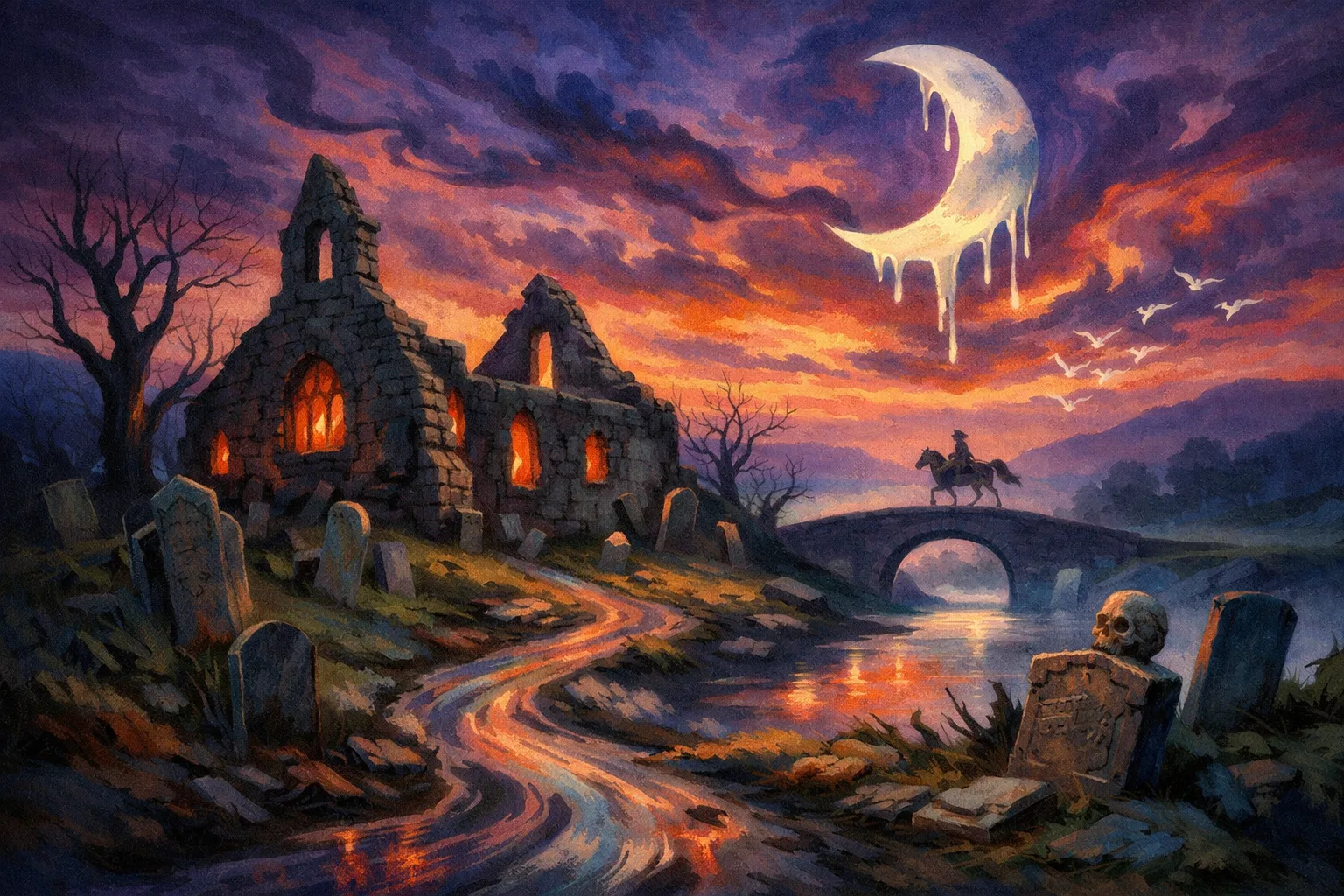
Alloway Auld Kirk is Ayrshire’s most famous supernatural landmark because Robert Burns made a real ruined church feel like the threshold between ordinary life and a witches’ sabbath. In Tam o’ Shanter, a farmer rides home from Ayr after a market-night drinking session, sees Alloway Kirk blazing through the trees, watches witches, warlocks and the Devil at their revels, then flees for the Brig o’ Doon with supernatural pursuers at his heels. The story is not a documented ghost sighting. Its power lies in the way Burns took local witchcraft lore, childhood superstition, a known Ayrshire road and a genuine ruin, then fused them into one of Scotland’s defining haunted scenes. The result is why Alloway, now in South Ayrshire but historically within Ayrshire, still functions as the county’s “haunted heart”: a place where literature, local memory, tourism and folklore have become almost impossible to separate.[nts.org.uk]nts.org.ukNational Trust for Scotland Alloway Auld Kirk | National Trust for ScotlandNational Trust for Scotland Alloway Auld Kirk | National Trust for Scotland
The real ruin behind the poem
Alloway Auld Kirk is not a vague Gothic invention. Historic Environment Scotland’s Trove record places Alloway Auld Kirk in the parish of Ayr, in the former county of Ayrshire, with the site classified as a medieval church and mortuary enclosure. The record also locates it precisely in South Ayrshire and notes its nearby designations, including Alloway Kirk as Scheduled Monument SM308 and the kirk graveyard as a listed building. That matters for haunted-history readers because Burns’s scene is attached to a specific, visitable ruin rather than to an anonymous “old church” of folklore.[Trove]trove.scotOpen source on trove.scot.
The National Trust for Scotland describes the Auld Kirk as a 16th-century church ruin and stresses that it was already ruined in Burns’s lifetime. That pre-existing decay is central to its atmosphere. Burns did not need to invent a remote abbey, a castle dungeon or a theatrical ruin: he had a weathered gable-end and kirkyard in the village landscape he knew. In the poem, that ordinary ruin becomes uncanny when Tam sees it lit from within, with “mirth and dancing” where there should be only darkness, graves and silence.[National Trust for Scotland]nts.org.ukNational Trust for Scotland Alloway Auld Kirk | National Trust for ScotlandNational Trust for Scotland Alloway Auld Kirk | National Trust for Scotland
The kirkyard deepens the setting because it is not merely scenic. Visitors can still see the graves of Burns’s father, William Burnes, and his sister Isabella Burns Begg, and the National Trust notes that many of the gravestones bear intricate carvings. This gives the place a double force: it is both a family and local burial ground and the imagined site of a supernatural revel. The eerie charge of Alloway Auld Kirk therefore comes from contrast. A ruin associated with worship, family memory and burial becomes, in Burns’s night-ride, the place where the dead and the demonic are made grotesquely active.[National Trust for Scotland]nts.org.ukNational Trust for Scotland Alloway Auld Kirk | National Trust for ScotlandNational Trust for Scotland Alloway Auld Kirk | National Trust for Scotland

Tam o’ Shanter’s witches and warlocks
The haunted action of Tam o’ Shanter begins before Tam reaches the kirk. Burns sets the story on a market night in Ayr, with Tam drinking indoors while the storm gathers outside. His wife has already warned him that he may end up drowned in the Doon or caught by warlocks near “Alloway’s auld haunted kirk”. That warning is important: the kirk is introduced as a known place of dread before Tam sees anything. Burns makes the reader feel that the local rumour has been waiting for the right hour, weather and foolish rider.[Scottish Poetry Library]scottishpoetrylibrary.org.ukScottish Poetry Library Tam o’ Shanter by Robert BurnsScottish Poetry Library Tam o’ Shanter by Robert Burns
When Tam reaches Alloway, the poem turns the ruin into a stage. The kirk appears to blaze through the trees; inside are witches and warlocks, the Devil plays music, and the scene builds into a wild dance. The National Galleries of Scotland’s account of the poem highlights the Halloween-like witches’ sabbath, the Devil’s music and the dead raised from coffins to hold torches, while the National Trust identifies the weathered gable-end as the point from which Tam first spies the capering figures. These details explain why the site became so visually memorable: Burns gives the reader light, sound, movement, bodies and a sudden chase, not just a vague report of a ghost.[National Galleries of Scotland]nationalgalleries.orgOpen source on nationalgalleries.org.
Tam’s mistake is not that he sees the supernatural gathering, but that he cannot keep silent. He cries out at the dancing witch Nannie, exposing himself to the company in the kirk. The chase that follows is one of the great pieces of haunted-road folklore in Scottish literature: Tam rides for the Brig o’ Doon because the pursuers cannot cross running water, and his mare Meg escapes only at the cost of her tail. This is why the story belongs not just to the church ruin but to a compact Alloway route: Ayr, the road home, the Auld Kirk, the River Doon and the bridge are all part of the same supernatural geography.[National Galleries of Scotland]nationalgalleries.orgOpen source on nationalgalleries.org.
What gives the episode its staying power is the balance Burns strikes between terror and comedy. The kirk scene is full of gruesome and infernal imagery, yet Tam is no solemn visionary. He is drunk, overexcited, foolish and recognisably human. The University of Glasgow’s Burns project describes the poem as more than a supernatural thriller: it is a humorous and complex reflection on folklore, place and human behaviour. That mixture prevents the Alloway haunting from becoming a simple ghost story. It is frightening, funny, moralising and mischievous all at once.[burnsc21.glasgow.ac.uk]burnsc21.glasgow.ac.ukOpen source on glasgow.ac.uk.
The old witch stories Burns reshaped
The deepest source for Alloway’s haunted reputation is not a single proven apparition but a chain of local storytelling. The National Trust for Scotland notes that Tam o’ Shanter was written in 1790 and published in 1791 at the request of the antiquarian Francis Grose, and that Burns supplied three “witch stories” associated with Alloway Kirk, the second of which was the Tam o’ Shanter material. This places the poem at an important junction: Burns was not simply inventing from nothing, but neither was he recording a witness statement in the modern sense. He was transforming local supernatural tradition into literature.[National Trust for Scotland]nts.org.ukOpen source on nts.org.uk.
The University of Glasgow’s Editing Robert Burns for the 21st Century project gives a useful account of that transformation. Grose was collecting material for The Antiquities of Scotland and wanted something to accompany an illustration of Alloway Kirk. Burns submitted prose fragments in June 1790, saying they came from local “Witch Stories”, and sent the verse tale later that year. The poem’s first setting in Grose’s antiquarian work helps explain its unusual flavour: it sits between local legend, antiquarian curiosity and comic literary performance.[burnsc21.glasgow.ac.uk]burnsc21.glasgow.ac.ukOpen source on glasgow.ac.uk.
Burns’s own childhood also matters. The National Trust highlights his 1787 autobiographical letter to Dr John Moore, in which Burns remembered the influence of Betty Davidson, a maid in his mother’s household, who had a large store of tales about devils, ghosts, fairies, brownies, witches, warlocks, kelpies, wraiths and apparitions. That background does not prove any supernatural event at Alloway Auld Kirk. It does show how naturally Burns could draw on oral folklore and make it feel locally rooted. The haunted kirk is therefore a literary crystallisation of stories he had heard, places he knew and fears that were already circulating in Ayrshire imagination.[National Trust for Scotland]nts.org.ukOpen source on nts.org.uk.
This is also why the story should be read carefully. A tourist may stand in the kirkyard and imagine Tam peering through the trees, but the strongest evidence is for folklore and literary afterlife, not for repeated modern apparitions. The “haunting” at Alloway is best understood as a place-tradition: a real ruin made famous by a poem that drew on older witchcraft lore and then fed back into how visitors experienced the site.
Why literature became local haunting
Alloway Auld Kirk is a useful example of how a literary work can become part of a county’s haunted geography. Many haunted places rely on reported sightings, named witnesses or repeated local anecdotes. Alloway is different. Its fame rests above all on a poem, but the poem is so strongly anchored in place that it has shaped the way the actual ruin is seen. The National Trust’s interpretation of Tam o’ Shanter in Alloway puts this plainly: it says it is impossible to separate poet, poem and place, and that the on-site interpretation builds on the blurred boundary between the real world and Tam’s world.[National Trust for Scotland]nts.org.ukOpen source on nts.org.uk.
That blurring begins with geography. Burns uses recognisable Ayrshire locations rather than a distant fantasy landscape. The poem starts in Ayr, sends Tam out into storm and darkness, brings him to Kirk Alloway, and then drives him towards the Brig o’ Doon. For readers and visitors, this makes the night ride feel traceable. The National Trust even promotes the Robert Burns Birthplace Museum experience by inviting visitors to follow in Tam o’ Shanter’s footsteps to Alloway Auld Kirk and over the Brig o’ Doon. The result is a haunted itinerary rather than a single haunted room.[National Trust for Scotland]nts.org.ukOpen source on nts.org.uk.
The physical heritage around the poem also reinforced the legend. The Burns Monument at Alloway opened in 1823, and the National Trust describes it as the point where Burns tourism in Alloway began. Once visitors began coming to honour Burns in his birthplace landscape, the Auld Kirk and Brig o’ Doon became more than local features. They became stations in a literary pilgrimage, and the supernatural episode from Tam o’ Shanter gave that pilgrimage its most atmospheric moment.[National Trust for Scotland]nts.org.ukthe great eight at robert burns birthplace museumthe great eight at robert burns birthplace museum
This is why Alloway’s haunted identity is unusually durable. A reported ghost may fade if witnesses are forgotten, but a poem read, recited, illustrated, taught and performed keeps renewing the scene. The National Galleries of Scotland’s discussion of Tam o’ Shanter shows how strongly the witches’ dance has lived in visual art, while the National Trust’s museum interpretation uses light, shadow, voice and story to connect Burns’s childhood, the old tales and the poem. The haunting is therefore not only in the ruin. It survives in books, paintings, museum displays, guided walks and the expectations visitors bring to the kirkyard.[National Galleries of Scotland]nationalgalleries.orgOpen source on nationalgalleries.org.
How credible is the Alloway haunting?
As a ghost or witchcraft “case”, Alloway Auld Kirk is folkloric rather than evidential. The strongest sources confirm the place, the ruin, the poem’s publication history, Burns’s connection to local witch stories, and the way heritage bodies interpret the site today. They do not establish that witches met there, that Tam existed exactly as described, or that a supernatural chase occurred on the road to the Brig o’ Doon. That distinction is essential for a trustworthy haunted-history page.[nts.org.uk]nts.org.ukOpen source on nts.org.uk.
The tradition is credible in a different sense: it is credible as a record of how Ayrshire supernatural imagination worked. Burns drew on oral stories about devils, witches, warlocks and uncanny beings; he placed them in a real ruined kirk; and he wrote for an antiquarian context interested in old sites and old tales. The University of Glasgow project notes the poem’s interplay between folk tradition and historical record, while the National Trust connects Burns’s Enlightenment education with the traditional Scottish mythology he used to dramatic effect. The poem is therefore not a paranormal report but a highly influential act of folklore-making.[burnsc21.glasgow.ac.uk]burnsc21.glasgow.ac.ukOpen source on glasgow.ac.uk.
There are also obvious sceptical readings. The poem frames Tam as drunk, late, frightened and riding through a storm. The kirk appears at a moment when weather, darkness, guilt, local warning and imagination all press on him. A modern reader can understand the witches as supernatural beings within the poem, as comic punishment for Tam’s excess, as a dramatisation of local superstition, or as Burns turning male foolishness into a chase scene. None of those readings cancels the haunted power of the place. They explain why the story works without requiring the reader to accept it as literal fact.
For Ayrshire’s haunted history, this makes Alloway Auld Kirk more important, not less. It shows how a county can be haunted by literature as much as by alleged apparitions. The ruin is real, the route is real, the poem is documented, and the local witch-story background is acknowledged by major Burns institutions. What remains uncertain is the supernatural event itself, which belongs to the realm of legend, performance and poetic imagination.
Visiting the haunted heart of Burns country
For modern visitors, Alloway Auld Kirk is best approached as part of a compact Burns landscape rather than as an isolated ruin. The National Trust for Scotland cares for the Robert Burns Birthplace Museum, Burns Cottage, Alloway Auld Kirk, the Brig o’ Doon, the Burns Monument and related landmarks, and its visitor material explicitly links the Auld Kirk and Brig o’ Doon through Tam’s route. This makes the story unusually easy to place on the ground: the reader can move from birthplace to kirk to bridge while carrying the poem’s night-ride in mind.[National Trust for Scotland]nts.org.ukOpen source on nts.org.uk.
The most rewarding way to read the site is to hold two versions of Alloway together. By day, the Auld Kirk is a protected church ruin and graveyard, with family graves, carved stones and a deep connection to Burns’s own life. In the poem’s darkness, the same ruin becomes a lit, noisy, impossible place where witches whirl and the dead assist the revel. That doubling is the whole point. Burns did not erase the real kirk; he made it stranger.
The story also sits naturally beside other Ayrshire haunted traditions, but it should not be swallowed by them. Culzean’s piper, castle White Ladies and witch-trial memories belong elsewhere in the county’s haunted map. Alloway’s special contribution is more precise: it is the place where Burns turned a local ruin and old witchcraft lore into Scotland’s most famous supernatural night ride. For a county-level haunted-history project, that makes the Auld Kirk not merely one eerie stop among many, but the imaginative centre from which much of haunted Ayrshire still takes its tone.
Amazon book picks
Further Reading
Books and field guides related to How Burns Made Alloway Ayrshire's Haunted Heart. Use these as the next step if you want deeper reading beyond the article.
The Penguin Book of Ghost Stories
Appeals to readers drawn to literary supernatural fiction.
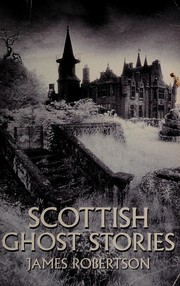
Scottish Ghost Stories
Expands readers' interest from Alloway into Scottish hauntings.
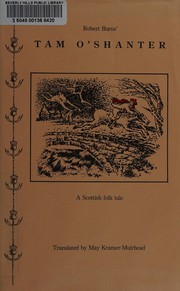
This book presents Robert Burns' Tam O'Shanter
First published 1984. Subjects: Halloween, Poetry, Scottish Dialect poetry.
Selected poems of Robert Burns
Places Tam o' Shanter within Burns's wider literary work.
eBay marketplace picks
Marketplace Samples
Live-tested eBay searches with available results related to this page.




Endnotes
1.
Source: trove.scot
Link:https://www.trove.scot/place/41599
2.
Source: burnsc21.glasgow.ac.uk
Link:https://burnsc21.glasgow.ac.uk/robert-burnss-tam-o-shanter-happy-halloween/
3.
Source: burnsc21.glasgow.ac.uk
Title: glasgow.ac.uk’Tam o’Shanter’ jug
Link:https://burnsc21.glasgow.ac.uk/tam-oshanter-jug/
4.
Source: trove.scot
Link:https://www.trove.scot/place/277367
5.
Source: nts.org.uk
Title: National Trust for Scotland Alloway Auld Kirk | National Trust for Scotland
Link:https://www.nts.org.uk/visit/places/robert-burns-birthplace-museum/highlights/alloway-auld-kirk
6.
Source: scottishpoetrylibrary.org.uk
Title: Scottish Poetry Library Tam o’ Shanter by Robert Burns
Link:https://www.scottishpoetrylibrary.org.uk/poem/tam-o-shanter-tale/
7.
Source: nationalgalleries.org
Link:https://www.nationalgalleries.org/art-and-artists/features/wad-ever-gracd-dance-witches-art-tam-oshanter
8.
Source: nts.org.uk
Link:https://www.nts.org.uk/collections/themes/witchcraft-and-burns-reality-and-rhyme
9.
Source: nts.org.uk
Link:https://www.nts.org.uk/stories/through-thick-and-thin-interpreting-tam-o-shanter-in-alloway
10.
Source: nts.org.uk
Link:https://www.nts.org.uk/visit/places/robert-burns-birthplace-museum
11.
Source: nts.org.uk
Title: National Trust for Scotland Tam o’ Shanter | National Trust for Scotland
Link:https://www.nts.org.uk/stories/tam-o-shanter
12.
Source: nts.org.uk
Title: the great eight at robert burns birthplace museum
Link:https://www.nts.org.uk/stories/the-great-eight-at-robert-burns-birthplace-museum
13.
Source: nts.org.uk
Title: celebrating 200 years of the burns monument
Link:https://www.nts.org.uk/stories/celebrating-200-years-of-the-burns-monument
14.
Source: Wikipedia
Title: Alloway Auld Kirk
Link:https://en.wikipedia.org/wiki/Alloway_Auld_Kirk
15.
Source: Wikipedia
Title: Alloway Auld Kirk
Link:https://de.wikipedia.org/wiki/Alloway_Auld_Kirk
16.
Source: Wikipedia
Title: William Burnes
Link:https://en.wikipedia.org/wiki/William_Burnes
17.
Source: Wikipedia
Title: Robert Burns Birthplace Museum
Link:https://en.wikipedia.org/wiki/Robert_Burns_Birthplace_Museum
18.
Source: nts.org.uk
Link:https://www.nts.org.uk/accessibility/robert-burns-birthplace-museum-accessibility-guide
19.
Source: nts.org.uk
Link:https://www.nts.org.uk/visit/places/robert-burns-birthplace-museum/planning-your-visit
20.
Source: nts.org.uk
Title: secrets of a shrine part 3
Link:https://www.nts.org.uk/stories/secrets-of-a-shrine-part-3
21.
Source: nts.org.uk
Title: the bark of ayrshire
Link:https://www.nts.org.uk/stories/the-bark-of-ayrshire
22.
Source: undiscoveredscotland.co.uk
Title: Burns Cottage
Link:https://www.undiscoveredscotland.co.uk/alloway/burnscottage/index.html
23.
Source: destinationsouthayrshire.co.uk
Title: burns monument
Link:https://destinationsouthayrshire.co.uk/things-to-do/burns-monument/
24.
Source: nationaltrustforscotland.teamkinetic.co.uk
Title: provider profile
Link:https://nationaltrustforscotland.teamkinetic.co.uk/volunteers/provider-profile//291170
25.
Source: tripadvisor.com
Title: Alloway Auld Kirk
Link:https://www.tripadvisor.com/Attraction_Review-g3723926-d14130391-Reviews-Alloway_Auld_Kirk-Alloway_South_Ayrshire_Ayrshire_Scotland.html
26.
Source: youtube.com
Title: Alloway Kirk
Link:https://www.youtube.com/watch?v=QTXNS25uj1M
27.
Source: rexby.com
Title: Alloway Auld Kirk
Link:https://www.rexby.com/ExploringScotland/ttd/historic-scottish-ruin-with-poetry
28.
Source: burnsmuseum.wordpress.com
Title: burns monument
Link:https://burnsmuseum.wordpress.com/tag/burns-monument/
29.
Source: arpl.co.uk
Link:https://www.arpl.co.uk/gallery-conservation-alloway.asp
Additional References
30.
Source: gettyimages.com
Link:https://www.gettyimages.com/photos/alloway-auld-kirk
31.
Source: gla.ac.uk
Link:https://www.gla.ac.uk/media/Media_518307_smxx.pdf
32.
Source: facebook.com
Link:https://www.facebook.com/groups/307795649410729/posts/1644761139047500/
33.
Source: hiddenscotland.com
Link:https://hiddenscotland.com/journal/alloway-auld-kirk-the-tale-of-tam-o-shanter
34.
Source: alamy.com
Link:https://www.alamy.com/alloway-auld-kirk-ayrshire-scotland-the-alloway-auld-kirk-which-dates-back-to-the-16th-century-is-a-ruin-in-alloway-south-ayrshire-scotland-celebrated-as-the-scene-of-the-witches-dance-in-the-poem-tam-o-shanter-by-robert-burnsscheduled-ancient-monument-and-category-a-listed-ruined-church-the-associated-graveyard-is-category-b-listed-other-notable-people-buried-here-include-lord-alloway-and-charles-acton-broke-he-was-the-son-of-rear-admiral-sir-philip-bowes-acton-broke-the-first-man-to-defeat-and-capture-an-american-ship-in-the-war-of-1812-image384234455.html
35.
Source: facebook.com
Link:https://www.facebook.com/groups/scottishscenery/posts/1708547673423299/
36.
Source: instagram.com
Link:https://www.instagram.com/p/DXMrTnijuQe/
37.
Source: hiddenscotland.com
Link:https://hiddenscotland.com/itineraries/exploring-robert-burns-birthplace-in-alloway
38.
Source: richietravel.com
Link:https://richietravel.com/robert-burns-birthplace-museum-and-burns-cottage/
39.
Source: tripadvisor.co.uk
Link:https://www.tripadvisor.co.uk/Attraction_Review-g186574-d2015510-Reviews-Robert_Burns_Birthplace_Museum-Ayr_South_Ayrshire_Ayrshire_Scotland.html
Topic Tree