Within Haunted Berkshire
Why Windsor Became Berkshire's Haunted Crown
Windsor's ghost stories mix royal death, castle tradition and the horned forest phantom made famous by Shakespeare.
On this page
- Herne the Hunter in Windsor Forest
- Royal ghosts inside the castle tradition
- How Shakespeare shaped the legend
Page outline Jump by section
Introduction
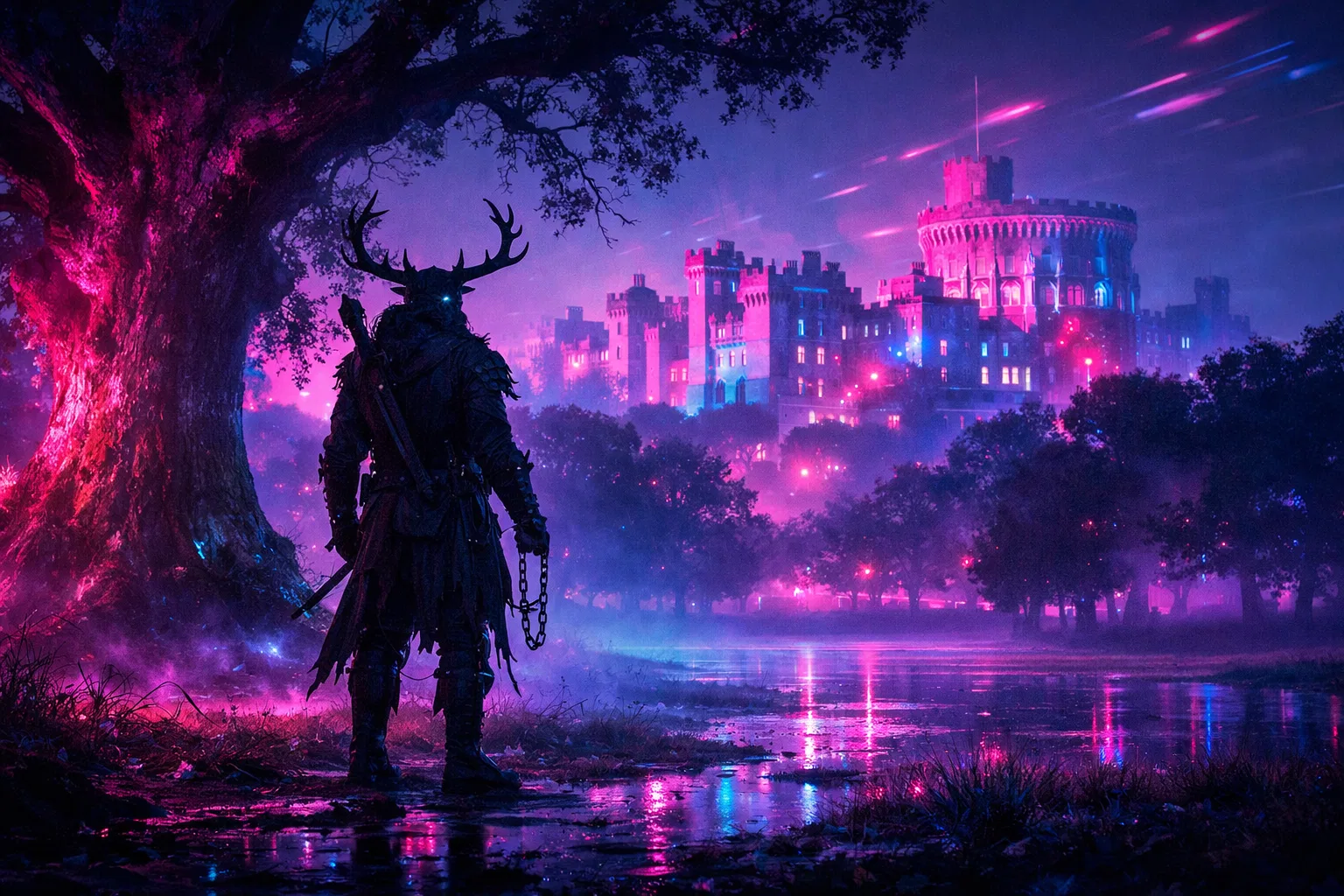
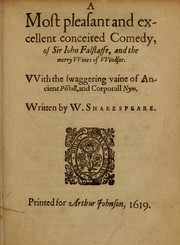
Windsor became Berkshire’s haunted crown because it joins three powerful ingredients in one landscape: a royal castle full of deaths, burials and political crisis; a former hunting forest with deep seasonal folklore; and Shakespeare’s most famous Berkshire ghost, Herne the Hunter. Herne is not a proven apparition. He is best understood as a Windsor tradition preserved, sharpened and partly transformed by literature: a horned forest keeper said to haunt an oak at winter midnight, rattling chains, damaging trees and troubling cattle. The earliest substantial written account is in The Merry Wives of Windsor, where the legend becomes the setting for Falstaff’s humiliation.[Folger Shakespeare Library]folger.eduShakespeare Library The Merry Wives of WindsorShakespeare Library The Merry Wives of Windsor
That is why Windsor’s haunted reputation feels different from a single haunted room or roadside sighting. The story spreads across castle, chapel, park, oak, stage and souvenir culture. In Berkshire’s wider haunted geography, Windsor is the place where royal memory and woodland superstition most visibly meet.
Herne the Hunter in Windsor Forest
Herne’s core story is simple enough to remember and strange enough to survive. In Shakespeare’s version, Mistress Page describes “an old tale” of Herne the Hunter, once a keeper in Windsor Forest, who walks around an oak at midnight in winter with ragged horns, shakes a chain, blasts the tree and makes milch cattle yield blood. The Folger Shakespeare text preserves the essential details: former forest keeper, winter midnight, oak, horns, chain and uncanny harm to cattle.[Folger Shakespeare Library]folger.eduShakespeare Library The Merry Wives of WindsorShakespeare Library The Merry Wives of Windsor
The Royal Shakespeare Company treats Herne as a mythical phantom huntsman associated with Windsor Forest and Great Park, recognised by horns, rattling chains, tree-blasting and cattle-bewitching. It also notes that the earliest written account comes from The Merry Wives of Windsor, usually dated around 1597, while later writers added much of the fuller back-story now attached to him.[Royal Society of Chemistry]rsc.org.ukHerne the Hunter in The Merry Wives of Windsor | Royal Shakespeare Company…
That matters for readers trying to judge the tale. Herne is often presented today as if he came down from a single ancient pagan myth fully formed, but the evidence is more awkward and more interesting. Shakespeare gives the first strong literary witness. Later antiquarians, novelists and folklorists embroidered the legend with suicide, stag wounds, bargains with the Devil, a phantom horse, hounds and warnings before disaster. Some of those details are evocative, but they should not be treated as equally old.
The place itself helps explain why the story took hold. Windsor Castle was founded high above the Thames, near a Saxon hunting ground, and its position gave monarchs both defensive value and access to a royal hunting forest. The Royal Collection Trust notes that William the Conqueror began building at Windsor around 1070, and that the castle’s closeness to the hunting forest helped make it an ideal royal residence.[Royal Collection Trust]rct.ukRoyal Collection Trust Who built Windsor Castle?Royal Collection Trust Who built Windsor Castle? Herne therefore belongs to a landscape where hunting was not picturesque decoration: it was part of royal power, land control and courtly identity.
The haunted oak problem
The most famous physical object in Herne’s story is not a castle chamber but a tree: Herne’s Oak. Yet the oak is also where the legend becomes hardest to pin down. There was not one uncontested tree whose identity passed cleanly from Shakespeare’s day to the present. There were rival candidates, changing local claims and a nineteenth-century fascination with relics.
The British Museum holds a block of oak described as a portion of Herne’s Oak from Home Park, Windsor. Its catalogue entry links the timber to the Shakespearean cult of the nineteenth century and states that the tree associated with Herne in The Merry Wives of Windsor was toppled in a gale in 1863.[British Museum]britishmuseum.orgOpen source on britishmuseum.org. The Royal Collection Trust also has an engraving of “Herne’s Oak, Windsor Park” from around 1799, showing how the tree had already become a subject of visual and antiquarian interest.[Royal Collection Trust]rct.ukhernes oak windsor parkhernes oak windsor park
Modern folklore scholarship complicates the neat tourist version. Simon Young’s study “Herne, the Windsor Bogey” argues that there were several candidate oaks in the park, with two especially important rivals: a “Blasted Oak”, cut down in 1796, and a “Maiden Tree” near Queen Elizabeth’s Walk, blown down in 1863. The controversy was not just a modern internet muddle; Young traces serious nineteenth-century argument over which tree was the true Herne’s Oak, including letters and William Perry’s 1867 treatise on the subject.[Chichester Fairy Tales Centre]sussexfolktalecentre.orgChichester Fairy Tales Centre Layout 1Chichester Fairy Tales Centre Layout 1
This uncertainty does not make the legend worthless. It makes it more revealing. The real question is not only “which tree was Herne’s?” but “why did people need there to be a Herne’s Oak at all?” The answer lies in the pull of place. Shakespeare gave Windsor a ghost with an address. Visitors, antiquarians and royal observers then wanted a tangible survivor: a trunk, a stump, a souvenir, a relic that made the theatrical ghost feel rooted in Berkshire soil.
Royal ghosts inside the castle tradition
Herne is Windsor’s most distinctive folklore figure, but he is not alone in the haunted royal landscape. Windsor Castle and St George’s Chapel have long attracted stories about dead monarchs who seem unwilling to leave the place where they lived, ruled, suffered or were buried.
The College of St George’s own archives blog presents these as claims and traditions rather than verified events. It says Henry VIII is purported to walk through the cloisters, dragging his ulcerated legs and groaning; Anne Boleyn is claimed to appear at a window overlooking the Dean’s Cloister; Elizabeth I has also reportedly been seen there; and Charles I, beheaded and buried at Windsor, is said to walk through Canons’ Cloister appearing intact.[College of St George]stgeorges-windsor.orgOpen source on stgeorges-windsor.org.
The historical anchors behind those stories are strong even when the ghost claims remain folklore. Henry VIII chose St George’s Chapel as his burial place beside Jane Seymour, though the grand tomb he planned was never completed.[Royal Collection Trust]rct.ukOpen source on rct.uk. The College of St George lists Henry VIII, Jane Seymour and Charles I in the Quire, and George III in the Royal Vault.[College of St George]stgeorges-windsor.orgCollege of St George Royal Burials in the Chapel by locationCollege of St George Royal Burials in the Chapel by location Windsor therefore gathers royal death in a concentrated way: not merely as rumour, but as stone, vault, chapel ritual and official memory.
That is why royal ghosts at Windsor feel plausible as stories even when they cannot be proved as sightings. They are attached to people whose lives were full of public drama: Henry VIII’s violence and bodily decline, Elizabeth I’s long reign, Charles I’s execution, George III’s illness and confinement. The haunting tradition turns national history into local atmosphere.
How Shakespeare shaped the legend
Shakespeare did not simply record Herne; he made Herne famous. In The Merry Wives of Windsor, the legend is used as a theatrical device. Falstaff is persuaded to dress as Herne, wearing deer antlers, and to meet the wives near the oak. The supposed ghost becomes a costume, a trap and a joke, while local children dressed as fairies torment him. The RSC summarises the scene as Falstaff standing beneath the oak in antlers, impersonating the horned phantom of Windsor Forest.[Royal Society of Chemistry]rsc.org.ukHerne the Hunter in The Merry Wives of Windsor | Royal Shakespeare Company…
This gives the legend a double life. Inside the play, Herne is a ghost story that the townspeople can exploit because everyone knows it. Outside the play, Shakespeare’s use of the tale helps ensure that later generations know it too. Young’s study puts the point sharply: Herne owed his fame to Shakespeare, because a local bogeyman entered world literature and survived when many neighbourhood spirits vanished without written record.[Chichester Fairy Tales Centre]sussexfolktalecentre.orgChichester Fairy Tales Centre Layout 1Chichester Fairy Tales Centre Layout 1
The 1602 quarto version adds another twist. The RSC notes that this early pirated version gives a different form of the monologue, suggesting the ghost story was used to frighten children into obedience.[Royal Society of Chemistry]rsc.org.ukHerne the Hunter in The Merry Wives of Windsor | Royal Shakespeare Company… Young’s study similarly notes the quarto’s “Horne” spelling and its image of Windsor mothers scaring children with a figure “in shape of a great stag”.[Chichester Fairy Tales Centre]sussexfolktalecentre.orgChichester Fairy Tales Centre Layout 1Chichester Fairy Tales Centre Layout 1 That small textual difference matters because it makes Herne look less like a grand supernatural lord and more like a local bogey: the sort of night figure used in family warning tales before later writers elevated him into a Wild Hunt or horned-god figure.
The result is not a clean choice between “ancient folklore” and “Shakespeare invented it”. The safest reading is that Shakespeare preserved or adapted a Windsor story whose earlier history is now hard to recover. He may have inherited a genuine local tale; he certainly gave it durable literary form.
Why Windsor’s haunted landscape feels royal and folkloric at once
Most haunted castles have stories of dead nobles, hidden crimes or footsteps in corridors. Windsor has those, but it also has something rarer: a forest phantom whose story is tied to the same royal environment as the castle itself. Herne is not a court ghost in crown and robe. He is a keeper, hunter or woodman — a figure from the managed woodland world that surrounded royal power.
That makes him a useful bridge between two kinds of haunting:
- The castle tradition turns monarchy into apparition: Henry VIII in the cloisters, Elizabeth I at a window, Charles I walking after execution.
- The forest tradition turns royal hunting land into folklore: a horned keeper, an oak, winter midnight, cattle harm and the threat of the uncanny outdoors.
- The Shakespeare tradition turns both into public memory: a local ghost becomes a scene, a performance, a tourist curiosity and a literary relic.
Windsor Great Park’s present landscape still supports that atmosphere because it remains a place of old trees, deer lawns and managed royal estate identity. The Windsor Great Park estate describes itself as covering around 6,400 hectares, including Windsor Great Park, Home Park Private, Sunninghill Park and Swinley Forest, while its conservation material emphasises ancient and veteran trees, especially English oak and beech.[Windsor Great Park]windsorgreatpark.co.ukWindsor Great Park Welcome to Windsor Great ParkWindsor Great Park Welcome to Windsor Great Park Even without accepting a supernatural claim, the setting gives Herne’s legend a convincing stage.
How credible is the Herne tradition?
The honest answer is that Herne is highly credible as folklore, but not as a documented ghost sighting. The earliest strong source is literary, not a parish deposition, legal record or dated witness statement. Shakespeare’s lines are precious because they show the story existed in some form by the late sixteenth century, or at least that it could be presented to an audience as an “old tale”. But they do not prove that anyone saw a horned apparition.
The later record is mixed. Antiquarian sources and nineteenth-century objects show that people cared deeply about Herne’s Oak. Museum pieces, prints and local debates prove a powerful afterlife for the legend. They do not prove the haunting. The most persuasive modern interpretation is that Herne began, or was remembered, as a Windsor bogey attached to forest, oak and winter fear; Shakespeare saved him from obscurity; later romantic and folkloric writing expanded him into something grander.[British Museum]britishmuseum.orgOpen source on britishmuseum.org.
That does not make the story less valuable for haunted Berkshire. It may make it more valuable. Herne shows exactly how a haunting becomes famous: a place gives it roots, a writer gives it words, visitors give it attention, and later generations give it new meanings. Windsor’s ghostly power lies not in one provable event, but in the way castle history, royal death and forest imagination have reinforced one another for centuries.
Why Windsor became Berkshire’s haunted crown
Windsor stands apart in Berkshire because its haunted stories operate on several levels at once. At street and visitor level, it offers the obvious drama of a great castle, chapel burials and royal apparitions. At landscape level, it offers Windsor Forest and Great Park, where Herne’s oak once gave the uncanny a specific place to gather. At literary level, it offers Shakespeare’s transformation of a local spirit into one of England’s best-known horned phantoms.
The county context matters. Historic Berkshire has changed administratively, especially after the 1974 boundary changes that moved several old Berkshire places into Oxfordshire and brought Slough from Buckinghamshire into Berkshire.[Berks County Family History Society]berksfhs.orgabout historic berkshireabout historic berkshire Windsor, however, remains securely central to Berkshire’s public identity: royal, riverside, theatrical and haunted.
Herne the Hunter is therefore not just another ghost in a list. He is the figure who explains why Windsor’s haunted landscape feels both local and national. He belongs to a particular oak, a particular forest and a particular Berkshire town, yet his fame travels through Shakespeare, royal tourism and English folklore. The best way to read him is not as a solved mystery, but as Windsor’s most enduring haunted question: how much of the horned hunter came from old local fear, and how much was made immortal by the stage?
Amazon book picks
Further Reading
Books and field guides related to Why Windsor Became Berkshire's Haunted Crown. Use these as the next step if you want deeper reading beyond the article.
The Haunted: A Social History of Ghosts
Explains why royal and legendary ghosts endure.

Ghostland: In Search of a Haunted Country
Explores haunted landscapes including legendary sites.
The Penguin Guide to the Superstitions of Britain and Ireland
Provides folklore context for Herne and woodland beliefs.
eBay marketplace picks
Marketplace Samples
Live-tested eBay searches with available results related to this page.
Endnotes
1.
Source: folger.edu
Title: Shakespeare Library The Merry Wives of Windsor
Link:https://www.folger.edu/explore/shakespeares-works/the-merry-wives-of-windsor/read/4/4/
2.
Source: rsc.org.uk
Title: Royal Society of Chemistry
Link:https://www.rsc.org.uk/the-merry-wives-of-windsor/about-the-play/herne-the-hunter
Source snippet
Herne the Hunter in The Merry Wives of Windsor | Royal Shakespeare Company...
3.
Source: folger.edu
Title: The Merry Wives of Windsor
Link:https://www.folger.edu/explore/shakespeares-works/the-merry-wives-of-windsor/read/
4.
Source: folger.edu
Title: The Merry Wives of Windsor
Link:https://www.folger.edu/explore/shakespeares-works/the-merry-wives-of-windsor/read/5/5/
5.
Source: royal.uk
Title: st georges chapel
Link:https://www.royal.uk/st-georges-chapel
6.
Source: people.com
Title: royal ghosts find out which of queen elizabeths castles are haunted
Link:https://people.com/royals/royal-ghosts-find-out-which-of-queen-elizabeths-castles-are-haunted/
7.
Source: rct.uk
Title: Royal Collection Trust Who built Windsor Castle?
Link:https://www.rct.uk/visit/windsor-castle/who-built-windsor-castle
8.
Source: britishmuseum.org
Link:https://www.britishmuseum.org/collection/object/H
9.
Source: rct.uk
Title: hernes oak windsor park
Link:https://www.rct.uk/collection/700759/hernes-oak-windsor-park
10.
Source: sussexfolktalecentre.org
Title: Chichester Fairy Tales Centre Layout 1
Link:https://sussexfolktalecentre.org/wp-content/uploads/Herne-the-Windsor-Bogey.pdf
11.
Source: stgeorges-windsor.org
Link:https://www.stgeorges-windsor.org/ghostly-goings-on/
12.
Source: rct.uk
Link:https://www.rct.uk/visit/windsor-castle/henry-viii-at-windsor-castle
13.
Source: stgeorges-windsor.org
Title: College of St George Royal Burials in the Chapel by location
Link:https://www.stgeorges-windsor.org/about-st-georges/royal-connection/royal-burials/royal-burials-chapel-location/
14.
Source: windsorgreatpark.co.uk
Title: Windsor Great Park Welcome to Windsor Great Park
Link:https://www.windsorgreatpark.co.uk/
15.
Source: windsorgreatpark.co.uk
Link:https://www.windsorgreatpark.co.uk/the-estate/environment/conservation-stewardship/woodland-parkland/
16.
Source: berksfhs.org
Title: about historic berkshire
Link:https://berksfhs.org/info/research-guides/about-historic-berkshire/
17.
Source: facebook.com
Title: english folklore
Link:https://www.facebook.com/groups/darkhistoryfolklore/posts/4379037112385313/
18.
Source: facebook.com
Link:https://www.facebook.com/RealCounties/photos/-1974-examples-of-county-identity-destruction-people-in-slough-bucks-told-they-w/884472127169689/
19.
Source: rct.uk
Link:https://www.rct.uk/collection/royal-archives
20.
Source: rct.uk
Link:https://www.rct.uk/visit/windsor-castle
21.
Source: Wikipedia
Title: Herne the Hunter
Link:https://en.wikipedia.org/wiki/Herne_the_Hunter
22.
Source: Wikipedia
Title: The Merry Wives of Windsor
Link:https://en.wikipedia.org/wiki/The_Merry_Wives_of_Windsor
23.
Source: Wikipedia
Title: Windsor Castle
Link:https://en.wikipedia.org/wiki/Windsor_Castle
24.
Source: Wikipedia
Title: Windsor Great Park
Link:https://en.wikipedia.org/wiki/Windsor_Great_Park
25.
Source: youtube.com
Link:https://www.youtube.com/watch?v=A0bsXXj04WY
26.
Source: stgeorges-windsor.org
Title: Henry VIIIResting Place
Link:https://www.stgeorges-windsor.org/wp-content/uploads/2017/08/HenryVIIIRestingPlace.pdf
27.
Source: 1066.co.nz
Link:https://www.1066.co.nz/Mosaic%20DVD/stamford%20bridge/Berkshire.htm
28.
Source: windsor.gov.uk
Title: windsor great park p236491
Link:https://www.windsor.gov.uk/things-to-do/windsor-great-park-p236491
29.
Source: englandspuzzle.com
Link:https://englandspuzzle.com/windsor-great-parks-famous-oak-trees/
30.
Source: berksfhs.org
Link:https://berksfhs.org/info/research-guides/berkshire-fhs-cds/
31.
Source: shakespeare-online.com
Title: The Merry Wives of Windsor
Link:https://www.shakespeare-online.com/plays/merry_5_5.html
32.
Source: mythologysource.com
Title: herne the hunter
Link:https://mythologysource.com/herne-the-hunter/
33.
Source: mythus.fandom.com
Link:https://mythus.fandom.com/wiki/Herne
34.
Source: pdsh.fandom.com
Title: Herne the Hunter
Link:https://pdsh.fandom.com/wiki/Herne_the_Hunter
35.
Source: fairweatherlewis.wordpress.com
Title: herne the hunter
Link:https://fairweatherlewis.wordpress.com/2010/04/01/herne-the-hunter/
36.
Source: britishfolklore.com
Title: Windsor Great Park
Link:https://britishfolklore.com/windsor-great-park/
Additional References
37.
Source: youtube.com
Title: Mysterious Secrets of Windsor Castle: A Royal Spooky Tale Part 2
Link:https://www.youtube.com/watch?v=1P-WvNshrDc
Source snippet
The Dark Story of Britain's LARGEST Castle: Windsor...
38.
Source: youtube.com
Title: Creating your image
Link:https://www.youtube.com/watch?v=BRnGTQrsc_g
Source snippet
"Herne the Hunter: Ghost, God or Guardian of the Forest?[https://www.youtube.com/watch?v=z6abaeoLaGw..."](https://www.youtube.com/watch?v=z6abaeoLaGw...")...
39.
Source: academia.edu
Link:https://www.academia.edu/36194698/Young_Herne_the_Windsor_Bogey
40.
Source: london-tickets.co.uk
Link:https://www.london-tickets.co.uk/windsor-castle-tickets/burials/
41.
Source: facebook.com
Link:https://www.facebook.com/groups/berkshiregenealogy/
42.
Source: genuki.org.uk
Link:https://www.genuki.org.uk/big/eng/BRK
43.
Source: englandcast.com
Link:https://www.englandcast.com/renaissance-ghosts/
44.
Source: great-castles.com
Link:https://great-castles.com/windsorghost.html
45.
Source: facebook.com
Link:https://www.facebook.com/groups/611808842738190/posts/1520279788557753/
46.
Source: youtube.com
Link:https://www.youtube.com/watch?v=z6abaeoLaGw
Source snippet
The Ghosts of Windsor Castle...
Topic Tree