Why Does Roxburghshire Feel So Haunted?
Roxburghshire’s haunted reputation belongs less to tidy “ghost trail” marketing than to the older, rougher memory of the Border country: ruined strongholds, reiver violence, prison cells, lonely roads, and stories gathered into ballads and local folklore.
Page outline Jump by section
Introduction
The county itself is a historic Scottish county in the Southern Uplands, now largely discussed within the modern Scottish Borders. Its old towns and landscapes include Jedburgh, Hawick, Kelso, Melrose, Teviotdale and Liddesdale, with Northumberland and Cumberland over the English border and Berwickshire, Selkirkshire and Dumfriesshire nearby.[Wikishire]wikishire.co.ukRoxburghshire13 May 2022 — The County of Roxburgh is an inland shire; the middlemost of the Middle Shires it looks both west and… That border setting matters: Roxburghshire’s ghost stories often make most sense as memories of a region where castles were not romantic backdrops but armed places in a disputed, violent landscape.
Why Roxburghshire feels haunted
Roxburghshire’s eerie folklore is rooted in its geography. This is inland Border country, shaped by the valleys of the Teviot, Tweed and Liddel, and by routes that once mattered militarily and economically. The former royal burgh of Roxburgh, from which the county took its name, declined after the medieval wars, while Jedburgh became the county town.[Wikishire]wikishire.co.ukRoxburghshire13 May 2022 — The County of Roxburgh is an inland shire; the middlemost of the Middle Shires it looks both west and… Modern visitors may arrive looking for abbeys, market towns and hill scenery, but the stories that cling to the county often come from an older world of strongholds, executions, feud, punishment and supernatural warning.
Historic county geography also needs a little care. “Roxburghshire” is not the same thing as the modern Scottish Borders council area, although much of the county now sits within that administrative frame. For a haunted-history page, the historic county is the best organising unit because older legends, estate histories, parish memories and antiquarian sources were usually preserved under county, dale, burgh or castle names rather than modern council boundaries. The relevant neighbouring haunted traditions therefore cross easily into Selkirkshire, Berwickshire, Dumfriesshire, Cumberland and Northumberland, but the centre of gravity here remains Roxburghshire.
The strongest pattern is not one neat county ghost type. Instead, Roxburghshire gives us several overlapping traditions:
- Castle hauntings, especially at Hermitage, where violence and legend have become inseparable.
- Border folklore beings, most notably the redcap, a murderous goblin of ruined towers and frontier places.
- Prison hauntings, centred on Jedburgh Castle Jail, where modern paranormal reports attach to a documented nineteenth-century gaol.
- Royal tragic memory, especially Mary Queen of Scots in Jedburgh and the famous ride to Hermitage.
- Ancient-site legend, where prehistoric stones at Ninestane Rig become the stage for a medieval tyrant’s supernatural punishment.
That mixture is what makes Roxburghshire distinctive. The ghosts are rarely polite drawing-room apparitions. They are more often figures of fear, punishment, grief or historical unease.
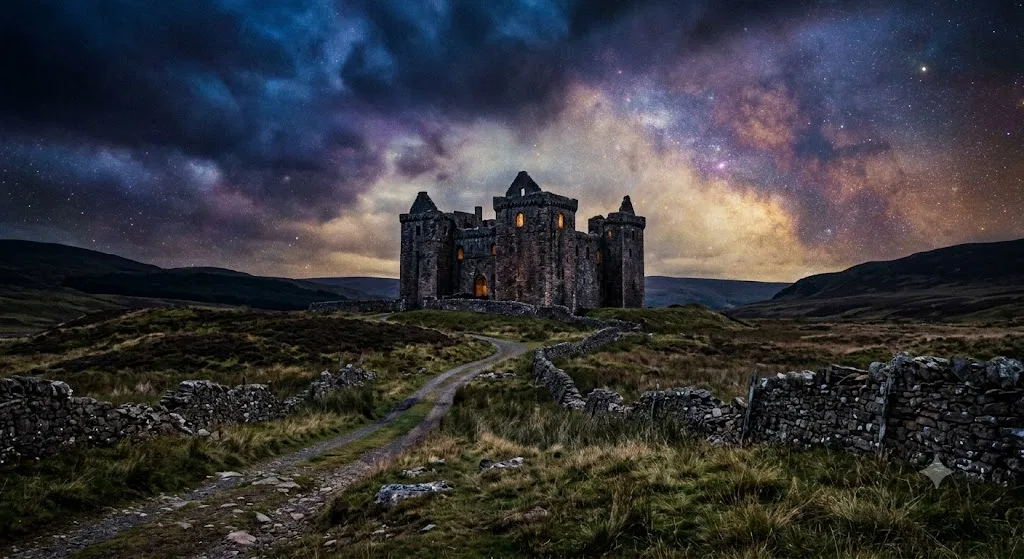
Hermitage Castle: Roxburghshire’s darkest haunted landmark
Hermitage Castle is the county’s major haunted site and one of the most atmospheric ruined castles in Scotland. Historic Environment Scotland describes it as an “awesome, eerie ruin” with a history of “intrigue, murder, torture and treason”, and its setting in Liddesdale gives the place much of its force: a massive stone stronghold in a remote valley rather than a picturesque castle above a busy town.[Historic Environment Scotland]historicenvironment.scotHistoric Environment ScotlandHermitage CastleThis awesome, eerie ruin has plenty of tales to tell, thanks to its role as “the guardhouse…
The castle’s historic fabric supports the atmosphere without needing embellishment. The scheduled monument includes the castle, chapel, enclosures, a probable deer trap, park boundary and farmstead remains. The main castle developed through several building phases from about 1360 into the late fourteenth and early fifteenth centuries, and it stands within large-scale earthworks.[Historic Environment Scotland]portal.historicenvironment.scotHistoric Environment ScotlandHermitage Castle, castle, chapel, enclosures, deer trap, park…24 Mar 2017 — The castle is an impressive u… These details matter because Hermitage’s haunted reputation is not floating free of the place: the grim stories are attached to a real fortified landscape of ditches, enclosures, chapel ruins and controlled territory.
The castle’s known history is dramatic enough to explain why legends flourished. It is associated with the de Soulis family, the Douglases, the Hepburns and the Scotts of Buccleuch. Historic Environment Scotland also highlights Mary Queen of Scots’ dangerous 1566 ride from Jedburgh to visit James Hepburn, 4th Earl of Bothwell, after he had been wounded in a clash with reivers.[Historic Environment Scotland]historicenvironment.scotOpen source on historicenvironment.scot. In a county where historical violence, later romance and literary memory overlap, Hermitage became almost too suitable a stage for haunting.
The most famous supernatural tradition at Hermitage is not a simple “white lady” story. It centres on Bad Lord Soulis and his familiar spirit, Robin Redcap. In the legend, Soulis is remembered as a cruel tyrant and sorcerer who oppressed his tenants and used dark arts at the castle. The redcap itself belongs to wider Anglo-Scottish Border folklore: a malicious goblin said to haunt ruined castles and blood-stained places along the border.[Undiscovered Scotland]undiscoveredscotland.co.ukOpen source on undiscoveredscotland.co.uk.
The story gained literary weight through Sir Walter Scott’s Minstrelsy of the Scottish Border, where “Lord Soulis” is placed at Hermitage with “Old Redcap sly”. Scott’s collection helped turn Border oral and antiquarian tradition into a lasting literary landscape, and it remains important for understanding why Hermitage’s folklore is so persistent.[Project Gutenberg]gutenberg.orgOpen source on gutenberg.org. The story should not be read as court record or documentary proof. It is better understood as a folklore cluster: a hated lord, a demonic helper, a magical invulnerability charm, and a spectacular punishment.
Hermitage also has a more historically grounded death story: Sir Alexander Ramsay of Dalhousie, Sheriff of Teviotdale, was imprisoned and starved by William Douglas, the Knight of Liddesdale, after political rivalry over the sheriffdom. Haunted-castle accounts often turn Ramsay into a wandering ghost of the ruins.[medieval-castle.com]medieval-castle.comHermitage CastleHermitage Castle The ghost claim itself is traditional rather than evidential, but the underlying tale of imprisonment, rivalry and death fits the violent realities of medieval Border lordship.
Mary Queen of Scots adds a different kind of haunting to Hermitage. Some popular accounts claim her apparition is among the spirits associated with the castle, but the stronger source base is historical rather than paranormal: her documented connection is the difficult ride from Jedburgh to Hermitage in October 1566, after Bothwell was wounded.[Historic Environment Scotland]historicenvironment.scotOpen source on historicenvironment.scot. The haunting, where told, is best treated as the emotional afterlife of that episode rather than as a well-attested apparition tradition.
Bad Lord Soulis, Robin Redcap and Ninestane Rig
The legend of Bad Lord Soulis does not end at Hermitage Castle. It reaches out into the landscape at Ninestane Rig, a small stone circle near Hermitage. Historic Environment Scotland’s scheduling record notes that the stone circle features in local folklore as the place where Lord Soules, the wicked inhabitant of Hermitage, was entrapped, encased in lead and roasted alive in a cauldron. The same record is careful to add that no excavation has taken place within the circle, so the truth of the story cannot be confirmed.[Historic Environment Scotland]portal.historicenvironment.scotOpen source on historicenvironment.scot.
That caution is exactly what makes the tale useful rather than merely lurid. The stones are real; the medieval tyrant tradition is old and locally anchored; the supernatural details belong to legend. A reader does not need to believe that a sorcerer boiled a magically protected lord at a prehistoric stone circle to see why the story lasted. It turns local resentment, lordly violence and an uncanny ancient monument into a memorable moral drama.
The redcap element deepens the Border identity of the tale. Redcaps are not generic demons imported into a castle story; they are strongly associated with the Anglo-Scottish borderlands and with ruined towers where wicked deeds were said to have taken place.[Wikipedia]WikipediaOpen source on wikipedia.org. In that sense, Robin Redcap is almost a personification of the violent frontier: small, vicious, territorial, and tied to bloodshed.
There is also a sceptical reading. The Soulis legend may preserve confused memories of real medieval politics, later family reputation, anti-tyrant storytelling and antiquarian romanticism. Scott’s version gave the tale literary authority, but literary authority is not the same as historical proof. The tradition survives because it works symbolically: Hermitage becomes the tyrant’s fortress, Ninestane Rig becomes the place of judgement, and Redcap becomes the supernatural shape of cruelty itself.
Jedburgh Castle Jail: the phantom piper and prison atmosphere
Jedburgh Castle Jail is Roxburghshire’s most prominent modern ghost-hunting site. The place has a layered history: a royal castle stood on the site from the twelfth century until 1409, when it was destroyed to prevent English use; a prison influenced by John Howard’s reformatory principles was then built between 1820 and 1824 on the site of the town gallows.[Jedburgh]jedburgh.org.ukOpen source on jedburgh.org.uk. That combination of medieval castle site, gallows association and nineteenth-century prison architecture gives the building an obvious haunted appeal.
The best-known reported apparition is the phantom piper, usually said to be seen on the battlements. Local event listings and paranormal operators also mention apparitions, unexplained noises, cold spots, bangs, screams, footsteps and feelings of being watched.[jedburgh.org.uk]jedburgh.org.ukOpen source on jedburgh.org.uk. These reports should be handled carefully. They are part of the site’s public haunted reputation, but many come from ghost-hunt promotion rather than independent archival testimony.
That does not make the tradition worthless. It tells us what kind of place Jedburgh Castle Jail has become in public imagination: a prison museum where visitors are primed to think about confinement, punishment and the lives of people once held there. Old prisons are especially fertile ground for haunting stories because their ordinary historical function already involves fear, isolation, surveillance and suffering. A cold corridor or a sudden sound can become meaningful in a building where the visitor is already thinking about cells, warders and condemned lives.
The phantom piper also links Jedburgh to a wider Scottish ghost motif. Phantom pipers are found in many Scottish legends, often connected with tunnels, battlements, caves or lost passages. At Jedburgh, the figure works because the building still carries a castle-like outline in the imagination even though the surviving institution is a gaol museum. The piper stands between two histories: the vanished medieval stronghold and the later prison.

Mary Queen of Scots in Jedburgh: history first, haunting second
Mary Queen of Scots’ House in Jedburgh is a different kind of haunted place. The building’s main importance is not that it has a deeply documented ghost tradition, but that it preserves one of Roxburghshire’s most powerful historical memories. The visitor centre is housed in a sixteenth-century tower house and tells the story of Mary’s month in Jedburgh in 1566, a period described by local heritage sources as a turning point in her life.[Live Borders]liveborders.org.ukLive Borders Mary Queen of Scots' Visitor CentreLive Borders Mary Queen of Scots' Visitor Centre
The historical episode is compelling. Mary was in Jedburgh for justice business when she rode to Hermitage Castle to see Bothwell after his wounding. The journey was long, difficult and politically charged, and she later became gravely ill.[Historic Environment Scotland]historicenvironment.scotOpen source on historicenvironment.scot. It is easy to see why the story attracted a supernatural afterglow: a tragic queen, a dangerous ride, illness, romance, political suspicion and a remote castle already wrapped in darker folklore.
Commercial ghost-hunt pages sometimes present Mary Queen of Scots’ House as a haunted site where Mary herself may still be present.[Haunted Happenings]hauntedhappenings.co.ukOpen source on hauntedhappenings.co.uk. That claim should be treated as modern paranormal tourism rather than settled local fact. The stronger and more responsible reading is that the house is haunted in the cultural sense: by Mary’s reputation, by the cult that grew up around her story, and by the way later generations turned her life into a chain of emotionally charged places.
There is even some uncertainty around the building tradition itself. Some summaries note doubt over whether Mary stayed in that exact house, though the museum has long used the building to interpret her life and Jedburgh connection.[Wikipedia]WikipediaMary Queen of Scots HouseMary Queen of Scots House For a haunted-history reader, this distinction matters. The site’s atmosphere is real, its museum role is real, and Mary’s Jedburgh episode is real; specific ghost claims need a lighter touch.
What the sources can and cannot prove
Roxburghshire’s haunted history sits on three different kinds of evidence, and mixing them up makes the stories less interesting, not more. The first kind is documented place history: castle construction, scheduled monuments, prison dates, museum interpretation and known figures such as Mary Queen of Scots, Bothwell, the Douglases and the Scotts. Historic Environment Scotland, Live Borders and related heritage records are strongest here.[Historic Environment Scotland]portal.historicenvironment.scotHistoric Environment ScotlandHermitage Castle, castle, chapel, enclosures, deer trap, park…24 Mar 2017 — The castle is an impressive u…
The second kind is folklore and literary preservation. Bad Lord Soulis, Robin Redcap and Ninestane Rig are not modern internet inventions; they are part of Border folklore shaped by antiquarian collection, ballad tradition and Sir Walter Scott’s literary influence.[gutenberg.org]gutenberg.orgOpen source on gutenberg.org. These sources are valuable because they show how people told the stories, not because they prove the supernatural events happened.
The third kind is reported paranormal experience and tourism lore. Jedburgh Castle Jail’s phantom piper, Hermitage’s wandering figures and Mary Queen of Scots’ supposed presence are widely circulated in ghost-hunt and haunted-travel contexts.[jedburgh.org.uk]jedburgh.org.ukOpen source on jedburgh.org.uk. These accounts are part of the county’s modern haunted reputation, but they are usually not documented with the same rigour as court records, archaeological scheduling or museum interpretation.
A fair reading is therefore layered. Roxburghshire has several genuinely old, place-specific supernatural traditions, especially around Hermitage and Ninestane Rig. It also has modern haunted attractions where atmosphere, visitor expectation and paranormal entertainment play a large role. The county’s best stories are strongest when read as folklore attached to real historic stress-points: fortress violence, border lawlessness, imprisonment, political tragedy and the uneasy survival of ruins.
Visiting Roxburghshire through its ghost stories
A haunted Roxburghshire itinerary naturally begins at Hermitage Castle. It is the most powerful single site because its landscape, architecture and legends still reinforce one another. The castle is not simply “said to be haunted”; it is a place where the historical record of violence and the folklore of Soulis, Redcap, Ramsay and Mary Queen of Scots have fused into one of Scotland’s most brooding Border landmarks.[Historic Environment Scotland]historicenvironment.scotHistoric Environment ScotlandHermitage CastleThis awesome, eerie ruin has plenty of tales to tell, thanks to its role as “the guardhouse…
Ninestane Rig is the natural companion site, especially for readers interested in how ancient monuments attract later legend. The Soulis execution story shows how a prehistoric stone circle can become part of a medieval and early modern moral tale. It is also a useful reminder that haunted landscapes are not confined to buildings; in Roxburghshire, open ground, old routeways and exposed upland places carry their own stories.
Jedburgh offers the county’s most accessible haunted cluster. Jedburgh Castle Jail gives the prison-haunting tradition, while Mary Queen of Scots’ House gives the tragic royal memory that links the town back to Hermitage. The two sites also show the difference between a place marketed for ghostly reports and a place where historical atmosphere may be stronger than the ghost claims themselves.[jedburgh.org.uk]jedburgh.org.ukOpen source on jedburgh.org.uk.
For readers exploring the wider project, Roxburghshire also connects naturally to neighbouring Border traditions: redcaps and ruined towers across the Anglo-Scottish frontier, reiver country in Northumberland and Cumberland, abbey towns and old roads across the Scottish Borders, and Mary Queen of Scots sites elsewhere in Scotland. Those links help explain why Roxburghshire’s hauntings feel less like isolated spooky anecdotes and more like fragments of a borderland memory.
The most credible haunted reading of Roxburghshire
The most credible conclusion is not that Roxburghshire is “proved” to be haunted. It is that the historic county has an unusually strong haunted imagination because its real history supplies the right materials: remote castles, violent lordship, disputed marches, ruined medieval power, prison reform, execution sites, royal tragedy and literary preservation.
Hermitage Castle is the key. Its legends of Bad Lord Soulis, Robin Redcap, Sir Alexander Ramsay and Mary Queen of Scots are not equal in evidential weight, but together they explain why the castle dominates Roxburghshire ghost lore. Ninestane Rig shows how the supernatural story moves into the wider landscape. Jedburgh Castle Jail shows how modern ghost tourism grows around prison atmosphere and repeated visitor reports. Mary Queen of Scots’ House shows how a place can feel haunted by historical memory even when the ghost claim is secondary.
Roxburghshire’s ghosts are best approached as careful folklore: eerie, memorable and locally rooted, but not to be mistaken for confirmed fact. Read that way, the county becomes richer rather than flatter. Its haunted places are not just stops on a spooky map. They are ways of seeing how the Border past survived in ruins, ballads, museum rooms, prison corridors and stories told long after the original fear had changed its shape.
eBay marketplace picks
Marketplace Samples
Live-tested eBay searches with available results related to this page.


Endnotes
1.
Source: Wikipedia
Link:https://en.wikipedia.org/wiki/Roxburghshire
2.
Source: gutenberg.org
Link:https://www.gutenberg.org/files/45778/45778-h/45778-h.htm
3.
Source: en.wikisource.org
Link:https://en.wikisource.org/wiki/Page%3ANotes_on_the_folk-lore_of_the_northern_counties_of_England_and_the_borders.djvu/276
4.
Source: medieval-castle.com
Title: Hermitage Castle
Link:https://www.medieval-castle.com/haunted_castles_scotland/hermitage_castle.htm
5.
Source: Wikipedia
Link:https://en.wikipedia.org/wiki/Redcap
6.
Source: Wikipedia
Title: Jedburgh Castle
Link:https://en.wikipedia.org/wiki/Jedburgh_Castle
7.
Source: Wikipedia
Title: Mary Queen of Scots House
Link:https://en.wikipedia.org/wiki/Mary_Queen_of_Scots_House
8.
Source: Wikipedia
Title: Hermitage Castle
Link:https://en.wikipedia.org/wiki/Hermitage_Castle
9.
Source: Wikipedia
Title: Ninestane Rig
Link:https://en.wikipedia.org/wiki/Ninestane_Rig
10.
Source: youtube.com
Link:https://www.youtube.com/watch?v=DEsDmfRETwA
Source snippet
Jedburgh Castle Jail | Ghost Hunting | Ghost Quest | GHOST CAUGHT ON CAMERA...
11.
Source: youtube.com
Title: Jedburgh Castle Jail | Ghost Hunting | Ghost Quest | GHOST CAUGHT ON CAMERA
Link:https://www.youtube.com/watch?v=a6rtat8NM94
Source snippet
9 Most Haunted Places in the Scottish Borders...
12.
Source: wikishire.co.uk
Link:https://wikishire.co.uk/wiki/Roxburghshire
Source snippet
Roxburghshire13 May 2022 — The County of Roxburgh is an inland shire; the middlemost of the Middle Shires it looks both west and...
Published: May 2022
13.
Source: historicenvironment.scot
Link:https://www.historicenvironment.scot/visit/all/hermitage-castle/
Source snippet
Historic Environment ScotlandHermitage CastleThis awesome, eerie ruin has plenty of tales to tell, thanks to its role as “the guardhouse...
14.
Source: portal.historicenvironment.scot
Link:https://portal.historicenvironment.scot/apex/f?p=1505%3A300%3A%3A%3A%3A%3AVIEWTYPE%2CVIEWREF%3Adesignation%2CSM90161
Source snippet
Historic Environment ScotlandHermitage Castle, castle, chapel, enclosures, deer trap, park...24 Mar 2017 — The castle is an impressive u...
15.
Source: historicenvironment.scot
Link:https://www.historicenvironment.scot/visit/all/hermitage-castle/history-and-stories/
16.
Source: undiscoveredscotland.co.uk
Link:https://www.undiscoveredscotland.co.uk/usbiography/s/williamdesoules.html
17.
Source: portal.historicenvironment.scot
Link:https://portal.historicenvironment.scot/apex/f?p=1505%3A300%3A%3A%3A%3A%3AVIEWTYPE%2CVIEWREF%3Adesignation%2CSM1688
18.
Source: jedburgh.org.uk
Link:https://www.jedburgh.org.uk/event-thespectresofjedburghjail25
19.
Source: haunted-houses.co.uk
Link:https://www.haunted-houses.co.uk/ghost-hunt/jedburgh-castle-jail/
20.
Source: hauntedhappenings.co.uk
Link:https://www.hauntedhappenings.co.uk/jedburgh-jail/
21.
Source: liveborders.org.uk
Title: Live Borders Mary Queen of Scots’ Visitor Centre
Link:https://www.liveborders.org.uk/culture/museums/our-museums/mary-queen-of-scots-visitor-centre/
22.
Source: hauntedhappenings.co.uk
Link:https://www.hauntedhappenings.co.uk/mary-queen-of-scots-house/
23.
Source: facebook.com
Link:https://www.facebook.com/groups/scotlandsscenery/posts/25941196092139752/
24.
Source: facebook.com
Link:https://www.facebook.com/BorderReiverGenealogy/photos/ninestane-rig-ninestane-rig-english-nine-stone-ridge-is-a-small-stone-circle-in-/2302955606385876/
25.
Source: tripadvisor.com
Title: Hermitage Castle
Link:https://www.tripadvisor.com/Attraction_Review-g186505-d216448-Reviews-Hermitage_Castle-Hawick_Scottish_Borders_Scotland.html
26.
Source: wikishire.co.uk
Link:https://wikishire.co.uk/wiki/Roxburgh
27.
Source: wikishire.co.uk
Title: Ninestane Rig
Link:https://wikishire.co.uk/wiki/Ninestane_Rig
28.
Source: paranormaleyeuk.co.uk
Link:https://www.paranormaleyeuk.co.uk/scotland/jedburgh-castle-ghost-hunt-
29.
Source: distinct.scot
Title: hermitage castle
Link:https://distinct.scot/journal/2023/1/19/hermitage-castle
30.
Source: evil.fandom.com
Title: Hermitage Castle
Link:https://evil.fandom.com/wiki/Hermitage_Castle
31.
Source: blog.historicenvironment.scot
Title: five minute folklore
Link:https://blog.historicenvironment.scot/2023/01/five-minute-folklore/
32.
Source: historicenvironment.scot
Link:https://www.historicenvironment.scot/visit/things-to-see-and-do/mary-queen-of-scots/
33.
Source: weewalkingtours.com
Title: jedburgh castle jail
Link:https://www.weewalkingtours.com/post/jedburgh-castle-jail
34.
Source: ivorythewriter.wordpress.com
Title: hermitage castle
Link:https://ivorythewriter.wordpress.com/2013/11/26/hermitage-castle/
35.
Source: thecastlesofscotland.co.uk
Title: jedburgh castle
Link:https://www.thecastlesofscotland.co.uk/the-best-castles/feature-articles/jedburgh-castle/
36.
Source: hauntedrooms.co.uk
Link:https://www.hauntedrooms.co.uk/ghost-hunts/jedburgh-castle-jail
Additional References
37.
Source: youtube.com
Title: GHOSTS of Jedburgh Castle Jail | ALONE Again!
Link:https://www.youtube.com/watch?v=CAHwfxiPeh0
Source snippet
Dark Shadows of Hermitage Castle: The Haunted Guardhouse of Scotland's Bloodiest Glen...
38.
Source: literaryballadarchive.com
Link:https://literaryballadarchive.com/wp-content/uploads/Leyden_4_Lord_Soulis_ff.pdf
39.
Source: folklorescotland.com
Link:https://folklorescotland.com/all-stories/
40.
Source: castlesandmanorhouses.com
Link:https://www.castlesandmanorhouses.com/ghosts.php?SelectCountry=Scotland&SelectQuality=ALL&SelectType=Ghost+Haunting&submit=
41.
Source: visitscotland.com
Link:https://www.visitscotland.com/things-to-do/attractions/arts-culture/myths-legends
42.
Source: folklorescotland.com
Link:https://folklorescotland.com/the-fearsome-redcaps-of-the-scottish-borders/
43.
Source: deadlive.co.uk
Link:https://www.deadlive.co.uk/haunted-scottish-castles-explore-ghostly-legends/
44.
Source: thecastleguide.co.uk
Link:https://thecastleguide.co.uk/castle/hermitage-castle/
45.
Source: visitnewcastleton.com
Link:https://www.visitnewcastleton.com/things-to-see/hermitage-castle/
46.
Source: facebook.com
Link:https://www.facebook.com/groups/553298215898417/posts/1525318105363085/
Topic Tree
Follow this branch
Related pages 91
- Haunted Clackmannanshire
- Haunted Antrim
- Haunted Armagh
- Haunted Durham
- Haunted Londonderry
- +86 more in sidebar