Where West Lothian's Ghost Stories Take Hold
West Lothian’s haunted history is not a single famous “most haunted county” story, but a tight cluster of royal ruins, prison castles, old estates, asylum buildings, witchcraft memory and modern strange-lore.
Page outline Jump by section
Where West Lothian’s ghost map begins
For this project, West Lothian is best read as the historic county also known as Linlithgowshire: a compact Lowland county on the south side of the Firth of Forth, with Linlithgow as its county town and neighbouring historic counties including Midlothian, Lanarkshire and Stirlingshire. That matters for haunted history because older newspapers, antiquarian works and local traditions may call the area “Linlithgowshire”, while present-day tourism and council sources usually say “West Lothian”.[Wikishire]wikishire.co.ukWest LothianWest Lothian
Modern West Lothian Council covers nine wards, including Linlithgow, Bathgate, Armadale and Blackridge, Whitburn and Blackburn, Broxburn, Uphall and Winchburgh, and Livingston areas. The modern map is useful for visitors, but it should not be treated as identical to the historic county: Scotland’s counties as local government areas were abolished in 1975, and the old West Lothian county boundaries had already been altered in the 1890s.[West Lothian Council]westlothian.gov.ukOpen source on westlothian.gov.uk.
The county’s haunted texture comes from three overlapping landscapes. First is royal West Lothian, centred on Linlithgow Palace and Blackness Castle. Second is landed and military West Lothian, seen in the House of the Binns and the legends of General Tam Dalyell. Third is industrial and institutional West Lothian: shale-oil villages, former hospitals, new-town woods and places where twentieth-century stories have become modern folklore.[Historic Environment Scotland]historicenvironment.scotOpen source on historicenvironment.scot.
Linlithgow Palace: royal ghosts beside the loch
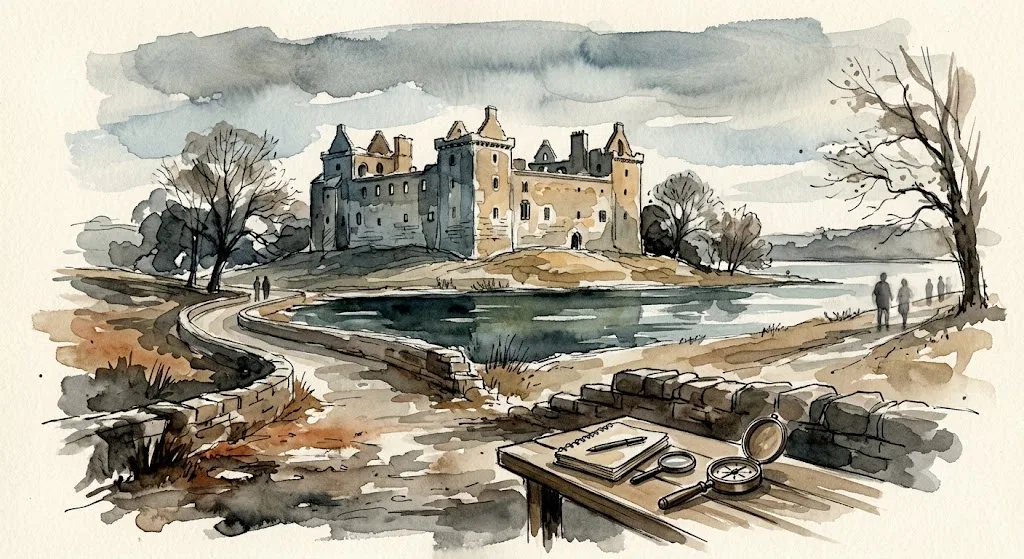
Linlithgow Palace is the county’s most obvious haunted landmark. Historic Environment Scotland describes it as a superb Renaissance residence, built and enlarged by the Stewart kings over two centuries, and famous as the birthplace of Mary, Queen of Scots. It stood beside Linlithgow Loch as a royal stopping place between Edinburgh Castle and Stirling Castle, which helps explain why later ghost stories so often attach themselves to queens, waiting, mourning and vanished court life.[Historic Environment Scotland]historicenvironment.scotOpen source on historicenvironment.scot.
The best-known apparition tradition says that a royal female figure haunts the palace precincts. Popular accounts identify the figure variously with Mary of Guise, mother of Mary, Queen of Scots, or with Margaret Tudor, wife of James IV. One recurring version places a woman in a blue gown near the palace and St Michael’s Church, sometimes with the sound or suggestion of rustling silk. These are not documented as official sightings in the way an archive might record a court case; they are modern haunted-heritage traditions layered over a real royal site.[The Fairytale Traveler]thefairytaletraveler.comThe Fairytale Traveler Linlithgow Palace: Ghosts of Scotland's castlesThe Fairytale Traveler Linlithgow Palace: Ghosts of Scotland's castles
The historical setting gives the story its emotional force. Linlithgow was associated with Stewart queens and royal births, but it declined after James VI moved the royal court to London in 1603. Later, the palace was left a roofless shell after eighteenth-century damage and neglect. A ruin that was once a nursery of kings and queens is almost designed to attract stories of women looking back towards lost power, lost family and lost home.[Historic Environment Scotland]historicenvironment.scotOpen source on historicenvironment.scot.
The credibility of the Linlithgow ghost tradition is therefore folkloric rather than evidential. The palace’s royal history is well supported; the identity of the apparition is not. For readers, the useful distinction is simple: Linlithgow Palace is certainly a historically charged ruin, and it is widely presented in ghost-story writing as haunted, but the ghost itself belongs to local and tourist legend rather than confirmed historical record.[Historic Environment Scotland]historicenvironment.scotOpen source on historicenvironment.scot.

Blackness Castle: the prison fortress and its phantom knight
Blackness Castle sits on the Firth of Forth near Linlithgow and has one of the strongest atmospheres in West Lothian’s haunted geography. Historic Environment Scotland notes that it was “never just a peaceful lordly residence”: it served as a garrison fortress and state prison, and its long, narrow form earned it the nickname “the ship that never sailed”.[Historic Environment Scotland]historicenvironment.scotOpen source on historicenvironment.scot.
Its ghost story is suitably martial. VisitScotland’s haunted-castles material describes a legend of a phantom knight in armour guarding the prison tower and startling visitors. Other paranormal retellings add late twentieth-century anecdotal sightings and unexplained noises, but the core motif remains the same: armour, stone stairs, prison space and a sudden frightening encounter.[VisitScotland]visitscotland.comOpen source on visitscotland.com.
The legend works because it fits the building’s known function. Blackness was a fortress, a royal possession and a prison; its towers and cells already carry associations of confinement and military authority. Even without accepting the apparition as factual, the phantom knight reads as a folk shorthand for the castle’s past: the armed guard who never quite left his post.[Historic Environment Scotland]historicenvironment.scotOpen source on historicenvironment.scot.
Blackness also shows how film and television can refresh older atmosphere. The castle is now a visitor attraction and has been used as a location for productions including Outlander, which has made many viewers newly aware of its bleak walls and waterside setting. That screen afterlife does not prove the haunting, but it does help explain why the castle’s ghost stories circulate so easily among visitors looking for dramatic historic places.[Co]visitwestlothian.co.ukOpen source on visitwestlothian.co.uk.
House of the Binns: Bluidy Tam and the Devil’s card table
The House of the Binns, near Linlithgow, is West Lothian’s richest named-house legend. The National Trust for Scotland describes it as the home of the Dalyell family, with around 400 years of family history and wide views across the surrounding countryside. Its supernatural reputation is tied above all to General Sir Tam Dalyell of the Binns, remembered in tradition as “Bluidy Tam”.[National Trust for Scotland]nts.org.ukOpen source on nts.org.uk.
The most famous tale is wonderfully physical: a marble-topped table in the entrance hall is said to be the table at which Dalyell played cards with the Devil. In the National Trust for Scotland’s telling, Dalyell used a mirror to read the Devil’s cards; the enraged opponent hurled the table at him, missed, and the table ended up in a pond outside. Later legends around Dalyell also include his cavalry boots marching around the house by themselves and a ghostly rider on a white horse galloping towards the Binns.[National Trust for Scotland]nts.org.ukdealing with the devildealing with the devil
This is not a gentle “white lady” haunting. It belongs to an older Scottish tradition in which feared or morally controversial men are turned into supernatural figures after death. Dalyell’s historical reputation as a hard military commander, especially in relation to the Covenanters, helps explain why later folklore cast him as a man bold enough to gamble with the Devil and sinister enough to return after death.[National Trust for Scotland]nts.org.ukdealing with the devildealing with the devil
The Binns tradition is stronger than many local ghost stories because it is attached to a specific object, a specific family house and a named historical figure. That does not make the Devil episode literally credible; it makes it a well-preserved legend with clear social meaning. It turns political violence, aristocratic memory and household display into a story visitors can grasp in one glance: a grand house, a feared soldier, a card table and a bargain that went wrong.[National Trust for Scotland]nts.org.ukbringing back the binns meet the visitor services managerbringing back the binns meet the visitor services manager
Bangour Village Hospital: modern ruins and uneasy memory
Bangour Village Hospital, west of Dechmont, represents a different kind of haunted West Lothian. Its reputation comes less from centuries-old folklore and more from the emotional force of an abandoned institutional landscape. Lothian Health Services Archive records Bangour’s hospital history through patient records, building records and photographs, while other archival summaries note its role as a psychiatric hospital and wartime medical site.[lhsa.is.ed.ac.uk]lhsa.is.ed.ac.ukBangour Hospital collectionBangour Hospital collection
The site officially opened in the early twentieth century as a village-style psychiatric institution and was later adapted for wartime medical use. National Records of Scotland catalogue material notes that Bangour was taken over by the War Office in 1915, with patients transferred elsewhere and staff and beds increased to receive wounded soldiers. That wartime and psychiatric history is often what gives later ghost stories their emotional charge.[National Records of Scotland]catalogue.nrscotland.gov.ukNational Records of Scotland SCAN CatalogueNational Records of Scotland SCAN Catalogue
Modern paranormal accounts describe mysterious figures on the grounds, eerie presences and the familiar haunted-hospital atmosphere of empty wards, corridors and overgrown paths. Those claims are much thinner than the documented hospital history. They sit closer to urban exploration folklore: stories generated by abandonment, restricted spaces, decaying buildings and the discomfort many people feel around former psychiatric institutions.[Scottish Paranormal]scottish-paranormal.co.ukScottish Paranormal Haunted Hospitals Scotland: Bangour Village HospitalScottish Paranormal Haunted Hospitals Scotland: Bangour Village Hospital
Bangour’s redevelopment is also changing the story. Planning and housing reports describe major proposals for a new residential community on the former hospital estate, including hundreds of homes and the retention or reuse of listed buildings. As the ruins become housing, the “haunted abandoned hospital” image may fade, but the deeper memory of Bangour as a place of treatment, war medicine, confinement and local curiosity will remain part of West Lothian’s eerie modern heritage.[scottishhousingnews.com]scottishhousingnews.comScottish Housing News Plans to build 998 new homes at Bangour Village HospitalScottish Housing News Plans to build 998 new homes at Bangour Village Hospital
Witches, fear and folklore in the Calder villages
West Lothian’s witchcraft memory is more historically serious than many ghost stories, because it points back to real accusation, punishment and execution. The University of Edinburgh’s Survey of Scottish Witchcraft covers Scottish witchcraft cases from 1563 to 1736 and is a major reference point for understanding how widespread witch-hunting became in early modern Scotland.[Scottish Witchcraft]witches.hca.ed.ac.ukOpen source on ed.ac.uk.
The most locally focused example is the Calder witch hunt of 1643–45. The Calder Witch Hunt project states that at least five women from Calder were executed for witchcraft during that period, and the Intangible Cultural Heritage Scotland account names Helen Stewart, Jonet Bruce, Agnes Bischope, Agnes Vassie and Marion Gibsone among those executed. It also records coercive treatment including sleep deprivation, confinement and pressure to name others.[Calder Witch Hunt]calderwitchhunt.co.ukOpen source on calderwitchhunt.co.uk.
This material needs careful handling. These were not “real witches” in the supernatural sense; they were people accused under a legal and religious system that treated witchcraft as a capital crime. Historic Environment Scotland’s discussion of the Witchcraft Act of 1563 explains the wider legal framework: the Act led to a century and a half of witch hunts in Scotland, with thousands accused and many killed.[Historic Environment Scotland Blog]blog.historicenvironment.scotthe witchcraft act and its impact in scotlandthe witchcraft act and its impact in scotland
West Lothian also has later “witch” folklore that is not the same as the witch trials. Lizzie Bryce, associated with Mid Calder, appears in local memory as a woman labelled a witch by children and later commemorated in place-name and roadside folklore. Accounts stress that she lived in the nineteenth century, long after Scotland’s witchcraft laws had been repealed, so her story is better read as social name-calling, folk memory and local character legend rather than a trial narrative.[Konect Magazines]konect.scotMagazines Who was Lizzie Bryce?Magazines Who was Lizzie Bryce?
Cairnpapple Hill and the older sacred landscape
Not every eerie West Lothian place is haunted by a named ghost. Cairnpapple Hill, in the Bathgate Hills, is important because it gives the county a much older ritual landscape. Historic Environment Scotland describes it as a rare ceremonial complex whose summit was used for ceremonies and burials for at least 4,000 years, with a henge dating from about 3800 BC and later Bronze Age burials.[Historic Environment Scotland]historicenvironment.scotOpen source on historicenvironment.scot.
This is not evidence for ghosts, and it should not be forced into a paranormal story. Its relevance is more subtle. Places like Cairnpapple remind readers that West Lothian’s eerie atmosphere is not only medieval or Victorian; it also comes from deep time, exposed hilltops, burial monuments and the sense that certain sites were meaningful long before written history.[West Lothian Council]westlothian.gov.ukOpen source on westlothian.gov.uk.
For a haunted-history page, Cairnpapple is best treated as an atmospheric companion site rather than a confirmed haunting. It belongs in the same mental map as burial mounds, old churches and ruined castles: places where landscape, death and memory overlap, even when there is no reliable apparition story attached.[Historic Environment Scotland]historicenvironment.scotOpen source on historicenvironment.scot.
Dechmont Law: not a ghost, but a modern legend
The Dechmont Law incident near Livingston is not a ghost story, but it is one of West Lothian’s best-known modern strange tales and often appears beside paranormal folklore. On 9 November 1979, forestry worker Robert Taylor reported an encounter with an unidentified object in woodland at Dechmont Law. West Lothian Council’s own visitor material presents the episode as one of Scotland’s best-known UFO encounters, while other summaries note that it became unusually famous because police treated Taylor’s injuries and torn clothing as a possible assault matter.[West Lothian Council]westlothian.gov.ukWest Lothian Council Top secretWest Lothian Council Top secret
The story has become local folklore because it has unusually concrete elements: a named witness, a precise date, a woodland setting, reported marks on the ground, injuries, police involvement and later commemoration. That gives it a different flavour from an old castle apparition. It is twentieth-century new-town weirdness rather than ancestral haunting.[West Lothian Council]westlothian.gov.ukWest Lothian Council Top secretWest Lothian Council Top secret
Sceptical explanations have also formed part of the story from early on. Accounts of the case discuss possibilities such as medical collapse, misperception, ground marks made by mundane objects, or other non-extraterrestrial explanations. For this West Lothian page, the important point is not to decide the case, but to recognise how quickly a puzzling personal experience can become a place-based legend.[Wikipedia]WikipediaRobert Taylor incidentRobert Taylor incident
Dechmont Law also helps widen the county’s haunted map beyond ruins and aristocratic houses. It shows that modern woods, footpaths and new-town edges can become folklore sites too. In that sense, it sits naturally beside haunted hospitals and roadside witch legends: all are stories about ordinary places suddenly made strange.[Co]visitwestlothian.co.ukwest lothian the home of ufoswest lothian the home of ufos
How credible are West Lothian’s hauntings?
West Lothian’s haunted evidence is mixed, and the differences matter. The buildings and historical settings are often very well documented: Linlithgow Palace’s royal role, Blackness Castle’s prison function, the House of the Binns’ Dalyell history, Bangour’s hospital records and the Calder witch executions all have institutional or archival support. The apparitions themselves are usually preserved through legend, tourism writing, local memory or paranormal retelling.[historicenvironment.scot]historicenvironment.scotOpen source on historicenvironment.scot.
The strongest folkloric cases are the ones tied to specific people, objects or places. Bluidy Tam’s card table at the Binns has a memorable object and a named historical figure. Linlithgow Palace’s royal woman draws force from identifiable queens and a known palace setting. Blackness Castle’s phantom knight fits the prison tower and fortress identity. Bangour, by contrast, is more of a modern mood-haunting: the atmosphere of abandonment often does more work than any single documented witness account.[nts.org.uk]nts.org.ukdealing with the devildealing with the devil
A fair reading is therefore neither dismissive nor credulous. These stories should not be presented as confirmed supernatural facts, but they are not worthless simply because they cannot be proved. They reveal how West Lothian remembers power, punishment, confinement, illness, religious fear and social outsiders. Ghost stories are often history told sideways: not always accurate as evidence, but revealing about what a place finds hard to forget.[ichscotland.org]ichscotland.orgscotlands year stories project calder witch huntscotlands year stories project calder witch hunt
West Lothian’s most useful haunted route
A reader looking for the county’s haunted history would do best to start at Linlithgow. Linlithgow Palace gives the royal ghost tradition its centre, while the nearby House of the Binns supplies the county’s best-developed devil legend. Blackness Castle, close by on the Forth, adds the darker prison-fortress strand. Together these three sites form the most coherent historic-haunting cluster in West Lothian.[historicenvironment.scot]historicenvironment.scotOpen source on historicenvironment.scot.
From there, the route can move inland towards Bathgate, Cairnpapple Hill and the Calder villages. This shifts the emphasis from royal apparitions to ritual landscape and witchcraft memory. The Calder material is especially important because it connects folklore with real persecution rather than theatrical spookiness.[historicenvironment.scot]historicenvironment.scotOpen source on historicenvironment.scot.
The final layer is Livingston and Dechmont: Bangour Village Hospital for modern ruin folklore, and Dechmont Law for the county’s best-known twentieth-century paranormal case. These places show that West Lothian’s strange stories did not end with castles and witch trials. They adapted to hospitals, forestry tracks, police reports, redevelopment plans and new-town life.[ed.ac.uk]lhsa.is.ed.ac.ukBangour Hospital collectionBangour Hospital collection
What West Lothian’s ghost stories are really about
West Lothian’s hauntings are most interesting when read as stories of memory under pressure. Linlithgow Palace remembers vanished monarchy. Blackness Castle remembers confinement and armed authority. The House of the Binns remembers a feared soldier through a demonic household legend. Bangour remembers institutional life and abandonment. Calder remembers women harmed by witchcraft accusation. Dechmont Law remembers the modern fear that even familiar woods can become inexplicable.[historicenvironment.scot]historicenvironment.scotOpen source on historicenvironment.scot.
That makes the county a strong haunted-history subject even without a vast catalogue of famous apparitions. Its stories are compact, place-specific and unusually varied: queenly figures, armoured phantoms, devil bargains, accused witches, abandoned wards and a woodland UFO case all sit within a small Lowland area. The haunted value of West Lothian lies less in proving ghosts than in seeing how powerfully local history can cling to stone, road, hill and ruin.

eBay marketplace picks
Marketplace Samples
Live-tested eBay searches with available results related to this page.
Endnotes
1.
Source: lhsa.is.ed.ac.uk
Title: Bangour Hospital collection
Link:https://lhsa.is.ed.ac.uk/collections/LHB40/lhb40_tlfa.htm
2.
Source: visitscotland.com
Link:https://www.visitscotland.com/nl-nl/things-to-do/attractions/castles/haunted
3.
Source: Wikipedia
Title: Blackness Castle
Link:https://en.wikipedia.org/wiki/Blackness_Castle
4.
Source: Wikipedia
Title: House of the Binns
Link:https://en.wikipedia.org/wiki/House_of_the_Binns
5.
Source: bangour-village.com
Link:https://bangour-village.com/about/
6.
Source: konect.scot
Title: Magazines Who was Lizzie Bryce?
Link:https://www.konect.scot/post/who-was-lizzie-bryce
7.
Source: Wikipedia
Title: Robert Taylor incident
Link:https://en.wikipedia.org/wiki/Robert_Taylor_incident
8.
Source: youtube.com
Link:https://www.youtube.com/watch?v=XkozK4v_w-8
9.
Source: wikishire.co.uk
Title: West Lothian
Link:https://wikishire.co.uk/wiki/West_Lothian
10.
Source: scotlandspeople.gov.uk
Link:https://www.scotlandspeople.gov.uk/content/west-lothian-county
11.
Source: westlothian.gov.uk
Link:https://www.westlothian.gov.uk/article/73807/West-Lothian-Ward-Map
12.
Source: historicenvironment.scot
Link:https://www.historicenvironment.scot/visit/all/linlithgow-palace/
13.
Source: historicenvironment.scot
Link:https://www.historicenvironment.scot/visit/all/blackness-castle/
14.
Source: historicenvironment.scot
Link:https://www.historicenvironment.scot/visit/all/linlithgow-palace/history-and-stories/
15.
Source: thefairytaletraveler.com
Title: The Fairytale Traveler Linlithgow Palace: Ghosts of Scotland’s castles
Link:https://thefairytaletraveler.com/2015/02/17/haunted-linlithgow-palace/
16.
Source: scottish-paranormal.co.uk
Title: blackness castle is blackness castle haunted
Link:https://www.scottish-paranormal.co.uk/post/blackness-castle-is-blackness-castle-haunted
17.
Source: visitwestlothian.co.uk
Link:https://www.visitwestlothian.co.uk/things-to-do/history-heritage/blackness-castle/
18.
Source: nts.org.uk
Link:https://www.nts.org.uk/visit/places/house-of-the-binns
19.
Source: nts.org.uk
Title: bringing back the binns meet the visitor services manager
Link:https://www.nts.org.uk/stories/bringing-back-the-binns-meet-the-visitor-services-manager
20.
Source: nts.org.uk
Title: dealing with the devil
Link:https://www.nts.org.uk/stories/dealing-with-the-devil
21.
Source: catalogue.nrscotland.gov.uk
Title: National Records of Scotland SCAN Catalogue
Link:https://catalogue.nrscotland.gov.uk/scancatalogue/person.aspx?code=NA17185&k=asylum&ko=o&r=&ro=s&st=1&tc=y&tl=n&tn=y&tp=y
22.
Source: scottish-paranormal.co.uk
Title: Scottish Paranormal Haunted Hospitals Scotland: Bangour Village Hospital
Link:https://www.scottish-paranormal.co.uk/post/haunted-hospitals-scotland-bangour-village-hospital
23.
Source: lothianlife.co.uk
Title: a ghost town in west lothian
Link:https://www.lothianlife.co.uk/2011/04/a-ghost-town-in-west-lothian/
24.
Source: scottishhousingnews.com
Title: Scottish Housing News Plans to build 998 new homes at Bangour Village Hospital
Link:https://www.scottishhousingnews.com/articles/plans-to-build-998-new-homes-at-bangour-village-hospital-approved
25.
Source: scottishconstructionnow.com
Title: ambassador homes secures final approval to retain listed buildings at bangour
Link:https://www.scottishconstructionnow.com/articles/ambassador-homes-secures-final-approval-to-retain-listed-buildings-at-bangour
26.
Source: witches.hca.ed.ac.uk
Link:https://witches.hca.ed.ac.uk/
27.
Source: calderwitchhunt.co.uk
Link:https://www.calderwitchhunt.co.uk/project
28.
Source: ichscotland.org
Title: scotlands year stories project calder witch hunt
Link:https://ichscotland.org/wiki/scotlands-year-stories-project-calder-witch-hunt
29.
Source: blog.historicenvironment.scot
Title: the witchcraft act and its impact in scotland
Link:https://blog.historicenvironment.scot/2022/06/the-witchcraft-act-and-its-impact-in-scotland/
30.
Source: historicenvironment.scot
Link:https://www.historicenvironment.scot/visit/all/cairnpapple-hill/
31.
Source: historicenvironment.scot
Link:https://www.historicenvironment.scot/visit/all/cairnpapple-hill/history-and-stories/
32.
Source: westlothian.gov.uk
Link:https://www.westlothian.gov.uk/article/39615/20-Cairnpapple-Hill-in-Bathgate-Hills
33.
Source: westlothian.gov.uk
Title: West Lothian Council Top secret
Link:https://www.westlothian.gov.uk/media/26988/Dechmont-Law-UFO-info/pdf/Dechmont_Law_UFO.pdf
34.
Source: visitwestlothian.co.uk
Title: west lothian the home of ufos
Link:https://www.visitwestlothian.co.uk/blog/2018/october/west-lothian-the-home-of-ufos/
35.
Source: undiscoveredscotland.co.uk
Link:https://www.undiscoveredscotland.co.uk/livingston/livingstonincident/index.html
36.
Source: visitwestlothian.co.uk
Link:https://www.visitwestlothian.co.uk/things-to-do/history-heritage/house-of-the-binns/
Additional References
37.
Source: youtube.com
Title: 8 Most Haunted Places in West Lothian
Link:https://www.youtube.com/watch?v=go9keeNokO4
Source snippet
Exploring The ABANDONED Haunting Bangour Village Psychiatric Hospital - Not Alone Inside...
38.
Source: gazetteer.org.uk
Link:https://gazetteer.org.uk/place/West_Lothian
39.
Source: youtube.com
Title: Exploring The ABANDONED Haunting Bangour Village Psychiatric Hospital
Link:https://www.youtube.com/watch?v=rw9untvGba4
Source snippet
Ghost of Blackness Castle...
40.
Source: youtube.com
Title: Ghost of Blackness Castle
Link:https://www.youtube.com/watch?v=33mN7dVvVBU
Source snippet
Blackness Castle: Scotland's "Ship That Never Sailed"...
41.
Source: heritagefund.org.uk
Title: mapping scotlands accused witches through open data
Link:https://www.heritagefund.org.uk/news/mapping-scotlands-accused-witches-through-open-data
42.
Source: youtube.com
Title: Blackness Castle: Scotland’s “Ship That Never Sailed”
Link:https://www.youtube.com/watch?v=XpYEuwAOF54
Source snippet
Forever Edinburgh...
43.
Source: app-hes-pubs-prod-neu-01.azurewebsites.net
Link:https://app-hes-pubs-prod-neu-01.azurewebsites.net/api/file/23740c6e-604b-40bb-bc9f-b2ad00a2524d
44.
Source: wayfaringkiwi.com
Title: things to do in west lothian
Link:https://www.wayfaringkiwi.com/things-to-do-in-west-lothian/
45.
Source: spookyisles.com
Title: linlithgow palace ghost
Link:https://www.spookyisles.com/linlithgow-palace-ghost/
46.
Source: archives.collections.ed.ac.uk
Link:https://archives.collections.ed.ac.uk/repositories/4/resources/86
Topic Tree
Follow this branch
Related pages 91
- Haunted Clackmannanshire
- Haunted Antrim
- Haunted Armagh
- Haunted Durham
- Haunted Londonderry
- +86 more in sidebar