Within Haunted East Lothian
Why East Lothian's Witch Stories Still Haunt
North Berwick and Dirleton show how East Lothian's witchcraft legends are tied to accusation, imprisonment and historical injustice.
On this page
- North Berwick and the royal panic
- Dirleton Castle as a place of imprisonment
- How to tell the story without repeating the accusation
Page outline Jump by section
Introduction
North Berwick and Dirleton are among the most unsettling places in East Lothian’s haunted landscape because their “witch” stories are not simply ghost tales. They are memories of accusation, imprisonment, torture and execution, attached to visible places: the harbour-side remains of St Andrew’s Auld Kirk at North Berwick, the ruined pit prison and great hall of Dirleton Castle, and the wider road east and west towards Tranent, Haddington and Edinburgh. The haunting here is best understood as historical memory rather than proof of apparitions. What lingers is the knowledge that named local people were accused of an impossible crime, pressured into confessions, and then turned by later tradition into eerie folklore. The task for any modern haunted-history page is therefore delicate: North Berwick and Dirleton can be atmospheric, but the story should not repeat the accusations as if the victims were truly witches. It should show how fear became evidence, how prisons became legends, and why East Lothian still feels shadowed by these trials.[gla.ac.uk]gla.ac.ukUniversity of Glasgow Newes from ScotlandUniversity of Glasgow Newes from Scotland
North Berwick and the royal panic
The North Berwick witch trials belong to the early 1590s and became notorious because King James VI was personally drawn into them. The best-known contemporary printed account, Newes from Scotland, was published in London in 1591 and claimed to describe the supposed life and crimes of Doctor Fian, also known as John Cunningham, who was burned in Edinburgh. The University of Glasgow’s copy of the pamphlet is especially important because the library describes it as the earliest tract on Scottish witchcraft and notes that it helped give the North Berwick case a lasting public shape.[University of Glasgow]gla.ac.ukUniversity of Glasgow Newes from ScotlandUniversity of Glasgow Newes from Scotland
The chain of accusation began not with a ghost, but with Geillis Duncan, a maidservant in Tranent. According to the Glasgow account of Newes from Scotland, her employer, David Smeaton of Tranent, suspected her because she was said to go out secretly at night and because she was believed to help sick people. The same account notes the wider pattern: people who healed others, including midwives and folk healers, could easily fall under suspicion in witch-hunt conditions. Duncan was tortured with pilliwinks on her fingers and by a rope or cord around her head; only after the alleged discovery of a “devil’s mark” did she confess and name others.[University of Glasgow]gla.ac.ukUniversity of Glasgow Newes from ScotlandUniversity of Glasgow Newes from Scotland
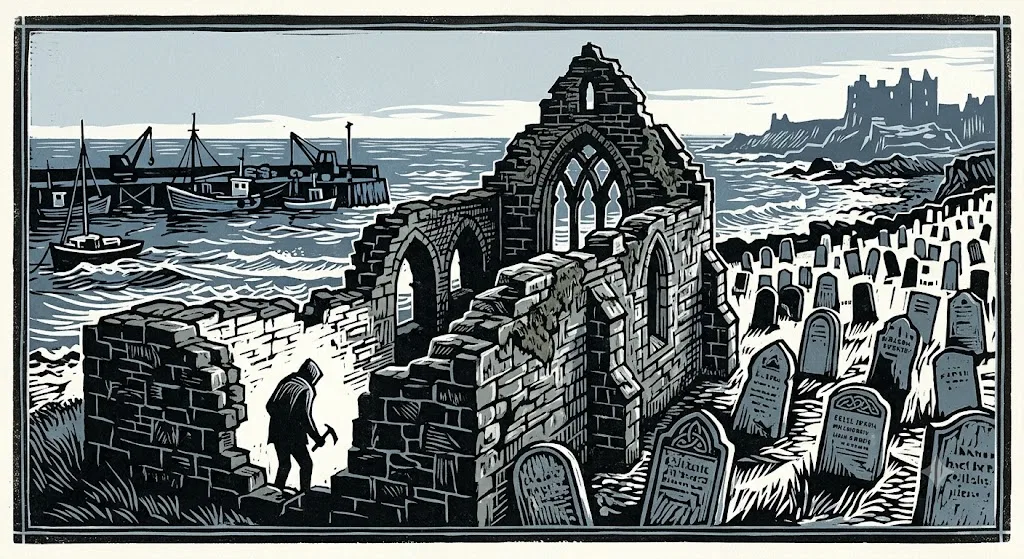
That is the first point a careful haunted-history reader needs to hold onto. North Berwick’s fame does not rest on a reliable supernatural sighting. It rests on coerced confession, royal fear, and a printed pamphlet that turned legal violence into a sensational story. The alleged gathering place was St Andrew’s Auld Kirk by the harbour, where later tradition placed a supposed meeting of witches. The tale claimed that a coven met the Devil there and worked magic against the king’s ship as James returned from Denmark with Anne of Denmark. The memorable image is powerful: a ruined kirk near the sea, a storm, a king, a night meeting, and a blackening of local people as servants of the Devil. But the surviving evidence points back to interrogation and propaganda, not to proof of magic.[University of Glasgow]gla.ac.ukUniversity of Glasgow Newes from ScotlandUniversity of Glasgow Newes from Scotland
The pamphlet’s most dramatic claims involve Agnes Sampson and Doctor Fian. Agnes Sampson’s alleged confession described a large meeting in North Berwick kirk and a spell involving a dead cat thrown into the sea to raise storms against the royal voyage. Doctor Fian, a schoolmaster at Saltpans, was said to have acted as a clerk to the accused. The Glasgow summary rightly catches the moral problem in the material: some of the stories sound farcical, but a real person was tortured and ultimately executed on the strength of this kind of “evidence”.[University of Glasgow]gla.ac.ukUniversity of Glasgow Newes from ScotlandUniversity of Glasgow Newes from Scotland
For East Lothian folklore, this makes North Berwick a place where the atmosphere comes from contradiction. The setting encourages the imagination: harbour winds, sea walls, the Bass Rock offshore, and the fragmentary survival of an old church site. Yet the core story asks for restraint. The “haunting” is not a dependable report of a figure seen at the kirk gates. It is the continuing unease caused by a historic panic in which local bodies, names and places were pressed into a national drama about kingship, religion and fear.
Where the story is located today
The North Berwick site most closely attached to the witch-trial legend is St Andrew’s Old Kirk, or St Andrew’s Auld Kirk, near the harbour and the modern Scottish Seabird Centre. Undiscovered Scotland describes the site as having a long ecclesiastical history, with a stone church begun in the mid-1100s and later additions before the sea took much of the building. A storm in 1656 caused nearly half of the church to collapse, and some people at the time apparently interpreted the destruction as divine retribution because the kirkyard had allegedly been a gathering place for witches in the 1590s.[Undiscovered Scotland]undiscoveredscotland.co.ukUndiscovered Scotland St Andrew's Old Kirk Feature Page on Undiscovered ScotlandUndiscovered Scotland St Andrew's Old Kirk Feature Page on Undiscovered Scotland
That later interpretation is important because it shows how the witch-trial memory became layered onto the physical ruin. The kirk was not simply remembered as a medieval church or a pilgrim stop. It became a place where weather, erosion and moral storytelling met. A natural coastal disaster could be read through the earlier witch-trial narrative, as though the building itself had been punished for what people believed had happened there. In haunted-place terms, that is a classic mechanism: a visible ruin gathers explanation, and the explanation becomes more memorable when it has sin, storm and supernatural danger in it.
The site’s present form also shapes the mood. Visitors are not entering a complete dark church. They are seeing the remains of a building partly lost to the sea, with a porch, fragments, display material and a harbour setting that is lively by day but capable of feeling bleak in poor weather. The ghostliness is therefore partly topographical. It comes from the gap between a busy modern waterfront and the knowledge that this was once a place onto which a national witch-panic was projected.[Undiscovered Scotland]undiscoveredscotland.co.ukUndiscovered Scotland St Andrew's Old Kirk Feature Page on Undiscovered ScotlandUndiscovered Scotland St Andrew's Old Kirk Feature Page on Undiscovered Scotland
For a visitor interested in East Lothian hauntings, the best way to read the North Berwick site is not to ask, “Which ghost appears here?” A better question is, “What did people need this place to mean?” In the 1590s, it became a stage for fear of diabolic conspiracy. In the later memory of the ruined kirk, it became a place where the sea itself seemed to confirm the legend. In modern heritage, it is increasingly a place where the accused can be spoken of as victims rather than villains.
Dirleton Castle as a place of imprisonment
Dirleton Castle gives the East Lothian witch-trial story a different kind of force. North Berwick supplies the famous legend of a coven at the kirk; Dirleton supplies the prison. Historic Environment Scotland describes Dirleton as a fortress-residence that served three noble families over 400 years and was badly damaged during Cromwell’s 1650 siege. Its ruins and gardens are now picturesque, but the castle also has a darker association with the witch panic of 1649–50, when six people from the parish of Dirleton were accused.[Historic Environment Scotland]historicenvironment.scotHistoric Environment Scotland Dirleton Castle | Historic ScotlandHistoric Environment Scotland Dirleton Castle | Historic Scotland
Historic Environment Scotland’s account of the Dirleton witch hunts is unusually valuable because it anchors the story in named accused people and specific spaces inside the castle. Agnes Clarkson, a widow, confessed in June 1649 after being held prisoner in Dirleton Castle, probably in the pit prison. She was interrogated by a presbytery, a church court, including Johne Makghie, the minister of Dirleton. Her alleged confession included claims that a woman from Longniddry, already burned as a witch, had visited her and tempted her to become the Devil’s servant.[Historic Environment Scotland Blog]blog.historicenvironment.scotHistoric Environment Scotland Blog The Dirleton Witch HuntsHistoric Environment Scotland BlogThe Dirleton Witch Hunts - Historic Environment Scotland Blog…
The names matter. Agnes Clarkson, Manie Halieburton, Patrik Watsone, Bessie Hogge, Marione Meik and Margaret Goodfellow are not spooky decorations for a castle story. They are the people through whom the parish panic can be traced. Manie Halieburton was also held in Dirleton Castle before questioning, and she was accused by Agnes Clarkson and by her own husband, Patrik Watsone. Patrik and Manie were then taken before the witch-pricker John Kincaid in the great hall, where their bodies were searched for supposed “devil’s marks”.[Historic Environment Scotland Blog]blog.historicenvironment.scotHistoric Environment Scotland Blog The Dirleton Witch HuntsHistoric Environment Scotland BlogThe Dirleton Witch Hunts - Historic Environment Scotland Blog…
This is where Dirleton becomes more disturbing than many conventional haunted castles. The “haunting” is not a romantic lady in white walking a battlement. It is the memory of rooms used for coercion. The pit prison and the great hall become charged spaces because they suggest the machinery of accusation: confinement, questioning, bodily inspection, and the search for signs that could be presented as proof. Historic Environment Scotland notes that, once a presbytery had gathered witness statements and confessions, it appealed to central authorities for a commission to try the accused; trials were often formalities, and confessions could almost guarantee execution.[Historic Environment Scotland Blog]blog.historicenvironment.scotHistoric Environment Scotland Blog The Dirleton Witch HuntsHistoric Environment Scotland BlogThe Dirleton Witch Hunts - Historic Environment Scotland Blog…
The outcome evidence for the Dirleton accused has not fully survived, which creates a different kind of uncertainty. We should not fill that gap with invented ghost stories. The honest point is sharper: even where the paper trail breaks, the surviving record is enough to show how easily a local panic could turn a castle into a holding place for people who had almost no chance of clearing their names. That is why Dirleton belongs in East Lothian’s haunted memory. It is a beautiful ruin with a history that resists being made merely picturesque.
Why these stories still haunt East Lothian
The North Berwick and Dirleton material remains famous because it ties the local to the national. North Berwick connects East Lothian to King James VI, the Danish royal marriage voyage, Newes from Scotland, and the later royal demonological imagination that fed into wider witch-hunting culture. Dirleton connects the county to the later 1649–50 panic, when hundreds were accused across southern and eastern Scotland. Historic Environment Scotland gives the wider figure for that panic as over 600 accusations, with six from Dirleton parish.[University of Glasgow]gla.ac.ukUniversity of Glasgow Newes from ScotlandUniversity of Glasgow Newes from Scotland
The haunted memory also persists because the sites are legible. St Andrew’s Auld Kirk is near the sea, exactly the sort of place where a story of storms and forbidden night meetings can attach itself to the senses. Dirleton Castle has a pit prison and a great hall, places that allow visitors to imagine confinement and judgement. In both cases, the physical setting helps the story survive.
Yet the deeper reason is ethical. Scotland’s modern public conversation has shifted from treating the accused as sinister folklore figures to recognising them as victims of historical injustice. The Survey of Scottish Witchcraft, created by researchers Julian Goodare, Lauren Martin, Joyce Miller and Louise Yeoman, was designed to let the public and researchers examine people accused of witchcraft in Scotland between 1563 and 1736, including biographical, social, legal and geographical patterns. The University of Edinburgh’s dataset description says the project aimed to create a database of people accused of witchcraft and to support study of accusation, belief, trial procedure and regional variation.[Witches]witches.hca.ed.ac.ukOpen source on ed.ac.uk.
That change in framing affects how East Lothian’s witch stories should be told. A century ago, a local tale might have leaned heavily into “witches at the kirk” or “witches in the castle”. A modern page can still be eerie, but it should make clear that these were people accused under a legal and religious system that made confession, denunciation and execution frighteningly possible. The Scottish Government’s 2022 apology used exactly this kind of language, stating that those accused were not witches but people, overwhelmingly women, and that the accusations and executions were an egregious historic injustice.[Scottish Government]gov.scotinternational womens day 2022 first ministers statement 8 march 2022Scottish GovernmentInternational Women's Day 2022: First Minister's statement - 8 March 2022 - gov.scot…
That apology does not turn North Berwick or Dirleton into simple morality tales. It does something more useful: it gives readers a way to understand why the stories feel unfinished. The dead are not “restless” because a ghost has been proved to walk. The memory is restless because the old accusations were once treated as truth, then repeated as legend, and only much later publicly reframed as injustice.
How to tell the story without repeating the accusation
The hardest part of writing about North Berwick and Dirleton is avoiding the trap built into the old sources. The surviving narratives are vivid because they were designed to be vivid. Newes from Scotland describes supposed witch meetings, storm magic, the Devil’s presence, confessions, torture and execution. If repeated carelessly, those details can make the accused sound guilty all over again.[University of Glasgow]gla.ac.ukUniversity of Glasgow Newes from ScotlandUniversity of Glasgow Newes from Scotland
A better approach is to separate three layers:
The historical events: named people were accused, imprisoned, interrogated, tortured or executed in connection with witchcraft allegations. Geillis Duncan, Agnes Sampson and Doctor Fian belong to the North Berwick panic; Agnes Clarkson, Manie Halieburton, Patrik Watsone, Bessie Hogge, Marione Meik and Margaret Goodfellow belong to the Dirleton parish accusations of 1649.[University of Glasgow]gla.ac.ukUniversity of Glasgow Newes from ScotlandUniversity of Glasgow Newes from Scotland
The accused claims: the stories about covens, dead cats, storms, the Devil, black dogs, dancing and devil’s marks come from confessional and prosecutorial contexts. They should be described as allegations or alleged confessions, not as events that happened.
The haunting memory: the modern eerie power of North Berwick and Dirleton comes from the collision between place and injustice. The kirk, the harbour, the castle prison and the great hall are not haunted in the same way as a simple apparition story. They are haunted by records, rumours and the afterlife of a panic.
This distinction is not a dull disclaimer. It makes the story stronger. The real horror is not that witches met in a churchyard. It is that a society believed such claims, extracted them under pressure, and used them to condemn people. In that sense, North Berwick and Dirleton are among East Lothian’s most serious haunted places: not because the legends are easy to prove, but because the historical fear behind them is documented.

What visitors should look for
A visitor following the witch-trial memory through East Lothian should begin at North Berwick’s harbour area, where St Andrew’s Auld Kirk survives as a fragmentary site tied to the famous 1590s allegations. The important thing is to notice the coastal setting. The story of storm-raising against King James VI’s ship makes emotional sense here because the place is dominated by wind, weather and the sea. Later tradition about the 1656 storm damaging the kirk shows how strongly people connected the physical site with the witch-trial legend.[Undiscovered Scotland]undiscoveredscotland.co.ukUndiscovered Scotland St Andrew's Old Kirk Feature Page on Undiscovered ScotlandUndiscovered Scotland St Andrew's Old Kirk Feature Page on Undiscovered Scotland
Dirleton Castle, a short distance inland from the coast, should be read differently. It is not the origin point of the famous royal panic, but it is a key East Lothian site for understanding imprisonment and procedure. The pit prison and great hall matter because they make visible the movement from accusation to confinement to bodily inspection. Historic Environment Scotland’s account places John Kincaid’s search for supposed devil’s marks in the great hall and identifies the pit prison as the likely place where accused women were held.[Historic Environment Scotland Blog]blog.historicenvironment.scotHistoric Environment Scotland Blog The Dirleton Witch HuntsHistoric Environment Scotland BlogThe Dirleton Witch Hunts - Historic Environment Scotland Blog…
The two places also connect naturally to other East Lothian haunted-history routes. North Berwick sits close to Tantallon Castle and the Bass Rock, both already heavy with dramatic coastal atmosphere. Dirleton sits within the county’s castle landscape, where picturesque ruins often mask uncomfortable histories. But the witch-trial page should stay centred on the accused people and the memory of injustice, rather than using them merely as colour for a spooky itinerary.
Folklore, evidence and credibility
As a haunting tradition, the North Berwick and Dirleton material is credible in one sense and highly questionable in another. It is credible that witch trials, accusations, imprisonment and executions occurred; those facts are supported by contemporary printed material, heritage research and major historical databases. It is not credible to treat the supernatural allegations themselves as factual evidence. The record is full of coercive conditions: torture, sleep deprivation, social pressure, church-court examination, witch-pricking and fear of implication.[gla.ac.uk]gla.ac.ukUniversity of Glasgow Newes from ScotlandUniversity of Glasgow Newes from Scotland
That makes these stories different from a modern ghost report in a castle or inn. There is no need to decide whether a witness saw an apparition. The main question is how a community came to believe, preserve and retell claims that began in violence. The folklore value is high because the motifs are so strong: storms at sea, a ruined kirk, a royal enemy, a castle prison, devilish marks and dances on the green. The evidential value of those motifs, however, is low when treated as proof of witchcraft. They tell us more about fear than about the accused.
Modern memorial campaigns reinforce this careful reading. Witches of Scotland, founded in 2020 by Claire Mitchell KC and Zoe Venditozzi, campaigns for a legal pardon, an apology and a national memorial for those accused under the Witchcraft Act. The campaign records the 2022 Scottish Government apology as a major milestone, while a Scottish Parliament petition called for pardon, apology and a national monument.[Witches of Scotland]witchesofscotland.comWitches of Scotland Scottish witch trials campaign — Witches of ScotlandWitches of Scotland Scottish witch trials campaign — Witches of Scotland
For East Lothian, that means the most respectful haunted interpretation is also the most historically interesting one. North Berwick and Dirleton are not places where the visitor should be invited to fear the accused. They are places where the visitor should be invited to feel the chill of accusation itself: how quickly suspicion spread, how strongly buildings preserve memory, and how long it can take for a community to change the question from “Were they witches?” to “What was done to them?”
Amazon book picks
Further Reading
Books and field guides related to Why East Lothian's Witch Stories Still Haunt. Use these as the next step if you want deeper reading beyond the article.


Scottish Witches and Witch-Hunters
Directly relevant to East Lothian's witch-trial history.

eBay marketplace picks
Marketplace Samples
Live-tested eBay searches with available results related to this page.



Endnotes
1.
Source: parliament.scot
Title: pe1855 pardon and memorialise those convicted under the witchcraft act 1563
Link:https://www.parliament.scot/get-involved/petitions/view-petitions/pe1855-pardon-and-memorialise-those-convicted-under-the-witchcraft-act-1563
2.
Source: north.tech
Link:https://north.tech/
3.
Source: youtube.com
Title: A History of Scottish Witches with Mary W. Craig
Link:https://www.youtube.com/watch?v=sxCgptDAhck
Source snippet
Witches: Truth Behind the Trials | National Geographic UK...
4.
Source: youtube.com
Title: Witches: Truth Behind the Trials | National Geographic UK
Link:https://www.youtube.com/watch?v=2hvNvBS3LgM
5.
Source: gla.ac.uk
Title: University of Glasgow Newes from Scotland
Link:https://www.gla.ac.uk/myglasgow/library/files/special/exhibns/month/aug2000.html
6.
Source: blog.historicenvironment.scot
Title: Historic Environment Scotland Blog The Dirleton Witch Hunts
Link:https://blog.historicenvironment.scot/2020/03/dirleton-witch-hunts/
Source snippet
Historic Environment Scotland BlogThe Dirleton Witch Hunts - Historic Environment Scotland Blog...
7.
Source: gov.scot
Title: international womens day 2022 first ministers statement 8 march 2022
Link:https://www.gov.scot/publications/international-womens-day-2022-first-ministers-statement-8-march-2022/
Source snippet
Scottish GovernmentInternational Women's Day 2022: First Minister's statement - 8 March 2022 - gov.scot...
Published: march 2022
8.
Source: undiscoveredscotland.co.uk
Title: Undiscovered Scotland St Andrew’s Old Kirk Feature Page on Undiscovered Scotland
Link:https://www.undiscoveredscotland.co.uk/northberwick/standrewsoldkirk/index.html
9.
Source: historicenvironment.scot
Title: Historic Environment Scotland Dirleton Castle | Historic Scotland
Link:https://www.historicenvironment.scot/visit-a-place/places/dirleton-castle/
10.
Source: witches.hca.ed.ac.uk
Link:https://witches.hca.ed.ac.uk/
11.
Source: witchesofscotland.com
Title: Witches of Scotland Scottish witch trials campaign — Witches of Scotland
Link:https://www.witchesofscotland.com/about
12.
Source: Wikipedia
Link:https://en.wikipedia.org/wiki/Dirleton
13.
Source: Wikipedia
Title: North Berwick witch trials
Link:https://en.wikipedia.org/wiki/North_Berwick_witch_trials
14.
Source: Wikipedia
Title: Survey of Scottish Witchcraft
Link:https://en.wikipedia.org/wiki/Survey_of_Scottish_Witchcraft
15.
Source: witches.hca.ed.ac.uk
Link:https://witches.hca.ed.ac.uk/about/
16.
Source: witches.hca.ed.ac.uk
Link:https://witches.hca.ed.ac.uk/case/C/EGD/110
17.
Source: witches.hca.ed.ac.uk
Link:https://witches.hca.ed.ac.uk/search/
18.
Source: gov.scot
Title: foi 202600509137
Link:https://www.gov.scot/publications/foi-202600509137/
19.
Source: anton-praetorius.de
Title: North Berwick witch trials
Link:https://www.anton-praetorius.de/downloads/North_Berwick_witch_trials_1590_Wikipedia.pdf
20.
Source: witchesofscotland.com
Link:https://www.witchesofscotland.com/
21.
Source: undiscoveredscotland.co.uk
Link:https://www.undiscoveredscotland.co.uk/dirleton/dirleton/index.html
22.
Source: stirling.gov.uk
Title: document of the month march 2026
Link:https://www.stirling.gov.uk/community-life-and-leisure/libraries-and-archives/archives/document-of-the-month/document-of-the-month-2026/document-of-the-month-march-2026/
Published: march 2026
23.
Source: eastlothian.gov.uk
Title: charity launches survey future north berwick landmark
Link:https://www.eastlothian.gov.uk/news/2026/charity-launches-survey-future-north-berwick-landmark
24.
Source: youtube.com
Title: Dirleton Castle
Link:https://www.youtube.com/watch?v=vhGAMe0fw_w
25.
Source: cntraveler.com
Title: dirleton castle
Link:https://www.cntraveler.com/activities/edinburgh/dirleton-castle
26.
Source: nationalarchives.gov.uk
Link:https://www.nationalarchives.gov.uk/explore-the-collection/explore-by-time-period/early-modern/witchcraft/
Additional References
27.
Source: istockphoto.com
Link:https://www.istockphoto.com/photos/dirleton
28.
Source: facebook.com
Link:https://www.facebook.com/100088539433942/posts/around-370-years-ago-dirleton-castle-became-a-prison-for-people-accused-of-witch/933168552977784/
29.
Source: visiteastlothian.org
Link:https://visiteastlothian.org/things-to-see-do/towns-villages/dirleton/
30.
Source: facebook.com
Link:https://www.facebook.com/groups/1174927186366625/posts/1888637418328928/
31.
Source: spookyscotland.net
Link:https://spookyscotland.net/north-berwick-witch-trials/
32.
Source: facebook.com
Link:https://www.facebook.com/WitchesofScotland/videos/listen-to-nicolasturgeon-give-the-official-apology-to-allthose-who-were-accused-/520775759398188/
33.
Source: historic-uk.com
Link:https://www.historic-uk.com/HistoryUK/HistoryofScotland/North-Berwick-Witch-Trials/
34.
Source: raws.scot
Link:https://www.raws.scot/
35.
Source: fabulousnorth.com
Link:https://fabulousnorth.com/st-andrews-auld-kirk/
36.
Source: instagram.com
Link:https://www.instagram.com/reel/DXW9aMzDO8T/
Topic Tree