Within Haunted Dorset
Who Haunts the Ruins of Corfe Castle?
Corfe Castle's ghost story turns siege, betrayal and ruined power into Dorset's most dramatic apparition legend.
On this page
- The woman in white on the battlements
- Civil War siege, betrayal and local memory
- Why ruins make ghost stories stronger
Page outline Jump by section
Introduction
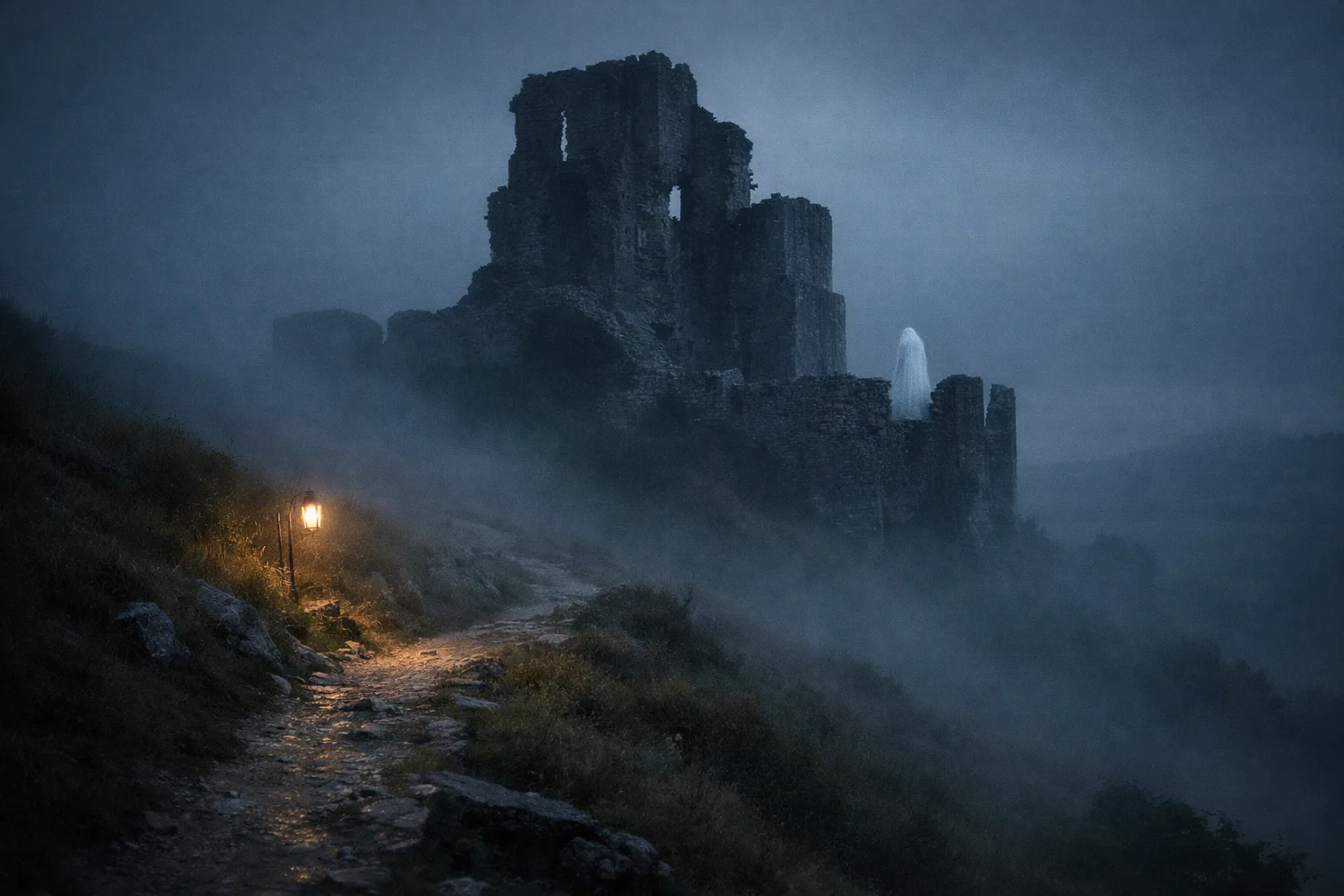
Corfe Castle’s best-known haunting is the woman in white: a headless or pale female figure said to appear on the battlements and among the shattered walls of the Dorset ruin. The story is usually tied to the English Civil War, when the Royalist Bankes family held the castle for the king before it fell in 1646 through betrayal and was then deliberately ruined by Parliament. The haunting matters because it is not just a spooky castle tale. It turns a real Dorset memory of siege, loyalty, treachery and broken power into one figure moving through the ruins. The sources should be read carefully: the Civil War destruction is well documented, but the apparition belongs to later folklore and visitor tradition, not proven history. The result is one of Dorset’s most atmospheric ghost stories, precisely because the stones themselves still look like the aftermath of violence.[National Trust]nationaltrust.org.ukNational Trust Our most haunted places | National TrustNational Trust Our most haunted places | National Trust
The woman in white on the battlements
The modern form of the legend is simple and memorable. A headless woman in white is said to stalk the battlements of Corfe Castle, and the National Trust’s own haunted-places guide links her, in belief rather than fact, with an act of treason during the Civil War. That careful wording is important. It tells us the story is recognised as part of the castle’s public folklore, while still leaving it in the realm of reported haunting and tradition rather than verified event.[National Trust]nationaltrust.org.ukNational Trust Our most haunted places | National TrustNational Trust Our most haunted places | National Trust
In popular retellings, the apparition is usually seen as a punishment-ghost: a woman associated with the betrayal that let Parliamentary forces into the castle. Some accounts make her simply “the woman who betrayed the Bankes”; others blur her with Lady Mary Bankes herself, the Royalist defender of Corfe. A specialist haunted-place gazetteer describes the same core tradition but adds other motifs around the site: strange lights on the ramparts, a weeping child in a nearby cottage, and the white lady fading away after chilling those who see her. Such details belong to ghost-lore rather than archival evidence, but they show how the castle’s haunting has grown beyond a single apparition into a wider atmosphere of ruined unease.[Haunted Britain]haunted-britain.comHaunted Britain Corfe Castle's Ghostly White LadyHaunted Britain Corfe Castle's Ghostly White Lady
The woman’s whiteness also matters. “White lady” apparitions are common in British castle and manor-house folklore, often attached to betrayal, grief, execution, confinement or family disaster. At Corfe, however, the figure feels unusually well fitted to the site because the Civil War story already supplies the necessary emotional charge. The battlements are not a neutral stage. They are the place where defenders, attackers and later visitors imagine looking out across Purbeck while the fortress is surrounded.
The headless detail is harder to anchor historically. Lady Mary Bankes was not beheaded; she lived until 1661, after the Restoration of Charles II. National Trust Collections notes that she lived to see her family estates returned, and the keys traditionally associated with the surrender are preserved within the Bankes family story at Kingston Lacy. That makes a literal identification of the headless woman with Lady Mary awkward, unless the image is read symbolically rather than biographically.[National Trust Collections]nationaltrustcollections.org.ukOpen source on nationaltrustcollections.org.uk.

Civil War siege, betrayal and local memory
Corfe Castle stands above the village of Corfe Castle on the Isle of Purbeck, guarding a gap through the Purbeck Hills. Long before its ghost stories, it was a royal fortress and residence. Historic England’s listing records the site’s deep medieval importance, including Norman and later royal phases, but the moment that shaped its haunted reputation came during the English Civil War.[Historic England]historicengland.org.ukHistoric EnglandCorfe Castle: a large enclosure castle, and 18th century Vineyard Bridge, Corfe Castle - 1011487 | Historic England…
The Bankes family acquired Corfe shortly before the war. The National Trust records that Sir John Bankes bought Corfe Castle and its estates in 1635; during the British Civil Wars, the Bankes family sided with the king. Mary, Lady Bankes, successfully defended the castle during the first siege of 1643, earning the remembered title “Brave Dame Mary”. The later fall came during the second siege, when Parliamentary troops entered after Lieutenant-Colonel Pitman allowed men disguised as Royalist reinforcements inside.[National Trust]nationaltrust.org.ukNational Trust The history of Corfe Castle, Dorset | National TrustNational Trust The history of Corfe Castle, Dorset | National Trust
Historic England’s summary is blunt: in February 1646 the castle was taken “by treachery and subterfuge”, and in March 1646 the Commons voted for its demolition. The National Trust adds that skilled sappers used explosives to blow the walls apart. This is the hard historical core beneath the haunting: a fortress that did not merely decay, but was intentionally disabled so it could not be used again.[Historic England]historicengland.org.ukHistoric EnglandCorfe Castle: a large enclosure castle, and 18th century Vineyard Bridge, Corfe Castle - 1011487 | Historic England…
That difference matters for ghost folklore. Many ruins invite stories because they look old; Corfe invites them because it looks wounded. Its leaning walls and broken towers are not simply picturesque decay. They are the visible remains of a political and military decision. A visitor does not need to know every detail of the Civil War to feel that something dramatic happened there. The woman in white gives that drama a human shape.
The betrayal motif also helps explain why the ghost became so memorable. Battles can be confusing, but betrayal is emotionally legible. It produces a villain, a victim and a moral charge. In the Corfe tradition, the apparition condenses the fall of a major Dorset stronghold into a single wandering figure. Whether imagined as the betrayer, the betrayed, or a later moral shadow, she keeps the story focused on treachery rather than tactics.
Was Lady Mary really the ghost?
The commonest confusion is whether the woman in white is meant to be Lady Mary Bankes. The best answer is: sometimes in retellings, but not securely in the stronger historical record. Lady Mary is central to Corfe’s Civil War memory because she defended the castle in 1643 and became the heroic face of the Bankes family story. But the ghost described by the National Trust’s haunted guide is not named as Lady Mary; it is a headless woman believed to have committed treason during the Civil War.[National Trust]nationaltrust.org.ukNational Trust Our most haunted places | National TrustNational Trust Our most haunted places | National Trust
There is also a historical problem with making Lady Mary the headless ghost. She survived the war, petitioned to recover her estates, and lived until after the Restoration. National Trust Collections describes the castle keys at Kingston Lacy as objects tied to family legend: they are said to have been returned to Lady Mary by the Parliamentary commander as a gesture of respect when Corfe surrendered. The same collections record also notes that historians still debate whether Lady Mary was actually at the castle during the second siege.[National Trust Collections]nationaltrustcollections.org.ukOpen source on nationaltrustcollections.org.uk.
That debate is useful because it shows how memory and documentation can diverge. The heroic Mary of family tradition, the Mary of Civil War scholarship, and the woman in white of haunted Corfe are related figures, but they are not identical. The family story emphasises courage and honour. The ghost story emphasises treason and punishment. The historical discussion asks what can actually be shown from records, including household accounts and the absence of certain details from Parliamentary correspondence.[National Trust Collections]nationaltrustcollections.org.ukOpen source on nationaltrustcollections.org.uk.
For readers, this does not make the haunting worthless. It makes it more interesting. Corfe’s woman in white is best understood as a folklore figure formed around Civil War memory, rather than as a straightforward report of one identifiable dead woman. She is the castle’s guilt, fear and treachery made visible.
Why ruins make the ghost story stronger
Corfe Castle is one of Dorset’s most powerful haunted settings because the ruin itself does much of the storytelling. The National Trust describes it as an iconic survivor of the English Civil War, partly demolished in 1646, with a thousand years of history as a royal palace and fortress. It is also a deliberately preserved ruin: after the Bankes family recovered their estates, they built Kingston Lacy rather than restoring Corfe as a home.[National Trust]nationaltrust.org.ukOpen source on nationaltrust.org.uk.
Ruins strengthen ghost stories because they leave gaps. A complete building tells visitors where rooms, doors and lives belonged. A ruin asks the imagination to rebuild what is missing. At Corfe, those gaps are unusually dramatic: broken towers, exposed walls, steep drops, views across Purbeck, and masonry that still appears twisted by the force used to destroy it. Historic England records that the slighting scattered fabric down the slopes and into the valley bottom, making the damage part of the landscape as well as the structure.[Historic England]historicengland.org.ukHistoric EnglandCorfe Castle: a large enclosure castle, and 18th century Vineyard Bridge, Corfe Castle - 1011487 | Historic England…
The castle’s later life as a Romantic ruin also helped preserve its eerie power. The National Trust notes that in the 18th and 19th centuries the ruined castle became a tourist attraction and inspired artists including J. M. W. Turner. This matters because ghost stories often thrive when a place becomes both historic site and emotional spectacle. Visitors come for architecture and views, but they also arrive ready to feel the past pressing through the stone.[National Trust]nationaltrust.org.ukNational Trust The history of Corfe Castle, Dorset | National TrustNational Trust The history of Corfe Castle, Dorset | National Trust
The woman in white belongs to that visitor-facing afterlife. She is not needed to prove that Corfe was important; the archaeology and documents already do that. Her role is different. She gives the ruin a nightly version of its daytime history. By day, the site tells of kings, sieges, family estates and military demolition. By night, folklore turns the same facts into a pale figure on the battlements.
What is solid history, and what is folklore?
A careful reading separates Corfe Castle’s story into three layers.[nationaltrust.org.uk]nationaltrust.org.ukSource details in endnotes.
The documented historic layer is strong. Corfe was a major fortress; the Bankes family sided with the king; the castle endured Civil War sieges; it fell in 1646 through disguise, betrayal or subterfuge; and Parliament ordered its demolition soon afterwards. These points are supported by the National Trust, Historic England and Dorset Council’s Bankes Archive material.[nationaltrust.org.uk]nationaltrust.org.ukNational Trust The history of Corfe Castle, Dorset | National TrustNational Trust The history of Corfe Castle, Dorset | National Trust
The family-memory layer is partly documentary and partly commemorative. The keys at Kingston Lacy, the “Brave Dame Mary” tradition, and later Bankes family commemorations preserve a proud Royalist memory of courage under siege. National Trust Collections is careful here: the keys are “said to be” from Corfe and “thought to have been” given to Lady Mary, while also noting scholarly debate over whether she was present at the second siege.[National Trust Collections]nationaltrustcollections.org.ukOpen source on nationaltrustcollections.org.uk.
The haunting layer is folkloric. The headless woman in white is repeatedly described in modern haunted-place accounts and is acknowledged by the National Trust’s haunted guide, but the apparition is not supported in the same way as the siege, surrender or slighting. The story’s credibility is therefore not the credibility of a court record or military dispatch. It is the credibility of a persistent local and visitor tradition attached to a place whose real history makes the haunting feel plausible as memory.[National Trust]nationaltrust.org.ukNational Trust Our most haunted places | National TrustNational Trust Our most haunted places | National Trust
This distinction protects the story from both overclaiming and dismissal. There is no need to present the woman in white as a proven ghost. Equally, there is no need to strip the legend of meaning because it cannot be proven. In haunted Dorset, Corfe Castle matters because its folklore and its history speak to each other so clearly.
Why Corfe Castle became Dorset’s dramatic apparition legend
Corfe Castle’s woman in white became locally famous because the tale has all the elements a durable haunting needs: a spectacular setting, a violent historical rupture, a named family, a contested heroine, a betrayal, and a ruin that looks as though the past has not finished collapsing. The story is easy to tell in one sentence, but it opens into deeper questions about memory: who gets remembered as loyal, who gets marked as traitor, and how a community turns political defeat into legend.
Within Dorset’s haunted landscape, Corfe is the county’s great castle haunting. It differs from the domestic strangeness of Athelhampton, the object-centred fear of the Bettiscombe skull, or the abandoned modern melancholy of Tyneham. Corfe’s ghost is inseparable from public history. The woman in white does not haunt a private corridor or a family bedroom; she walks the battlements of a ruined fortress visible for miles.
That is why the legend still works. It does not depend on a single named witness or a sensational modern investigation. It depends on the meeting point between place and memory. The Civil War broke Corfe Castle as a military object. Folklore rebuilt it as an emotional one. The woman in white is the figure left behind when siege, betrayal and ruined power are translated into Dorset ghost story.
Amazon book picks
Further Reading
Books and field guides related to Who Haunts the Ruins of Corfe Castle?. Use these as the next step if you want deeper reading beyond the article.
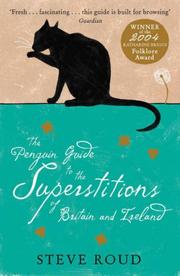
The Penguin Guide to the Superstitions of Britain and Ireland
Explains White Lady and castle folklore motifs.

eBay marketplace picks
Marketplace Samples
Live-tested eBay searches with available results related to this page.

Endnotes
1.
Source: haunted-britain.com
Title: Haunted Britain Corfe Castle’s Ghostly White Lady
Link:https://www.haunted-britain.com/corfe-castle.htm
2.
Source: nationaltrust.org.uk
Title: National Trust Our most haunted places | National Trust
Link:https://www.nationaltrust.org.uk/visit/houses-buildings/most-haunted-places-to-visit
3.
Source: nationaltrust.org.uk
Title: National Trust The history of Corfe Castle, Dorset | National Trust
Link:https://www.nationaltrust.org.uk/visit/dorset/corfe-castle/the-history-of-corfe-castle
4.
Source: historicengland.org.uk
Link:https://historicengland.org.uk/listing/the-list/list-entry/1011487
Source snippet
Historic EnglandCorfe Castle: a large enclosure castle, and 18th century Vineyard Bridge, Corfe Castle - 1011487 | Historic England...
5.
Source: nationaltrustcollections.org.uk
Link:https://www.nationaltrustcollections.org.uk/object/1255200
6.
Source: nationaltrust.org.uk
Link:https://www.nationaltrust.org.uk/visit/dorset/corfe-castle
7.
Source: nationaltrust.org.uk
Link:https://www.nationaltrust.org.uk/visit/worcestershire-herefordshire/croft-castle-and-parkland/ghost-trees-a-walk-through-time-and-art-at-croft-castle
8.
Source: shop.nationaltrust.org.uk
Link:https://shop.nationaltrust.org.uk/
9.
Source: nationaltrust.org.uk
Link:https://www.nationaltrust.org.uk/services/media
10.
Source: nationaltrust.org.uk
Link:https://www.nationaltrust.org.uk/visit/houses-buildings/places-with-a-royal-story-to-tell
11.
Source: nationaltrust.org.uk
Link:https://www.nationaltrust.org.uk/
12.
Source: nationaltrust.org.uk
Link:https://www.nationaltrust.org.uk/visit/worcestershire-herefordshire/croft-castle-and-parkland/the-parkland-at-croft-castle
13.
Source: nationaltrust.org.uk
Link:https://www.nationaltrust.org.uk/visit/peak-district-derbyshire/calke-abbey
14.
Source: nationaltrust.org.uk
Title: watch corfe castle on hidden treasures
Link:https://www.nationaltrust.org.uk/visit/dorset/corfe-castle/watch-corfe-castle-on-hidden-treasures
15.
Source: nationaltrust.org.uk
Link:https://www.nationaltrust.org.uk/visit/london/ham-house-and-garden
16.
Source: Wikipedia
Title: Mary Bankes
Link:https://en.wikipedia.org/wiki/Mary_Bankes
17.
Source: Wikipedia
Title: Corfe Castle
Link:https://en.wikipedia.org/wiki/Corfe_Castle
18.
Source: freakyfolktales.wordpress.com
Title: corfe castle
Link:https://freakyfolktales.wordpress.com/tag/corfe-castle/
Additional References
19.
Source: moonmausoleum.com
Title: the headless ghost of the lady in white at corfe castle
Link:https://moonmausoleum.com/the-headless-ghost-of-the-lady-in-white-at-corfe-castle/
Source snippet
Moon MausoleumThe Headless Ghost of the Lady in White at Corfe Castle2 Oct 2023 — It is said to be the ghost of Lady Mary Bankes who foug...
20.
Source: youtube.com
Title: The ‘Extraordinary’ Siege Of Corfe Castle | BBC Timestamp
Link:https://www.youtube.com/watch?v=FJmuF7L-phE
Source snippet
The Woman In White: A Victorian Ghost Seen Across England — 2+ Hour Deep Lore...
21.
Source: youtube.com
Title: Secrets of Corfe Castle | A Fortress of Kings and Betrayals
Link:https://www.youtube.com/watch?v=Cm_qycmsnFQ
Source snippet
Full Tour Of Corfe Castle Village Dorset...
22.
Source: instagram.com
Link:https://www.instagram.com/p/DNFRVHHoY-9/
23.
Source: facebook.com
Link:https://www.facebook.com/groups/143520235831162/posts/3322213477961806/
24.
Source: facebook.com
Link:https://www.facebook.com/61554921195366/posts/learn-about-the-remarkable-history-and-eventual-fall-of-corfe-castle-in-dorsetco/122293843814164039/
25.
Source: facebook.com
Link:https://www.facebook.com/61554921195366/videos/learn-about-the-remarkable-history-and-eventual-fall-of-corfe-castle-in-dorsetco/897868333340659/
26.
Source: facebook.com
Link:https://www.facebook.com/groups/1131210866918643/posts/25315664791379913/
27.
Source: youtube.com
Title: What is the History of Corfe Castle?
Link:https://www.youtube.com/watch?v=gwtiinwd6LY
Source snippet
Secrets of Corfe Castle | A Fortress of Kings and Betrayals...
28.
Source: youtube.com
Title: The Woman In White: A Victorian Ghost Seen Across England — 2+ Hour Deep Lore
Link:https://www.youtube.com/watch?v=Cam8xaKqkCA
Source snippet
What is the History of Corfe Castle?...
Topic Tree