Within Haunted Berkshire
Is Reading Abbey Haunted by History Itself?
Reading Abbey feels haunted because execution, dissolution and scattered royal remains left a powerful historical charge.
On this page
- Hugh Faringdon and the abbey's violent end
- Dissolution, ruined stone and scattered burials
- Why atmosphere can outlast apparition records
Page outline Jump by section
Introduction
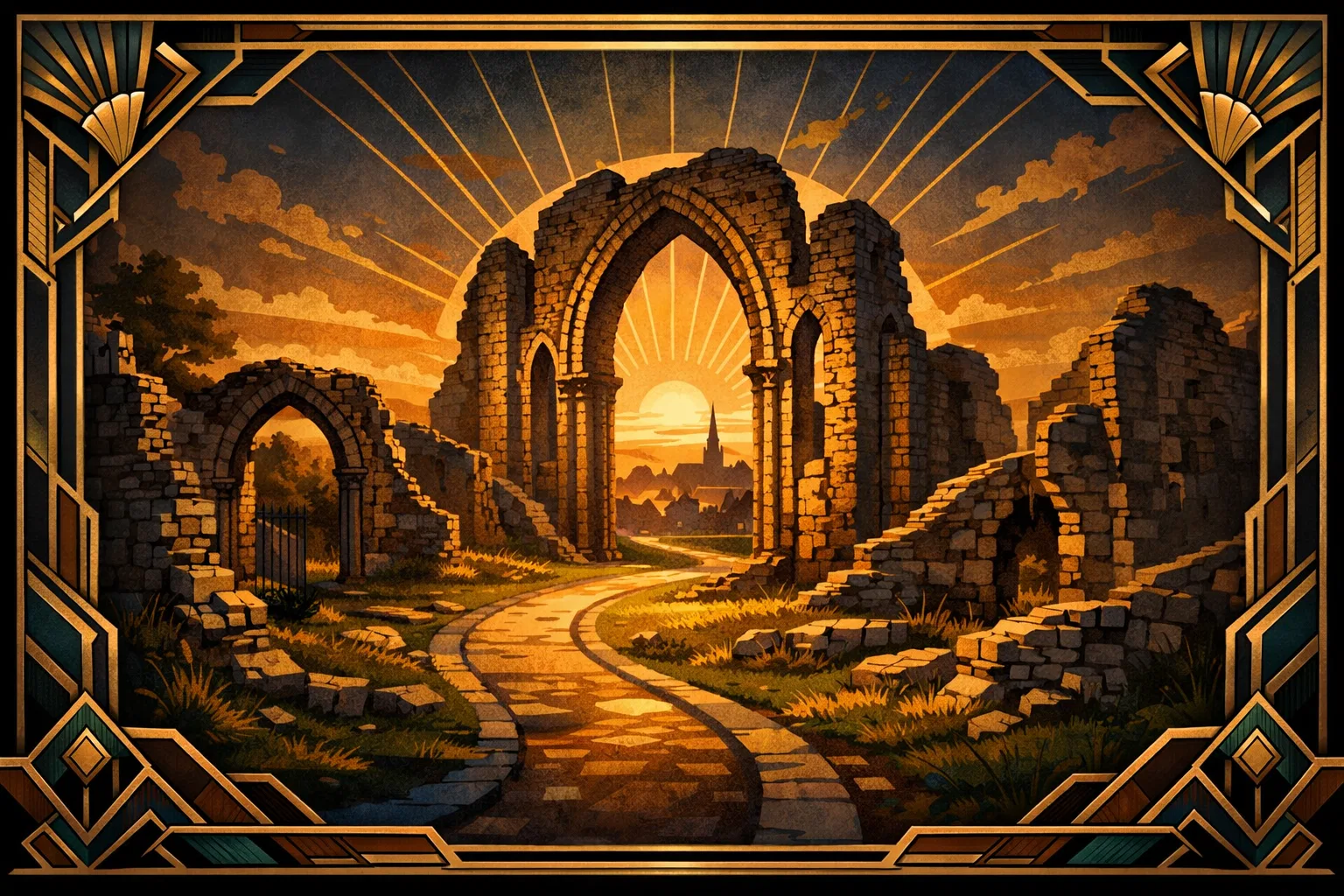
Reading Abbey is often described as one of Berkshire’s most atmospheric ruins, but its haunting is better understood as a haunting of documented memory than as a strong, repeated apparition tradition. The site has all the ingredients of a ghost story: a royal founder buried and later lost, a powerful monastery violently dissolved, an abbot publicly executed, sacred stone stripped and reused, and modern archaeology still trying to read what remains beneath the town. Yet the most reliable evidence points less to a named ghost walking the ruins and more to a place where violence, absence and remembrance have made history feel restless.
That distinction matters. Reading Abbey does not need an invented phantom to feel uncanny. Its surviving walls, protected today as both a Scheduled Monument and a Grade I listed building, stand in the middle of modern Reading as proof of something abruptly broken: a royal religious house that once shaped the town, then became rubble, fragments, burials, civic memory and tourist landscape.[Reading Museum]readingmuseum.org.ukReading Museum Abbey Ruins | Reading MuseumReading Museum Abbey Ruins | Reading Museum
Hugh Faringdon and the abbey’s violent end
The figure most closely tied to Reading Abbey’s darker atmosphere is Hugh Cook of Faringdon, the last abbot. He is not best treated as a reliably documented ghost; he is better understood as the person whose death gives the ruins their sharpest human charge. Reading Museum describes how, in October 1539, Thomas Cromwell wrote that “the abbot Reading” was to be sent down to be tried and executed at Reading with his accomplices. A royal writ then established a court to try Hugh Cook and two fellow priests for high treason, on the charge that they had denied the king’s supremacy over the Church in England.[Reading Museum]readingmuseum.org.ukReading Museum The last Abbot of Reading | Reading MuseumReading Museum The last Abbot of Reading | Reading Museum
The speed and brutality of what followed are central to the abbey’s haunted reputation. The trial took place on 13 November 1539 and lasted less than a day. All three men were convicted and sentenced to be hanged, drawn and quartered. Reading Museum records that the men were dragged on hurdles around the centre of Reading, hanged, cut down while still alive, disembowelled, beheaded, and then quartered, with body parts placed around the town and abbey.[Reading Museum]readingmuseum.org.ukReading Museum The last Abbot of Reading | Reading MuseumReading Museum The last Abbot of Reading | Reading Museum
For a haunted-history reader, this is the point where folklore could easily outrun evidence. It is tempting to imagine the abbot’s spirit returning to the gateway or the ruined church. Some modern haunted-place writing does fold Reading Abbey into broader lists of eerie Reading and Berkshire locations. But the stronger documented tradition is not a chain of early witness accounts saying “the abbot was seen”. It is the record of a public execution deliberately staged at the centre of local life. The horror was not hidden. It was performed as royal power.
That is why Hugh Faringdon works differently from many Berkshire ghosts. At Windsor, Herne the Hunter belongs to woodland legend and Shakespearean memory; at Bisham and Littlecote, the stories often gather around apparitions in houses. At Reading Abbey, the most compelling “presence” is created by the collision of place and record: the gateway, the town route, the trial, the sentence, the remembered body. The abbey feels haunted because the archive is itself disturbing.
Reading’s modern commemoration has reinforced that effect. In 2021, a public vote chose Hugh Faringdon as the historical figure to be carved on an unfinished head-stop at the Abbey Gateway for the abbey’s 900th anniversary. Reading Borough Council reported that voters saw the choice as a way of “righting the wrongs of the past” and giving the last abbot recognition.[Reading Borough Council News]media.reading.gov.ukhugh farringdon announced as the winning choice for abbey head carvinghugh farringdon announced as the winning choice for abbey head carving That is not a ghost sighting, but it is an important act of local haunting: the dead abbot is returned to the fabric of the site, not as proof of the paranormal, but as a face memory had insisted on recovering.
Dissolution, ruined stone and scattered burials
Reading Abbey was founded by Henry I in 1121 and became one of medieval England’s great royal monasteries. Reading Museum describes the Abbey Quarter as the former precinct of a royal monastery whose church was among the largest in Europe, with Henry I buried there in 1136 in front of the high altar. The abbey also hosted royal funerals, weddings, court business, Parliament, pilgrims and a monastic community that lived there for more than 400 years.[Reading Museum]readingmuseum.org.ukReading Museum History of the Abbey Quarter | Reading MuseumReading Museum History of the Abbey Quarter | Reading Museum
The scale of that former importance is part of what makes the ruins feel so charged. Historic England records that the abbey flourished in the thirteenth and early fourteenth centuries and had become one of the ten richest abbeys in the country by the mid-fourteenth century. It was forcibly taken by the Crown in 1539; the monks were evicted, Hugh Faringdon was hanged at the Abbey Gate, and Lord Somerset later demolished most of the church and much of the abbey buildings.[Historic England]historicengland.org.ukOpen source on historicengland.org.uk.
The ruins visitors see today are not simply picturesque decay. They are the exposed core of a stripped building. Historic England notes that the surviving walls stand almost to their original height in places, but have been robbed of their facing stone, leaving the core exposed. The Grade I list entry describes the remains as rubble core stripped almost entirely of facing stone, with fragments of abbey stone reused across Reading and beyond.[Historic England]historicengland.org.ukOpen source on historicengland.org.uk.
This is one reason Reading Abbey can feel more haunted than its apparition record justifies. The loss is legible. The walls do not merely say “old building”; they say “dismantled sacred building”. Reading Museum’s account of the Dissolution explains that Henry VIII took the abbey’s valuables, the monks scattered, and the abbot was executed. Under Edward VI, lead was stripped from roofs, good stone was removed and reused, and the flint cores of the church walls were left standing.[Reading Museum]readingmuseum.org.ukshort history reading readings royal abbeyshort history reading readings royal abbey
The burial question deepens that sense of unsettled memory. Henry I had founded Reading Abbey intending it to be his burial place, and Reading Borough Council records that he died in Normandy in December 1135, was brought back for burial in January 1136, and was buried in front of the high altar, the most prestigious location. The same council account states that the tomb did not survive the abbey’s destruction after the Dissolution.[Reading Borough Council News]media.reading.gov.ukOpen source on reading.gov.uk.
Modern investigation has not turned that absence into certainty. The Hidden Abbey Project used ground-penetrating radar in 2016 around St James Church, Forbury Gardens and Reading Gaol car park to locate the abbey church in its present urban setting and identify possible archaeological targets. Initial results suggested features probably related to the abbey’s construction and possible graves in an area associated with Henry I’s burial, but the survey could not identify the high altar or the king’s tomb, and there was no evidence for who was buried in the graves.[Reading Borough Council News]media.reading.gov.ukOpen source on reading.gov.uk.
For haunted-history purposes, that uncertainty matters more than any easy claim that Henry’s ghost wanders the site. The abbey contains a royal burial known from history but partly lost in the ground. Its tomb was destroyed; fragments may or may not relate to it; archaeological signals remain suggestive rather than conclusive. That is a classic condition for local haunting: not a proven apparition, but a gap in the record that keeps pulling attention back to the same place.
Why atmosphere can outlast apparition records
A cautious reading of Reading Abbey’s ghostly reputation starts with a simple point: the site’s documented violence is stronger than its documented ghost evidence. There are modern haunted-location summaries that place Reading’s ruins among local ghost-story routes, and recent popular writing about Reading ghost stories refers broadly to monks, prisoners and restless souls around the town.[Spooky Isles]spookyisles.comSpooky Isles Ghost Stories In Reading: Hauntings And Creepy LegendsSpooky Isles Ghost Stories In Reading: Hauntings And Creepy Legends But these are late, general accounts, not a deep chain of dated early testimony for a specific abbey apparition.
That does not make the abbey irrelevant to Berkshire’s haunted map. It makes it more interesting. Many haunted places depend on a recurring figure: a grey lady, a headless rider, a monk seen on a staircase. Reading Abbey’s strongest eerie force is instead made from three overlapping kinds of memory:
- Documented state violence: Hugh Faringdon’s trial and execution are recorded in institutional local history, not merely in ghost lore.[Reading Museum]readingmuseum.org.ukReading Museum The last Abbot of Reading | Reading MuseumReading Museum The last Abbot of Reading | Reading Museum
- Visible architectural injury: the walls survive as stripped cores, their missing stone as important to the atmosphere as the stone that remains.[Historic England]historicengland.org.ukOpen source on historicengland.org.uk.
- Unsettled royal burial: Henry I’s burial place is historically central but materially disturbed, with modern archaeology still unable to resolve every question.[Reading Borough Council News]media.reading.gov.ukOpen source on reading.gov.uk.
This is why the phrase “haunted by history itself” fits Reading Abbey better than a confident claim of a resident ghost. The abbey is haunted in the cultural sense: people keep returning to its broken evidence, its moral shock and its missing bodies. Local walks, museum interpretation, public art, conservation work and archaeology all keep the story active. The dead are not simply past; they remain part of how Reading explains itself.
There is also a wider English pattern here. Ruined abbeys often attract ghost stories because the Dissolution created a national landscape of broken sacred buildings. The Guardian, reporting on English Heritage ghost-story traditions in 2025, quoted historian Michael Carter describing how post-medieval and later storytelling around monastic ruins often involved narratives of sacrilege, punishment and spirits guarding despoiled religious sites.[The Guardian]theguardian.comMichael Carter of English Heritage sees these stories not merely as spooky myths, but as part of a cultural practice of storytelling that… Reading Abbey fits that emotional pattern even when its own apparition evidence is thin: sacred destruction becomes a story engine.
The risk is overclaiming. A responsible haunted-history page should not pretend that Reading Abbey has the same kind of apparition dossier as better-attested psychical cases or long-circulating local legends. Its value is different. It shows how a place can become eerie because the facts are already severe enough: a dissolved abbey, an executed abbot, a lost royal tomb, scattered fragments, and walls that look less like a romantic ruin than a wound left open.
Where the haunting is located today
The modern visitor encounters Reading Abbey not as an isolated ruin in open countryside, but as a layered urban site within Reading’s Abbey Quarter. The Abbey Ruins include the south transept, treasury, chapter house, dormitory, necessarium and refectory; the chapter house is described by Reading Museum as the most complete room within the ruins. Nearby are the mill arch over the Holy Brook, the Abbey Gateway, Forbury Gardens and Reading Gaol’s walls.[Reading Museum]readingmuseum.org.ukReading Museum Abbey Ruins | Reading MuseumReading Museum Abbey Ruins | Reading Museum
That urban setting shapes the atmosphere. The ruins are not only medieval remains; they sit beside later civic, religious, penal and memorial landscapes. Historic England’s scheduled-monument entry includes not just the abbey ruins but associated remains such as the mill, hospitium and other parts of the precinct. It also records later layers, including Civil War earthwork material incorporated into Forbury Gardens.[Historic England]historicengland.org.ukOpen source on historicengland.org.uk.
The result is a compact Berkshire site where several kinds of unease overlap. A reader looking for a conventional ghost may come away disappointed if they expect a clear, named apparition with repeated dated sightings. A reader interested in haunted history, however, will find a more durable kind of darkness: the feeling of standing where power changed hands, bodies were displayed, burials were disrupted, and a town rebuilt itself with the bones of its own abbey.
The best way to understand Reading Abbey’s haunting is therefore to walk it as a memory map. The gateway carries the story of Hugh Faringdon’s public death. The exposed wall cores carry the story of architectural stripping. The lost high altar area carries the question of Henry I’s tomb. The museum collections carry carved fragments and visual retellings of the abbey’s past. The haunting is not one figure glimpsed at midnight; it is the way the site keeps making absence visible.
How credible is the haunting tradition?
As a supernatural claim, Reading Abbey’s haunting should be treated as weakly evidenced. The available public record supports atmosphere, local unease and modern haunted-place association more strongly than it supports a specific recurring ghost. There is no need to dismiss visitors who find the ruins eerie, but there is also no good reason to present apparitions as established fact.
As haunted history, however, the site is highly credible. The violence attached to Hugh Faringdon is documented by Reading Museum; the Dissolution damage and stripped ruins are described by Reading Museum and Historic England; the royal burial and unresolved archaeology are recorded by Reading Borough Council and the Hidden Abbey Project material.[readingmuseum.org.uk]readingmuseum.org.ukReading Museum The last Abbot of Reading | Reading MuseumReading Museum The last Abbot of Reading | Reading Museum
That makes Reading Abbey one of Berkshire’s most useful cautionary cases. Some haunted places become famous because a ghost story is stronger than the history beneath it. Reading Abbey is almost the reverse. The known history is stronger than the ghost story. Its power lies in the fact that the imagination does not have to work very hard. A royal abbey was raised to glory, violently emptied, materially consumed, and left in fragments; its last abbot was publicly butchered; its founder’s tomb was lost or destroyed. The “ghost” is the record refusing to settle.
Within Berkshire’s wider haunted landscape, Reading Abbey therefore belongs beside Windsor, Bisham and Littlecote, but with a different emphasis. It is not primarily a page about sightings. It is a page about how documented loss can behave like a haunting: returning through ruins, carved heads, museum paintings, archaeological searches and the uneasy knowledge that some places remember more than they reveal.

Amazon book picks
Further Reading
Books and field guides related to Is Reading Abbey Haunted by History Itself?. Use these as the next step if you want deeper reading beyond the article.
The stripping of the altars
Explains the world destroyed by the Dissolution that shaped Reading Abbey.
The Haunted: A Social History of Ghosts
Supports interpretation of haunted historic sites.

Ghostland: In Search of a Haunted Country
Fits the page's emphasis on memory rather than apparitions.
The Penguin Guide to the Superstitions of Britain and Ireland
Provides background on beliefs surrounding ruins and ghosts.
eBay marketplace picks
Marketplace Samples
Live-tested eBay searches with available results related to this page.
Endnotes
1.
Source: medieval.eu
Title: byland abbey ghosts
Link:https://www.medieval.eu/byland-abbey-ghosts/
2.
Source: medieval.eu
Title: search begins king henry hidden abbey reading
Link:https://www.medieval.eu/search-begins-king-henry-hidden-abbey-reading/
3.
Source: readingmuseum.org.uk
Title: Reading Museum Abbey Ruins | Reading Museum
Link:https://www.readingmuseum.org.uk/your-visit/abbey-quarter/abbey-ruins
4.
Source: historicengland.org.uk
Link:https://historicengland.org.uk/listing/the-list/list-entry/1007932
5.
Source: readingmuseum.org.uk
Title: Reading Museum The last Abbot of Reading | Reading Museum
Link:https://www.readingmuseum.org.uk/blog/last-abbot-reading
6.
Source: media.reading.gov.uk
Title: hugh farringdon announced as the winning choice for abbey head carving
Link:https://media.reading.gov.uk/news/hugh-farringdon-announced-as-the-winning-choice-for-abbey-head-carving
7.
Source: readingmuseum.org.uk
Title: Reading Museum History of the Abbey Quarter | Reading Museum
Link:https://www.readingmuseum.org.uk/your-visit/abbey-quarter/history-abbey-quarter
8.
Source: historicengland.org.uk
Title: Historic England Reading Abbey Ruins, Non Civil Parish
Link:https://historicengland.org.uk/listing/the-list/list-entry/1113477
9.
Source: readingmuseum.org.uk
Title: short history reading readings royal abbey
Link:https://www.readingmuseum.org.uk/blog/short-history-reading-readings-royal-abbey
10.
Source: media.reading.gov.uk
Link:https://media.reading.gov.uk/news/next-steps-announced-in-uncovering-king-henry-i-s-hidden-abbey
11.
Source: spookyisles.com
Title: Spooky Isles Ghost Stories In Reading: Hauntings And Creepy Legends
Link:https://www.spookyisles.com/ghost-stories-in-reading/
12.
Source: theguardian.com
Link:https://www.theguardian.com/uk-news/2025/oct/24/ghost-stories-english-heritage-faceless-figure-chester-castle
Source snippet
Michael Carter of English Heritage sees these stories not merely as spooky myths, but as part of a cultural practice of storytelling that...
13.
Source: historicengland.org.uk
Title: reading abbey re opened
Link:https://historicengland.org.uk/whats-new/in-your-area/south-east/reading-abbey-re-opened/
14.
Source: historicengland.org.uk
Title: The Forbury Garden, Non Civil Parish
Link:https://historicengland.org.uk/listing/the-list/list-entry/1000586
15.
Source: historicengland.org.uk
Link:https://historicengland.org.uk/local/locations/reading/
16.
Source: historicengland.org.uk
Link:https://historicengland.org.uk/listing/the-list/list-entry/1113478
17.
Source: historicengland.org.uk
Link:https://historicengland.org.uk/listing/the-list/results/
18.
Source: historicengland.org.uk
Link:https://historicengland.org.uk/advice/grants/visit/reading-abbey-ruins-st-james-church-reading-rg1-3hw/
19.
Source: historicengland.org.uk
Title: Greyfriars Church, Non Civil Parish
Link:https://historicengland.org.uk/listing/the-list/list-entry/1321952
20.
Source: historicengland.org.uk
Title: Abbey Gate, Non Civil Parish
Link:https://historicengland.org.uk/listing/the-list/list-entry/1155691
21.
Source: historicengland.org.uk
Title: scheduling selection
Link:https://historicengland.org.uk/listing/selection-criteria/scheduling-selection/
22.
Source: historicengland.org.uk
Title: Page 199
Link:https://historicengland.org.uk/listing/heritage-at-risk/search-register/results/?%3Fq=.yip¤t=n_199_n
23.
Source: historicengland.org.uk
Title: Abbey Mill Ruins, Non Civil Parish
Link:https://historicengland.org.uk/listing/the-list/list-entry/1113390
24.
Source: historicengland.org.uk
Title: list entry
Link:https://historicengland.org.uk/listing/the-list/list-entry/1365173
25.
Source: historicengland.org.uk
Link:https://historicengland.org.uk/listing/the-list/asset-type-terms/
26.
Source: philippalangley.co.uk
Title: Hidden Abbey Project
Link:https://www.philippalangley.co.uk/hidden-abbey-project.html
27.
Source: Wikipedia
Title: Reading Abbey
Link:https://en.wikipedia.org/wiki/Reading_Abbey
28.
Source: Wikipedia
Title: Hugh Faringdon
Link:https://en.wikipedia.org/wiki/Hugh_Faringdon
29.
Source: media.reading.gov.uk
Title: newly restored abbey gateway revealed
Link:https://media.reading.gov.uk/news/newly-restored-abbey-gateway-revealed
30.
Source: thechurchexporer.blogspot.com
Title: reading abbey
Link:https://thechurchexporer.blogspot.com/2019/02/reading-abbey.html
31.
Source: kids.kiddle.co
Title: Hugh Faringdon
Link:https://kids.kiddle.co/Hugh_Faringdon
32.
Source: wsh.wokingham.gov.uk
Link:https://wsh.wokingham.gov.uk/sites/schoolshub/files/2023-10/Reading%20Abbey.doc
33.
Source: planning.data.gov.uk
Link:https://www.planning.data.gov.uk/entity/31570763
34.
Source: academic.oup.com
Link:https://academic.oup.com/book/26895/chapter/195962677
35.
Source: theguardian.com
Title: the last abbot of reading review abbey ruins
Link:https://www.theguardian.com/stage/2021/jun/18/the-last-abbot-of-reading-review-abbey-ruins
36.
Source: opendata-historicengland.hub.arcgis.com
Link:https://opendata-historicengland.hub.arcgis.com/datasets/historicengland%3A%3Anational-heritage-list-for-england-nhle/about?layer=6
37.
Source: democracy.brent.gov.uk
Title: 02l Appendix 12 Historic England Understanding the list entry
Link:https://democracy.brent.gov.uk/documents/s148382/02l%20Appendix%2012%20Historic%20England%20Understanding%20the%20list%20entry.pdf
Additional References
38.
Source: youtube.com
Title: Reading Abbey Ruins: one of the most beautiful ruins in England
Link:https://www.youtube.com/watch?v=pAtRMEJZ1dw
Source snippet
2 Bl. Hugh Faringdon (14 November): Butler's Lives of the Saints...
39.
Source: youtube.com
Title: Bl. Hugh Faringdon (14 November): Butler’s Lives of the Saints
Link:https://www.youtube.com/watch?v=uFqyvvXdlj0
Source snippet
3 Exploring the Abbey Quarter in Reading, Berkshire (England)...
40.
Source: sirencraftbrew.com
Link:https://www.sirencraftbrew.com/blogs/news/10-things-you-might-not-know-about-reading-abbey-ruins?srsltid=AfmBOorTUADlxFqKEfDHTaRqS8i4XkevsmaLZ_H_Rw91iQ5Oo7hcHZgi
41.
Source: facebook.com
Link:https://www.facebook.com/MedievalHistoryButWeLoveOtherErasToo/posts/archaeologists-begin-hunt-for-remains-of-king-henry-isurveyors-have-begun-scouri/531628977020628/
42.
Source: paranormaldatabase.com
Link:https://www.paranormaldatabase.com/berkshire/berkdata.php?pageNum_paradata=1
43.
Source: facebook.com
Link:https://www.facebook.com/BerkshireLive/posts/from-drowned-witches-and-dead-kings-to-dastardly-criminals-these-are-the-spookie/10159322900484274/
44.
Source: ghost-walks.com
Link:https://ghost-walks.com/ghost-stories/titchfield-abbey
45.
Source: tudorplace.com.ar
Link:https://www.tudorplace.com.ar/Bios/HughCookFaringdon.htm
46.
Source: facebook.com
Link:https://www.facebook.com/itvnewsmeridian/posts/hugh-faringdon-the-last-abbot-of-reading-has-been-announced-as-the-winning-choic/3825058687555175/
47.
Source: kupi.com
Link:https://www.kupi.com/en-ae/explore/united-kingdom/reading/reading-abbey-ruins
Topic Tree