Within Haunted Selkirkshire
Is Newark Castle Selkirkshire's Strongest Haunting?
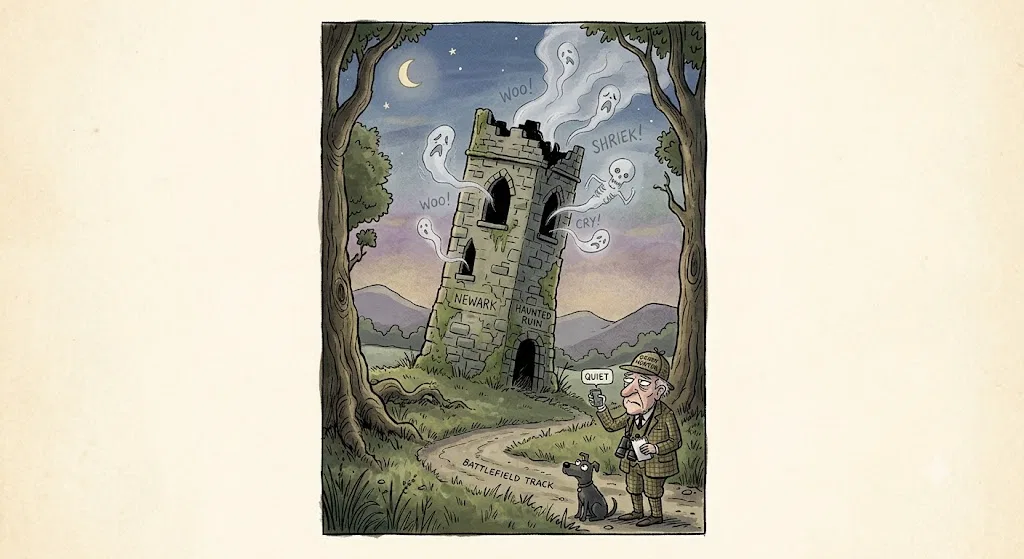
Newark Castle's ghost tradition draws its force from the violence and executions that followed Philiphaugh in 1645.
On this page
- The battle and the ruined tower
- Slain Men's Lea and massacre memory
- Ghost claims, bones and cautious evidence
Page outline Jump by section
Introduction
Newark Castle and Philiphaugh form Selkirkshire’s most historically grounded haunting: not because the ghost evidence is strong in a modern investigative sense, but because the story is tied to a documented battlefield, a named massacre site, recorded human remains, and a precise anniversary. The core tradition says that cries or screams are heard around Newark Castle on 13 September, the date of the Battle of Philiphaugh in 1645, when Royalist prisoners and camp followers were said to have been killed after Montrose’s defeat. Historic Environment Scotland’s battlefield record identifies Slain Men’s Lea, near Newark, as the place where burials were found in the nineteenth century and where tradition locates the slaughter after the battle.[Historic Environment Scotland]portal.historicenvironment.scotHistoric Environment Scotland Battle of Philiphaugh (BTL14Historic Environment ScotlandBattle of Philiphaugh (BTL14) - Historic Environment Portal21 Mar 2011 — Military findspots including Slain…
That is why Newark is often treated as Selkirkshire’s strongest haunting. The apparition claims themselves remain folkloric, but the setting is unusually firm: a ruined tower west of Selkirk, the Ettrick and Yarrow landscape, a nationally recognised battlefield, and a story of civil-war violence that local memory has not allowed to fade. Selkirkshire’s older county geography still matters here, because the legend belongs to the Yarrow and Ettrick country around Selkirk even though the modern administrative area is the Scottish Borders.[Gazetteer]gazetteer.org.ukOpen source on gazetteer.org.uk.
The battle and the ruined tower
Newark Castle stands about three miles west of Selkirk, in the Bowhill Estate, above the Yarrow Water. It is a ruined tower house associated with the old power structures of Ettrick Forest, visible from estate roads but not generally an interior visitor attraction in the way that better-preserved castles are. One modern castle guide describes it as a fifteenth-century Douglas tower, derelict and locked, with public visibility from estate roads rather than ordinary public access inside the building.[The Castle Guide]thecastleguide.co.ukOpen source on thecastleguide.co.uk.
The haunting tradition depends on what happened nearby on 13 September 1645. The Battle of Philiphaugh was fought during the Wars of the Three Kingdoms, after James Graham, Marquis of Montrose, had enjoyed a startling run of Royalist victories in Scotland. At Philiphaugh, Sir David Leslie’s Covenanter force caught and defeated Montrose’s army near Selkirk. The Battlefield Trust describes the action as the decisive battle of the Civil War in Scotland, shattering Montrose’s reputation for invincibility and ending his ability to face the Covenanters again in open battle.[Battlefields Trust]battlefieldstrust.comBattlefields Trust Battle of PhiliphaughBattlefields Trust Battle of Philiphaugh
Historic Environment Scotland’s battlefield entry gives the most important frame for the ghost story. It does not merely mark a vague “battlefield”; it identifies several related zones, including military findspots, Slain Men’s Lea, Harewood Glen to Newark Castle, and the probable westward route of the rout. It also records the tradition that camp followers were taken to the castle before being slaughtered at Slain Men’s Lea.[Historic Environment Scotland]portal.historicenvironment.scotHistoric Environment Scotland Battle of Philiphaugh (BTL14Historic Environment ScotlandBattle of Philiphaugh (BTL14) - Historic Environment Portal21 Mar 2011 — Military findspots including Slain…
That route matters. Many haunted castles have stories that float free of evidence: a white lady, a hidden room, a nameless prisoner. Newark’s legend is more specific. The ghostly cries are said to belong to people killed after a particular defeat, in the aftermath of a battle whose location and importance are independently recognised. The castle ruin becomes a focus for the story because it lies close to the post-battle violence, not because there is a long sequence of signed witness statements from inside the tower.

Slain Men’s Lea and massacre memory
The phrase that gives the tradition its force is Slain Men’s Lea. It is not a dramatic invention by a modern ghost writer; it appears in battlefield records as a historically meaningful place-name connected with burials and the aftermath of Philiphaugh. Historic Environment Scotland notes that burials were discovered there in the nineteenth century, while the Trove version of the battlefield designation states that human remains were recorded during the construction of a school in 1810 and were said to be the remains of some of Montrose’s army.[Historic Environment Scotland]portal.historicenvironment.scotHistoric Environment Scotland Battle of Philiphaugh (BTL14Historic Environment ScotlandBattle of Philiphaugh (BTL14) - Historic Environment Portal21 Mar 2011 — Military findspots including Slain…
The reported victims are usually described as Royalist soldiers, Irish troops in Montrose’s army, and camp followers, including women and children. The details vary across retellings. Some accounts emphasise about 100 prisoners; others give higher numbers for women, children, and non-combatants. The careful reading is that the massacre tradition is strong, but the exact numbers and categories of victims are less secure than the broad claim that post-battle killings occurred and became attached to Newark and Slain Men’s Lea.[The Castles of Scotland]thecastlesofscotland.co.ukOpen source on thecastlesofscotland.co.uk.
This is where the haunting becomes a memory-story rather than a simple “seen ghost” case. The alleged sound heard on 13 September is commonly described as the annual crying or screaming of those killed after the battle. A modern haunted-place retelling says that the cries of men, women and children are heard on the anniversary at Newark Castle, and it links the story to the discovery of human remains at Slain Men’s Lea in 1810. That is not proof of a supernatural event, but it shows how the folklore has been preserved and repeated in a recognisable form.[hauntedisles.blogspot.com]hauntedisles.blogspot.comhaunted newark castle selkirk septemberhaunted newark castle selkirk september
The story also fits a wider Scottish and Border pattern: a violent death becomes anchored to a precise spot, then the landscape itself seems to remember. In Newark’s case the “haunting” is not mainly a wandering figure on a stair. It is a soundscape: screams, cries, or echoes associated with a massacre field, a ruined tower, and the anniversary of a civil-war defeat. That makes it less theatrical than many castle ghost stories, but arguably more disturbing, because the historical event underneath it is not decorative.
Ghost claims, bones and cautious evidence
The strongest evidence at Newark and Philiphaugh is historical and archaeological, not paranormal. The battle is well attested, the battlefield is formally inventoried, Newark Castle is a recognised historic structure, and Slain Men’s Lea has a recorded association with human remains. The haunting claim, by contrast, rests on tradition: reports that cries are heard on 13 September and that the dead of the massacre still trouble the place.[historicenvironment.scot]portal.historicenvironment.scotHistoric Environment Scotland Battle of Philiphaugh (BTL14Historic Environment ScotlandBattle of Philiphaugh (BTL14) - Historic Environment Portal21 Mar 2011 — Military findspots including Slain…
That distinction is important for any honest haunted-history page. The discovery of bones does not prove that screams are heard. It does, however, explain why the story has persisted. A “haunted castle” tale becomes much more memorable when local people can point to a named field where remains were reportedly found and to a battlefield record that accepts the massacre tradition as part of the historic landscape.[Trove Scot]trove.scotOpen source on trove.scot.
Archaeology also introduces caution. The Battle of Philiphaugh Community Archaeology Project recommended further geophysical survey at Slain Men’s Lea to investigate whether pits or graves might be associated with the battle and the later execution of Irish soldiers in the Royalist army. That recommendation shows both the promise and the limits of the evidence: the place is highly suggestive, but not every detail of the massacre landscape has been archaeologically pinned down.[Academia]academia.eduThe Battle of Philiphaugh Community Archaeology ProjectThe Battle of Philiphaugh Community Archaeology Project
The landscape has also changed since 1645. Battlefield Trust material notes that later landscaping, planting, road realignment, alterations to the River Ettrick, and changes to mill leats make exact battlefield mapping difficult. That matters for readers trying to match the ghost story to a modern walk or map. The tradition is localised around Newark, Slain Men’s Lea and Philiphaugh, but the seventeenth-century terrain cannot simply be read from today’s roads, parks and fields without care.[Battlefields Trust]battlefieldstrust.comOpen source on battlefieldstrust.com.
The most credible interpretation is therefore layered:
- Historically strong: the Battle of Philiphaugh, the Royalist defeat, the aftermath tradition, Newark’s association with the route and killings, and the Slain Men’s Lea remains.
- Folklorically strong: the annual cries on 13 September, repeated in modern haunted-place accounts and local retellings.
- Paranormally unproven: no source found in the main evidence slate establishes a tested, contemporary, independently documented witness case that would turn the haunting from tradition into verified experience.
That does not make the story worthless. It places it in the category where many of Britain’s most durable hauntings belong: not confirmed supernatural events, but emotionally charged traditions formed around real violence, place-names, ruins, bones, and repeated telling.

Why Newark feels like Selkirkshire’s strongest haunting
Newark Castle’s claim is stronger than many ghost stories because its horror does not depend on an invented backstory. The place was already old by 1645. It had been a Douglas and royal tower, part of the Ettrick Forest landscape, and later a ruin watched over by the Bowhill estate. When the massacre tradition attached itself to the castle and Slain Men’s Lea, it did so in a landscape already full of authority, memory and old Border violence.[The Castles of Scotland]thecastlesofscotland.co.ukOpen source on thecastlesofscotland.co.uk.
The setting also has unusual atmospheric coherence. Selkirkshire is defined by the Ettrick and Yarrow waters, which rise in the west and run through a landscape long associated with song and story. The Gazetteer for Selkirkshire notes the importance of these rivers and the traditional celebration of Yarrow in literature and song. Newark and Philiphaugh sit inside that same cultural geography: not an isolated haunted ruin, but part of a county where history, ballad, river valleys and local memory continually overlap.[Gazetteer]gazetteer.org.ukOpen source on gazetteer.org.uk.
For visitors and readers, the key is to separate three experiences. There is the historical site: Philiphaugh as a battlefield and Newark as a ruined tower. There is the memorial landscape: Slain Men’s Lea, the recorded bones, and the remembered massacre. Then there is the haunting tradition: the cries said to be heard on the anniversary. The first two can be discussed with firmer evidence; the third should be treated as folklore rooted in trauma rather than as a proven phenomenon.
That is why the best answer to “Is Newark Castle Selkirkshire’s strongest haunting?” is a careful yes. It is not the best documented modern ghost case in the county, because the apparition evidence is thin. It is the strongest haunted-place tradition because the story is inseparable from a real battlefield, a named massacre site, and an unusually persistent local memory of the dead.
How to read the story without flattening it
The Newark and Philiphaugh haunting can be mishandled in two opposite ways. A sensational version turns the massacre into a simple ghost-tour shock, using the women and children of the story as atmosphere. A sceptical version dismisses the whole thing because annual screams cannot be verified. Neither approach does justice to the place.
A better reading is to treat the haunting as a form of memory. The screams said to echo on 13 September are not evidence that a visitor will hear anything. They are evidence that the violence after Philiphaugh has remained morally unsettled in local tradition. The dead are remembered not only through monuments and battlefield inventories, but through a story that refuses to make the massacre quiet.
That makes Newark different from a castle with a decorative phantom. Its ghost tradition asks a sharper question: how does a community remember killings that were brutal, politically charged and difficult to reconcile? The answer, in Selkirkshire’s haunted geography, is that the landscape keeps the story in circulation. A ruined tower, a field called Slain Men’s Lea, a battlefield by the Ettrick and Yarrow, and the date 13 September do the work that a formal archive cannot do on its own.
Visiting the legend today
Newark Castle should be approached as a historic ruin within a living estate landscape, not as a guaranteed ghost attraction. Modern access information can change, and the tower itself has been subject to repair and safety work; recent Historic Environment Scotland records refer to structural repairs, crack stitching, masonry stabilisation, internal vault repair and protective barriers for openings where there is a fall risk.[Historic Environment Scotland]portal.historicenvironment.scotHistoric Environment Scotland Newark Castle, PhiliphaughHistoric Environment Scotland Newark Castle, Philiphaugh
For the haunted-history reader, the most meaningful visit is not necessarily an attempt to “hunt” the screams. It is to understand the relationship between three nearby points: Selkirk, where Montrose’s officers were quartered; Philiphaugh, where the battle destroyed the Royalist position; and Newark or Slain Men’s Lea, where tradition locates the post-battle killings. Historic Environment Scotland’s battlefield boundary is especially useful because it treats the rout, the findspots, the earthworks and the massacre tradition as connected parts of one landscape.[Historic Environment Scotland]portal.historicenvironment.scotHistoric Environment Scotland Battle of Philiphaugh (BTL14Historic Environment ScotlandBattle of Philiphaugh (BTL14) - Historic Environment Portal21 Mar 2011 — Military findspots including Slain…
The result is a haunting that feels less like a single ghost story and more like a dark historical corridor. The battlefield explains the castle legend; the castle gives the battlefield a visible ruin; Slain Men’s Lea gives the story a name that cannot be softened. In a county where many supernatural traditions come through ballad, fairy lore and literary retelling, Newark and Philiphaugh stand out because the eerie element grows directly from documented civil-war violence and the unresolved memory of the dead.
Amazon book picks
Further Reading
Books and field guides related to Is Newark Castle Selkirkshire's Strongest Haunting?. Use these as the next step if you want deeper reading beyond the article.

Sir Walter Scott's Minstrelsy of the Scottish border
First published 1902. Subjects: Texts, Scots Ballads, English Ballads.
eBay marketplace picks
Marketplace Samples
Live-tested eBay searches with available results related to this page.
Endnotes
1.
Source: trove.scot
Link:https://www.trove.scot/designation/BTL14
2.
Source: hauntedisles.blogspot.com
Title: haunted newark castle selkirk september
Link:https://hauntedisles.blogspot.com/2014/09/haunted-newark-castle-selkirk-september.html
3.
Source: academia.edu
Title: The Battle of Philiphaugh Community Archaeology Project
Link:https://www.academia.edu/6099136/The_Battle_of_Philiphaugh_Community_Archaeology_Project_Final_Report_2012
4.
Source: portal.historicenvironment.scot
Title: Historic Environment Scotland Battle of Philiphaugh (BTL14)
Link:https://portal.historicenvironment.scot/apex/f?p=1505%3A300%3A%3A%3A%3A%3AVIEWTYPE%2CVIEWREF%3Adesignation%2CBTL14
Source snippet
Historic Environment ScotlandBattle of Philiphaugh (BTL14) - Historic Environment Portal21 Mar 2011 — Military findspots including Slain...
5.
Source: gazetteer.org.uk
Link:https://gazetteer.org.uk/place/Selkirkshire
6.
Source: thecastleguide.co.uk
Link:https://thecastleguide.co.uk/castle/newark-castle-selkirk/
7.
Source: thecastlesofscotland.co.uk
Link:https://www.thecastlesofscotland.co.uk/the-best-castles/scenic-castles/newark-castle-bowhill/
8.
Source: battlefieldstrust.com
Title: Battlefields Trust Battle of Philiphaugh
Link:https://www.battlefieldstrust.com/resource-centre/battleview.asp?BattleFieldId=74
9.
Source: scotlandsfinest.nl
Title: newark castle
Link:https://www.scotlandsfinest.nl/what-s-to-see/scotland-s-finest-castles/newark-castle
10.
Source: portal.historicenvironment.scot
Link:https://portal.historicenvironment.scot/apex/f?p=1505%3A300%3A%3A%3A%3A%3AVIEWTYPE%2CVIEWREF%3Adesignation%2CSM1729
11.
Source: battlefieldstrust.com
Link:https://www.battlefieldstrust.com/media/647.pdf
12.
Source: portal.historicenvironment.scot
Title: Historic Environment Scotland Newark Castle, Philiphaugh
Link:https://portal.historicenvironment.scot/apex/f?p=1505%3A300%3A%3A%3A%3A%3AVIEWTYPE%2CVIEWREF%3Adecision%2C900077947
13.
Source: Wikipedia
Title: Battle of Philiphaugh
Link:https://en.wikipedia.org/wiki/Battle_of_Philiphaugh
14.
Source: Wikipedia
Link:https://en.wikipedia.org/wiki/Selkirkshire
15.
Source: portal.historicenvironment.scot
Link:https://portal.historicenvironment.scot/apex/f?p=1505%3A300%3A%3A%3A%3A%3AVIEWTYPE%2CVIEWREF%3Adesignation%2CLB15556
16.
Source: historicenvironment.scot
Link:https://www.historicenvironment.scot/visit/all/newark-castle/
17.
Source: borderarchaeology.co.uk
Link:https://www.borderarchaeology.co.uk/home/sites/newark
18.
Source: heatherliehouse.com
Title: Newark Castle
Link:https://heatherliehouse.com/newark-castle/
19.
Source: historic-uk.com
Title: The Battle of Philiphaugh
Link:https://www.historic-uk.com/HistoryMagazine/DestinationsUK/The-Battle-of-Philiphaugh/
20.
Source: battlefieldstrust.com
Link:https://www.battlefieldstrust.com/media/661.pdf
Additional References
21.
Source: youtube.com
Link:https://www.youtube.com/watch?v=leemeAVT230
Source snippet
Newark Castle Selkirk Newark Castle, Selkirk, An Aerial Observation Alan Murray...
Published: September 1645
22.
Source: youtube.com
Link:https://www.youtube.com/watch?v=YDdNqWGsL6o
Source snippet
The Battle of Philiphaugh September 1645, the retreat, rout, massacre and aftermath...
Published: September 1645
23.
Source: youtube.com
Title: Newark Castle, Selkirk, An Aerial Observation
Link:https://www.youtube.com/watch?v=ygQ2TB846TE
Source snippet
Battlefield Guide. The Battle of Philiphaugh, September 1645...
Published: September 1645
24.
Source: todoinscotland.com
Link:https://todoinscotland.com/the-courtyard-of-execution-haunting-in-the-scottish-borders
25.
Source: guard-archaeology.co.uk
Link:https://www.guard-archaeology.co.uk/news/news14/ARO11News.html
26.
Source: abcounties.com
Link:https://abcounties.com/counties/county-profiles/selkirkshire/
27.
Source: scotclans.com
Link:https://www.scotclans.com/pages/1645-battle-of-philiphaugh?srsltid=AfmBOoovjJKvlomliZG5mKmN8TZ6V8NjxE6_0MkMTpSD1WV4r8_FCqJU
28.
Source: bowhillhouse.co.uk
Link:https://www.bowhillhouse.co.uk/borders-estate/preserving-our-heritage/
29.
Source: museumsandtheweb.com
Link:https://www.museumsandtheweb.com/paper_keywords/canmore.html
30.
Source: archaeologyscotland.org.uk
Link:https://www.archaeologyscotland.org.uk/wp-content/uploads/2022/05/1995.pdf
Topic Tree