Within Haunted Staffordshire
Is Mary Still Felt at Tutbury?
Tutbury's haunting reputation rests on the documented imprisonment of Mary Queen of Scots and the later ghost traditions built around it.
On this page
- Mary Queen of Scots at Tutbury
- The castle as prison and haunted ruin
- Where history ends and ghost tradition begins
Page outline Jump by section
Introduction
Tutbury Castle’s ghost story is powerful because it begins with a documented imprisonment, not with a vague rumour. Mary Queen of Scots was held at Tutbury in Staffordshire during her long English captivity, and the ruined castle’s later haunting reputation has grown around that memory: a royal prisoner, a damp and decaying fortress, repeated returns, and a woman whose death came elsewhere but whose misery is strongly attached to this place. The most careful reading is that Tutbury is not “proved haunted”; it is a historic site where Tudor captivity has been turned into local ghost tradition, visitor experience and paranormal folklore. Historic England records Mary’s imprisonments there in 1569, 1570 and 1585, while modern ghost-hunt and heritage material presents her as the castle’s most famous alleged presence.[Historic England]historicengland.org.ukHistoric England Tutbury Castle, TutburyHistoric England Tutbury Castle, Tutbury
For Staffordshire’s haunted history, Tutbury matters because it joins a national Tudor story to a very local landscape. The castle stands at Tutbury, on the Staffordshire side of the River Dove, close to the Derbyshire border, and its ruins look across the Dove valley towards the neighbouring county. That borderland setting helps explain why its stories often sit between county history, royal history, tourist storytelling and ghost-lore.[Wikishire]wikishire.co.ukOpen source on wikishire.co.uk.
Mary Queen of Scots at Tutbury
Mary arrived in England in 1568 after defeat in Scotland and sought help from Elizabeth I, but she was detained instead. National Museums Scotland summarises the turning point clearly: after Mary fled Scotland, Elizabeth ordered her detention at Carlisle; by February 1569 Mary had been taken to Tutbury Castle in Staffordshire, where George Talbot, Earl of Shrewsbury, became her jailer.[National Museums Scotland]nms.ac.ukOpen source on nms.ac.uk.
Tutbury was one of more than ten castles or manor houses used during Mary’s English captivity, but it gained a particular place in memory because it represented the start of her long confinement under Shrewsbury. She was not held like an ordinary prisoner in a cell: she had attendants, nobles, servants and household goods, and she was sometimes allowed to ride. Yet that relative status did not make Tutbury comfortable. It was a prison of rank, surveillance and political danger rather than a dungeon story, and that distinction is important when reading later ghost traditions.[National Museums Scotland]nms.ac.ukOpen source on nms.ac.uk.
Historic England’s scheduled monument entry gives the hard historical frame. Tutbury Castle was a medieval stronghold, Crown property from 1399, and an administrative centre of the Duchy of Lancaster estate. By the sixteenth century it was already reported to be in disrepair, and Mary was imprisoned there during three recorded years: 1569, 1570 and 1585. The same entry places Mary’s imprisonment in a long sequence of castle history, from Norman foundation to Civil War fortification and later destruction.[Historic England]historicengland.org.ukHistoric England Tutbury Castle, TutburyHistoric England Tutbury Castle, Tutbury
Those details matter because the ghost story depends on the condition of the place. Mary’s remembered Tutbury is not a glittering palace, but a declining fortress pressed into use as a secure royal prison. History Hit describes her first arrival on 4 February 1569 and notes that she disliked Tutbury both because it was a prison and because of its run-down state, with complaints about damp, wet plaster and draughty old carpentry.[History Hit]historyhit.comHistory Hit Tutbury CastleHistory Hit Tutbury Castle

Why Tutbury became Mary’s “haunted” castle
Mary did not die at Tutbury. She was executed at Fotheringhay Castle in Northamptonshire in 1587 after nineteen years in captivity. That raises the central question for any sceptical reader: why should Tutbury, rather than Fotheringhay, carry such a strong Mary ghost tradition?[National Museums Scotland]nms.ac.ukOpen source on nms.ac.uk.
The answer lies in memory rather than mechanics. Tutbury was repeatedly associated with the indignity, frustration and physical discomfort of Mary’s captivity. It was the Staffordshire place where a former queen’s life became unmistakably narrowed by Elizabethan security. National Museums Scotland records that Shrewsbury held Mary for fifteen years, and that Tutbury was among the places in which her failing health, household arrangements and permitted movements had to be managed.[National Museums Scotland]nms.ac.ukOpen source on nms.ac.uk.
Later accounts sharpen this into atmosphere: cold rooms, damp walls, a draughty lodging, and a captive queen trying to preserve dignity under watch. The National Archives’ education material on Mary’s correspondence notes that she was first taken to Tutbury in February 1569 and complained of cold, draughty and damp rooms that she said aggravated her health.[The National Archives]nationalarchives.gov.ukmary queen of scots to sir william cecilmary queen of scots to sir william cecil
This is the point where history and haunting begin to overlap. A castle ruin already suggests absence. Add a famous prisoner who hated being there, a repeated captivity, a Tudor political tragedy, and a later visitor economy built on night tours and ghost hunts, and the site becomes a natural container for apparition stories. The haunting tradition is not convincing because it supplies strong paranormal proof; it is compelling because it attaches a vivid emotional memory to a real place.
The castle as prison and haunted ruin
Tutbury’s physical history gives the Mary legend its stage. Historic England identifies the surviving remains as a motte-and-bailey castle built by 1071 by Henry de Ferrers, with later medieval structures including John of Gaunt’s Gate, curtain walls, towers and surviving chapel remains. The castle later became Crown property, entered the Duchy of Lancaster world, and was eventually slighted after the Civil War.[Historic England]historicengland.org.ukHistoric England Tutbury Castle, TutburyHistoric England Tutbury Castle, Tutbury
The ruin that visitors encounter today is therefore not the fully functioning prison Mary knew. It is a layered remnant: Norman earthwork, medieval aristocratic stronghold, Tudor prison, Civil War site and post-war ruin. That layering matters for ghost stories because the “haunted castle” seen by modern visitors is already a selective reconstruction in the imagination. People stand among broken walls and attach the visible ruin to Mary’s captivity, even though the exact arrangements of sixteenth-century lodging, surveillance and household life were more complex than a simple tower-cell image.[Historic England]historicengland.org.ukHistoric England Tutbury Castle, TutburyHistoric England Tutbury Castle, Tutbury
The modern tourism frame reinforces that atmosphere. Discover East Staffordshire describes Tutbury Castle as a Staffordshire medieval stronghold above the River Dove, known for royal connections including Mary’s imprisonment, and notes that the site hosts events such as re-enactments, historical talks, medieval festivals and ghost hunts. It also states that the castle is not currently open for general public access, which makes organised events especially important in shaping how many visitors encounter it.[Discover East Staffordshire]discovereaststaffordshire.comDiscover East Staffordshire Tutbury Castle – DISCOVER EAST STAFFORDSHIREDiscover East Staffordshire Tutbury Castle – DISCOVER EAST STAFFORDSHIRE
That event culture is not incidental. A place can be historically important without becoming a famous haunted site; Tutbury’s modern identity has been shaped by people presenting its past in performance, interpretation and night-time investigation. Lesley Smith, curator of Tutbury Castle from 2000 to 2024, is described on her own site as a medical historian and public performer known for costumed portrayals of historical figures, including Mary Queen of Scots.[lesleysmithhistorians.co.uk]lesleysmithhistorians.co.ukLesley Smith | Lesley Smith Historians LtdLesley Smith | Lesley Smith Historians Ltd
What is said to haunt Tutbury?
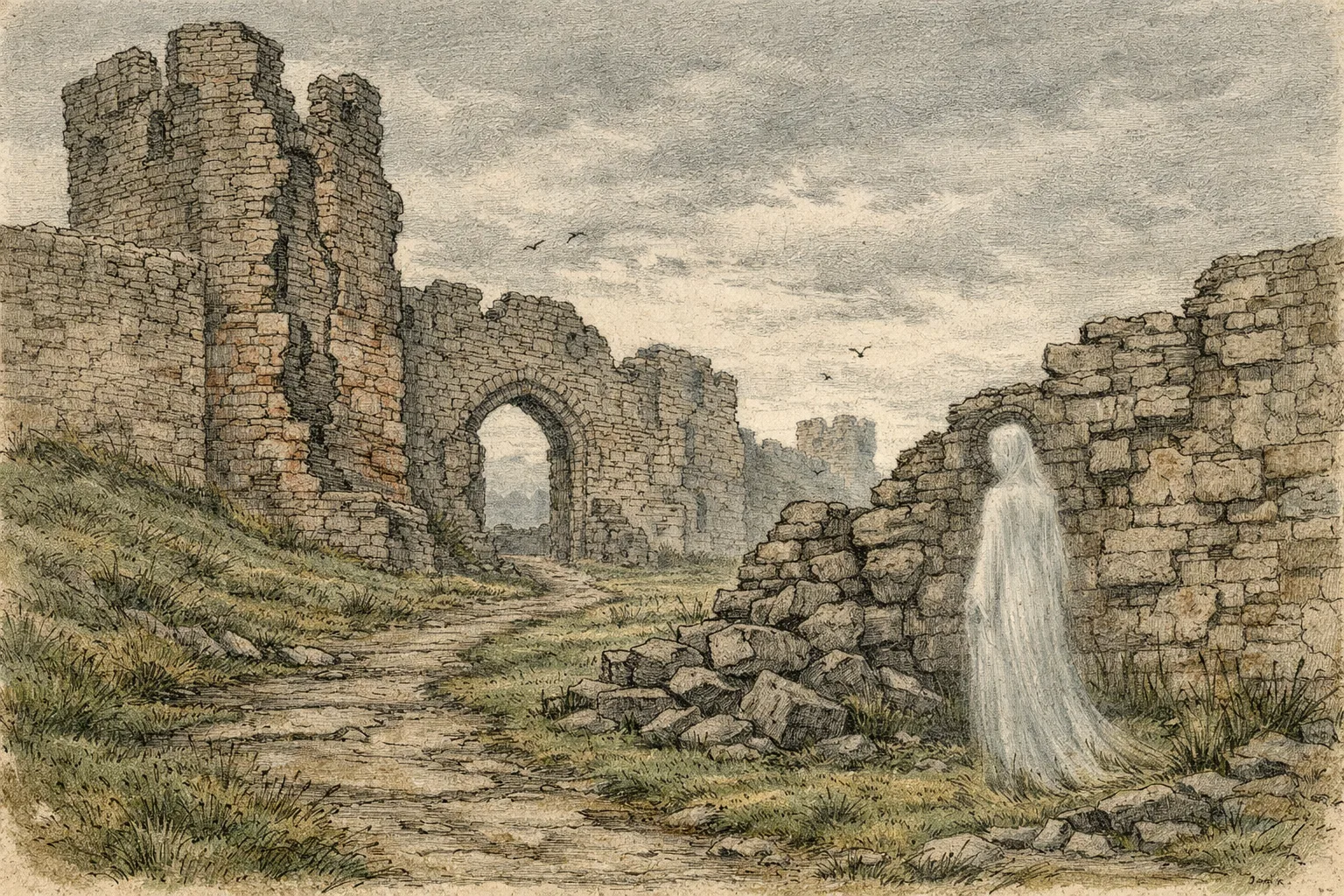
The dominant ghost tradition is that Mary Queen of Scots is still somehow present at the castle. Modern paranormal accounts usually describe her as an apparition in period dress, sometimes white, sometimes black, and sometimes seen on or near the South Tower, the Great Hall area or the open grounds. These accounts should be read as reported traditions rather than verified events.[Tastes Of History]tastesofhistory.co.ukTastes Of History Paranormal thinking?Tastes Of History Paranormal thinking?
One often repeated modern story concerns a sighting in 2004, when a group reportedly saw a woman in a white Elizabethan-style gown at the top of the South Tower around midnight. The account is interesting not because it proves anything, but because it shows how quickly a visual impression can be interpreted through the known history of the site. A woman in historic-looking dress at Tutbury is almost automatically read as Mary.[Tastes Of History]tastesofhistory.co.ukTastes Of History Paranormal thinking?Tastes Of History Paranormal thinking?
Other reported figures are less tightly tied to Mary: a man in armour, a white lady, a little boy and a small girl appear in paranormal listings and ghost-hunt descriptions. These figures broaden the castle’s haunted reputation beyond one royal prisoner, but they are less historically distinctive. Mary remains the figure that gives Tutbury’s ghost lore its public identity, because her real imprisonment is firmly documented and emotionally legible.[Paranormal Eye Uk]paranormaleyeuk.co.ukOpen source on paranormaleyeuk.co.uk.
The better question is not “which ghost is real?” but “why is Mary the ghost people expect?” She is famous, wronged in the eyes of many admirers, politically dangerous in her own time, and visually easy to imagine in Tudor dress. Tutbury’s ruin supplies the setting; Mary supplies the face.
Where history ends and ghost tradition begins
The evidence for Mary’s imprisonment is strong. The evidence for Mary’s ghost is folkloric. Keeping those two statements separate makes the story more interesting, not less.
On the historical side, several independent source types agree on the core facts: official heritage listing, museum chronology, educational archives and castle-history summaries all place Mary at Tutbury during her English captivity. Historic England records her imprisonments in 1569, 1570 and 1585; National Museums Scotland places her there in February 1569 under Shrewsbury; and modern historical summaries describe her dislike of the castle’s damp and decayed condition.[historicengland.org.uk]historicengland.org.ukHistoric England Tutbury Castle, TutburyHistoric England Tutbury Castle, Tutbury
On the ghost-story side, the sources are much more dependent on later retelling, visitor accounts, paranormal-event copy and sceptical commentary about those accounts. Lesley Smith Historians’ ghost-hunt page states that Tutbury is famous for its ghosts and that particular interest grew from around 2000, when activity was said to have been caught on television and radio recordings. That is evidence of a modern haunting reputation, not evidence that the haunting itself is objectively true.[lesleysmithhistorians.co.uk]lesleysmithhistorians.co.ukGhost Hunts & Paranormal Investigations | Lesley Smith Historians LtdGhost Hunts & Paranormal Investigations | Lesley Smith Historians Ltd
The strongest sceptical reading is that Tutbury’s haunting tradition works through expectation. Visitors know Mary was imprisoned there; they visit at night; they are primed by castle ruins, costume, darkness and stories; ambiguous sights or sounds can then be interpreted through the Mary legend. The Tastes of History discussion makes this point directly when it questions how witnesses at night could confidently identify a distant figure as Mary Queen of Scots, or even distinguish one period style of dress from another.[Tastes Of History]tastesofhistory.co.ukTastes Of History Paranormal thinking?Tastes Of History Paranormal thinking?
That does not make the folklore worthless. It simply shifts the value of the story. Tutbury’s Mary is best understood as a memory-ghost: a figure through whom visitors imagine captivity, political fear and Tudor tragedy in one Staffordshire location.
The 1585 return and the road to Chartley
Tutbury’s haunted reputation is strengthened by Mary’s last Staffordshire phase. In 1585 her custody tightened under Sir Amyas Paulet, and her conditions became more confined and less comfortable. National Museums Scotland notes that Paulet took charge in April 1585, detested Mary and revoked many of the privileges Shrewsbury had allowed.[National Museums Scotland]nms.ac.ukOpen source on nms.ac.uk.
This matters because the last Tutbury stay leads directly into another Staffordshire Mary site: Chartley. Lesley Smith Historians’ event description states that Mary was held at Tutbury on four occasions, left Tutbury for the last time in 1585, moved to nearby Chartley, and from there was sent on towards Fotheringhay. The page gives the execution year as 1586, but the accepted date of Mary’s execution is 8 February 1587, as National Museums Scotland records.[lesleysmithhistorians.co.uk]lesleysmithhistorians.co.ukMary Queen of Scots at Lichfield Methodist Church | Lesley Smith Historians LtdMary Queen of Scots at Lichfield Methodist Church | Lesley Smith Historians Ltd
For a Staffordshire haunted-history project, this creates a natural internal link between Tutbury Castle and Chartley. Tutbury is the damp, repeated prison of memory; Chartley is the later Staffordshire stage in the story that leads into the Babington Plot and Mary’s final removal. National Museums Scotland summarises the plot sequence: Walsingham’s agents intercepted Mary’s secret correspondence, and the Babington Plot sealed her fate before she was moved to Fotheringhay in September 1586.[National Museums Scotland]nms.ac.ukOpen source on nms.ac.uk.
The ghost tradition, however, keeps returning to Tutbury. That is telling. Folklore does not always settle on the place of death; it often settles on the place that feels emotionally unresolved.
Why the Mary legend still works for visitors
Tutbury’s Mary story works because it asks visitors to hold two pictures in mind at once. One is the historical Mary: queen by birth, former queen of France, deposed Scottish ruler, Catholic claimant, Elizabeth’s prisoner and a woman whose letters, movements and household were watched for political danger. The other is the folklore Mary: a pale or dark figure at a ruined Staffordshire castle, glimpsed at night where a real prisoner once complained of damp and confinement.[National Museums Scotland]nms.ac.ukOpen source on nms.ac.uk.
The gap between those pictures is where the atmosphere lives. The history gives the story weight; the haunting gives it immediacy. A visitor may not remember every date in Mary’s captivity, but they can remember the idea of a queen looking out from a cold castle she hated, still bound to the place in local imagination.
The castle’s modern interpretation has kept that memory active through events, guided experiences and ghost hunts. Discover East Staffordshire presents the site as a place of royal history and organised events, while Lesley Smith Historians explicitly connects the castle’s ghost-hunt reputation with its identity as an eleventh-century royal castle and prison of Mary Queen of Scots.[Discover East Staffordshire]discovereaststaffordshire.comDiscover East Staffordshire Tutbury Castle – DISCOVER EAST STAFFORDSHIREDiscover East Staffordshire Tutbury Castle – DISCOVER EAST STAFFORDSHIRE
That mix should be handled carefully. It is easy to flatten Tutbury into a “most haunted castle” label, but the better story is subtler: a ruin where a documented Tudor imprisonment has become a durable local haunting tradition. The ghost is not needed to make Tutbury significant. Instead, the ghost tradition shows how a community and its visitors keep returning to the emotional residue of the history.
How credible is the haunting?
As a historical claim, “Mary Queen of Scots was imprisoned at Tutbury” is well supported. As a paranormal claim, “Mary Queen of Scots haunts Tutbury” rests on reported sightings, promotional ghost-hunt culture and repeated tradition rather than verifiable evidence. That does not mean every witness account should be mocked, but it does mean the evidence sits in folklore, not in the same category as the scheduled monument record or Mary’s captivity chronology.[historicengland.org.uk]historicengland.org.ukHistoric England Tutbury Castle, TutburyHistoric England Tutbury Castle, Tutbury
A fair credibility assessment would separate three layers:
Documented history: Mary’s captivity at Tutbury, the castle’s disrepair, its Staffordshire location, and its later ruin are well evidenced through official and reputable historical sources.[Historic England]historicengland.org.ukHistoric England Tutbury Castle, TutburyHistoric England Tutbury Castle, Tutbury
Local and visitor tradition: The idea that Mary is Tutbury’s most famous ghost is widely repeated in paranormal and heritage-adjacent material, and the castle’s modern ghost-hunt culture has helped preserve it.[lesleysmithhistorians.co.uk]lesleysmithhistorians.co.ukGhost Hunts & Paranormal Investigations | Lesley Smith Historians LtdGhost Hunts & Paranormal Investigations | Lesley Smith Historians Ltd
Paranormal proof: The apparition accounts remain anecdotal. They are interesting as witness stories and folklore, but they do not establish that Mary’s spirit is present in any testable sense. Sceptical discussion of the 2004 “woman in white” account shows the main problem: distance, darkness, expectation and costume association can all shape what people believe they have seen.[Tastes Of History]tastesofhistory.co.ukTastes Of History Paranormal thinking?Tastes Of History Paranormal thinking?
The result is a story that is credible as memory and folklore, but unproven as a haunting. For many readers of haunted history, that is exactly what makes Tutbury compelling. It is not an invented ruin with a pasted-on ghost. It is a real Staffordshire prison-site where the documented misery of a famous captive has become an enduring spectral tradition.

Tutbury’s place in Staffordshire ghost lore
Within Staffordshire’s haunted map, Tutbury Castle stands apart from more purely local legends because Mary Queen of Scots brings international Tudor memory into the county. Tamworth Castle has its Black Lady and White Lady; Cannock Chase has modern strange-figure traditions; Stafford’s old buildings carry town-centre ghost stories. Tutbury’s distinct role is different: it turns political imprisonment into haunted memory.
The castle also reminds readers that Staffordshire ghost lore is not only about fear. It is about how places remember pressure. Tutbury remembers confinement, surveillance, damp rooms, failed hopes and the long wait before a death sentence carried out elsewhere. The alleged apparition of Mary is therefore less a simple “ghost in a castle” than a way of giving visible form to the discomfort of history.
That is why the most honest answer to “Is Mary still felt at Tutbury?” is: yes, in the cultural and imaginative sense, very strongly. Her presence is felt in the site’s interpretation, in ghost-hunt advertising, in visitor expectation, and in the way the castle’s ruins are read. Whether anything supernatural walks there remains unproven. What is beyond doubt is that Tutbury Castle has become one of Staffordshire’s clearest examples of haunted memory: a place where the past is not merely described, but repeatedly sensed, staged and retold.


eBay marketplace picks
Marketplace Samples
Live-tested eBay searches with available results related to this page.


Endnotes
1.
Source: lesleysmithhistorians.co.uk
Title: Ghost Hunts & Paranormal Investigations | Lesley Smith Historians Ltd
Link:https://lesleysmithhistorians.co.uk/ghost-hunts-and-paranormal-investigations/
2.
Source: lesleysmithhistorians.co.uk
Title: Lesley Smith | Lesley Smith Historians Ltd
Link:https://lesleysmithhistorians.co.uk/lesley-smith/
3.
Source: lesleysmithhistorians.co.uk
Title: Mary Queen of Scots at Lichfield Methodist Church | Lesley Smith Historians Ltd
Link:https://lesleysmithhistorians.co.uk/liveevent/mary-queen-of-scots-at-lichfield-methodist-church/
4.
Source: lesleysmithhistorians.co.uk
Title: prosecco with mary queen of scots at tutbury castle
Link:https://lesleysmithhistorians.co.uk/liveevent/prosecco-with-mary-queen-of-scots-at-tutbury-castle/
5.
Source: historicengland.org.uk
Title: Historic England Tutbury Castle, Tutbury
Link:https://historicengland.org.uk/listing/the-list/list-entry/1006112
6.
Source: wikishire.co.uk
Link:https://wikishire.co.uk/wiki/Tutbury
7.
Source: wikishire.co.uk
Title: Tutbury Castle
Link:https://wikishire.co.uk/wiki/Tutbury_Castle
8.
Source: nms.ac.uk
Link:https://www.nms.ac.uk/discover-catalogue/life-and-deathline-of-mary-queen-of-scots
9.
Source: historyhit.com
Title: History Hit Tutbury Castle
Link:https://www.historyhit.com/locations/tutbury-castle/
10.
Source: nationalarchives.gov.uk
Title: mary queen of scots to sir william cecil
Link:https://www.nationalarchives.gov.uk/education/resources/elizabeth-monarchy/mary-queen-of-scots-to-sir-william-cecil/
11.
Source: discovereaststaffordshire.com
Title: Discover East Staffordshire Tutbury Castle – DISCOVER EAST STAFFORDSHIRE
Link:https://discovereaststaffordshire.com/?attractions=tutbury-castle
12.
Source: tastesofhistory.co.uk
Title: Tastes Of History Paranormal thinking?
Link:https://www.tastesofhistory.co.uk/post/paranormal-thinking
13.
Source: paranormaleyeuk.co.uk
Link:https://www.paranormaleyeuk.co.uk/peuk1/tutbury-castle-derbyshire-ghost-hunt
14.
Source: Wikipedia
Link:https://en.wikipedia.org/wiki/Tutbury
15.
Source: Wikipedia
Title: Tutbury Castle
Link:https://en.wikipedia.org/wiki/Tutbury_Castle
16.
Source: Wikipedia
Title: Lesley Smith (historian)
Link:https://en.wikipedia.org/wiki/Lesley_Smith_%28historian%29
17.
Source: historicengland.org.uk
Title: The Castle, Tutbury
Link:https://historicengland.org.uk/listing/the-list/list-entry/1374431
18.
Source: crazyaboutcastles.com
Link:https://crazyaboutcastles.com/english-castles/tutbury-castle/
19.
Source: tripadvisor.com
Title: Tutbury Castle
Link:https://www.tripadvisor.com/Attraction_Review-g186379-d218502-Reviews-Tutbury_Castle-Tutbury_Staffordshire_England.html
20.
Source: tripadvisor.com
Title: Lesley Smith, Curator of Tutbury Castle
Link:https://www.tripadvisor.com/ShowUserReviews-g186379-d218502-r280202992-Tutbury_Castle-Tutbury_Staffordshire_England.html
21.
Source: genuki.org.uk
Link:https://www.genuki.org.uk/big/eng/STS/Tutbury
22.
Source: oldroadsofderbyshire.com
Title: mary queen of scots
Link:https://oldroadsofderbyshire.com/tag/mary-queen-of-scots/
23.
Source: brookesparanormal.co.uk
Title: Tutbury Castle
Link:https://www.brookesparanormal.co.uk/tutbury-castle
Additional References
24.
Source: youtube.com
Title: The Infamous Ruins Of Tutbury Castle
Link:https://www.youtube.com/watch?v=xdas0KTA6Fw
Source snippet
16th Century Tutbury Castle Reconstruction 3D...
25.
Source: english-heritage.org.uk
Link:https://www.english-heritage.org.uk/visit/inspire-me/travel-guides/derbyshire/
26.
Source: thetudortravelguide.com
Link:https://thetudortravelguide.com/captive-queen-the-decrypted-history-of-mary-queen-of-scots/
27.
Source: facebook.com
Link:https://www.facebook.com/100064533826405/posts/halloween-specialthis-is-tutbury-castle-it-is-supposed-to-be-haunted-by-a-number/959776282850157/
28.
Source: facebook.com
Link:https://www.facebook.com/thetudorintruders/posts/-mary-queen-of-scots-and-tutbury-castle-tutbury-castle-in-staffordshire-was-extr/1497212322048516/
29.
Source: english-heritage.org.uk
Link:https://www.english-heritage.org.uk/visit/places/carlisle-castle/history/mary-queen-of-scots/
30.
Source: hauntedbuildings.uk
Link:https://hauntedbuildings.uk/project/tutbury-castle
31.
Source: facebook.com
Link:https://www.facebook.com/groups/735389799823006/posts/7715519958476587/
32.
Source: crsbi.ac.uk
Link:https://www.crsbi.ac.uk/view-item?i=162
33.
Source: gazetteer.org.uk
Link:https://gazetteer.org.uk/place/Staffordshire
Topic Tree