Within Haunted Suffolk
Why Black Shuck Still Haunts Suffolk
Black Shuck links Suffolk's churches, storm memory and black-dog folklore into the county's most famous supernatural tale.
On this page
- The Bungay storm story
- Blythburgh's door marks
- From devil dog to folklore icon
Page outline Jump by section
Introduction
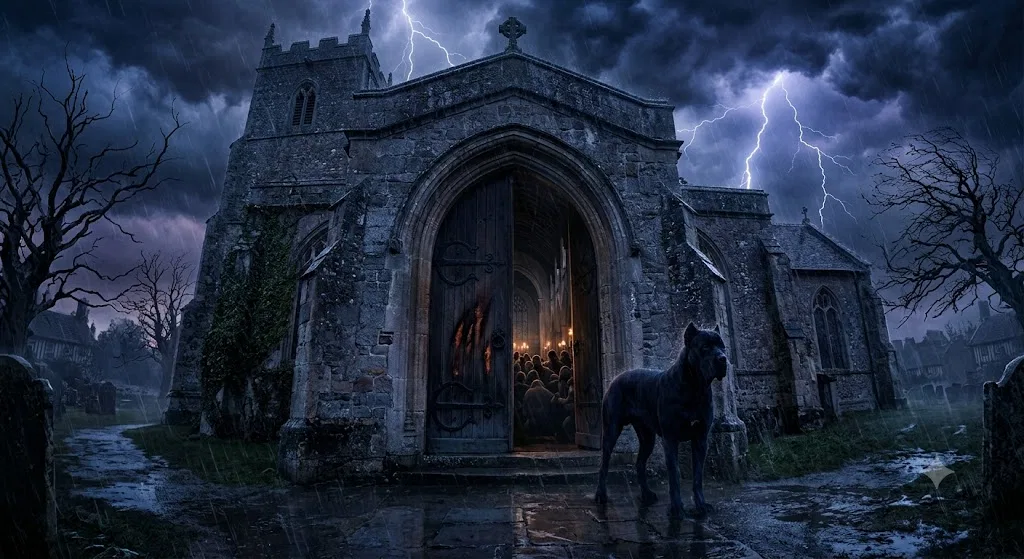
Black Shuck is Suffolk’s most famous supernatural dog: a huge black hound said to have appeared during a violent storm on Sunday 4 August 1577, first at St Mary’s Church in Bungay and then at Holy Trinity, Blythburgh. The story matters because it is not just a vague fireside tale. It is tied to a precise date, two real Suffolk churches, a contemporary printed pamphlet by Abraham Fleming, visible marks still associated with the legend at Blythburgh, and a long afterlife in local identity. The safer reading is not that a ghost dog was proved to exist, but that a terrifying church storm was quickly interpreted through the religious fear and black-dog folklore of Elizabethan East Anglia. Fleming’s 1577 text describes rain, lightning, thunder, darkness, deaths and damage; later Suffolk tradition turned that catastrophe into the enduring image of Black Shuck, the devil dog who still haunts the county’s imagination.[quod.lib.umich.edu]quod.lib.umich.eduOpen source on umich.edu.
The Bungay storm story
The core Suffolk legend begins at St Mary’s Church, Bungay, a former priory church in the Waveney Valley. The Churches Conservation Trust describes St Mary’s as a late-medieval church built as part of a Benedictine priory, later kept as the parish church after the priory was closed under Henry VIII in 1536. It also notes that St Mary’s is famous for the “Black Dog of Bungay”, said to have appeared during a terrifying storm in 1577 and attacked the congregation.[Churches Conservation Trust]visitchurches.org.ukChurches Conservation Trust St Mary's Church, Bungay, SuffolkChurches Conservation Trust St Mary's Church, Bungay, Suffolk
The earliest major printed account is Abraham Fleming’s A straunge and terrible wunder, published in London in 1577. Its full title is important because it frames the event as both weather disaster and supernatural sign: a “great tempest of violent raine, lightning, and thunder” in Bungay, with “the appeerance of an horrible shaped thing” perceived by the people assembled in the church. The University of Michigan’s Early English Books Online edition identifies Fleming as the author and gives the publication date as 1577, placing the pamphlet unusually close to the event it describes.[quod.lib.umich.edu]quod.lib.umich.eduOpen source on umich.edu.
Fleming says the storm broke between nine and ten in the morning on Sunday 4 August 1577. His description is vivid even when read cautiously: violent rain, forceful thunder, lightning, darkness, and a church that seemed to “quake and stagger” to the frightened congregation. In that charged darkness, he says, a black dog appeared amid flashes of fire, causing the people to think doomsday had come.[quod.lib.umich.edu]quod.lib.umich.eduOpen source on umich.edu.
The pamphlet then turns from storm report to moral drama. Fleming calls the creature “this black dog, or the diuel in such a likenesse”, and says it ran down the body of the church with extraordinary speed. According to the account, it passed between two kneeling people and killed them instantly; another man was left injured, and the church clerk was struck down by thunder while working on the church gutter but survived. Fleming also points to physical damage as proof of the event: marks in the stonework and church door, and the breaking of clock wires and wheels.[quod.lib.umich.edu]quod.lib.umich.eduOpen source on umich.edu.
For a modern reader, this is where the legend needs careful handling. Fleming’s text is not a neutral incident report in the modern sense. It is an Elizabethan religious pamphlet, written to present an alarming event as a warning about sin, judgement and repentance. That does not mean there was no storm, no damage and no deaths; it means the “black dog” should be read through the habits of its time, when lightning, darkness, panic and injury inside a church could be interpreted as a supernatural visitation rather than as a natural disaster alone. Bungay’s own local history page makes this distinction plainly: today, the event would be attributed to lightning striking the church, while in a more superstitious age disasters were often understood as the work of the Devil.[bungay-suffolk.co.uk]bungay-suffolk.co.ukThe Black DogThe Black Dog
The Bungay tradition also contains a useful tension between printed folklore and local record. The town history page says there is no official record of injuries caused by the dog itself, but that churchwardens’ accounts mention two men in the belfry being killed. That distinction matters: the storm appears to belong to local historical memory, while the hound is the interpretive figure that gave the event its lasting supernatural shape.[bungay-suffolk.co.uk]bungay-suffolk.co.ukThe Black DogThe Black Dog

Blythburgh’s door marks
The legend’s second great scene is Holy Trinity Church, Blythburgh, often known as the “Cathedral of the Marshes”. The Black Shuck story is especially powerful here because visitors can still be shown a physical object: dark marks on the church door, traditionally called the Devil’s Fingerprints. In folklore terms, Blythburgh gives the tale what many ghost stories lack — a place where the story seems to have left a mark.
Fleming says that on the same day a similar thing entered the parish church of “Blibery”, generally understood as Blythburgh. In his version, the creature placed itself on a beam where the rood had stood, then swung down through the church, killing two men and a boy and burning another person’s hand. He adds that several others were “blasted”, a word that suits both lightning injury and supernatural terror in early modern language.[quod.lib.umich.edu]quod.lib.umich.eduOpen source on umich.edu.
Blythburgh’s village history page is unusually frank about how the story works. It quotes Fleming’s account of the thing entering the church, killing “two men and a lad”, and burning another person’s hand; then it explains that Fleming turned a violent thunderstorm into a religious warning, using a familiar superstitious image to dramatise his message. It also notes that the Blythburgh version was repeated in Holinshed’s Chronicles, but because Fleming later edited Holinshed, that should not be treated as an independent witness.[blythburgh.onesuffolk.net]blythburgh.onesuffolk.netA Strange and Terrible Wonder' »A Strange and Terrible Wonder' »
That point is crucial for credibility. Many retellings make it sound as though several independent contemporary sources confirm every detail. The evidence is more cautious: there is a strong early printed account, but the most influential later printed repetition may not be separate confirmation. The story is historically important because it shows how the event was interpreted soon after it happened, not because it gives laboratory-grade proof of a supernatural animal.
The marks at Blythburgh add another layer. Atlas Obscura describes the long black scorch marks on the wooden doors as locally known as the Devil’s Fingerprints, but also gives a sceptical explanation: researchers studying protective burn marks, often loosely grouped with “witch marks”, have suggested that such tear-shaped marks may have been deliberately made with a candle or taper to protect a building from evil rather than caused by evil entering it.[Atlas Obscura]atlasobscura.comAtlas Obscura The Devil's Fingerprints in BlythburghAtlas Obscura The Devil's Fingerprints in Blythburgh
This explanation does not make the folklore less interesting. In fact, it makes it more revealing. If the marks were protective burns, they still belong to a world in which churches, thresholds and doors were imagined as places needing spiritual defence. In that reading, Blythburgh’s door is not evidence that Black Shuck clawed his way out; it is evidence that people marked buildings against danger, and later memory folded those marks into the county’s most dramatic storm legend.
Holy Trinity still treats the legend as part of the visitor experience. The National Churches Trust listing for Blythburgh mentions regular free tours introducing visitors to the angels, mason’s marks, 15th-century graffiti and “the real story behind the legend of Black Shuck”. That phrase is telling: the church is not simply trading in a ghost story, but placing it among architecture, medieval carving, Reformation damage and local memory.[National Churches Trust]nationalchurchestrust.orgNational Churches Trust Blythburgh Holy Trinity | National Churches TrustNational Churches Trust Blythburgh Holy Trinity | National Churches Trust
Why the 1577 account became more than a weather report
The Black Shuck legend became famous because it joined three powerful forms of memory: a frightening natural event, a religious explanation, and an older regional black-dog motif. Had the storm merely damaged a church, it might have survived in parish records. Had the dog been only a wandering folklore beast, it might have remained one local tale among many. The 1577 legend endured because the hound entered a church at the moment of thunder, death and darkness.
Fleming’s pamphlet makes the religious meaning explicit. After describing the black dog and the deaths, he calls the event an example of God’s wrath and urges readers to turn away from sin. This is not incidental decoration; it is the purpose of the text. The dog is frightening because it appears in consecrated space during common prayer, at a time when England was still working through the religious tensions of the Reformation.[quod.lib.umich.edu]quod.lib.umich.eduOpen source on umich.edu.
Recent scholarship has strengthened that interpretation. Christian Owen’s peer-reviewed study, The Black Dog of Bungay: Religious Conflict and Supernatural Terror in a Suffolk Parish, argues that the 1577 event should be read in the context of grassroots religious division, insecurity and conflict in Bungay during the early Elizabethan Reformation. The study uses churchwardens’ accounts from Bungay’s two parishes to examine the years before the storm, treating the Black Shuck event as a “dark capstone” to a decade or more of local tension.[Cambridge Repository]repository.cam.ac.ukOpen source on cam.ac.uk.
This does not mean that people invented the storm to make a theological point. It means the disaster was received in a society already primed to read extraordinary events as signs. In a church full of people, during a violent storm, with lightning, darkness and structural damage, a sudden death could become a judgement, a shape in the flashes could become a dog, and a dog could become the Devil.
There is also a practical reason the story travelled well. Black dog folklore was already a strong British and East Anglian tradition. Later summaries describe Black Shuck as a spectral black dog associated with Suffolk, Norfolk, Essex and the Cambridgeshire Fens, sometimes an omen of death, sometimes a terrifying wanderer of coasts, lanes, churchyards and lonely roads. Suffolk’s 1577 church storm gave that wider folklore a dramatic anchor: a date, a place, a pamphlet and two buildings people could visit.[The Suffolk Coast]thesuffolkcoast.co.ukThe Legend of the Bungay Black Dog…
From devil dog to folklore icon
Black Shuck’s modern life in Suffolk is not confined to ghost books. Bungay has turned the Black Dog into a civic emblem. The town history page says the popularity of the legend led to the Black Dog being incorporated into the town’s coat of arms, with depictions around Bungay and names used by local businesses and organisations. It also notes that the Black Shuck Festival began in 2022 on 4 August, the anniversary of the legendary storm.[bungay-suffolk.co.uk]bungay-suffolk.co.ukThe Black DogThe Black Dog
Tourism sources along the Suffolk coast present the same afterlife: the hound appears in local iconography, a weather vane, club names, sporting references and visitor trails. This is where Black Shuck changes from a warning tale into a place-brand: still eerie, still rooted in death and storm, but also part of how Bungay and Blythburgh tell their history to visitors.[The Suffolk Coast]thesuffolkcoast.co.ukThe Legend of the Bungay Black Dog…
The shift is worth noticing. In Fleming’s pamphlet, the dog is a terrifying sign of divine anger. In modern Suffolk, the same figure can be a festival symbol, a football nickname, a running-club name, a tourist curiosity and a piece of local pride. That does not soften the original story so much as show how folklore survives: each generation keeps the image, but changes what it is for.
Blythburgh’s role is slightly different. Bungay owns the civic dog; Blythburgh owns the visible threshold. The dark marks on the door, whether interpreted as Shuck’s claws, lightning damage, or protective candle burns, make the story feel materially present. A visitor does not need to believe in a hellhound to understand why the marks matter. They are a meeting point between medieval church fabric, post-Reformation fear, early modern print culture and modern haunted tourism.
How credible is the Black Shuck legend?
The most credible part of the story is that a severe storm struck Suffolk churches on 4 August 1577 and that Bungay and Blythburgh preserved memories of death, injury or damage connected with it. Fleming’s pamphlet was published in the same year, names Bungay, gives the date and time, describes the weather, and links the event to physical damage in the church. St Mary’s and Holy Trinity are real, visitable Suffolk churches with continuing traditions attached to the event.[umich.edu]quod.lib.umich.eduOpen source on umich.edu.
The less certain part is the dog itself. Fleming says witnesses perceived a black dog, but he writes in a devotional, warning style and repeatedly turns the incident into a lesson about sin and divine judgement. Blythburgh’s own history page stresses that his use of Black Shuck dramatised a religious message, while Bungay’s local history page states that a modern explanation would centre on lightning, fear and damage rather than a literal devil dog.[blythburgh.onesuffolk.net]blythburgh.onesuffolk.netA Strange and Terrible Wonder' »A Strange and Terrible Wonder' »
The door marks at Blythburgh are also ambiguous. They are powerful folklore objects, but not straightforward evidence of claw marks. The protective-burn explanation is plausible and fits wider research into apotropaic marks — marks made to avert evil — on historic buildings. If that explanation is right, the “Devil’s Fingerprints” are less a trace of Shuck than a trace of the same fear of evil that helped Shuck’s story flourish.[Atlas Obscura]atlasobscura.comAtlas Obscura The Devil's Fingerprints in BlythburghAtlas Obscura The Devil's Fingerprints in Blythburgh
So the best evidence-aware conclusion is balanced: Black Shuck is not a proven apparition, but the 1577 church storm legend is far stronger than a modern internet ghost story. It has an early printed source, named locations, church traditions, physical objects that have been absorbed into the tale, and a historical setting in which religious anxiety and violent weather could easily fuse. That is why it remains Suffolk’s defining spectral legend.

Why Black Shuck still haunts Suffolk
Black Shuck endures because the story gives Suffolk a haunting that is local, dramatic and unusually well anchored. It belongs to two named churches rather than an anonymous moor. It happened on a named Sunday rather than “long ago”. It was printed in 1577 rather than first appearing in a modern ghost anthology. It offers visible marks at Blythburgh, civic imagery at Bungay, and a natural explanation that does not drain away the atmosphere.
The tale also captures something older than the dog itself: the fear of being trapped in a dark church while the sky seems to break open. Fleming’s congregation hears thunder, sees lightning, feels the building shake, and interprets catastrophe through the language available to them — judgement, Devil, monstrous hound. Modern readers may replace the devil dog with lightning strike, panic, falling masonry, ball lightning, smoke, darkness or rumour, but the emotional structure of the story still works.
That is the real reason Black Shuck still haunts Suffolk. The legend sits exactly where haunted history is most durable: between event and explanation, church and storm, visible mark and disputed meaning. Whether treated as ghost dog, devil, weather memory or folklore icon, Black Shuck remains the county’s most memorable example of how a real place can become haunted by the way people explain what frightened them.
Amazon book picks
Further Reading
Books and field guides related to Why Black Shuck Still Haunts Suffolk. Use these as the next step if you want deeper reading beyond the article.


The lore of the land
Provides context for legendary creatures attached to specific places.
The Penguin Guide to the Superstitions of Britain and Ireland
Explains black dog legends in their wider cultural setting.
The collected ghost stories of M. R. James
First published 1931. Subjects: Fiction, ghost, Fiction, short stories (single author), English Ghost stories.
eBay marketplace picks
Marketplace Samples
Live-tested eBay searches with available results related to this page.




Endnotes
1.
Source: quod.lib.umich.edu
Link:https://quod.lib.umich.edu/e/eebo/a00943.0001.001/1%3A3?rgn=div1&view=fulltext
2.
Source: bungay-suffolk.co.uk
Title: The Black Dog
Link:https://bungay-suffolk.co.uk/about/history/bungay-history-the-black-dog/
3.
Source: blythburgh.onesuffolk.net
Title: ‘A Strange and Terrible Wonder’ »
Link:https://blythburgh.onesuffolk.net/history/tales-from-blythburgh-history/a-strange-and-terrible-wonder/
4.
Source: thesuffolkcoast.co.uk
Title: The Suffolk Coast
Link:https://www.thesuffolkcoast.co.uk/articles/the-legend-of-the-bungay-black-dog
Source snippet
The Legend of the Bungay Black Dog...
5.
Source: quod.lib.umich.edu
Link:https://quod.lib.umich.edu/e/eebo/A00943.0001.001?view=toc
6.
Source: visitchurches.org.uk
Title: Churches Conservation Trust St Mary’s Church, Bungay, Suffolk
Link:https://www.visitchurches.org.uk/visit/our-churches/bun
7.
Source: atlasobscura.com
Title: Atlas Obscura The Devil’s Fingerprints in Blythburgh
Link:https://www.atlasobscura.com/places/the-devils-fingerprints
8.
Source: nationalchurchestrust.org
Title: National Churches Trust Blythburgh Holy Trinity | National Churches Trust
Link:https://www.nationalchurchestrust.org/church/holy-trinity-blythburgh
9.
Source: repository.cam.ac.uk
Link:https://www.repository.cam.ac.uk/items/6efd49e1-0c66-4883-b888-1d407b089a6f
10.
Source: Wikipedia
Title: Black Shuck
Link:https://en.wikipedia.org/wiki/Black_Shuck
11.
Source: Wikipedia
Title: Holy Trinity Church, Blythburgh
Link:https://en.wikipedia.org/wiki/Holy_Trinity_Church%2C_Blythburgh
12.
Source: Wikipedia
Link:https://en.wikipedia.org/wiki/Black
13.
Source: reddit.com
Title: Black Shuck
Link:https://www.reddit.com/r/folklore/comments/mop6xy/black_shuck_the_ghostly_spectral_dog_of_east/
14.
Source: stmaryschurchbungay.co.uk
Link:https://stmaryschurchbungay.co.uk/history/
15.
Source: creatures-of-myth.fandom.com
Title: Black Shuck
Link:https://creatures-of-myth.fandom.com/wiki/Black_Shuck
16.
Source: noobs-guide-to-necromancy.fandom.com
Title: Black Shuck
Link:https://noobs-guide-to-necromancy.fandom.com/wiki/Black_Shuck
17.
Source: caspar-test.fandom.com
Title: Black Shuck
Link:https://caspar-test.fandom.com/wiki/Black_Shuck
18.
Source: hiddenea.com
Link:https://www.hiddenea.com/shuckland/bungay.htm
19.
Source: evajordanwriter.com
Title: The Legend of Black Shuck
Link:https://evajordanwriter.com/2018/10/31/the-legend-of-black-shuck/
Additional References
20.
Source: youtube.com
Title: Black Shuck Myth walk in Blythburgh with Outdoor Active | East Anglia Walks
Link:https://www.youtube.com/watch?v=PasONiEHZb0
Source snippet
"The Black Dog of Bungay: England's Hellhound[https://www.youtube.com/watch?v=V-KkcGkRAEk..."](https://www.youtube.com/watch?v=V-KkcGkRAEk...")...
21.
Source: youtube.com
Link:https://www.youtube.com/watch?v=y7HDJRWx6To
Source snippet
Charlie Cooper's Myth Country - 1. Black Shuck (BBC)...
22.
Source: youtube.com
Title: Charlie Cooper’s Myth Country
Link:https://www.youtube.com/watch?v=NBG8Rwcmo2E
Source snippet
Black Shuck Myth walk in Blythburgh with Outdoor Active | East Anglia Walks...
23.
Source: breadandbutterscience.com
Link:https://www.breadandbutterscience.com/climatehistory.pdf
24.
Source: facebook.com
Link:https://www.facebook.com/thepamphleteers/photos/a-strange-and-terrible-wunder-by-rev-abraham-fleming-an-account-of-the-appearanc/2931045323580354/
25.
Source: amazon.com
Link:https://www.amazon.com/Straunge-Terrible-Wunder-Wrought-Fleming/dp/B009ESCQPQ?tag=searcht-20
26.
Source: amazon.co.uk
Link:https://www.amazon.co.uk/Straunge-Terrible-Wunder-Wrought-Parish-ebook/dp/B07HWY6SP4?tag=searcht-20
27.
Source: facebook.com
Link:https://www.facebook.com/groups/norfolk.history.tales.myths/posts/25347819451473755/
28.
Source: merriam-webster.com
Link:https://www.merriam-webster.com/dictionary/black
29.
Source: facebook.com
Link:https://www.facebook.com/HistoryExtra/videos/when-black-shuck-was-a-cat/1080401597574351/
Topic Tree