Within Haunted Inverness shire
What Haunts the Dark Water of Loch Ness?
Loch Ness links older kelpie folklore with monster traditions and Boleskine House's modern occult reputation.
On this page
- Kelpies before the monster legend
- Boleskine House and occult fame
- Tourism, rumour and folklore boundaries
Page outline Jump by section
Introduction
Loch Ness is not only the home of the modern “monster” legend. In Inverness-shire’s haunted landscape, it is a place where older water-spirit folklore, saintly miracle story, twentieth-century media myth, occult reputation and dark-tourism curiosity overlap. The most useful way to read it is not as a single ghost story, but as a layered supernatural tradition: kelpies and water-horses warned people about dangerous depths; the St Columba story gave the River Ness an early Christian water-beast episode; the 1933 “water beast” reports turned local lore into a global monster hunt; and Boleskine House, above the south-eastern shore near Foyers, added a modern occult landmark to the loch’s already eerie reputation. None of these strands proves a haunting or creature. Together, they show how Loch Ness became one of Inverness-shire’s most powerful imaginative places: a dark body of water where folklore keeps finding new shapes.[apnews.com]apnews.comOpen source on apnews.com.
Why Loch Ness Feels Haunted Without Being a Simple Ghost Story
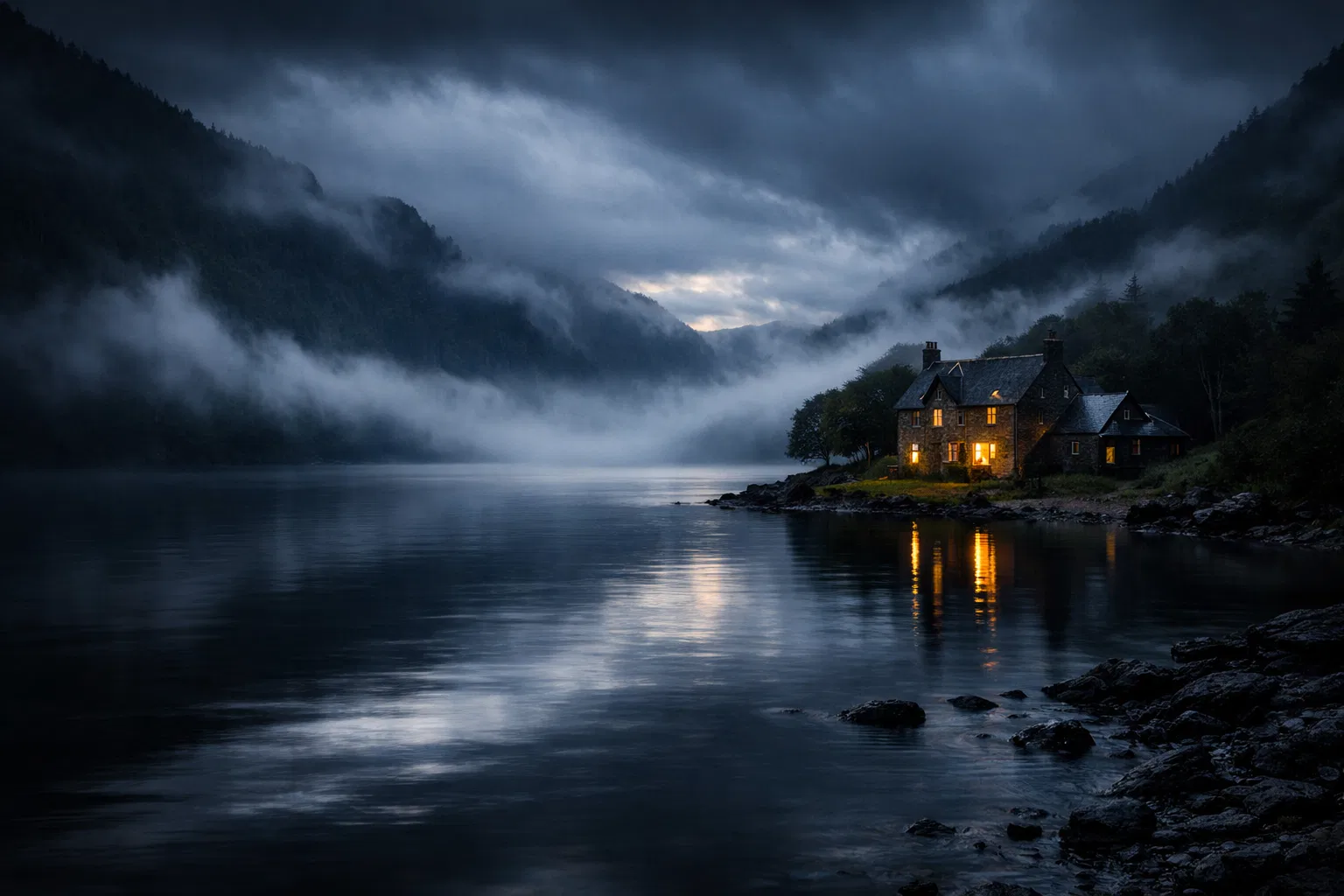
Loch Ness sits in the haunted-history map of Inverness-shire in an unusual position. It is not chiefly known for a white apparition, a ruined castle phantom, or a battlefield revenant. Its supernatural charge comes from water: depth, danger, reflection, poor visibility, sudden weather, and the old suspicion that some bodies of water have wills of their own. The Associated Press, reporting on a modern organised search, described Loch Ness as the largest body of freshwater by volume in the United Kingdom and up to about 750 feet, or 230 metres, deep — exactly the kind of physical setting that helps rumour survive because the place itself feels able to hide things.[AP News]apnews.comOpen source on apnews.com.
That matters for a haunted-county project because “haunting” in Highland tradition often extends beyond dead human spirits. A loch may be haunted by a water horse, a dangerous presence, a warning story, a monstrous shape, or an inherited fear of the edge between land and water. The Scottish Government’s Scotland.org folklore guide defines the kelpie as a supernatural water horse said to haunt Scotland’s lochs and lonely rivers, usually horse-shaped but sometimes capable of human form. It also gives the key narrative pattern: the creature appears as a stray pony, entices a rider, then carries the victim down into a watery grave.[Scotland]scotland.orgScottish myths, folklore and legends | Scotland.orgScottish myths, folklore and legends | Scotland.org…
In that sense, Loch Ness belongs with Inverness-shire’s fairy hills, churchyards and battlefield traditions, but it speaks a different supernatural language. Culloden is haunted by memory of a specific human catastrophe. Boleskine is haunted by biography, occult reputation and later rumour. Loch Ness itself is haunted by uncertainty: the feeling that the surface is only a thin cover over something older.
Kelpies Before the Monster Legend
The kelpie tradition is important because it shows that Loch Ness did not need twentieth-century newspapers to make it uncanny. Long before “Nessie” became a mascot, the loch could be understood through a wider Scottish pattern of water-spirit belief. Kelpies, water-horses and similar beings are not normally “ghosts” in the narrow sense. They are folklore beings attached to hazardous water, especially places where children, travellers or livestock might be tempted too close.
Two details recur across accessible folklore summaries. First, the creature looks familiar enough to lower suspicion: a horse or pony by the water, sometimes dark grey or white, with a dripping mane. Second, the story turns on fatal contact. The victim mounts, touches or approaches the being, and the water takes them. Scotland.org stresses the dripping mane and the fatal ride; the Scottish Maritime Museum adds that kelpies are shape-shifters, most often imagined as black horses with wet manes, and that such stories work as cautionary tales about drowning.[Scotland]scotland.orgScottish myths, folklore and legends | Scotland.orgScottish myths, folklore and legends | Scotland.org…
That cautionary function is easy to underplay if the reader comes to Loch Ness expecting only monster-hunting. A kelpie story is not just a “creature sighting”. It is a practical warning turned into a memorable supernatural image. In rural and Highland settings, deep water, fast streams and cold lochs were real dangers. Folklore gave those dangers a face — or, more often, a horse’s body.
The distinction between kelpie, water-horse and loch monster is not always tidy. The Scottish Maritime Museum notes that some folklorists distinguish fresh-water kelpies from sea- and loch-dwelling water-horses, while also acknowledging that the terms are often treated as interchangeable in popular telling.[Scottish Maritime Museum]scottishmaritimemuseum.orgScottish Maritime Museum Here be Monsters! Sea Monsters of Scottish FolktaleScottish Maritime Museum Here be Monsters! Sea Monsters of Scottish Folktale For Loch Ness, that ambiguity is part of the story. The modern monster is usually imagined as long-necked, reptilian or eel-like, not as a horse. Yet the older pattern — a dangerous being in the water, known by report rather than capture, half-warning and half-wonder — prepared the cultural ground.
St Columba and the River Ness Beast
The story most often presented as the earliest “Loch Ness Monster” account is not actually set in Loch Ness itself, but on the River Ness. In Adomnán’s Life of St Columba, usually dated to the late seventh century, Columba comes upon Picts burying a man said to have been killed by a water beast. When Columba sends a companion into the river, the beast rises again; the saint commands it to go back, and the creature retreats. The University of the Highlands and Islands’ Institute for Northern Studies summarises the episode as a terrifying River Ness account and notes that it is often argued to be the earliest Nessie sighting.[UHI]uhi.ac.ukcolumba, nessie, and the deadly loathsome little creaturescolumba, nessie, and the deadly loathsome little creatures
For haunted-history purposes, the important point is not whether Adomnán recorded a zoological fact. It is how the episode works as a sacred local encounter. The tale is part of a saint’s life, a genre built around miracle, authority and conversion. The beast’s defeat demonstrates Columba’s holiness; the water is a stage on which Christian power overcomes danger. That makes it different from later monster sightings, which depend on ambiguity, eyewitness surprise and the possibility of scientific investigation.
Still, the Columba episode gives Loch Ness folklore a deep historical echo. It ties the wider Ness waters to a medieval tradition of dangerous aquatic beings. It also shows why sceptical and believing readings can both find something of value. A believer may see continuity: a water beast was known in the area from early times. A folklorist may see a mobile miracle motif attached to a dramatic landscape. A local-history reader may simply notice that the River Ness and Loch Ness have been good places to tell supernatural water stories for well over a millennium.
How the Modern Monster Changed the Older Water-Spirit Tradition
The modern Loch Ness Monster story took recognisable public shape in 1933. The Loch Ness Centre stands in the former Drumnadrochit Hotel, where the modern legend is closely associated with manager Aldie Mackay’s reported sighting of a “water beast” in the loch. AP’s account of the 2023 organised search identifies that 1933 report as the point from which enduring worldwide fascination took off, followed by hoaxes, hundreds of eyewitness accounts, and theories ranging from prehistoric reptiles to eels, sturgeon, floating logs and wind effects.[AP News]apnews.comOpen source on apnews.com.
That moment matters because it shifted the tradition from folklore warning to mass-media mystery. Kelpies were moral and practical: beware water, do not trust the attractive creature at the edge. Nessie became investigable: photograph it, scan for it, record it, search for DNA, argue about the evidence. The loch was no longer just a place of inherited fear; it became a public arena where local report, tourism, newspapers, science and scepticism could all meet.
Science has not confirmed a monster. The University of Otago’s 2019 environmental DNA study reported no evidence in its sampled data for a plesiosaur-like reptile, shark, catfish or sturgeon in Loch Ness. It did find eel DNA at almost every location sampled, leaving very large eels as a possibility that could not be ruled out from that data alone, while also stressing that DNA cannot reveal eel size by itself.[University of Otago]otago.ac.nzfirst edna study of loch ness points to something fishyfirst edna study of loch ness points to something fishy
That result is useful because it shows the boundary between folklore and evidence. It does not “solve” every sighting, nor does it validate a monster. It narrows the plausible biological explanations while leaving room for misidentification, surface effects, hoaxes and unusual ordinary animals. In haunted-history terms, it also shows how an old supernatural landscape adapts: the water horse becomes the monster; the monster becomes a DNA question; the DNA question becomes another chapter in the legend.
Boleskine House and Occult Fame
Boleskine House adds a different kind of darkness to the Loch Ness story. The house stands near Foyers on the south-eastern side of the loch, within the historic Inverness-shire frame even though modern local-government labels use Highland. Historic Environment Scotland lists Boleskine House as a Category B listed building, begun in the late eighteenth century and enlarged until about 1830, with a single-storey irregular seven-bay form, pink harling, ashlar dressings and a long internal corridor.[Historic Environment Scotland]portal.historicenvironment.scotOpen source on historicenvironment.scot.
Its haunted reputation, however, rests less on architecture than on ownership and rumour. The Boleskine House Foundation’s own history records that Aleister Crowley bought Boleskine in 1899, and that Led Zeppelin guitarist Jimmy Page, a collector of Crowley material, bought it in 1971. Page sought to remodel the house with a Crowley-like theme, though he spent little time there and relied on others to look after it.[Boleskine House]boleskinehouse.orghistoryhistory
Crowley’s connection is the engine of the modern legend. He was not merely an eccentric owner in local memory; he was a writer, occultist and ceremonial magician whose reputation made Boleskine a destination for people interested in esoteric history. STV reported in 2026 that Crowley bought the house in 1899 partly for seclusion while pursuing occult ritual work, and that the building later became a global pilgrimage point for people drawn to that reputation.[STV News]news.stv.tvOpen source on stv.tv.
This is where Boleskine differs from older Inverness-shire hauntings. Culloden’s ghosts arise from mass death and national trauma. Loch Ness water spirits arise from danger, depth and inherited supernatural ecology. Boleskine’s fame is modern, biographical and media-amplified. It is a house whose atmosphere has been shaped by who owned it, what they were believed to have done there, and how later music culture, occult tourism and local rumour turned those facts into legend.

What Is Actually Said to Haunt Boleskine?
The Boleskine stories usually mix three ingredients: older graveyard unease, Crowley’s ritual reputation, and later witness claims from people linked to Jimmy Page’s ownership. They should be treated as claims and traditions, not as verified events. Their value is that they show how a real listed house on Loch Ness became a modern haunted landmark.
One widely repeated thread concerns the nearby burial ground and older sacred landscape. Historic Environment Scotland separately records the site of Boleskine Parish Church before 1777 on a steeply sloping site on the shores of Loch Ness, and records the parish church and burial ground as a listed historic place.[Historic Environment Scotland]portal.historicenvironment.scotHistoric Environment Scotland Listed BuildingHistoric Environment Scotland Listed Building This matters because haunted-house legends often intensify when a domestic building stands close to a burial ground, former church site or older consecrated landscape. It does not prove paranormal activity, but it helps explain why stories of restless presences found such an easy home there.
Another thread belongs to the Page era. Popular music and rock-history accounts preserve claims from caretakers and visitors: strange rumblings, doors and furniture behaving oddly, a frightening animal-like presence outside a bedroom door, and stories attached to a rolling severed head. Louder Sound, previewing the house’s public opening, repeated the head-rolling legend and the house’s association with Page and Crowley, while also noting the restoration after the 2015 and 2019 fires.[Louder]loudersound.comCrowley bought the remote property in 1899 to conduct occult rituals, while Page, inspired by Crowley's mysticism, purchased it in 1971 b… These are colourful stories, but they are not the same kind of evidence as a dated official record. They belong to the folklore of the house: memorable, repeatable, shaped by setting and reputation.
The strongest sceptical reading is simple. Once a remote Loch Ness house is associated with Aleister Crowley, a churchyard, a famous rock musician and destructive fires, almost any creak, bad dream or odd noise can be folded into a larger narrative. The strongest folklore reading is equally simple: Boleskine shows how modern haunted places are made. They do not need centuries of ghost reports. They need a charged location, a set of dramatic owners, a few vivid anecdotes, and a public ready to connect the dots.
Fire, Restoration and the Public Afterlife of the Legend
Boleskine’s recent history has made its legend more visible rather than less. The Guardian reported that a major blaze in December 2015 destroyed about 60 per cent of the building by the time fire crews arrived, at a house already famous for Crowley and Jimmy Page.[The Guardian]theguardian.comOpen source on theguardian.com. The Boleskine House Foundation states that the 2015 fire rendered the property uninhabitable, that it was put on the market in April 2019, purchased that July, and then placed into the care of the charity for long-term restoration.[Boleskine House]boleskinehouse.orgBoleskine House Discover Boleskine Estate's StoryBoleskine House Discover Boleskine Estate's Story
The restoration creates an interesting tension for haunted-history readers. A ruin can feel more frightening because it looks abandoned to decay. A restored house, by contrast, becomes visitable, interpretable and managed. That can soften the ghost-story atmosphere, but it can also make the legend easier to understand responsibly. Boleskine is no longer only a rumoured occult ruin glimpsed from the road or discussed in rock-music lore; it is a heritage site whose owners must balance architecture, conservation, local history, visitor curiosity and the unavoidable Crowley myth.
Recent reporting shows that this balance remains contested. The Times reported in 2026 that the foundation presented the restored property as a secular educational centre for Highland history and conservation, while critics questioned whether occult associations were being downplayed or revived.[The Times]thetimes.comSledge, a YouTuber specializing in esoteric studies, served time in jail in 2003 for assembling an unregistered firearm and was previousl… That dispute is part of Boleskine’s public afterlife. The haunting here is not only a matter of apparitions; it is also a struggle over interpretation. Is the house mainly a listed Highland building, an occult pilgrimage site, a rock-history landmark, a local curiosity, or a haunted stop on the Loch Ness imagination trail? The answer depends on who is telling the story.
Tourism, Rumour and Folklore Boundaries
Loch Ness is one of the clearest examples in Inverness-shire of folklore becoming tourism without losing all of its older force. The monster draws visitors, webcams, organised searches, museums and media attention. AP described a 2023 search using thermal-imaging drones, infrared cameras and a hydrophone, with volunteers watching from boats, shore and webcams; at the same time, the report noted ordinary explanations such as floating logs, strong winds, pranks and natural behaviour on the loch.[AP News]apnews.comOpen source on apnews.com.
That is the right boundary to keep. Loch Ness should not be flattened into either “it is all nonsense” or “the monster is real”. The more interesting truth is cultural. People keep watching the water because it is deep, dark, famous and unresolved. Scientific surveys can reduce the likelihood of some explanations. They cannot remove the atmosphere that made people look in the first place.
Boleskine works the same way. Its fires, owners and occult associations are real historical material; its demons, head-rolling sounds and oppressive presences are better treated as legend, witness claim or rumour. To present them as fact would weaken the story rather than strengthen it. The house is most compelling when seen as a meeting point between documented heritage and modern myth-making.
For a visitor following Inverness-shire’s haunted places, the best reading is comparative. Culloden asks how a battlefield becomes a place of heard cries and anniversary dread. The Old High Church traditions in Inverness ask how civic punishment and Jacobite memory become urban haunting. Loch Ness asks how dangerous water becomes a monster tradition. Boleskine asks how a house becomes occultly famous when biography, architecture, burial ground, celebrity and rumour all converge on one shore.

What Haunts the Dark Water of Loch Ness?
What “haunts” Loch Ness is not one thing. It is a sequence of forms laid over the same landscape. The oldest layer is the dangerous water being: kelpie, water-horse, drowning warning, threshold spirit. The medieval Christian layer is the River Ness beast subdued by St Columba, a miracle story that later readers could connect to the monster tradition. The modern layer is Nessie, born into mass attention in 1933 and sustained by photographs, hoaxes, sightings, searches and sceptical explanations. The Boleskine layer is land-based but inseparable from the loch’s atmosphere: a restored house whose occult and rock-history associations keep pulling visitors toward the darker side of Loch Ness fame.
That layered reading keeps the page inside Inverness-shire’s haunted-history frame without forcing every story to behave like a conventional ghost account. Loch Ness is not merely a monster site, and Boleskine is not merely an “evil house”. They are places where folklore changes costume. A water horse becomes a cryptid. A saint’s miracle becomes a monster prehistory. An eighteenth-century house becomes a modern occult landmark. The haunting is the persistence of the question itself: what, if anything, waits below the surface, and why do people keep needing to imagine that something does?
Amazon book picks
Further Reading
Books and field guides related to What Haunts the Dark Water of Loch Ness?. Use these as the next step if you want deeper reading beyond the article.

eBay marketplace picks
Marketplace Samples
Live-tested eBay searches with available results related to this page.
Endnotes
1.
Source: scotland.org
Title: Scottish myths, folklore and legends | Scotland.org
Link:https://www.scotland.org/inspiration/scottish-myths-folklore-and-legends
Source snippet
Scottish myths, folklore and legends | Scotland.org...
2.
Source: uhi.ac.uk
Title: columba, nessie, and the deadly loathsome little creatures
Link:https://www.uhi.ac.uk/en/research-enterprise/cultural/institute-for-northern-studies/blogs–exhibitions/old-mimirs-well-articles/columba%2C-nessie%2C-and-the-deadly-loathsome-little-creatures/
3.
Source: news.stv.tv
Link:https://news.stv.tv/highlands-islands/how-loch-ness-mansion-owned-by-aleister-crowley-and-jimmy-page-became-global-pilgrimage-site-for-occultists
4.
Source: apnews.com
Link:https://apnews.com/article/d07af6dff2138e2198f5d33c76442577
5.
Source: boleskinehouse.org
Title: Boleskine House Discover Boleskine Estate’s Story
Link:https://boleskinehouse.org/history
6.
Source: scottishmaritimemuseum.org
Title: Scottish Maritime Museum Here be Monsters! Sea Monsters of Scottish Folktale
Link:https://www.scottishmaritimemuseum.org/here-be-monsters-sea-monsters-of-scottish-folktale-by-shelby-judge/
7.
Source: otago.ac.nz
Title: first edna study of loch ness points to something fishy
Link:https://www.otago.ac.nz/news/newsroom/first-edna-study-of-loch-ness-points-to-something-fishy
8.
Source: portal.historicenvironment.scot
Link:https://portal.historicenvironment.scot/apex/f?p=1505%3A300%3A%3A%3A%3A%3AVIEWTYPE%2CVIEWREF%3Adesignation%2CLB1849
10.
Source: portal.historicenvironment.scot
Title: Historic Environment Scotland Listed Building
Link:https://portal.historicenvironment.scot/apex/f?p=1505%3A300%3A%3A%3A%3A%3AVIEWTYPE%2CVIEWREF%3Adesignation%2CLB1847
11.
Source: portal.historicenvironment.scot
Link:https://portal.historicenvironment.scot/apex/f?p=1505%3A300%3A%3A%3A%3A%3AVIEWTYPE%2CVIEWREF%3Adesignation%2CLB1846
12.
Source: loudersound.com
Link:https://www.loudersound.com/bands-artists/jimmy-page-aleister-crowleyboleskine-house-opening
Source snippet
Crowley bought the remote property in 1899 to conduct occult rituals, while Page, inspired by Crowley's mysticism, purchased it in 1971 b...
13.
Source: theguardian.com
Link:https://www.theguardian.com/uk-news/2015/dec/23/blaze-destroys-most-of-mansion-once-owned-by-jimmy-page
14.
Source: thetimes.com
Link:https://www.thetimes.com/uk/scotland/article/boleskine-house-aleister-crowley-occult-69n825vg8
Source snippet
Sledge, a YouTuber specializing in esoteric studies, served time in jail in 2003 for assembling an unregistered firearm and was previousl...
15.
Source: Wikipedia
Title: Loch Ness Monster
Link:https://en.wikipedia.org/wiki/Loch_Ness_Monster
16.
Source: Wikipedia
Link:https://en.wikipedia.org/wiki/Loch
17.
Source: Wikipedia
Link:https://en.wikipedia.org/wiki/Kelpie
18.
Source: Wikipedia
Title: Boleskine House
Link:https://en.wikipedia.org/wiki/Boleskine_House
19.
Source: portal.historicenvironment.scot
Link:https://portal.historicenvironment.scot/apex/f?p=1505%3A300%3A%3A%3A%3A%3AVIEWTYPE%2CVIEWREF%3Adesignation%2CLB1854
20.
Source: portal.historicenvironment.scot
Link:https://portal.historicenvironment.scot/apex/f?p=1505%3A300%3A%3A%3A%3A%3AVIEWTYPE%2CVIEWREF%3Adesignation%2CLB1852
21.
Source: portal.historicenvironment.scot
Link:https://portal.historicenvironment.scot/apex/f?p=1505%3A300%3A%3A%3A%3A%3AVIEWTYPE%2CVIEWREF%3Adesignation%2CLB1867
22.
Source: portal.historicenvironment.scot
Link:https://portal.historicenvironment.scot/apex/f?p=1505%3A300%3A%3A%3A%3A%3AVIEWTYPE%2CVIEWREF%3Adesignation%2CSM9762
23.
Source: portal.historicenvironment.scot
Link:https://portal.historicenvironment.scot/apex/f?p=1505%3A300%3A%3A%3A%3A%3AVIEWTYPE%2CVIEWREF%3Adesignation%2CLB1874
24.
Source: historicenvironment.scot
Link:https://www.historicenvironment.scot/
25.
Source: boleskinehouse.org
Link:https://boleskinehouse.org/
26.
Source: boleskinehouse.org
Link:https://boleskinehouse.org/archives/9194
27.
Source: boleskinehouse.org
Link:https://boleskinehouse.org/archives/23354
28.
Source: boleskinehouse.org
Link:https://boleskinehouse.org/support-for-boleskine-house-restoration-received-from-historic-environment-team-of-the-highland-council/
29.
Source: facebook.com
Link:https://www.facebook.com/boleskine.house.foundation/posts/boleskine-house-then-and-now-this-was-boleskine-during-jimmypages-ownership-and-/1227981106158504/
30.
Source: instagram.com
Link:https://www.instagram.com/p/DQRETieDwNL/?hl=en
31.
Source: trove.scot
Link:https://www.trove.scot/place/12570
32.
Source: reddit.com
Title: Boleskine House, Loch ness
Link:https://www.reddit.com/r/Paranormal/comments/6e7nor/boleskine_house_loch_ness_aleister_crowleys_house/
33.
Source: lochness.com
Link:https://lochness.com/about/
34.
Source: tripadvisor.com
Title: Boleskine House
Link:https://www.tripadvisor.com/Attraction_Review-g186543-d17420829-Reviews-Boleskine_House-Inverness_Scottish_Highlands_Scotland.html
35.
Source: localenergy.scot
Link:https://localenergy.scot/casestudy/boleskine-house/
36.
Source: icysedgwick.com
Title: loch ness monster
Link:https://www.icysedgwick.com/loch-ness-monster/
37.
Source: scotlandswild.com
Title: The Loch Ness Monster
Link:https://www.scotlandswild.com/experience-scotlands-wild-blog-posts/the-story-of-the-loch-ness-monster
38.
Source: mapeffects.co
Link:https://www.mapeffects.co/tutorials/kelpie
39.
Source: scotlands-stories.com
Title: Traditional Scottish Kelpie Legends
Link:https://scotlands-stories.com/scottish-kelpie-legends/
40.
Source: atlasobscura.com
Title: boleskine house
Link:https://www.atlasobscura.com/places/boleskine-house
41.
Source: highlandguide.co.uk
Link:https://highlandguide.co.uk/locations/boleskine-house/
Additional References
42.
Source: researchgate.net
Link:https://www.researchgate.net/publication/390620130_The_Loch_Ness_Monster_If_It%27s_Real_Could_It_Be_an_Eel
43.
Source: academia.edu
Link:https://www.academia.edu/20769667/The_monster_in_the_river_Ness_in_Vita_Sancti_Columbae_a_study_of_a_miracle
44.
Source: visitscotland.com
Link:https://www.visitscotland.com/things-to-do/landscapes-nature/lochs
45.
Source: thelasttuesdaysociety.org
Link:https://thelasttuesdaysociety.org/event/the-centre-of-a-thousand-legends-a-brief-history-of-boleskine-house-and-aleister-crowley-dr-andrew-wiseman/
46.
Source: ebay.com
Link:https://www.ebay.com/itm/227289736562?mkevt=1&mkcid=1&mkrid=710-53481-19255-0&campid=5339151051&customid=endnote-source&toolid=10001
47.
Source: facebook.com
Link:https://www.facebook.com/groups/837602803572207/posts/1512932539372560/
48.
Source: imdb.com
Link:https://www.imdb.com/title/tt1674855/
49.
Source: instagram.com
Link:https://www.instagram.com/reel/DQkEOMUE0Dw/
50.
Source: tripadvisor.co.uk
Link:https://www.tripadvisor.co.uk/Attraction_Review-g186543-d17420829-Reviews-Boleskine_House-Inverness_Scottish_Highlands_Scotland.html
51.
Source: facebook.com
Link:https://www.facebook.com/groups/141086595460/posts/10161386679695461/
Topic Tree