Within Haunted Pembrokeshire
Why Does St Govan's Chapel Feel Haunted?
St Govan's Chapel is less a ghost story than a haunted coastal legend of pirates, storm, saintly protection and a bell in the rock.
On this page
- The saint, the pirates and the magic bell
- The chapel steps and the rock legend
- Coastal danger, pilgrimage and haunted atmosphere
Page outline Jump by section
Introduction
St Govan’s Chapel feels haunted because its legend turns a real cliff-edge place into a story about pursuit, refuge and warning. The small medieval chapel is tucked into the limestone cliffs near Bosherston, on the south Pembrokeshire coast, where visitors descend rough stone steps into a narrow cleft above the sea. The tradition is not mainly a ghost story in the usual sense. Its eeriness comes from sacred danger: a saint chased by pirates, a rock opening to save him, a bell stolen and returned by angels, a wish-making cleft, curative water, and a coastal path where the modern warning signs are sometimes as serious as the old legends.[coflein.gov.uk]coflein.gov.ukDetails | 95059 | Sites | CofleinSt Govan's Chapel is a medieval pilgrimage chapel situated within a rocky gorge on the sea-coast…
That is why St Govan’s belongs in Pembrokeshire’s haunted history even without a recurring apparition. Like Carew Castle or the county’s roadside ghost traditions, it attaches fear to a specific visible place. Here the fear is older and more elemental: the sea below, pirates offshore, illness brought to a holy well, a body squeezed into stone, and the uneasy feeling that the chapel is both sanctuary and trap.
Why the chapel feels haunted without needing a ghost
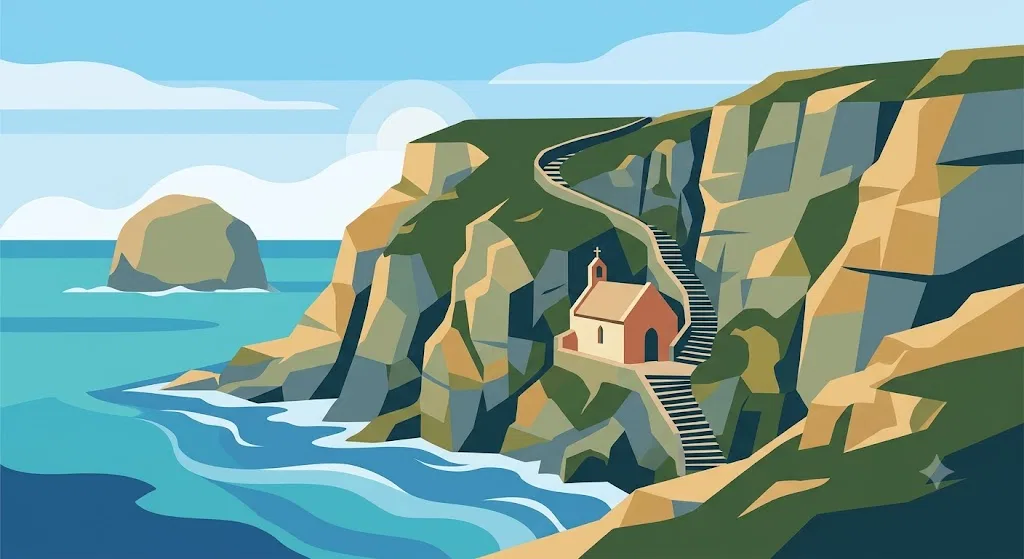
St Govan’s Chapel is often described as a hermit’s cell built into the cliff rather than as a conventional church. Coflein, the online record of the Royal Commission on the Ancient and Historical Monuments of Wales, identifies it as a medieval pilgrimage chapel within a rocky sea-coast gorge, reached by around 50 stone steps in the limestone cliff. The same record says the late medieval building may stand on the site of an early medieval hermitage and was once a dependent chapelry of St Michael and All Angels, Bosherston.[Coflein]coflein.gov.ukDetails | 95059 | Sites | CofleinSt Govan's Chapel is a medieval pilgrimage chapel situated within a rocky gorge on the sea-coast…
The atmosphere begins with that setting. The visitor does not simply walk into a churchyard; they go down from the clifftop into a fissure where the building almost disappears into the rock. Cadw’s listed building report places the chapel below the sea cliffs, about 1 kilometre west of St Govan’s Head, and records it as Grade I, the highest listed-building grade in Wales. It also notes that services are still occasionally held there, so the site is not only picturesque ruin or folklore theatre; it retains a religious afterlife.[Cadw Public API]cadwpublic-api.azurewebsites.netCadw Public APIFull Report for Listed BuildingsCadw Public APIFull Report for Listed Buildings
The result is a different kind of haunting. There is no need for a named white lady at a window or a phantom monk crossing the floor. St Govan’s makes the landscape itself behave like a supernatural witness. The cleft remembers the saint’s body. The rock holds the bell. The steps refuse to be counted properly. The well was once sought for cures. The place feels animated because each feature has been turned into evidence of an invisible event.

The saint, the pirates and the magic bell
The best-known version of the legend says that St Govan was a holy man of the 5th or 6th century who was walking along the south Pembrokeshire coast when pirates pursued him. As he fled, a cleft opened in the cliff and allowed him to hide; the space was so tight, in the National Park’s telling, that the marks of his ribs can still be seen in the rock. After the pirates had gone, the cleft opened again, and St Govan chose to remain there as a hermit, living on fish and water from a sacred spring nearby.[Pembrokeshire Coast National Park]pembrokeshirecoast.walesPembrokeshire Coast National ParkSt Govan's ChapelTucked into the cliffs on the Castlemartin Range, St Govan's Chapel is a great place to…
This is the central mechanism of the story: danger creates holiness. The saint is not shown conquering the pirates by force. He survives by being absorbed into the cliff. The coastal landscape becomes a protector, and the chapel later fixes that moment in stone. For a haunted-history page, this matters because the legend explains why the place feels uncanny. The rocks are not just scenery; they are treated as participants in the story.
The bell legend extends the same idea. St Govan is said to have owned a magic bell, probably used to warn others when pirates returned. The pirates stole it, but a storm wrecked their ship; angels recovered the bell and placed it inside a great rock so it could not be stolen again. After that, when St Govan struck the rock in time of need, it sounded louder than the original bell. The Pembrokeshire Coast National Park’s “Land of Legends” account still points visitors towards “bell rock” as a visible survival of the tale.[Pembrokeshire Coast National Park]pembrokeshirecoast.walesPembrokeshire Coast National ParkSt Govan's ChapelTucked into the cliffs on the Castlemartin Range, St Govan's Chapel is a great place to…
The bell is important because it turns a frightening coastal memory into a warning system. In a county shaped by seaborne threat, wreck, weather and exposed settlements, the sound of danger matters. Whether or not the story preserves any specific memory of raiding, it captures a realistic fear: trouble could come from the sea, and the difference between safety and disaster might be early warning.
The chapel steps and the rock legend
One reason St Govan’s has become locally famous is that the legend is easy to test. Visitors are told to count the steps down and then count them again on the way back up; tradition says the number will not be the same. Visit Pembrokeshire repeats this as part of the site’s public-facing visitor identity, while the National Park’s St Govan’s Head walk also notes the belief that the steps differ between descent and return.[Visit Pembrokeshire]visitpembrokeshire.comOpen source on visitpembrokeshire.com.
There is a simple sceptical explanation: rough steps, uneven rhythm, distraction, fatigue, and the different experience of climbing rather than descending can all alter a casual count. But that is precisely why the legend works. It does not depend on a spectacular apparition. It turns an ordinary visitor action into a small ritual, and the landscape seems to answer back.
The rock cleft has its own folklore. The National Park version says a wish made while standing in the cleft may come true, provided the person does not change their mind before turning around. Pembrokeshire Historical Society’s detailed discussion of St Govan’s Well notes that earlier accounts include several variants of the cell tradition: St Govan, Jesus, or another sacred figure hiding in the cavity; rib-like impressions in the rock; and a wish granted if the person can squeeze in and turn around while making it.[Pembrokeshire Coast National Park]pembrokeshirecoast.walesPembrokeshire Coast National ParkSt Govan's ChapelTucked into the cliffs on the Castlemartin Range, St Govan's Chapel is a great place to…
These details give St Govan’s its “haunted” feel. The chapel asks the body to participate. The visitor counts, descends, squeezes, turns, looks for marks, listens for the imagined bell, and stands between chapel wall and cliff face. Many ghost stories are watched from a distance. St Govan’s is felt through awkward movement, narrow space and the awareness of rock pressing close.

Coastal danger, pilgrimage and haunted atmosphere
The sacred danger at St Govan’s was not only about pirates. It was also about illness, healing and the difficult journey down to the well. Coflein records that the chapel was known for miraculous cures of lameness and eye diseases, while Pembrokeshire Historical Society traces a long history of accounts describing sick visitors using the water, clay or mud associated with the chapel and well.[Coflein]coflein.gov.ukDetails | 95059 | Sites | CofleinSt Govan's Chapel is a medieval pilgrimage chapel situated within a rocky gorge on the sea-coast…
The historian Richard Fenton, writing in the early 19th century, is especially useful because he treated the claims sceptically while still preserving evidence that people came in hope of cures. Pembrokeshire Historical Society summarises his 1807 account of visitors bathing limbs at the well and leaving crutches in the chapel as votive offerings. Fenton doubted that the water itself caused cures, suggesting instead that air, diet, exercise and changed habits might explain recoveries. That scepticism is valuable: it shows that the healing reputation was already established, but also contested, by the early 1800s.[Pembrokeshire Historical Society]pembrokeshirehistoricalsociety.co.ukOpen source on pembrokeshirehistoricalsociety.co.uk.
This makes the chapel more complex than a romantic beauty spot. In its pilgrimage tradition, people came with pain, disability, failing sight and desperation. Some accounts mention water used for “all diseases”, others focus on eyes, lameness, rheumatism or clay applied to the body. The exact rituals varied, and the evidence is a mixture of antiquarian observation, local report and later interpretation, but the pattern is clear: St Govan’s was remembered as a place where bodily danger met sacred hope.[Pembrokeshire Historical Society]pembrokeshirehistoricalsociety.co.ukOpen source on pembrokeshirehistoricalsociety.co.uk.
That helps explain the chapel’s peculiar mood. The haunting is not only fear of pirates. It is the memory of vulnerable bodies being carried or helped down steep steps to a cramped place above the sea, seeking relief where medicine, poverty and faith overlapped. For modern visitors, the well may be a curiosity; for earlier pilgrims, it could have represented a last refuge.
What is historically secure, and what is folklore?
The secure facts are modest but strong. There is a real medieval chapel at St Govan’s Head, built into a limestone cliff near Bosherston. It is recorded by Coflein as a medieval pilgrimage chapel, probably late medieval but possibly on the site of an early medieval hermitage. Cadw lists it as Grade I, with a formal designation date of 8 February 1996.[Coflein]coflein.gov.ukDetails | 95059 | Sites | CofleinSt Govan's Chapel is a medieval pilgrimage chapel situated within a rocky gorge on the sea-coast…
The identity of St Govan is less secure. The National Church Trust presents the common tradition that he was an Irish monk from Wexford and links him with a 5th- or 6th-century saintly foundation. Other traditions associate him with Arthurian material, including Sir Gawain, but those identifications belong to legend and later interpretation rather than firm biography.[National Churches Trust]nationalchurchestrust.orgOpen source on nationalchurchestrust.org.
The pirate story, bell rock, rib marks, wishing cleft and uncountable steps should therefore be read as folklore attached to a genuine sacred site, not as documented events. Their value is not that they prove supernatural intervention. Their value is that they show how Pembrokeshire people and visitors made sense of an extreme place: a chapel below the cliffs, exposed to the Atlantic, reached by a descent that feels like entering the earth.
The healing tradition sits somewhere between folklore and social history. The cures themselves cannot be verified in the way a medical record could be verified, but the use of the site by sick visitors is better evidenced through antiquarian accounts, including Fenton’s sceptical observations and later summaries of well traditions. That makes St Govan’s a good example of how haunted and sacred history often overlap: the doubtful miracle may be unprovable, while the human behaviour around it is historically revealing.[Pembrokeshire Historical Society]pembrokeshirehistoricalsociety.co.ukOpen source on pembrokeshirehistoricalsociety.co.uk.

Why modern danger reinforces the old story
St Govan’s still carries a real danger that sharpens the folklore. The chapel sits within the Castlemartin Range area, and access can be restricted when military training is taking place. Visit Pembrokeshire warns that the road to St Govan’s passes through an MOD army tank range and is closed at certain times, while the National Park’s St Govan’s Head walk advises that the route is closed when the range is in use.[Visit Pembrokeshire]visitpembrokeshire.comOpen source on visitpembrokeshire.com.
The Ministry of Defence’s Castlemartin firing notices are blunt. They warn visitors not to cross the range boundary when red flags or red lamps are displayed, not to enter the danger area when it is in use, and not to touch military debris because it may be dangerous. A June 2026 notice specifically listed closures affecting the road from Bosherston to St Govan’s Chapel and the footpath from St Govan’s Head to Broadhaven on firing days.[GOV.UK]GOV.UKcastlemartin firing notice june 202623 Jun 2026 — Castlemartin Range Complex Firing times. Govan's Chapel. Govan's Chapel. Learn more about accessing MOD training areas safe…
This modern layer does not belong to the medieval legend, but it intensifies the site’s atmosphere. St Govan’s is still a place where access depends on warnings. The old story imagines a bell sounding against pirates; the modern visitor checks firing notices, red flags and closed roads. The mechanism is oddly similar: safety depends on reading signs before entering a beautiful but hazardous coast.
There is also ordinary coastal risk. The chapel steps are steep and rough, the surrounding cliffs are exposed, and the sea below gives the place much of its drama. That physical unease is part of the experience. The story feels plausible not because rocks literally open on command, but because the visitor can understand why a person might seek shelter there, why a bell would matter, and why the cliff could feel both protective and threatening.
How St Govan’s fits Pembrokeshire’s haunted map
In Pembrokeshire’s wider haunted geography, St Govan’s Chapel is the coastal-sacred counterpart to castle ghosts and roadside apparitions. Carew Castle offers named spectres and family legends; the Waterston Lady belongs to road and death-omen tradition; St Govan’s belongs to cliff, pilgrimage and warning. Its power is not in a single ghostly sighting but in the way every feature of the place seems to carry a story.
It also shows why “haunted” history in Pembrokeshire should not be limited to apparitions. Some places are haunted by repeated reports of figures or sounds. Others are haunted by ritual memory: the story everyone tells when they reach the steps, the rock they point out, the wish they half-make, the danger notice they check before entering. St Govan’s Chapel is the second kind of haunted place.
The most credible reading is therefore neither dismissive nor gullible. The chapel is a real medieval pilgrimage site in a dramatic cliff setting. Its saintly biography is uncertain. Its pirate and bell legends are folklore. Its healing reputation is historically attested but not medically proven. Its modern access dangers are official and practical. Together, those layers make St Govan’s one of Pembrokeshire’s most atmospheric sacred legends: a place where sanctuary, fear and the sea meet in stone.
Amazon book picks
Further Reading
Books and field guides related to Why Does St Govan's Chapel Feel Haunted?. Use these as the next step if you want deeper reading beyond the article.

The Mammoth Book of Celtic Myths and Legends
Supports themes of saints, legend and sacred landscapes.


The Penguin Book of Ghost Stories
First published 2010. Subjects: Fiction, Literature, Ghost stories, English Ghost stories, English fiction.
eBay marketplace picks
Marketplace Samples
Live-tested eBay searches with available results related to this page.




Endnotes
1.
Source: coflein.gov.uk
Link:https://coflein.gov.uk/en/sites/95059
Source snippet
Details | 95059 | Sites | CofleinSt Govan's Chapel is a medieval pilgrimage chapel situated within a rocky gorge on the sea-coast...
2.
Source: GOV.UK
Title: castlemartin firing notice june 2026
Link:https://www.gov.uk/government/publications/castlemartin-firing-notice–2/castlemartin-firing-notice-june-2026
Source snippet
23 Jun 2026 — Castlemartin Range Complex Firing times. Govan's Chapel. Govan's Chapel. Learn more about accessing MOD training areas safe...
Published: june 2026
3.
Source: cadwpublic-api.azurewebsites.net
Title: Cadw Public APIFull Report for Listed Buildings
Link:https://cadwpublic-api.azurewebsites.net/reports/listedbuilding/FullReport?id=17980
4.
Source: datamap.gov.wales
Title: Data Map Wales Listed Buildings | Data Map Wales
Link:https://datamap.gov.wales/layers/inspire-wg%3ACadw_ListedBuildings
5.
Source: GOV.UK
Link:https://www.gov.uk/government/publications/castlemartin-firing-notice–2
6.
Source: cadw.gov.wales
Title: wales Understanding listing | Cadw
Link:https://cadw.gov.wales/advice-support/historic-assets/listed-buildings/understanding-listing
7.
Source: cadw.gov.wales
Title: wales Understanding Listing in Wales
Link:https://cadw.gov.wales/sites/default/files/2019-05/Understanding%20Listing%20in%20Wales.pdf
8.
Source: cadw.gov.wales
Link:https://cadw.gov.wales/advice-support/cof-cymru/search-cadw-records
9.
Source: cadw.gov.wales
Title: wales Managing Change to Listed Buildings in Wales
Link:https://cadw.gov.wales/sites/default/files/2024-09/1Managing%20Change%20to%20Listed%20Buildings%20in%20Wales%2024303%20EN.pdf
10.
Source: coflein.gov.uk
Link:https://coflein.gov.uk/en/sites/32502?simpleTerm=hillfort&sort_ord=asc&sort_typ=classsub&submit=Search&z=360
11.
Source: coflein.gov.uk
Link:https://coflein.gov.uk/en/sites/100610
12.
Source: assets.publishing.service.gov.uk
Link:https://assets.publishing.service.gov.uk/media/66dad331fb86ba5a1f214efd/Castlemartin.pdf
13.
Source: insidedio.blog.gov.uk
Title: blog.gov.uk Behind-the-scenes at Castlemartin Training Area
Link:https://insidedio.blog.gov.uk/2016/08/15/behind-the-scenes-at-castlemartin-training-area/
14.
Source: walescoastpath.gov.uk
Title: Walks to explore the area
Link:https://www.walescoastpath.gov.uk/places-to-go/pembrokeshire/walks-to-explore-the-area-in-pembrokeshire/?lang=en
15.
Source: pembrokeshirecoast.wales
Link:https://www.pembrokeshirecoast.wales/about-the-national-park/culture-and-heritage/land-of-legends/st-govans-chapel/
Source snippet
Pembrokeshire Coast National ParkSt Govan's ChapelTucked into the cliffs on the Castlemartin Range, St Govan's Chapel is a great place to...
16.
Source: pembrokeshirecoast.wales
Link:https://www.pembrokeshirecoast.wales/things-to-do/access-for-all/walks-for-all/st-govans-head/
17.
Source: visitpembrokeshire.com
Link:https://www.visitpembrokeshire.com/attraction-listing/st-govans-chapel
18.
Source: pembrokeshirehistoricalsociety.co.uk
Link:https://www.pembrokeshirehistoricalsociety.co.uk/famous-cure-diseases-st-govans-well-350-years/
19.
Source: nationalchurchestrust.org
Link:https://www.nationalchurchestrust.org/church/st-govan-chapel-bosherston
20.
Source: pembrokeshirecoast.wales
Link:https://www.pembrokeshirecoast.wales/things-to-do/access-for-all/walks-for-all/stack-rocks-to-st-govans/
21.
Source: pembrokeshirecoast.wales
Link:https://www.pembrokeshirecoast.wales/planning/building-conservation/listed-buildings/
22.
Source: pembrokeshirecoast.wales
Link:https://www.pembrokeshirecoast.wales/wp-content/uploads/2022/04/Climbing-eng.pdf
Additional References
23.
Source: youtube.com
Title: St Govan’s
Link:https://www.youtube.com/watch?v=UEvXpdfCt3Q
Source snippet
The Legend of a Saint and the Pirates Who Chased Him: St Govan's Chapel and Lawrenny Mud Flats...
24.
Source: youtube.com
Link:https://www.youtube.com/watch?v=IOKdnwl0w5k
Source snippet
Mysterious St Govan's Chapel Hidden In The Cliffs Of South Pembrokeshire Wales...
25.
Source: youtube.com
Title: Mysterious St Govan’s Chapel Hidden In The Cliffs Of South Pembrokeshire Wales
Link:https://www.youtube.com/watch?v=MenM8cwlq5I
Source snippet
The Hidden Chapel of St Govan on the Pembrokeshire Coast, Wales...
26.
Source: youtube.com
Title: The Hidden Chapel of St Govan on the Pembrokeshire Coast, Wales
Link:https://www.youtube.com/watch?v=4aD7o8c4U0s
Source snippet
St Govan's Chapel Walk | A Hidden Cliffside Landmark in Wales...
27.
Source: facebook.com
Link:https://www.facebook.com/BBCWalesNews/posts/if-you-are-brave-enough-to-tackle-uncountable-steps-carved-into-a-cliffside-youl/794863912682675/
28.
Source: st.com
Link:https://www.st.com/content/st_com/en.html
29.
Source: merriam-webster.com
Link:https://www.merriam-webster.com/dictionary/st
30.
Source: collinsdictionary.com
Link:https://www.collinsdictionary.com/dictionary/english/st
31.
Source: tripadvisor.co.uk
Link:https://www.tripadvisor.co.uk/Attraction_Review-g1474995-d544260-Reviews-St_Govan_s_Chapel-Stackpole_Pembroke_Pembrokeshire_Wales.html
32.
Source: tripadvisor.com
Link:https://www.tripadvisor.com/Attraction_Review-g1474995-d544260-Reviews-St_Govan_s_Chapel-Stackpole_Pembroke_Pembrokeshire_Wales.html
Topic Tree