Within Haunted Londonderry
Why Is Springhill's Ghost Called Friendly?
Springhill's grey lady tradition links a Plantation-era house with grief, children, wartime memory and National Trust preservation.
On this page
- Olivia Lenox Conyngham and the house
- The Blue Room, staircase and nursery
- Family grief, wartime stories and later retellings
Page outline Jump by section
Introduction
Springhill House near Moneymore is one of County Londonderry’s most memorable haunted-house traditions because its ghost is not usually described as threatening. The figure most often named is Olivia Lenox-Conyngham, second wife of George Lenox-Conyngham, whose death at Springhill in November 1816 became the emotional centre of the story. Visitors and retellings associate her with the Blue Room, the staircase and the nursery: not as a vengeful spirit, but as a watchful, anxious presence still tied to husband, children and household duty. The result is a rare kind of country-house haunting, where grief and family memory matter more than horror. Springhill’s setting also matters: the National Trust describes it as a late seventeenth-century Plantation-era house in County Londonderry, home to generations of the Conyngham and Lenox-Conyngham family before its preservation in the twentieth century.[National Trust]nationaltrust.org.ukhistory of springhill house and estateNational TrustHistory of Springhill House and EstateBuilt in the late 1600s, Springhill is a rare surviving example of a Plantation-era h…
Olivia Lenox-Conyngham and the house
Springhill stands at Ballindrum near Moneymore, with the present National Trust address at 20 Springhill Road, Moneymore, Magherafelt, County Londonderry. The house is important without the ghost story: it is a rare surviving Plantation-era country house, built in the late 1600s and associated for more than 250 years with the Conyngham and Lenox-Conyngham family. That continuity gives Olivia’s haunting its particular force. This is not a tale attached loosely to an anonymous ruin, but to a furnished family house where portraits, rooms, stairs and domestic objects still help visitors imagine generations of private life.[National Trust]nationaltrust.org.ukhistory of springhill house and estateNational TrustHistory of Springhill House and EstateBuilt in the late 1600s, Springhill is a rare surviving example of a Plantation-era h…
The family story usually begins earlier than Olivia. Springhill’s origins are linked to the Plantation of Ulster and to the building ambitions of William Conyngham; later generations altered the house, added wings and turned it into a more refined Georgian family seat. The National Trust’s own account frames Springhill as a layered place, moving from Plantation origins through Georgian refinement, wartime requisition and the writings of Mina Lenox-Conyngham in the twentieth century.[National Trust]nationaltrust.org.ukhistory of springhill house and estateNational TrustHistory of Springhill House and EstateBuilt in the late 1600s, Springhill is a rare surviving example of a Plantation-era h…
Olivia enters the story through George Lenox-Conyngham, who inherited Springhill in the late eighteenth century and took the Lenox-Conyngham name. Several historical-house accounts identify Olivia Irvine of Castle Irvine, County Fermanagh, as George’s second wife, while Springhill’s ghost tradition says she remained emotionally bound to the house after George’s death in 1816.[Irish Historic Houses]irishhistorichouses.comlenox conyngham georgeSpringhill, County Derry. William Lenox-Conyngham (1792-1858) courtesy of National Trust.Read more…
The core tradition is that George died by suicide in the Blue Room after a long period of mental distress. One widely repeated version gives the dates as 20–22 November 1816, saying he lingered for two days after the pistol shot. Because the story involves suicide, later retellings often handle it through the language of melancholy, family shock and religious consolation rather than modern clinical explanation. The haunting then turns not on George’s apparition, but on Olivia’s repeated return to the moment when she supposedly tried, and failed, to reach him in time.[The Witching Hour]4girlsandaghost.wordpress.comghosts of ireland spring hillThe Witching HourGhosts of Ireland: Spring Hill | The Witching HourMarch 12, 2011 — 11 Mar 2011 — During the Regency period, the owner of…
That is why the Springhill ghost is often called “friendly”. Olivia is not generally presented as a dangerous house spirit. She is remembered as a wife and mother caught in a loop of care: rushing towards the Blue Room, standing on the stairs, or watching over children. The “friendly” label is not proof of an apparition; it is a clue to how the family and later storytellers wanted the haunting understood. Springhill’s ghost is grief made domestic.
The Blue Room, staircase and nursery
The Blue Room is the traditional centre of the haunting because it is identified as the place where George Lenox-Conyngham shot himself in 1816. Ireland’s Eye, in a visitor account of Springhill, describes one of the bedrooms open to the public as the Blue Room and directly links it to George’s death after months in a melancholy state of mind. It also repeats the local claim that Olivia haunts the scene and calls her one of Ulster’s most widely authenticated phantoms, a phrase that should be read as folklore language rather than a scientific judgement.[Ireland's Eye]irelandseye.comOpen source on irelandseye.com.
The most dramatic Blue Room version places Olivia at the threshold. She is said to appear at or near the door, sometimes with raised hands, as if arriving just too late. In another repeated account, a late nineteenth-century guest sleeping in the Blue Room heard anxious murmuring and saw a door open in a wall where no visible door remained. The next morning, the guest was reportedly told that a doorway had once existed there but had been blocked or papered over. This is a classic haunted-house motif: the building remembers an older layout, and the witness seems to glimpse a room as it once functioned.[Spirited Isle]spiritedisle.ieOpen source on spiritedisle.ie.
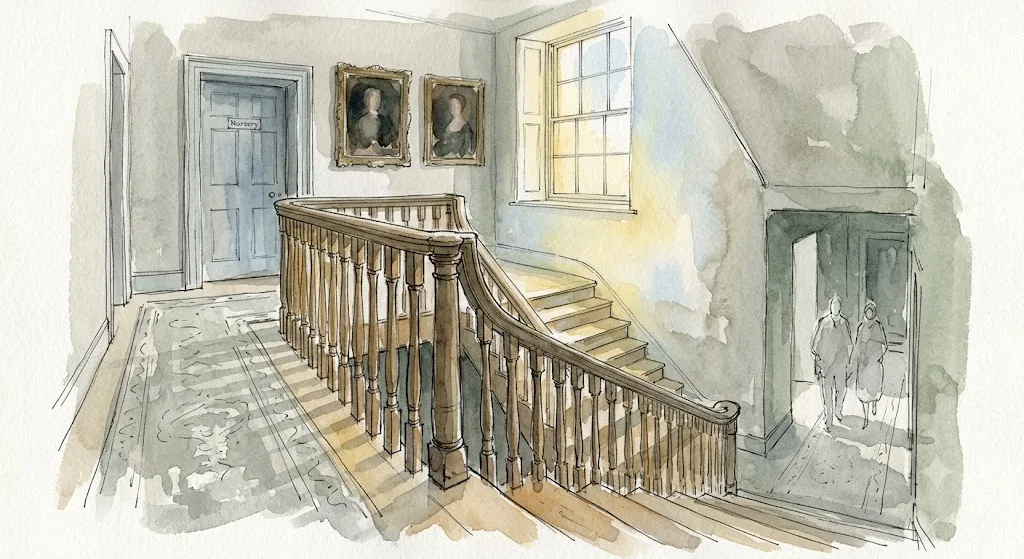
The staircase gives the story a second stage. The National Trust notes that Springhill’s entrance hall preserves a rare late seventeenth-century staircase, with yew balusters and oak treads, a survival from the older house rather than a later fashionable replacement. That matters for the ghost story because staircases are natural places of encounter: half public, half private, linking family rooms, bedrooms and service movement. A figure seen there can feel both at home and out of time.[National Trust]nationaltrust.org.ukthings to see and do at springhillthings to see and do at springhill
Modern retellings often describe Olivia as a tall grey or dark-clad lady seen calmly on the stairs or moving through the house. Spirited Isle’s account, drawing together local and paranormal retellings, contrasts the more urgent Blue Room image with quieter sightings in which Olivia walks through the house or stands on the staircase. This is part of the reason the tradition feels less like a jump-scare and more like a family presence.[Spirited Isle]spiritedisle.ieOpen source on spiritedisle.ie.
The nursery is the third important space. Springhill is a house where the ghost’s meaning depends on children. The story says Olivia was especially connected with young people and was sometimes seen watching over them in the nursery. One twentieth-century version describes a nursemaid seeing her near the children, apparently checking that they were well, before the figure disappeared. Whether taken as folklore, family anecdote or ghost testimony, the scene changes the emotional temperature of the haunting: the apparition is not an intruder, but a motherly guardian.[The Witching Hour]4girlsandaghost.wordpress.comghosts of ireland spring hillThe Witching HourGhosts of Ireland: Spring Hill | The Witching HourMarch 12, 2011 — 11 Mar 2011 — During the Regency period, the owner of…
Why the ghost became “friendly”
Many country-house ghosts are framed around punishment, inheritance, betrayal or hidden crime. Olivia’s story is different because it is built around helplessness. The central image is a woman trying to prevent a death, then remaining associated with the spaces where family anxiety was most concentrated: the bedroom, the stairs and the nursery. That makes the haunting unusually sympathetic.
The “friendly ghost” idea also suits Springhill’s public identity as a preserved family home. Visit Mid Ulster describes Springhill as a welcoming property whose portraits, furniture and decorative arts bring the Lenox-Conyngham generations to life, while the National Trust presents it as a place of continuity and change rather than as a ruin or horror attraction. In that setting, Olivia becomes part of the house’s emotional interpretation: a story visitors can hear while still understanding Springhill as a domestic, historic and architectural site.[Visit Mid Ulster]visitmidulster.comVisit Mid Ulster SpringhillVisit Mid Ulster Springhill
The friendliness is also relative. The reported experiences are still unsettling: murmuring voices in an empty room, a hidden doorway apparently glimpsed at night, a figure passing through the house, and unexplained nursery sounds. But the interpretation repeatedly given to them is protective rather than hostile. This is an important distinction in County Londonderry’s haunted geography. Springhill’s ghost is not like a banshee warning of death from outside the household, nor like a disturbed ecclesiastical spirit attached to a grave. Olivia belongs inside the family rooms.
The story’s persistence may owe as much to good narrative shape as to any claim of evidence. It has a named person, a dated tragedy, a recognisable room, recurring locations and a moral emotion: love arriving too late. These are the ingredients that allow a ghost story to survive repeated retelling without needing constant embellishment.
Family grief and wartime retellings
Springhill’s haunting did not remain frozen in 1816. Later generations and visitors added further layers, especially around the nursery and the Second World War. WartimeNI records that Springhill House and grounds were used during the Second World War as a base for soldiers in training, with United States Army troops among those associated with the site before the house was derequisitioned in December 1944.[WartimeNI]wartimeni.comOpen source on wartimeni.com.
This wartime setting is significant because one of the best-known later anecdotes concerns a nursery cot. The story says that during the period when soldiers were staying at Springhill, a cot in the nursery rocked or knocked by itself, disturbing the men enough that they asked for it to be removed; once removed, the knocking stopped. Spirited Isle repeats this as part of the Olivia tradition, linking the noise to the nursery and to Olivia’s reputation for concern over children.[Spirited Isle]spiritedisle.ieOpen source on spiritedisle.ie.
As evidence, that cot story is hard to verify from public sources. As folklore, it is extremely revealing. Soldiers temporarily occupying a family house hear unexplained sounds from a nursery: the story immediately turns wartime disruption into domestic unease. It suggests that the old house resisted becoming merely a billet or camp. Even in wartime, the nursery remained symbolically charged as a place of children, care and family continuity.
The twentieth-century preservation of Springhill also shaped the ghost story’s survival. Captain William Lowry Lenox-Conyngham bequeathed Springhill to the National Trust in 1957, and Mina Lowry Lenox-Conyngham, the last family member to live there, remained closely associated with the house and its memory. The National Trust’s history page specifically places Mina’s writings within Springhill’s layered story, while other accounts identify her book on the old Ulster house as a key family-history source.[National Trust]nationaltrust.org.ukhistory of springhill house and estateNational TrustHistory of Springhill House and EstateBuilt in the late 1600s, Springhill is a rare surviving example of a Plantation-era h…
That matters because Olivia’s ghost is not only a public ghost-tour tale. It is also a family-preserved narrative, passed through a house where domestic memory was unusually intact. Springhill’s rooms, objects and family papers gave the story a setting that could be visited, repeated and emotionally understood.
How credible is Springhill’s ghost story?
The strongest historical claims in the Springhill story are the setting and family framework: Springhill is a late seventeenth-century Plantation-era house near Moneymore; it was home to the Conyngham and Lenox-Conyngham family for generations; George Lenox-Conyngham died in 1816; and Olivia Irvine was his second wife. These points are supported by National Trust material and historical-house sources.[nationaltrust.org.uk]nationaltrust.org.ukhistory of springhill house and estateNational TrustHistory of Springhill House and EstateBuilt in the late 1600s, Springhill is a rare surviving example of a Plantation-era h…
The ghost claims are different. Reports of Olivia’s apparition, the Blue Room murmuring, the hidden doorway, the nursery figure and the wartime cot belong to the categories of family tradition, visitor anecdote and paranormal retelling. They are valuable as folklore, but they should not be treated as independently proven events. The phrase sometimes attached to Olivia — that she is among the “best documented” ghosts in Ireland or Ulster — is better understood as a claim about the quantity and persistence of stories, not as confirmation that the haunting is objectively established.[Ireland's Eye]irelandseye.comOpen source on irelandseye.com.
There are also ordinary reasons why Springhill lends itself to such experiences. Old houses contain blocked doorways, altered room plans, uneven acoustics, creaking stairs, draughts, inherited stories and strong expectations. The Blue Room is already charged by the knowledge of George’s death; the staircase is a dramatic route through the house; the nursery invites protective interpretation. Once visitors know Olivia’s story, ambiguous sights or sounds can easily be organised around her.
Yet sceptical explanation does not make the tradition worthless. For a haunted-history project, the important question is not only “Did it happen?” but “Why has this story attached itself so firmly to this place?” At Springhill, the answer is clear. Olivia’s ghost gives emotional form to a documented family tragedy, and the house gives the story rooms that visitors can imagine or enter. The legend survives because it turns architecture into memory.

Why Springhill matters in County Londonderry’s haunted history
Springhill’s ghost story is one of County Londonderry’s clearest examples of a haunting rooted in domestic history rather than public spectacle. The county has dramatic haunted settings — city walls, churches, ruins, roads and great estates — but Springhill is intimate. Its ghost is not primarily a warning from the landscape or a punishment from the grave. She is a family figure moving through a house that still preserves the textures of family life.
That makes Olivia Lenox-Conyngham a useful contrast with other County Londonderry traditions. At St Columb’s Cathedral, the haunting story is tied to a disturbed grave and ecclesiastical restoration. At Springhill, the disturbance is private: a husband’s death, a wife’s grief, children’s rooms, wartime occupation and the long afterlife of family storytelling. The house’s rare staircase, Blue Room and nursery provide a map of the legend, while the National Trust’s preservation has kept the physical setting legible for modern visitors.[National Trust]nationaltrust.org.ukthings to see and do at springhillthings to see and do at springhill
The story is best read as a careful blend of history and folklore. George’s death belongs to family history. Olivia’s repeated appearances belong to ghost tradition. The enduring power of the tale lies between the two. Springhill asks the visitor to imagine a house where grief was not sealed away in a document or grave, but continued to be felt in rooms, stairs and children’s spaces — not as terror, but as a lingering act of care.
Amazon book picks
Further Reading
Books and field guides related to Why Is Springhill's Ghost Called Friendly?. Use these as the next step if you want deeper reading beyond the article.
The Mammoth Book of Haunted House Stories
Matches readers drawn to country-house hauntings.
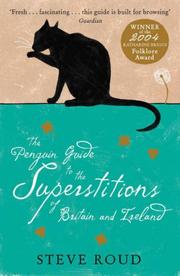
The Penguin Guide to the Superstitions of Britain and Ireland
Explains traditions underlying domestic ghost stories.

eBay marketplace picks
Marketplace Samples
Live-tested eBay searches with available results related to this page.
Endnotes
1.
Source: wartimeni.com
Link:https://wartimeni.com/location/northern-ireland/co-londonderry/moneymore/springhill-house/
2.
Source: archives.wartimeni.com
Title: springhill house moneymore co londonderry
Link:https://archives.wartimeni.com/location/springhill-house-moneymore-co-londonderry/
3.
Source: nationaltrust.org.uk
Title: history of springhill house and estate
Link:https://www.nationaltrust.org.uk/visit/northern-ireland/springhill/history-of-springhill-house-and-estate
Source snippet
National TrustHistory of Springhill House and EstateBuilt in the late 1600s, Springhill is a rare surviving example of a Plantation-era h...
4.
Source: nationaltrust.org.uk
Link:https://www.nationaltrust.org.uk/visit/northern-ireland/springhill
Source snippet
National TrustSpringhill | Northern IrelandFind out more about Springhill in Northern Ireland, a pretty 17th-century plantation house wit...
5.
Source: irishhistorichouses.com
Title: lenox conyngham george 1752 1816
Link:https://irishhistorichouses.com/tag/lenox-conyngham-george-1752-1816/
Source snippet
Springhill, County Derry. William Lenox-Conyngham (1792-1858) courtesy of National Trust.Read more...
6.
Source: Wikipedia
Title: Springhill House
Link:https://en.wikipedia.org/wiki/Springhill_House
7.
Source: 4girlsandaghost.wordpress.com
Title: ghosts of ireland spring hill
Link:https://4girlsandaghost.wordpress.com/2011/03/11/ghosts-of-ireland-spring-hill/
Source snippet
The Witching HourGhosts of Ireland: Spring Hill | The Witching HourMarch 12, 2011 — 11 Mar 2011 — During the Regency period, the owner of...
Published: March 12, 2011
8.
Source: spiritedisle.ie
Link:https://spiritedisle.ie/explore/listing/springhill-house/
9.
Source: irelandseye.com
Link:https://www.irelandseye.com/aarticles/travel/attractions/houses/springhl2.shtm
10.
Source: nationaltrust.org.uk
Title: things to see and do at springhill
Link:https://www.nationaltrust.org.uk/visit/northern-ireland/springhill/things-to-see-and-do-at-springhill
11.
Source: nationaltrustcollections.org.uk
Link:https://www.nationaltrustcollections.org.uk/place/springhill
12.
Source: visitmidulster.com
Title: Visit Mid Ulster Springhill
Link:https://www.visitmidulster.com/things-to-do/springhill-p675711
13.
Source: irelandseye.ie
Title: The ‘Mud Hut’ and the ‘Mansion’
Link:https://irelandseye.ie/the-mud-hut-and-the-mansion
14.
Source: heritagerecords.nationaltrust.org.uk
Title: Mon Record.aspx
Link:https://heritagerecords.nationaltrust.org.uk/HBSMR/MonRecord.aspx?uid=MNA160564
15.
Source: smart-guide.org
Title: Springhill House
Link:https://www.smart-guide.org/destinations/en/northern-ireland/?place=Springhill+House
16.
Source: lordbelmontinnorthernireland.blogspot.com
Title: springhill house
Link:https://lordbelmontinnorthernireland.blogspot.com/2014/03/springhill-house.html
17.
Source: ancient-yew.org
Title: Springhill House
Link:https://www.ancient-yew.org/yew_tree_database/springhill-house-magherafelt/
18.
Source: nationaltrustscones.com
Link:https://www.nationaltrustscones.com/2019/08/springhill.html
19.
Source: artuk.org
Link:https://artuk.org/visit/venues/national-trust-springhill-5833
20.
Source: irishhistorichouses.com
Title: Springhill House, County Derry
Link:https://irishhistorichouses.com/tag/springhill-house-county-derry/
21.
Source: spiritedisle.ie
Link:https://spiritedisle.ie/video-springhill-house/
22.
Source: wikishire.co.uk
Title: Springhill House
Link:https://wikishire.co.uk/wiki/Springhill_House
23.
Source: theirishaesthete.com
Link:https://theirishaesthete.com/tag/springhill/
Additional References
24.
Source: facebook.com
Link:https://www.facebook.com/nationaltrustni/posts/doesnt-springhill-look-spookyits-open-all-week-mon-24-sun-30-oct-from-12-4-pm-en/1214201948651474/
25.
Source: scribd.com
Link:https://www.scribd.com/document/960857098/Haunted-Place1
26.
Source: facebook.com
Link:https://www.facebook.com/groups/1204411701350878/posts/1346267450498635/
27.
Source: facebook.com
Link:https://www.facebook.com/groups/676500406259034/posts/1817287558846974/
28.
Source: fionasplace.net
Link:https://www.fionasplace.net/springhillhouse.html
29.
Source: ancientclans.org
Link:https://ancientclans.org/heritage-site/springhill-house-and-estate/
30.
Source: facebook.com
Link:https://www.facebook.com/ParanormalFilesuk/photos/springhill-house-moneymore-northern-irelandspringhill-house-is-a-remarkable-17th/1125892179518480/
31.
Source: facebook.com
Link:https://www.facebook.com/groups/1053120724802843/posts/4461426123972269/
32.
Source: vipauk.org
Link:https://vipauk.org/enter/muse/ni/i32.html
33.
Source: facebook.com
Link:https://www.facebook.com/groups/760422160677687/posts/2483839738335912/
Topic Tree