Where Berkshire's Ghost Stories Still Linger
Berkshire’s haunted reputation is strongest where ordinary local history already feels charged: Windsor’s royal courts and forest, Reading’s ruined abbey, Donnington’s Civil War earthworks, Bisham’s riverside house, and Littlecote’s Tudor scandal.
Page outline Jump by section
Introduction
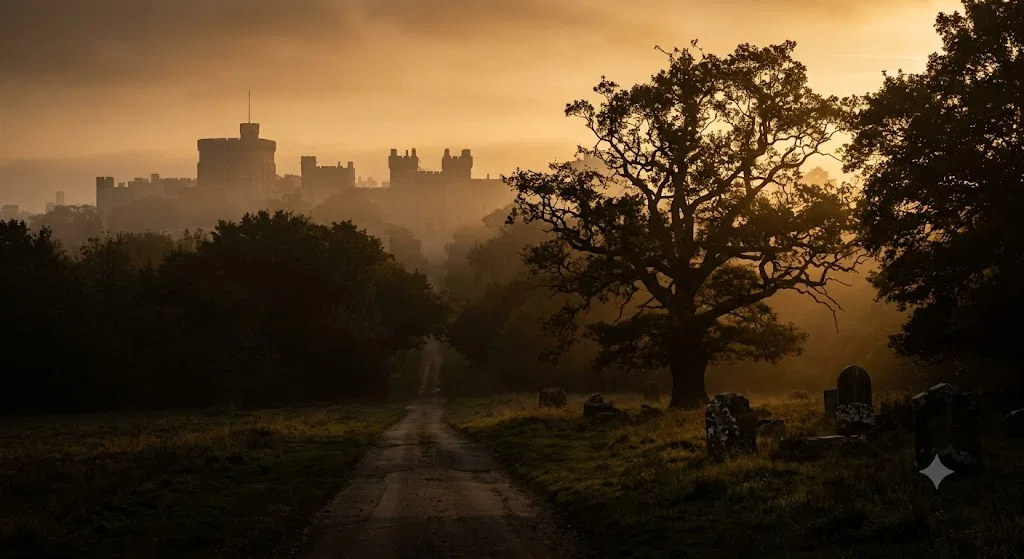
Berkshire’s haunted reputation is strongest where ordinary local history already feels charged: Windsor’s royal courts and forest, Reading’s ruined abbey, Donnington’s Civil War earthworks, Bisham’s riverside house, and Littlecote’s Tudor scandal. The best Berkshire ghost stories are not proven supernatural events; they are traditions, reported apparitions, literary survivals and local memories attached to places where death, punishment, power or family shame left a mark. The county’s most distinctive legend is Herne the Hunter, the horned phantom of Windsor Forest, whose earliest surviving written form appears in Shakespeare’s The Merry Wives of Windsor. Other stories are more house-bound: Lady Hoby at Bisham Abbey, the Grey Lady of Littlecote, royal ghosts at Windsor Castle, and battlefield or roadside figures around Newbury and Bracknell. Berkshire is therefore best read as a haunted map of status and disturbance: castles, abbeys, inns, manor houses and old routes where history has been retold until it became folklore.
What counts as Berkshire in haunted-history terms?
For this page, Berkshire means the historic county as the centre of gravity, while recognising that modern administration has shifted the map. This matters because ghost stories often cling to older estates, parishes, roads and market networks rather than to current council lines. Berkshire Family History Society notes that, until the 1974 changes, Berkshire had a distinctive “boot” shape reaching west towards the Oxford area; the same guide explains that the Thames formed the northern border for more than 100 miles, while the Rivers Enborne and Blackwater helped define the Hampshire boundary.[Berks County Family History Society]berksfhs.orgBerks County Family History Society About Historic BerkshireBerks County Family History Society About Historic Berkshire
The 1974 local-government changes removed places such as Wantage, Didcot, Faringdon, Wallingford, Abingdon and the Vale of the White Horse from administrative Berkshire into Oxfordshire, while Slough moved from Buckinghamshire into Berkshire.[Berks County Family History Society]berksfhs.orgBerks County Family History Society About Historic BerkshireBerks County Family History Society About Historic Berkshire That means older “Berkshire” folklore can legitimately include some places now administered elsewhere, but this page keeps its main focus on places still strongly associated with Berkshire in public memory: Windsor, Reading, Newbury, Bisham, Bray, Hungerford and the county’s old roads and riverside estates.
Windsor: royal ghosts and the forest phantom
Windsor dominates Berkshire’s haunted landscape because it combines two different kinds of ghost story. One is royal: the castle as a burial place, prison, residence and stage for national crisis. The other is folkloric: Windsor Forest as the home of Herne the Hunter, a horned night figure who belongs as much to theatre and woodland imagination as to local legend.
Windsor Castle’s historical weight is not in doubt. The Royal Collection Trust says Henry I was the first king to use Windsor Castle as a residence; Henry II, Henry III and Edward III all developed it, and Edward III made it central to the Order of the Garter.[Royal Collection Trust]rct.ukRoyal Collection Trust Who lived at Windsor Castle?Royal Collection Trust Who lived at Windsor Castle? The Royal Family’s own history of Windsor adds that ten British monarchs are buried in St George’s Chapel, including Henry VIII, Charles I and George III, and that during the Civil War the castle was captured by Parliament, used as a prison, and later received Charles I’s body for burial after his execution.[The Royal Family]royal.ukThe Royal Family Royal Residences: Windsor Castle | The Royal FamilyThe Royal Family Royal Residences: Windsor Castle | The Royal Family
That background explains why Windsor’s ghost stories usually gather around dead monarchs rather than anonymous spirits. Henry VIII is often said in popular ghost literature to haunt the castle or its cloisters, while Elizabeth I, Charles I and George III also appear in recurring accounts. The historical facts behind these stories are strong enough to make the setting persuasive: Henry VIII frequently visited Windsor, hunted in the surrounding parks and forests, rebuilt the principal archway now known as the Henry VIII Gate, and chose St George’s Chapel as his burial place beside Jane Seymour.[Royal Collection Trust]rct.ukRoyal Collection Trust Henry VIII at Windsor CastleRoyal Collection Trust Henry VIII at Windsor Castle The haunting claims themselves, however, remain folklore and reported tradition rather than documentary proof.
Herne the Hunter is more important still because he is Berkshire’s most famous named supernatural figure. The Royal Shakespeare Company describes Herne as a mythical phantom huntsman said to haunt an oak in Windsor Forest and Great Park, recognised by horns, rattling chains, blasted trees and bewitched cattle.[Royal Society of Chemistry]rsc.org.ukHerne the Hunter in The Merry Wives of Windsor | Royal Shakespeare Company… The same source is careful about origins: the earliest written account comes from The Merry Wives of Windsor, probably written around 1597, and later writers expanded the story with suicide, local-keeper and Wild Hunt interpretations.[Royal Society of Chemistry]rsc.org.ukHerne the Hunter in The Merry Wives of Windsor | Royal Shakespeare Company…
That makes Herne unusually useful for readers who want to separate folklore from evidence. He may preserve an older Windsor belief, or Shakespeare may have shaped a local rumour into something memorable. Either way, the legend became famous because it gave Berkshire a figure with place, season and behaviour: a horned keeper circling an oak at midnight in winter, part ghost, part warning, part theatrical disguise.

Reading Abbey: ruins, martyrdom and the making of a haunted atmosphere
Reading’s strongest eerie tradition is less about a well-attested named apparition than about the atmosphere of a ruined royal abbey where violence, dissolution and urban memory overlap. Reading Abbey was one of medieval England’s great religious houses, and its ruin sits in the middle of a modern town, which gives it a particularly vivid haunted quality: not remote Gothic decay, but sacred wreckage absorbed into everyday streets.
Reading Museum explains that the abbey’s last abbot, Hugh Cook of Faringdon, was convicted of treason in 1539, tied to a hurdle, dragged through Reading and executed with John Eynon and John Rugg.[Reading Museum]readingmuseum.org.ukOpen source on readingmuseum.org.uk. The museum also notes that after the abbey was closed, lead was stripped from roofs, good stone was reused across Reading and beyond, and the flint cores of some walls were left standing; tombs were vandalised and royal bones were probably scattered.[Reading Museum]readingmuseum.org.ukOpen source on readingmuseum.org.uk.
Those facts help explain why ghostly stories have attached themselves to the abbey precinct even when the evidence for specific apparitions is thin. The place contains several classic ingredients of English haunting tradition: monastic ruin, execution, desecrated burial, and the abrupt ending of a religious community. Hugh Faringdon’s story also reaches beyond local legend. Reading Museum identifies him as probably born in or near Faringdon, then in west Berkshire, and elected abbot in 1520.[Reading Museum]readingmuseum.org.ukReading Museum The last Abbot of Reading | Reading MuseumReading Museum The last Abbot of Reading | Reading Museum
For a careful haunted-history reader, Reading Abbey is best treated as a place where the historical record is more compelling than the ghost record. The execution and dissolution are well grounded; the ghostly atmosphere is a later cultural response to that rupture. This does not make the abbey less important to Berkshire’s haunted map. It makes it a reminder that some “haunted” places are haunted first by documented memory.
Littlecote House: Tudor scandal on the Berkshire–Wiltshire edge
Littlecote House, near Hungerford, sits close to the Berkshire–Wiltshire border, so it often appears in both Berkshire and Wiltshire ghost traditions. Its best-known haunting is the story of “Wild Will” Darrell, an alleged infanticide, a terrified midwife, and a Grey Lady searching the house for her child. It is one of the county area’s most dramatic legends, but also one that needs especially cautious handling because later retellings have embroidered it heavily.
Warner Hotels, which now operates Littlecote House, presents the legend as a reported house tradition: in 1575, William “Wild Will” Darrell’s illegitimate child was born there, Darrell threw the baby into the fire, and the Grey Lady has since been seen roaming the house in search of her baby. The same modern hotel account also mentions rumoured sightings of a phantom black dog on the Jerusalem Staircase.[Warner Hotels]warnerhotels.co.ukWarner Hotels Spooky Hotel Ghost Stories and Legends | Warner HotelsWarner Hotels Spooky Hotel Ghost Stories and Legends | Warner Hotels
The Guardian’s travel coverage of Littlecote similarly treats it as a place rich in murder, scandal, romance and ghostly stories, noting its medieval origins, mainly Tudor surviving fabric, associations with Henry VIII and Jane Seymour, and later ownership by Judge Popham, who was involved in the trials of Guy Fawkes and Sir Walter Raleigh.[The Guardian]theguardian.comThe Guardian A haunted hotel which will raise your spiritsThe Guardian A haunted hotel which will raise your spirits
The key interpretive point is that Littlecote’s ghost story works because it fuses domestic architecture with moral accusation. The alleged crime is not a battlefield death or a royal execution, but a hidden household horror: a baby, a bedroom, a midwife, a staircase, a family name. Whether taken as legend, scandal memory or ghost story, it belongs to a familiar English pattern in which old houses preserve stories of inheritance, illegitimacy and patriarchal violence.
Bisham Abbey: Lady Hoby, photographs and a useful sceptical twist
Bisham Abbey, near Marlow on the Thames, gives Berkshire one of its most valuable case studies because the archives preserve both ghostly belief and a plausible explanation. The usual story concerns Lady Hoby, said in many retellings to wander the house, weeping or washing blood from her hands after cruelty towards a child. That tradition is dramatic, but the most trustworthy modern source is more interesting because it shows how ghost evidence can be made, misread and corrected.
Royal Berkshire Archives describes items in the Vansittart Neale family papers that appear to relate to ghosts, including photographs that seemed to show a figure on the stairs and inside a room. The supposed figure was associated with Lady Hoby of Bisham Abbey, though the archive points out that it was uncertain whether the intended identification was the seventeenth-century Lady Hoby or Lady Hoby Mill, who sold Bisham Abbey to George Vansittart in 1780.[royalberkshirearchives.org.uk]royalberkshirearchives.org.ukThe lady casts a ghostly figure | The Royal Berkshire ArchivesThe lady casts a ghostly figure | The Royal Berkshire Archives
The same archival account then undercuts the haunting in two ways. A written “Ghost story” in the family collection turns out to describe burglars rather than spirits, and the ghostly photographs are identified not as Lady Hoby but as Florence Vansittart Neale, produced by triple exposure.[royalberkshirearchives.org.uk]royalberkshirearchives.org.ukThe lady casts a ghostly figure | The Royal Berkshire ArchivesThe lady casts a ghostly figure | The Royal Berkshire Archives
That does not erase Bisham’s place in Berkshire folklore. It makes it better. Bisham shows how a haunting can survive through family storytelling, portrait-like recognition, misread photographs and the pleasure of being frightened by one’s own house. It is an excellent example of a county ghost story where the legend remains culturally meaningful even after one piece of “evidence” has been explained.
Donnington and Newbury: battle memory on a haunted hill
Donnington Castle, north of Newbury, is one of Berkshire’s clearest examples of battlefield haunting: the stories matter because the documented violence was real and the landscape still shows its scars. English Heritage describes Donnington as a Royalist stronghold during the English Civil War, held under Sir John Boys through a 20-month siege from July 1644 until surrender in April 1646. The castle played a key role in the Second Battle of Newbury, and Charles I stayed there overnight with a large army in November 1644.[English Heritage]english-heritage.org.ukEnglish Heritage The Siege of Donnington Castle | English HeritageEnglish Heritage The Siege of Donnington Castle | English Heritage
The setting strengthens the story. English Heritage notes that the castle overlooks both the old Southampton-to-Oxford route and the London-to-Bristol road, making it strategically important between the king’s headquarters at Oxford and Parliament’s at London.[English Heritage]english-heritage.org.ukEnglish Heritage The Siege of Donnington Castle | English HeritageEnglish Heritage The Siege of Donnington Castle | English Heritage The same account describes Boys strengthening the hilltop with substantial star-shaped earthworks designed to resist cannon fire, a major engineering project whose shapes remain easier to read from aerial views than from the ground.[English Heritage]english-heritage.org.ukEnglish Heritage The Siege of Donnington Castle | English HeritageEnglish Heritage The Siege of Donnington Castle | English Heritage
Modern ghost retellings speak of figures, lights or a spectral “Green Lady” around Donnington, but these claims are not as well sourced as the Civil War history. A cautious reading is that the haunting tradition grows from the place’s visible military trauma: a ruined gatehouse, earthworks, siege, artillery, roads, and two battles fought around Newbury in successive years. The folklore is strongest when treated as battle memory rather than as evidence of a specific apparition.
Bray, Oakley Court and the horror-film afterlife
Not every haunted Berkshire place is famous because of ancient folklore. Oakley Court at Bray is a different kind of eerie landmark: a Victorian Gothic riverside house whose later identity was shaped by cinema. It is often discussed as haunted or sinister, but its strongest evidence-based claim is that it became part of Britain’s horror-film imagination.
Hammer Films’ own account says production on The Man in Black, the first Hammer film shot at Oakley Court, began on 8 August 1949, before the company moved on from the Thames-side house.[Hammer Films]hammerfilms.comHammer Films The Road to BrayHammer Films The Road to Bray Historic England’s Heritage Calling has also highlighted Oakley Court as a location used in classic British horror films, including Hammer titles such as The Curse of Frankenstein, The Brides of Dracula and The Plague of the Zombies.[The Historic England Blog]heritagecalling.comOpen source on heritagecalling.com.
This matters because Oakley Court shows how “haunting” can be manufactured by architecture and media memory. A building can become ghostly in the public mind because it looks like the kind of place where ghosts ought to appear, and because film-makers repeatedly used it to represent dread, secrecy and aristocratic decay. Reported local apparitions may exist in popular databases and hotel lore, but Oakley Court’s most reliable haunted significance is cultural: it helped teach audiences what a haunted British house should look like.
Roadside ghosts, local databases and the problem of thin evidence
Berkshire also has many smaller ghost traditions: figures by railway arches, white dogs, hooded shapes, haunted inns, tunnel stories and manor-house apparitions. These are often preserved in paranormal directories, local websites or seasonal round-ups rather than in archives or contemporary newspapers. They are still part of the county’s haunted culture, but they require a different level of confidence.
The Paranormal Database’s Berkshire pages, for example, collect entries such as hooded figures near Oakley Court at Bray, a Bracknell railway-arch apparition, and Powlett Wright at Englefield House, where a former owner is said to haunt the building and a bricked-up tunnel.[Paranormal Database]paranormaldatabase.comParanormal Database Berkshire Ghosts, Folklore and Forteana BracknellParanormal Database Berkshire Ghosts, Folklore and Forteana Bracknell These entries are useful for mapping motifs and locations, but they usually summarise “published media” or local lore rather than giving a full chain of witnesses, dates and primary documentation.
That pattern is common in county ghost research. The most famous places, such as Windsor, Bisham, Littlecote and Donnington, can be anchored to strong historical sources even when the apparition itself remains unproven. Smaller roadside or tunnel stories may be atmospheric and locally valued, but they are harder to verify. A good Berkshire haunted map should therefore separate three things: documented history, documented folklore, and repeated but lightly sourced modern claims.
How credible are Berkshire’s hauntings?
Berkshire’s haunted stories are credible as folklore, memory and tourism, but not as proof that ghosts exist. The strongest cases are not the ones with the loudest supernatural claims; they are the ones where a story can be placed in a well-documented setting and followed through older literary, archival or local-history sources.
Herne the Hunter is strong as literature and folklore because the Royal Shakespeare Company can trace him to The Merry Wives of Windsor and explain how later writers expanded the legend.[Royal Society of Chemistry]rsc.org.ukHerne the Hunter in The Merry Wives of Windsor | Royal Shakespeare Company… Windsor Castle’s royal ghosts are plausible as traditions because the castle’s burials, imprisonments and royal associations are exceptionally well documented, even though the apparitions themselves are not.[The Royal Family]royal.ukThe Royal Family Royal Residences: Windsor Castle | The Royal FamilyThe Royal Family Royal Residences: Windsor Castle | The Royal Family Bisham Abbey is valuable because Royal Berkshire Archives preserves the ghostly material and also explains the triple-exposure photograph, showing how a haunting can be both sincerely believed and technically mistaken.[royalberkshirearchives.org.uk]royalberkshirearchives.org.ukThe lady casts a ghostly figure | The Royal Berkshire ArchivesThe lady casts a ghostly figure | The Royal Berkshire Archives
Littlecote and Donnington sit in the middle. Littlecote has a vivid, long-lived legend attached to a real house, but the tale’s details are usually given in modern retellings rather than in robust primary evidence. Donnington has excellent Civil War documentation and visible earthworks, while its specific ghosts are much less firmly evidenced.[English Heritage]english-heritage.org.ukEnglish Heritage The Siege of Donnington Castle | English HeritageEnglish Heritage The Siege of Donnington Castle | English Heritage
For readers exploring haunted Berkshire, the best approach is not to ask “which ghost is real?” but “what does this story preserve?” At Windsor it preserves forest fear and royal death. At Reading it preserves the shock of dissolution. At Littlecote it preserves scandal and domestic violence. At Bisham it preserves family storytelling and photographic misinterpretation. At Donnington it preserves the memory of siege and civil war. That is where Berkshire’s haunted history is most convincing: not as certainty, but as a county’s shadow archive.
Amazon book picks
Further Reading
Books and field guides related to Where Berkshire's Ghost Stories Still Linger. Use these as the next step if you want deeper reading beyond the article.
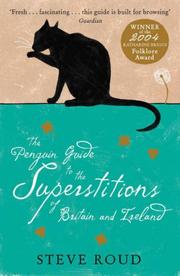
The Penguin Guide to the Superstitions of Britain and Ireland
Places Berkshire stories within British supernatural traditions.

eBay marketplace picks
Marketplace Samples
Live-tested eBay searches with available results related to this page.

Endnotes
1.
Source: royal.uk
Title: The Royal Family Royal Residences: Windsor Castle | The Royal Family
Link:https://www.royal.uk/royal-residences-windsor-castle
2.
Source: rsc.org.uk
Title: Royal Society of Chemistry
Link:https://www.rsc.org.uk/the-merry-wives-of-windsor/about-the-play/herne-the-hunter
Source snippet
Herne the Hunter in The Merry Wives of Windsor | Royal Shakespeare Company...
3.
Source: royalberkshirearchives.org.uk
Title: The lady casts a ghostly figure | The Royal Berkshire Archives
Link:https://www.royalberkshirearchives.org.uk/this-months-highlight/article/october-2016-lady-casts-ghostly-figure
4.
Source: hansard.parliament.uk
Title: uk Uffington (White Horse)
Link:https://hansard.parliament.uk/commons/1974-07-16/debates/d4f0d599-f844-4604-956c-6762a74af339/Uffington%28WhiteHorse%29
5.
Source: royal.uk
Link:https://www.royal.uk/sites/default/files/media-packs/rlra_guide_to_collections.pdf
6.
Source: youtube.com
Title: Herne the Hunter: Demon, God, or Something Older?
Link:https://www.youtube.com/watch?v=BRnGTQrsc_g
Source snippet
Herne the Hunter | Ghost of Windsor Forest...
7.
Source: youtube.com
Title: Herne the Hunter | Ghost of Windsor Forest
Link:https://www.youtube.com/watch?v=A0bsXXj04WY
Source snippet
Strange But True Littlecote House & Pluckley...
8.
Source: berksfhs.org
Title: Berks County Family History Society About Historic Berkshire
Link:https://berksfhs.org/info/research-guides/about-historic-berkshire/
9.
Source: rct.uk
Title: Royal Collection Trust Who lived at Windsor Castle?
Link:https://www.rct.uk/visit/windsor-castle/who-has-lived-at-windsor-castle
10.
Source: rct.uk
Title: Royal Collection Trust Henry VIII at Windsor Castle
Link:https://www.rct.uk/visit/windsor-castle/henry-viii-at-windsor-castle
11.
Source: readingmuseum.org.uk
Link:https://www.readingmuseum.org.uk/blog/short-history-reading-readings-royal-abbey
12.
Source: readingmuseum.org.uk
Title: Reading Museum The last Abbot of Reading | Reading Museum
Link:https://www.readingmuseum.org.uk/blog/last-abbot-reading
13.
Source: warnerhotels.co.uk
Title: Warner Hotels Spooky Hotel Ghost Stories and Legends | Warner Hotels
Link:https://www.warnerhotels.co.uk/blog/spooky-stories-this-halloween-at-warner-hotels
14.
Source: theguardian.com
Title: The Guardian A haunted hotel which will raise your spirits
Link:https://www.theguardian.com/travel/2008/apr/06/berkshire.weekends
15.
Source: english-heritage.org.uk
Title: English Heritage The Siege of Donnington Castle | English Heritage
Link:https://www.english-heritage.org.uk/visit/places/donnington-castle/history/civil-war-siege/
16.
Source: hammerfilms.com
Title: Hammer Films The Road to Bray
Link:https://hammerfilms.com/blogs/news/the-road-to-bray
17.
Source: heritagecalling.com
Link:https://heritagecalling.com/2025/10/17/10-historic-locations-featured-in-classic-british-horror-movies/
18.
Source: paranormaldatabase.com
Title: Paranormal Database Berkshire Ghosts, Folklore and Forteana Bracknell
Link:https://www.paranormaldatabase.com/berkshire/berkdata.php?pageNum_paradata=1
19.
Source: paranormaldatabase.com
Link:https://www.paranormaldatabase.com/berkshire/berkdata.php?pageNum_paradata=2
20.
Source: wikishire.co.uk
Link:https://wikishire.co.uk/wiki/Berkshire
21.
Source: Wikipedia
Title: Herne the Hunter
Link:https://en.wikipedia.org/wiki/Herne_the_Hunter
22.
Source: Wikipedia
Link:https://en.wikipedia.org/wiki/Berkshire
23.
Source: Wikipedia
Title: Royal Collection
Link:https://en.wikipedia.org/wiki/Royal_Collection
24.
Source: Wikipedia
Title: Hugh Faringdon
Link:https://en.wikipedia.org/wiki/Hugh_Faringdon
25.
Source: Wikipedia
Title: Donnington Castle
Link:https://en.wikipedia.org/wiki/Donnington_Castle
26.
Source: Wikipedia
Title: Oakley Court
Link:https://en.wikipedia.org/wiki/Oakley_Court
27.
Source: english-heritage.org.uk
Link:https://www.english-heritage.org.uk/members-area/members-magazine/stories-of-england-ghost-stories/
28.
Source: english-heritage.org.uk
Link:https://www.english-heritage.org.uk/visit/places/donnington-castle/history/
29.
Source: english-heritage.org.uk
Link:https://www.english-heritage.org.uk/visit/places/donnington-castle/
30.
Source: rct.uk
Link:https://www.rct.uk/collection
31.
Source: horrorbound.net
Title: Oakley Court
Link:https://www.horrorbound.net/blog/2020/11/20/oakley-court-a-hidden-horror-mecca
32.
Source: britishfolklore.com
Title: Bisham Abbey
Link:https://britishfolklore.com/bisham-abbey/
33.
Source: hauntedwiltshire.blogspot.com
Title: littlecote house
Link:https://hauntedwiltshire.blogspot.com/2012/06/littlecote-house.html
34.
Source: the-pigs.co.uk
Title: Bisham Abbey
Link:https://www.the-pigs.co.uk/project/bisham-abbey/
35.
Source: thamesweb.co.uk
Title: Oakley Court
Link:https://www.thamesweb.co.uk/windsor/windsorhistory/oakleycourt.htm
Additional References
36.
Source: academia.edu
Link:https://www.academia.edu/36194698/Young_Herne_the_Windsor_Bogey
37.
Source: aaahs.org.uk
Link:https://www.aaahs.org.uk/Harrison_bibliography/4sz.htm
38.
Source: abcounties.com
Link:https://abcounties.com/counties/county-profiles/berkshire/
39.
Source: themysteriousshire.co.uk
Link:https://www.themysteriousshire.co.uk/index
40.
Source: gutenberg.org
Link:https://www.gutenberg.org/ebooks/53312.epub.images
41.
Source: newadvent.org
Link:https://www.newadvent.org/cathen/07518a.htm
42.
Source: reddit.com
Link:https://www.reddit.com/r/castles/comments/5xtma1/donnington_castle_is_a_ruined_medieval_castle/
43.
Source: facebook.com
Link:https://www.facebook.com/groups/1424720167832570/posts/3751381645166399/
44.
Source: paullee.com
Link:https://www.paullee.com/ghosts/ghostgeo/extractghostdata.php?location=51o443157_-1o106059_Englefield+House.txt
45.
Source: facebook.com
Link:https://www.facebook.com/groups/WantageAndGroveCommunity/posts/1628097337901415/
Topic Tree
Follow this branch
Related pages 91
- Haunted Clackmannanshire
- Haunted Antrim
- Haunted Armagh
- Haunted Durham
- Haunted Londonderry
- +86 more in sidebar