Within Berwickshire Hauntings
What Do Berwickshire's Thin Ghost Records Reveal?
Houndwood, Duns Castle and other thinly sourced sites show how local legend survives when evidence is scattered.
On this page
- Houndwood House and partial apparitions
- Duns Castle, Fast Castle and ruined settings
- How to read haunted place catalogues carefully
Page outline Jump by section
Introduction
Berwickshire’s fragmentary haunted houses and ruins are valuable not because they prove a hidden world of ghosts, but because they show how local legend survives when the paperwork is patchy. Houndwood House near Reston has one of the oddest scraps: a partial apparition known simply as “Legs”, alongside an older silk-clad household spirit called “Chappie”. Duns Castle carries the reputed ghost of Alexander Hay, linked in later haunted-place listings to Waterloo. Fast Castle, meanwhile, is less a documented ghost site than a ruin whose cliff-edge setting, smuggling lore and association with Sir Walter Scott’s The Bride of Lammermoor have made it feel haunted even when the evidence is more literary than testimonial.
These are not Berwickshire’s strongest ghost “cases”. They are thinner, stranger and more revealing: short catalogue entries, antiquarian notes, tourist retellings and atmospheric ruins where the gaps matter as much as the claims.
Why Berwickshire’s Thin Ghost Records Matter
A famous haunted house story usually has a recognisable chain: a named witness, a dated incident, a printed source, later retellings and perhaps a local tradition that can be checked against estate history. Berwickshire’s lesser haunted houses and ruins often do not work like that. They survive as fragments: a nickname, a single apparition, a sentence in a folklore collection, a brief entry in a paranormal gazetteer, or a modern heritage page that confirms the building’s age but says nothing about ghosts.
That makes them useful in a different way. They show how haunted-place traditions are built from three separate layers:
- The place itself: a tower house, castle, ruin, stair, cellar, bridge or cliff approach.
- The historical atmosphere: Border warfare, old families, military memory, Mary Queen of Scots traditions, smuggling tales, vanished mansions and ruined estates.
- The ghost label: often added or preserved by folklore collectors, local talk, tourism writing or modern catalogues.
The danger is obvious. A sparse entry can be copied repeatedly until it looks more substantial than it is. Houndwood, Duns Castle and Fast Castle therefore need to be read with care: not dismissed, but not inflated. Historic Environment Scotland’s records can confirm that a building or ruin has genuine antiquity, but they do not automatically confirm the haunting attached to it. Houndwood House, for example, is listed as a significant house incorporating older tower-house fabric, while the ghost traditions come from separate folklore and paranormal sources.[historicenvironment.scot]portal.historicenvironment.scotOpen source on historicenvironment.scot.

Houndwood House and the Problem of Partial Apparitions
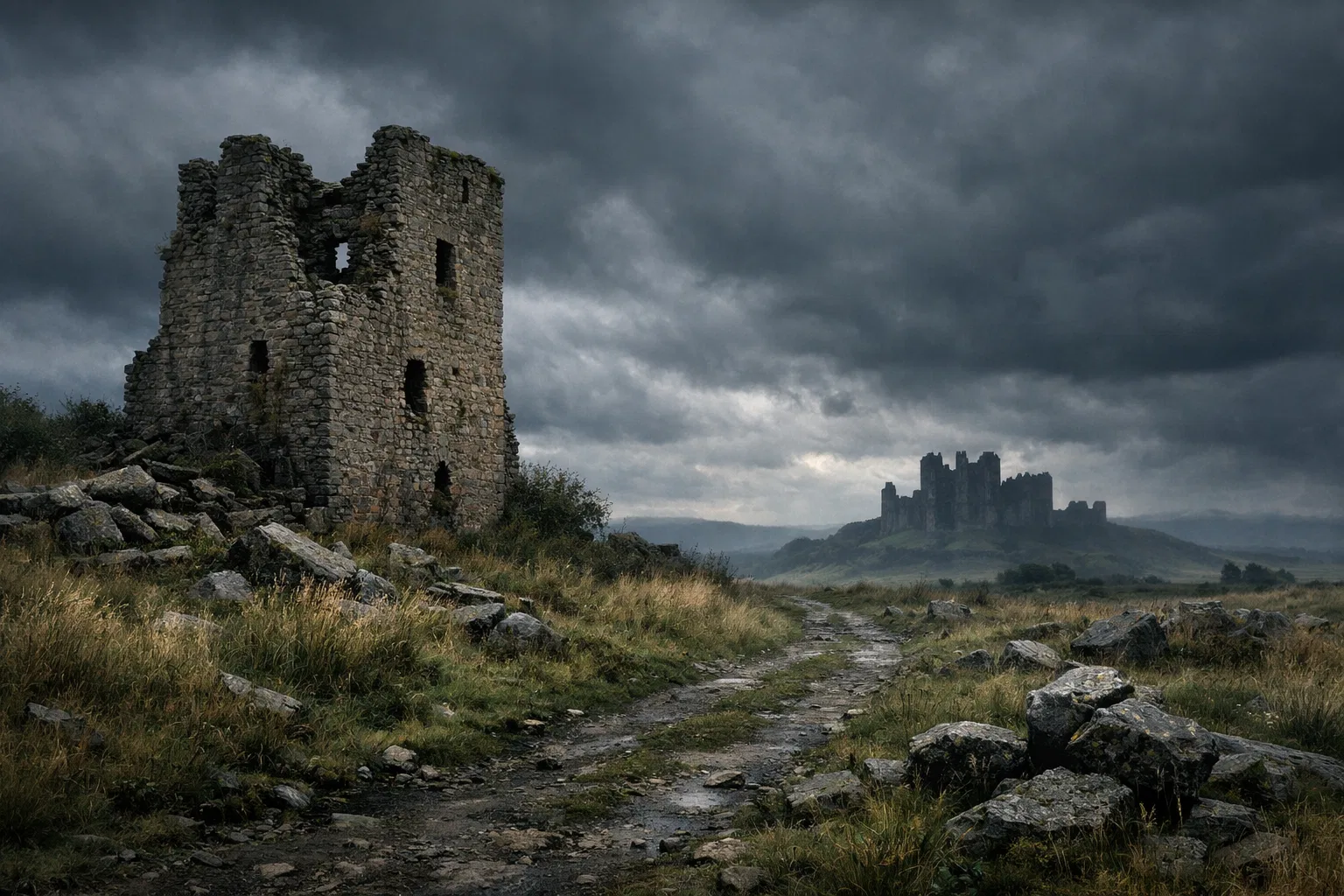
Houndwood House is the most distinctive of Berwickshire’s fragmentary haunted-house traditions because its reported ghosts are so oddly specific. Modern paranormal catalogues record a manifestation at Houndwood called “Legs”, said to consist only of the lower part of a ghost striding around the house. The same site is also linked with “Chappie”, a woman in silk, though the surviving accounts give little in the way of date, witness identity or detailed circumstances.[Paranormal Database]paranormaldatabase.comParanormal Database The Paranormal DatabaseParanormal Database The Paranormal Database
The older and more useful thread is “Chappie”. In William Henderson’s Notes on the Folk-Lore of the Northern Counties of England and the Borders, first published in the nineteenth century, Houndwood appears not as a modern paranormal destination but as one example in a cluster of “silky” female apparitions. Henderson says, drawing on James Hardy, that “Chappie” was the family apparition of Houndwood in Berwickshire: repeated knocking was heard at the front door, and on one occasion a grand lady swept in and went upstairs, but was not seen again.[Wikisource]en.wikisource.orgChapter 7Chapter 7
That is a compact but revealing tradition. It does not give the reader a dramatic death, a wronged bride or a named victim. Instead, it preserves a domestic image: the front door, the staircase, the sound of knocking, the rustle and status of silk. Henderson’s discussion places Chappie beside other silk-clad spirits in northern and Border folklore, suggesting that the clothing itself mattered. In rural settings, silk marked rank, wealth and strangeness; a “lady in silk” could become a portable ghost motif as much as a memory of one individual person.[Wikisource]en.wikisource.orgChapter 7Chapter 7
The building gives the story a plausible architectural setting, even if it does not verify the apparition. Historic Environment Scotland describes Houndwood House as one of the most significant houses in its parish and notes that it is thought to date partly from the later sixteenth century. Although little outside clearly announces a peel tower, the interior evidence — a vaulted basement, thick walls and a turnpike stair — suggests that an older tower was incorporated into the later house.[Historic Environment Scotland]portal.historicenvironment.scotOpen source on historicenvironment.scot.
That matters because Houndwood’s ghost tradition is not floating in empty space. A house with a tower room, stair, vaulted basement and layers of rebuilding offers exactly the kind of interior geography in which a household apparition can be remembered: a knock at the door, a figure on the stair, movement through older parts of the building. The National Record of the Historic Environment also records local traditions that there may have been a dwelling at Houndwood as early as 1143 and that Mary Queen of Scots was said to have stayed there in 1555, though those points are presented as reported information rather than secure proof.[Trove]trove.scotOpen source on trove.scot.
“Legs” is harder to assess. A partial apparition is memorable, but the public evidence is extremely thin. Without a dated witness account, a named collector, or a traceable first publication, it should be treated as a late catalogue survival or local tale rather than a documented case. Its value is not that it gives us a reliable event; it shows how ghost traditions can shrink to one vivid detail and still remain attached to a place.
Duns Castle and the Waterloo Ghost
Duns Castle has a stronger historical profile than its ghost record. The castle stands at the edge of Duns, the historic county town of Berwickshire, and its built history is substantial. Historic Environment Scotland describes it as a four-storey crenellated baronial Tudor mansion designed by James Gillespie Graham in 1820–23, incorporating an intact pele tower associated with the original castle and later eighteenth-century improvements.[Historic Environment Scotland]portal.historicenvironment.scotOpen source on historicenvironment.scot.
The National Record of the Historic Environment gives a slightly more cautious architectural reading. It records the traditional claim that the oldest part was built between 1316 and 1320, but also notes that the altered tower at the east end appears to be of fifteenth- or sixteenth-century date rather than securely 1320. That distinction is important for haunted history because old-house legends often lean on impressive foundation dates, even when the surviving fabric is more complicated.[Trove]trove.scotOpen source on trove.scot.
The main ghost attached to Duns Castle is Alexander Hay, said in haunted-castle listings to have been killed at the Battle of Waterloo in 1815 and to haunt the castle afterwards. Several modern castle and travel sources repeat the claim, sometimes adding that he was connected with the Duke of Wellington or served as an aide-de-camp.[castlesandmanorhouses.com]castlesandmanorhouses.comOpen source on castlesandmanorhouses.com.
This is a classic example of a locally attractive but thinly evidenced haunting. The historical hook is strong: Waterloo is one of the great named events of British military memory, and Duns Castle has a long Hay family association. Duns Castle’s own heritage and visitor material stresses the Hay family connection, while Historic Houses states that the castle has been home to the Hay family since 1696.[Historic Houses]historichouses.orgduns castle estateduns castle estate
What is missing, at least in easily accessible public evidence, is the kind of early ghost account that would turn the story into a robust case history. The repeated modern wording tends to be brief: Alexander Hay died at Waterloo; his ghost haunts Duns Castle. One catalogue also adds a “phantom soldier”, described as a teenage soldier haunting a building once used as barracks.[Castles & Manor Houses]castlesandmanorhouses.comOpen source on castlesandmanorhouses.com.
The most careful reading is therefore not “Duns Castle is haunted by Alexander Hay”, but “Duns Castle has a reputed Waterloo-linked family ghost, preserved mainly in modern haunted-place and castle-tourism sources.” That phrasing keeps the atmosphere without pretending the evidence is stronger than it is.
It also helps explain why the story sticks. Duns Castle is not a ruin; it is a lived-in and event-used historic house with parkland, lakes and a strong family identity. A ghost attached to such a place does not need elaborate horror. A returning soldier, a family name, a great battle and an old castle are enough for a compact legend to travel.
Fast Castle: A Ruin That Feels Haunted Even When the Ghost Is Vague
Fast Castle is different from Houndwood and Duns Castle. Its haunted quality comes less from a stable named apparition and more from landscape, ruin, literature and coastal danger. It stands on a narrow Berwickshire promontory, almost surrounded by cliffs, with the remains of the castle occupying a plateau separated from the mainland by a chasm. Historic Environment Scotland’s Canmore record describes cliffs of roughly 100 to 150 feet and notes that a modern footbridge replaced the old drawbridge over the narrow gap.[Trove]trove.scotOpen source on trove.scot.
That physical setting matters. Fast Castle already has the ingredients of a ghost story before any ghost is added: a dangerous approach, a broken stronghold, sea below, wind, isolation and fragmentary masonry. Its archaeology is real enough; Canmore records excavations between 1975 and 1984 and cites William Douglas’s 1921 paper on the castle and its owners, which describes the ruin on the Berwickshire coast and traces a complicated medieval history in which the site changed hands between Scottish and English interests.[Trove]trove.scotOpen source on trove.scot.
The most important cultural association is Sir Walter Scott. Fast Castle has long been identified as an inspiration for Wolf’s Crag, the bleak Ravenswood stronghold in The Bride of Lammermoor. The National Galleries of Scotland notes that the Berwickshire cliff castle was generally taken to be the inspiration for Scott’s imaginary castle, and that Scott’s friend the Rev. John Thomson painted it repeatedly from different viewpoints and in different weather.[National Galleries of Scotland]nationalgalleries.orgOpen source on nationalgalleries.org.
Scott himself was cautious. In the introduction to The Bride of Lammermoor, he wrote that Wolf’s Crag had been identified by some with Fast Castle, but that he was not competent to judge the resemblance because he had only seen Fast Castle from the sea. That is an excellent warning for haunted-place writing: an association can be powerful, picturesque and old without being exact.[Project Gutenberg]gutenberg.orgOpen source on gutenberg.org.
Fast Castle also carries darker coastal lore. Modern local and travel writing repeats the story that the castle was once associated with “false” lights used to mislead ships, linking the name with “Fause” or “False” Castle and with smugglers or wreckers. This is atmospheric and locally sticky, but it should be handled as legend unless supported by stronger documentary evidence.[Northumberland Traveller]northumberlandtraveller.wordpress.comNorthumberland Traveller Fast Castle Walk, BerwickshireNorthumberland Traveller Fast Castle Walk, Berwickshire
For a haunted Berwickshire page, Fast Castle is best understood as a ruined setting rather than a clean ghost case. Its spectral force comes from accumulated associations: medieval violence, exposed geology, maritime danger, Scott’s gothic imagination and later visitors approaching a ruin that seems designed for uncanny interpretation. The ghost is almost secondary; the place itself does much of the haunting.
What These Fragmentary Sites Reveal About Local Legend
Houndwood, Duns Castle and Fast Castle show three different ways a haunted reputation can survive with limited evidence.
At Houndwood, the legend is motif-led. Chappie belongs to the wider family of silk-clad female apparitions in northern and Border folklore. The detail is vivid, but the account is brief. The later “Legs” tradition is even more reduced: a memorable visual fragment without much source depth.[Wikisource]en.wikisource.orgChapter 7Chapter 7
At Duns Castle, the legend is family-and-event-led. Alexander Hay’s reported ghost draws force from Waterloo and the Hay family’s long association with the castle. The history of the house is well recorded, but the haunting itself mostly appears in short modern summaries.[historicenvironment.scot]portal.historicenvironment.scotOpen source on historicenvironment.scot.
At Fast Castle, the legend is place-led. The ruin’s cliff setting, drawbridge approach and literary afterlife make it feel haunted even when specific apparition evidence is weak. It is a strong gothic landscape with scattered supernatural or sinister associations rather than a well-documented ghost report.[trove.scot]trove.scotOpen source on trove.scot.
This distinction is useful for readers because it prevents all haunted places from being treated as the same kind of evidence. A nineteenth-century folklore note, a modern paranormal database entry, a listed-building record and a travel article are not equal sources for the same claim. Each answers a different question. Heritage records can tell us what survives in stone; folklore collections can show how a story circulated; tourist pages can show what has become locally marketable; catalogues can preserve scraps that might otherwise disappear, but often without enough detail to test them.
How to Read Haunted-Place Catalogues Carefully
Haunted-place catalogues are useful starting points, especially for thin Berwickshire traditions, but they can easily create false confidence. A short entry may be copied from an older book, a local guide, a now-lost newspaper item, a visitor anecdote or another catalogue. Without a visible source trail, the reader should treat it as a lead rather than a conclusion.
A careful reading asks four simple questions.
First, does the source separate the building from the haunting? Houndwood’s tower-house fabric is independently supported by Historic Environment Scotland, but “Legs” depends on paranormal catalogue material. Those are different levels of evidence.[Historic Environment Scotland]portal.historicenvironment.scotOpen source on historicenvironment.scot.
Second, is there an early printed version? Chappie is stronger than Legs because Henderson’s nineteenth-century folklore collection preserves a specific account, including the knocking, the woman in silk and the staircase episode. It is still folklore, but it has a traceable source.[Wikisource]en.wikisource.orgChapter 7Chapter 7
Third, does the ghost story fit too neatly into a famous historical label? Duns Castle’s Waterloo ghost is plausible as family memory, but the public retellings are brief. A famous battle can make a haunting easier to remember and easier to market, but it can also hide the absence of early testimony.[Castles & Manor Houses]castlesandmanorhouses.comOpen source on castlesandmanorhouses.com.
Fourth, is the place doing the imaginative work? Fast Castle feels like a haunted ruin because its topography is dramatic and its literary associations are strong. That is not a weakness; it is part of how haunted landscapes operate. But it means the reader should distinguish between “a place with ghost reports” and “a place with a powerful gothic reputation.”[National Galleries of Scotland]nationalgalleries.orgOpen source on nationalgalleries.org.
The Appeal of Berwickshire’s Lost Legends
The fragmentary haunted houses and ruins of Berwickshire are not lesser stories simply because they are thin. Their incompleteness is part of their appeal. A fully developed ghost legend tells the reader what to imagine; a fragment leaves room for the house, stair, road, ruin or cliff to do some of the work.
Houndwood’s Chappie is almost nothing more than a knock, a silk dress and a movement upstairs, yet that is enough to evoke a whole household listening. Duns Castle’s Alexander Hay is a brief military after-image, but the connection with Waterloo gives the tradition a sombre historical charge. Fast Castle may not offer a tidy resident ghost, but its exposed ruins and Wolf’s Crag associations make it one of Berwickshire’s most naturally uncanny settings.
These stories also preserve the county’s Border character. Berwickshire’s haunted geography is not only about famous apparitions such as Pearlin Jean or stronger house legends elsewhere in the county. It is also about the scraps: a half-seen figure, a family name, a ruined tower, a cliff path, a castle altered beyond its medieval form, a tale repeated because it still fits the place.
That is why thin records deserve careful treatment. They should not be exaggerated into proof, but neither should they be thrown away. Read properly, they show how haunted history often survives in the margins: not as settled fact, but as a relationship between memory, architecture, landscape and the stories people keep retelling when a place already feels charged.
Amazon book picks
Further Reading
Books and field guides related to What Do Berwickshire's Thin Ghost Records Reveal?. Use these as the next step if you want deeper reading beyond the article.
The Penguin Book of Ghost Stories
Supports broader interest in ghost traditions and storytelling.
Haunted Britain and Ireland
Provides comparable examples of lightly documented hauntings.
eBay marketplace picks
Marketplace Samples
Live-tested eBay searches with available results related to this page.

Endnotes
1.
Source: en.wikisource.org
Title: Chapter 7
Link:https://en.wikisource.org/wiki/Notes_on_the_folk-lore_of_the_northern_counties_of_England_and_the_borders/Chapter_7
2.
Source: trove.scot
Link:https://www.trove.scot/place/59900
3.
Source: trove.scot
Link:https://www.trove.scot/place/58652
4.
Source: scotland.org.uk
Title: Duns Castle
Link:https://www.scotland.org.uk/guide/castles/duns-castle
5.
Source: trove.scot
Link:https://www.trove.scot/place/59944
6.
Source: gutenberg.org
Link:https://www.gutenberg.org/files/471/471-h/471-h.htm
7.
Source: en.wikisource.org
Title: Notes on the folk lore of the northern counties of England and the borders
Link:https://en.wikisource.org/wiki/Notes_on_the_folk-lore_of_the_northern_counties_of_England_and_the_borders/Index
8.
Source: gutenberg.org
Link:https://www.gutenberg.org/ebooks/45362.epub.images
9.
Source: portal.historicenvironment.scot
Link:https://portal.historicenvironment.scot/apex/f?p=1505%3A300%3A%3A%3A%3A%3AVIEWTYPE%2CVIEWREF%3Adesignation%2CLB4098
10.
Source: paranormaldatabase.com
Title: Paranormal Database The Paranormal Database
Link:https://www.paranormaldatabase.com/lowlands/borddata.php
11.
Source: portal.historicenvironment.scot
Link:https://portal.historicenvironment.scot/apex/f?p=1505%3A300%3A%3A%3A%3A%3AVIEWTYPE%2CVIEWREF%3Adesignation%2CGDL00161
12.
Source: castlesandmanorhouses.com
Link:https://www.castlesandmanorhouses.com/ghosts.php?SelectCountry=Scotland&SelectQuality=ALL&SelectType=ALL&Sort=Country&submit=
13.
Source: historichouses.org
Title: duns castle estate
Link:https://www.historichouses.org/house/duns-castle-estate/
14.
Source: nationalgalleries.org
Link:https://www.nationalgalleries.org/art-and-artists/5499
15.
Source: northumberlandtraveller.wordpress.com
Title: Northumberland Traveller Fast Castle Walk, Berwickshire
Link:https://northumberlandtraveller.wordpress.com/2022/04/06/fast-castle-walk-berwickshire/
16.
Source: Wikipedia
Title: Fast Castle
Link:https://en.wikipedia.org/wiki/Fast_Castle
17.
Source: Wikipedia
Title: Duns Castle
Link:https://en.wikipedia.org/wiki/Duns_Castle
18.
Source: Wikipedia
Title: The Bride of Lammermoor
Link:https://en.wikipedia.org/wiki/The_Bride_of_Lammermoor
19.
Source: historicenvironment.scot
Link:https://www.historicenvironment.scot/protect-and-care/protected-historic-places/what-is-a-scheduled-monument/
20.
Source: portal.historicenvironment.scot
Link:https://portal.historicenvironment.scot/apex/f?p=1505%3A300%3A%3A%3A%3A%3AVIEWTYPE%2CVIEWREF%3Adesignation%2CSM6183
21.
Source: dunscastle.co.uk
Title: Duns Castle
Link:https://dunscastle.co.uk/
22.
Source: paranormaldatabase.com
Link:https://www.paranormaldatabase.com/
23.
Source: crazyaboutcastles.com
Link:https://crazyaboutcastles.com/scottish-castles/duns-castle/
24.
Source: wikishire.co.uk
Title: Duns Castle
Link:https://wikishire.co.uk/wiki/Duns_Castle
25.
Source: dunsehistorysociety.co.uk
Title: duns castle
Link:https://www.dunsehistorysociety.co.uk/duns-castle
26.
Source: argyll-bute.gov.uk
Title: Historic Environment Scotland
Link:https://www.argyll-bute.gov.uk/moderngov/documents/s108665/Historic%20Environment%20Scotland.pdf
27.
Source: castlesandmanorhouses.com
Link:https://www.castlesandmanorhouses.com/ghosts.php?SelectCountry=Scotland&SelectQuality=ALL&SelectType=Ghost+Haunting&submit=
28.
Source: ascottishworld.com
Title: Duns Castle
Link:https://ascottishworld.com/blog/lowlands/scottish-borders-lowlands/duns-castle/
29.
Source: northumberlandtraveller.wordpress.com
Link:https://northumberlandtraveller.wordpress.com/
Additional References
30.
Source: youtube.com
Title: Ghosts of the Scottish Borders: Haunting tales from Littledean Tower
Link:https://www.youtube.com/watch?v=bVJHNdI4HKE
Source snippet
St Helen's Church to Fast Castle | Berwickshire Coastal Path...
31.
Source: youtube.com
Title: St Helen’s Church to Fast Castle | Berwickshire Coastal Path
Link:https://www.youtube.com/watch?v=4YDdlYHAFd0
Source snippet
Great Scottish Castles: Duns & Dunnottar...
32.
Source: instagram.com
Link:https://www.instagram.com/p/DQce0l3iExZ/
33.
Source: brawscottishtours.com
Link:https://brawscottishtours.com/blog/a-guide-to-scotlands-most-haunted-castles
34.
Source: canmore.org.uk
Link:https://canmore.org.uk/site/96317
35.
Source: canmore.org.uk
Link:https://canmore.org.uk/site/59944/fast-castle
36.
Source: hsds.ac.uk
Link:https://hsds.ac.uk/data-catalogue/resource/7e5c6e30d9d4100ea3ed193e0c2cb966a10658f70874bd091802d95ab25ffe10
37.
Source: instagram.com
Link:https://www.instagram.com/reel/DRhsSXKDRrn/
38.
Source: komoot.com
Link:https://www.komoot.com/highlight/5629422
39.
Source: instagram.com
Link:https://www.instagram.com/reel/DVylGxVNpC1/?hl=en
Topic Tree