Within Haunted Fife
Who Haunts Falkland Palace's Royal Rooms?
Falkland Palace turns royal glamour into folklore through gallery apparitions, waiting women, Mary Queen of Scots traditions and preserved rooms.
On this page
- The Grey Lady and the Waiting Lover
- Mary Queen of Scots in Palace Folklore
- Why Rooms, Galleries and Windows Matter
Page outline Jump by section
Introduction
Falkland Palace’s haunted reputation centres on royal rooms rather than dungeon theatrics. The best-known tradition says a sorrowing woman appears in or near the Tapestry Gallery, pacing as she waits for a soldier-lover who rode away to battle and never returned. National Trust for Scotland retellings also preserve a wider cluster: a Mary, Queen of Scots apparition, a White Lady, a Grey Lady in the ruined East Range, and sinister faces said to appear at the window of the Queen’s Room. The result is not one neat ghost story, but a family of palace apparitions shaped by courtly romance, royal memory, preserved interiors, ruined doorways and the long afterlife of Mary Stuart in Scottish folklore. Falkland matters within Fife’s haunted map because its ghosts are attached to a pleasure palace: a place built for hunting, tennis, tapestries and display, now remembered through waiting, watching and return.[National Trust for Scotland]nts.org.ukNational Trust for Scotland Ghosts of the Trust | National Trust for ScotlandNational Trust for Scotland Ghosts of the Trust | National Trust for Scotland
Where the Haunting Sits in Falkland Palace
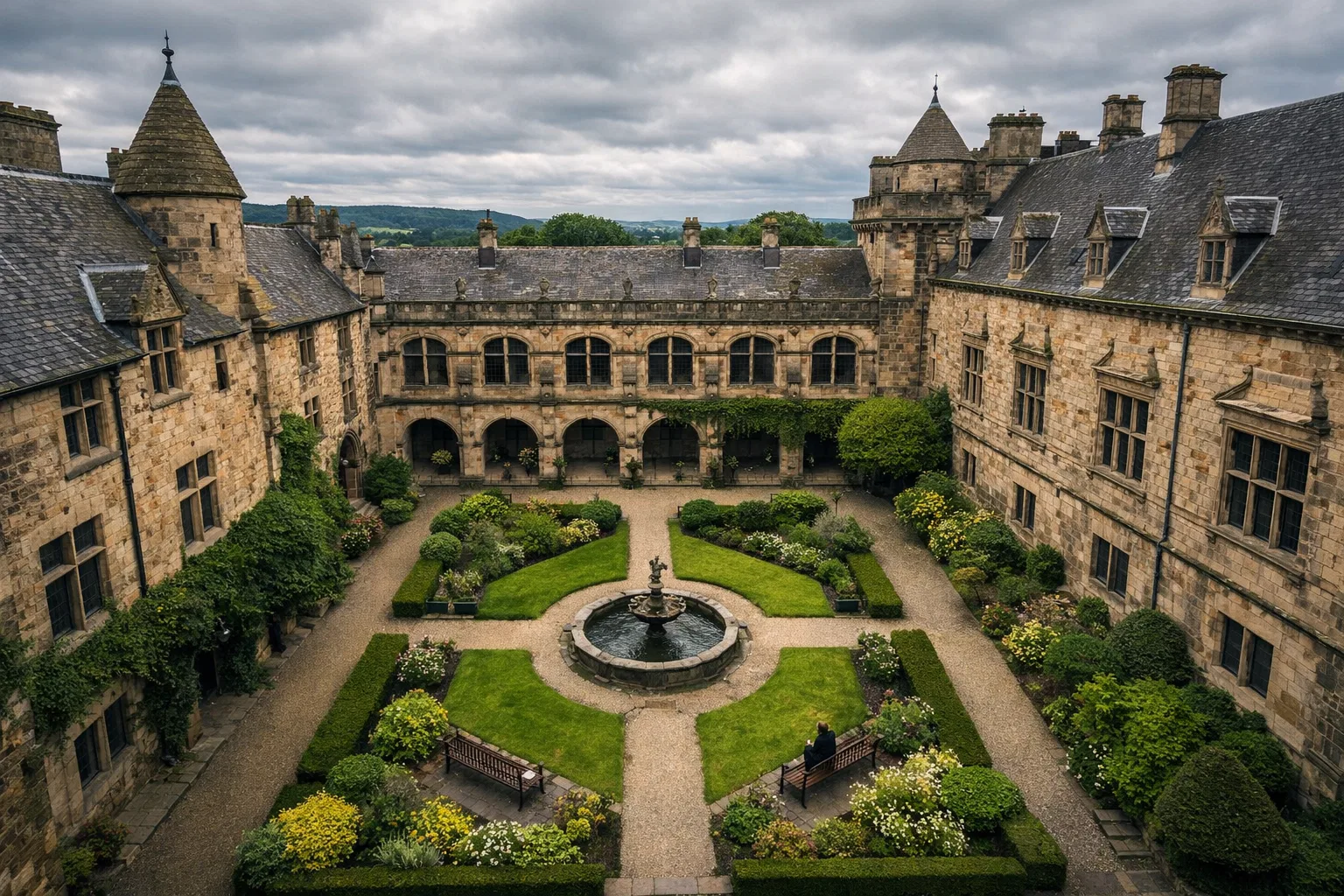
Falkland Palace stands in the town of Falkland in Fife, on the north side of the settlement beneath the Lomond Hills. Historic Environment Scotland describes the palace and gardens as lying between the A912 and the streets of Falkland, enclosed by high stone walls and set on a sandstone ridge overlooking the Howe of Falkland. That setting matters for the ghost tradition because Falkland does not present itself like a remote fortress on a cliff. It is a royal residence embedded in a village, with formal rooms, garden views and partial ruins folded into ordinary visitor routes.[Historic Environment Scotland]portal.historicenvironment.scotOpen source on historicenvironment.scot.
The National Trust for Scotland frames Falkland as a royal “pleasure palace” with a Victorian twist, inspired by French châteaux and transformed by successive Stuart royals into one of Scotland’s finest surviving Renaissance buildings. Its public highlights include Mary, Queen of Scots associations, carved interiors, paintings, furniture, gardens and one of Britain’s oldest original real tennis courts. This is important because the ghost stories do not float above an anonymous ruin; they are attached to named visitor spaces: the Tapestry Gallery, the Queen’s Room, the Chapel Royal, the East Range and the palace windows.[National Trust for Scotland]nts.org.ukNational Trust for Scotland Falkland Palace | National Trust for ScotlandNational Trust for Scotland Falkland Palace | National Trust for Scotland
Architecturally, the building itself helps explain why apparition stories settle where they do. The Historic Environment Scotland listing describes the palace as a formerly three-sided quadrangular structure, with the North Quarter reduced to foundations after fire damage, the East Quarter partly ruined, and the South Quarter refaced in the 1530s and early 1540s. The Cross House within the East Range was rebuilt from first-floor level upwards in the 1890s, while the East Quarter’s courtyard façade survived more substantially than the rest. In folklore terms, this gives Falkland the perfect haunted mixture: restored rooms that look inhabited, ruined sections that suggest loss, and architectural breaks where a figure can vanish “through a wall where once there was a door”.[Historic Environment Scotland]portal.historicenvironment.scotOpen source on historicenvironment.scot.

The Grey Lady and the Waiting Lover
The most visitor-friendly version of the Falkland haunting is the Grey Lady of the Tapestry Gallery. In the National Trust for Scotland’s “Ghosts of the Trust” account, the Grey Lady is said to frequent the gallery, pacing anxiously while waiting for her lover, a soldier who said farewell, rode off to battle and never returned. VisitScotland gives a similar tourism-facing version, describing a lady with a grey glow who mourns her dead soldier beloved, alongside reports of unexplained footsteps and sightings in the palace rooms, especially the Tapestry Gallery.[National Trust for Scotland]nts.org.ukNational Trust for Scotland Ghosts of the Trust | National Trust for ScotlandNational Trust for Scotland Ghosts of the Trust | National Trust for Scotland
What makes this story work is its emotional simplicity. It does not require the reader to know the details of Scottish dynastic politics. A woman waits. A man goes to war. The house preserves the waiting after the world that caused it has disappeared. That places Falkland’s Grey Lady within a much wider Scottish and British pattern of female castle apparitions: women in white, grey, green or black who are remembered through grief, betrayal, thwarted marriage, battle loss or unfinished loyalty. Historic Environment Scotland, writing about Stirling Castle’s ghost traditions, notes that female phantoms at historic sites often come colour-coded, with the “White Lady” motif appearing across many cultures and Scottish castle legends.[Historic Environment Scotland Blog]blog.historicenvironment.scotHistoric Environment Scotland Blog Ghost Stories from Stirling CastleHistoric Environment Scotland Blog Ghost Stories from Stirling Castle
Falkland’s version is gentler than many of Fife’s darker hauntings. There is no execution scene, no dungeon torture and no explicit curse in the core Grey Lady tale. Its power lies in repetition: pacing up and down, returning to the same gallery, looking for someone who will never come. This suits a palace associated with courtly movement. Galleries were places of walking, display, conversation and waiting; the ghost does what the architecture invites.
There is, however, an important source problem. National Trust for Scotland material is not perfectly consistent about the colour and location of Falkland’s female ghosts. One Trust article identifies the Tapestry Gallery figure as the Grey Lady. Another says the White Lady roams the Tapestry Gallery awaiting her lost lover, while the Grey Lady walks the ruined East Range and disappears through a former doorway. That contradiction does not destroy the tradition; it reveals how folklore behaves. Names, colours and precise locations can shift while the underlying motifs remain stable: a waiting woman, royal rooms, a gallery, ruined fabric and a disappearance into the building.[National Trust for Scotland]nts.org.ukNational Trust for Scotland Ghosts of the Trust | National Trust for ScotlandNational Trust for Scotland Ghosts of the Trust | National Trust for Scotland
Mary Queen of Scots in Palace Folklore
Mary, Queen of Scots is not just a historical footnote at Falkland. The palace’s whole public identity is bound up with her. The National Trust for Scotland describes Falkland as used and loved by Mary, and says she pursued falconry, hunting and tennis there; another Trust account calls it her “favourite sanctuary”, a place of leisure rather than defence. In that sense, Mary’s ghostly association has a stronger historical setting than many royal apparition tales: she really belongs in Falkland’s story.[National Trust for Scotland]nts.org.ukNational Trust for Scotland Falkland Palace | National Trust for ScotlandNational Trust for Scotland Falkland Palace | National Trust for Scotland
The Mary tradition also changes the mood of the haunting. At Holyrood, Lochleven or English imprisonment sites, Mary’s afterlife is usually linked to murder, captivity, abdication or execution. At Falkland, the emotional register is different. The remembered Mary is young, athletic and temporarily at ease: hunting in the park, playing tennis, moving through a court that had recently arrived from St Andrews. A National Trust reconstruction of a 1562 royal visit imagines the palace in turmoil as servants prepare for Mary’s return from the day’s sport, only months after she had landed at Leith from France.[National Trust for Scotland]nts.org.ukOpen source on nts.org.uk.
This is why Falkland’s Mary folklore feels unusually bittersweet. The palace preserves the idea of Mary before the worst of her story overtook her. The apparition, when mentioned in haunting lists, is not usually tied to a single dramatic sighting or named witness. It functions more as royal memory made spectral: the sense that a queen so strongly associated with the place might still be glimpsed, felt or imagined in the rooms where visitors are invited to “follow in her footsteps”.[National Trust for Scotland]nts.org.ukOpen source on nts.org.uk.
There is also a wider folklore reason Mary appears so often in ghost stories. She is one of the great magnetic figures of Scottish historical imagination: tragic queen, Catholic monarch, French-raised ruler, prisoner, mother of James VI and I, and executed rival of Elizabeth I. Spooky retellings across Britain attach her to many castles and houses, sometimes with strong historical links and sometimes with much looser claims. Falkland belongs near the stronger end of that spectrum because Mary’s presence at the palace is central to its documented heritage identity, even if the apparition reports themselves remain tradition rather than firm evidence.[National Trust for Scotland]nts.org.ukNational Trust for Scotland Falkland Palace | National Trust for ScotlandNational Trust for Scotland Falkland Palace | National Trust for Scotland
Why Rooms, Galleries and Windows Matter
The Tapestry Gallery is the heart of the haunting because it is already a room of looking, movement and atmosphere. The current Falkland tapestries are not surviving Stuart royal hangings; National Trust for Scotland conservation material says the set has been at Falkland since 1906, was made in Flanders in the 17th century, and depicts verdure hunting scenes that suit the palace’s history as a royal hunting lodge. That matters because a visitor standing in the gallery sees a layered reconstruction: old textiles, later collecting, restored palace space and Tudor-Stuart associations braided together. It is exactly the kind of room where the imagination supplies footsteps.[National Trust for Scotland]nts.org.ukOpen source on nts.org.uk.
The gallery also bridges the palace’s historical identity and its ghostly one. Falkland was built between 1501 and 1541 as a hunting retreat for James IV and James V; hunting, falconry, tennis and other sports were played there through the 16th century, and the palace later fell out of use once the Scottish court moved to London. The tapestries’ hunting scenes echo that older life, even though the textiles themselves arrived much later. The Grey or White Lady moving through this space becomes a figure caught between courtly splendour and historical absence.[National Trust for Scotland]nts.org.ukOpen source on nts.org.uk.
The ruined East Range adds a different kind of haunting. A restored gallery can feel inhabited; a ruined range feels interrupted. In the National Trust account that separates the figures, the Grey Lady is associated not with the Tapestry Gallery but with the East Range, where she disappears through a wall where a door once existed. This is one of the most revealing details in the Falkland cluster. It ties the apparition to architectural memory: the building remembers an entrance that the modern visitor may not immediately see.[National Trust for Scotland]nts.org.ukOpen source on nts.org.uk.
The Queen’s Room window completes the trio of haunted features. The same Trust account says sinister faces appear at the window of the Queen’s Room. This is not as narratively developed as the waiting lover story, but it is effective because windows are threshold points in ghost lore. They divide inside from outside, private from public, past from present. At Falkland, where visitors are constantly aware of looking into royal rooms and looking out to gardens, a face at a window turns heritage display into encounter.[National Trust for Scotland]nts.org.ukOpen source on nts.org.uk.
How Old and Credible Are the Accounts?
The strongest public sources for Falkland’s ghosts are modern heritage and tourism retellings rather than early witness depositions, parish records or psychical research case files. National Trust for Scotland articles preserve the main story cluster, while VisitScotland repeats the Grey Lady as part of a haunted-castles travel feature. These are useful sources for understanding what is now publicly said about the palace, but they do not prove that apparitions have occurred. They show a living heritage tradition rather than a documented paranormal case.[National Trust for Scotland]nts.org.ukNational Trust for Scotland Ghosts of the Trust | National Trust for ScotlandNational Trust for Scotland Ghosts of the Trust | National Trust for Scotland
That distinction is important. The historical palace is very well grounded: its Stuart use, Mary associations, tennis court, tapestries, restoration and architectural development are documented by heritage bodies. The ghost identities are much less securely pinned down. The unnamed lover, the soldier’s battle, the woman’s social status and the earliest form of the Grey Lady story are not clearly established in the public sources found for visitors. The tale is therefore best treated as palace folklore attached to a real royal setting, not as a historically verified biography of a dead woman.[National Trust for Scotland]nts.org.ukNational Trust for Scotland Falkland Palace | National Trust for ScotlandNational Trust for Scotland Falkland Palace | National Trust for Scotland
The internal inconsistency between “Grey Lady in the Tapestry Gallery” and “White Lady in the Tapestry Gallery, Grey Lady in the East Range” is especially useful for assessing credibility. In a courtroom sense, it weakens the account: the details do not settle into one fixed testimony. In a folklore sense, it is normal. Colour-coded ladies in old buildings often exchange attributes as stories are retold for guides, seasonal articles, local memory and tourism copy. The reliable claim is not “this precise woman has been identified”, but “Falkland has a persistent tradition of female apparitions associated with its gallery, ruined range and royal rooms”.[National Trust for Scotland]nts.org.ukNational Trust for Scotland Ghosts of the Trust | National Trust for ScotlandNational Trust for Scotland Ghosts of the Trust | National Trust for Scotland
A sceptical reading does not have to be dismissive. Falkland is full of the ingredients that make people expect ghosts: dim interiors, old textiles, portraits, creaking floors, restored rooms, ruined walls, partial architectural survival, royal tragedy by association and the knowledge that James V’s body lay in state in the Chapel Royal after his death in 1542. The same Trust ghost-story summary links the palace’s atmosphere to turbulence, the imprisonment and reputed starvation of the Duke of Rothesay in earlier Falkland Castle, the Cromwellian destruction, and James V’s funeral presence. Such material gives the haunting emotional depth, even where the apparition evidence remains anecdotal.[National Trust for Scotland]nts.org.ukOpen source on nts.org.uk.
Why Falkland’s Royal Ghosts Became Locally Memorable
Falkland’s ghosts are memorable because they soften and humanise a grand royal site. A palace can be admired from a distance as architecture; a haunting brings it closer. The Grey Lady is not a monarch or a general but a waiting woman. Mary is not only a queen of portraits and politics but a presence imagined in rooms where she relaxed. The faces in the Queen’s Room window turn formal heritage into the feeling of being watched back.
The stories also fit Falkland’s unusual place in Fife’s haunted geography. St Andrews offers ruined religious grandeur and Reformation violence; Balgonie and Wemyss carry castle-family apparitions; Culross and Kellie lean into domestic and lairdly interiors. Falkland’s distinct contribution is royal leisure haunted by absence. It was not primarily a fortress of last resort, as the National Trust’s visitor-services account notes, but a place of relaxation, hunting and sport — “the Balmoral of its time”. That makes its ghosts feel less like battlefield revenants and more like after-images of courtly life.[National Trust for Scotland]nts.org.ukOpen source on nts.org.uk.
The palace’s Victorian and 20th-century restoration history also shapes the haunting. National Trust material notes that Falkland had fallen into disrepair by the late 1600s, was saved from ruin in the 19th century by the 3rd Marquess of Bute, and has been cared for by the Trust since 1952. The tapestries, meanwhile, were purchased by Lord Ninian Crichton-Stuart and gifted to the Trust in 1952. In other words, the rooms visitors experience are preserved and curated spaces, not untouched survivals. Ghost stories thrive in exactly that tension between authenticity and reconstruction: the past is visibly present, but never wholly recoverable.[National Trust for Scotland]nts.org.ukOpen source on nts.org.uk.
What the Falkland Apparitions Reveal About Fife Folklore
Falkland Palace shows how Fife’s ghost stories often grow from specific architectural features rather than vague “haunted place” labels. Here the important anchors are the Tapestry Gallery, the East Range, the Queen’s Room window and the Chapel Royal. Each carries a different emotional charge: waiting, ruin, watching and royal mortality. Together they turn the palace into a haunted map.
The stories also show how royal history becomes folklore when it is filtered through rooms. Mary, Queen of Scots gives the palace glamour and tragedy by association, but the most durable ghost is not necessarily Mary herself. It is the anonymous lady who waits. That balance is revealing. Famous names attract visitors, yet folklore often gives its strongest emotional role to unnamed figures: the lover left behind, the servant, the lady at the window, the woman walking a passage after everyone else has gone.
For a careful reader, Falkland’s haunting is strongest when approached as layered tradition. The palace’s royal history is well evidenced. The specific apparitions are preserved mainly through modern heritage and tourism retellings. The contradictions in colour and location should be noticed, not hidden. But the stories remain valuable because they express what Falkland feels like: a Renaissance pleasure palace in Fife where restored rooms, old textiles and broken ranges make the royal past seem close enough to move.
Amazon book picks
Further Reading
Books and field guides related to Who Haunts Falkland Palace's Royal Rooms?. Use these as the next step if you want deeper reading beyond the article.


eBay marketplace picks
Marketplace Samples
Live-tested eBay searches with available results related to this page.



Endnotes
1.
Source: visitscotland.com
Title: Visit Scotland10 Most Haunted Castles in Scotland | Visit Scotland
Link:https://www.visitscotland.com/nl-nl/things-to-do/attractions/castles/haunted
2.
Source: ntswebstorage01.blob.core.windows.net
Title: NTS TP Mary Queen Scots
Link:https://ntswebstorage01.blob.core.windows.net/nts-web-assets-production/downloads/NTS_TP_Mary-Queen-Scots.pdf
3.
Source: nts.org.uk
Title: National Trust for Scotland Ghosts of the Trust | National Trust for Scotland
Link:https://www.nts.org.uk/stories/ghosts-of-the-trust
4.
Source: nts.org.uk
Link:https://www.nts.org.uk/stories/scottish-ghost-stories-witches-murder-and-folklore
5.
Source: nts.org.uk
Title: National Trust for Scotland Falkland Palace | National Trust for Scotland
Link:https://www.nts.org.uk/visit/places/falkland-palace
6.
Source: portal.historicenvironment.scot
Link:https://portal.historicenvironment.scot/apex/f?p=1505%3A300%3A%3A%3A%3A%3AVIEWTYPE%2CVIEWREF%3Adesignation%2CGDL00176
7.
Source: nts.org.uk
Link:https://www.nts.org.uk/stories/the-great-eight-at-falkland-palace-garden
8.
Source: portal.historicenvironment.scot
Link:https://portal.historicenvironment.scot/apex/f?p=1505%3A300%3A%3A%3A%3A%3AVIEWTYPE%2CVIEWREF%3Adesignation%2CLB8798
9.
Source: blog.historicenvironment.scot
Title: Historic Environment Scotland Blog Ghost Stories from Stirling Castle
Link:https://blog.historicenvironment.scot/2023/10/ghost-stories-from-stirling-castle/
10.
Source: nts.org.uk
Link:https://www.nts.org.uk/stories/mary-queen-of-scots-visit-to-falkland-palace
11.
Source: spookyisles.com
Title: mary queen of scots
Link:https://www.spookyisles.com/mary-queen-of-scots/
12.
Source: nts.org.uk
Link:https://www.nts.org.uk/stories/stitching-the-past-the-tale-of-the-falkland-tapestries
13.
Source: nts.org.uk
Link:https://www.nts.org.uk/stories/tapestries-travel-to-belgium-for-special-treatment
14.
Source: blog.historicenvironment.scot
Title: how mary of guise came to scotland
Link:https://blog.historicenvironment.scot/2022/02/how-mary-of-guise-came-to-scotland/
15.
Source: portal.historicenvironment.scot
Title: scot FALKLAN D PALACE
Link:https://portal.historicenvironment.scot/apex/f?p=1505%3A300%3A%3A%3A%3A%3AVIEWTYPE%2CVIEWREF%3Adesignation%2CLB8799
16.
Source: portal.historicenvironment.scot
Title: scot Falkland Palace (SM854)
Link:https://portal.historicenvironment.scot/apex/f?p=1505%3A300%3A%3A%3A%3A%3AVIEWTYPE%2CVIEWREF%3Adesignation%2CSM854
17.
Source: nts.org.uk
Title: sporting collections
Link:https://www.nts.org.uk/stories/sporting-collections
18.
Source: nts.org.uk
Link:https://www.nts.org.uk/visit/things-to-do/castles-in-scotland
19.
Source: nts.org.uk
Link:https://www.nts.org.uk/visit/places/falkland-palace/highlights/podcast
20.
Source: nts.org.uk
Link:https://www.nts.org.uk/stories/love-scotland-podcast-season-9
21.
Source: nts.org.uk
Link:https://www.nts.org.uk/stories/love-scotland-podcast-season-4
22.
Source: historicfalkland.scot
Title: Falkland Castle
Link:https://historicfalkland.scot/wiki/index.php?title=Falkland_Castle
23.
Source: aocarchaeology.com
Title: falkland palace
Link:https://www.aocarchaeology.com/news/article/falkland-palace
24.
Source: Wikipedia
Title: Falkland Palace
Link:https://en.wikipedia.org/wiki/Falkland_Palace
25.
Source: thecastlesofscotland.co.uk
Title: falkland palace
Link:https://www.thecastlesofscotland.co.uk/the-best-castles/grand-castles/falkland-palace/
26.
Source: historyhit.com
Title: Falkland Palace
Link:https://www.historyhit.com/locations/falkland-palace/
27.
Source: trove.scot
Link:https://www.trove.scot/place/29774
28.
Source: wikishire.co.uk
Title: Falkland Palace
Link:https://wikishire.co.uk/wiki/Falkland_Palace
Additional References
29.
Source: youtube.com
Link:https://www.youtube.com/watch?v=Yz3UZqjPQ5w
Source snippet
FALKLAND (Fife): Where History Meets Mystery & Spooky...
30.
Source: instagram.com
Link:https://www.instagram.com/p/DXzGAHmiLbz/
31.
Source: facebook.com
Link:https://www.facebook.com/100088539433942/videos/falkland-palace-was-one-of-mary-queen-of-scots-favourite-retreats-a-place-where-/1133693115458885/
32.
Source: instagram.com
Link:https://www.instagram.com/reel/DRNtX6ojU-V/
33.
Source: facebook.com
Link:https://www.facebook.com/DundeeRep/posts/ghost-post-4-claypotts-castlethe-spirit-of-a-white-lady-has-been-seen-on-numerou/10153100922307976/
34.
Source: facebook.com
Link:https://www.facebook.com/groups/424158421972977/posts/1440501523671990/
35.
Source: deadlive.co.uk
Link:https://deadlive.co.uk/haunted-scottish-castles-explore-ghostly-legends/
37.
Source: facebook.com
Link:https://www.facebook.com/TheRoyalEdinburghMilitaryTattoo/posts/have-you-met-the-grey-lady-her-legend-lingers-within-the-walls-of-edinburgh-cast/1258860682945902/
38.
Source: spookyscotland.net
Link:https://spookyscotland.net/mary-queen-of-scots/
Topic Tree