Within Haunted Buckinghamshire
Why Do the Hellfire Caves Feel Haunted?
West Wycombe's caves mix labour history, elite scandal, tourism and ghost stories into Buckinghamshire's most famous haunted landscape.
On this page
- Dashwood's tunnels and the chalk hill
- Paul Whitehead, Sukie and modern cave legends
- Tourism, scandal and sceptical readings
Page outline Jump by section
Introduction
The Hellfire Caves feel haunted because West Wycombe was deliberately built as a landscape of theatre: a chalk hill pierced by tunnels, a church and mausoleum above, a grand house across the valley, and a long afterlife of scandal, ghost tours and local legend. The best-known stories name two figures: Paul Whitehead, the poet and steward of Dashwood’s circle whose heart was placed in an urn at the mausoleum, and Sukie, usually described as a wronged young woman whose story belongs more to folklore than documentary history. The stronger evidence is not that ghosts have been proved, but that West Wycombe has turned real 18th-century poverty, elite performance and political scandal into Buckinghamshire’s most famous haunted visitor landscape. Historic England lists the cave entrance as part of Sir Francis Dashwood’s 18th-century scheme, with man-made caves running about a quarter of a mile under the hill and traditionally linked to Hell-Fire Club meetings.[Historic England]historicengland.org.ukHistoric England The Cave, West WycombeHistoric EnglandThe Cave, West Wycombe - 1332393 | Historic England…
Where the haunting begins in West Wycombe
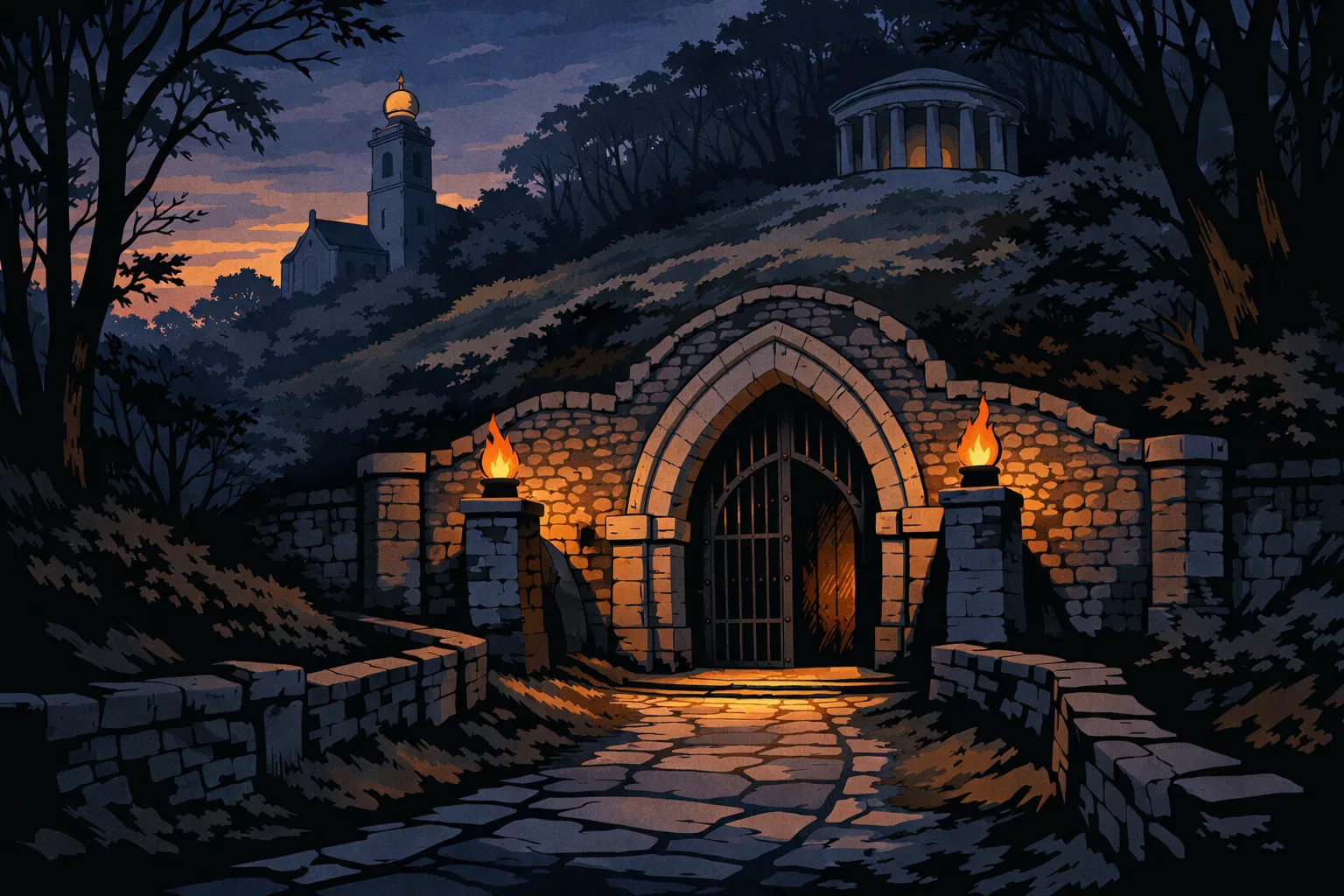
West Wycombe lies in the Chilterns near High Wycombe, and its haunted reputation is unusually concentrated in one visible arrangement: the caves cut into West Wycombe Hill, St Lawrence’s Church and the Dashwood Mausoleum above, and West Wycombe Park below. This matters because the ghost stories are not detached tales floating around an old building. They depend on the geography. Visitors can stand in the village, look up to the golden ball on the church tower and the mausoleum, then enter a tunnel system that seems to lead into a symbolic underworld.
The National Trust describes West Wycombe Park as one of the most theatrical of 18th-century English country houses, shaped by Francis Dashwood’s flamboyant tastes, classical interests and appetite for spectacle. Dashwood’s wider work included alterations to St Lawrence’s Church, the building of the family mausoleum and the creation of the Hellfire Caves in the mid-1700s.[National Trust]nationaltrust.org.ukNational Trust West Wycombe's history | Buckinghamshire | National TrustNational Trust West Wycombe's history | Buckinghamshire | National Trust The result is a haunted setting that was already dramatic before later ghost stories attached themselves to it.
Historic England’s listing gives the caves their firm architectural anchor. It dates the entrance to 1750–52, describes the flint retaining walls, arched niches and pointed doorway, and calls the caves one of the landscape features of Dashwood’s 18th-century scheme. It also records the traditional association with Hell-Fire Club meetings, carefully phrased as a “supposed” scene rather than a fully documented certainty.[Historic England]historicengland.org.ukHistoric England The Cave, West WycombeHistoric EnglandThe Cave, West Wycombe - 1332393 | Historic England… That cautious wording is useful: it allows the place to be read as history, performance and legend at once.
Dashwood’s tunnels and the chalk hill
The most repeated origin story is that the caves were dug partly as relief work. The National Trust says Dashwood had the caves built to relieve serious unemployment caused by three successive harvest failures between 1748 and 1750, and to provide material for a new main road between West Wycombe and High Wycombe.[National Trust]nationaltrust.org.ukNational TrustWest Wycombe Trail | BuckinghamshireHellfire Caves. Sir Francis Dashwood (2nd Baronet) had the caves built to relieve serio… The Chilterns National Landscape gives a similar practical explanation: in the early 1750s, Dashwood burrowed chalk out of West Wycombe Hill to supply material for straightening the main road, now the A40, and the resulting caves were extended into a curious estate feature.[Chilterns National Landscape]chilterns.org.ukChilterns National Landscape Sir Francis Dashwood | Chilterns National LandscapeChilterns National Landscape Sir Francis Dashwood | Chilterns National Landscape
That labour history is central to why the caves feel more substantial than a simple Halloween attraction. The tunnels are not merely a stage set for wealthy men’s jokes. They also represent local work, hard manual excavation, failed harvests and the improvement schemes of an aristocratic landowner. Subterranea Britannica, a specialist underground-sites organisation, describes the Hellfire Caves as an extensive folly constructed through chalk in the 1740s, commissioned by Sir Francis Dashwood, and notes that there had previously been an open-cast quarry on the site.[Subterranea Britannica]subbrit.org.ukSubterranea Britannica Hellfire Caves – Subterranea BritannicaSubterranea Britannica Hellfire Caves – Subterranea Britannica
The “folly” label is important. A folly is a building or landscape feature made partly for effect, symbolism or amusement rather than straightforward practical use. At West Wycombe, the caves seem to sit between categories. They were connected to road material and local employment, but they were also made strange, theatrical and suggestive. The BBC’s archived local-history feature puts it neatly: the caves may have been a mixture of philanthropy and folly, reflecting aristocratic ideals of the period.[BBC]bbc.co.ukOpen source on bbc.co.uk.
The hill itself deepens the effect. Country Life’s 2025 architectural reassessment describes Wycombe Hill as a dramatic focus of the views from the house, crowned by St Lawrence’s Church and its hollow golden ball, with the hexagonal mausoleum just below. It then places the caves halfway down the hill, with the banqueting hall and Inner Temple as part of the same landscape of “serious play”.[Country Life]countrylife.co.ukOpen source on countrylife.co.uk. In other words, the haunted atmosphere is not accidental. West Wycombe was designed to make visitors look, climb, descend and interpret.
The Hellfire Club: scandal, myth and what can be said safely
The popular version is simple: the caves were the secret home of the Hellfire Club, where aristocrats held blasphemous rites, drank heavily and mocked religion. The historical version is more complicated. The National Trust identifies Dashwood as the founder of the Order of the Knights of St Francis, also known as the Franciscans of Medmenham, one of several exclusive 18th-century social groups later gathered under the label “Hellfire Clubs”. It also notes his political career and his Grand Tour interests in Italy, Greece, Asia Minor and Russia, which shaped the classical architecture and landscaping at West Wycombe.[National Trust]nationaltrust.org.ukNational Trust West Wycombe's history | Buckinghamshire | National TrustNational Trust West Wycombe's history | Buckinghamshire | National Trust
That distinction matters because “Hellfire Club” is now a loaded name. The BBC notes that the Knights first met at Medmenham Abbey and were labelled a Hell-Fire club by contemporaries, although they did not use that name for themselves. It also stresses that little is known of their activities and that many surrounding stories are probably myth, even while accepting that the group likely met in the caves on occasion.[BBC]bbc.co.ukOpen source on bbc.co.uk.
Modern heritage writing has become more cautious about the most lurid claims. Country Life’s 2025 article argues that Dashwood’s reputation as a libertine and organiser of satanic rites was heavily shaped by political smears, satire and later repetition, especially around his unpopular period as Chancellor of the Exchequer in 1762–63. It does not present him as a puritanical figure, but it does challenge the lazy version in which every rumour is treated as proof.[Country Life]countrylife.co.ukOpen source on countrylife.co.uk.
For a haunted-history page, that caution makes the caves more interesting, not less. The supernatural atmosphere is partly produced by uncertainty. West Wycombe’s legends grow in the gap between what is documented, what was rumoured, what enemies exaggerated, what tourists wanted to hear, and what later paranormal culture amplified. The place became famous not because the evidence is clean, but because scandal, architecture and underground space reinforce each other so well.
Paul Whitehead, the missing heart and the oldest ghostly thread
Paul Whitehead is the strongest named figure in the cave legends because his story rests on a real and memorable historical detail. The Hellfire Caves’ own history page describes Whitehead as the poet and steward of the Hellfire Club, and records his bequest to Lord le Despencer: his heart and £50 for a marble urn to be placed in the mausoleum as a memorial of attachment.[The Hellfire Caves]hellfirecaves.co.ukOpen source on hellfirecaves.co.uk.
That is exactly the sort of fact from which ghost folklore grows. A heart separated from the body, placed in an urn, displayed in a mausoleum on a hill above a tunnel system associated with secretive aristocrats: the imagery almost writes the haunting for itself. Later versions commonly say that Whitehead’s ghost wanders the caves, hill or village searching for the missing heart.
The historian Jason M. Kelly, writing from his research into the Hellfire Club’s public reputation, gives the story an important chronology. He notes that ghost stories about West Wycombe were already circulating in 1781, when the ageing Francis Dashwood and servants on the estate reportedly claimed to have seen Whitehead’s ghost in the house and gardens. Kelly also describes how, as tourism grew at the turn of the 19th century, visitors were told ghost stories and were even allowed to hold Whitehead’s heart until it was stolen in 1829.[Jason M. Kelly]jasonmkelly.comJason M. Kelly Ghosts, Satanism, and 19th-Century Tourism at WestJason M. Kelly Ghosts, Satanism, and 19th-Century Tourism at West
This makes Whitehead different from many commercial ghost stories. The details still need care: the sightings are reported through later historical interpretation, and the emotional relationship between Whitehead and Dashwood is often embroidered by retellers. But the basic ingredients are early, local and connected to a named person, a physical object and a known tourist practice. In terms of folklore credibility, Whitehead’s legend is not evidence of an apparition, but it is strong evidence of a ghost tradition that became part of West Wycombe’s identity relatively early.
Sukie and the modern cave legend
Sukie, often spelt Suki or Sukie, is the other major resident ghost in modern accounts of the Hellfire Caves. She is usually described as a young woman connected with the village, sometimes a barmaid or servant, who was lured to the caves by a cruel trick and killed by thrown stones. In many retellings she becomes a white-clad female apparition seen near the Banqueting Hall or deeper parts of the cave route.
The official visitor operation now openly uses the legend as part of its paranormal offer. Its after-hours tour page says the caves are reputed to have resident ghosts including Suki, Paul Whitehead and other spectral figures, and markets the site as one of Britain’s haunted locations.[The Hellfire Caves]hellfirecaves.co.ukThe Hellfire Caves Tours & Guides — The Hellfire CavesThe Hellfire Caves Tours & Guides — The Hellfire Caves Commercial ghost-hunt companies repeat similar versions, often placing Sukie beside Whitehead and sometimes Benjamin Franklin in a modern paranormal cast list.[Haunted Rooms®]hauntedrooms.co.ukOpen source on hauntedrooms.co.uk.
Sukie’s story should be read more cautiously than Whitehead’s. The available versions are vivid, but they are usually presented as legend rather than as a documented inquest, parish record or contemporary newspaper case. The story also carries familiar folklore features: the betrayed young woman, the false message, the cruel prank, the sudden death, and the white figure who remains near the scene. Those features do not make the tale meaningless. They suggest that Sukie functions as the caves’ emotional ghost: a victim figure set against a landscape otherwise dominated by aristocratic men, secret clubs and performative excess.
In reader terms, Sukie answers a different question from Whitehead. Whitehead explains why the caves have an old, macabre, historically attached haunting. Sukie explains why modern visitors expect a personal, tragic apparition. Together they give the site its current ghost-story balance: one legend of elite intimacy and a stolen relic, one of vulnerability, betrayal and a restless young woman.
Why the caves work so well as a haunted place
The Hellfire Caves are among Buckinghamshire’s most effective haunted settings because they combine atmosphere with a legible route. A visitor does not merely enter a room and hear a story; they descend through chalk passages, pass named chambers, move towards an Inner Temple, and know that a church and mausoleum sit above. The route encourages symbolic reading: surface and underworld, church and cave, respectability and scandal, public estate and private ritual.
The names attached to the cave route deepen that symbolism. Accounts of the layout commonly refer to chambers associated with figures such as Whitehead, Lord Sandwich and Benjamin Franklin, along with the Banqueting Hall, the River Styx and the Inner Temple. Even when a visitor treats the ghost stories sceptically, the language borrows from classical underworld imagery and turns a chalk excavation into a journey through staged darkness.
There are also good non-paranormal reasons why people report unease in such places. Chalk tunnels can feel enclosed, cold, echoing and disorientating. Lighting changes the apparent depth of alcoves. The expectation of ghosts alters perception: once a visitor has been told about Whitehead, Sukie or secret rites, ordinary sounds and glimpses can be interpreted through that frame. This does not disprove individual experiences, but it explains why West Wycombe is unusually productive as a haunted attraction.
The strongest sceptical reading is not that the stories are “fake” and therefore worthless. It is that West Wycombe has always been a place of performance. Dashwood’s estate used classical references, follies, temples, caves, church architecture and scandalous humour to create meanings that visitors were expected to decode. Modern ghost tours continue that pattern, with paranormal language replacing some of the 18th-century classical and political jokes.
Tourism, scandal and local memory
West Wycombe’s haunted fame depends on tourism as much as on folklore. The caves were restored and reopened as a visitor attraction in the 20th century, and the official site still presents them as a place where visitors travel deep underground into the Chiltern Hills.[The Hellfire Caves]hellfirecaves.co.ukOpen source on hellfirecaves.co.uk. The National Trust’s wider West Wycombe material places the caves within a preserved village, park, hill and house, making the area a natural stop for people interested in atmospheric heritage rather than only ghost hunting.[National Trust]nationaltrust.org.ukNational Trust West Wycombe's history | Buckinghamshire | National TrustNational Trust West Wycombe's history | Buckinghamshire | National Trust
The 19th-century tourist layer is especially important. Kelly’s account of West Wycombe after the Hellfire circle had faded describes tourists coming for the famed gardens and walks of the “Monks”, while rumours of hauntings helped fuel interest. The idea that visitors could once handle Whitehead’s heart, before its reported theft, shows how macabre curiosity and heritage tourism were already intertwined long before modern ghost-hunt marketing.[Jason M. Kelly]jasonmkelly.comJason M. Kelly Ghosts, Satanism, and 19th-Century Tourism at WestJason M. Kelly Ghosts, Satanism, and 19th-Century Tourism at West
The scandal layer also keeps the place famous. Stories of secret meetings, mock monks, libertine behaviour and anti-clerical jokes are more durable than dry estate history. Yet the best recent writing urges restraint. The BBC’s archived piece says many stories around the club are probably myth, while Country Life argues that political enemies and commercial storytellers helped create the more extreme image of Dashwood and his circle.[BBC]bbc.co.ukOpen source on bbc.co.uk.
That is why the Hellfire Caves belong so centrally in Buckinghamshire’s haunted history. They are not just “spooky tunnels”. They are a place where several kinds of memory meet: agricultural hardship, elite leisure, political satire, anti-Catholic mockery, macabre relics, village tourism and modern paranormal entertainment. The legends have survived because each generation found a slightly different use for them.
How credible are the West Wycombe legends?
The fairest answer is mixed. The physical place is well evidenced. The caves, mausoleum, church and wider Dashwood landscape are documented by heritage bodies, official visitor material and specialist underground-history sources.[historicengland.org.uk]historicengland.org.ukHistoric England The Cave, West WycombeHistoric EnglandThe Cave, West Wycombe - 1332393 | Historic England… The association with Dashwood’s circle is also historically grounded, though the exact nature and frequency of meetings in the caves are more difficult to pin down.
Paul Whitehead’s legend has the strongest historical spine. He was a real person linked to Dashwood’s circle, his heart-in-an-urn bequest is recorded in cave history, and ghost stories about him appear to have been circulating by the late 18th and early 19th centuries.[The Hellfire Caves]hellfirecaves.co.ukOpen source on hellfirecaves.co.uk. That makes his haunting one of the more interesting Buckinghamshire ghost traditions, even if the sightings themselves remain claims rather than proof.
Sukie’s legend is weaker as documentary history but powerful as folklore. The story is widely repeated in modern paranormal and visitor contexts, but the readily available evidence usually treats her as a reputed ghost rather than a clearly verified historical victim. The official caves’ tour material names Suki among the resident ghosts, but it does so as part of a haunted-tour offer, not as archival proof of a death.[The Hellfire Caves]hellfirecaves.co.ukThe Hellfire Caves Tours & Guides — The Hellfire CavesThe Hellfire Caves Tours & Guides — The Hellfire Caves
The most credible reading is therefore layered. West Wycombe is genuinely historic, genuinely theatrical and genuinely rich in long-running ghost tradition. Its hauntings should not be presented as confirmed supernatural fact, but neither should they be dismissed as empty invention. They are part of how Buckinghamshire remembers a remarkable place: a hill where poverty, privilege, secrecy, performance and tourism all went underground.
Amazon book picks
Further Reading
Books and field guides related to Why Do the Hellfire Caves Feel Haunted?. Use these as the next step if you want deeper reading beyond the article.


Haunted Inns of Britain and Ireland
First published 2004. Subjects: Guidebooks, Haunted hotels.
Hell-Fire Clubs: A History of Anti-Morality
Directly addresses the Dashwood circle behind the Hellfire Caves.
eBay marketplace picks
Marketplace Samples
Live-tested eBay searches with available results related to this page.
Endnotes
1.
Source: historicengland.org.uk
Title: Historic England The Cave, West Wycombe
Link:https://historicengland.org.uk/listing/the-list/list-entry/1332393
Source snippet
Historic EnglandThe Cave, West Wycombe - 1332393 | Historic England...
2.
Source: nationaltrust.org.uk
Title: National Trust West Wycombe’s history | Buckinghamshire | National Trust
Link:https://www.nationaltrust.org.uk/visit/oxfordshire-buckinghamshire-berkshire/west-wycombe-park-village-and-hill/history-of-west-wycombe-park-village-and-hill
3.
Source: nationaltrust.org.uk
Link:https://www.nationaltrust.org.uk/visit/oxfordshire-buckinghamshire-berkshire/west-wycombe-park-village-and-hill/west-wycombe-trail
Source snippet
National TrustWest Wycombe Trail | BuckinghamshireHellfire Caves. Sir Francis Dashwood (2nd Baronet) had the caves built to relieve serio...
4.
Source: chilterns.org.uk
Title: Chilterns National Landscape Sir Francis Dashwood | Chilterns National Landscape
Link:https://www.chilterns.org.uk/map_marker/sir-francis-dashwood/
5.
Source: subbrit.org.uk
Title: Subterranea Britannica Hellfire Caves – Subterranea Britannica
Link:https://www.subbrit.org.uk/sites/hellfire-caves/
6.
Source: bbc.co.uk
Link:https://www.bbc.co.uk/legacies/heritage/england/beds_herts_bucks/article_3.shtml
7.
Source: countrylife.co.uk
Link:https://www.countrylife.co.uk/architecture/west-wycombe-park-the-neo-classical-country-seat-created-by-a-man-smeared-as-a-convenor-of-orgies-satanic-rites-and-a-leading-light-of-the-notorious-hellfire-club-of-18th-century-london
8.
Source: hellfirecaves.co.uk
Link:https://www.hellfirecaves.co.uk/history
9.
Source: jasonmkelly.com
Title: Jason M. Kelly Ghosts, Satanism, and 19th-Century Tourism at West
Link:https://jasonmkelly.com/jason-m-kelly/2013/09/02/ghosts-satanism-and-19th-century-tourism-at-west-wycombe
10.
Source: hellfirecaves.co.uk
Title: The Hellfire Caves Tours & Guides — The Hellfire Caves
Link:https://www.hellfirecaves.co.uk/toursguides
11.
Source: hauntedrooms.co.uk
Link:https://www.hauntedrooms.co.uk/hellfire-caves-ghost-hunts-buckinghamshire
12.
Source: facebook.com
Link:https://www.facebook.com/groups/796107227225506/posts/3329041650598705/
13.
Source: facebook.com
Title: the hellfire caves1750spresent west wycombe england paranormal realcase
Link:https://www.facebook.com/truemysteriesreels/posts/the-hellfire-caves1750spresent-west-wycombe-england-paranormal-realcase/122132700771139127/
14.
Source: Wikipedia
Title: Hellfire Caves
Link:https://en.wikipedia.org/wiki/Hellfire_Caves
15.
Source: Wikipedia
Title: West Wycombe Park
Link:https://en.wikipedia.org/wiki/West_Wycombe_Park
16.
Source: nationaltrust.org.uk
Link:https://www.nationaltrust.org.uk/visit/oxfordshire-buckinghamshire-berkshire/west-wycombe-park-village-and-hill/visiting-the-gardens-at-west-wycombe-park
17.
Source: nationaltrust.org.uk
Link:https://www.nationaltrust.org.uk/visit/oxfordshire-buckinghamshire-berkshire/west-wycombe-park-village-and-hill/things-to-do-in-west-wycombe-park-house
18.
Source: hellfirecaves.co.uk
Link:https://www.hellfirecaves.co.uk/
19.
Source: hellfirecaves.co.uk
Link:https://www.hellfirecaves.co.uk/paranormal-investigation
20.
Source: historicengland.org.uk
Title: list entry
Link:https://historicengland.org.uk/listing/the-list/list-entry/1160521
21.
Source: hellfiresecrets.wordpress.com
Title: ghosts satanism and 19th century tourism at west wycombe
Link:https://hellfiresecrets.wordpress.com/2013/09/02/ghosts-satanism-and-19th-century-tourism-at-west-wycombe/
22.
Source: hellfiresecrets.wordpress.com
Title: paul whitehead
Link:https://hellfiresecrets.wordpress.com/tag/paul-whitehead/
23.
Source: hellfiresecrets.wordpress.com
Link:https://hellfiresecrets.wordpress.com/tag/sukie/
24.
Source: ghostfables.wordpress.com
Title: the hellfire caves
Link:https://ghostfables.wordpress.com/2013/08/14/the-hellfire-caves/
25.
Source: ancaslifestyle.co.uk
Title: Hellfire Caves
Link:https://ancaslifestyle.co.uk/hellfire-caves/
26.
Source: heritagexplore.com
Title: Hellfire Caves
Link:https://www.heritagexplore.com/houses/hellfire-caves/
27.
Source: burialsandbeyond.com
Title: The Hellfire Caves: Sex, Drugs and Darkness
Link:https://burialsandbeyond.com/2022/08/29/the-hellfire-caves-sex-drugs-and-darkness/
28.
Source: thelittlehouseofhorrors.com
Title: the hellfire caves
Link:https://thelittlehouseofhorrors.com/the-hellfire-caves/
29.
Source: westwycombevillage.co.uk
Title: dashwood mausoleum
Link:https://www.westwycombevillage.co.uk/dashwood-mausoleum/
30.
Source: wikishire.co.uk
Title: Hellfire Caves
Link:https://wikishire.co.uk/wiki/Hellfire_Caves
31.
Source: dandlwandering10.blogspot.com
Title: west wycombe
Link:https://dandlwandering10.blogspot.com/2015/07/west-wycombe.html
Additional References
32.
Source: youtube.com
Title: Mysteries of the Hellfire Caves | Secret Society and Ghostly Sightings
Link:https://www.youtube.com/watch?v=yhbAM_rnJCU
Source snippet
Dashwood Mausoleum and The Hellfire Caves...
33.
Source: youtube.com
Title: Black Masses, Debauchery, and Scandal with the Hellfire Club
Link:https://www.youtube.com/watch?v=yqcZkiHIObY
Source snippet
Exploring the Hellfire Caves | Home of the Hellfire Club...
34.
Source: facebook.com
Link:https://www.facebook.com/MarqEnglishVlogger/posts/a-return-to-the-infamous-hellfire-caves-i-have-returned-to-one-of-the-most-uniqu/1025031342864891/
35.
Source: facebook.com
Link:https://www.facebook.com/groups/uncannyfan/posts/2264510757358876/
36.
Source: facebook.com
Link:https://www.facebook.com/groups/957741139593445/posts/1275024691198420/
37.
Source: instagram.com
Link:https://www.instagram.com/p/DY9wPF8CLv3/
38.
Source: brocarde.com
Link:https://brocarde.com/ghosts-that-haunt-the-hellfire-caves-in-west-wycombe/
39.
Source: facebook.com
Link:https://www.facebook.com/groups/vintageweird/posts/318007152198938/
40.
Source: facebook.com
Link:https://www.facebook.com/groups/highwycombe/posts/10168822890945058/
41.
Source: westwycombeparishcouncil.gov.uk
Link:https://westwycombeparishcouncil.gov.uk/history-of-west-wycombe.php
Topic Tree