Within Haunted Shetland
How Witchcraft Fear Shaped Shetland's Dark Folklore
Shetland's witchcraft traditions preserve fear, accusation and remembered injustice from the wider Scottish witch-hunt period.
On this page
- The 17 th century witch hunt context
- Household charms, steel and silver protections
- Why witchcraft memory belongs in haunted history
Page outline Jump by section
Introduction
Shetland’s witchcraft memory is not a simple story of broomsticks and Halloween imagery. It is a darker local history in which 17th-century fear, neighbourly suspicion, sea danger, illness, failed cattle, folk healing and official punishment became tangled together. Between about 1615 and 1680, Shetland experienced the same witch-hunt anxiety that affected much of Scotland and northern Europe, but in a distinctly island form: accusations often turned on drowned fishermen, trows in kirkyards, cursed livestock, stolen milk profit and charms used around the household.[Shetland Museum & Archives]shetlandmuseumandarchives.org.ukShetland Museum & Archives Witchcraft in Shetland | Shetland Museum & ArchivesShetland Museum & Archives Witchcraft in Shetland | Shetland Museum & Archives
For haunted-history readers, this matters because Shetland’s witchcraft traditions are less about “haunted houses” than about haunted memory. Scalloway Castle, Gallow Hill, Hillswick, Eshaness, Fetlar, Delting and Yell are not just atmospheric places on a map; they are attached to stories of people accused, tried, executed or later remembered through folklore, museum displays, local writing and modern memorials.[scallowaymuseum.org]scallowaymuseum.orgSCALLOWAY MUSEUMScalloway CastleSCALLOWAY MUSEUM…
The 17th-century fear behind Shetland’s witch stories
Shetland’s witch-hunt period sits inside Scotland’s wider early modern crisis of witchcraft belief. The Scottish Witchcraft Act of 1563 made witchcraft a capital offence, and Historic Environment Scotland describes the Act as part of a post-Reformation drive by Church and government to enforce “godliness” and root out people believed to be in league with the Devil.[Historic Environment Scotland Blog]blog.historicenvironment.scotOpen source on historicenvironment.scot.
In Shetland, the surviving stories show how that national framework was translated into local fears. The Shetland Museum and Archives dates the islands’ witchcraft panic broadly from around 1615 to 1680, noting that Shetlanders and their superiors “suddenly began to worry about ‘witches’”. The first major Shetland witch trial identified in that account took place in 1616, after the fall of Earl Patrick Stewart’s administration and the arrival of a new regime at Scalloway.[Shetland Museum & Archives]shetlandmuseumandarchives.org.ukShetland Museum & Archives Witchcraft in Shetland | Shetland Museum & ArchivesShetland Museum & Archives Witchcraft in Shetland | Shetland Museum & Archives
That change of power is important. The accusations were not merely private gossip; they were heard in a legal and political setting. Scalloway Castle, built for Earl Patrick Stewart and used as a seat of power in Shetland, is remembered locally as a place where witch trials were often held in the great hall during the 1600 to 1650 period. Convicted people were then taken to Gallow Hill, west of the village, where Scalloway Museum says they were strangled or hanged and their bodies burned nearby.[SCALLOWAY MUSEUM]scallowaymuseum.orgSCALLOWAY MUSEUMScalloway CastleSCALLOWAY MUSEUM…
This is why Shetland witchcraft belongs in the island’s haunted landscape. The fear was not abstract. It had rooms, roads, hills and bodies attached to it.
Scalloway, Gallow Hill and remembered injustice
Scalloway is the strongest geographical anchor for Shetland’s witchcraft memory. It links administration, trial, execution and modern remembrance in one compact landscape: the castle where power was exercised, the hill where condemned people were killed, and the later community effort to mark the victims.
In 2024, a memorial was erected on Scalloway’s Gallow Hill to commemorate those killed in Shetland’s 17th-century witchcraft trials. Shetland News reported that the memorial stands where the last woman accused of witchcraft was burned in the early 1700s, and that Barbara Tulloch and her daughter Helen are remembered as the last recorded executions in Shetland.[Shetland News]shetnews.co.ukOpen source on shetnews.co.uk.
The article also records a revealing local detail: organisers described Gallow Hill as a burial site in its own right, because the people killed there had no ordinary grave. One organiser pointed to a layer of peat ash on the ground as evidence of a large peat fire, while archivist Brian Smith welcomed the memorial as recognition of women and men accused of a crime “that of course does not exist”.[Shetland News]shetnews.co.ukOpen source on shetnews.co.uk.
That modern language changes the tone of the story. Older folklore might speak of witches as dangerous supernatural figures; modern Shetland memory increasingly treats them as victims of fear, legal violence and social accusation. For a haunted-history page, the haunting is therefore double: the supernatural fear people once believed in, and the historical injustice now remembered at the place where executions took place.
Accusations shaped by island life
Shetland’s witchcraft accusations often reveal what island communities feared most: danger at sea, fragile livestock, household survival and unseen forces moving between people and place.
The 1616 cases described by Shetland Museum and Archives are vivid examples. Catherine Johnson of Stenness in Eshaness was accused of long association with the Devil and of speaking with trows in the kirkyards of Hillswick and Stenness. Jonka Dynneis, linked with Fetlar, Aith and Hillswick, was connected in testimony with a husband in danger offshore and later with a curse after a quarrel, followed by a man’s death at sea. Barbara Thomasdochter of Delting was accused both of healing and of more harmful magic, including a charm called a “resting thread” used for a man suffering severe insomnia.[Shetland Museum & Archives]shetlandmuseumandarchives.org.ukShetland Museum & Archives Witchcraft in Shetland | Shetland Museum & ArchivesShetland Museum & Archives Witchcraft in Shetland | Shetland Museum & Archives
These stories show the Shetland pattern clearly. The accusations do not float free from ordinary life. They attach themselves to fishing trips, sleep, sexuality, cattle, neighbourly conflict and churchyards. A person could be feared because a cure seemed to work, because a curse appeared to be followed by misfortune, or because an old story placed them too close to trows, the supernatural hill-folk of Shetland tradition.
The cases also show why these accounts must be read carefully. They preserve what courts and communities alleged, not proof that the accused did anything supernatural. Shetland Museum’s account explicitly describes some charges as “preposterous”, and records that the 1616 defendants were found guilty by a jury before being taken to the hill of Houll, strangled and burned.[Shetland Museum & Archives]shetlandmuseumandarchives.org.ukShetland Museum & Archives Witchcraft in Shetland | Shetland Museum & ArchivesShetland Museum & Archives Witchcraft in Shetland | Shetland Museum & Archives
Marion Pardone and the sea as supernatural evidence
Marion Pardone is one of the most memorable figures in Shetland’s witchcraft memory because her story ties accusation to the sea. Shetland.org describes her as a Shetland woman executed in 1644 under the Witchcraft Act of 1563, accused of acts of sorcery and demonology, including an allegation that she drowned four fishermen in fair weather near Hillswick while disguised as a porpoise.[Shetland.org]shetland.orgDa Fateful Tale o Marion Pardone: Witchcraft in Shetland | Shetland.orgDa Fateful Tale o Marion Pardone: Witchcraft in Shetland | Shetland.org
The detail is striking because it feels deeply Shetlandic. In an island community, unexplained death at sea demanded explanation. A fair-weather drowning was especially disturbing because it seemed to violate ordinary expectations. Witchcraft supplied a terrifying answer: the sea had not simply taken men by chance; someone had willed it.
Modern retellings of Marion Pardone’s story are careful to separate memory from endorsement. Claire White’s 2024 account of creating a song and short film about Marion explains that the lyrics drew on trial papers and accusations, but says this was not to endorse the testimony against her. The same article links the film to the new memorial at Scalloway’s Gallow Hill and to a wider movement to remember people unjustly executed for a non-existent crime.[Shetland.org]shetland.orgDa Fateful Tale o Marion Pardone: Witchcraft in Shetland | Shetland.orgDa Fateful Tale o Marion Pardone: Witchcraft in Shetland | Shetland.org
For haunted-history readers, Marion’s story is powerful not because it proves shapeshifting or sea magic. It is powerful because it shows how a community under pressure could turn grief, coincidence and fear into a fatal supernatural narrative.
Household charms, steel and silver protections
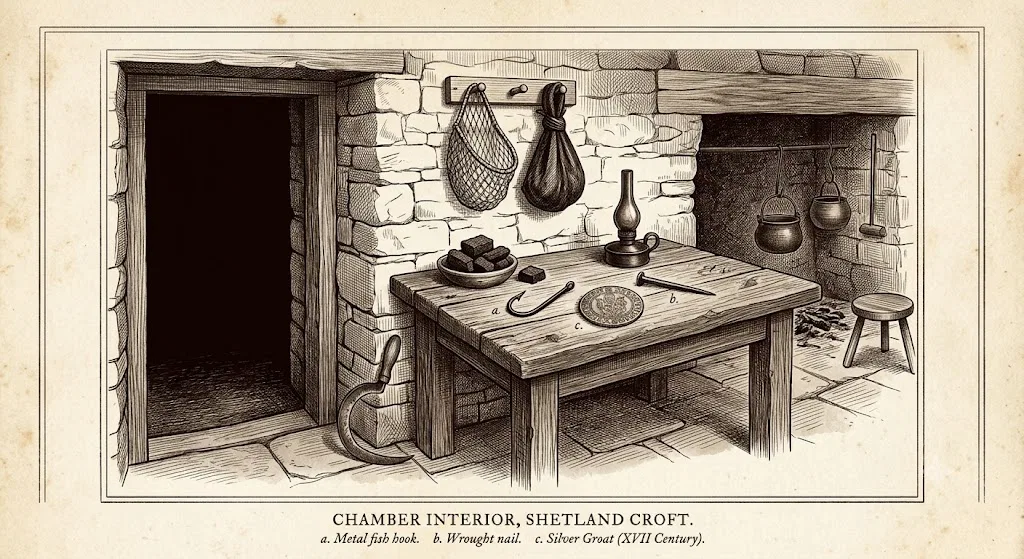
Shetland witchcraft memory also survives in the small protective habits of everyday life. These are not ghost stories in the narrow sense, but they belong to the same haunted world: a world in which the home, byre, churn, cow tether and door threshold all needed guarding.
Shetland Museum and Archives’ folklore gallery explicitly includes customs and superstition around births, marriages, deaths, witchcraft, the supernatural and language. Among its highlights are sickles, described as everyday tools with an extra use to ward off witches.[Shetland Museum & Archives]shetlandmuseumandarchives.org.ukShetland Museum & Archives Customs and Folklore | Shetland Museum & ArchivesShetland Museum & Archives Customs and Folklore | Shetland Museum & Archives
That detail matters because it shows how supernatural fear was handled practically. A sickle was not a theatrical magical object; it was a farm tool. Its protective value came from the belief that metal, sharpness and household placement could resist harm. Across Scottish folk practice more widely, National Museums Scotland notes that people used charms and special materials to cure or ward off illness and death, in a world where misfortune could be understood as having supernatural as well as natural causes.[National Museums Scotland]nms.ac.ukOpen source on nms.ac.uk.
In Shetland folklore, the fear was especially strong around dairy work. John Spence’s Shetland Folk-Lore, preserved on Wikisource, says that around Johnsmas, witchcraft was most dreaded because witches were believed to steal the “profit” of milk and butter. Housewives avoided lending domestic utensils at sensitive times, especially when a cow was about to calve, and even simple actions such as stepping over a cow’s tether or taking grass from a byre wall could be imagined as magical theft.[Wikisource]en.wikisource.orgShetland Folk-Lore/Folk-LoreShetland Folk-Lore/Folk-Lore
The same source preserves elaborate counter-charms involving nettles, metal needles, flint, steel, tinder, a kirkyard and the byre. In one recorded rite, needles were fixed into cloth in the form of a cross, and the charm’s aim was not wealth but the return of “luck” to the cows.[Wikisource]en.wikisource.orgShetland Folk-Lore/Folk-LoreShetland Folk-Lore/Folk-Lore
To modern readers, these rituals may seem strange. In context, they are a window into insecurity. A cow’s milk was food, income and survival. When it failed, supernatural explanation gave people both a culprit and a remedy.

Trows, witches and the blurred edge of folklore
Shetland witchcraft memory is unusually intertwined with trow folklore. Trows were not ghosts of the dead, but in Shetland tradition they inhabited a neighbouring supernatural world of mounds, kirkyards, music, livestock and night movement. The Shetland Museum folklore gallery includes a reconstructed “trowie knowe”, while its witchcraft account records Catherine Johnson being accused of speaking with trows in kirkyards.[Shetland Museum & Archives]shetlandmuseumandarchives.org.ukShetland Museum & Archives Customs and Folklore | Shetland Museum & ArchivesShetland Museum & Archives Customs and Folklore | Shetland Museum & Archives
This overlap helps explain why Shetland’s haunted traditions feel different from many mainland ghost stories. A haunted castle tale may centre on an apparition in a corridor. A Shetland witchcraft tale may centre on a woman said to talk with trows, a cow believed to be elf-shot, a byre protected with metal, or a person accused of raising trows to harm crops or neighbours.
Shetland News reported that accusations behind the Scalloway executions included raising trows, crop failure and consorting with the Devil. Hidden Scotland’s account similarly notes accusations of summoning trows, causing boats to come into danger at sea and stealing the profit from the byre.[Shetland News]shetnews.co.ukOpen source on shetnews.co.uk.
That mixture is crucial. The legal language of witchcraft, especially after the 1563 Act, leaned towards demonic crime. The local imagination, however, preserved older and more domestic fears: hill-folk, milk theft, animal wasting, sea luck and harmful words. Shetland’s dark folklore lives in the space between those systems.
Why ordinary skills could become suspicious
One of the most unsettling features of witchcraft history is that helpful knowledge could be reframed as dangerous power. Barbara Thomasdochter’s “resting thread” is a good example. In the Shetland Museum account, she used crosses and conjurations over a thread to help a man with insomnia, and the remedy was said to have worked. Yet the same kind of practice could be interpreted as proof of witchcraft.[Shetland Museum & Archives]shetlandmuseumandarchives.org.ukShetland Museum & Archives Witchcraft in Shetland | Shetland Museum & ArchivesShetland Museum & Archives Witchcraft in Shetland | Shetland Museum & Archives
This ambiguity appears across Scottish witchcraft history. Historic Environment Scotland notes that the 1563 Act did not clearly define what a witch was or what counted as witchcraft, which allowed communities and authorities to identify witches through testimony, suspicion and alleged signs. It also explains that neighbours’ testimonies could arise from quarrels and that accusations could spread when one accused person named others.[Historic Environment Scotland Blog]blog.historicenvironment.scotOpen source on historicenvironment.scot.
In Shetland, where isolated settlements depended on practical knowledge of weather, animals, illness and childbirth, a person with unusual skill could be valued one year and feared the next. A healer, charm-worker or sharp-tongued neighbour might become vulnerable if misfortune followed a dispute.
This is one reason modern interpretation should avoid romanticising accused witches as powerful occult figures. Some may have practised folk healing or charms; some may simply have been unpopular, poor, old, widowed, outspoken or unlucky. The historical damage came from a society prepared to treat suspicion as evidence.
From fear to folklore memory
By the late 17th and early 18th centuries, official attitudes were changing. Shetland Museum and Archives states that soon after 1680 the authorities realised witchcraft was “bunkum”; later alleged cases in Sandness were investigated by the Presbytery of Shetland, but witchcraft had ceased to be a capital matter and the parties went free. The same account notes an 1883 Yell case in which someone was accused of “witching” a boat, but by then such accusations drew laughter in court.[Shetland Museum & Archives]shetlandmuseumandarchives.org.ukShetland Museum & Archives Witchcraft in Shetland | Shetland Museum & ArchivesShetland Museum & Archives Witchcraft in Shetland | Shetland Museum & Archives
That shift did not erase belief overnight. Instead, witchcraft moved from capital crime into folklore, family memory, museum interpretation, songs, local history and eerie storytelling. The fear lost its legal force, but its images remained: trows in graveyards, a cursed boat, milk stolen from the byre, a charm hidden in household practice, a hill where bodies were burned.
This is the point at which witchcraft memory becomes part of haunted history. It is not necessary to claim that Scalloway Castle or Gallow Hill is haunted by named apparitions for the places to feel haunted. They are haunted by record, atmosphere and remembrance: by the knowledge that supernatural fear once had lethal consequences there.
How credible are the sources?
Shetland witchcraft stories survive through several different kinds of evidence, and they do not all carry the same weight.
The strongest anchors are institutional and archival sources: Shetland Museum and Archives, Scalloway Museum, Historic Environment Scotland, the University of Edinburgh’s Survey of Scottish Witchcraft project, and local reporting on the Scalloway memorial. These sources support the broad historical frame: the Witchcraft Act, the period of prosecutions, the use of Scalloway Castle and Gallow Hill, and named cases preserved in trial material or later historical discussion.[historicenvironment.scot]blog.historicenvironment.scotOpen source on historicenvironment.scot.
Folklore sources such as Shetland Folk-Lore are valuable for understanding belief, ritual and fear, but they should not be read as neutral records of events. They tell us what people said, remembered, performed or believed about witches, trows and household protection. They are excellent evidence for supernatural imagination, not proof that supernatural harm occurred.[Wikisource]en.wikisource.orgShetland Folk-Lore/Folk-LoreShetland Folk-Lore/Folk-Lore
Modern cultural retellings, such as the Marion Pardone song and film, are another layer again. They show how Shetland is now reworking witchcraft memory as injustice, heritage and artistic remembrance. They are not substitutes for trial records, but they are important evidence for how the story is being publicly remembered today.[Shetland.org]shetland.orgDa Fateful Tale o Marion Pardone: Witchcraft in Shetland | Shetland.orgDa Fateful Tale o Marion Pardone: Witchcraft in Shetland | Shetland.org
Why witchcraft memory belongs in Shetland’s haunted history
Shetland’s witchcraft memory belongs in haunted history because it explains a kind of fear that ordinary ghost stories often miss. It shows how the supernatural once entered the kitchen, the byre, the fishing boat, the court room and the execution place.
The central question is not whether witches, trows or shapeshifters were real. A careful haunted-history approach asks something more useful: what did people fear, who paid the price, and why did these stories last?
In Shetland, the answer is stark. People feared the sea taking men without warning. They feared cattle failing, milk spoiling, illness lingering, sleep disappearing and neighbours cursing them. They feared unseen beings in kirkyards and mounds. Authorities then turned some of those fears into prosecutions, and accused people were executed at places still identifiable in the landscape.[shetlandmuseumandarchives.org.uk]shetlandmuseumandarchives.org.ukShetland Museum & Archives Witchcraft in Shetland | Shetland Museum & ArchivesShetland Museum & Archives Witchcraft in Shetland | Shetland Museum & Archives
That makes Shetland’s witchcraft traditions more than a sidebar to ghost tourism. They are part of the emotional map of the islands: a reminder that some of the darkest hauntings are not apparitions at all, but memories of what fear can make a community do.
Amazon book picks
Further Reading
Books and field guides related to How Witchcraft Fear Shaped Shetland's Dark Folklore. Use these as the next step if you want deeper reading beyond the article.

Scottish Witches and Witch-Hunters
Provides the essential context for Shetland's witch trials and beliefs.

The visions of Isobel Gowdie
Explores Scottish witch beliefs, fairy encounters and early modern culture.

The Penguin book of witches
Offers wider historical context for European witchcraft beliefs.

eBay marketplace picks
Marketplace Samples
Live-tested eBay searches with available results related to this page.

Endnotes
1.
Source: scallowaymuseum.org
Title: SCALLOWAY MUSEUMScalloway Castle
Link:https://www.scallowaymuseum.org/scalloway-castle.html
Source snippet
SCALLOWAY MUSEUM...
2.
Source: shetland.org
Title: Da Fateful Tale o Marion Pardone: Witchcraft in Shetland | Shetland.org
Link:https://www.shetland.org/blog/da-fateful-tale-o-marion-pardone-witchcraft-in-shetland
3.
Source: en.wikisource.org
Title: Shetland Folk-Lore/Folk-Lore
Link:https://en.wikisource.org/wiki/Shetland_Folk-Lore/Folk-Lore
4.
Source: shetland.org
Title: spooky tales from shetland
Link:https://www.shetland.org/blog/spooky-tales-from-shetland
5.
Source: en.wikisource.org
Link:https://en.wikisource.org/wiki/User%3AAndreas/Sandbox2
6.
Source: shetlandmuseumandarchives.org.uk
Title: Shetland Museum & Archives Witchcraft in Shetland | Shetland Museum & Archives
Link:https://www.shetlandmuseumandarchives.org.uk/blog/shetland-witches
7.
Source: blog.historicenvironment.scot
Link:https://blog.historicenvironment.scot/2022/06/the-witchcraft-act-and-its-impact-in-scotland/
8.
Source: shetnews.co.uk
Link:https://www.shetnews.co.uk/2024/04/07/new-memorial-scalloway-remembers-victims/
9.
Source: shetlandmuseumandarchives.org.uk
Title: Shetland Museum & Archives Customs and Folklore | Shetland Museum & Archives
Link:https://www.shetlandmuseumandarchives.org.uk/visit/galleries/customs-and-folklore
10.
Source: nms.ac.uk
Link:https://www.nms.ac.uk/discover-catalogue/from-amulets-to-elf-bolts-10-scottish-charms
11.
Source: shetlandmuseumandarchives.org.uk
Title: 2024 05 23t21 08 32 01 00
Link:https://www.shetlandmuseumandarchives.org.uk/events/smaa-archive/2024-05-23t21
12.
Source: Wikipedia
Title: Survey of Scottish Witchcraft
Link:https://en.wikipedia.org/wiki/Survey_of_Scottish_Witchcraft
13.
Source: spookyscotland.net
Link:https://spookyscotland.net/trow/
Additional References
14.
Source: youtube.com
Link:https://www.youtube.com/watch?v=RkqTQLdvrdQ
Source snippet
'Very Superstitious' Shetland Folklore Stories for Scotland's Year of Stories 2022...
15.
Source: youtube.com
Link:https://www.youtube.com/watch?v=PbuOKvMxymo
Source snippet
Spooky Shetland Part 2 - Njuggles, Brigdis, Selkies, Finns and more...
16.
Source: instagram.com
Link:https://www.instagram.com/p/DTe83PUimv4/
17.
Source: uodiyala.edu.iq
Link:https://uodiyala.edu.iq/uploads/PDF%20ELIBRARY%20UODIYALA/EL34/Dictionary%20of%20plant%20lore.pdf
18.
Source: rcpe.ac.uk
Link:https://www.rcpe.ac.uk/sites/default/files/e_b_jamieson.pdf
19.
Source: nationalarchives.gov.uk
Link:https://www.nationalarchives.gov.uk/education/resources/early-modern-witch-trials/
20.
Source: rcn.org.uk
Link:https://www.rcn.org.uk/-/media/RCN-Foundation/Documents/Witches-Project—Witch-List.pdf?hash=61AEA542FDCF3949860D7957700A93D5&la=en
21.
Source: electricscotland.com
Link:https://electricscotland.com/history/waifs/FolkMedicine..pdf
22.
Source: archive.org
Link:https://archive.org/stream/countyfolklore03folkuoft/countyfolklore03folkuoft_djvu.txt
23.
Source: researchgate.net
Link:https://www.researchgate.net/profile/Adam-Grydehoj/publication/230667855_Historiography_of_Picts_Vikings_Scots_and_Fairies_and_Its_Influence_on_Shetland%27s_Twenty-First_Century_Economic_Development/links/09e41502b76e0245ec000000/Historiography-of-Picts-Vikings-Scots-and-Fairies-and-Its-Influence-on-Shetlands-Twenty-First-Century-Economic-Development.pdf
Topic Tree