Why Does Fife Feel So Haunted?
Fife’s haunted reputation is built less on one spectacular “most haunted” claim than on a chain of atmospheric places: ruined church towers at St Andrews, royal rooms at Falkland, restored lairdly houses such as Kellie and Culross, coastal castles at Wemyss and Balgonie, and later Gothic ruins such as Crawford Priory.
Page outline Jump by section
Introduction
For this UK haunted-history project, Fife is treated as the historic county shown in the Wikishire-derived historic-county mapping, broadly corresponding to the Kingdom of Fife rather than simply a modern tourism label. Wikimedia Commons’ locator for historic Fifeshire identifies it as “Historic Fifeshire (Fife County) in Scotland” and derives from the wider British Isles historic-counties map used as the project’s geographic index.[Wikimedia Commons]commons.wikimedia.orgFile:Fifeshire locator map.svgFile:Fifeshire locator map.svg
Where Fife’s ghost stories cluster
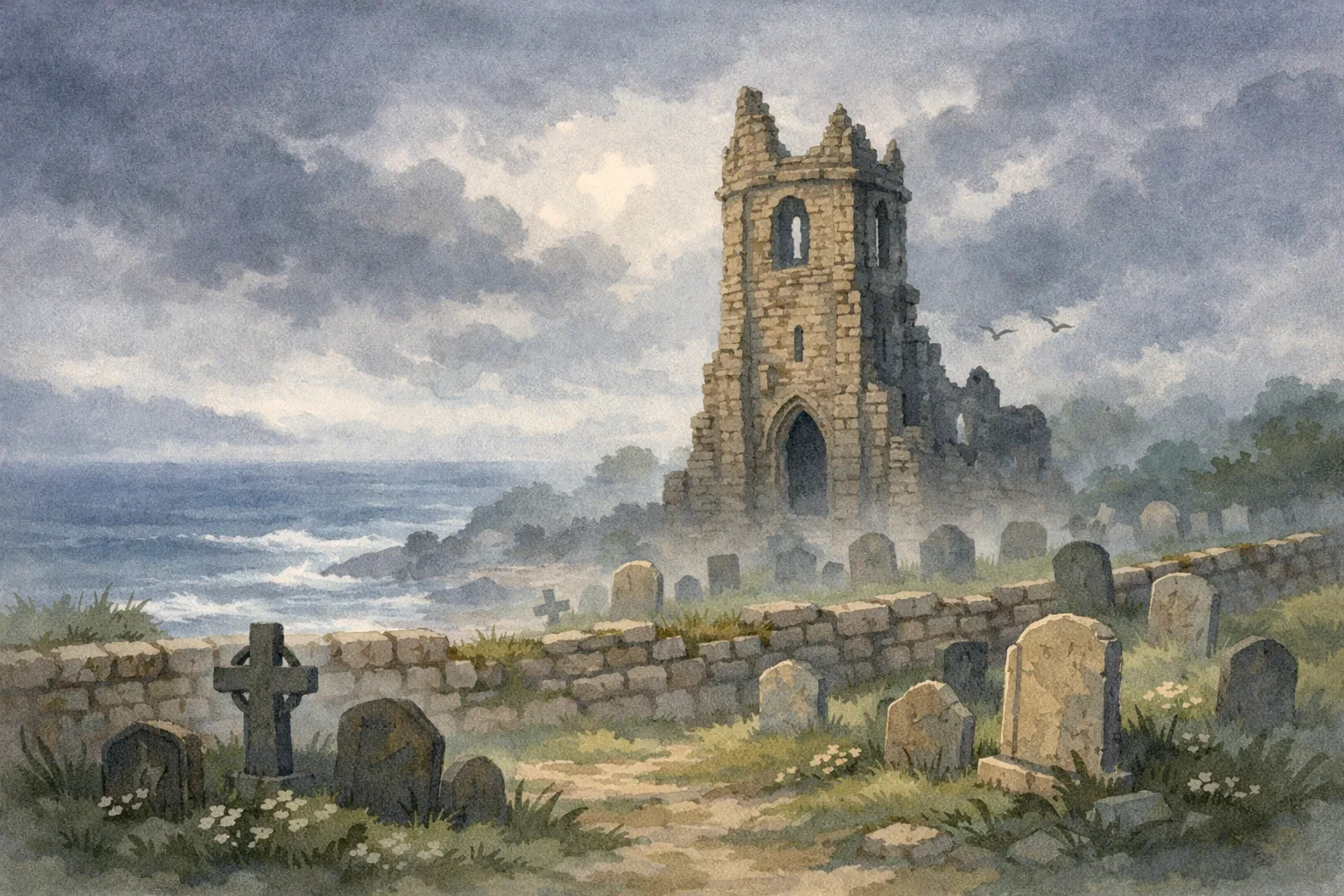
Fife’s best-known ghost traditions gather around places that already feel layered: medieval religious ruins, royal palaces, old burghs, castles and estate houses. St Andrews contributes the strongest public-facing cluster, with cathedral and castle stories shaped by pilgrimage, Reformation conflict and the town’s long habit of retelling itself to visitors. Historic Environment Scotland describes St Andrews Cathedral as the remains of what was once Scotland’s largest church, with an earlier religious presence on the site from the 8th century and St Rule’s Tower probably serving as a beacon for pilgrims.[Historic Environment Scotland]historicenvironment.scotOpen source on historicenvironment.scot.
The county’s haunted geography is also coastal and transitional. St Andrews looks out over the North Sea; Culross and Wemyss face the Firth of Forth; Balgonie stands above the River Leven; Crawford Priory lies inland near Cupar but has the staged drama of a romantic ruin. These settings are not incidental. Ghost stories often thrive where a place already asks to be interpreted: a sealed tower, a ruined gallery, a spiral stair, a dungeon, a family mausoleum, a cave, or a room preserved by a heritage body.
The strongest Fife material falls into several recurring types:
- White lady traditions, especially at St Andrews Cathedral, where the figure is linked to the so-called Haunted Tower.
- Green lady traditions, at Wemyss Castle and Balgonie Castle, part of a wider Scottish pattern of colour-coded castle apparitions.
- Royal and aristocratic ghosts, at Falkland Palace, Culross Palace, Kellie Castle and Crawford Priory.
- Reformation and prison-haunting stories, particularly at St Andrews Castle and Dunfermline.
- Modern heritage and ghost-tour retellings, where older local tales are shaped for visitors but still preserve useful clues about what the place means locally.
St Andrews: the White Lady and a town built for eerie walking
St Andrews is Fife’s most visible haunted town because its legends are embedded in highly legible historic scenery: cathedral ruins, St Rule’s Tower, the castle, old streets, harbour approaches and university buildings. VisitScotland summarises the cathedral tradition as two rumours: a friendly monk encountered on the stairs at St Rule’s Tower and the White Lady, seen in the cathedral grounds before vanishing into the haunted tower. It also notes the long-running version in which workmen discovered coffins inside a sealed chamber.[VisitScotland]visitscotland.comOpen source on visitscotland.com.
The White Lady story is powerful because it binds a ghostly image to a real episode of repair and discovery. Local historian Gregor Stewart’s account, published through Spooky Isles, says the tower was known locally as the Haunted Tower and that late-19th-century clearance and repair work around the cathedral ruins exposed a lower chamber. The details vary between tellings, but the repeated core is the discovery of several well-preserved bodies, including a young woman in white with long gloves.[Spooky Isles]spookyisles.comSpooky Isles Death And Haunting In Fife With Gregor StewartSpooky Isles Death And Haunting In Fife With Gregor Stewart
That is exactly the sort of story that becomes locally durable: it has a place, a discovery, witnesses by occupation rather than fame, and an object-image memorable enough to survive retelling. The white clothing and gloves matter because they make the apparition visible in the mind before any evidence is weighed. The chamber matters because it gives the story an apparent physical anchor. The tower matters because it can still be pointed out.
The historical setting does not prove the apparition, but it explains why St Andrews could sustain such a legend. Historic Environment Scotland’s history of the cathedral places St Rule’s Tower in the older sacred landscape of St Andrews and describes it as a landmark and beacon for pilgrims heading to the shrine of St Andrew.[Historic Environment Scotland]historicenvironment.scotOpen source on historicenvironment.scot. A haunted tower in that context is not just a spooky building; it is a leftover vertical marker from a vanished pilgrimage centre.
St Andrews Castle: violence, prison memory and Cardinal Beaton
St Andrews Castle is haunted in a different register. Its most memorable stories are not gentle apparitions in a churchyard but prison, siege and murder. Historic Environment Scotland notes that Protestant preacher George Wishart may have been held in the castle’s bottle dungeon, that Cardinal Beaton’s murdered body was certainly kept in that “dank and airless” hole, and that the assassination led to the 1546–47 siege, during which attackers and defenders dug the surviving mine and countermine.[Historic Environment Scotland]historicenvironment.scotOpen source on historicenvironment.scot.
This makes the castle fertile ground for ghost stories even when the supernatural claims are lightly sourced. A place with a bottle dungeon, a murdered cardinal, a siege tunnel and a Reformation martyr does not need much embellishment to feel haunted. GetYourGuide’s current St Andrews ghost-tour copy, for example, folds Cardinal Beaton, university apparitions, the Grey Lady of Market Street and ghostly galleons off East Scores into a visitor route. That is tourism language rather than archival proof, but it shows which figures are now marketable within the town’s haunted identity.[GetYourGuide]getyourguide.comghost vampire tours tc23ghost vampire tours tc23
The castle’s history gives the folklore its weight. The Historic Scotland teaching material describes St Andrews Castle as a key site in the Wars of Independence and the Reformation, with the mine, countermine and bottle dungeon as evidence of its “bloodthirsty past”.[cdnsm5-ss6.sharpschool.com]cdnsm5-ss6.sharpschool.comOpen source on sharpschool.com. That phrase is educational rather than paranormal, but it captures why the site lends itself to ghost walks: the building’s real history already supplies confinement, fear, religious conflict and bodies treated with political cruelty.
A careful reading should separate three layers. First, the documented history: imprisonment, execution, assassination and siege. Second, the local ghost tradition: figures such as Beaton, spectral scholars or grey ladies attached to St Andrews’ streets and ruins. Third, the visitor economy: tours and articles that compress many tales into a walkable evening. All three shape how haunted St Andrews is experienced, but only the first is securely historical.
Falkland Palace: royal glamour and the Grey Lady
Falkland Palace’s ghost stories are less ruinous than St Andrews and more domestic: galleries, rooms, scents, cold spots and figures said to wait for someone who never returns. The National Trust for Scotland identifies Falkland Palace as a royal hunting lodge loved by Mary, Queen of Scots, and highlights its Renaissance architecture, garden and one of Britain’s oldest original real tennis courts.[National Trust for Scotland]nts.org.ukOpen source on nts.org.uk. The real tennis court was ordered by James V in late 1538, according to the Trust, giving the site one of its most distinctive historical anchors.[National Trust for Scotland]nts.org.ukNational Trust for Scotland Tennis courtNational Trust for Scotland Tennis court
The Trust also preserves the palace’s ghost tradition directly. In its “Ghosts of the Trust” material, Falkland is associated with a Grey Lady in the Tapestry Gallery, seen pacing while waiting for a soldier-lover who went to battle and never came back.[National Trust for Scotland]nts.org.ukOpen source on nts.org.uk. Another National Trust ghost-story page says Falkland has had visits from the ghosts of Mary, Queen of Scots, a White Lady in the Tapestry Gallery, a Grey Lady in the East Range, and sinister faces at the window of the Queen’s Room.[National Trust for Scotland]nts.org.ukOpen source on nts.org.uk.
The overlap and variation are important. In one telling, the gallery figure is Grey; in another, the White Lady roams the Tapestry Gallery while the Grey Lady walks the East Range. That does not make the stories worthless; it makes them folklore. Colour, room, motive and identity shift as the story is retold, while the underlying emotional pattern remains stable: a woman waits, searches, paces or appears at a window.
Falkland is also a useful example of how Mary, Queen of Scots becomes a magnet for haunting traditions. She genuinely used and enjoyed Falkland, but many Scottish and English sites claim her ghost. At Falkland, the stronger reading is not that Mary’s apparition has been verified, but that royal memory gives the palace’s hauntings a recognisable face. Visitors arrive already knowing Mary as a tragic queen, so the palace’s eerie stories can attach themselves to a familiar historical figure.
Culross Palace: money, witchcraft memory and a coal-owning ghost
Culross Palace offers one of Fife’s neatest ghost images: Sir George Bruce counting his money in a stone-vaulted strongroom. The National Trust for Scotland says Culross Palace was built by Sir George Bruce around 1600 and invites visitors to imagine interrupting him in the strongroom as he counts his money. On the same page, the Trust places the palace within a darker burgh history of accused witches imprisoned and tortured in the Town House, petty criminals branded with an S-shaped courtroom key, and offenders punished at the Mercat Cross.[National Trust for Scotland]nts.org.ukOpen source on nts.org.uk.
The story works because it fits Bruce’s real-world identity. Culross was not merely a picturesque village; it was tied to industry, coastal trade and coal wealth. A ghost guarding or counting money is a moralised memory of mercantile success. It turns economic power into a scene: a wealthy man below stairs, stone vaults around him, the visitor warned away from his fortune.
The Trust’s own Fife visitor material describes Culross Palace as having dark wood-panelled rooms, connecting passageways and “a spooky ghost story or two”.[National Trust for Scotland]nts.org.ukOpen source on nts.org.uk. That is light heritage language, but the important point is that the ghost is not disconnected from the building. It is tied to the architecture visitors can see: rooms, passages and vaults. It is also tied to the social memory of authority: courts, punishments, witchcraft accusation and commercial wealth.
Culross shows the difference between a haunted-place tradition and a random ghost claim. The apparition is memorable because it expresses the place’s historic character. Even sceptically, the story tells readers what Culross was: a burgh of money, discipline, work, trade and fear of transgression.
Kellie Castle: footsteps, red shoes and the Lorimer afterlife
Kellie Castle’s hauntings are intimate and architectural. They belong to corridors and stairs rather than battlefields or public executions. The National Trust for Scotland’s castle tour material traces the estate from a first mention in 1150 through Siward, Oliphant and Erskine ownership, then to decline after 1797 and revival by the Lorimer family in the 1870s, when Professor James Lorimer leased and restored the castle as a family holiday home.[National Trust for Scotland]nts.org.ukOpen source on nts.org.uk.
The reported ghosts are usually James Lorimer and Anne Erskine. The Castles of Scotland says a turnpike stair is reputedly haunted by Anne Erskine, who died after falling from an upstairs window, and that James Lorimer’s ghost has been seen seated in a passageway.[The Castles of Scotland]thecastlesofscotland.co.ukOpen source on thecastlesofscotland.co.uk. Spooky Isles gives the same basic pairing, adding the striking detail that Anne is rarely seen directly; instead, footsteps may be heard on the staircase and a pair of red shoes has been reported running up the stairs.[Spooky Isles]spookyisles.comSpooky Isles Haunted Kellie Castle, FifeSpooky Isles Haunted Kellie Castle, Fife
That red-shoes detail is one of Fife’s strongest pieces of ghostly imagery because it is specific without requiring a grand claim. It is not “a terrifying presence” or “many spirits”; it is an almost theatrical fragment: shoes on a stair. This is how many durable haunting traditions work. A small repeated sensory detail can outlast a complicated backstory.
Kellie also raises a useful credibility point. The castle’s documented history is strong; the ghost stories are traditional. The Lorimers’ restoration and artistic life at Kellie are well attested by the National Trust, which describes Professor James Lorimer’s lease and the family’s creative presence there.[National Trust for Scotland]nts.org.ukOpen source on nts.org.uk. The apparition of Lorimer seated in a passage is not documented in the same way. It is better presented as a castle tradition preserved by guidebooks, local retellings and haunted-heritage writing.
Balgonie and Wemyss: Fife’s green ladies
Green Lady stories are common across Scottish castles, and Fife has two notable versions: Green Jeanie at Balgonie Castle and Green Jean at Wemyss Castle. The colour matters. Green in older British and Scottish folk belief can suggest bad luck, otherworldliness, fairy association, jealousy, death-warning or simply a distinctive identifying costume. It is a folklore shorthand, not a single fixed meaning.
Balgonie Castle’s version is especially well developed. The Castles of Scotland says Green Jeanie, thought to be the spirit of one of the Lundie family, has been seen in recent times and was recorded in 1842 as a “well-known ghost”. Other reported presences include a 17th-century soldier, the sound of a spectral dog, a hooded figure and a medieval apparition.[The Castles of Scotland]thecastlesofscotland.co.ukOpen source on thecastlesofscotland.co.uk. Spooky Isles similarly notes that Green Jeanie is believed to be connected with the Lundies and distinguishes her from Wemyss Castle’s Green Jean.[Spooky Isles]spookyisles.comSpooky Isles Haunted Balgonie Castle In Fife, ScotlandSpooky Isles Haunted Balgonie Castle In Fife, Scotland
The castle’s real fabric supports the atmosphere. Balgonie stands near Milton of Balgonie, with a 14th-century keep and later additions; the keep has been restored while other parts remain roofless.[Wikipedia]WikipediaBalgonie CastleBalgonie Castle A partially restored, partially ruined castle is ideal for layered ghost stories because visitors move between domestic survival and architectural loss.
Wemyss Castle’s Green Jean has a more coastal and death-warning flavour. The Castles of Scotland describes her as a Green Lady seen by family and servants, wearing green with a hooded mantle in an 1890s description, and also notes a 1904 sighting in which a family member reportedly walked beside her until she vanished.[The Castles of Scotland]thecastlesofscotland.co.ukOpen source on thecastlesofscotland.co.uk. The SCAPE Trust’s record for Green Jean’s Cave at West Wemyss notes the tradition that Green Jean was seen nearby shortly before a death, citing a local booklet produced by the Save the Wemyss Ancient Caves Society.[The SCAPE Trust]scapetrust.orgsites at risksites at risk
Balgonie and Wemyss show how similar motifs adapt to different places. At Balgonie, the green lady sits within a castle of family ownership, soldiers, dogs and restoration. At Wemyss, the story spreads into the coastal landscape, even attaching to a named cave. The repeated colour makes the tales feel related; the local setting makes each one distinct.
Dunfermline: abbey shadows and urban ghost walks
Dunfermline’s haunted material is more scattered in publicly accessible sources than St Andrews’, but the setting is potent. Dunfermline Abbey was founded in the 12th century and became one of Scotland’s great royal and religious sites; the present church occupies part of the medieval abbey complex, with substantial remains still visible.[Wikipedia]WikipediaDunfermline AbbeyDunfermline Abbey The city’s history of monarchy, monastic life, Reformation damage and ruin gives ghost-walk storytellers a deep stage.
Modern Dunfermline ghost-walk material includes several reported apparitions: a well-dressed woman in the ruin sometimes identified as Anne of Denmark, a white glowing woman looking down from the upper palace, and a dark hooded figure in the abbey graveyard.[Haunting Nights Interactive Ghost Walks]hauntingnightsghostwalks.co.ukOpen source on hauntingnightsghostwalks.co.uk. These are event-promotional claims, so they should be treated cautiously, but they indicate the motifs now circulating in the city’s public haunted identity: royal women, luminous figures and monastic or graveyard presences.
Abbot House adds a more domestic monastic story. The Castles of Scotland says the building is reputedly haunted by the ghost of a monk, with footsteps and the rustle of a robe heard on the main staircase.[The Castles of Scotland]thecastlesofscotland.co.ukThe Castles of Scotland Abbot House | DunfermlineThe Castles of Scotland Abbot House | Dunfermline Again, the detail is small but effective: not a complex apparition, but sound and movement on a stair.
The value of Dunfermline’s haunted tradition lies in how it turns a major historic centre into a night-time walking landscape. Abbey, palace, graveyard, old houses and urban closes become connected by stories. The evidence for the ghosts is weak in a strict historical sense, but the stories are meaningful as a way of reading the city’s old religious and royal topography after dark.
Crawford Priory: a Gothic ruin made for a ghost
Crawford Priory, near Cupar, is one of Fife’s more modern haunted settings. It is not medieval despite its name and ecclesiastical styling. Trove, drawing on Historic Environment Scotland material, preserves archival references to Lady Mary Lindsay Crawford’s involvement in additions to Crawford Lodge and a letter discussing David Hamilton and James Gillespie Graham.[Trove]trove.scotOpen source on trove.scot. Other architectural summaries describe the building as a ruined Gothic Revival mansion, originally an 18th-century lodge, later transformed in the early 19th century under Lady Mary.[Wikipedia]WikipediaCrawford PrioryCrawford Priory
The ghost story is closely tied to Lady Mary herself. The University of St Andrews’ Centre for the Study of Philanthropy and Public Good refers to her as a figure whose ghostly apparition is said to wander the grounds of Crawford Priory on windy days, while also stressing that the point of their article is the lack of firm knowledge about her philanthropy.[csppg.wp.st-andrews.ac.uk]csppg.wp.st-andrews.ac.ukscottish philanthropy snippet lady mary lindsay crawfordscottish philanthropy snippet lady mary lindsay crawford A Fife walking guide similarly warns that the building is supposedly haunted by Lady Crawford.[Fife Walking]fifewalking.comFife Walking Crawford Priory and Lady Mary's Tomb – Fife WalkingFife Walking Crawford Priory and Lady Mary's Tomb – Fife Walking
The most evocative version has Lady Mary walking with her animals. A local-history blog describes the rumour of her spirit wandering the estate with the pets and creatures she loved, especially on windy nights.[shadows fly away]shadowsflyaway.blogshadows fly away Crawford Priory, Cupar, Fifeshadows fly away Crawford Priory, Cupar, Fife The story is not strongly evidenced, but it is psychologically well matched to the ruin: a reclusive owner, a Gothic house, a mausoleum, animals, wind and decay.
Crawford Priory demonstrates how later ruins can acquire ghost stories that feel ancient even when the building is comparatively recent. Its haunting is not about medieval violence or Reformation trauma. It is about abandonment, personality, architecture and the melancholy of an estate outliving its intended world.
How credible are Fife’s haunted sources?
Fife’s haunted evidence is uneven, and that should be part of the article rather than a problem to hide. The strongest sources establish the history of the places: Historic Environment Scotland for St Andrews Cathedral and Castle, the National Trust for Scotland for Falkland, Kellie and Culross, Trove and architectural records for Crawford Priory, and specialist castle references for Balgonie and Wemyss. These sources support the settings, dates, ownerships and historical events that make the legends intelligible.[historicenvironment.scot]historicenvironment.scotOpen source on historicenvironment.scot.
The ghost claims themselves often come from a different kind of evidence: heritage storytelling, local-history writing, ghost-tour promotion, paranormal databases, newspaper features, castle guidebooks and oral tradition. These sources are useful for tracing what is said, where it is said, and how the story is framed. They are not the same as proof that an apparition appeared. For example, the Paranormal Database records Fife entries such as the White Woman at St Andrews Cathedral and Falkland Palace’s phantom female, but often lists dates as unknown and sources as published media or user submission.[Paranormal Database]paranormaldatabase.comParanormal Database FifeParanormal Database Fife
That does not make the stories worthless. Folklore is not valuable only when it can be verified as an event. It is valuable because it shows what a community or visitor culture finds memorable: the sealed tower, the woman waiting in a gallery, the miser in the vault, the green lady before a death, the monk on the stair. The correct question is often not “did this definitely happen?” but “why did this place attract this story?”
A practical credibility scale for Fife’s hauntings would look like this:
- Historically secure setting, folkloric apparition: St Andrews Cathedral’s White Lady; St Andrews Castle’s Beaton-related atmosphere; Falkland’s gallery ghosts.
- Guidebook and heritage-tradition ghosts: Kellie’s Anne Erskine and James Lorimer; Culross’s Sir George Bruce; Balgonie’s Green Jeanie.
- Locally persistent but thinner public documentation: Wemyss’s Green Jean death-warning tradition; Dunfermline’s urban ghost-walk figures.
- Atmospheric modern ruin folklore: Crawford Priory’s Lady Mary and her ghostly animals.

Why Fife feels haunted even before the ghosts appear
Fife’s haunted history is persuasive because its ghost stories rarely float free of place. They cling to specific features: St Rule’s Tower, the bottle dungeon, Falkland’s Tapestry Gallery, Culross’s strongroom, Kellie’s turnpike stair, Balgonie’s keep, Wemyss’s cave and Crawford Priory’s windy grounds. That gives the county’s folklore a map.
The stories also preserve social memory. St Andrews remembers religious conflict and pilgrimage. Culross remembers wealth, punishment and witchcraft accusation. Falkland remembers royal leisure and romantic waiting. Kellie remembers restoration and family occupation. Balgonie and Wemyss remember old landed households through green-clad women. Crawford Priory remembers a solitary owner through a ruin that already looks like an elegy.
The most honest way to enjoy Fife’s haunted places is to hold two truths together. The apparitions are traditions, claims and stories, not confirmed facts. Yet the places are real, the histories are often dramatic, and the legends reveal how strongly buildings can gather feeling after their original worlds have gone.
Amazon book picks
Further Reading
Books and field guides related to Why Does Fife Feel So Haunted?. Use these as the next step if you want deeper reading beyond the article.
The Mammoth Book of Haunted House Stories
Matches the castle and historic house atmosphere found across Fife.


Ghosts
First published 2015. Subjects: Ghosts, History, BODY, MIND & SPIRIT, Parapsychology, General.
The lore of Scotland
Provides nationwide folklore context for Fife's ghost traditions.
eBay marketplace picks
Marketplace Samples
Live-tested eBay searches with available results related to this page.
Endnotes
1.
Source: commons.wikimedia.org
Title: File:Fifeshire locator map.svg
Link:https://commons.wikimedia.org/wiki/File%3AFifeshire_locator_map.svg
2.
Source: visitscotland.com
Link:https://www.visitscotland.com/things-to-do/attractions/haunted-sites
3.
Source: getyourguide.com
Title: ghost vampire tours tc23
Link:https://www.getyourguide.com/en-gb/fife-l2597/ghost-vampire-tours-tc23/
4.
Source: cdnsm5-ss6.sharpschool.com
Link:https://cdnsm5-ss6.sharpschool.com/UserFiles/Servers/Server_65154/File/Migration/st_andrews-castle.pdf
5.
Source: Wikipedia
Title: Balgonie Castle
Link:https://en.wikipedia.org/wiki/Balgonie_Castle
6.
Source: Wikipedia
Title: Dunfermline Abbey
Link:https://en.wikipedia.org/wiki/Dunfermline_Abbey
7.
Source: trove.scot
Link:https://www.trove.scot/place/31613
8.
Source: Wikipedia
Title: Crawford Priory
Link:https://en.wikipedia.org/wiki/Crawford_Priory
9.
Source: csppg.wp.st-andrews.ac.uk
Title: scottish philanthropy snippet lady mary lindsay crawford
Link:https://csppg.wp.st-andrews.ac.uk/2021/01/21/scottish-philanthropy-snippet-lady-mary-lindsay-crawford/
10.
Source: commons.wikimedia.org
Title: Category:SVG maps of historic counties of Scotland
Link:https://commons.wikimedia.org/wiki/Category%3ASVG_maps_of_historic_counties_of_Scotland
11.
Source: commons.wikimedia.org
Title: Category:Old county maps of Fife
Link:https://commons.wikimedia.org/wiki/Category%3AOld_county_maps_of_Fife
12.
Source: commons.wikimedia.org
Title: Category:Old maps of Fife
Link:https://commons.wikimedia.org/wiki/Category%3AOld_maps_of_Fife
13.
Source: commons.wikimedia.org
Title: File:Fife Map.png
Link:https://commons.wikimedia.org/wiki/File%3AFife_Map.png
14.
Source: commons.wikimedia.org
Title: Category:Maps of traditional counties of Scotland
Link:https://commons.wikimedia.org/wiki/Category%3AMaps_of_traditional_counties_of_Scotland
15.
Source: commons.wikimedia.org
Title: Category:Maps of counties of Scotland
Link:https://commons.wikimedia.org/wiki/Category%3AMaps_of_counties_of_Scotland
16.
Source: commons.wikimedia.org
Title: Category:Maps of Scotland
Link:https://commons.wikimedia.org/wiki/Category%3AMaps_of_Scotland
17.
Source: Wikipedia
Title: Kellie Castle
Link:https://en.wikipedia.org/wiki/Kellie_Castle
18.
Source: Wikipedia
Title: File:Fife Brit Isles Sect 2.svg
Link:https://en.wikipedia.org/wiki/File%3AFife_Brit_Isles_Sect_2.svg
19.
Source: Wikipedia
Title: St Andrews Castle
Link:https://en.wikipedia.org/wiki/St_Andrews_Castle
20.
Source: Wikipedia
Title: St Andrews Cathedral
Link:https://en.wikipedia.org/wiki/St_Andrews_Cathedral
21.
Source: Wikipedia
Title: Falkland Palace
Link:https://en.wikipedia.org/wiki/Falkland_Palace
22.
Source: trove.scot
Link:https://www.trove.scot/place/34371
23.
Source: trove.scot
Link:https://www.trove.scot/place/349332
24.
Source: historicenvironment.scot
Link:https://www.historicenvironment.scot/visit/all/st-andrews-cathedral/
25.
Source: spookyisles.com
Title: Spooky Isles Death And Haunting In Fife With Gregor Stewart
Link:https://www.spookyisles.com/gregor-stewart-interview/
26.
Source: historicenvironment.scot
Link:https://www.historicenvironment.scot/visit/all/st-andrews-cathedral/history-and-stories/
27.
Source: historicenvironment.scot
Link:https://www.historicenvironment.scot/visit/all/st-andrews-castle/
28.
Source: nts.org.uk
Link:https://www.nts.org.uk/visit/places/falkland-palace
29.
Source: nts.org.uk
Title: National Trust for Scotland Tennis court
Link:https://www.nts.org.uk/visit/places/falkland-palace/highlights/tennis-court
30.
Source: nts.org.uk
Link:https://www.nts.org.uk/stories/ghosts-of-the-trust
31.
Source: nts.org.uk
Link:https://www.nts.org.uk/stories/scottish-ghost-stories-witches-murder-and-folklore
32.
Source: nts.org.uk
Link:https://www.nts.org.uk/visit/things-to-do/things-to-do-in-fife
33.
Source: nts.org.uk
Link:https://www.nts.org.uk/visit/places/kellie-castle/highlights/castle-tour
34.
Source: thecastlesofscotland.co.uk
Link:https://www.thecastlesofscotland.co.uk/the-best-castles/grand-castles/kellie-castle/
35.
Source: spookyisles.com
Title: Spooky Isles Haunted Kellie Castle, Fife
Link:https://www.spookyisles.com/haunted-kellie-castle-fife/
36.
Source: nts.org.uk
Link:https://www.nts.org.uk/visit/places/kellie-castle/highlights/podcast
37.
Source: thecastlesofscotland.co.uk
Link:https://www.thecastlesofscotland.co.uk/the-best-castles/grand-castles/balgonie-castle/
38.
Source: spookyisles.com
Title: Spooky Isles Haunted Balgonie Castle In Fife, Scotland
Link:https://www.spookyisles.com/haunted-balgonie-castle/
39.
Source: thecastlesofscotland.co.uk
Link:https://www.thecastlesofscotland.co.uk/the-best-castles/grand-castles/wemyss-castle/
40.
Source: scapetrust.org
Title: sites at risk
Link:https://scapetrust.org/sites-at-risk/12866/
41.
Source: hauntingnightsghostwalks.co.uk
Link:https://hauntingnightsghostwalks.co.uk/event/dunfermline-interactive-ghost-walk/
42.
Source: thecastlesofscotland.co.uk
Title: The Castles of Scotland Abbot House | Dunfermline
Link:https://www.thecastlesofscotland.co.uk/the-best-castles/grand-castles/abbot-house-dunfermline/
43.
Source: fifewalking.com
Title: Fife Walking Crawford Priory and Lady Mary’s Tomb – Fife Walking
Link:https://fifewalking.com/find-a-walk/north-fife/crawford-priory-and-lady-marys-tomb/
44.
Source: shadowsflyaway.blog
Title: shadows fly away Crawford Priory, Cupar, Fife
Link:https://shadowsflyaway.blog/2020/01/20/a-wandering-ghost-and-a-memorial-to-a-favourite-deer-crawford-priory-cupar-fife/
45.
Source: paranormaldatabase.com
Title: Paranormal Database Fife
Link:https://www.paranormaldatabase.com/lowlands/Fifedata.php?pageNum_paradata=3
46.
Source: paranormaldatabase.com
Link:https://www.paranormaldatabase.com/lowlands/Fifedata.php?pageNum_paradata=1
47.
Source: falklandtennis.wordpress.com
Link:https://falklandtennis.wordpress.com/history/
48.
Source: nts.org.uk
Link:https://www.nts.org.uk/stories/scottish-ghost-stories-witches-murder-and-folklore-part-2
49.
Source: nts.org.uk
Title: architecture inspires art at kellie castle
Link:https://www.nts.org.uk/stories/architecture-inspires-art-at-kellie-castle
50.
Source: nts.org.uk
Link:https://www.nts.org.uk/stories/spooky-stories
51.
Source: nts.org.uk
Link:https://www.nts.org.uk/stories/halloween-hidden-secrets
52.
Source: play.google.com
Title: Gregor Stewart
Link:https://play.google.com/store/info/name/Gregor_Stewart?id=11c52dn4sj
53.
Source: paranormaldatabase.com
Link:https://www.paranormaldatabase.com/lowlands/Fifedata.php
54.
Source: paranormaldatabase.com
Link:https://www.paranormaldatabase.com/lowlands/Fifedata.php?pageNum_paradata=4
55.
Source: blog.historicenvironment.scot
Title: real tennis
Link:https://blog.historicenvironment.scot/2019/09/real-tennis/
56.
Source: spookyisles.com
Title: ghosts of st andrews
Link:https://www.spookyisles.com/ghosts-of-st-andrews/
57.
Source: spookyisles.com
Title: crawford priory
Link:https://www.spookyisles.com/crawford-priory/
58.
Source: spookyisles.com
Title: mary queen of scots
Link:https://www.spookyisles.com/mary-queen-of-scots/
59.
Source: app-hes-pubs-prod-neu-01.azurewebsites.net
Title: St Andrews Castle
Link:https://app-hes-pubs-prod-neu-01.azurewebsites.net/api/file/4bcc72ad-0de7-4993-8985-ab3c00a5753e
60.
Source: holeousia.com
Title: crawford priory
Link:https://holeousia.com/time-passes-listen/ruins/fife/crawford-priory/
Additional References
61.
Source: youtube.com
Link:https://www.youtube.com/watch?v=oCW6Cx4ic7U
Source snippet
History of PITTENWEEM - Witch Trials and Miracles...
62.
Source: facebook.com
Link:https://www.facebook.com/groups/260827821738102/posts/1598072641346940/
63.
Source: facebook.com
Link:https://www.facebook.com/groups/uncannyfan/posts/2148546728955280/
64.
Source: facebook.com
Link:https://www.facebook.com/groups/450349229053607/posts/1477892536299266/
65.
Source: facebook.com
Link:https://www.facebook.com/groups/scotlandsscenery/posts/5841304522555539/
66.
Source: fabulousnorth.com
Link:https://fabulousnorth.com/crawford-priory/
67.
Source: facebook.com
Link:https://www.facebook.com/groups/620001246646566/posts/1203553968291288/
68.
Source: hiddenscotland.com
Link:https://hiddenscotland.com/journal/crawford-priorys-ghostly-menagerie
69.
Source: facebook.com
Link:https://www.facebook.com/andythehighlander/videos/culross-palace-is-believed-by-some-to-be-one-of-the-most-haunted-buildings-in-sc/2227053937477916/
70.
Source: great-castles.com
Link:https://great-castles.com/fyvieghost.html
Topic Tree
Follow this branch
Related pages 91
- Haunted Clackmannanshire
- Haunted Antrim
- Haunted Armagh
- Haunted Durham
- Haunted Londonderry
- +86 more in sidebar