Within Haunted Denbighshire
How Do Denbighshire's Ghost Stories Travel?
Denbighshire's haunted stories follow castles, old roads, houses, abbeys, and moorland routes rather than neat modern council lines.
On this page
- Historic county versus modern boundary
- Ruthin, Denbigh, Llangollen, and the moors
- Neighbouring legends and North Wales routes
Page outline Jump by section
Introduction
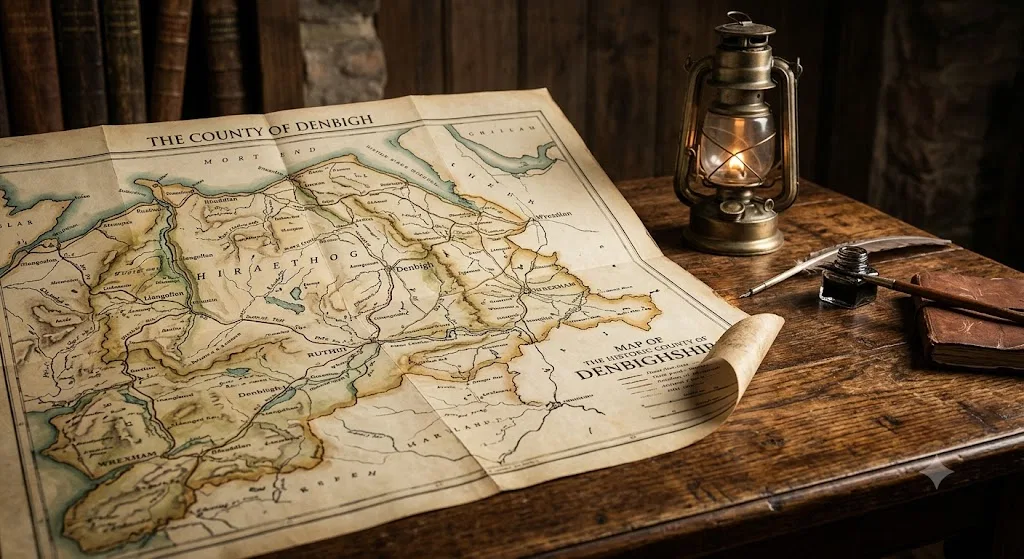
Denbighshire’s ghost map is best read as a travelling map rather than a pin-board of isolated haunted buildings. The county’s best-known stories gather around Ruthin, Denbigh, Llangollen, Rhuddlan, old prisons, castle ruins, timber-framed houses, abbey routes, and the bleak uplands of Hiraethog, but the routes between them matter just as much as the sites themselves. Historic Denbighshire once included towns and borderlands that do not sit neatly inside the modern council area, while modern Denbighshire includes places with older Flintshire or Merionethshire connections. That is why a Denbighshire haunted-places map should use the historic county as its centre of gravity, then mark where stories leak across the Dee Valley, the Clwydian Range, the former county of Clwyd, Wrexham, Flintshire, Conwy, and the wider North Wales tourist circuit.[gov.wales]datamap.gov.walesData Map Wales Historic County Boundaries of WalesData Map Wales Historic County Boundaries of Wales
The result is not a claim that the hauntings are factual. It is a way of reading folklore geographically. Ruthin Castle’s Grey Lady, Ruthin Gaol’s condemned-cell atmosphere, Denbigh Castle’s fatal-well tradition, Llangollen’s romantic and ruin-haunted landscape, and the moorland stories around Gwylfa Hiraethog all sit on older lines of movement: roads, river crossings, markets, prisons, military routes, visitor trails, and county borders.[denbighshire.gov.uk]denbighshire.gov.ukOpen source on denbighshire.gov.uk.
Historic county versus modern boundary
For a public haunted-history project, the important first decision is whether “Denbighshire” means the modern principal area or the older county used in historic records, maps, county histories, and many local identities. The historic county was one of the thirteen historic counties of Wales created after the Laws in Wales Acts, while today’s Denbighshire was formed in 1996 from parts of the former county of Clwyd and covers a “substantially different” area from the old county.[Data Map Wales]datamap.gov.walesData Map Wales Historic County Boundaries of WalesData Map Wales Historic County Boundaries of Wales
That difference is not a technical quibble. Haunted-place writing often follows old county labels, especially where stories were gathered in Victorian antiquarian works, local newspapers, early road books, or later “North Wales” ghost guides. Historic Denbighshire included places such as Wrexham and Llanrwst, while present-day Denbighshire includes Rhyl and Prestatyn, which had older Flintshire connections, and Edeyrnion areas formerly tied to Merionethshire before the late twentieth-century reorganisations.[Wikipedia]WikipediaOpen source on wikipedia.org.
A map that ignores this will mislead readers in two ways. It may push genuinely Denbighshire-associated legends into the “wrong” modern county, or it may treat modern council lines as if they were the boundaries known to older storytellers. The cleaner method is to make the historic county visible, then add a second layer for the modern administrative boundary. The haunted story can then be labelled by its strongest relationship: historic county, present council area, nearest town, old parish, estate, road, valley, or regional tourist route.
This is especially useful in North Wales because the old regional label “Clwyd” still appears in family-history, local-history, and paranormal listings, even though Clwyd as an administrative county existed only from 1974 to 1996. A reader searching for “haunted Denbighshire” may find Ruthin, Denbigh, Llangollen, Rhuddlan, Plas Teg, Gwydir, or Penrhyn Old Hall in the same North Wales list, though several of those places belong to neighbouring modern authorities. The map should therefore make crossings legible instead of pretending they do not exist.[dailypost.co.uk]dailypost.co.ukhalloween haunted houses north wales 7994174halloween haunted houses north wales 7994174
Ruthin, Denbigh, Llangollen, and the moors
The densest part of Denbighshire’s haunted map is Ruthin. It gives readers the classic ingredients of a county ghost cluster: a castle, a gaol, a timber-framed house, old court associations, narrow streets, and a market-town setting that makes stories easy to walk between.
Ruthin Castle is the most recognisable haunted landmark in the county. Its popular Grey Lady story is normally told as a tale of jealousy, murder, punishment, and restless return, but its map value lies in the way it anchors a larger Ruthin circuit. The castle’s documented history supplies the atmosphere without proving the apparition: the site is tied to Edward I’s conquest, the de Grey lordship, Owain Glyndŵr’s conflict with Reginald de Grey, and an eleven-week Civil War siege before partial demolition.[ruthincastle.co.uk]ruthincastle.co.uk1282 history1282 history
Ruthin Gaol sits nearby as a different kind of haunted place: not aristocratic tragedy, but institutional memory. Denbighshire County Council presents it as the only purpose-built Pentonville-style prison open to the public as a heritage attraction, with punishment cells, a dark cell, a condemned cell, and the story of William Hughes, described by the council as the last man to be hanged there. This makes it a strong map point even when ghost claims come from paranormal tourism rather than archival proof.[Denbighshire County Council]denbighshire.gov.ukOpen source on denbighshire.gov.uk.
Nantclwyd y Dre adds a quieter layer. It is a timber-framed townhouse in Ruthin with over 500 years of history, interpreted today as a historic house and garden. The council even offers the venue for paranormal investigations, which shows how heritage presentation and ghost-tour culture now overlap in the town. The haunting claim is therefore less important than the building’s role as a lived-in survivor of late medieval and later urban Denbighshire.[Denbighshire County Council]denbighshire.gov.ukOpen source on denbighshire.gov.uk.
Denbigh forms the second major node. Denbigh Castle and town walls were built after Edward I’s conquest of North Wales, on the site associated with Dafydd ap Gruffudd, and Cadw notes that Henry de Lacy began a huge stone fortress and extensive town walls there from 1282. The most directly “ghost-map” item is Cadw’s own “fatal fall” tradition: the castle was never fully completed, and tradition says de Lacy was devastated after his eldest son Edmund fell to his death down the castle well. That is not the same as a documented apparition, but it is precisely the sort of local tragedy that can become a haunting motif in visitor memory.[Cadw]cadw.gov.walesCadw Denbigh Castle | CadwCadw Denbigh Castle | Cadw
Llangollen works differently again. It is not just a haunted-place pin; it is a route hub. Cadw’s urban character study describes the town as sitting at a natural crossing point of the Dee, with a bridge recorded from the late thirteenth century, and as a key position for routes into and out of Wales. That makes Llangollen a boundary-crossing engine for folklore: stories can move along the river, the road, the canal, the railway, the abbey path, and the tourist trail rather than belonging only to one building.[Cadw]cadw.gov.walesOpen source on gov.wales.
Above Llangollen, Castell Dinas Brân and the ruins around Valle Crucis give the map its hilltop and abbey atmosphere. Cadw’s Llangollen study records Valle Crucis Abbey as founded in 1201 and Dinas Brân as a masonry castle built around 1260 on an earlier Iron Age hillfort, overlooking the town and controlling a trading centre. The castle’s later reputation is full of legend, but for a careful map it is enough to mark it as a place where medieval power, high views, ruin, and romantic tourism feed ghostly interpretation.[gov.wales]cadw.gov.walesOpen source on gov.wales.
The moors complete the pattern. Gwylfa Hiraethog, also known through the Sportsman’s Arms, stands in a landscape where loneliness itself becomes part of the story. The Royal Commission records the former tavern as the highest in Wales at around 495 metres above sea level and notes that it was often snowed in during winter; this is exactly the kind of place where ghost stories attach to exposure, isolation, travel risk, and abandoned buildings.[Royal Commission Wales]rcahmw.gov.ukgwylfa hiraethog the welsh watchtowergwylfa hiraethog the welsh watchtower
Neighbouring legends and North Wales routes
Denbighshire’s haunted stories travel because North Wales travel has always been corridor-shaped. The Vale of Clwyd, the Dee Valley, the coast road, the moor roads, and the London-to-Holyhead route all encouraged people, goods, prisoners, soldiers, tourists, and stories to move across administrative lines.
The Dee Valley is the clearest example. Llangollen’s bridge, church, river crossing, canal, railway, and road network made it a stopping point on wider routes, not a sealed local pocket. Cadw notes that road improvements from London to Holyhead, followed by the railway and canal, turned Llangollen into part of a much wider transport network; Natural Resources Wales similarly describes Llangollen and Corwen as historic tourist towns at Dee crossing points, in a landscape shaped by road, rail, and canal travel.[Cadw]cadw.gov.walesOpen source on gov.wales.
That matters for ghost mapping because route-based legends rarely stop at a county edge. A traveller who visits Llangollen may also follow the canal toward Pontcysyllte, cross into Wrexham, continue towards Chirk, or move west towards Corwen and Bala. Haunted-place lists therefore often group Llangollen, Ruthin, Plas Teg in Flintshire, and other North Wales houses together under a regional rather than county heading. This is useful for visitors, but it can blur Denbighshire’s distinct shape unless the map distinguishes “inside the county”, “historic Denbighshire association”, and “nearby North Wales continuation”.[Haunted Rooms®]hauntedrooms.co.ukplas teg flintshire north walesplas teg flintshire north wales
The castle network creates a second crossing pattern. Denbigh and Rhuddlan belong to Edward I’s North Wales conquest landscape. Cadw describes Rhuddlan as a castle where Edward used the River Clwyd as a supply route and even had the river deepened and diverted; Denbigh, meanwhile, was built as a huge fortress and walled town after Dafydd ap Gruffudd’s defeat. Haunted interpretation should not turn that military history into invented phantoms, but it should recognise why these ruins invite spectral storytelling: they were built to dominate movement, borders, settlement, and memory.[Cadw]cadw.gov.walesOpen source on gov.wales.
The former prison map also crosses boundaries. Ruthin Gaol’s later history connected it with wider North Wales punishment and administration. A local-history account notes that HMP Ruthin covered the old counties of Denbighshire, Flintshire, and Merionethshire after other prisons closed, while the Crime and Punishment Collections Network records that Ruthin Gaol ceased to be a prison in 1916 and prisoners and guards were transferred to Shrewsbury. Even when treated cautiously, this makes the gaol a boundary-crossing site of memory: its stories do not belong only to Ruthin residents, but to a wider prison catchment.[Curious Clwyd]mythslegendsodditiesnorth-east-wales.co.ukruthin gaolruthin gaol
How to read the map without overclaiming
A good Denbighshire ghost map should separate three kinds of evidence. First are documented historic sites: castles, abbeys, prisons, old houses, roads, and bridges whose dates, ownership, or functions can be checked. Second are named traditions: Lady Grey at Ruthin Castle, the fatal-well story at Denbigh Castle, prison stories at Ruthin Gaol, and moorland tales around Hiraethog. Third are modern paranormal claims, which may be important to tourism but should be labelled as reports, events, or visitor experiences rather than proof.
That distinction keeps the page spooky without becoming careless. For example, the Grey Lady story belongs on the map because it is locally famous and strongly attached to Ruthin Castle. The strongest supporting history, however, is the castle’s real role in conquest, lordship, rebellion, siege, and later reinvention as a hotel, not a verifiable medieval murder record. Ruthin Gaol belongs because its condemned cell and William Hughes story are documented heritage interpretation; any alleged haunting should be presented as folklore or paranormal-tour testimony.[denbighshire.gov.uk]denbighshire.gov.ukOpen source on denbighshire.gov.uk.
The map should also warn readers that “near Denbighshire” is not the same as “in Denbighshire”. Plas Teg, Gwydir Castle, Penrhyn Old Hall, and other North Wales haunted sites may be useful comparison points, but they should not be absorbed into Denbighshire unless the page is explicitly discussing routes, neighbouring traditions, or historic-county ambiguity. This protects both geography and folklore: a legend is more interesting when its real route is visible than when it is forced into the wrong county for convenience.[haunted-houses.co.uk]haunted-houses.co.ukOpen source on haunted-houses.co.uk.
For readers planning an atmospheric route, the most coherent Denbighshire sequence runs from Ruthin’s castle, gaol, and Nantclwyd y Dre; to Denbigh Castle and town walls; north towards Rhuddlan and the Clwyd corridor; south-east through Llangollen, Dinas Brân, Valle Crucis, and the Dee crossings; and west or south-west onto the lonely roads of Hiraethog and Edeyrnion. That route follows the way the stories themselves behave: they cling to buildings, but they travel by roads, rivers, valleys, old jurisdictions, and remembered borders.
Amazon book picks
Further Reading
Books and field guides related to How Do Denbighshire's Ghost Stories Travel?. Use these as the next step if you want deeper reading beyond the article.
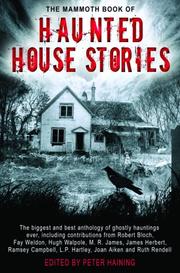
The Mammoth Book of Haunted House Stories
Provides broad haunted-place context that fits Welsh ghost routes.


eBay marketplace picks
Marketplace Samples
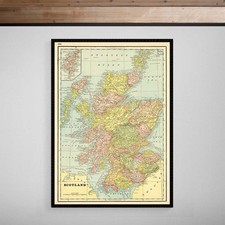
Live-tested eBay searches with available results related to this page.
Endnotes
1.
Source: Wikipedia
Link:https://en.wikipedia.org/wiki/Denbighshire
2.
Source: Wikipedia
Title: Denbighshire (historic)
Link:https://en.wikipedia.org/wiki/Denbighshire_%28historic%29
3.
Source: cadw.gov.wales
Link:https://cadw.gov.wales/sites/default/files/2019-05/Llangollen-%20Understanding%20Urban%20Character_0.pdf
4.
Source: Wikipedia
Title: Flintshire (historic)
Link:https://en.wikipedia.org/wiki/Flintshire_%28historic%29
5.
Source: Wikipedia
Title: Historic counties of Wales
Link:https://en.wikipedia.org/wiki/Historic_counties_of_Wales
6.
Source: Wikipedia
Title: Ruthin Gaol
Link:https://en.wikipedia.org/wiki/Ruthin_Gaol
7.
Source: Wikipedia
Title: Denbigh Castle and town walls
Link:https://en.wikipedia.org/wiki/Denbigh_Castle_and_town_walls
8.
Source: Wikipedia
Title: Castell Dinas Brân
Link:https://en.wikipedia.org/wiki/Castell_Dinas_Br%C3%A2n
9.
Source: Wikipedia
Title: Rhuddlan Castle
Link:https://en.wikipedia.org/wiki/Rhuddlan_Castle
10.
Source: open.edu
Link:https://www.open.edu/openlearn/pluginfile.php/59855/mod_oucontent/oucontent/369/6a0adbe5/240f9b92/edward_7.pdf?forcedownload=1
11.
Source: youtube.com
Title: The Haunted House
Link:https://www.youtube.com/watch?v=EwJl9xx29CQ
Source snippet
Denbigh Castle - Unseen And Untold: Walkaround Documentary...
12.
Source: youtube.com
Title: Denbigh Castle
Link:https://www.youtube.com/watch?v=0VecNDSDq_w
13.
Source: datamap.gov.wales
Title: Data Map Wales Historic County Boundaries of Wales
Link:https://datamap.gov.wales/layers/geonode%3Ahistoric_counties_bng_rcahmw_ply
14.
Source: wikishire.co.uk
Link:https://wikishire.co.uk/wiki/Denbighshire
15.
Source: denbighshire.gov.uk
Link:https://www.denbighshire.gov.uk/en/leisure-and-tourism/museums-and-historic-houses/ruthin-gaol.aspx
16.
Source: cadw.gov.wales
Title: more about denbigh castle
Link:https://cadw.gov.wales/more-about-denbigh-castle
17.
Source: rcahmw.gov.uk
Title: gwylfa hiraethog the welsh watchtower
Link:https://rcahmw.gov.uk/gwylfa-hiraethog-the-welsh-watchtower/
18.
Source: mythslegendsodditiesnorth-east-wales.co.uk
Title: ruthin gaol
Link:https://www.mythslegendsodditiesnorth-east-wales.co.uk/ruthin-gaol
19.
Source: dailypost.co.uk
Title: halloween haunted houses north wales 7994174
Link:https://www.dailypost.co.uk/whats-on/whats-on-news/halloween-haunted-houses-north-wales-7994174
20.
Source: therebeghosts.com
Title: There Be Ghosts NORTH WALES
Link:https://www.therebeghosts.com/destinations/great-britain/north-wales/
21.
Source: hauntedrooms.co.uk
Title: plas teg flintshire north wales
Link:https://www.hauntedrooms.co.uk/plas-teg-flintshire-north-wales
22.
Source: ruthincastle.co.uk
Title: 1282 history
Link:https://www.ruthincastle.co.uk/1282-history/
23.
Source: ruthinhistoryhanesrhuthun.org
Link:https://www.ruthinhistoryhanesrhuthun.org/ruthin-castle
24.
Source: historic-uk.com
Link:https://www.historic-uk.com/HistoryMagazine/DestinationsUK/Ruthin/
25.
Source: denbighshire.gov.uk
Link:https://www.denbighshire.gov.uk/en/leisure-and-tourism/museums-and-historic-houses/nantclwyd-y-dre/about.aspx
26.
Source: denbighshire.gov.uk
Title: paranormal investigations.aspx
Link:https://www.denbighshire.gov.uk/en/leisure-and-tourism/museums-and-historic-houses/nantclwyd-y-dre/hiring-this-venue/paranormal-investigations.aspx
27.
Source: cadw.gov.wales
Title: Cadw Denbigh Castle | Cadw
Link:https://cadw.gov.wales/visit/places-to-visit/denbigh-castle
28.
Source: llangollenmuseum.org.uk
Link:https://llangollenmuseum.org.uk/the-story-of-dinas-bran-castle/
29.
Source: archwilio.org.uk
Link:https://www.archwilio.org.uk/arch/query/page.php?dbname=cpat&tbname=core&watprn=CPAT101174
30.
Source: cadw.gov.wales
Link:https://cadw.gov.wales/visit/places-to-visit/castell-rhuddlan
31.
Source: cadw.gov.wales
Link:https://cadw.gov.wales/more-about-castell-rhuddlan
32.
Source: haunted-houses.co.uk
Link:https://www.haunted-houses.co.uk/ghost-hunt/penrhyn-old-hall-ghost-hunt/
33.
Source: denbighshire.gov.uk
Link:https://www.denbighshire.gov.uk/en/leisure-and-tourism/visiting-denbighshire/town-and-city-maps.aspx
34.
Source: moderngov.denbighshire.gov.uk
Title: Minbook May E
Link:https://moderngov.denbighshire.gov.uk/Data/County%20Council/20010515/Agenda/Minbook-May-E.pdf
35.
Source: moderngov.denbighshire.gov.uk
Title: Public reports pack Tuesday 25 Jun 2019 10.00 Cabinet
Link:https://moderngov.denbighshire.gov.uk/documents/g5821/Public%20reports%20pack%20Tuesday%2025-Jun-2019%2010.00%20Cabinet.pdf?LLL=0&T=10
36.
Source: moderngov.denbighshire.gov.uk
Title: Public reports pack Tuesday 25 Feb 2014 10.00 County Council
Link:https://moderngov.denbighshire.gov.uk/documents/g4685/Public%20reports%20pack%20Tuesday%2025-Feb-2014%2010.00%20County%20Council.pdf?LLL=0&T=10
37.
Source: moderngov.denbighshire.gov.uk
Title: Public reports pack Tuesday 09 Dec 2014 10.00 County Council
Link:https://moderngov.denbighshire.gov.uk/documents/g4934/Public%20reports%20pack%20Tuesday%2009-Dec-2014%2010.00%20County%20Council.pdf?LLL=0&T=10
38.
Source: moderngov.denbighshire.gov.uk
Title: Pecyn adroddiadau cyhoeddus Dydd Mawrth 09 Rhag 2014 10.00 Cyngor Sir
Link:https://moderngov.denbighshire.gov.uk/documents/g4934/Pecyn%20adroddiadau%20cyhoeddus%20Dydd%20Mawrth%2009-Rhag-2014%2010.00%20Cyngor%20Sir.pdf?LLL=1&T=10
39.
Source: moderngov.denbighshire.gov.uk
Link:https://moderngov.denbighshire.gov.uk/documents/g4737/Pecyn%20adroddiadau%20cyhoeddus%20Dydd%20Iau%2010-Ebr-2014%2009.30%20Pwyllgor%20Craffu%20Partneriaethau.pdf?LLL=1&T=10
40.
Source: denbighshire.gov.uk
Title: news detail.aspx
Link:https://www.denbighshire.gov.uk/en/news/news-detail.aspx?article=3207d575-c2d6-4e7a-9ec5-9826d8d966aa
41.
Source: maps.denbighshire.gov.uk
Link:https://maps.denbighshire.gov.uk/MyDenbighshire.aspx?tab=1
42.
Source: cadw.gov.wales
Link:https://cadw.gov.wales/sites/default/files/2019-04/InterpplanPrincesGwynedd_EN_0.pdf
43.
Source: cadw.gov.wales
Link:https://cadw.gov.wales/sites/default/files/2019-04/InterpplanCastlesEdwardI_EN.pdf
44.
Source: cadw.gov.wales
Link:https://cadw.gov.wales/advice-support/placemaking/historic-character/urban-character-reports
45.
Source: mythslegendsodditiesnorth-east-wales.co.uk
Link:https://www.mythslegendsodditiesnorth-east-wales.co.uk/ruthin-castle
46.
Source: mythslegendsodditiesnorth-east-wales.co.uk
Title: Nantclwyd y Dre House
Link:https://www.mythslegendsodditiesnorth-east-wales.co.uk/nantclwyd-y-dre-house
47.
Source: facebook.com
Title: Ruthin Gaol
Link:https://www.facebook.com/ruthincastlehotelandspa/posts/ruthin-gaol-one-of-the-most-haunted-locations-in-wales-just-down-the-road-from-t/2890993350929539/
48.
Source: museumsuk.com
Title: Denbigh Castle and Town Walls
Link:https://museumsuk.com/museums/denbigh/denbigh-castle.html
49.
Source: dailypost.co.uk
Title: spooky moment haunted doll speaks 14989401
Link:https://www.dailypost.co.uk/news/north-wales-news/spooky-moment-haunted-doll-speaks-14989401
50.
Source: ruthingaolblog.wordpress.com
Title: william hughes
Link:https://ruthingaolblog.wordpress.com/2017/02/01/william-hughes/
51.
Source: travelrat.wordpress.com
Title: nantclwyd y dre
Link:https://travelrat.wordpress.com/2016/07/06/nantclwyd-y-dre/
52.
Source: flintshire.gov.uk
Link:https://www.flintshire.gov.uk/en/PDFFiles/Community-safety/Alcohol-PSPO/Flintshire-County-Map.pdf
53.
Source: mainlymuseums.com
Title: ruthin gaol
Link:https://mainlymuseums.com/post/244/ruthin-gaol/
54.
Source: naturalresourceswales.gov.uk
Title: nlca15 dee valley description
Link:https://naturalresourceswales.gov.uk/media/682575/nlca15-dee-valley-description.pdf
55.
Source: haunted-houses.co.uk
Title: haunted places north wales
Link:https://www.haunted-houses.co.uk/haunted-places-north-wales/
56.
Source: friendsofnantclwyd.co.uk
Link:https://friendsofnantclwyd.co.uk/history/
57.
Source: denbightowncouncil.gov.uk
Title: History of Denbigh
Link:https://www.denbightowncouncil.gov.uk/en/town-and-area/history-of-denbigh
58.
Source: castlestudiestrust.org
Title: reginald de grey
Link:https://castlestudiestrust.org/blog/tag/reginald-de-grey/
59.
Source: everydaybitsandbobs.blogspot.com
Title: ruthin castle
Link:https://everydaybitsandbobs.blogspot.com/2014/03/ruthin-castle.html
60.
Source: spookymrsgreen.com
Title: ruthin castle hotel
Link:https://spookymrsgreen.com/tag/ruthin-castle-hotel/
61.
Source: hauntedrooms.co.uk
Link:https://www.hauntedrooms.co.uk/ruthin-gaol
62.
Source: hauntedrooms.co.uk
Link:https://www.hauntedrooms.co.uk/product/ruthin-castle-hotel-denbighshire-north-wales
Additional References
63.
Source: youtube.com
Title: Inside Ruthin Gaol | The Dark History of North Wales’ Haunted Prison
Link:https://www.youtube.com/watch?v=PM3YySkv37I
Source snippet
"NEVER Drive Here at Night! The Most Haunted Roads in Wales and Beyond...
64.
Source: clwydfhs.org.uk
Link:https://www.clwydfhs.org.uk/en/miscellanea/ancient-flintshire-parishes
65.
Source: castlewales.com
Link:https://www.castlewales.com/dinas.html
66.
Source: clwydianrangeanddeevalleyaonb.org.uk
Link:https://www.clwydianrangeanddeevalleyaonb.org.uk/article/dinas-bran-castle-from-donkeys-to-camera-obscuras/
67.
Source: castellogy.com
Link:https://castellogy.com/sites/sites-wales/denbigh-castle-and-town-walls
68.
Source: antiquemaps.com
Link:https://www.antiquemaps.com/uk/wales/northwales/denbigh/
69.
Source: juniorparanormalevents.co.uk
Link:https://juniorparanormalevents.co.uk/f/ghostly-experiences-at-ruthin-castle
70.
Source: deadlive.co.uk
Link:https://www.deadlive.co.uk/ghostly-lady-grey-ruthin-castle-ruthin/
71.
Source: hauntedhosts.com
Link:https://hauntedhosts.com/haunted-places/clwyd/location/270-grey-lady-ruthin-castle
72.
Source: facebook.com
Link:https://www.facebook.com/BBCCymruWales/posts/have-you-heard-about-wales-most-haunted-places/1217968760363118/
Topic Tree