Within Haunted Aberdeenshire
Why Is Fyvie Castle So Haunted?
Fyvie Castle brings together a Green Lady legend, a phantom trumpeter and one of the north-east's strongest haunted reputations.
On this page
- The Green Lady of Fyvie
- Andrew Lammie and the phantom trumpeter
- Folklore, inheritance and ballad memory
Page outline Jump by section
Introduction
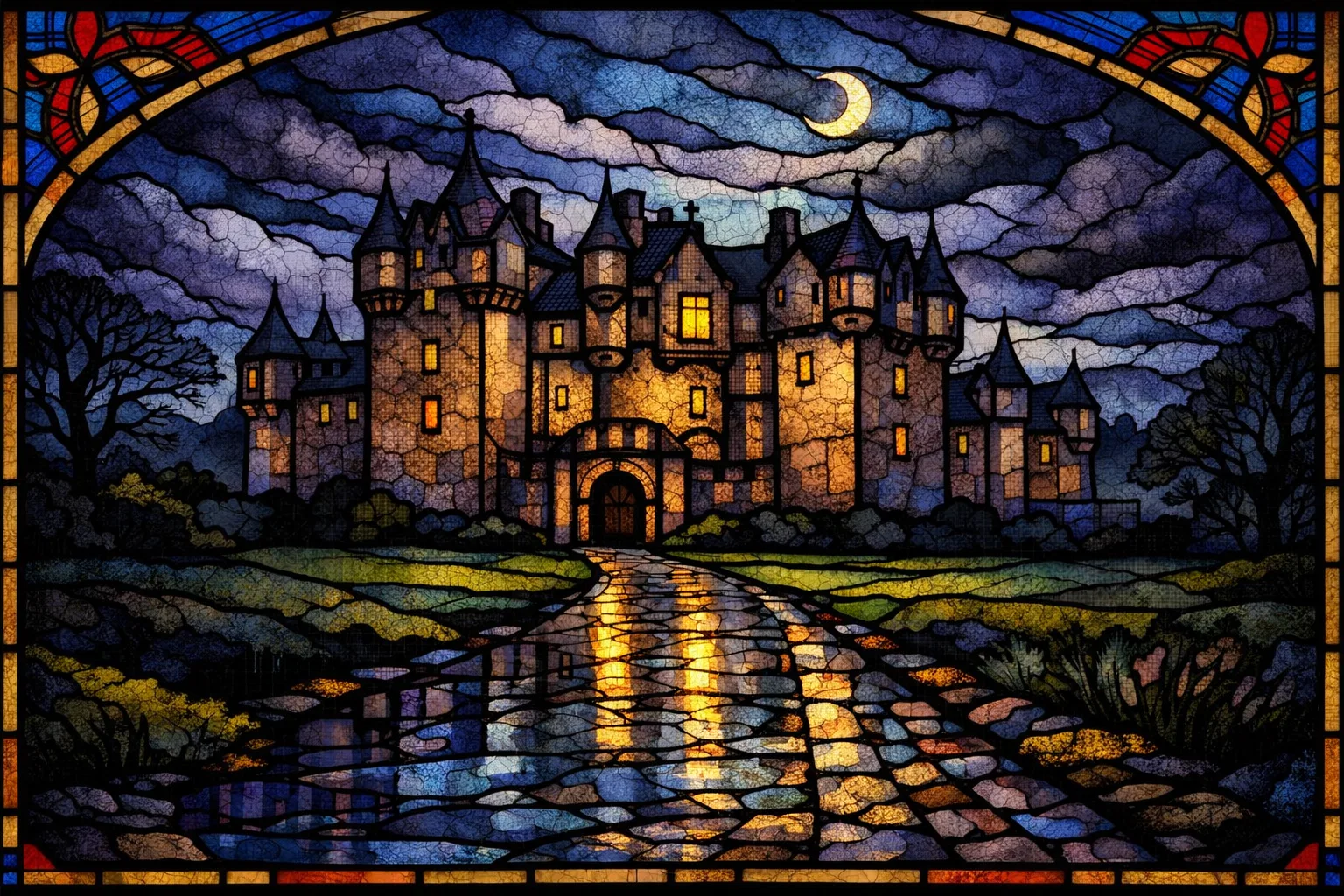
Fyvie Castle, near Turriff in Aberdeenshire, is said to be haunted not by one simple ghost story, but by a knot of family legend, visible castle fabric, local song and inherited tragedy. Its best-known apparition is the Green Lady, usually identified as Dame Lilias Drummond, first wife of Alexander Seton. The other distinctive strand is the phantom trumpeter, linked to Andrew Lammie, the castle servant whose doomed romance with Agnes Smith of Mill o’ Tifty became one of Aberdeenshire’s most famous traditional ballads. The National Trust for Scotland presents Fyvie as an 800-year-old fortress where “ghosts, legends and folklore” are woven into the site’s history, while also treating the haunting material as tradition rather than proven fact.[National Trust for Scotland]nts.org.ukfyvie castleNational Trust for ScotlandFyvie Castle, Garden & EstateAn imposing 800-year-old fortress, William the Lion was at Fyvie around 1214 and…
What makes Fyvie unusually rich for haunted-history readers is that its stories are anchored in things visitors can still locate: the Drummond Room, the carved name associated with Lilias, the castle’s towers, Fyvie kirkyard, Tifty’s landscape and the remembered role of a trumpeter in a ballad collected and classified as Child Ballad 233. The result is less a single “sighting” case than a haunted estate tradition: a place where aristocratic marriage, succession anxiety, servant status, women’s suffering and north-east song culture have all been given ghostly form.[nts.org.uk]nts.org.ukOpen source on nts.org.uk.
Why Fyvie feels so haunted
Fyvie’s reputation begins with the building itself. The castle stands in the village of Fyvie, near Turriff, and its history reaches back into the medieval period. The National Trust for Scotland describes it as an imposing fortress of around 800 years’ standing, associated with William the Lion around 1214 and later with Robert the Bruce and Charles I. Historic Environment Scotland’s listing points to major surviving and remodelled work from the Seton period, including early seventeenth-century fabric and the great wheel stair, while its designed-landscape record notes that Alexander Seton acquired Fyvie in 1596 and remodelled it as a display of wealth and influence.[nts.org.uk]nts.org.ukfyvie castleNational Trust for ScotlandFyvie Castle, Garden & EstateAn imposing 800-year-old fortress, William the Lion was at Fyvie around 1214 and…
That matters because Fyvie’s ghost stories are not attached to an anonymous ruin. They cling to a house built and rebuilt by powerful families: Preston, Meldrum, Seton, Gordon and Forbes-Leith in the common account of the castle’s layered ownership. The castle is therefore a good example of a Scottish haunted-place pattern in which each family era adds a tower, a room, a death story or a warning legend. The Green Lady belongs to the Seton era; the phantom trumpeter belongs to the Fyvie estate’s social world of lairds, servants, mills and parish memory.[Historic Environment Scotland]portal.historicenvironment.scotOpen source on historicenvironment.scot.
For Aberdeenshire’s haunted map, Fyvie is important because it joins two kinds of evidence that often sit apart. The Green Lady is a castle apparition with a named noblewoman and a physical trace said to survive in the building. Andrew Lammie is a ballad figure whose story travelled through oral tradition and print, but remained tied to actual local places: Fyvie Castle, Mill o’ Tifty and Fyvie kirkyard. That double anchoring is why Fyvie’s haunting reputation has lasted better than many looser “old castle ghost” anecdotes.[nts.org.uk]nts.org.ukOpen source on nts.org.uk.

The Green Lady of Fyvie
The Green Lady is usually said to be the ghost of Lilias Drummond, wife of Alexander Seton. In the familiar version, Lilias failed to provide Seton with a male heir, was cruelly treated or starved, and returned after death on the night of his second marriage. The National Trust for Scotland’s ghost-story account describes the classic signs of her presence as a sudden drop in temperature and the scent of roses; it also repeats the tradition that her name appeared freshly scratched into the castle wall after ghostly lamenting outside the bedchamber.[National Trust for Scotland]nts.org.ukOpen source on nts.org.uk.
The castle’s visitor interpretation gives the story a particularly strong physical focus. The National Trust for Scotland says that, on the tour, visitors can view the window ledge associated with Lilias’s carved name and the lonely room where she was allegedly starved to death. This is one reason the Green Lady story feels unusually concrete: it is not only a tale of a woman in green moving through corridors, but a legend attached to a named room, a visible inscription and a family crisis.[National Trust for Scotland]nts.org.ukOpen source on nts.org.uk.
The historical outline is more cautious. Lilias Drummond was a real noblewoman connected to a real political marriage. Genealogical and historical summaries identify her as Alexander Seton’s first wife and place her death in 1601, before Seton’s later marriage to Grizel Leslie. The National Trust’s version preserves the haunting as legend, while other historical commentary notes that the more dramatic claims of starvation or murder are not securely evidenced. One careful local-folklore treatment argues that there is no firm proof Seton starved Lilias and suggests that repeated childbirth, illness, infidelity or emotional distress may all sit behind the later story.[wikipedia.org]WikipediaAlexander Seton, 1st Earl of DunfermlineAlexander Seton, 1st Earl of Dunfermline
That uncertainty does not weaken the folklore; it helps explain it. The Green Lady legend turns a difficult early modern reality into a memorable haunting. Noble marriages were bound up with property, status and inheritance. A wife’s ability to produce a son could be treated as a family and dynastic matter, even though modern readers understand that responsibility for a child’s sex did not lie with the mother. Fyvie’s story preserves that pressure in a severe form: a woman remembered not for political power, but for daughters, abandonment, a second marriage and a name that refuses to disappear.[goblinshead.co.uk]goblinshead.co.ukOpen source on goblinshead.co.uk.
The detail of roses is also important. Many castle ghost stories rely on sight alone: a figure on a stair, a face at a window, a woman crossing a room. Fyvie’s Green Lady tradition uses atmosphere as evidence within the story world. Cold air, fragrance and lamenting make her presence felt before she is seen. That suits the castle setting, where stone chambers, draughts, old fabric and guided-tour expectation can all intensify the experience without requiring the reader to accept a supernatural explanation.[National Trust for Scotland]nts.org.ukOpen source on nts.org.uk.
Andrew Lammie and the phantom trumpeter
Fyvie’s second great haunting is stranger because it comes through song. Andrew Lammie, also known through the ballad “Mill o’ Tifty’s Annie”, is remembered as Lord Fyvie’s trumpeter. The traditional story tells how Andrew loved Annie or Agnes Smith, the daughter of the miller at Tifty, but the match was opposed because Andrew was a servant and therefore socially beneath her. Francis James Child catalogued the ballad as Child 233, and accessible texts of the ballad open by placing the action plainly in the neighbourhood of Fyvie and naming Andrew as Lord Fyvie’s trumpeter.[Wikisource]en.wikisource.orgChapter 233Chapter 233
The ballad is not a minor footnote to the ghost story. It is one of the reasons the ghost story has cultural weight. A modern folk-song reference site identifies “Andrew Lammie / Mill o’ Tifty’s Annie” as Roud 98 and Child 233, and summarises the story as a tragic romance set around Fyvie Castle and Mill o’ Tifty. Academic work on the ballad describes it as set in the parish and estate of Fyvie near Turriff in the early 1670s, and notes that the evidence strongly suggests a real Andrew Lammie existed.[Mainly Norfolk]mainlynorfolk.infoOpen source on mainlynorfolk.info.
In the haunting tradition, the trumpeter is heard rather than merely seen. Later ghost accounts say trumpet sounds are heard in or around the castle, and some versions add a tall male figure in rich tartan near the castle wall who vanishes when approached. The usual interpretation is that this is Andrew Lammie, mourning Annie or warning the Fyvie family. These accounts are much weaker as eyewitness evidence than the ballad is as folklore evidence, but they show how a remembered song can become a castle haunting.[Haunted Rooms®]hauntedrooms.co.ukOpen source on hauntedrooms.co.uk.
The power of the Andrew Lammie story lies in its social contrast with the Green Lady. Lilias Drummond belongs to elite marriage and dynastic pressure. Andrew and Annie belong to the estate’s wider world: servants, millers, kinship discipline and local reputation. Both stories turn blocked relationships into supernatural memory. In one, a wife returns to accuse or haunt the husband who replaced her; in the other, the sound of a trumpet keeps alive a romance that family and rank destroyed.[JSTOR]jstor.orgOpen source on jstor.org.
The ballad landscape also remains unusually legible. Accounts of the tradition associate Agnes Smith with Fyvie kirkyard, where her gravestone tradition became part of the story’s proof-world. Child’s notes record that a decayed stone was replaced in 1845 with a facsimile and that a polished granite cross was added in 1869 by public subscription. That kind of memorial history matters: it shows the ballad was not only sung, but localised, visited and publicly maintained.[Internet Archive]archive.orgenglishandscopt204chiluoft djvu.txtenglishandscopt204chiluoft djvu.txt
Folklore, inheritance and ballad memory
Fyvie’s Green Lady and trumpeter stories are often grouped with the castle’s wider lore of curses, sealed spaces and unlucky inheritance, but the strongest way to read them is as memory stories. They preserve anxiety about who belongs inside the castle and who is excluded from it. Lilias belongs by marriage, but is remembered as displaced by the demand for a son and by Seton’s remarriage. Andrew belongs by service, but not by rank. Annie belongs to the nearby mill, close enough to the castle to love its trumpeter, but not powerful enough to control her own story.[goblinshead.co.uk]goblinshead.co.ukOpen source on goblinshead.co.uk.
The inheritance theme is clearest in the Green Lady tale. The legend depends on the belief that Lilias was blamed for having daughters rather than a male heir. Historically, Seton did have daughters with Lilias, and later children through subsequent marriages; the ghost story compresses that family history into one cruel moral image. Whether or not the starvation claim is true, the legend became a way of accusing patriarchal ambition. The carved name is so effective because it makes Lilias seem to answer the family record with her own signature.[wikipedia.org]WikipediaAlexander Seton, 1st Earl of DunfermlineAlexander Seton, 1st Earl of Dunfermline
The ballad theme is different but related. “Andrew Lammie” is a story about status boundaries enforced at household level. Annie’s family disapproves of a servant-trumpeter; in many versions, pressure and violence follow. A traditional-song summary describes Annie as the daughter of a well-to-do miller whose family mistreats her and whose brother kills her while Andrew is away. The exact details vary across versions, but the repeated emotional structure is stable: love crosses a social line, the household closes ranks, and death fixes the story in local memory.[springthyme.co.uk]springthyme.co.ukOpen source on springthyme.co.uk.
This is why the phrase “ballad ghosts” suits Fyvie. Andrew Lammie’s ghost is not just a reported apparition added to a castle guidebook; it is the afterlife of a sung narrative. The trumpet is the sound of the ballad entering the building. Listeners who already know Annie’s fate hear more than a musical note: they hear class tension, bereavement, absence and accusation.[Wikisource]en.wikisource.orgChapter 233Chapter 233
Fyvie also shows how folklore can be both local and mobile. The story is rooted in Aberdeenshire place-names, yet the ballad travelled through singers, collectors and printed texts. Child’s nineteenth-century classification helped preserve it as part of the wider English and Scottish ballad tradition, while later performers and archives have kept “Mill o’ Tifty’s Annie” in circulation. That movement does not detach it from Fyvie; it makes Fyvie one of those rare haunted places whose legend can be visited in stone, sung in performance and read in ballad scholarship.[archive.org]archive.orgOpen source on archive.org.
How credible are Fyvie’s ghost stories?
Fyvie’s haunting reputation is credible as folklore, but not as proof that apparitions exist. The strongest evidence is not paranormal evidence in the scientific sense. It is historical and cultural evidence: the castle is real, Lilias Drummond and Alexander Seton were real, the Seton remodelling of Fyvie is documented, and “Andrew Lammie” is a long-preserved traditional ballad with a specific Aberdeenshire setting.[historicenvironment.scot]portal.historicenvironment.scotOpen source on historicenvironment.scot.
The Green Lady story has several layers of reliability. The existence of Lilias and the broad sequence of death and remarriage are historically plausible and source-supported. The claim that she was starved to death is much less secure and should be treated as legend. The carved-name tradition is part of the visitor experience and is reported by the National Trust for Scotland, but the supernatural explanation for the carving is a matter of belief and storytelling rather than demonstrated fact.[goblinshead.co.uk]goblinshead.co.ukOpen source on goblinshead.co.uk.
The Andrew Lammie material is strongest where it belongs to ballad history. The ballad’s collection, classification and long performance tradition are well attested. The claim that Andrew’s ghost literally sounds a trumpet in the castle is a later haunting interpretation, and evidence for specific sightings or sounds is mostly anecdotal. For a careful reader, the fair conclusion is that Fyvie’s phantom trumpeter is best understood as a folk-memory figure: a ghost created where song, landscape and local tragedy meet.[wikisource.org]en.wikisource.orgChapter 233Chapter 233
Sceptical explanations do not need to flatten the stories. Cold rooms, draughts, old stone, scent association, expectation on ghost tours and the emotional force of guided storytelling can all shape what visitors notice. At the same time, those explanations cannot fully account for why these particular stories lasted. Fyvie’s legends endure because they fit the building’s history: a powerful laird remodelling a castle, a first wife remembered in the fabric, a servant musician tied to a fatal ballad, and a parish landscape that still carries the names.[historicenvironment.scot]portal.historicenvironment.scotOpen source on historicenvironment.scot.
Why the story still matters in Aberdeenshire
Fyvie Castle stands out in Aberdeenshire because its haunting traditions are not interchangeable with any other castle’s Green Lady tale. Many Scottish castles have women in green, grey or white, often attached to betrayal, death or family misfortune. Fyvie’s version is sharper because Lilias Drummond’s story is linked to early modern inheritance pressure, a visible carved-name tradition and the Seton remodelling of the castle.[National Trust for Scotland]nts.org.ukOpen source on nts.org.uk.
The Andrew Lammie tradition gives Fyvie something even more distinctive: a ghost story with a soundtrack. “Mill o’ Tifty’s Annie” connects the castle to the wider north-east ballad world, where local tragedies were preserved not only in records but in voices. For readers exploring Aberdeenshire’s haunted history, this makes Fyvie a key site because it bridges two kinds of eerie heritage: the aristocratic apparition in the castle room and the sung tragedy carried through the parish.[mainlynorfolk.info]mainlynorfolk.infoOpen source on mainlynorfolk.info.
The best way to understand Fyvie, then, is not to ask whether every reported cold spot, rose scent or trumpet note can be proved. It is to ask why these are the forms the haunting took. The Green Lady makes a wronged woman impossible to erase. The phantom trumpeter makes a servant’s grief audible in a noble house. Together, they turn Fyvie Castle from a grand Aberdeenshire monument into a place where social memory still seems to move through rooms, windowsills, kirkyards and song.
Amazon book picks
Further Reading
Books and field guides related to Why Is Fyvie Castle So Haunted?. Use these as the next step if you want deeper reading beyond the article.
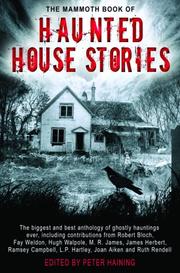
The Mammoth Book of Haunted House Stories
Supports interest in haunted estates and castles.
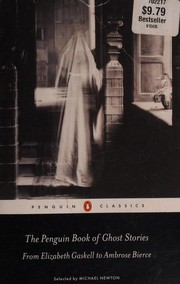
The Penguin Book of Ghost Stories
Expands readers into classic supernatural literature.
eBay marketplace picks
Marketplace Samples
Live-tested eBay searches with available results related to this page.
Endnotes
1.
Source: en.wikisource.org
Title: Chapter 233
Link:https://en.wikisource.org/wiki/The_English_and_Scottish_Popular_Ballads/Part_8/Chapter_233
2.
Source: jstor.org
Link:https://www.jstor.org/stable/23208182
3.
Source: archive.org
Title: englishandscopt204chiluoft djvu.txt
Link:https://archive.org/stream/englishandscopt204chiluoft/englishandscopt204chiluoft_djvu.txt
4.
Source: Wikipedia
Title: Alexander Seton, 1st Earl of Dunfermline
Link:https://en.wikipedia.org/wiki/Alexander_Seton%2C_1st_Earl_of_Dunfermline
5.
Source: goblinshead.co.uk
Link:https://www.goblinshead.co.uk/bogles/fyvie/
6.
Source: springthyme.co.uk
Link:https://www.springthyme.co.uk/ah08/ah08_15.html
7.
Source: archive.org
Link:https://archive.org/details/englishscottishp08chil
8.
Source: tobarandualchais.co.uk
Link:https://www.tobarandualchais.co.uk/track/55606?l=en
9.
Source: archive.org
Link:https://archive.org/download/englishscottishp00sarg/englishscottishp00sarg.pdf
10.
Source: archive.org
Link:https://archive.org/download/historyoffamilv200seto/historyoffamilv200seto.pdf
11.
Source: Wikipedia
Title: Fyvie Castle
Link:https://en.wikipedia.org/wiki/Fyvie_Castle
12.
Source: Wikipedia
Title: Andrew Lammie
Link:https://en.wikipedia.org/wiki/Andrew_Lammie
13.
Source: en.wikisource.org
Title: Mill o’ Tiftie’s Annie, or, Andrew Lammie, the trumpeter of Fyvie (1)
Link:https://en.wikisource.org/wiki/Mill_o%27Tiftie%27s_Annie%2C_or%2C_Andrew_Lammie%2C_the_trumpeter_of_Fyvie%281%29
14.
Source: nts.org.uk
Title: fyvie castle
Link:https://www.nts.org.uk/visit/places/fyvie-castle
Source snippet
National Trust for ScotlandFyvie Castle, Garden & EstateAn imposing 800-year-old fortress, William the Lion was at Fyvie around 1214 and...
15.
Source: nts.org.uk
Link:https://www.nts.org.uk/stories/ghosts-of-the-trust
16.
Source: nts.org.uk
Link:https://www.nts.org.uk/visit/places/fyvie-castle/highlights/castle
17.
Source: portal.historicenvironment.scot
Link:https://portal.historicenvironment.scot/apex/f?p=1505%3A300%3A%3A%3A%3A%3AVIEWTYPE%2CVIEWREF%3Adesignation%2CLB9615
18.
Source: portal.historicenvironment.scot
Link:https://portal.historicenvironment.scot/apex/f?p=1505%3A300%3A%3A%3A%3A%3AVIEWTYPE%2CVIEWREF%3Adesignation%2CGDL00184
19.
Source: mainlynorfolk.info
Link:https://mainlynorfolk.info/folk/songs/andrewlammie.html
20.
Source: hauntedrooms.co.uk
Link:https://www.hauntedrooms.co.uk/fyvie-castle-near-turiff-aberdeenshire
21.
Source: nts.org.uk
Link:https://www.nts.org.uk/stories/scottish-ghost-stories-witches-murder-and-folklore-part-2
22.
Source: nts.org.uk
Link:https://www.nts.org.uk/visit/places/fyvie-castle/highlights/history
23.
Source: trove.scot
Link:https://www.trove.scot/place/19091
24.
Source: geni.com
Title: Dame Lilias Drummond
Link:https://www.geni.com/people/Dame-Lilias-Drummond/6000000002188028602
25.
Source: folkworld.de
Link:https://www.folkworld.de/73/e/child.html
26.
Source: journals.socantscot.org
Link:https://journals.socantscot.org/index.php/psas/article/view/8099
27.
Source: tripadvisor.com
Title: Fyvie Castle
Link:https://www.tripadvisor.com/Attraction_Review-g672723-d189557-Reviews-Fyvie_Castle-Fyvie_Aberdeenshire_Scotland.html
28.
Source: thomaslindie.wordpress.com
Title: fyvie castle
Link:https://thomaslindie.wordpress.com/2016/06/22/fyvie-castle/
29.
Source: thecastlesofscotland.co.uk
Link:https://www.thecastlesofscotland.co.uk/the-best-castles/grand-castles/fyvie-castle/
30.
Source: icysedgwick.com
Title: green lady
Link:https://www.icysedgwick.com/green-lady/
31.
Source: hauntedhosts.com
Title: Lilias Drummond
Link:https://hauntedhosts.com/ghosts/aberdeenshire/fyvie-castle/lilias-drummond-green-lady/
Additional References
32.
Source: youtube.com
Title: The Ghosts of Fyvie Castle: Haunted History and Mysterious Phenomena
Link:https://www.youtube.com/watch?v=beytI9BB7As
Source snippet
Fyvie Castle By James Scott Skinner, performed by Paul Anderson...
33.
Source: youtube.com
Title: We Explored One of Scotland’s Most Haunted Castles!
Link:https://www.youtube.com/watch?v=3_2IBeNGZ8A
Source snippet
The Ghosts of Fyvie Castle: Haunted History and Mysterious Phenomena...
34.
Source: upload.wikimedia.org
Link:https://upload.wikimedia.org/wikipedia/commons/1/15/A_history_of_the_family_of_Seton_during_eight_centuries.%28With_plates%2C_including_portraits%2C_illustrations%2C_facsimiles%2C_a_bibliography_and_genealogical_tables.%29%28IA_historyoffamilv100seto%29.pdf
35.
Source: facebook.com
Link:https://www.facebook.com/NationalTrustforScotland/posts/a-new-chapter-starts-in-the-story-of-fyvie-castle-garden-estate-nts-in-aberdeens/1155924749896606/
36.
Source: facebook.com
Link:https://www.facebook.com/groups/2089437891184119/posts/5777149445746260/
37.
Source: musicanet.org
Link:https://www.musicanet.org/robokopp/scottish/atfyvie.htm
38.
Source: facebook.com
Link:https://www.facebook.com/visitabdn/posts/believed-to-be-one-of-the-most-haunted-castles-in-the-uk-so-much-so-that-even-th/2034451509989597/
39.
Source: great-castles.com
Link:https://great-castles.com/fyvieghost.html
40. Source: douglashistory.co.uk
41.
Source: aboutaberdeen.com
Link:https://aboutaberdeen.com/Fyvie-Castle
Topic Tree