Within Haunted Meirionnydd
What Haunts Merionethshire's Coast?
Harlech and Barmouth show how castle legend, coastal memory and local civic storytelling give Merionethshire its haunted edge.
On this page
- Harlech Castle, war memory and mythic atmosphere
- Barmouth's Min y Mor ghost story
- How coastal places preserve local shame and danger
Page outline Jump by section
Introduction
Harlech and Barmouth give Merionethshire’s coast a haunted character that is quieter, older-fashioned and more locally rooted than the commercial ghost trails found in larger tourist centres. Harlech is not mainly famous for a named resident spectre, but for a castle landscape where siege history, marsh lights, war memory and Welsh myth make the place feel charged. Barmouth’s strongest coastal haunting is more domestic and civic: the Min y Môr ghost story, preserved by the town council, in which a young woman’s shame, grief and a school bell become attached to mist, water and a seafront building. Together, the two towns show how Merionethshire’s haunted coast works: not as proof of ghosts, but as a chain of stories about danger, exile, guilt, military endurance and the uneasy pull of the sea.
The historic-county frame matters because both places now sit within Gwynedd, while older local identity, folklore routes and county histories often use Merionethshire or Meirionnydd. Wikishire describes Merionethshire as a county “on the sea coast and of the mountains”, with Harlech on the western coast and Barmouth further south on Cardigan Bay and the Mawddach estuary.[Wikishire]wikishire.co.ukMerionethshire25 Oct 2024 — Merionethshire is a county on the sea coast and of the mountains. It lies between Caernarfonshire an…
Why This Coast Feels Haunted
The haunted history of Harlech and Barmouth is best understood as a coastal sequence rather than a list of isolated ghost sites. Harlech stands above what was once a much closer shoreline, with a medieval fortress looking over marsh, dunes and sea. Barmouth sits where the Mawddach opens into Cardigan Bay, a place shaped by shipbuilding, fishing, tourism and the practical dangers of weather and water. The stories preserved here are therefore not random: they grow out of cliffs, towers, bells, storms, shame, siege and mist.
This is also a landscape where the boundary between history and legend has long been porous. At Harlech, official heritage bodies emphasise the castle’s military importance, but local storytelling also connects the site with the Mabinogion world of Bendigeidfran and Branwen. At Barmouth, local history records the town’s growth from a tiny settlement into a maritime and seaside community, while civic storytelling keeps a tragic ghost tale attached to a named building on the shore.[gov.wales]cadw.gov.walesCadw Castell Harlech | CadwCadw Castell Harlech | Cadw
The result is a coastal haunted route with two different moods. Harlech is haunted by atmosphere: old war, national memory, mythic scale and eerie marshland. Barmouth is haunted by a story: a young woman, a child, a bell and a disappearance into the sea. Both belong to Merionethshire’s wider pattern, where the strongest ghost traditions often preserve moral pressure as much as supernatural fear.
Harlech Castle: War Memory and Mythic Atmosphere
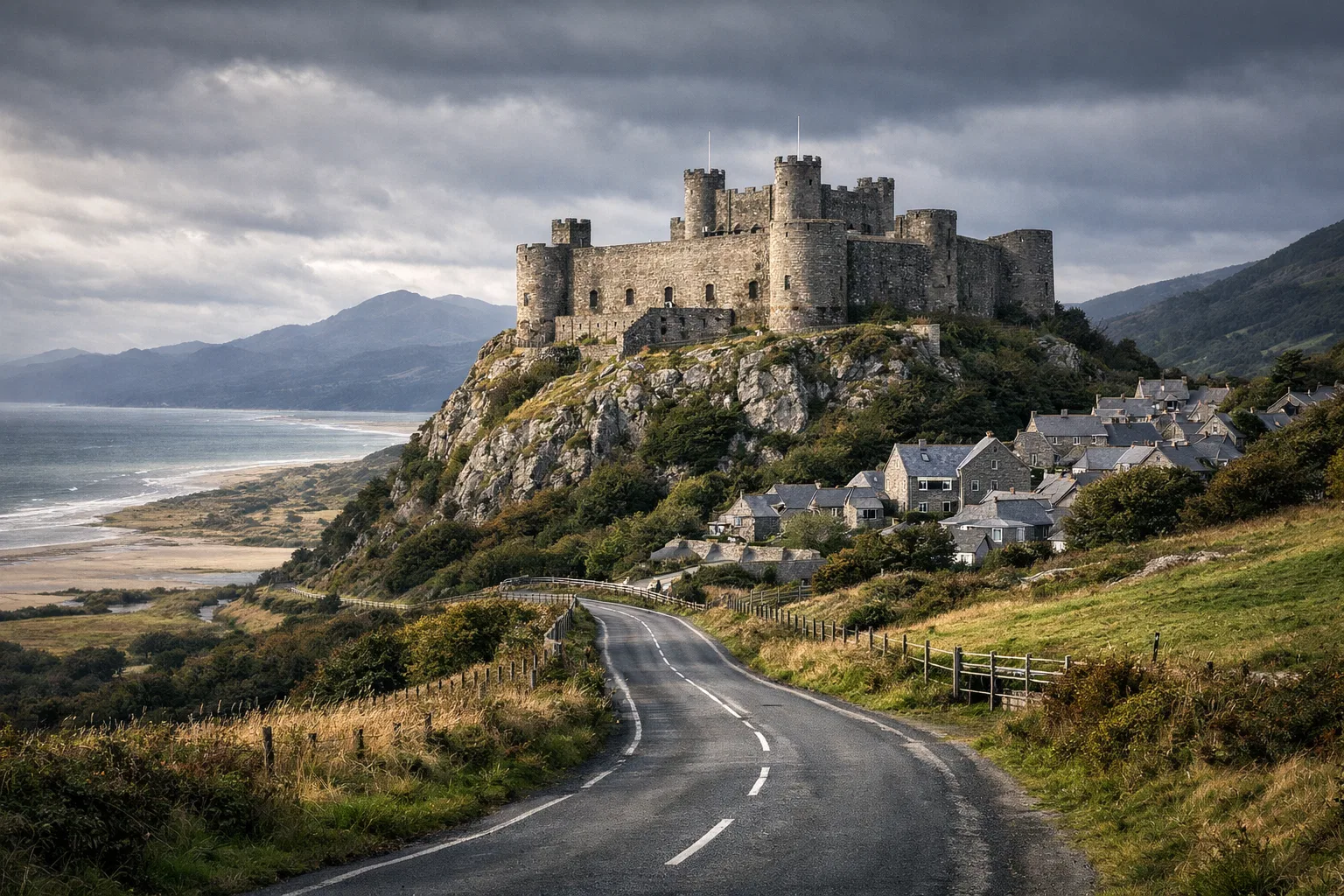
Harlech Castle is one of the great historic anchors of the Merionethshire coast. Cadw describes Castell Harlech as a fortress completed in seven years under Master James of St George, using a “walls within walls” design and the natural defence of a rocky crag. Its famous “Way from the Sea”, a steep route of 108 steps, allowed defenders to be supplied by ship when landward access was cut off.[Cadw]cadw.gov.walesCadw Castell Harlech | CadwCadw Castell Harlech | Cadw
That detail is crucial to Harlech’s haunted feel. The castle was not merely built beside the coast; its survival depended on the sea. Today, dunes and marshland separate the castle from the water more than medieval visitors would have expected, but the memory of sea access remains part of the site’s identity. A reader looking for a conventional ghost may be disappointed; a reader looking for haunted history will find a place where the geography itself feels like a memory of siege.
Harlech’s military story is long and layered. It was part of Edward I’s castle-building programme in north Wales, and UNESCO includes Harlech with Beaumaris, Caernarfon and Conwy in the Castles and Town Walls of King Edward in Gwynedd World Heritage Site, calling Beaumaris and Harlech especially notable for their double-wall structures and architectural quality.[UNESCO World Heritage Centre]whc.unesco.orgOpen source on unesco.org. The castle later became entangled in rebellion, dynastic conflict and civil war. Eryri National Park notes the seven-year siege during the Wars of the Roses and the association with the tune “Men of Harlech”, while Cadw’s own interpretation stresses repeated sieges and “heroism in the face of overwhelming odds”.[Eryri National Park]eryri.gov.walesOpen source on gov.wales.
That does not make Harlech a documented apparition site in the same way as a house with dated witness testimony. Its haunting is more cultural than evidential. War memory clings to the walls; the steep drop, the old sea route and the long view across the coast make the site easy to imagine as a place of waiting, hunger and watchfulness. The castle’s popular “haunted” reputation is therefore partly atmospheric, partly historical and partly supplied by later tourism.
One modern example shows the problem clearly. In 2014, local press reported a photograph said by some to show a “black-robed monk” at Harlech Castle. Such reports are part of the modern ghost-story economy: a striking image, an interpretation, a brief burst of publicity. They are interesting as evidence of continuing haunted imagination around the site, but they are not strong evidence of an older, stable Harlech ghost tradition.[Daily Post]dailypost.co.ukghostly black robed monk harlech castle 7948507ghostly black robed monk harlech castle 7948507
Marsh Lights, Ghosts and the Romantic Harlech
The more valuable Harlech ghost evidence is not the modern photograph but the older tradition of eerie lights and spectral atmosphere around the marshland below the castle. People’s Collection Wales records that Romantic-period visitors were drawn to Harlech’s dramatic combination of setting and history, and notes that the German journalist Francis Brömel enjoyed local tales of ghosts and will-o’-the-wisps hovering over the marshland formed by centuries of silting.[People's Collection Wales]peoplescollection.walesOpen source on peoplescollection.wales.
This matters because it places Harlech’s haunted reputation in a recognisable coastal environment. Will-o’-the-wisp traditions are often linked to boggy or marshy ground, where lights seen at night could be interpreted as spirits, omens or dangerous guides. At Harlech, the silted coastal plain beneath a war castle gave such stories an unusually theatrical setting: the fortress above, the marsh below, the sea withdrawing into memory and the mountains behind.
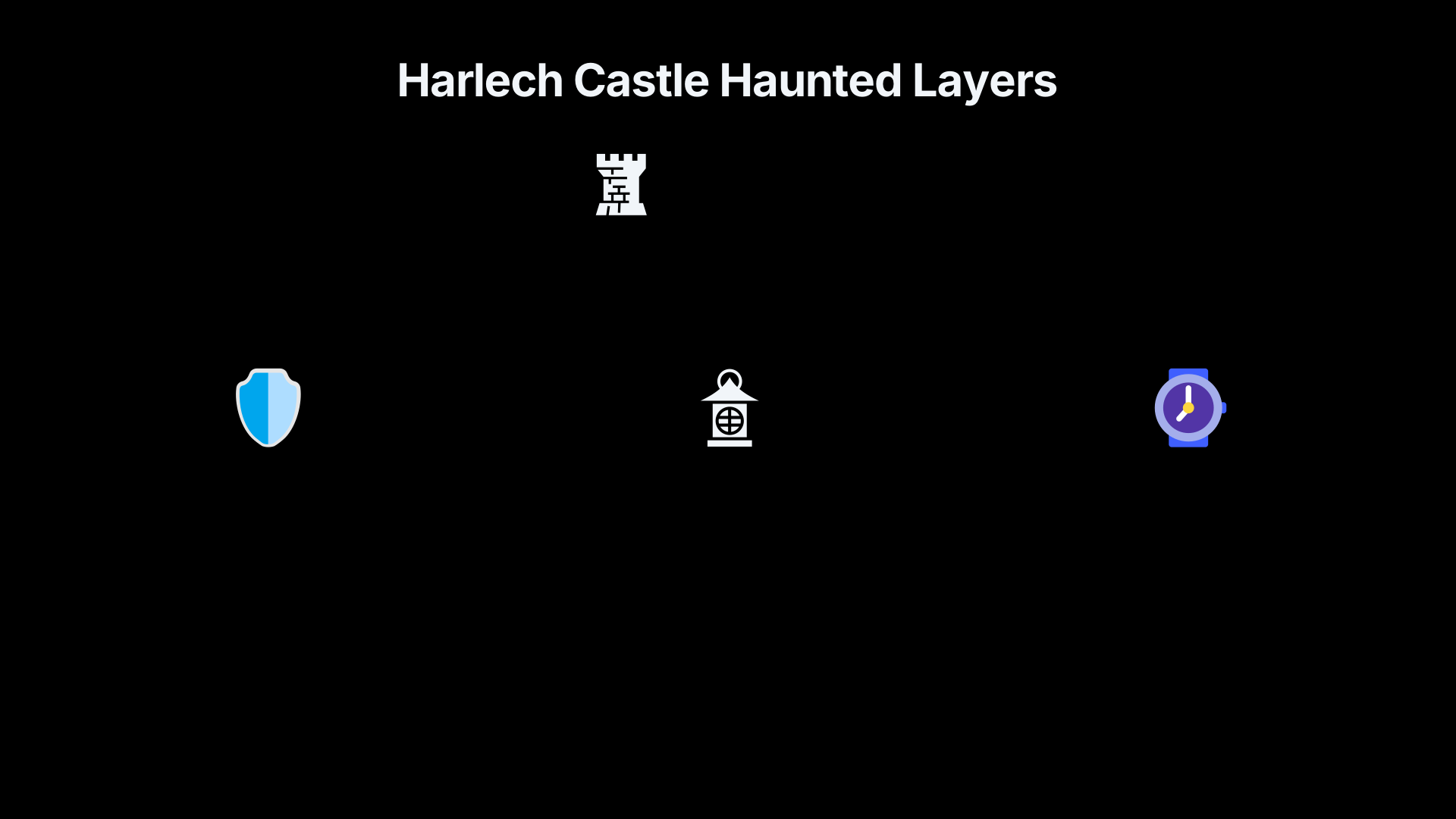
A careful reading should separate three layers:
The built castle: a documented medieval fortress, protected and interpreted as a major heritage site.
The military memory: sieges, rebellion and endurance, especially the long Wars of the Roses association and the later “Men of Harlech” tradition.
The spectral landscape: ghost and marsh-light stories preserved in travel and local memory, especially around the land below the castle.
Those layers reinforce one another, but they are not the same kind of evidence. Cadw and UNESCO support the castle’s historical importance; People’s Collection Wales supports the existence of local ghost and marsh-light traditions; modern press reports show that visitors still frame odd experiences at Harlech in ghostly terms. The credible conclusion is not that Harlech Castle is “proved haunted”, but that it has long invited haunted interpretation because its history and setting make supernatural readings feel plausible to the imagination.[gov.wales]cadw.gov.walesCadw Castell Harlech | CadwCadw Castell Harlech | Cadw
Harlech and the Mabinogion: A Coast Already Full of Giants
Harlech’s eerie power is not only medieval and military. It also belongs to Welsh myth. Cadw’s educational material on Branwen places the opening of the tale at Harlech, where Bendigeidfran and Manawydan sit looking out to sea and see ships approaching from Ireland.[Cadw]cadw.gov.walesCadw Branwen ferch Llyˆ rCadw Branwen ferch Llyˆ r Land of Legends Wales similarly presents Harlech as the site of the old court associated with Matholwch’s arrival to marry Branwen, a marriage that leads to catastrophe and war.[Land of Legends]landoflegends.walesharlech castleharlech castle
This mythic association gives Harlech a different kind of haunted history. The figures are not ghosts in the usual sense, but the story gives the coast a deep memory of watching, invasion, kinship, betrayal and grief. A castle visitor may come for Edward I’s masonry, yet the older legendary frame imagines the same seaward gaze as the beginning of a tragic cycle between Wales and Ireland.
That is why Harlech works so well within Merionethshire’s haunted-history map. The county’s strongest legends often make landscape carry emotional weight. At Nannau, a hollow oak becomes the hiding place of a political killing. At Cader Idris, a mountain becomes a test of madness, poetry and death-portent lore. At Harlech, the coast becomes a stage where military architecture, marsh lights and mythic sea-watch all overlap.
There is also a useful corrective here. Calling Harlech “haunted” should not flatten its Welsh legendary associations into a generic castle ghost story. The more interesting reading is that Harlech is haunted by accumulated memory: medieval conquest, Welsh resistance, Romantic travel, marsh folklore and mythic grief. That makes it a powerful haunted-history site even when named apparitions are less firmly rooted than the atmosphere around them.
Barmouth’s Min y Môr Ghost Story
Barmouth’s best-preserved coastal ghost story is much more specific. Barmouth Town Council records the tale of the Min y Môr Ghost, centred on a young woman named Blodwyn Griffiths. According to the town’s account, Blodwyn was sent to Barmouth to give birth to an illegitimate child after an affair with an English gentleman. She was then made to work as a nursery nurse for a local butcher with seven children. One of her duties was to take two children to Min y Môr, then serving as a school, and ring the bell in the tower to call pupils to class.[Barmouth Town Council]barmouthtowncouncil.gov.ukOpen source on barmouthtowncouncil.gov.uk.
The tragedy in the story is stark. While climbing the stairs, Blodwyn drops her baby; the child dies a week later. The account says Blodwyn never recovers from grief and guilt. In 1889, on a misty November night, she is seen walking to the shore, picking up a small child, cradling it and continuing into the waves. The haunting survives in the claim that when mist rolls in, people can still hear the school bell tolling.[Barmouth Town Council]barmouthtowncouncil.gov.ukOpen source on barmouthtowncouncil.gov.uk.
This is the clearest apparition-style story in the Harlech-Barmouth coastal pairing, but it should still be handled carefully. The strongest accessible source is a civic heritage page rather than a contemporary 1889 newspaper report, parish entry or coroner’s record. That means the story is best presented as a preserved local legend, not as a verified historical case. Its value lies in what it reveals about coastal social memory: illegitimacy, class vulnerability, domestic service, child death, women’s shame and the sea as a place of disappearance.
Min y Môr also has the right physical ingredients for a haunting tradition to stick. The story has a named building, a tower, a bell, a repeated sound, a mist condition and a route to the shore. Those details make it memorable and retellable. A vague ghost story can drift; a bell in a tower beside the sea can be pointed to, photographed, repeated and folded into town identity.

Why Barmouth Preserved This Story
Barmouth’s Min y Môr story is not just a sad tale with a supernatural ending. It belongs to a town whose public identity has long depended on the meeting of local life and visitors’ imagination. Bangor University’s “Journey to the Past” summary describes Barmouth as first recorded as a four-house settlement in 1565, later developing through coastal shipping, shipbuilding, fishing and the export of wool from Merioneth sheep farms.[Footsteps]footsteps.bangor.ac.ukFootsteps BarmouthFootsteps Barmouth Barmouth Town Council’s maritime history records the scale of late eighteenth- and early nineteenth-century shipbuilding, including hundreds of vessels built around the town and Mawddach.[Barmouth Town Council]barmouthtowncouncil.gov.ukOpen source on barmouthtowncouncil.gov.uk.
By the nineteenth century, Barmouth was also becoming a seaside destination. The town’s history project and heritage material emphasise growth along the water’s edge, tourism, Marine Parade and the increasing need for accommodation in the late 1800s and early 1900s.[barmouth-wales.co.uk]barmouth-wales.co.ukhistory projecthistory project That matters because ghost stories often travel well in resort towns. They give visitors a way to experience a place after dark, while giving residents a way to preserve older anxieties beneath the holiday surface.
The Min y Môr story is especially revealing because it does not turn Barmouth’s coast into simple Gothic scenery. It makes the seafront a moral landscape. The haunting is linked to illegitimacy, service, school discipline, child care and public shame. The bell does not merely frighten; it recalls duty. The mist does not merely obscure; it creates the conditions in which a hidden grief returns.
There is a wider Barmouth texture around this, too. The town’s historic fabric includes buildings associated with maritime trade, law, punishment and old settlement. Tŷ Gwyn, for example, is recorded by Cadw-linked listing material as a late fifteenth-century building connected with Gryffydd Fychan of Corsygedol and the Lancastrian world of Jasper Tudor; Tŷ Crwn, the round lock-up, was built in 1833 for drunks and petty offenders, with local tradition explaining its circular form as leaving the Devil no corners to hide in.[azurewebsites.net]cadwpublic-api.azurewebsites.netCadw Public APIListed BuildingsCadw Public APIListed Buildings These are not all ghost stories, but they show why Barmouth’s haunted imagination gathers around shame, confinement, danger and the edge between respectable public life and what a town prefers not to say aloud.
What the Two Towns Reveal About Coastal Haunting
Harlech and Barmouth preserve different kinds of haunted history, and the contrast is the point. Harlech’s ghostliness is monumental and atmospheric. Barmouth’s is intimate and narrative. One looks out from a fortress over marsh and sea; the other follows a grieving woman from a school tower to the water.
The evidence differs as well. Harlech has strong official support for its historical setting and a good record of ghostly atmosphere in Romantic and local tradition, especially the will-o’-the-wisp stories around the marsh. Its named modern apparition reports are weaker and more anecdotal. Barmouth’s Min y Môr legend is more coherent as a ghost story, but its accessible sourcing is largely local civic preservation rather than contemporary documentation. Both cases therefore ask for the same balanced treatment: they are meaningful traditions, not proven supernatural events.
Several themes make the coast distinctive within Merionethshire:
War becomes atmosphere at Harlech. The castle’s sieges, sea access and commanding position create a sense of endurance and watchfulness even before any ghost is mentioned.[Cadw]cadw.gov.walesCadw Castell Harlech | CadwCadw Castell Harlech | Cadw
Marsh and mist turn landscape into folklore. Harlech’s will-o’-the-wisp traditions and Barmouth’s mist-bell motif both depend on weather and visibility. These are coastal stories in which the air itself seems to remember.[People's Collection Wales]peoplescollection.walesOpen source on peoplescollection.wales.
Local shame becomes haunting at Barmouth. The Min y Môr tale preserves a social tragedy: a woman judged for pregnancy outside marriage, placed in service, overwhelmed by grief and remembered through a sound associated with school and duty.[Barmouth Town Council]barmouthtowncouncil.gov.ukOpen source on barmouthtowncouncil.gov.uk.
Tourism helps stories survive. Harlech’s Romantic visitors and Barmouth’s resort development both encouraged dramatic local narratives to be repeated for outsiders, but the best stories endure because they also mean something locally.[People's Collection Wales]peoplescollection.walesOpen source on peoplescollection.wales.
How Credible Are the Hauntings?
The most honest answer is that Harlech and Barmouth offer credible folklore rather than conclusive ghost evidence. The historical settings are real and well documented. Harlech Castle’s architecture, siege history and coastal setting are supported by Cadw, UNESCO and heritage records. Barmouth’s maritime and resort development is supported by local history projects, Bangor University material and town records.[gov.wales]cadw.gov.walesCadw Castell Harlech | CadwCadw Castell Harlech | Cadw
The supernatural claims sit on a different evidential level. Harlech’s marsh lights and ghost traditions are valuable because they are attached to older travel and local storytelling, but they do not amount to verified apparitions. Barmouth’s Min y Môr story is vivid and locally preserved, but without a contemporary documentary trail in the accessible sources, it should be described as a town legend rather than a confirmed historical incident.
Sceptical explanations do not empty these stories of meaning. Marsh lights may be misread natural lights, reflections, atmospheric effects or later embellishments. A school bell heard in mist may be memory, sound carried strangely by weather, a later tale attached to a building, or simply a story repeated because it gives grief a form. What matters for haunted history is that communities chose these images: a light over marshland, a bell in fog, a woman walking into the sea.
That is the real haunted edge of Merionethshire’s coast. Harlech and Barmouth do not need to compete with famous “most haunted” castles or heavily marketed ghost hunts. Their power lies in quieter survivals: a fortress that looks over a changed shoreline, marshland once alive with uncanny lights, a seafront school bell tied to shame and loss, and a coastline where history repeatedly returns as atmosphere.



eBay marketplace picks
Marketplace Samples
Live-tested eBay searches with available results related to this page.
Endnotes
1.
Source: whc.unesco.org
Link:https://whc.unesco.org/en/list/374/
2.
Source: cadwpublic-api.azurewebsites.net
Title: Cadw Public APIListed Buildings
Link:https://cadwpublic-api.azurewebsites.net/reports/listedbuilding/FullReport?id=4897
3.
Source: wales.com
Title: unesco heritage sites wales
Link:https://www.wales.com/visit/visiting-wales/unesco-heritage-sites-wales
4.
Source: whc.unesco.org
Link:https://whc.unesco.org/en/decisions/1540/
5.
Source: wikishire.co.uk
Link:https://wikishire.co.uk/wiki/Merionethshire
Source snippet
Merionethshire25 Oct 2024 — Merionethshire is a county on the sea coast and of the mountains. It lies between Caernarfonshire an...
6.
Source: cadw.gov.wales
Title: Cadw Castell Harlech | Cadw
Link:https://cadw.gov.wales/visit/places-to-visit/castell-harlech
7.
Source: peoplescollection.wales
Link:https://www.peoplescollection.wales/collections/606462
8.
Source: barmouthtowncouncil.gov.uk
Link:https://www.barmouthtowncouncil.gov.uk/myths
9.
Source: footsteps.bangor.ac.uk
Title: Footsteps Barmouth
Link:https://footsteps.bangor.ac.uk/en/location/barmouth
10.
Source: eryri.gov.wales
Link:https://eryri.gov.wales/discover/history-and-heritage/castles-and-historic-sites/harlech-castle/
11.
Source: cadw.gov.wales
Link:https://cadw.gov.wales/more-about-castell-harlech
12.
Source: dailypost.co.uk
Title: ghostly black robed monk harlech castle 7948507
Link:https://www.dailypost.co.uk/news/north-wales-news/ghostly-black-robed-monk-harlech-castle-7948507
13.
Source: cadw.gov.wales
Title: Cadw Branwen ferch Llyˆ r
Link:https://cadw.gov.wales/sites/default/files/2019-05/Branwen_EN.pdf
14.
Source: landoflegends.wales
Title: harlech castle
Link:https://www.landoflegends.wales/location/harlech-castle
15.
Source: barmouthtowncouncil.gov.uk
Link:https://www.barmouthtowncouncil.gov.uk/maritime
16.
Source: barmouth-wales.co.uk
Title: history project
Link:https://www.barmouth-wales.co.uk/history-project
17.
Source: barmouthtowncouncil.gov.uk
Link:https://www.barmouthtowncouncil.gov.uk/town
18.
Source: barmouth-wales.co.uk
Title: heritage trail stops
Link:https://www.barmouth-wales.co.uk/heritage-trail-stops
19.
Source: britishlistedbuildings.co.uk
Link:https://britishlistedbuildings.co.uk/300004898-ty-crwn-the-lock-up-barmouth
20.
Source: barsailinst.org.uk
Link:https://barsailinst.org.uk/crwn.html
21.
Source: barmouthtowncouncil.gov.uk
Link:https://www.barmouthtowncouncil.gov.uk/historyproject
22.
Source: rcahmw.gov.uk
Link:https://rcahmw.gov.uk/discover/
23.
Source: rcahmw.gov.uk
Link:https://rcahmw.gov.uk/
24.
Source: rcahmw.gov.uk
Link:https://rcahmw.gov.uk/royal-commission-archive-library-bulletin-of-newly-catalogued-material-october-2017/
Published: october 2017
25.
Source: cadw.gov.wales
Link:https://cadw.gov.wales/world-heritage-day-tours
26.
Source: gov.wales
Link:https://www.gov.wales/sites/default/files/consultations/2025-11/active-travel-guidance-2025-en_0.pdf
27.
Source: cadw.gov.wales
Link:https://cadw.gov.wales/advice-support/cof-cymru/search-cadw-records
28.
Source: cadw.gov.wales
Title: wales Historic Environment records in Wales
Link:https://cadw.gov.wales/sites/default/files/2019-05/20170531Historic%20Environment%20Records%20in%20Wales%20Standards%20and%20Benchmarks%2026919%20EN.pdf
29.
Source: cadw.gov.wales
Link:https://cadw.gov.wales/advice-support/historic-assets/listed-buildings
30.
Source: cadw.gov.wales
Link:https://cadw.gov.wales/stay-home-heritage
31.
Source: datamap.gov.wales
Title: wales Listed Buildings | Data Map Wales
Link:https://datamap.gov.wales/layers/inspire-wg%3ACadw_ListedBuildings
32.
Source: sublimewales.wordpress.com
Link:https://sublimewales.wordpress.com/places/barmouth/
33.
Source: Wikipedia
Title: Harlech Castle
Link:https://en.wikipedia.org/wiki/Harlech_Castle
34.
Source: Wikipedia
Link:https://en.wikipedia.org/wiki/Barmouth
35.
Source: Wikipedia
Link:https://en.wikipedia.org/wiki/Merionethshire
36.
Source: Wikipedia
Link:https://en.wikipedia.org/wiki/Harlech
37.
Source: cadwpublic-api.azurewebsites.net
Title: Listed Buildings
Link:https://cadwpublic-api.azurewebsites.net/reports/listedbuilding/FullReport?id=15484
38.
Source: cadwpublic-api.azurewebsites.net
Title: Full Report for Listed Buildings
Link:https://cadwpublic-api.azurewebsites.net/reports/listedbuilding/FullReport?id=4997
39.
Source: cadwpublic-api.azurewebsites.net
Title: Listed Buildings
Link:https://cadwpublic-api.azurewebsites.net/reports/listedbuilding/FullReport?id=14506&lang=en
40.
Source: wikishire.co.uk
Link:https://wikishire.co.uk/wiki/Harlech
41.
Source: wikishire.co.uk
Title: unties of the United Kingdom
Link:https://wikishire.co.uk/wiki/Counties_of_the_United_Kingdom
42.
Source: greatbritishcoast.com
Link:https://greatbritishcoast.com/barmouth-an-iconic-seaside-resort-of-wales/
43.
Source: peoplescollection.wales
Link:https://www.peoplescollection.wales/
44.
Source: peoplescollection.wales
Link:https://www.peoplescollection.wales/collections/606495
45.
Source: dailypost.co.uk
Title: victorian seaside resort dream rival 34152339
Link:https://www.dailypost.co.uk/whats-on/victorian-seaside-resort-dream-rival-34152339
46.
Source: coflein.gov.uk
Link:https://coflein.gov.uk/en/search?filter%5B0%5D%5Blevel%5D=Item&filter%5B1%5D%5Barcnum%5D=6403538&type=archive
47.
Source: archwilio.org.uk
Link:https://archwilio.org.uk/her/chi3/report/page.php?watprn=GAT2908
48.
Source: castlecrawlcymru.co.uk
Title: harlech castle
Link:https://www.castlecrawlcymru.co.uk/castles/harlech-castle
49.
Source: werelderfgoedfotos.nl
Title: Harlech Castle
Link:https://www.werelderfgoedfotos.nl/en/photos/204-harlech-castle.html
50.
Source: corporate.jctltd.co.uk
Title: harlech castle
Link:https://corporate.jctltd.co.uk/harlech-castle/
51.
Source: landoflegends.wales
Link:https://www.landoflegends.wales/theme/ghosts
52.
Source: worldhistory.org
Title: Harlech Castle
Link:https://www.worldhistory.org/Harlech_Castle/
Additional References
53.
Source: youtube.com
Title: Inside Wales’ most haunted castle | Race Around The World | ABC iview
Link:https://www.youtube.com/watch?v=lLMjsNtcmC0
Source snippet
Castle Ghosts of Wales (HD) (1995) (COMPLETE EPISODE)...
54.
Source: youtube.com
Link:https://www.youtube.com/watch?v=TBFRXDDrxhc
Source snippet
Halloween Special - Spooky Tales From The North Of Wales...
55.
Source: youtube.com
Title: Halloween Special
Link:https://www.youtube.com/watch?v=eeG4RvHEwJA
Source snippet
Legends of Denbigh Moors: Ghosts, Snow and the Tylwyth Teg...
56.
Source: youtube.com
Link:https://www.youtube.com/watch?v=TCIbQusjiKw
Source snippet
1973: The GHOSTS of the Black Lake | Nationwide | BBC Archive...
57.
Source: facebook.com
Link:https://www.facebook.com/visitwales/posts/a-victorian-seaside-resort-a-vibrant-university-town-and-now-a-unesco-city-of-li/1479753070858402/
58.
Source: marionowentravel.com
Link:https://www.marionowentravel.com/pdfs/blog-post/Quick%20newsletter%2020%20pages%20WEB-20230516122821.pdf
59.
Source: facebook.com
Link:https://www.facebook.com/groups/Meirionnydd/posts/1116525058713009/
60.
Source: facebook.com
Link:https://www.facebook.com/groups/barmouth.history/posts/4162280850704622/
61.
Source: everything-everywhere.com
Link:https://everything-everywhere.com/unesco-world-heritage-site-170-castles-and-town-walls-of-king-edward-in-gwynedd/
62.
Source: facebook.com
Link:https://www.facebook.com/groups/barmouth.history/posts/3728254590773919/
Topic Tree