Why Do Kincardineshire's Castles Feel Haunted?
Kincardineshire’s haunted reputation rests less on a crowded catalogue of ghosts than on a few powerful places where landscape, violence, imprisonment and family legend have fused into memorable stories.
Page outline Jump by section
Introduction
The county’s strongest ghost-story anchors are Dunnottar Castle, where the Green Lady and other reported apparitions draw power from a documented history of siege, religious imprisonment and cliff-edge drama; Crathes Castle, where the National Trust for Scotland preserves the famous Green Lady tradition; and Muchalls Castle, whose smuggling-tunnel legend links a drowned young woman to an underground passage to the shore. These should be read as traditions and reported hauntings, not proven supernatural events. Their value lies in what they reveal about local memory: danger at sea, hidden chambers, persecuted prisoners, old family houses and the way ruined stone can make history feel unfinished.
Where Kincardineshire’s haunted stories belong on the map
Historic Kincardineshire is a compact coastal county, about 380 square miles, with Stonehaven as its county town and the older name “the Mearns” still widely used for the area. Its geography matters because several of its best-known eerie sites sit on routes and edges: cliff-top castles above the North Sea, old roads between Stonehaven and Aberdeen, and estates where medieval tower houses were rebuilt as later residences.[Wikishire]wikishire.co.ukOpen source on wikishire.co.uk.
For readers using modern maps, the main point is that Kincardineshire is not usually presented as a current council area. Most of the old county is now within Aberdeenshire, while some southern Aberdeen City ground crosses historic boundaries. That is why Crathes, Dunnottar and Muchalls may appear in modern tourism material under Aberdeenshire, even when they belong naturally to this Kincardineshire haunted-history page.[wikipedia.org]WikipediaOpen source on wikipedia.org.
This boundary issue is especially important for ghost stories. Folklore rarely obeys administrative lines. A legend may be told by a tourist board under “Aberdeen and Aberdeenshire”, preserved by a castle trust, repeated in a local paper, or indexed by a historic-county source. The best approach is to keep the old county as the centre of gravity while being clear when a source uses a modern label.
Dunnottar Castle: why one ruin carries so much ghostly weight
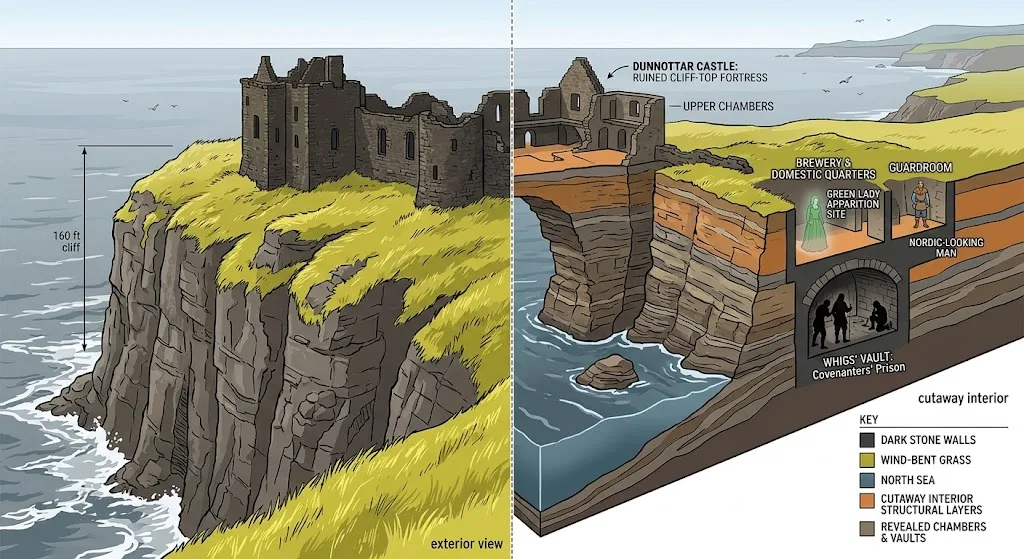
Dunnottar Castle is the dominant haunted landmark in Kincardineshire. It stands on a 160-foot rock near Stonehaven, surrounded on three sides by the North Sea, and is presented by the castle’s own site as a dramatic cliff-top fortress of the Earls Marischal.[Dunnottar Castle]dunnottarcastle.co.ukOpen source on dunnottarcastle.co.uk. Historic Environment Scotland lists Dunnottar as a scheduled monument, confirming its national heritage significance even before any ghost story is considered.[Historic Environment Scotland]portal.historicenvironment.scotHistoric Environment Scotland Dunnottar Castle (SM986Historic Environment Scotland Dunnottar Castle (SM986
The most commonly repeated apparition at Dunnottar is a Green Lady. Modern haunted-castle accounts usually place her in or near the brewery area, sometimes describing her as a young girl or woman in green or tartan, wandering as though searching for lost children. Other reported figures include a Nordic-looking man in the guardroom and indistinct presences in the ruined interiors.[Higgypop Paranormal]higgypop.comParanormal Dunnottar CastleParanormal Dunnottar Castle These details are not supported like a court record or estate inventory; they belong to the oral and tourist-haunting layer of the castle’s history. What makes them stick is Dunnottar’s setting: a roofless stronghold, sea below, wind through chambers, and a past dense enough to invite haunting.
The castle’s documented history gives the legends their emotional force. Dunnottar is famous for sheltering the Honours of Scotland, the Scottish crown jewels, from Cromwell’s forces in the 17th century, and for its association with the Keith family, Earls Marischal.[Wikipedia]WikipediaDunnottar CastleDunnottar Castle Its darkest remembered episode is the Whigs’ Vault. Dunnottar’s own history page says more than 167 Covenanters and Whigs were imprisoned in a cellar there in 1685 for refusing religious reforms imposed by King Charles II.[Dunnottar Castle]dunnottarcastle.co.ukOpen source on dunnottarcastle.co.uk. Later summaries describe the conditions as terrible, with deaths, attempted escapes and transportation among the outcomes.[Wikipedia]WikipediaDunnottar CastleDunnottar Castle
That matters for the ghost tradition because Dunnottar’s hauntings are not just “a lady in a castle”. They cluster around captivity, loyalty, political violence and exposed terrain. The Whigs’ Vault is already an emotionally charged place without any supernatural claim: a confined cellar beneath a great fortress, remembered for suffering and religious coercion. When visitors later speak of cries, shadows or presences, those reports attach themselves to a real historical wound.
The credibility assessment is therefore mixed but useful. The castle, the vault, the siege history and the national importance of the site are well grounded in official and historical sources. The Green Lady and other apparitions are best treated as recurring legends and visitor traditions, repeated in haunted-place guides rather than documented as verifiable events. The story is still important because it shows how Dunnottar’s real past has shaped the way people experience the ruin.
Crathes Castle: the Green Lady with the strongest institutional backing
Crathes Castle, near Banchory, is often treated in modern geography as Aberdeenshire, but it lies within the historic county of Kincardineshire and belongs naturally in this county’s ghost map.[Wikipedia]WikipediaCrathes CastleCrathes Castle Historic Environment Scotland describes Crathes as a modified L-plan tower house with dated panels from 1553 and 1596, and notes that it is a National Trust for Scotland property.[Historic Environment Scotland]portal.historicenvironment.scotOpen source on historicenvironment.scot.
The haunting here is one of Scotland’s better-known Green Lady traditions. The National Trust for Scotland says the Green Lady’s Room is named after the spirit of a young woman often seen by the fireplace wearing a green dress and cradling an infant. The Trust also records the striking associated detail that, during 19th-century renovations, the bones of a child were found under the hearthstone.[National Trust for Scotland]nts.org.ukOpen source on nts.org.uk.
This makes Crathes different from many loosely sourced haunted-house stories. The National Trust does not prove a ghost exists, but it does preserve the legend as part of the visitor interpretation of the house. The claim is not just a random internet retelling; it is part of the site’s public cultural identity. The Trust has also run ghost-investigation events at Crathes, describing the castle as known for ghostly goings-on, from the Green Lady to lesser-known reported entities.[National Trust for Scotland]nts.org.ukOpen source on nts.org.uk.
For a reader interested in folklore rather than proof, Crathes is valuable because the legend has a clear motif. A woman in green, a child, a fireplace, hidden remains and a named room all give the story a compact, memorable structure. It also sits within a wider Scottish pattern of “Green Lady” apparitions attached to castles, family houses and unresolved domestic tragedy. In Kincardineshire terms, Crathes is the more polished and visitor-facing counterpart to Dunnottar: less ruinous, more curated, but still haunted by a story of a woman and child placed at the heart of the house.
Muchalls Castle: the drowned girl, the tunnel and the smuggling coast
Muchalls Castle adds a different kind of haunting to Kincardineshire’s map: not a famous public ruin, but a private castle with a tale of secret movement between house and shore. The Aberdeenshire Historic Environment Record describes Muchalls as an early 17th-century Scottish mansion house incorporating an earlier Fraser tower-house, erected by the Burnets in 1619–27, and notes that it is a Category A listed building.[her.aberdeenshire.gov.uk]her.aberdeenshire.gov.ukOpen source on aberdeenshire.gov.uk.
The same official record also gives a detail that matters directly to the ghost story: an underground tunnel, now blocked, once connected the castle to the shore.[her.aberdeenshire.gov.uk]her.aberdeenshire.gov.ukOpen source on aberdeenshire.gov.uk. Haunted-castle sources attach the castle’s Green Lady or drowned girl to that passage. One version says a young woman drowned in a cave that could formerly be reached by a subterranean stair from the wine cellar; another says she died while helping a smuggler boyfriend by the sea, and that her ghost is linked to the castle and its passage to the water.[The Castles of Scotland]thecastlesofscotland.co.ukmuchalls castlemuchalls castle
This is a good example of how a physical feature can make a legend feel plausible without proving it. The tunnel is historically noted; the ghost story explains the tunnel in dramatic human terms. Smuggling, hidden stairs, caves and violent seas are exactly the ingredients that make a coastal castle memorable in local lore. The tale also reflects a wider pattern around the north-east coast, where danger, illicit trade and drowned bodies become part of place-memory.
Muchalls is not as easy for the casual visitor to interpret as Dunnottar or Crathes, because it is private and its ghost lore is preserved mainly in castle guides and paranormal indexes rather than official visitor interpretation. That does not make the legend worthless, but it does change how it should be read. The strongest evidence supports the castle’s age, status and tunnel; the drowned girl is best understood as a traditional haunting attached to those facts.
Stonehaven Tolbooth: a prison atmosphere without a major ghost tradition
Stonehaven Tolbooth is worth including because it helps explain the county’s atmosphere of imprisonment and punishment, even though it does not have the same famous ghost as Dunnottar, Crathes or Muchalls. The Tolbooth Museum says its collections include artefacts linked to Stonehaven’s heritage and to the building’s use as a prison, including an original cell door, Inverbervie stocks and a crank punishment device.[stonehaventolbooth.co.uk]stonehaventolbooth.co.ukOpen source on stonehaventolbooth.co.uk. Aberdeenshire Council’s museum page likewise presents it as a community-run museum supported by Aberdeenshire Council and Aberdeenshire Museums Service, with prison-related objects among its displays.[livelifeaberdeenshire.org.uk]livelifeaberdeenshire.org.ukOpen source on livelifeaberdeenshire.org.uk.
The Tolbooth’s value for haunted-history readers is not that it supplies a famous apparition, but that it grounds the local landscape of confinement. Kincardineshire’s most powerful eerie stories repeatedly return to cells, vaults, hidden rooms and punitive authority. Dunnottar has the Whigs’ Vault; Stonehaven has a preserved civic prison; Muchalls has a tunnel and crypt-like spaces. These are not interchangeable places, but together they explain why the county’s supernatural imagination is so architectural. Its ghosts tend to be placed in rooms, vaults, passages, stairways and shoreward routes.
The sensible reading is cautious. The Tolbooth should not be oversold as one of Scotland’s great haunted prisons unless strong local witness material is found. Its role is quieter: it gives visitors a tangible sense of the justice system, punishment and civic authority that shaped the same county where religious prisoners were held at Dunnottar.
Witchcraft, wells and older folklore beneath the castle stories
Kincardineshire’s supernatural texture is not only castle ghosts. The wider Mearns also carries older layers of folk belief, witchcraft memory and sacred-site tradition. The University of Edinburgh’s Survey of Scottish Witchcraft is an important resource for separating early modern witch-trial evidence from later romanticised “witch” folklore; it defines an accused witch as someone denounced for witchcraft where ecclesiastical, civil or both forms of action were pursued.[Edinburgh DataShare]datashare.ed.ac.ukEdinburgh Data Share Survey of Scottish WitchcraftEdinburgh Data Share Survey of Scottish Witchcraft
Fetteresso Castle, just west of Stonehaven, is a useful cautionary case. Secondary historic-county sources say a woman named Jean Hunter lived at Fetteresso and was accused of witchcraft and hanged at her home in the 17th century.[Wikishire]wikishire.co.ukFetteresso CastleFetteresso Castle However, the University of Edinburgh database result for a Jean Hunter shows a 1649 case associated with Haddington, not a clear Fetteresso entry, so the local version should be handled carefully unless a firmer primary reference is identified.[Witches]witches.hca.ed.ac.ukOpen source on ed.ac.uk.
Older sacred geography also lingers around the lost county town of Kincardine. A 19th-century folklore work on Scottish lochs and springs notes that a chapel to St Catherine once stood at Kincardine in the Mearns, with only its graveyard remaining, and that St Catherine’s Fair was transferred to neighbouring Fettercairn in 1612.[Project Gutenberg]gutenberg.orgOpen source on gutenberg.org. This is not a ghost story in itself, but it shows how vanished chapels, fairs and graveyards leave behind the sort of half-visible landscape in which later legends thrive.
The important distinction is between documented belief systems and modern haunting claims. Witch trials were real legal and social persecutions, not proof of magic. Wells, chapels and fairs were part of religious and community life, not automatically paranormal sites. For a trustworthy haunted-history page, these older materials should deepen the atmosphere without being turned into sensational claims.
What makes Kincardineshire’s hauntings feel distinctive
Kincardineshire’s ghost stories have a particular flavour. They are not mainly urban theatre hauntings or inn-room poltergeists. They are coastal, architectural and memory-heavy. The key settings are cliff fortresses, tower houses, cellars, fireplaces, tunnels, vaults and old roads.
Three motifs stand out.
The Green Lady. Dunnottar, Crathes and Muchalls all have versions of a female apparition in green or linked to a “Green Lady” tradition. At Crathes, the National Trust preserves the clearest version: a woman in green with an infant by the fireplace.[National Trust for Scotland]nts.org.ukOpen source on nts.org.uk. At Dunnottar and Muchalls, the figure is more fluid, shifting between a girl, a woman, a lost mother or a drowned lover.[Higgypop Paranormal]higgypop.comParanormal Dunnottar CastleParanormal Dunnottar Castle
The hidden or confined space. The Whigs’ Vault at Dunnottar, the Green Lady’s Room at Crathes, the blocked tunnel at Muchalls and the prison cells of Stonehaven Tolbooth all give the county’s haunted stories strong physical anchors. These are places where readers can imagine sound, darkness, restricted movement and fear.[dunnottarcastle.co.uk]dunnottarcastle.co.ukOpen source on dunnottarcastle.co.uk.
The sea as a witness. Dunnottar and Muchalls both face the North Sea, and both use that exposure in their eerie appeal. Dunnottar’s cliffs intensify stories of imprisonment, escape and cries in the night; Muchalls’ shoreward tunnel makes a drowned-girl smuggling legend feel locally rooted.[dunnottarcastle.co.uk]dunnottarcastle.co.ukOpen source on dunnottarcastle.co.uk.
These motifs make Kincardineshire’s haunted history feel coherent even when individual stories vary in source quality. The county’s ghosts are less about jump scares than about unresolved presence: women at fireplaces, prisoners in vaults, drowned figures near the shore, and old houses that seem to remember more than they explain.
How credible are the stories?
The strongest historical facts behind Kincardineshire’s haunted places are well supported. Dunnottar is a nationally designated monument; its Whigs’ Vault episode is documented in official and historical summaries; Crathes is a major National Trust property with an institutionally preserved Green Lady tradition; Muchalls is a listed historic building with an officially recorded blocked tunnel to the shore.[historicenvironment.scot]portal.historicenvironment.scotHistoric Environment Scotland Dunnottar Castle (SM986Historic Environment Scotland Dunnottar Castle (SM986
The apparition claims themselves are much harder to prove. They usually appear in visitor lore, haunted-castle guides, paranormal indexes, tourism writing and repeated local storytelling. That does not make them meaningless, but it places them in the category of folklore and reported experience rather than established fact. A fair reading is that Kincardineshire has several strongly place-based ghost traditions, with varying levels of documentation.
The most reliable way to enjoy these stories is to separate three layers:
Documented history: castles, owners, dates, imprisonments, tunnels, listed status and museum collections.
Preserved tradition: named rooms, Green Lady stories, repeated accounts in heritage or tourism sources, and local retellings.
Paranormal claim: sightings, sounds, apparitions, temperature drops, feelings of presence and investigation results.
When those layers are kept distinct, the stories become more interesting rather than less. Dunnottar’s Green Lady does not need to be “proved” to matter; she matters because she has become a way of giving human shape to a place already marked by fear, loyalty and loss. Crathes’ Green Lady matters because a major heritage body preserves her as part of the castle’s identity. Muchalls’ drowned girl matters because she turns a real coastal tunnel into a story about secrecy, love and danger.
Visiting the haunted county with a clear head
For most readers, Dunnottar is the essential Kincardineshire haunted stop. It is public-facing, visually unforgettable and historically rich, with the Whigs’ Vault giving its ghost stories a serious emotional core. Crathes offers a more domestic and curated experience: a preserved castle, gardens, a named Green Lady’s Room and a Trust-backed legend. Muchalls is more complicated because it is private, so it is better treated as a story to understand rather than a place to seek out casually.
Stonehaven is the natural base for the county’s darker heritage. From there, Dunnottar lies just along the coast, the Tolbooth gives a civic-prison counterpoint, and the wider Mearns opens out into old estates, roads and vanished settlements. Modern tourism routes may label the area Aberdeenshire, but the historic-county lens reveals a tighter pattern: Kincardineshire’s hauntings gather where the Mearns meets the sea, where noble houses command routes and where remembered suffering is enclosed in stone.
The most rewarding approach is atmospheric but sceptical. Read the Green Ladies as folklore, not evidence. Treat the Whigs’ Vault as history first and haunting second. Notice how often stories attach to architectural details: a fireplace, a cellar, a tunnel, a stair, a barred cell. In Kincardineshire, the supernatural is rarely floating free. It is usually rooted in a particular room, a particular cliff, a particular family house, or a particular remembered injustice.
Amazon book picks
Further Reading
Books and field guides related to Why Do Kincardineshire's Castles Feel Haunted?. Use these as the next step if you want deeper reading beyond the article.
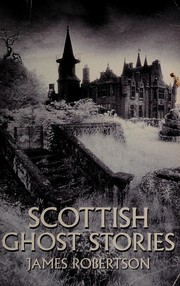
Scottish Ghost Stories
Introduces readers to traditional Scottish supernatural folklore.
The Lore of Scotland
Explains the legends and traditions behind Scottish haunted places.

Ghosts
First published 2015. Subjects: Ghosts, History, BODY, MIND & SPIRIT, Parapsychology, General.
The world's most haunted places
Places Scottish castle hauntings within a wider haunted-sites tradition.
eBay marketplace picks
Marketplace Samples
Live-tested eBay searches with available results related to this page.
Endnotes
1.
Source: Wikipedia
Link:https://en.wikipedia.org/wiki/Kincardineshire
2.
Source: Wikipedia
Title: Crathes Castle
Link:https://en.wikipedia.org/wiki/Crathes_Castle
3.
Source: higgypop.com
Title: Paranormal Dunnottar Castle
Link:https://www.higgypop.com/hauntings/dunnottar-castle/
4.
Source: Wikipedia
Title: Dunnottar Castle
Link:https://en.wikipedia.org/wiki/Dunnottar_Castle
5.
Source: her.aberdeenshire.gov.uk
Link:https://her.aberdeenshire.gov.uk/Monument/MAB42716/
6.
Source: stonehaventolbooth.co.uk
Link:https://www.stonehaventolbooth.co.uk/about-us.html
7.
Source: stonehaventolbooth.co.uk
Link:https://www.stonehaventolbooth.co.uk/
8.
Source: livelifeaberdeenshire.org.uk
Link:https://www.livelifeaberdeenshire.org.uk/museums/stonehaven-museum/
9.
Source: Wikipedia
Title: Fetteresso Castle
Link:https://en.wikipedia.org/wiki/Fetteresso_Castle
10.
Source: gutenberg.org
Link:https://www.gutenberg.org/files/56034/56034-h/56034-h.htm
11.
Source: Wikipedia
Title: Stonehaven Tolbooth
Link:https://en.wikipedia.org/wiki/Stonehaven_Tolbooth
12.
Source: Wikipedia
Title: Great Scottish Witch Hunt of 1649–1650
Link:https://en.wikipedia.org/wiki/Great_Scottish_Witch_Hunt_of_1649%E2%80%931650
13.
Source: Wikipedia
Title: Muchalls Castle
Link:https://en.wikipedia.org/wiki/Muchalls_Castle
14.
Source: Wikipedia
Title: Muchalls Castle
Link:https://de.wikipedia.org/wiki/Muchalls_Castle
15.
Source: scotland.com
Link:https://www.scotland.com/blog/discover-historic-muchalls-castle/
16.
Source: her.aberdeenshire.gov.uk
Link:https://her.aberdeenshire.gov.uk/Monument/MAB42334/
17.
Source: her.aberdeenshire.gov.uk
Link:https://her.aberdeenshire.gov.uk/Monument/MAB41542
18.
Source: youtube.com
Title: Scotland Visit Crathes Haunted Castle
Link:https://www.youtube.com/watch?v=a3SnLZ7Qllk
Source snippet
Crathes Castle - Scottish Heraldry Documentary (Heraldry Explained)...
19.
Source: youtube.com
Title: Crathes Castle
Link:https://www.youtube.com/watch?v=v38nqpwqtZ4
Source snippet
& Garden | Aberdeenshire, Scotland...
20.
Source: wikishire.co.uk
Link:https://wikishire.co.uk/wiki/Kincardineshire
21.
Source: abcounties.com
Link:https://abcounties.com/counties/county-profiles/kincardineshire/
22.
Source: gazetteer.org.uk
Link:https://gazetteer.org.uk/search?place=Kincardineshire&type=em
23.
Source: gazetteer.org.uk
Link:https://gazetteer.org.uk/place/Muchalls_Castle%2C_Kincardineshire_303438
24.
Source: dunnottarcastle.co.uk
Link:https://www.dunnottarcastle.co.uk/
25.
Source: portal.historicenvironment.scot
Title: Historic Environment Scotland Dunnottar Castle (SM986)
Link:https://portal.historicenvironment.scot/apex/f?p=1505%3A300%3A%3A%3A%3A%3AVIEWTYPE%2CVIEWREF%3Adesignation%2CSM986
26.
Source: dunnottarcastle.co.uk
Link:https://www.dunnottarcastle.co.uk/history
27.
Source: pressandjournal.co.uk
Title: dunnottar castle finding new ways to tell 1000 years of siege royalty and honour
Link:https://www.pressandjournal.co.uk/fp/past-times/2808331/dunnottar-castle-finding-new-ways-to-tell-1000-years-of-siege-royalty-and-honour/
28.
Source: portal.historicenvironment.scot
Link:https://portal.historicenvironment.scot/apex/f?p=1505%3A300%3A%3A%3A%3A%3AVIEWTYPE%2CVIEWREF%3Adesignation%2CLB3262
29.
Source: nts.org.uk
Link:https://www.nts.org.uk/stories/ghosts-of-the-trust
30.
Source: nts.org.uk
Link:https://www.nts.org.uk/stories/scottish-ghost-stories-witches-murder-and-folklore-part-2
31.
Source: nts.org.uk
Link:https://www.nts.org.uk/visit/places/crathes-castle/events/1421341323159
32.
Source: thecastlesofscotland.co.uk
Title: muchalls castle
Link:https://www.thecastlesofscotland.co.uk/the-best-castles/other-articles/muchalls-castle/
33.
Source: datashare.ed.ac.uk
Title: Edinburgh Data Share Survey of Scottish Witchcraft
Link:https://datashare.ed.ac.uk/bitstream/handle/10283/45/Witchcraftsurvey_download.pdf?isAllowed=y&sequence=2
34.
Source: witches.hca.ed.ac.uk
Link:https://witches.hca.ed.ac.uk/
35.
Source: wikishire.co.uk
Title: Fetteresso Castle
Link:https://wikishire.co.uk/wiki/Fetteresso_Castle
36.
Source: witches.hca.ed.ac.uk
Link:https://witches.hca.ed.ac.uk/trial/T/JO/134
37.
Source: witches.hca.ed.ac.uk
Link:https://witches.hca.ed.ac.uk/quick/?fullname=&page=182&sort=-lastname
38.
Source: stonehavenhistory.wordpress.com
Title: fetteresso castle
Link:https://stonehavenhistory.wordpress.com/fetteresso-castle/
39.
Source: stonehavenhistory.wordpress.com
Title: muchalls castle
Link:https://stonehavenhistory.wordpress.com/muchalls-castle/
40.
Source: doriccolumns.wordpress.com
Link:https://doriccolumns.wordpress.com/pre-history-beyond/castles/
41.
Source: facebook.com
Link:https://www.facebook.com/groups/uncannyfan/posts/2265389410604344/
42.
Source: facebook.com
Link:https://www.facebook.com/groups/scotlandsscenery/posts/25729406876652009/
43.
Source: facebook.com
Link:https://www.facebook.com/groups/scotlandsscenery/posts/8807421262610502/
44.
Source: facebook.com
Link:https://www.facebook.com/groups/1284134892237822/posts/1680347449283229/
45.
Source: portal.historicenvironment.scot
Link:https://portal.historicenvironment.scot/apex/f?p=1505%3A300%3A%3A%3A%3A%3AVIEWTYPE%2CVIEWREF%3Adesignation%2CGDL00119
46.
Source: witches.hca.ed.ac.uk
Link:https://witches.hca.ed.ac.uk/reading/
47.
Source: witches.hca.ed.ac.uk
Link:https://witches.hca.ed.ac.uk/about/
48.
Source: thistleandtime.scot
Title: dunnottar castle key events through history
Link:https://thistleandtime.scot/2025/10/07/dunnottar-castle-key-events-through-history/
49.
Source: spookyscotland.net
Title: dunnottar castle dark deeds and desperate defences
Link:https://spookyscotland.net/dunnottar-castle-dark-deeds-and-desperate-defences/
50.
Source: nts.org.uk
Link:https://www.nts.org.uk/stories/scottish-ghost-stories-witches-murder-and-folklore
51.
Source: nts.org.uk
Link:https://www.nts.org.uk/visit/places/crathes-castle
52.
Source: nts.org.uk
Link:https://www.nts.org.uk/gd-gb/visit/places/crathes-castle/events/1421341323159
53.
Source: nts.org.uk
Link:https://www.nts.org.uk/visit/things-to-do/north-east-castle-trail
54.
Source: trove.scot
Link:https://www.trove.scot/place/36969
55.
Source: prisonhistory.org
Title: Stonehaven Tolbooth
Link:https://www.prisonhistory.org/lockup/stonehaven-tolbooth/
56.
Source: castlecore.uk
Title: Fetteresso Castle
Link:https://castlecore.uk/site/fetteresso-castle
57.
Source: youtube.com
Title: Tolbooth Museum
Link:https://www.youtube.com/watch?v=ASbMcfuUTzY
58.
Source: wildernessscotland.com
Title: Dunnottar Castle
Link:https://www.wildernessscotland.com/blog/dunnottar-castle/
59.
Source: historichouses.org
Link:https://www.historichouses.org/house/dunnottar-castle/
60.
Source: artuk.org
Link:https://artuk.org/visit/venues/national-trust-for-scotland-crathes-castle-garden-estate-7248
61.
Source: thecastleguide.co.uk
Link:https://thecastleguide.co.uk/castle/dunnottar-castle/
Additional References
62.
Source: youtube.com
Title: Crathes Castle & Garden | Aberdeenshire, Scotland
Link:https://www.youtube.com/watch?v=dONADmoEcW4
Source snippet
Halloween Special 2025 Haunted Places In The UK: London, West Wales, Dublin, Aberdeenshire...
63.
Source: visitscotland.com
Link:https://www.visitscotland.com/nl-nl/things-to-do/attractions/castles/haunted
64.
Source: reddit.com
Link:https://www.reddit.com/r/Ghosts/comments/18drv7a/a_closer_look_at_the_green_of_crathes_castle/
65.
Source: northlinkferries.co.uk
Link:https://www.northlinkferries.co.uk/aberdeen-blog/a-trip-to-dunnottar-castle/
66.
Source: facebook.com
Link:https://www.facebook.com/kincardineshire/posts/an-interesting-feature-on-haunted-castles-appeared-in-todays-the-press-and-journ/122220924938023681/
67.
Source: instagram.com
Link:https://www.instagram.com/p/DQbJyLBjJWO/
68.
Source: facebook.com
Link:https://www.facebook.com/terry.meyers.733/posts/carmichael-house-was-once-a-grand-seat-of-the-carmichael-clan-reflecting-centuri/10164839724537674/
69.
Source: scotclans.com
Link:https://www.scotclans.com/pages/castles-in-aberdeen-aberdeenshire?srsltid=AfmBOor09pGJB41qyUTl5qvs-v6pZp9E9jqIUO6hhUJ4V169aqaqeVKq
70.
Source: scotclans.com
Link:https://www.scotclans.com/pages/castles-in-aberdeen-aberdeenshire?srsltid=AfmBOoofjW3xcuXDaxLp4tfsEr3h7iJrbGM32L5yo9NKIpDSZ_hWMm8S
71.
Source: scotclans.com
Link:https://www.scotclans.com/pages/castles-in-aberdeen-aberdeenshire?srsltid=AfmBOorjZosOlugbSR54WdGGC2O7GlHRhuwmAFyuXVVmbvNSRmHY7aSr
Topic Tree
Follow this branch
Related pages 91
- Haunted Clackmannanshire
- Haunted Antrim
- Haunted Armagh
- Haunted Durham
- Haunted Londonderry
- +86 more in sidebar