Within Haunted Devon
Does Drake's Ghost Still Haunt Buckland Abbey?
Buckland Abbey links monastic history, Tudor ambition and Sir Francis Drake to legends of the Devil, ghostly dogs and a warning drum.
On this page
- Abbey, mansion and Drake family history
- The Devil, spectral dogs and Drake's Drum
- National memory, folklore and historic objects
Page outline Jump by section
Introduction
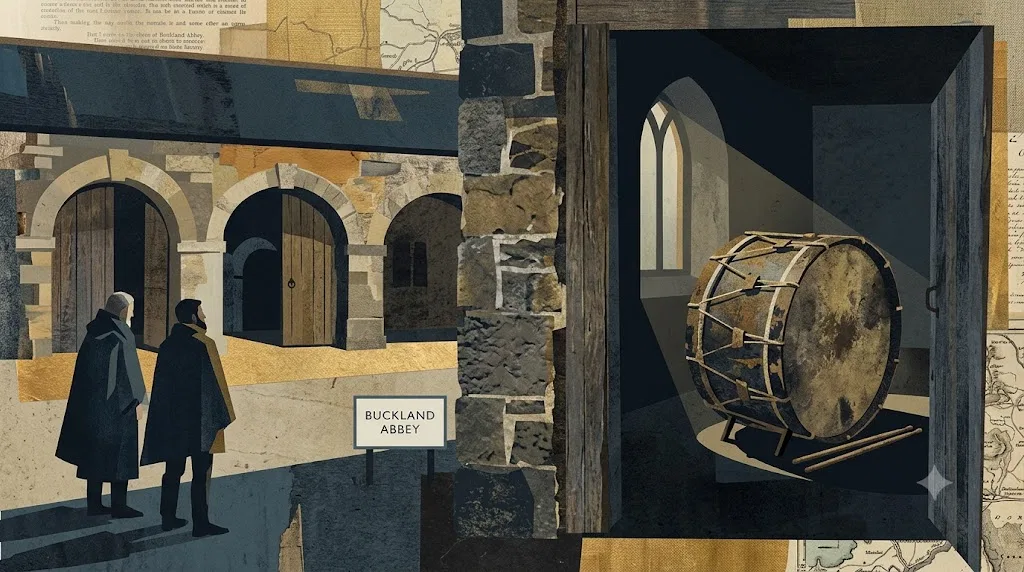
Buckland Abbey, near Yelverton in Devon, is one of the county’s strongest examples of a haunted place where documented history and folklore are almost impossible to separate in the popular imagination. The house began as a Cistercian monastery, became a Tudor mansion after the Dissolution, and was bought by Sir Francis Drake in 1581 after his celebrated circumnavigation of the globe. Today it is a National Trust property, but its ghostly reputation rests on older and darker stories: Drake’s alleged bargain with the Devil, a black hearse drawn by headless horses, spectral hounds on Dartmoor, and Drake’s Drum, said in legend to beat when England is in danger.[nationaltrust.org.uk]nationaltrust.org.ukNational TrustBuckland Abbey's history | DevonExplore Buckland Abbey to uncover 800 years of history, from the remains of a 13th-century…
The important point is not that Buckland Abbey proves Drake’s ghost exists. It does not. Its value as a Devon haunting is that it shows how a real historic house, a morally complicated national hero, monastic ruins, Armada memory and Dartmoor’s black-dog folklore fused into one of the county’s most enduring supernatural traditions. The legend is atmospheric, but its sources are uneven: some elements are preserved in 19th-century folklore collections, some in local retelling, and some in modern tourism and paranormal writing.
Why Buckland Abbey Became Drake’s Haunted House
Buckland Abbey stands in the Tamar Valley, close enough to Plymouth and Dartmoor for both to shape its story. The National Trust describes the site as a place with around 800 years of history, moving from a 13th-century monastic foundation to a Tudor house associated with Sir Richard Grenville and Sir Francis Drake. Its medieval Great Barn still signals the Cistercian estate that existed before the Reformation, while the main house preserves the later memory of Drake and his descendants.[National Trust]nationaltrust.org.ukNational TrustBuckland Abbey's history | DevonExplore Buckland Abbey to uncover 800 years of history, from the remains of a 13th-century…
That layered history matters because haunted traditions often gather at places where one age has visibly overwritten another. Buckland is not a simple ruined abbey, nor simply an Elizabethan manor. It is a former religious house converted into a residence for ambitious seafaring families after the Dissolution of the Monasteries. Historic England records the abbey’s conversion into an Elizabethan mansion by Sir Richard Grenville, followed by its sale to Drake in 1581; the property remained with the Drake family until the 20th century.[Historic England]historicengland.org.uklist entryHistoric EnglandBuckland AbbeyThe abbey was converted into an Elizabethan mansion by Sir Richard Grenville… In 1581 the property was s…
Drake himself supplied the story with the kind of public reputation that easily becomes supernatural. In official heritage language he is often described as a sea captain, privateer and national naval figure, but modern interpretation increasingly notes his involvement in slave-trading and violent privateering as well as his Elizabethan fame. The National Trust now identifies him as an “Elizabethan hero, sea captain, privateer and slave trader”, while Royal Museums Greenwich explains that a privateer was authorised by the Crown to raid enemy ships and cargoes.[National Trust]nationaltrust.org.ukNational TrustBuckland Abbey's history | DevonExplore Buckland Abbey to uncover 800 years of history, from the remains of a 13th-century…
This mixture of fame, violence, wealth and local unease helps explain why folklore made Drake larger than life. To some English traditions he was a defender of the realm; to Spanish accounts he was a pirate; to Devon legend he could become something stranger still — a man whose worldly success looked so extraordinary that it was explained by magical help, infernal bargaining or restless punishment after death.[National Park Service]nps.govOpen source on nps.gov.

Abbey, Mansion and Drake Family Memory
The haunted image of Buckland Abbey depends heavily on its physical transformation. The site was founded as a Cistercian house in the late 13th century and dissolved in 1538, then remodelled into a mansion. Heritage Gateway’s Devon record summarises the sequence clearly: Cistercian foundation, dissolution, conversion by Sir Richard Grenville in the 1570s, acquisition by Drake in 1581, and later alterations.[Heritage Gateway]heritagegateway.org.ukResults Single.aspxResults Single.aspx
That transformation creates the imaginative tension behind several legends. A monastic building made into a rich Tudor house invites stories of spiritual disturbance, curses, uneasy inheritance and hidden punishment. One Drake legend collected by the Drake Exploration Society says Drake and Grenville expelled the monks from Buckland Abbey and were cursed by them. Historically, the broad Dissolution context is real, but the curse motif belongs to legend rather than a verifiable record of a specific monastic curse at Buckland.[Indrakes Wake]indrakeswake.co.ukIndrakes Wake The Drake Exploration SocietyIndrakes Wake The Drake Exploration Society
The Drake family then helped preserve the house as a memorial to their famous ancestor. The National Trust notes that Buckland remained in Drake family ownership until the 20th century, and that successive generations were highly aware of the ancestral connection, preserving and enhancing features associated with Drake’s achievements. This family memory is crucial: Buckland became not just a house Drake owned, but a stage on which later generations displayed, curated and mythologised him.[National Trust]nationaltrust.org.ukNational TrustBuckland Abbey's history | DevonExplore Buckland Abbey to uncover 800 years of history, from the remains of a 13th-century…
The modern public presentation of Buckland strengthened this association further. After a major fire in 1938, the property was repaired through the involvement of Plymouth City Council and the National Trust, with the aim of creating a museum focused on Drake and the abbey’s naval history. That means visitors today encounter the haunted stories against a backdrop already designed around Drake’s legend, portraits, naval memory and family inheritance.[National Trust]nationaltrust.org.ukNational Trust Visiting Buckland Abbey and Great BarnNational Trust Visiting Buckland Abbey and Great Barn
The Devil, the Hearse and the Headless Hounds
The darkest Buckland legend says Drake’s success came from a pact with the Devil. In some versions, he used infernal help to rebuild or transform Buckland Abbey at impossible speed; in others, he gained supernatural aid in his naval victories. These are not contemporary legal or eyewitness records. They are folklore: a way of explaining extraordinary wealth, military success and local power through the language of magic, sin and punishment.[Historic Mysteries]historicmysteries.comHistoric Mysteries Ghost of Buckland Abbey: Does Sir Francis Drake HauntHistoric Mysteries Ghost of Buckland Abbey: Does Sir Francis Drake Haunt
The classic afterlife punishment is vivid. Drake is said to drive a black hearse or coach at night, drawn by headless horses and accompanied by devils and yelping headless dogs. Robert Hunt’s 19th-century collection Popular Romances of the West of England preserves a compact version of this tradition under “Sir Francis Drake and his Demon”, saying that Drake drives a black hearse drawn by headless horses through Jump, on the road from Tavistock to Plymouth.[Internet Sacred Text Archive]sacred-texts.comOpen source on sacred-texts.com.
This matters because Hunt gives the legend a firmer folkloric pedigree than many modern haunted-place summaries. He was not proving the haunting; he was recording West Country oral tradition. His version places Drake’s supernatural afterlife not only at Buckland Abbey itself, but along the road-world between Tavistock, Plymouth and Dartmoor — exactly the kind of liminal landscape where coach ghosts, death omens and black dogs thrive in British folklore.
Later retellings often attach the same story more tightly to Buckland Abbey. Modern haunted-place accounts describe Drake’s ghostly cortege as a punishment for demonic dealings, sometimes adding a pack of spectral hounds whose cries are fatal to living dogs. These details vary, which is typical of oral legend: the stable core is Drake, night travel, infernal animals, and punishment; the number of horses, dogs, goblins or demons shifts from version to version.[Haunted Britain]haunted-britain.comHaunted Britain Buckland AbbeyHaunted Britain Buckland Abbey
The hounds also connect Buckland to wider Dartmoor folklore. Dartmoor has long traditions of black dogs, “Wisht Hounds” and spectral hunting packs, often linked to wild upland places such as Wistman’s Wood, the Dewerstone and old moorland routes. In that context, Drake’s ghost is not an isolated house apparition. He has been absorbed into a larger Devon pattern: the dangerous night ride, the demonic hunt, and the terrifying sound of invisible hounds in rough country.[Legendary Dartmoor]legendarydartmoor.co.ukfran drakefran drake
Drake’s Drum and the Return of the Hero
Drake’s Drum is the most famous object in Buckland Abbey’s haunted afterlife. The legend says that, shortly before Drake died off Panama in 1596, he ordered the drum to be returned to Buckland Abbey and promised that if England were ever in danger, the drum should be beaten and he would return to defend the country. Historic UK gives this as the core of the tradition, while the National Trust presents the drum as one of Buckland’s best-known heirlooms and invites visitors to learn its legend.[Historic UK]historic-uk.comLegend Of Drakes DrumLegend Of Drakes Drum
The drum story is different in tone from the black hearse legend. The hearse makes Drake a damned or dangerous figure. The drum makes him a sleeping defender, ready to return in national crisis. It belongs to a broader folklore pattern sometimes called the “king asleep” motif, where a heroic figure is not truly gone but waits to be summoned when the land is threatened. In Buckland’s case, the object gives that idea a physical focus: not a cave, tomb or mountain, but a military drum kept at the family house.[Wikipedia]WikipediaDrake's DrumDrake's Drum
Claims about when the drum has been heard vary widely. Modern summaries often mention national moments such as the Spanish Armada’s long after-memory, Napoleon’s arrival at Plymouth as a prisoner, the First World War, the German fleet’s surrender in 1918, or the opening of the Second World War. These accounts should be handled cautiously. They are part of the drum’s legend-cycle, not a continuous archive of independently verified acoustic events.[Wikipedia]WikipediaDrake's DrumDrake's Drum
The object itself also complicates the story. The Drake Exploration Society argues that there is no evidence that the drum accompanied Drake on his circumnavigation or had particular personal significance to him, though it may have been one of the side-drums from his final voyage and is a genuine 16th-century drum. Modern visitor accounts and local reporting also note that the drum on display at Buckland is a replica, while the fragile original is kept in controlled storage.[indrakeswake.co.uk]indrakeswake.co.ukIndrakes Wake The Drake Exploration SocietyIndrakes Wake The Drake Exploration Society
That does not make the legend worthless. It changes what kind of value it has. Drake’s Drum is less useful as proof of a supernatural warning system and more useful as a rare example of how a historic object can gather national myth. At Buckland, a drum becomes a bridge between museum display, family memory, naval patriotism and ghostly expectation.

Why the Same Drake Can Be Hero, Devil’s Man and Ghost
The most interesting feature of Buckland Abbey’s haunting is that Drake does not settle into one simple role. In different versions he is a patriot, pirate, magician, sinner, protector, restless ghost or demonic coachman. That instability reflects the historical Drake himself. He was celebrated in England for circumnavigation and service against Spain, feared and hated by Spanish interests, enriched through privateering, and involved in early English slave-trading voyages.[npg.org.uk]npg.org.ukNational Portrait Gallery Sir Francis DrakeNational Portrait Gallery Sir Francis Drake
Folklore often attaches supernatural power to people who seem to exceed normal limits. Drake’s wealth after his voyages, his purchase of Buckland, his role in Elizabethan sea war, and the later national myth of the Armada all made him unusually available for legendary enlargement. If a figure is already imagined as larger than life, ghost stories do not have to create grandeur from nothing; they only redirect it into the uncanny.
Buckland Abbey sharpened that process because it held three powerful ingredients in one place:
- A former monastery, with the emotional charge of the Reformation and the Dissolution.
- A Tudor mansion, associated with elite wealth, naval ambition and the rise of seafaring families.
- A Drake family shrine, where descendants and later curators preserved the memory of an ancestor whose reputation was both heroic and troubling.[nationaltrust.org.uk]nationaltrust.org.ukNational TrustBuckland Abbey's history | DevonExplore Buckland Abbey to uncover 800 years of history, from the remains of a 13th-century…
This is why the legends remain memorable even when their factual basis is thin. They express a real cultural tension. Was Drake a defender of England, a violent opportunist, a pirate, a patriot, or something more morally ambiguous? Buckland’s ghost stories answer in folklore’s language: he was so powerful that ordinary death could not quite contain him.
How Credible Are the Buckland Abbey Hauntings?
As evidence for literal apparitions, the Buckland Abbey stories are weak. There is no strong body of contemporary witness testimony, no stable sequence of dated reports, and no institutional claim from the National Trust that the haunting is a proven phenomenon. The strongest sources support the history of the site and the existence of the legends, not the reality of the supernatural events.[nationaltrust.org.uk]nationaltrust.org.ukNational TrustBuckland Abbey's history | DevonExplore Buckland Abbey to uncover 800 years of history, from the remains of a 13th-century…
As folklore, however, the case is much stronger. Robert Hunt’s 19th-century collection shows that Drake’s demon-coach tradition was already established in West Country lore, while later local and specialist retellings preserve related motifs of Buckland, Dartmoor, headless horses, ghostly hounds and the warning drum. The consistency lies in the pattern rather than every detail.[sacred-texts.com]sacred-texts.comOpen source on sacred-texts.com.
A careful reading separates the case into three layers. The first layer is documented history: Buckland Abbey’s monastic foundation, conversion, ownership by Drake, Drake family continuity, and modern museum role. The second is object history: Drake’s Drum as a famous heirloom with a complicated provenance and modern display arrangements. The third is legend: Devil pacts, death coaches, spectral hounds and national warnings. Confusing these layers makes the story less trustworthy; keeping them distinct makes it richer.[heritagegateway.org.uk]heritagegateway.org.ukResults Single.aspxResults Single.aspx
Sceptical explanations are also straightforward. Dartmoor’s weather, darkness, animal cries, dangerous roads and strong storytelling culture all encourage eerie interpretation. A black coach or pack of hounds belongs to widespread British and European ghostly-hunt traditions rather than to one unique Buckland incident. Drake’s legend looks less like a single haunting that began on a known night, and more like a set of older motifs drawn towards the most famous Devonian available.[Wikipedia]WikipediaBlack dog (folkloreBlack dog (folklore
Buckland Abbey’s Place in Devon’s Haunted Map
Buckland Abbey belongs firmly within Devon’s haunted geography, but it differs from places such as Berry Pomeroy Castle or the Hairy Hands of Dartmoor. Berry Pomeroy is a ruined-house haunting focused on female apparitions and family tragedy. The Hairy Hands is a road legend centred on sudden danger and loss of control. Buckland’s story is more historical and national: it turns a real Elizabethan figure, a former abbey, a famous object and a naval myth into one layered haunting.
Its geography also helps explain its reach. Buckland sits near Yelverton, with Plymouth’s naval identity to the south and Dartmoor’s folklore landscape to the east and north. Drake’s life and memory are strongly tied to Plymouth, Tavistock, the Tamar Valley and the wider West Devon landscape. This allows his ghost to move easily in tradition: at Buckland Abbey, on Dartmoor, along roads between Tavistock and Plymouth, and through the symbolic sound of a drum that belongs both to the house and to the nation.[nationaltrust.org.uk]nationaltrust.org.ukNational Trust Visiting Buckland Abbey and Great BarnNational Trust Visiting Buckland Abbey and Great Barn
For visitors, the most grounded way to approach Buckland Abbey is to see the haunting as part of the site’s interpretation rather than as a detachable ghost story. The abbey’s medieval fabric, Tudor conversion, Drake associations, Great Barn, museum displays and surrounding countryside all contribute to the atmosphere. The supernatural traditions are not an extra pasted on top; they are a popular way of processing the same facts that make the place historically charged.[nationaltrust.org.uk]nationaltrust.org.ukNational TrustBuckland Abbey | DevonMedieval Abbey converted into a Tudor house following the Dissolution. Once home to seafarers Sir Ric…

What the Legend Leaves Behind
Buckland Abbey’s haunted afterlife survives because it gives Drake two endings at once. In history, he died off the coast of Panama in 1596 and was buried at sea. In legend, he came home to Devon: into the drum at Buckland, into the night roads of Dartmoor, into the sound of spectral hounds, and into the uneasy memory of a former abbey turned into a house of Elizabethan power.[npg.org.uk]npg.org.ukNational Portrait Gallery Sir Francis DrakeNational Portrait Gallery Sir Francis Drake
That double ending is what makes Buckland Abbey distinctive among Devon hauntings. It is not merely a report of a figure seen on a staircase or a cold spot in an old room. It is a whole folklore system built around one place and one name: Drake as national defender, Drake as Devil-touched overreacher, Drake as restless rider, and Drake as a sound waiting in a silent drum. The result is one of Devon’s most atmospheric examples of how haunted history can preserve admiration, fear, guilt and local pride in the same story.
Amazon book picks
Further Reading
Books and field guides related to Does Drake's Ghost Still Haunt Buckland Abbey?. Use these as the next step if you want deeper reading beyond the article.

The Penguin Guide to the Superstitions of Britain and Ireland
First published 2006. Subjects: Nonfiction, Reference, Superstition, Dictionaries, History.
eBay marketplace picks
Marketplace Samples
Live-tested eBay searches with available results related to this page.
Endnotes
1.
Source: haunted-britain.com
Title: Haunted Britain Buckland Abbey
Link:https://www.haunted-britain.com/buckland_abbey.htm
2.
Source: Wikipedia
Title: Black dog (folklore)
Link:https://en.wikipedia.org/wiki/Black_dog_%28folklore%29
3.
Source: historic-uk.com
Title: Legend Of Drakes Drum
Link:https://www.historic-uk.com/CultureUK/Legend-Of-Drakes-Drum/
4.
Source: Wikipedia
Title: Drake’s Drum
Link:https://en.wikipedia.org/wiki/Drake%27s_Drum
5.
Source: archive.org
Link:https://archive.org/download/popularromanceso00huntuoft/popularromanceso00huntuoft.pdf
6.
Source: Wikipedia
Title: Buckland Abbey
Link:https://en.wikipedia.org/wiki/Buckland_Abbey
7.
Source: Wikipedia
Title: Francis Drake
Link:https://en.wikipedia.org/wiki/Francis_Drake
8.
Source: history.com
Title: sir francis drake
Link:https://www.history.com/articles/sir-francis-drake
9.
Source: nationaltrust.org.uk
Link:https://www.nationaltrust.org.uk/visit/devon/buckland-abbey/history-of-buckland-abbey
Source snippet
National TrustBuckland Abbey's history | DevonExplore Buckland Abbey to uncover 800 years of history, from the remains of a 13th-century...
10.
Source: historicengland.org.uk
Title: list entry
Link:https://historicengland.org.uk/listing/the-list/list-entry/1018366
Source snippet
Historic EnglandBuckland AbbeyThe abbey was converted into an Elizabethan mansion by Sir Richard Grenville... In 1581 the property was s...
11.
Source: nationaltrust.org.uk
Link:https://www.nationaltrust.org.uk/visit/devon/buckland-abbey
Source snippet
National TrustBuckland Abbey | DevonMedieval Abbey converted into a Tudor house following the Dissolution. Once home to seafarers Sir Ric...
12.
Source: heritagegateway.org.uk
Title: Results Single.aspx
Link:https://www.heritagegateway.org.uk/Gateway/Results_Single.aspx?resourceID=19191&uid=437786
13.
Source: rmg.co.uk
Link:https://www.rmg.co.uk/stories/maritime-history/sir-francis-drake-facts
14.
Source: nps.gov
Link:https://www.nps.gov/people/sirfrancisdrake.htm
15.
Source: heritagegateway.org.uk
Title: Results Single.aspx
Link:https://www.heritagegateway.org.uk/gateway/Results_Single.aspx?resourceID=104&uid=MDV5451
16.
Source: indrakeswake.co.uk
Title: Indrakes Wake The Drake Exploration Society
Link:https://www.indrakeswake.co.uk/Society/Research/legends.htm
17.
Source: nationaltrustcollections.org.uk
Title: buckland abbey
Link:https://www.nationaltrustcollections.org.uk/place/buckland-abbey
18.
Source: nationaltrust.org.uk
Title: National Trust Visiting Buckland Abbey and Great Barn
Link:https://www.nationaltrust.org.uk/visit/devon/buckland-abbey/visiting-buckland-abbey-and-great-barn
19.
Source: historicmysteries.com
Title: Historic Mysteries Ghost of Buckland Abbey: Does Sir Francis Drake Haunt
Link:https://www.historicmysteries.com/myths-legends/francis-drake-ghost/31246/
20.
Source: sacred-texts.com
Link:https://sacred-texts.com/neu/eng/prwe/prwe105.htm
21.
Source: sacred-texts.com
Link:https://sacred-texts.com/neu/eng/prwe/index.htm
22.
Source: legendarydartmoor.co.uk
Title: fran drake
Link:https://www.legendarydartmoor.co.uk/2016/03/28/fran_drake/
23.
Source: indrakeswake.co.uk
Title: Indrakes Wake The Drake Exploration Society
Link:https://www.indrakeswake.co.uk/Society/Research/drum.htm
24.
Source: npg.org.uk
Title: National Portrait Gallery Sir Francis Drake
Link:https://www.npg.org.uk/collections/search/person/mp01357/sir-francis-drake
25.
Source: nationaltrust.org.uk
Title: addressing our histories of colonialism and historic slavery
Link:https://www.nationaltrust.org.uk/who-we-are/research/addressing-our-histories-of-colonialism-and-historic-slavery
26.
Source: visitplymouth.co.uk
Link:https://www.visitplymouth.co.uk/things-to-do/buckland-abbey-national-trust-p1371643
27.
Source: nationaltrustscones.com
Title: buckland abbey
Link:https://www.nationaltrustscones.com/2019/08/buckland-abbey.html
28.
Source: tavistock.gov.uk
Link:https://www.tavistock.gov.uk/sites/default/files/inline-content/tav-drake-panel.pdf
29.
Source: npg.org.uk
Title: Sir Francis Drake
Link:https://www.npg.org.uk/collections/search/portrait/mw192864/Sir-Francis-Drake
30.
Source: npg.org.uk
Title: Sir Francis Drake
Link:https://www.npg.org.uk/collections/search/portraitConservation/mw01932/Sir-Francis-Drake
31.
Source: tumblr.com
Title: Sir Francis Drake
Link:https://www.tumblr.com/cherry-witchcraft/648628351415812096
32.
Source: exploration.marinersmuseum.org
Title: francis drake
Link:https://exploration.marinersmuseum.org/subject/francis-drake/
33.
Source: mauritshuis.nl
Title: National Trust
Link:https://www.mauritshuis.nl/en/what-s-on/exhibitions/exhibitions-from-the-past/national-trust/buckland-abbey
34.
Source: haunted-devon.co.uk
Title: buckland abbey
Link:https://www.haunted-devon.co.uk/articles/hauntings/devon/buckland-abbey
35.
Source: oldluckettstation.com
Link:https://oldluckettstation.com/things_to_do/national-trust-buckland-abbey/
36.
Source: laurencestravels.co.uk
Title: Buckland Abbey
Link:https://www.laurencestravels.co.uk/2023/09/buckland-abbey.html
37.
Source: wikishire.co.uk
Title: Buckland Abbey
Link:https://wikishire.co.uk/wiki/Buckland_Abbey
38.
Source: pirates.fandom.com
Title: Francis Drake
Link:https://pirates.fandom.com/wiki/Francis_Drake
39.
Source: visit-tavistock.co.uk
Link:https://www.visit-tavistock.co.uk/buckland-abbey
40.
Source: visitdevon.co.uk
Title: National Trust
Link:https://www.visitdevon.co.uk/listing/national-trust-buckland-abbey/279270301/
41.
Source: flickr.com
Title: Buckland Abbey
Link:https://www.flickr.com/photos/25946256%40N00/4670756677
Additional References
42.
Source: facebook.com
Link:https://www.facebook.com/thetudorintruders/posts/after-the-dissolution-of-the-monasteries-buckland-abbey-which-was-founded-as-a-c/1447662017003547/
43.
Source: devongardenstrust.org.uk
Link:https://devongardenstrust.org.uk/gardens/buckland-abbey
44.
Source: facebook.com
Link:https://www.facebook.com/groups/paigntonphotoclub.org/posts/3118688241619921/
45.
Source: tripadvisor.co.uk
Link:https://www.tripadvisor.co.uk/Attraction_Review-g315961-d584741-Reviews-Buckland_Abbey_National_Trust-Yelverton_Dartmoor_National_Park_Devon_England.html
46.
Source: instagram.com
Link:https://www.instagram.com/p/DWVqcmUCJpG/
47.
Source: devonguide.com
Link:https://www.devonguide.com/attractions/buckland-abbey.htm
48.
Source: public-library.uk
Link:https://public-library.uk/ebooks/30/18.pdf
49.
Source: exploredevon.info
Link:https://www.exploredevon.info/activities/places/buckland-abbey/
50.
Source: plympton.academy
Link:https://www.plympton.academy/site-plympton/assets/files/4019/history_around_us_buckland_revision_booklet.pdf
51.
Source: facebook.com
Link:https://www.facebook.com/CryptozoologyFacts/posts/its-thought-that-the-giant-black-dog-in-sir-arthur-conan-doyles-hound-of-the-bas/1454831946652976/
Topic Tree