Within Haunted Radnorshire
Why Pilleth Feels Haunted Without a Ghost
Pilleth's eerie power comes from the Battle of Bryn Glas, where documented violence and quiet burial memory make the hillside feel haunted.
On this page
- The battle on Bryn Glas
- Church, graves and local memory
- Why battlefields become uncanny
Page outline Jump by section
Introduction
Pilleth is one of Radnorshire’s most unsettling historic places not because it has a famous named ghost, but because its landscape behaves like a haunting. A small white church, a holy well, steep ground above the River Lugg, and remembered burial places all point back to the Battle of Bryn Glas, fought on 22 June 1402 during Owain Glyndŵr’s rising. The story preserved here is not a tidy apparition tale. It is battlefield memory: violence, disputed medieval accounts, bodies said to have been left unburied, later bones, memorial trees and a churchyard that turns a quiet hillside into a place of unease.[Coflein]coflein.gov.ukCoflein English – CofleinCoflein English – Coflein
That makes Pilleth important within Radnorshire’s haunted geography. It shows how a place can feel ghostly without needing a recurring phantom in a window or a spectre on a road. The “haunting” is carried by terrain, burial tradition and local interpretation. Visitors are asked to imagine what happened on the slope, but also to notice how little certainty survives after six centuries.[Coflein]coflein.gov.ukCoflein English – CofleinCoflein English – Coflein
The battle on Bryn Glas
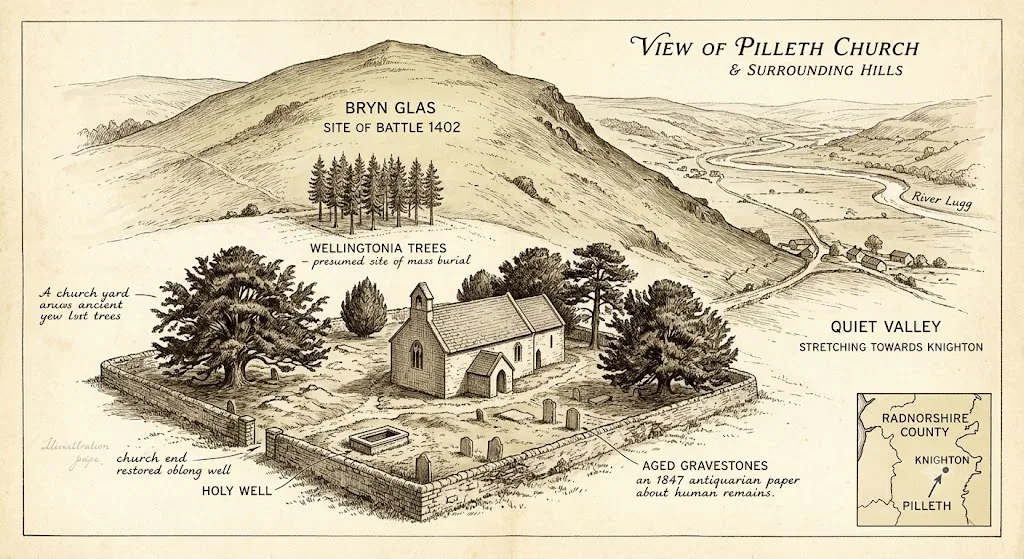
Pilleth lies near Knighton, in historic Radnorshire, now within Powys. The battlefield is usually known either as Bryn Glas or the Battle of Pilleth. Royal Commission material records it as a medieval battle site in the old county of Radnorshire, in the community of Llangunllo, with the relevant area centred around the hills near St Mary’s Church.[Coflein]coflein.gov.ukCoflein English – CofleinCoflein English – Coflein
The basic story is stark. Owain Glyndŵr’s forces met an English force commanded by Edmund Mortimer, a powerful Marcher lord. The most detailed near-contemporary account cited by Coflein, from the Historia Vitae et Regni Ricardi Secundi, says that Glyndŵr was on one of the mountains beside Pilleth, that Mortimer ascended to meet him, that men of Maelienydd turned against Mortimer, and that Mortimer was captured. The same record gives about 400 English dead, including knights, while other later estimates vary widely.[Coflein]coflein.gov.ukCoflein English – CofleinCoflein English – Coflein
Cadw’s interpretation plan, drawing on the Welsh Battlefields Project Pilot Study, places the likely main action on the slopes of Bryn Glas, around St Mary’s Church and the ground to its east, west and south. It also warns that the fighting may have spread much more widely after the English rout, possibly down towards the floodplain north of the River Lugg. This uncertainty matters: the haunted feeling of Pilleth is not confined to a single plaque or grave, but extends across a hillside where historians can point to probabilities rather than exact lines of combat.[Cadw]cadw.gov.walesCadw Microsoft WordMicrosoft Word - Owain Glyn Dwr Interpretation Plan - final gyda lluniau.doc…
The battle became nationally important because it was one of Glyndŵr’s great victories. Cadw’s plan quotes historian R. R. Davies in describing Bryn Glas or Pilleth as one of the most momentous battles of the revolt, exposing border towns such as Hereford, Leominster and Ludlow after the defeat of a substantial English county levy. Cadw’s public Wales history map also presents Pilleth as the site of Glyndŵr’s most memorable military victory, where visitors can still see the church and the hill at the centre of the battle story.[Cadw]cadw.gov.walesCadw Microsoft WordMicrosoft Word - Owain Glyn Dwr Interpretation Plan - final gyda lluniau.doc…

Church, graves and local memory
St Mary’s Church is the emotional centre of the site. It stands on the lower slopes of Bryn Glas and is part of the reason Pilleth feels so intimate: the battlefield is not an anonymous open field, but a place where worship, burial and violence overlap. Coflein records the battle site in relation to the parish church, while Cadw’s plan notes that substantial sections of the church stood at the time of the battle and that the building probably played a role before being burnt by Glyndŵr’s forces.[Coflein]coflein.gov.ukCoflein English – CofleinCoflein English – Coflein
The church is also tied to older sacred landscape. Coflein records a holy well on the north side of St Mary’s parish church, and holy-well research citing the Royal Commission’s 1911 visit describes it as a restored oblong enclosure with steps down to the water, formerly resorted to for diseases of the eyes. This gives Pilleth a layered atmosphere: a healing place, a medieval church, a battlefield and a burial landscape occupy the same small zone.[Coflein]coflein.gov.ukDetails | 306353 | Sites - CofleinA holy well on the north side of St Mary's parish church (nprn 96544), Pilleth. (source OS495 ca…
The burial traditions are central to the site’s eerie reputation. Cadw’s interpretation plan identifies evidence for at least two burial places connected with the battle: one within the churchyard itself, and another further up the hillside west of the church. It cites an 1847 antiquarian paper noting an exceptional number of corpses in the churchyard, and says a square patch of Wellingtonia trees was planted by Sir Richard Green-Price to mark a place where human bones, presumed to be battle dead, had been found.[Cadw]cadw.gov.walesCadw Microsoft WordMicrosoft Word - Owain Glyn Dwr Interpretation Plan - final gyda lluniau.doc…
Modern visitor accounts and heritage summaries continue to frame the Wellingtonia trees and churchyard as markers of mass burial. The National Trail description says the dead appear to have been buried both within St Mary’s churchyard and on Bryn Glas hill at a place now marked by redwood trees. Britain Express similarly describes a mass grave in the churchyard, a commemorative slate stone, and bones reportedly turned up around the churchyard and slopes. These are not ghost testimonies, but they are exactly the kind of material from which battlefield haunting traditions grow: visible markers, disturbed remains, and a community memory that refuses to let the dead become abstract.[National Trail]nationaltrail.co.ukOpen source on nationaltrail.co.uk.
Why Pilleth feels haunted without a ghost
A conventional haunted-place entry usually begins with a sighting: a woman in white, a headless horseman, a phantom monk, a light in a window. Pilleth works differently. The most reliable sources do not establish a recurring apparition. Instead, the site’s power comes from what might be called moral weather: a peaceful churchyard overlaid by accounts of slaughter, mutilation, delayed burial and later memorialisation.[Coflein]coflein.gov.ukCoflein English – CofleinCoflein English – Coflein
Medieval chroniclers helped create that atmosphere. Cadw’s plan reports that chroniclers described corpses left lying in blood because burial was forbidden for a long time, and also recorded the mutilation of corpses by Welsh women. Coflein’s battlefield entry is more cautious and factual, emphasising that contemporary and near-contemporary chronicles exist but that exact battlefield location remains difficult to determine from surviving documentary and archaeological evidence. Read together, the sources show both why the story became horrific and why it must be handled carefully.[Cadw]cadw.gov.walesCadw Microsoft WordMicrosoft Word - Owain Glyn Dwr Interpretation Plan - final gyda lluniau.doc…
The uncertainty is part of the uncanny effect. Archaeological and documentary work has not pinned the fighting to one neat spot. Coflein states that non-invasive and invasive fieldwork found no battle evidence on the hill immediately west of St Mary’s, and that the most likely site lies somewhere around Bryn Glas, Graig Hill and Black Hill. Cadw’s plan likewise treats the battlefield as a zone of probable action rather than a single confirmed point. A visitor standing there is therefore not simply looking at “where it happened”, but at a landscape in which memory, topography and incomplete evidence overlap.[Coflein]coflein.gov.ukCoflein English – CofleinCoflein English – Coflein
That is why Pilleth belongs naturally in Radnorshire’s haunted history even without a famous ghost legend. It is a place where the dead are not reduced to a date on a board. The churchyard, memorial, hillside trees and holy well all make the past feel close to the surface, while the absence of a single dramatic apparition keeps the story from becoming theatrical. The haunting is quieter and more persuasive: a sense that the land itself is carrying the event.
What a careful visitor should notice
The first thing to notice is the slope. Battle accounts make much more sense when the ground is read physically. Glyndŵr’s position on high ground and Mortimer’s advance uphill are central to most retellings, and Cadw’s interpretation plan stresses the steep slopes of Bryn Glas as the place where much of the fighting is believed to have happened.[Cadw]cadw.gov.walesCadw Microsoft WordMicrosoft Word - Owain Glyn Dwr Interpretation Plan - final gyda lluniau.doc…
The second is the church’s restraint. Cadw describes the restored church as simple, bare and highly atmospheric, with no electricity, and notes that the Friends of Pilleth Church did not want the building overwhelmed by the battle episode alone. That is important. Pilleth is not a theme-park battlefield. Its power depends on the tension between ordinary worship, local care and the memory of extreme violence.[Cadw]cadw.gov.walesCadw Microsoft WordMicrosoft Word - Owain Glyn Dwr Interpretation Plan - final gyda lluniau.doc…
The third is the way the site asks for imagination but not credulity. Bones, memorial trees and medieval texts are real evidence of a remembered battle landscape, but they do not prove supernatural activity. The most honest reading is that Pilleth is haunted in the historical and folkloric sense: not by a documented recurring ghost, but by a story of death so firmly attached to place that the hillside still feels inhabited by it.
How credible is the haunted landscape?
As a battlefield, Pilleth is strongly evidenced. Official heritage records, Cadw interpretation material and the Welsh Battlefields work all agree that a major 1402 battle associated with Glyndŵr and Mortimer took place in this vicinity, even though the exact distribution of fighting remains uncertain.[Coflein]coflein.gov.ukCoflein English – CofleinCoflein English – Coflein
As a ghost site, the evidence is much thinner. The best sources support an eerie battlefield memory rather than a verifiable apparition tradition. There are no strong, recurring, named ghost reports in the material most closely tied to the site. Instead, the “haunting” rests on battlefield trauma, burial memory, medieval horror stories, later discoveries of bones, memorial practice and the charged setting of the church and holy well.[gov.wales]cadw.gov.walesCadw Microsoft WordMicrosoft Word - Owain Glyn Dwr Interpretation Plan - final gyda lluniau.doc…
That does not make Pilleth less valuable to a haunted Radnorshire map. In some ways it makes it more interesting. Many famous haunted places rely on a single story repeated until it hardens into legend. Pilleth’s unease is broader and older: the place itself is the witness. Its atmosphere comes from the knowledge that something violent happened here, that the dead were remembered in the ground, and that the exact shape of the event can never now be fully recovered.
Amazon book picks
Further Reading
Books and field guides related to Why Pilleth Feels Haunted Without a Ghost. Use these as the next step if you want deeper reading beyond the article.


The world's most haunted places
Offers broader reading on famous haunted historic sites.
eBay marketplace picks
Marketplace Samples
Live-tested eBay searches with available results related to this page.




Endnotes
1.
Source: coflein.gov.uk
Title: Coflein English – Coflein
Link:https://coflein.gov.uk/en/sites/306352
2.
Source: cadw.gov.wales
Title: Cadw Microsoft Word
Link:https://cadw.gov.wales/sites/default/files/2019-04/InterpplanOwainGlyndwr_EN.pdf
Source snippet
Microsoft Word - Owain Glyn Dwr Interpretation Plan - final gyda lluniau.doc...
3.
Source: cadw.gov.wales
Link:https://cadw.gov.wales/visit/best-history/wales-history-map
Source snippet
Wales history mapEnrich your adventure further by visiting Pilleth (Bryn Glas) – the site of his most memorable victory in battle. Yo...
4.
Source: coflein.gov.uk
Link:https://coflein.gov.uk/en/sites/306353
Source snippet
Details | 306353 | Sites - CofleinA holy well on the north side of St Mary's parish church (nprn 96544), Pilleth. (source OS495 ca...
5.
Source: nationaltrail.co.uk
Link:https://www.nationaltrail.co.uk/en_GB/attraction/battle-bryn-glas-hill-pilleth/
6.
Source: Wikipedia
Title: Battle of Bryn Glas
Link:https://en.wikipedia.org/wiki/Battle_of_Bryn_Glas
7.
Source: Wikipedia
Link:https://en.wikipedia.org/wiki/Pilleth
8.
Source: cadw.gov.wales
Link:https://cadw.gov.wales/advice-support/cof-cymru/search-cadw-records
9.
Source: coflein.gov.uk
Link:https://coflein.gov.uk/en/sites/306352/images
10.
Source: coflein.gov.uk
Title: st marys church pilleth
Link:https://coflein.gov.uk/en/site/96544/details/st-marys-church-pilleth
11.
Source: coflein.gov.uk
Link:https://coflein.gov.uk/en/archives/6441439/sites
12.
Source: wikishire.co.uk
Link:https://wikishire.co.uk/wiki/Pilleth
13.
Source: heneb.org.uk
Link:https://heneb.org.uk/archive/cpat/ycom/radnor/pilleth.pdf
14.
Source: castles99.ukprint.com
Link:https://www.castles99.ukprint.com/gazetteer/Churches/Pilleth.html
15.
Source: planning.data.gov.uk
Link:https://www.planning.data.gov.uk/entity/31842170
16.
Source: valeofglamorgan.gov.uk
Link:https://www.valeofglamorgan.gov.uk/Documents/Living/Planning/Listed%20Buildings/Listed_Buildings_Inventory_October_2011.pdf
17.
Source: youtube.com
Title: Battle of Bryn Glas
Link:https://www.youtube.com/watch?v=uML19e1he1E
Source snippet
Site of the Battle of Pilleth, St Marys Church...
Additional References
18.
Source: youtube.com
Title: How Glyndŵr Shook England at the Battle of Bryn Glas!
Link:https://www.youtube.com/watch?v=c3V_ZyUfukU
Source snippet
Owain Glyndŵr & the Welsh Revolt // Medieval Wales History Documentary...
19.
Source: celticos.com
Link:https://www.celticos.com/public/blog/battlefield-tours-wales
20.
Source: britainexpress.com
Link:https://www.britainexpress.com/wales/mid/countryside/pilleth-battlefield.htm
21.
Source: britishholywells.co.uk
Link:https://britishholywells.co.uk/wales/radnorshire/holywellpilleth/holywellpilleth.html
22.
Source: britishlistedbuildings.co.uk
Link:https://britishlistedbuildings.co.uk/300009108-church-of-st-mary-whitton
23.
Source: academia.edu
Link:https://www.academia.edu/39134350/Ghosts_of_Place_and_Spirits_of_War_Spectral_Belief_in_Early_Modern_England_and_Protestant_Germany
24.
Source: britishlistedbuildings.co.uk
Link:https://britishlistedbuildings.co.uk/wales/powys/grade-iix
25.
Source: senedd.wales
Link:https://senedd.wales/media/z23j52y2/bus-guide-n0000000000000000000000000004174-english.pdf
26.
Source: romneymarshhistory.co.uk
Link:https://romneymarshhistory.co.uk/listedbuildings
27.
Source: pembrokeshirecoast.wales
Link:https://www.pembrokeshirecoast.wales/planning/building-conservation/listed-buildings/
Topic Tree