Within Haunted Wigtownshire
Can You Still Hear Dunskey's Lost Piper?
Dunskey Castle links a cliff-edge ruin, hidden caves and the lost piper tradition into Wigtownshire's most memorable ghost story.
On this page
- The cliff castle above Portpatrick
- The piper, the passage and the cave
- Natural sounds, folklore and modern retellings
Page outline Jump by section
Introduction
Dunskey Castle’s piper legend is one of Wigtownshire’s most memorable coastal hauntings: a ruined cliff-edge stronghold south of Portpatrick, a prisoner forced into music and mockery, a hidden passage to a sea cave, and the sound of pipes said to rise from below on wild nights. The story is best treated as folklore rather than evidence of a ghost, but it matters because it joins three things that make the Rhinns of Galloway so atmospheric: castle violence, sea-cliff danger and the old Scottish motif of the lost piper in a tunnel or cave.
The most useful early printed version is J. Maxwell Wood’s 1911 collection Witchcraft and Superstitious Record in the South-Western District of Scotland. Wood places Dunskey first among the ghost traditions of western Galloway and says the tale concerns Walter de Curry, an Irish piper taken prisoner, and a secret passage from the castle dungeons to a cave on the shore.[Project Gutenberg]gutenberg.orgWitchcraft and Superstitious Record in the South-Western District of Scotland, by J. Maxwell Wood—A Project Gutenberg eBook… Later local and visitor-facing retellings keep the same core: the piper or jester escapes the dungeon into caves beneath the castle, is never seen again, and is still heard when the sea and wind are loud.[Solway Firth Partnership]solwayfirthpartnership.co.ukSolway Firth Partnership Rhins of Galloway Stories GuideSolway Firth Partnership Rhins of Galloway Stories Guide
The cliff castle above Portpatrick
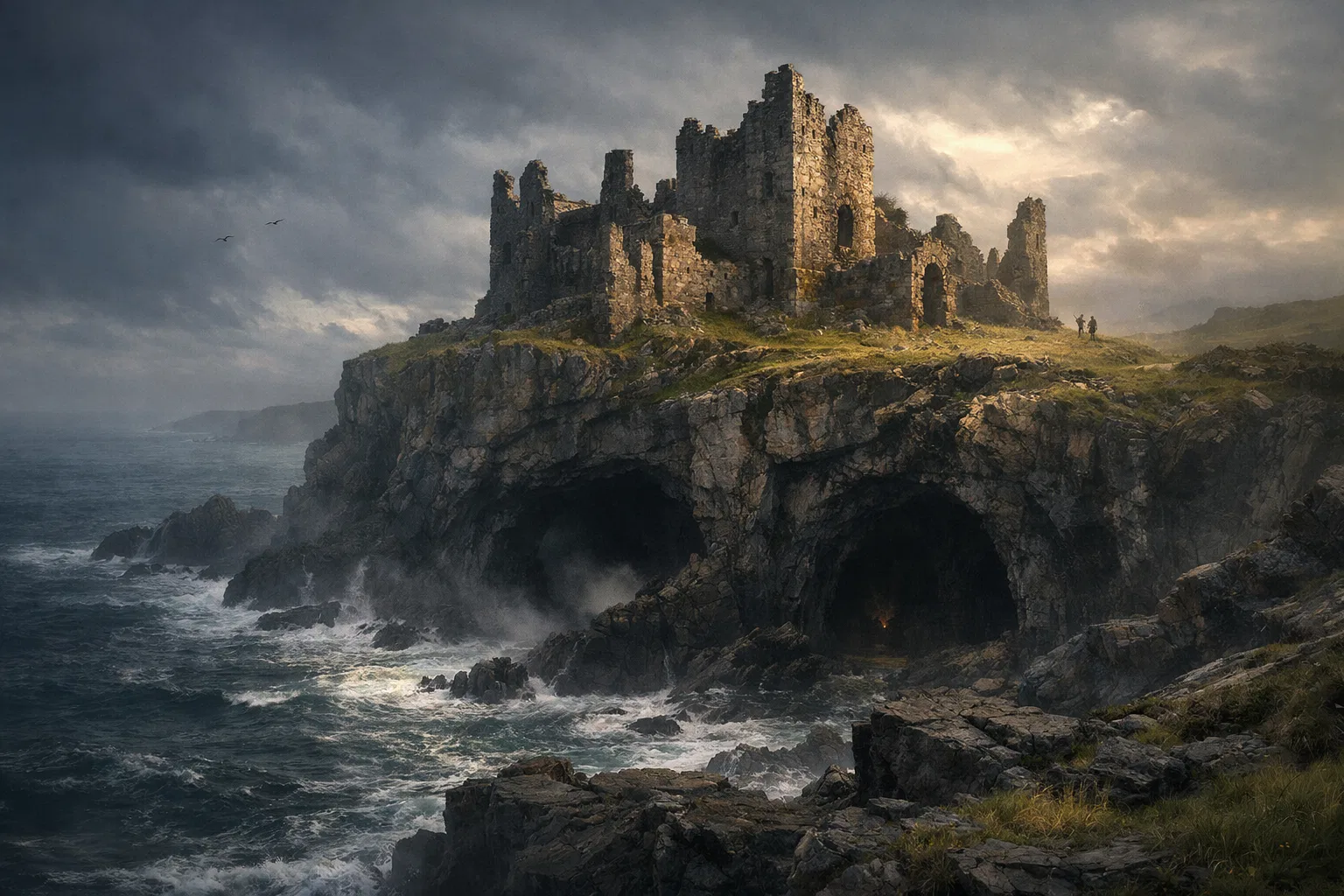
Dunskey Castle stands just south of Portpatrick on the west coast of the Rhinns of Galloway, within historic Wigtownshire. Its position is central to the ghost story. This is not a tale attached to a comfortable country house or a neatly interpreted visitor attraction, but to a ruin on a promontory above the North Channel, where the castle, shore, caves and weather all feel connected.
Historic Environment Scotland describes the surviving ruin as an early 16th-century L-plan castle, with a mid-16th-century addition, set on a cliff-edge promontory. The landward side is cut off by a moat and reached by a causeway, which gives the place the feel of a fortress deliberately separated from ordinary ground.[Historic Environment Scotland]portal.historicenvironment.scotOpen source on historicenvironment.scot. Trove’s national historic environment record likewise describes Dunskey as a promontory site, partly cut off by a deep ditch, with thick-walled, roofless remains and evidence of associated structures near the cliff edge. It also notes older antiquarian references suggesting the present building replaced or developed from earlier fortification.[Trove Scot]trove.scotOpen source on trove.scot.
That physical setting helps explain why the piper story has lasted. A dungeon tale needs darkness; a cave tale needs a believable opening into the rock; a ghostly music tale needs wind, surf and echo. Dunskey supplies all three. Even modern walking accounts of the route from Portpatrick emphasise the short but dramatic clifftop approach, the tower-house ruin, the passageways and vaults, and the sea views across the North Channel.[Scotland Off the Beaten Track]sobt.co.ukScotland Off the Beaten Track Walk: Clifftop hop to Dunskey CastleScotland Off the Beaten Track Walk: Clifftop hop to Dunskey Castle
The castle’s actual history should be kept separate from the legend. The standing ruin is early modern in fabric, while Wood’s version pushes the piper story back to the fourteenth century and to Walter de Curry, a “sea rover”.[Project Gutenberg]gutenberg.orgWitchcraft and Superstitious Record in the South-Western District of Scotland, by J. Maxwell Wood—A Project Gutenberg eBook… That mismatch is not unusual in castle folklore. Stories often attach themselves to the most dramatic visible ruin, even when the tale claims an earlier date or preserves older memories of a site before the present masonry.
The piper, the passage and the cave
In Wood’s 1911 account, Walter de Curry is said to have taken an Irish piper prisoner and forced him into service as a minstrel and jester. The piper’s fault is not cowardice or trespass, but speech: he is “outspoken and fearless”, and his words anger his captor. Curry condemns him to starvation in the castle dungeons. The piper then finds a secret subterranean passage leading from the castle to a cave on the sea-shore, but cannot escape from the cave and dies there.[Project Gutenberg]gutenberg.orgWitchcraft and Superstitious Record in the South-Western District of Scotland, by J. Maxwell Wood—A Project Gutenberg eBook…
The haunting lies in what happens afterwards. Wood says the piper’s troubled ghost was long reputed to march backwards and forwards along the passage, playing eerie pipe music. Listeners above supposedly took the sound as marking the direction of the hidden underground route.[Project Gutenberg]gutenberg.orgWitchcraft and Superstitious Record in the South-Western District of Scotland, by J. Maxwell Wood—A Project Gutenberg eBook… This detail is important because it turns the ghost into a kind of map. The music is not merely a spooky noise; in the old belief, it traces an unseen passage under the castle.
Later retellings simplify but preserve the shape of the story. The Solway Firth Partnership’s Rhins of Galloway stories guide says Dunskey is associated with a piper or jester imprisoned in the dungeons who escaped into caves beneath the castle, was never seen again, and whose pipes are said to be heard from the beach caves on stormy nights.[Solway Firth Partnership]solwayfirthpartnership.co.ukSolway Firth Partnership Rhins of Galloway Stories GuideSolway Firth Partnership Rhins of Galloway Stories Guide Dark Galloway gives a fuller popular version: the piper is thrown into the dungeons, finds a secret passage to a cave on the shore, cannot climb the steep cliffs, dies there, and is said still to march along the passage while the sound of pipes carries above the waves.[Dark Galloway]darkgalloway.wordpress.comDark Galloway Dunskey Castle | Dark GallowayDark Galloway Dunskey Castle | Dark Galloway
The story works because the piper is both victim and warning. He is trapped between two forms of imprisonment: the dungeon behind him and the cliffs in front of him. The sea cave offers hope, but only just enough to make the ending crueller. That is why the legend feels more like a memory of confinement than a simple apparition story.
Why this became Wigtownshire’s signature castle ghost
Dunskey’s piper legend is locally powerful because it belongs exactly where it is told. The Rhinns coastline is full of recesses, stacks, arches, caves and hazardous approaches to the sea. The Solway Firth Partnership’s coastal folklore guide places Dunskey among a wider Rhins landscape of caves, witch rocks, hermit shelters, cliff arches and named supernatural places, which shows that the piper story is not an isolated invention but part of a broader coastal storytelling environment.[Solway Firth Partnership]solwayfirthpartnership.co.ukSolway Firth Partnership Rhins of Galloway Stories GuideSolway Firth Partnership Rhins of Galloway Stories Guide
The tale also fits Dunskey’s reputation as a place of violence and uncanny occupation. Wood’s version begins the ghost-lore chapter with Dunskey before moving east through other Galloway hauntings, which suggests the story already had a strong place in regional folklore by the early twentieth century.[Project Gutenberg]gutenberg.orgWitchcraft and Superstitious Record in the South-Western District of Scotland, by J. Maxwell Wood—A Project Gutenberg eBook… Modern local-history retellings add other reputed hauntings at the ruin, including a nursemaid who is said to have dropped a child from the castle and then thrown herself from the cliffs, though that is a separate tradition and should not be folded into the piper story too heavily.[Dark Galloway]darkgalloway.wordpress.comDark Galloway Dunskey Castle | Dark GallowayDark Galloway Dunskey Castle | Dark Galloway
The piper’s Irishness also matters. Portpatrick faces Ireland across the North Channel, and the coast’s history is shaped by crossings, trade, raiding, migration and sea routes. In the legend, the captured piper is not simply a nameless musician: he is an Irish prisoner in a Scottish coastal stronghold, forced to entertain a violent lord. That gives the story a human tension beyond the usual haunted-castle furniture.
There is also a social edge to the tale. The piper is punished for speech and ridicule. He is a performer, but not a powerless fool; he uses music, wit and mockery against a brutal captor. The haunting preserves the voice of the punished man. Even after death, the pipes continue, turning the castle’s hidden underside into a place where the victim cannot be fully silenced.

Natural sounds and the folklore of hidden passages
A careful reading should not treat the pipes as proven supernatural sound. The more grounded explanation is that Dunskey’s setting is especially good at producing suggestive noises: wind moving through broken masonry, waves striking caves and inlets, seabirds on the cliffs, and echo effects around rock faces and openings. A listener already familiar with the story might easily hear rhythm or piping in the weather.
That does not make the legend worthless. Folklore often begins where natural effects are given meaning. At Dunskey, the setting makes the claim plausible enough to be memorable: a ruined castle above caves, a tradition of a hidden passage, and a coast where sound travels unpredictably. The cave registry entry for Dunskey Castle Cave notes that the site has its own version of the widespread piper legend, with a spectral piper and jester linked to caves below the stronghold.[Scottish Cave and Mine Database]registry.gsg.org.ukOpen source on gsg.org.uk.
The “lost piper” pattern is much wider than Dunskey. Scottish castle and cave folklore repeatedly tells of a piper sent or driven into an underground passage, playing so that people above can follow his progress, before the music stops and he is never seen again. At Culzean Castle in Ayrshire, for example, the National Trust for Scotland records a local legend in which a piper and dog enter the caves below the castle; the pipes and barking fade, stop, and the pair disappear, with pipes later heard from the caves on significant or stormy nights.[National Trust for Scotland]nts.org.ukthe ghosts of culzean castlethe ghosts of culzean castle Smithsonian Magazine, writing about Culzean’s caves, summarises the same legend as part of a broader association between Scottish castles, smugglers’ caves and ghostly pipers.[Smithsonian Magazine]smithsonianmag.comSmithsonian Magazine Hidden Medieval Door Leading to Smugglers' CavesSmithsonian Magazine Hidden Medieval Door Leading to Smugglers' Caves
Dunskey’s version is distinctive because it is not mainly an exploration dare. The piper is not sent into the tunnel to test it; he is a prisoner trying to escape. That makes the Wigtownshire story darker and more intimate than many parallel tales. The usual lost-piper motif is still visible, but Dunskey turns it into a story of captivity, failed escape and punishment.
How strong is the evidence?
The evidence for Dunskey’s piper is strongest as folklore, not as a documented haunting. The best early source available online is Wood’s 1911 printed collection, which records the tradition in confident narrative form but does not give a named eyewitness, date of a sighting, parish informant or archival case file for the sound of the pipes.[Project Gutenberg]gutenberg.orgWitchcraft and Superstitious Record in the South-Western District of Scotland, by J. Maxwell Wood—A Project Gutenberg eBook… That makes it valuable as a record of regional ghost lore, but weak as evidence for a specific paranormal event.
The historical setting is firmer than the ghost claim. Dunskey is a real, protected ruin on a cliff-edge promontory; official heritage records support the castle’s location, form and significance.[Historic Environment Scotland]portal.historicenvironment.scotOpen source on historicenvironment.scot. The cave-and-passage element is more slippery. Older and modern accounts repeat the idea of a cave below the castle and a passage from dungeon to shore, but the tradition should not be read as proof that a complete accessible tunnel existed exactly as described. Coastal caves, blocked openings, collapsed masonry and local memory can easily combine into a convincing underground legend.
Modern retellings also show how the story has been polished for visitors. Atlas Obscura summarises the tale as a piper who found a way into the caves below the castle, vanished, and is still sometimes heard.[Atlas Obscura]atlasobscura.comAtlas Obscura Dunskey Castle in PortpatrickAtlas Obscura Dunskey Castle in Portpatrick The Rhins guide frames it as one of several local stories attached to specific coastal places.[Solway Firth Partnership]solwayfirthpartnership.co.ukSolway Firth Partnership Rhins of Galloway Stories GuideSolway Firth Partnership Rhins of Galloway Stories Guide These versions help keep the legend alive, but they generally depend on the same inherited tradition rather than new witness testimony.
The fairest conclusion is that Dunskey’s lost piper is a classic Wigtownshire ghost legend with a strong sense of place, a good early folklore source, and a plausible natural soundscape behind it. It is not a verified haunting, but it is one of the clearest examples of how the county’s coast turns ruins, caves and weather into supernatural memory.

Visiting the story without losing the thread
For readers approaching Dunskey from Portpatrick, the useful question is not “can this be proved?” but “why does this story belong here?” The answer is visible in the landscape. The castle is separated from the land by defensive works, open to the sea on a high promontory, and tied in local tradition to caves below. Historic records make the ruin tangible; folklore gives the ruin a voice.
The piper legend is best understood in three layers:
The place: a real cliff-edge castle south of Portpatrick, protected as a nationally significant historic site and long associated with the older power struggles of the Rhinns.[Historic Environment Scotland]portal.historicenvironment.scotOpen source on historicenvironment.scot.
The tale: an Irish piper or jester, imprisoned by Walter de Curry, finds a passage to a sea cave but dies without escape; his ghostly pipes are said to sound from below.[Project Gutenberg]gutenberg.orgWitchcraft and Superstitious Record in the South-Western District of Scotland, by J. Maxwell Wood—A Project Gutenberg eBook…
The explanation: a mixture of inherited lost-piper folklore, natural coastal acoustics, ruined architecture and local storytelling, rather than a claim that can be confirmed as a literal haunting.
That balance is what makes Dunskey valuable within Wigtownshire’s haunted history. It is atmospheric without needing exaggeration. The castle does not require invented horrors: a lonely ruin, a trapped musician, a cave under the cliffs and the sound of the sea are enough.
Amazon book picks
Further Reading
Books and field guides related to Can You Still Hear Dunskey's Lost Piper?. Use these as the next step if you want deeper reading beyond the article.
Witchcraft and superstitious record in the south-western dist...
Contains one of the best-known early printed versions of the Dunskey Castle piper legend.

Scottish Myths and Legends
Places local ghost stories and supernatural traditions within the wider landscape of Scottish folklore.
The Mammoth Book of Haunted House Stories
Appeals to readers interested in haunted buildings, castles, and enduring ghost traditions.
The Lore of Scotland
Provides authoritative context for Scottish legends, hauntings, and traditional tales like the lost piper motif.
eBay marketplace picks
Marketplace Samples
Live-tested eBay searches with available results related to this page.
Endnotes
1.
Source: gutenberg.org
Title: Project Gutenberg
Link:https://www.gutenberg.org/files/43966/43966-h/43966-h.htm
Source snippet
Witchcraft and Superstitious Record in the South-Western District of Scotland, by J. Maxwell Wood—A Project Gutenberg eBook...
2.
Source: trove.scot
Link:https://www.trove.scot/place/60632
3.
Source: trove.scot
Title: Dunskey Castle
Link:https://www.trove.scot/designation/SM2017
4.
Source: gutenberg.org
Link:https://www.gutenberg.org/ebooks/43966
5.
Source: scotland.org
Title: scottish myths folklore and legends
Link:https://www.scotland.org/inspiration/scottish-myths-folklore-and-legends
6.
Source: dunskey.com
Link:https://www.dunskey.com/castle/
7.
Source: solwayfirthpartnership.co.uk
Title: Solway Firth Partnership Rhins of Galloway Stories Guide
Link:https://www.solwayfirthpartnership.co.uk/wp-content/uploads/2022/09/web-Rhins-of-Galloway-Stories-Guide.pdf
8.
Source: darkgalloway.wordpress.com
Title: Dark Galloway Dunskey Castle | Dark Galloway
Link:https://darkgalloway.wordpress.com/tag/dunskey-castle/
9.
Source: portal.historicenvironment.scot
Link:https://portal.historicenvironment.scot/apex/f?p=1505%3A300%3A%3A%3A%3A%3AVIEWTYPE%2CVIEWREF%3Adesignation%2CLB16777
10.
Source: sobt.co.uk
Title: Scotland Off the Beaten Track Walk: Clifftop hop to Dunskey Castle
Link:https://sobt.co.uk/walk-dunskey-castle/
11.
Source: registry.gsg.org.uk
Link:https://registry.gsg.org.uk/sr/sitedetails.php?id=719
12.
Source: nts.org.uk
Title: the ghosts of culzean castle
Link:https://www.nts.org.uk/stories/the-ghosts-of-culzean-castle
13.
Source: smithsonianmag.com
Title: Smithsonian Magazine Hidden Medieval Door Leading to Smugglers’ Caves
Link:https://www.smithsonianmag.com/smart-news/hidden-medieval-door-leading-smugglers-caves-discovered-underneath-scottish-castle-180970172/
14.
Source: atlasobscura.com
Title: Atlas Obscura Dunskey Castle in Portpatrick
Link:https://www.atlasobscura.com/places/dunskey-castle
15.
Source: Wikipedia
Title: Dunskey Castle
Link:https://de.wikipedia.org/wiki/Dunskey_Castle
16.
Source: Wikipedia
Title: Dunskey Castle
Link:https://en.wikipedia.org/wiki/Dunskey_Castle
17.
Source: wikishire.co.uk
Title: Dunskey Castle
Link:https://wikishire.co.uk/wiki/Dunskey_Castle
18.
Source: portal.historicenvironment.scot
Link:https://portal.historicenvironment.scot/apex/f?p=1505%3A300%3A%3A%3A%3A%3AVIEWTYPE%2CVIEWREF%3Adesignation%2CSM2017
19.
Source: solwayfirthpartnership.co.uk
Title: CAVE S & GRAVES
Link:https://www.solwayfirthpartnership.co.uk/wp-content/uploads/2020/06/Caves-and-Graves.pdf
20.
Source: solwayfirthpartnership.co.uk
Link:https://www.solwayfirthpartnership.co.uk/wp-content/uploads/2021/08/South-west-Rhins-guide-V2-reduced.pdf
21.
Source: darkgalloway.wordpress.com
Link:https://darkgalloway.wordpress.com/?query-8-page=2
22.
Source: paranormalscholar.com
Title: Witchcraft and Superstitious Record
Link:https://www.paranormalscholar.com/wp-content/uploads/2018/11/Witchcraft-and-Superstitious-Record-in-the-South-Western-District-of-Scotland-J.-Maxwell-Wood-1911.pdf
23.
Source: waymarking.com
Title: Dunskey Castle
Link:https://waymarking.com/waymarks/wmWQRQ_Dunskey_Castle_Portpatrick_Scotland_UK
Additional References
24.
Source: youtube.com
Title: Dunskey Castle History (Portpatrick) & a Look Inside
Link:https://www.youtube.com/watch?v=-2HrL6Wu4LM
Source snippet
3 Southwest Scotland Dunskey Castle, Dumfries & Galloway...
25.
Source: instagram.com
Link:https://www.instagram.com/reel/CdlQYKZKZCP/
26.
Source: instagram.com
Link:https://www.instagram.com/reel/DaWIyOUK1Q5/
27.
Source: storiedcollection.com
Link:https://storiedcollection.com/an-irish-dynasty-at-dunskey-castle/
28.
Source: facebook.com
Link:https://www.facebook.com/groups/scotlandfromtheroadside/posts/10160015638237280/
29.
Source: aubreyresearch.com
Link:https://www.aubreyresearch.com/monuments/dunskey-castle-sm2017
30.
Source: instagram.com
Link:https://www.instagram.com/reel/CQyXgWuHNPe/
31.
Source: facebook.com
Link:https://www.facebook.com/groups/scotlandsscenery/posts/9066261533393139/
32.
Source: instagram.com
Link:https://www.instagram.com/reel/DMNMmFgItZH/
33.
Source: instagram.com
Link:https://www.instagram.com/reel/DPgBvBMjOL4/
Topic Tree