Within Haunted Yorkshire
Why Do Yorkshire's Ruins Attract Ghost Stories?
Yorkshire's ruins and coast gather stories of monks, headless figures, abbey atmospheres and Gothic tourism.
On this page
- Whitby Abbey and Gothic atmosphere
- Scarborough Castle and coastal apparitions
- How ruined places turn history into folklore
Page outline Jump by section
Introduction
Yorkshire’s abbeys, castles and sea-facing ruins attract ghost stories because they make history feel unfinished. A broken arch, a cliff-edge keep or a monastery stripped at the Dissolution gives the imagination both a setting and a wound: a visible place where religious change, siege, exile, execution, shipwreck, tourism and literature can be turned into haunting. The strongest Yorkshire examples are not “proof” of ghosts, but they are unusually good evidence for how ghost traditions form: Whitby Abbey became a national Gothic landmark through Bram Stoker’s Dracula; Scarborough Castle gives a violent political death a headless apparition; Byland, Rievaulx and Roche show how monastic ruins gathered medieval and later supernatural storytelling around them. English Heritage itself describes Whitby’s headland as a place of myths and legends, including St Hild, lost bells, a shipwreck and the making of Whitby as England’s “Goth capital”.[English Heritage]english-heritage.org.ukOpen source on english-heritage.org.uk.
The pattern is not accidental. Ruins invite people to look at absence: the missing roofs, vanished communities, silenced bells and empty windows. In Yorkshire, that absence is intensified by dramatic geography. Whitby Abbey and Scarborough Castle stand above the North Sea, while inland monastic ruins such as Rievaulx, Byland, Roche and Fountains sit in valleys, parks and old religious landscapes where the past is still physically walkable. The result is a county haunted as much by atmosphere and memory as by named apparitions.
Why ruined Yorkshire feels haunted
A ruin is already a kind of ghost story. It shows what has disappeared while leaving enough stone behind to make the loss visible. Yorkshire’s monastic ruins are especially powerful because they carry a double memory: first as medieval religious communities, then as places broken, sold, quarried, landscaped, visited and romanticised after the Reformation.
English Heritage historians Michael Carter and Dale Townshend argue that supernatural stories at English abbeys and priories go back many centuries, but changed meaning over time. Medieval monastic ghost stories often involved souls seeking prayers, absolution or moral correction. Later, after the Dissolution of the Monasteries in the 1530s, ruined abbeys became settings for warning tales about sacrilege, despoiling and the protection of old buildings. In the 18th and 19th centuries, ivy-clad ruins then fed the Gothic imagination in fiction, drama and poetry.[English Heritage]english-heritage.org.ukOpen source on english-heritage.org.uk.
That gives Yorkshire’s abbey stories a useful reading frame. A spectral monk at a ruin is not just a spooky figure in a habit. He may represent a vanished community, anxiety about religious destruction, a tourist’s reaction to silence, or a much older Christian idea that the dead remain close to the living until properly settled. A headless nobleman at a castle works differently: he ties a specific act of political violence to the dangerous edge of a fortress. A coastal Gothic legend works differently again, because the sea adds fog, wreckage, graveyards, gulls, storms and the feeling that something foreign or ancient might arrive by night.
The credibility of these traditions varies. Some are tied to named medieval manuscripts or recorded historical events. Others appear mainly in modern tourism writing, ghost walks, local guidebooks and visitor lore. The useful question is not simply “did it happen?” but “why did this place become the right setting for this story?” In Yorkshire, the answer is usually a mixture of architecture, landscape, loss and repetition.

Whitby Abbey and Gothic atmosphere
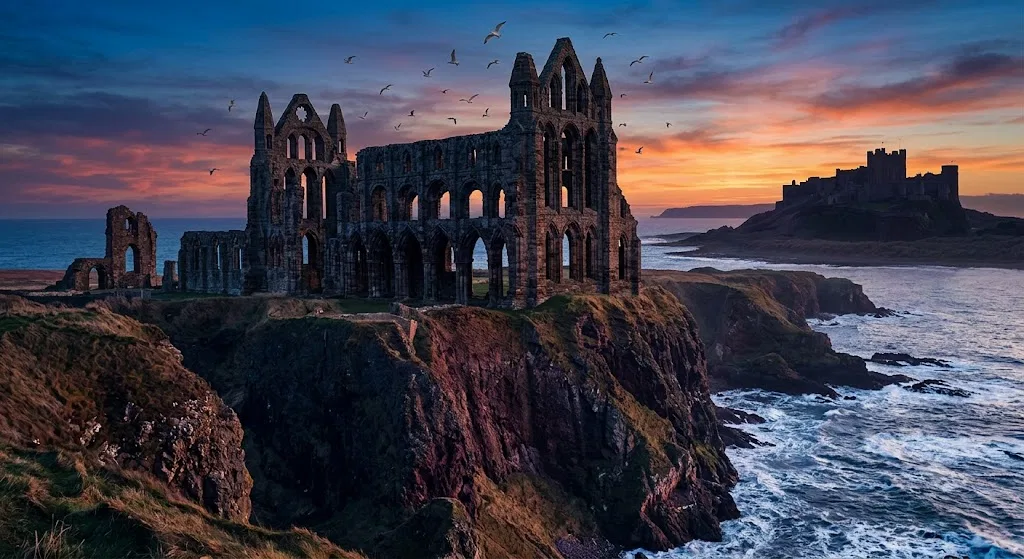
Whitby is Yorkshire’s clearest example of a place where real history, local legend and literary Gothic have become almost inseparable. The abbey ruins crown the East Cliff above the old fishing port, beside St Mary’s churchyard and the famous 199 steps. English Heritage presents the headland as a long-used sacred and legendary site: St Hild’s Anglo-Saxon monastery, the later medieval abbey, a Stuart mansion, the story of St Hild turning snakes to stone, the tale of Caedmon the poet, lost abbey bells heard beneath the sea, and the shipwreck tradition that helped inspire Dracula.[English Heritage]english-heritage.org.ukOpen source on english-heritage.org.uk.
Bram Stoker visited Whitby in 1890, seven years before Dracula was published in 1897. English Heritage’s account of “How Dracula Came to Whitby” stresses that Stoker drew on the town’s scenery, its library research and a real shipwreck narrative when shaping the novel’s Whitby episode. In the book, the doomed ship reaches the harbour, its captain lashed to the wheel, and a large dog bounds from the wreck before running up the 199 steps towards the church and abbey. English Heritage also notes the symbolic date of 8 August in the novel, linking it with Stoker’s discovery of the name “Dracula” in Whitby library.[English Heritage]english-heritage.org.ukOpen source on english-heritage.org.uk.
What matters for haunted Yorkshire is that Whitby’s ghostliness is not limited to a single apparition. It is an atmosphere built from several layers:
The abbey as silhouette. The ruin is visible from the town, the harbour and the cliffs. At dusk or in sea mist it becomes less a building than a black outline, which is exactly the kind of visual form Gothic fiction loves.
The churchyard and steps. The route up from the old town to St Mary’s and the abbey makes visitors physically climb into the story-world: from streets and harbour to graves, wind and ruin.
The sea as a threshold. Stoker’s Whitby episode turns the coast into an entry point for the uncanny. The arrival is not from a crypt but from the North Sea, through storm, shipwreck and animal transformation.
Tourism that repeats the legend. Whitby has not merely preserved its Dracula association; it has performed it for generations through walks, attractions, festivals, shops and visitor interpretation. The official Whitby Goth Weekend describes itself as an alternative music festival founded in 1994 and now one of the world’s premier Goth events, while English Heritage explicitly links Dracula with Whitby’s later reputation as England’s “Goth capital”.[whitbygothweekend.co.uk]whitbygothweekend.co.ukOpen source on whitbygothweekend.co.uk.
Whitby Abbey also carries older local motifs that sit beside Dracula rather than beneath it. English Heritage’s visitor interpretation highlights stories of St Hild and the fossil “snakes”, Caedmon, and the lost bells beneath the waves. These are not vampire stories, but they matter because they show that Whitby was already a place of sacred legend, sound, sea and wonder before Stoker made it internationally Gothic.[English Heritage]english-heritage.org.ukOpen source on english-heritage.org.uk.
The result is a rare case where a Yorkshire ruin has changed not just local ghost tourism but national Gothic identity. People do not come to Whitby only to ask whether a particular ghost has been seen in a particular window. They come because the whole cliff feels like a Gothic stage set that happens to be real.
Scarborough Castle and coastal apparitions
Scarborough Castle offers a sharper, more violent kind of coastal legend. It stands on a rocky promontory between the North and South Bays, a fortress landscape where height, wind and danger are part of the experience. English Heritage describes it as one of England’s great royal fortresses, important for guarding the Yorkshire coast, Scarborough’s port trade and the north of England. Its long history includes royal use, prisoners from Edward I’s Scottish wars, sieges and eventual decline into ruin.[English Heritage]english-heritage.org.ukOpen source on english-heritage.org.uk.
The haunting most often attached to Scarborough Castle is the headless figure of Piers Gaveston, favourite of Edward II. The historical core is clear. In 1312, Gaveston took refuge at Scarborough Castle during the political crisis caused by baronial hostility to his power and closeness to the king. English Heritage records that the castle was besieged, terms of surrender were agreed, and Gaveston was later beheaded after being taken from custody.[English Heritage]english-heritage.org.ukOpen source on english-heritage.org.uk.
The ghost story turns that political betrayal into a local apparition. English Heritage’s Halloween material says staff at Scarborough Castle have reported unsettling feelings around the Master Gunner’s House and a mysterious figure seen in the fog at closing time; it also repeats the tradition that Gaveston returned to his place of sanctuary and tries to lure people towards the cliff edge.[English Heritage]english-heritage.org.ukOpen source on english-heritage.org.uk.
This is a good example of how a castle legend translates history into haunting. Gaveston was not executed at Scarborough, but the castle was the place where his last protection failed. Folklore therefore sends the ghost back to the point of collapse: the stronghold that could not save him. The headless form is not subtle, but it is symbolically efficient. It makes the manner of death visible, and it matches the danger of the site: a cliff-top fortress where edges, drops and fog already make visitors physically alert.
Scarborough’s coastal setting also changes the tone of the story. A headless figure in an inland hall might feel like a domestic haunting. A headless figure near sea cliffs feels more like a warning: history, weather and landscape combine. The apparition is said to appear not in a sealed room but in an exposed ruin, where mist and poor visibility can make ordinary shapes uncertain. That does not prove the story false or true; it explains why the story fits the place so well.
Byland, Rievaulx and the monastic dead
Yorkshire’s abbey-haunting tradition is not only Victorian or tourist-made. Byland Abbey gives the county one of England’s most important medieval ghost collections. Around the early 15th century, an anonymous monk connected with Byland wrote a set of twelve Latin ghost stories into blank spaces in a manuscript now identified as British Library Royal MS 15 A XX. Modern summaries and scholarship describe the tales as local Yorkshire stories, probably drawn from oral tradition and shaped for religious instruction.[medievalists.net]medievalists.netMedieval Ghost Stories: The Chilling Haunts of Byland AbbeyMedieval Ghost Stories: The Chilling Haunts of Byland Abbey
The Byland tales matter because they show a different kind of ghost from the modern “white lady” or “grey monk”. These revenants are often active, troublesome and morally entangled. They may appear in frightening shapes, speak to the living, ask for help, or need absolution. Medievalists note a repeated pattern: the living person confronts the dead, invokes Christian protection, learns the ghost’s name or sin, and helps resolve the spiritual problem.[Medieval Histories]medieval.eubyland abbey ghostsbyland abbey ghosts
That makes Byland valuable for a haunted Yorkshire map because it preserves not just a location but a worldview. In these stories, the dead are not entertainment figures; they are part of a religious system in which unfinished sin, poor confession, debt, violence or exclusion can disturb the boundary between the living and the dead. A ruined abbey later becomes an atmospheric visitor site, but the manuscript tradition reminds us that Yorkshire’s monastic ghosts began in a culture where ghosts could be treated as moral cases.
Rievaulx Abbey adds another layer. Founded in 1132, it was the first Cistercian abbey in northern England and became one of Britain’s most powerful and spiritually renowned monastic centres, with a community of about 650 at its height in the 1160s under Abbot Aelred. It was suppressed in 1538, and its ruins later became a favourite subject for Romantic artists in the 18th and 19th centuries.[English Heritage]english-heritage.org.ukOpen source on english-heritage.org.uk.
That history explains why Rievaulx so readily attracts stories of ghostly monks, bells, chanting and sorrow, even when individual modern accounts are harder to verify than the Byland manuscript. The setting is almost designed for auditory imagination: a roofless church, a valley, broken monastic spaces and a known history of communal worship. Reports of bells where no bell survives, or chanting in the ruins at dusk, may be modern folklore, misheard sound, atmosphere, expectation or personal experience. What makes them believable as stories is that they echo the abbey’s actual former function: prayer, song, rhythm and enclosure.
Roche Abbey, in South Yorkshire, shows that this tradition is not limited to the North York Moors. English Heritage’s account of haunted monasteries notes that the 13th-century chronicler Matthew Paris recorded a ghostly tournament of knights near Roche Abbey in 1236. The University of Sheffield’s Cistercian project adds that Matthew did not claim to witness the event himself, but reported what he had heard from witnesses he considered reliable.[English Heritage]english-heritage.org.ukOpen source on english-heritage.org.uk.
These examples widen the picture. Yorkshire’s abbey ghosts are not all the same. Some are manuscript revenants seeking spiritual remedy; some are later ruined-abbey atmospheres; some are martial apparitions near monastic land; some are modern visitor traditions. What links them is the way monastic sites preserve an unusually strong sense of interrupted life.
How ruined places turn history into folklore
The mechanism behind Yorkshire’s Gothic ruins is easier to see when the examples are placed side by side. Whitby Abbey, Scarborough Castle, Byland Abbey, Rievaulx Abbey and Roche Abbey are different kinds of site, but they all convert historical pressure into repeatable story.
At Whitby, the mechanism is literary amplification. The abbey was already historically and visually powerful, but Dracula made it internationally legible as Gothic. The place now feeds the book, and the book feeds the place. Visitors see the steps, churchyard and abbey through Stoker’s scene, while the town’s festivals and attractions keep renewing that association.[English Heritage]english-heritage.org.ukOpen source on english-heritage.org.uk.
At Scarborough, the mechanism is violent attachment. Gaveston’s actual death happened after he left Scarborough, but the castle is where his political safety collapsed. Folklore therefore anchors his headless ghost to the fortress, turning a constitutional crisis into a cliff-edge haunting.[English Heritage]english-heritage.org.ukOpen source on english-heritage.org.uk.
At Byland, the mechanism is religious recording. The ghost stories survive because someone wrote them into a manuscript, probably adapting local oral tales for moral or devotional use. Here the “haunted place” is not only the ruin but the archive: the manuscript preserves medieval Yorkshire’s way of imagining restless dead people.[Medievalists.net]medievalists.netMedieval Ghost Stories: The Chilling Haunts of Byland AbbeyMedieval Ghost Stories: The Chilling Haunts of Byland Abbey
At Rievaulx and similar abbeys, the mechanism is aesthetic afterlife. The Dissolution ended the community, but the ruins later became picturesque, Romantic and tourist-facing. English Heritage’s Rievaulx history notes the abbey’s suppression in 1538 and its later popularity with Romantic artists, while its source list points to 18th- and 19th-century depictions of the ruins.[English Heritage]english-heritage.org.ukOpen source on english-heritage.org.uk.
At Roche, the mechanism is reported marvel. Matthew Paris’s ghostly tournament sits between chronicle, hearsay and wonder. It is not a modern ghost-tour invention, but neither is it a straightforward eyewitness record by the chronicler. That ambiguity is exactly where much durable folklore lives.[DHI]dhi.ac.ukOpen source on dhi.ac.uk.
The shared process is simple but powerful: a place becomes haunted when a visible setting, an unresolved memory and a repeatable narrative meet. The ruin supplies the stage. History supplies the emotional charge. Local tellers, writers, guides, heritage bodies and visitors supply repetition.
How credible are Yorkshire’s ruin legends?
The evidence is strongest when a legend is tied to a dated document, a named historical event, or a heritage body that clearly separates history from tradition. Byland is especially valuable because the manuscript collection can be placed in the early 15th century and linked to medieval monastic culture. Scarborough’s Gaveston story has a firm historical core in the 1312 siege and his subsequent beheading, even though the headless apparition itself belongs to legend rather than documented fact. Whitby’s Dracula association is also strongly evidenced: Stoker’s 1890 visit, the novel’s Whitby episode and English Heritage’s interpretation of the place are well established.[medieval.eu]medieval.eubyland abbey ghostsbyland abbey ghosts
The evidence becomes thinner where stories are repeated mainly as modern visitor lore: a monk glimpsed at dusk, bells heard from a vanished tower, a feeling of sadness in a ruined nave. Such accounts should be treated as folklore, atmosphere or personal testimony unless they can be traced to a clear source. That does not make them worthless. It means they are better read as evidence of how people respond to ruins than as evidence that a specific apparition has been objectively verified.
Sceptical explanations are often plausible. Sea fret, low light, wind, gulls, traffic, distant voices, uneven stone, expectation and the suggestive power of guidebook stories can all shape what visitors think they see or hear. At coastal sites such as Whitby and Scarborough, weather is part of the legend-making machinery. At abbeys, acoustics and silence matter: a ruined church can make ordinary sounds feel disembodied because the building no longer behaves like a complete building.
Yet a purely sceptical reading can miss why these stories endure. They survive because they give emotional form to real historical rupture. The Dissolution of the Monasteries did destroy religious communities and leave many buildings roofless. Scarborough Castle really was a place of siege and political crisis. Whitby really did become a Gothic landmark through Dracula. The ghosts are disputed; the memories they organise are not.
What visitors are really encountering
A visitor to Yorkshire’s Gothic ruins is usually encountering three things at once: the physical site, the historical record and the story-world built around it. At Whitby, the abbey, churchyard and steps are real; Dracula is fiction; the tourist identity that joins them is now part of the town’s real cultural life. At Scarborough, the fortress and Gaveston’s downfall are historical; the headless spectre is a legend; the cliff-edge setting makes the legend feel natural. At Byland, the surviving manuscript makes medieval ghost belief unusually tangible, even if the individual tales remain moral stories rather than courtroom evidence.
That is why these ruins belong together as a Yorkshire subtopic. They show ghost tradition forming in public view. A haunted house often depends on private rooms and disputed witness accounts. A ruined abbey or castle depends on something more communal: a skyline, a guidebook, a path, a repeated story, a place people can stand in and imagine what is missing.
The best way to read Yorkshire’s abbeys, castles and coastal Gothic legends is therefore neither gullible nor dismissive. They are not confirmed hauntings, but they are serious folklore. They reveal how Yorkshire has turned broken religious houses, exposed castles and sea-facing ruins into places where the past feels close enough to answer back.
Amazon book picks
Further Reading
Books and field guides related to Why Do Yorkshire's Ruins Attract Ghost Stories?. Use these as the next step if you want deeper reading beyond the article.
The Essential Dracula
An essay on the history of the vampire myth in literature accompanies an annotated version of the classic vampire tale.
The world's most haunted places
Readers often enjoy comparing famous haunted landmarks.
eBay marketplace picks
Marketplace Samples
Live-tested eBay searches with available results related to this page.



Endnotes
1.
Source: whitbygothweekend.co.uk
Link:https://www.whitbygothweekend.co.uk/
2.
Source: medievalists.net
Title: Medieval Ghost Stories: The Chilling Haunts of Byland Abbey
Link:https://www.medievalists.net/2024/11/medieval-ghost-stories/
3.
Source: medieval.eu
Title: byland abbey ghosts
Link:https://www.medieval.eu/byland-abbey-ghosts/
4.
Source: dhi.ac.uk
Link:https://www.dhi.ac.uk/cistercians/roche/location/quote.php
5.
Source: english-heritage.org.uk
Link:https://www.english-heritage.org.uk/visit/places/whitby-abbey/
6.
Source: english-heritage.org.uk
Link:https://www.english-heritage.org.uk/members-area/members-magazine/haunted-monasteries/
7.
Source: english-heritage.org.uk
Link:https://www.english-heritage.org.uk/visit/places/whitby-abbey/history-and-stories/dracula/
8.
Source: english-heritage.org.uk
Link:https://www.english-heritage.org.uk/visit/places/scarborough-castle/history/
9.
Source: english-heritage.org.uk
Link:https://www.english-heritage.org.uk/visit/places/scarborough-castle/history/significance/
10.
Source: english-heritage.org.uk
Link:https://www.english-heritage.org.uk/learn/histories/lgbtq-history/piers-gaveston-hugh-despenser-and-the-downfall-of-edward-ii/
11.
Source: english-heritage.org.uk
Link:https://www.english-heritage.org.uk/halloween/spooky-stories/
12.
Source: multoghost.wordpress.com
Title: Multo (Ghost)Twelve Medieval Ghost Stories
Link:https://multoghost.wordpress.com/2023/09/01/twelve-medieval-ghost-stories/
13.
Source: english-heritage.org.uk
Link:https://www.english-heritage.org.uk/visit/places/rievaulx-abbey/history-and-stories/history/
14.
Source: english-heritage.org.uk
Link:https://www.english-heritage.org.uk/visit/places/rievaulx-abbey/history-and-stories/history/sources/
15.
Source: great-castles.com
Link:https://great-castles.com/scarborough.html
16.
Source: theguardian.com
Title: english heritage ghost story tours monasteries
Link:https://www.theguardian.com/culture/2022/sep/30/english-heritage-ghost-story-tours-monasteries
17.
Source: bitaboutbritain.com
Title: scarborough castle
Link:https://bitaboutbritain.com/scarborough-castle/
18.
Source: whitbypark.co.uk
Link:https://whitbypark.co.uk/event/whitby-goth-weekend/
19.
Source: english-heritage.org.uk
Link:https://www.english-heritage.org.uk/members-area/members-magazine/podcast-extras/ghosts-and-ghouls/
20.
Source: english-heritage.org.uk
Link:https://www.english-heritage.org.uk/siteassets/home/visit/places-to-visit/scarborough-castle/school-visits/learning-resources/timeline-ks2-ks3-scarborough-castle.pdf
21.
Source: english-heritage.org.uk
Link:https://www.english-heritage.org.uk/visit/places/rievaulx-abbey/
22.
Source: yorkshirecoastalcottages.com
Title: whitby goth weekend
Link:https://www.yorkshirecoastalcottages.com/blog/whitby-goth-weekend/
23.
Source: nationalgeographic.com
Title: whitby goth weekend
Link:https://www.nationalgeographic.com/travel/article/whitby-goth-weekend
24.
Source: dhi.ac.uk
Link:https://www.dhi.ac.uk/cistercians/rievaulx/buildings/church/church4.php
25.
Source: english-heritageshop.org.uk
Title: Whitby Abbey
Link:https://www.english-heritageshop.org.uk/collections/collection-englands-heritage/dracula-at-whitby-abbey
26.
Source: amandanorman.com
Title: rievaulx abbey
Link:https://amandanorman.com/rievaulx-abbey/
27.
Source: historynewsnetwork.org
Title: english heritage reveals most haunted sites
Link:https://www.historynewsnetwork.org/article/english-heritage-reveals-most-haunted-sites
28.
Source: Wikipedia
Title: Whitby Abbey
Link:https://en.wikipedia.org/wiki/Whitby_Abbey
29.
Source: Wikipedia
Title: Scarborough Castle
Link:https://en.wikipedia.org/wiki/Scarborough_Castle
30.
Source: Wikipedia
Title: Rievaulx Abbey
Link:https://en.wikipedia.org/wiki/Rievaulx_Abbey
Additional References
31.
Source: youtube.com
Title: Christmas Hauntings Ghost Stories & Legends of Britain’s Ancient Abbeys
Link:https://www.youtube.com/watch?v=JST1fMBRk7c
Source snippet
Postcard from Whitby Abbey, Yorkshire | England Drone Footage...
32.
Source: youtube.com
Title: Our visit to the historic seaside town of Whitby in Yorkshire
Link:https://www.youtube.com/watch?v=3p9GUXcHiMI
Source snippet
Spooky Nights in Scarborough — Our Haunted Caravan Adventure...
33.
Source: youtube.com
Title: Postcard from Whitby Abbey, Yorkshire | England Drone Footage
Link:https://www.youtube.com/watch?v=6tLkAaa7FPg
Source snippet
Our visit to the historic seaside town of Whitby in Yorkshire...
34.
Source: youtube.com
Title: Exploring Whitby Abbey: The Inspiration Behind Dracula
Link:https://www.youtube.com/watch?v=uYJqR5-gPN4
Source snippet
Christmas Hauntings Ghost Stories & Legends of Britain's Ancient Abbeys...
35.
Source: draculaexperience.co.uk
Link:https://draculaexperience.co.uk/
36.
Source: facebook.com
Link:https://www.facebook.com/CUScarborough/posts/watch-out-for-that-beheaded-figure-in-and-around-scarborough-castle-ever-heard-t/1616459289175512/
37.
Source: futurumcareers.com
Link:https://futurumcareers.com/Dale-Townshend-and-Michael-Carter-Article.pdf
38.
Source: nationaltrust.org.uk
Link:https://www.nationaltrust.org.uk/visit/yorkshire/fountains-abbey-and-studley-royal-water-garden
39.
Source: facebook.com
Link:https://www.facebook.com/groups/735389799823006/posts/4936540909707853/
40.
Source: great-castles.com
Link:https://great-castles.com/scarboroughghost.html
Topic Tree