Within Haunted Worcestershire
Why Do Worcestershire's Great Houses Feel Haunted?
Worcestershire's great houses link family scandal, priest-hole fear and ruined-estate atmosphere to enduring ghost stories.
On this page
- Emma Vernon and Hanbury Hall
- Priest holes and recusant legends
- Witley Court and the memory of ruin
Page outline Jump by section
Introduction
Worcestershire’s haunted great houses are not all haunted in the same way. Hanbury Hall has a named apparition story, usually attached to Emma Vernon, whose unhappy marriage, elopement and return to the estate turned family scandal into a ghostly walking route. Harvington Hall is more complicated: its strongest eerie power comes less from repeated apparitions than from its real priest holes, recusant danger and the fear of being discovered. Witley Court, meanwhile, feels haunted because it is a spectacular ruin, a burnt-out shell of Victorian and Edwardian grandeur where later stories of spectral dogs, figures and “Lady Dudley” cling to a place already shaped by loss.
These halls matter because they show how country-house hauntings are made. The ghost story is not just a figure in a corridor. It can be a path between house and church, a hidden space under a staircase, a gutted mansion after fire, or a tourist route that turns social memory into atmosphere. The best reading is careful rather than credulous: these are traditions, reports and interpretations, set against documented histories of marriage, religion, wealth, secrecy and decay.
Why great houses make such convincing ghost stories
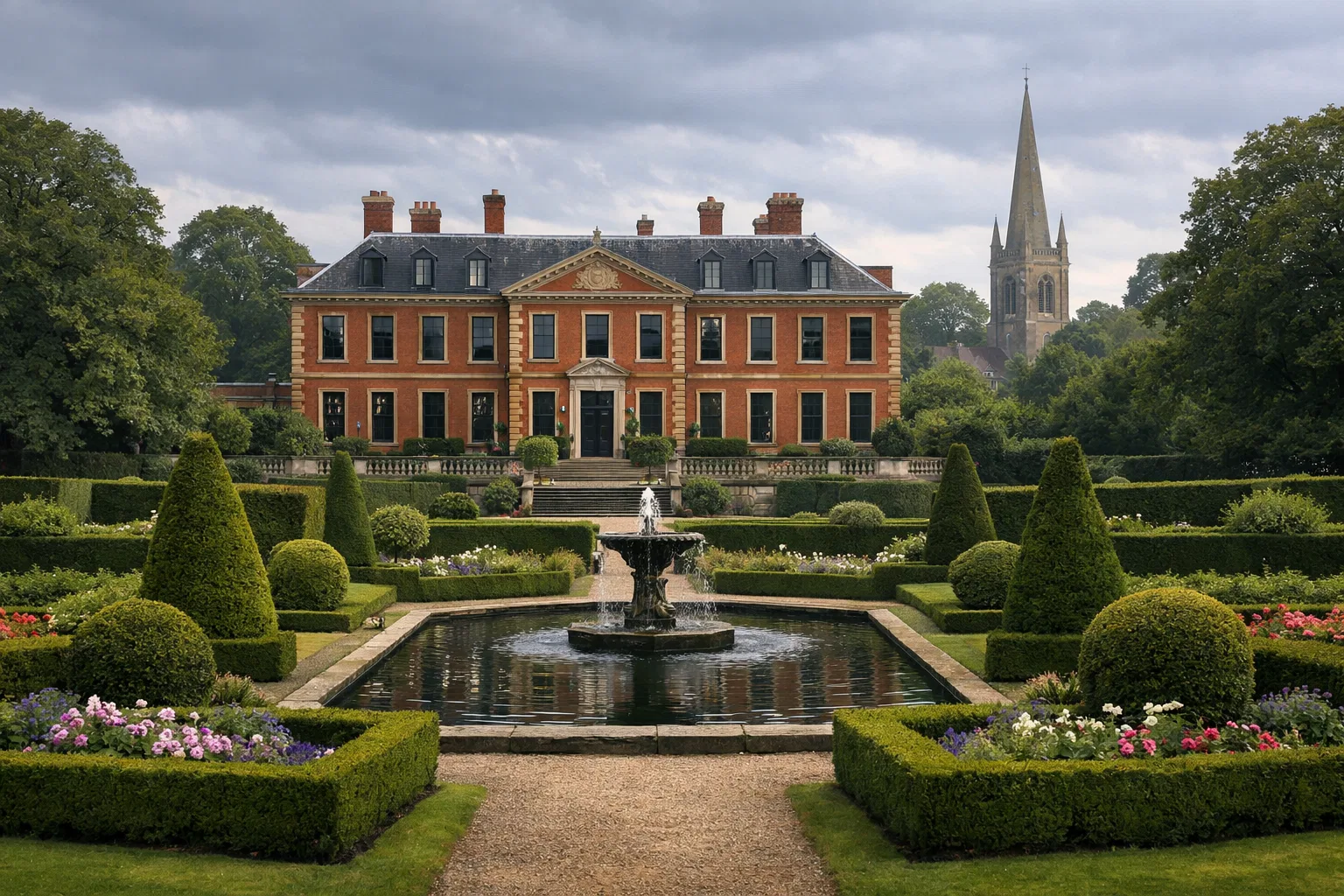
Country houses are ideal ghost-story machines because they compress public history and private emotion into one building. They have portraits, staircases, servants’ corridors, locked rooms, family scandals, chapels, estate churches and long approaches through parkland. In Worcestershire, Hanbury, Harvington and Witley each gives that pattern a different mechanism.
At Hanbury, the haunting is personal. The story works because Emma Vernon’s life is well enough documented to make the ghost feel anchored: she married Henry Cecil, later 1st Marquess of Exeter, lived at Hanbury, endured an unhappy marriage, eloped with the local curate William Sneyd, divorced in 1791, and returned to Hanbury in 1804 after Henry’s death. The National Trust’s account of Hanbury’s history confirms the core human drama behind the later folklore, including the debt, unhappy marriage, elopement, divorce, sale of contents and Emma’s return.[National Trust]nationaltrust.org.ukNational Trust Hanbury Hall's History | Worcestershire | National TrustNational Trust Hanbury Hall's History | Worcestershire | National Trust
At Harvington, the haunting is architectural and religious. The official history describes Humphrey Pakington as a Catholic recusant under Elizabethan penal laws, at a time when non-attendance at Church of England services became financially ruinous and, from 1585, it was illegal for a Catholic priest to set foot in England. That is why the hall was equipped with priest holes.[Harvington Hall]harvingtonhall.co.ukHarvington Hall Our StoryHarvington Hall Our Story The fear here is not primarily that a ghost appears, but that a living person might be heard breathing behind a wall.
At Witley Court, the haunting is ruin-memory. English Heritage describes Witley as once one of England’s great country houses, transformed by the Foley and Ward families and famous in the Victorian period for opulence and extravagant parties, before the devastating fire of 1937 made it one of the country’s most spectacular ruins.[English Heritage]english-heritage.org.ukEnglish Heritage History of Witley Court | English HeritageEnglish Heritage History of Witley Court | English Heritage Its ghost stories work because the ruin itself already feels like an apparition: the outline of a vanished house still standing in stone.
Emma Vernon and Hanbury Hall
Hanbury Hall, near Droitwich Spa, is the most classically “haunted” of the three in popular retellings. The figure usually described is a woman in black, often identified as Emma Vernon, said to move through the grounds or along the route associated with her meetings with William Sneyd. Haunted Britain’s account frames the story as “lost love”, placing Emma’s childhood at Hanbury, her 1776 marriage to Henry Cecil and the later sightings of a black-clad figure within the grounds.[Haunted Britain]haunted-britain.comHaunted Britain Hanbury HallHaunted Britain Hanbury Hall
The story has force because the scandal was real, even if the apparition cannot be proved. The National Trust records that Emma fell in love with the Rev. William Sneyd, eloped with him, divorced Henry in 1791, married Sneyd and took him to Portugal in the hope of improving his tuberculosis, only for him to die a few years later. Emma then returned to Hanbury in 1804 after Henry Cecil’s death and died in 1818.[National Trust]nationaltrust.org.ukNational Trust Hanbury Hall's History | Worcestershire | National TrustNational Trust Hanbury Hall's History | Worcestershire | National Trust This gives the legend a clear emotional shape: a young heiress, an unsuitable love, exile, widowhood and a return to the family seat.
What makes the Hanbury tale memorable is not just the alleged apparition, but its geography. The ghost is not usually imagined as a random presence in a room; she is remembered in motion, crossing the estate landscape between the hall and the church. That matters because country-house ghost stories often preserve routes of tension: servants’ stairs, hidden passages, drives, church paths and thresholds. A walking ghost can turn private scandal into a map.
There is also a useful caution. The wider Hanbury area has more than one “Emma Vernon” ghost claim in online paranormal listings, including a separate poltergeist story at the Country Girl inn dated to 1981. The Paranormal Database records that account as a local girl called Emma Vernon who drowned in the village pond and was later blamed for a brief bar-room poltergeist outbreak.[paranormaldatabase.com]paranormaldatabase.comThe Paranormal DatabaseThe Paranormal Database That is not the same story as the National Trust’s Emma Vernon of Hanbury Hall, and the overlap of name and place shows how easily local traditions can blur. For this page, the stronger Hanbury Hall tradition is the woman-in-black story attached to the historical Emma Vernon and the Cecil-Sneyd scandal.
The credibility, then, is mixed in the best folklore sense. The marriage, elopement, divorce and return are historically grounded. The ghostly sightings are later tradition, preserved by haunted-place writers rather than by a clearly dated official witness record. The story’s value lies not in proving a spectre, but in showing how a dramatic female biography became the emotional centre of a haunted estate.
Priest holes and recusant legends
Harvington Hall, near Kidderminster, is one of Worcestershire’s most atmospheric historic houses, but its haunted reputation should be handled carefully. Some haunted-place sources explicitly say that Harvington itself is not known for an admitted ghost, while still describing the house as steeped in the “spirit of times gone by” because of its Elizabethan wall paintings and priest holes.[Haunted Britain]haunted-britain.comHaunted Britain Haunted Herefordhsire and WorcestershireHaunted Britain Haunted Herefordhsire and Worcestershire That distinction is important: Harvington’s eeriness is not thin evidence for an apparition; it is thick evidence for fear.
The house’s real history is dramatic enough. Harvington Hall’s official site says the building has seven priest hides, more than any other house in England, along with rare Elizabethan wall paintings and stories of Catholic persecution.[Harvington Hall]harvingtonhall.co.ukOpen source on harvingtonhall.co.uk. Historic England’s listing calls the hiding places one of the best-known collections of priests’ holes, noting examples under the main staircase, entered by hinged steps, and in Dr Dod’s Library, entered by swinging a stud. The hall stands on a moated island, which adds to the impression of enclosure and secrecy.[Historic England]historicengland.org.ukHistoric England Harvington Hall and Attached East Bridge, Chaddesley CorbettHistoric England Harvington Hall and Attached East Bridge, Chaddesley Corbett
That makes Harvington a different kind of haunted hall. Its central image is not a transparent lady drifting down a corridor, but a hidden priest waiting in darkness while searchers tear through the house. The fear is historical, physical and spatial. A modern visitor can stand near the staircase and understand why a creak, a cough or a misjudged panel could have meant capture.
The folklore mechanism is powerful because the architecture already behaves like a ghost story. A room contains another room. A stair hides an entrance. A library stud opens a route no casual visitor would suspect. These are not invented Gothic props; they are listed historic features. Once a building has genuine concealment built into its fabric, later legends do not need to work hard. The house teaches the imagination to suspect every surface.
Harvington also belongs to a wider Worcestershire recusant landscape. The nearby Hindlip Hall tradition, for example, includes ghost stories around hidden priests and annual revelation of secret places in The Paranormal Database’s Worcestershire listings.[paranormaldatabase.com]paranormaldatabase.comThe Paranormal DatabaseThe Paranormal Database That does not prove anything supernatural at Harvington, but it shows the local pattern: priest holes, Catholic secrecy and hunted households became one of the county’s most fertile sources of spectral legend.

Witley Court and the memory of ruin
Witley Court, at Great Witley, is haunted above all by absence. Its roofless walls, formal gardens and restored Perseus and Andromeda fountain make it one of Worcestershire’s most dramatic haunted-looking places, even before any apparition is mentioned. English Heritage describes the estate as a great country house transformed through several phases, enriched by fortunes from iron and coal, famous for Victorian opulence and extravagant parties, then devastated by the fire of 7–8 September 1937.[English Heritage]english-heritage.org.ukEnglish Heritage History of Witley Court | English HeritageEnglish Heritage History of Witley Court | English Heritage
Historic England’s listing explains why the ruin feels so theatrical. The surviving shell contains layers of the 17th-century Russell house, later Foley additions, early 19th-century porticos associated with John Nash, and the mid-19th-century transformation by Samuel Whitfield Daukes into a “virtual palace”. The wider setting includes elaborate lodges, rough kilometre-long approaches, terraces, balustrades, French and Italian-style gardens, great fountains and the adjacent Grade I church of Great Witley.[Historic England]historicengland.org.ukHistoric England Witley Court, Great WitleyHistoric England Witley Court, Great Witley
The ghost stories attached to Witley are more fragmentary than Hanbury’s Emma Vernon tradition. The Paranormal Database records a “Barking Hound” at Witley Court, linked to a 1960s ghost-hunting visit by Bob Dylan, Kevyn Gammond and others, with Dylan reportedly hearing a dog bark while others were less convinced. The same listing mentions a reputed Lady Dudley and a 2000s photograph of a figure in a window, while also suggesting that the photograph is more likely reflection and pareidolia — the tendency to see meaningful forms in ambiguous shapes.[paranormaldatabase.com]paranormaldatabase.comThe Paranormal DatabaseThe Paranormal Database
That sceptical note is valuable. Witley’s broken walls and empty openings invite the eye to complete missing rooms and populate dark windows. A supposed face or figure in a ruined aperture may feel persuasive in the moment, but ruins are especially good at producing visual tricks: shadows, reflections, changing light, blocked sightlines and the viewer’s expectation that someone ought to be there.
Even so, Witley’s haunted reputation is not simply a mistake. It expresses something real about the site’s history. The 1937 fire did not just damage a building; it ended a way of life. English Heritage notes that although half the central block and east wing were gutted and much of the contents was salvaged, restoration was too much for Sir Herbert Smith to contemplate, the contents sale in 1938 lasted seven days, and “Witley seemed doomed”.[English Heritage]english-heritage.org.ukEnglish Heritage History of Witley Court | English HeritageEnglish Heritage History of Witley Court | English Heritage That is the perfect seedbed for ruin folklore: a great house survives, but only as the ghost of itself.
What these three halls reveal about Worcestershire hauntings
Hanbury, Harvington and Witley show three different ways a Worcestershire house can feel haunted without needing the same kind of evidence.
At Hanbury, biography becomes apparition. Emma Vernon’s life supplies the plot: inheritance, marriage, affair, elopement, loss, return. The woman-in-black story feels compelling because it follows a real emotional wound in the estate’s history.
At Harvington, architecture becomes fear. The priest holes are documented, visible and historically serious. Even where explicit ghost evidence is thin, the house’s concealed spaces make it one of the county’s most naturally unsettling buildings.
At Witley, ruin becomes memory. The fire, abandonment and shell-like survival of the mansion create a place where ghost stories gather around absence. Reports of a hound, a Lady Dudley or a window figure sit on top of a stronger, verifiable story of sudden decline.
Together, they also show why “haunted” is not one simple category. A ghost tourist might arrive looking for apparitions, but the deeper pattern is social memory. Hanbury remembers marriage and scandal. Harvington remembers religious danger and secrecy. Witley remembers vanished wealth, industrial fortunes and catastrophic loss. In each case, the story is attached to a specific mechanism rather than a generic spooky label.
How to read the evidence
The strongest evidence on this subtopic is historical rather than paranormal. Hanbury’s Emma Vernon story rests on a documented family history, but the apparitional layer is preserved mainly in haunted-place retellings. Harvington’s priest holes are officially and architecturally well attested, but its ghost tradition is comparatively cautious. Witley’s ruin-history is strongly documented by English Heritage and Historic England, while its ghostly hound, Lady Dudley and window-figure reports belong to folklore and paranormal cataloguing.
That does not make the stories worthless. It makes them readable. A careful haunted-history approach asks what each story is doing: whether it preserves a scandal, dramatises fear, explains a ruin, supports tourism, or turns a difficult past into something visitors can feel. Hanbury, Harvington and Witley are worth grouping together because they show the haunted hall as a mechanism: private emotion, hidden religion and ruined grandeur, each leaving a different kind of trace in Worcestershire’s ghost map.
Amazon book picks
Further Reading
Books and field guides related to Why Do Worcestershire's Great Houses Feel Haunted?. Use these as the next step if you want deeper reading beyond the article.


Story of the Country House
First published 2021. Subjects: Architecture, Country homes, History, ARCHITECTURE / General.
eBay marketplace picks
Marketplace Samples
Live-tested eBay searches with available results related to this page.


Endnotes
1.
Source: haunted-britain.com
Title: Haunted Britain Hanbury Hall
Link:https://www.haunted-britain.com/hanbury-hall.htm
2.
Source: paranormaldatabase.com
Title: The Paranormal Database
Link:https://www.paranormaldatabase.com/worcestershire/worcestdata.php?pageNum_paradata=1
3.
Source: haunted-britain.com
Title: Haunted Britain Haunted Herefordhsire and Worcestershire
Link:https://www.haunted-britain.com/hereford-and-worcester.htm
4.
Source: youtube.com
Title: Ghosts Of Hanbury Hall
Link:https://www.youtube.com/watch?v=ZTevinZOShE
Source snippet
Harvington Hall Hauntings – History, Priest Holes & Local Legends...
5.
Source: youtube.com
Title: Harvington Hall Hauntings – History, Priest Holes & Local Legends
Link:https://www.youtube.com/watch?v=KsVyLjghHbQ
Source snippet
The mass haunting of Harvington Hall: The Ghost of Lady Mary Yates...
6.
Source: nationaltrust.org.uk
Title: National Trust Hanbury Hall’s History | Worcestershire | National Trust
Link:https://www.nationaltrust.org.uk/visit/worcestershire-herefordshire/hanbury-hall/history-of-hanbury-hall
7.
Source: harvingtonhall.co.uk
Title: Harvington Hall Our Story
Link:https://harvingtonhall.co.uk/our-story/
8.
Source: english-heritage.org.uk
Title: English Heritage History of Witley Court | English Heritage
Link:https://www.english-heritage.org.uk/visit/places/witley-court-and-gardens/history/
9.
Source: harvingtonhall.co.uk
Link:https://harvingtonhall.co.uk/
10.
Source: historicengland.org.uk
Title: Historic England Harvington Hall and Attached East Bridge, Chaddesley Corbett
Link:https://historicengland.org.uk/listing/the-list/list-entry/1348331
11.
Source: historicengland.org.uk
Title: Historic England Witley Court, Great Witley
Link:https://historicengland.org.uk/listing/the-list/list-entry/1000901
12.
Source: english-heritage.org.uk
Title: fountain 1937
Link:https://www.english-heritage.org.uk/visit/places/witley-court-and-gardens/things-to-do/fountain-1937/
13.
Source: english-heritage.org.uk
Title: witley court and gardens
Link:https://www.english-heritage.org.uk/visit/places/witley-court-and-gardens/
14.
Source: english-heritage.org.uk
Link:https://www.english-heritage.org.uk/visit/inspire-me/spotlight-on/witley-court/
15.
Source: historichouses.org
Link:https://www.historichouses.org/house/harvington-hall/
16.
Source: podscan.fm
Link:https://podscan.fm/podcasts/ghost-tales-by-the-fireside-true-ghost-stories-podcast/episodes/harvington-hall-hauntings-history-priest-holes-amp-local-legends
17.
Source: Wikipedia
Title: Witley Court
Link:https://en.wikipedia.org/wiki/Witley_Court
18.
Source: Wikipedia
Title: Harvington Hall
Link:https://en.wikipedia.org/wiki/Harvington_Hall
19.
Source: Wikipedia
Title: Hanbury Hall
Link:https://en.wikipedia.org/wiki/Hanbury_Hall
20.
Source: facebook.com
Link:https://www.facebook.com/Harvington/posts/imagine-the-fear-the-sound-of-boots-at-the-doorthe-house-being-torn-apart-above-/1525479769580610/
21.
Source: facebook.com
Link:https://www.facebook.com/groups/143520235831162/posts/2360864057430091/
22.
Source: spookyisles.com
Title: hanbury hall
Link:https://www.spookyisles.com/hanbury-hall/
23.
Source: susanaellisauthor.blog
Title: emma vernon
Link:https://susanaellisauthor.blog/tag/emma-vernon/
24.
Source: pocketcasts.com
Link:https://pocketcasts.com/podcast/ghost-tales-by-the-fireside-true-ghost-stories-podcast/7e2660d0-7aaa-0139-3480-0acc26574db2/harvington-hall-hauntings-history-priest-holes-local-legends/cf15e77c-8609-4a7f-be8b-b823396e9741
25.
Source: nationaltrustscones.com
Title: hanbury hall
Link:https://www.nationaltrustscones.com/2015/06/hanbury-hall.html
26.
Source: youtube.com
Title: Hanbury Hall
Link:https://www.youtube.com/watch?v=WrGM3WXnQIc
27.
Source: britainexpress.com
Title: Harvington Hall, History & Photos
Link:https://www.britainexpress.com/attractions.htm?attraction=3809
28.
Source: thetudortravelguide.com
Link:https://thetudortravelguide.com/harvington-hall/
29.
Source: greatbritishghosttour.co.uk
Link:https://www.greatbritishghosttour.co.uk/Pages/England/Worcestershire/Hanbury.html
Additional References
30.
Source: youtube.com
Title: The Dark Story of Britain’s Most Abandoned Palace: Witley Court
Link:https://www.youtube.com/watch?v=XfF-VrNXVHw
Source snippet
Hanbury Hall ghost Hanbury Hall: 18th-Century Stately Home, Scandal, and Ghostly Legends | Worcestershire History Bloomburys...
31.
Source: youtube.com
Title: The mass haunting of Harvington Hall: The Ghost of Lady Mary Yates
Link:https://www.youtube.com/watch?v=xsWrJAYDfl4
Source snippet
The Dark Story of Britain's Most Abandoned Palace: Witley Court...
32.
Source: facebook.com
Link:https://www.facebook.com/STOURPORTPAST/posts/andrew-beard-said-ive-heard-a-few-stories-from-recent-residents-about-the-crown-/716617328390456/
33.
Source: archive.org
Link:https://archive.org/stream/ramblerinworcest01noakiala/ramblerinworcest01noakiala_djvu.txt
34.
Source: facebook.com
Link:https://www.facebook.com/groups/129133077147570/posts/27685078857792954/
35.
Source: facebook.com
Link:https://www.facebook.com/Harvington/posts/hidden-for-centuries-and-almost-nobody-has-ever-seen-it-harvingtonhall-priesthol/1542798421182078/
36.
Source: facebook.com
Link:https://www.facebook.com/ParanormalFilesuk/posts/huddington-court-hauntings-of-the-talbot-and-wintour-familyhuddington-court-a-mo/1120727410034957/
37.
Source: facebook.com
Link:https://www.facebook.com/100083218874573/posts/priest-holes-at-harvington-hallenglands-most-famous-priest-hidethey-were-hidden-/1008777455239541/
38.
Source: facebook.com
Link:https://www.facebook.com/InnatPerryCabin/posts/an-unknown-fun-fact-is-that-our-library-contains-a-secret-passageway-through-the/6101124356633997/
39.
Source: instagram.com
Link:https://www.instagram.com/severedheadfilms/reel/DW9e4BfDvcz/?hl=fr
Topic Tree