Within Haunted Montgomeryshire
Why is Powis Castle Montgomeryshire's most famous haunting?
Powis Castle's ghost lore blends an eighteenth-century apparition tale with later legends of mysterious music and unseen presences.
On this page
- The 1780 apparition story
- Later ghost traditions
- Folklore or historical evidence?
Page outline Jump by section
Introduction
Powis Castle is Montgomeryshire’s most famous haunting because it has something many castle ghost stories lack: a named early source, a detailed narrative, and a clear route by which the tale entered Welsh folklore writing. The central story is the 1780 account preserved by the antiquary Elias Owen, in which a poor Methodist woman staying at the castle is said to have met a gentleman in a gold-laced hat and waistcoat who led her to a hidden box beneath the floor. Later traditions add a lady in black, piano music in an empty ballroom, knocks on locked doors, and unseen touches on stairs, but these belong to a looser tourism-and-local-legend layer rather than to the same evidential class as the older apparition tale.[Project Gutenberg]gutenberg.orgProject Gutenberg Welsh Folk-LoreProject Gutenberg Welsh Folk-Lore
The setting matters. Powis Castle stands near Welshpool in historic Montgomeryshire, now within the modern county of Powys. The National Trust describes it as a thirteenth-century Welsh castle, later remodelled into the Herbert family’s great house, and modern heritage sources still present it as one of the most important historic visitor sites in Mid Wales. That long domestic history — servants’ rooms, state rooms, locked interiors, hidden spaces and family papers — gives the haunting its atmosphere, but the evidence has to be read carefully: Powis has a strong ghost tradition, not a proven ghost.[National Trust]nationaltrust.org.ukNational Trust Powis Castle and Garden | Wales | National TrustNational Trust Powis Castle and Garden | Wales | National Trust
Why Powis Castle became Montgomeryshire’s haunted landmark
Powis Castle has several advantages over quieter Montgomeryshire ghost sites. It is architecturally dramatic, nationally known, open to visitors, and old enough to invite stories about hidden chambers and unfinished business. The National Trust summarises the castle’s development from a medieval fortress built by Welsh princes into the grand Herbert family residence, while its gardens, state rooms and collections make it a place where the public can still imagine the older household world in which the main ghost story is set.[National Trust]nationaltrust.org.ukNational Trust Powis Castle and Garden | Wales | National TrustNational Trust Powis Castle and Garden | Wales | National Trust
For a county-level haunted-history page, Powis is also unusually well anchored. Many “haunted castle” stories circulate as short unattributed snippets: a grey lady in a corridor, a phantom monk, footsteps in a tower. Powis has those later motifs too, but its best-known tale was printed in Elias Owen’s Welsh Folk-Lore, published in 1896, and Owen did not present it as a vague rumour. He traced it to the autobiography of the grandfather of Thomas Wright, the Shropshire antiquary, and said the story had been told in 1780 by John Hampson senior, a Methodist preacher who had recently arrived from Wales.[Project Gutenberg]gutenberg.orgProject Gutenberg Welsh Folk-LoreProject Gutenberg Welsh Folk-Lore
That does not make the apparition factual, but it does make the tradition historically interesting. The story had already moved through several hands before Owen printed it: the unnamed woman, Hampson, Wright’s grandfather, the family memoir, and finally Owen’s folklore collection. This chain is exactly why Powis Castle sits at the centre of Montgomeryshire’s haunted map. It is not simply “a castle said to be haunted”; it is a castle whose ghost story shows how eighteenth-century religious testimony, household rumour and nineteenth-century folklore collecting could combine into a durable local legend.
The 1780 apparition story
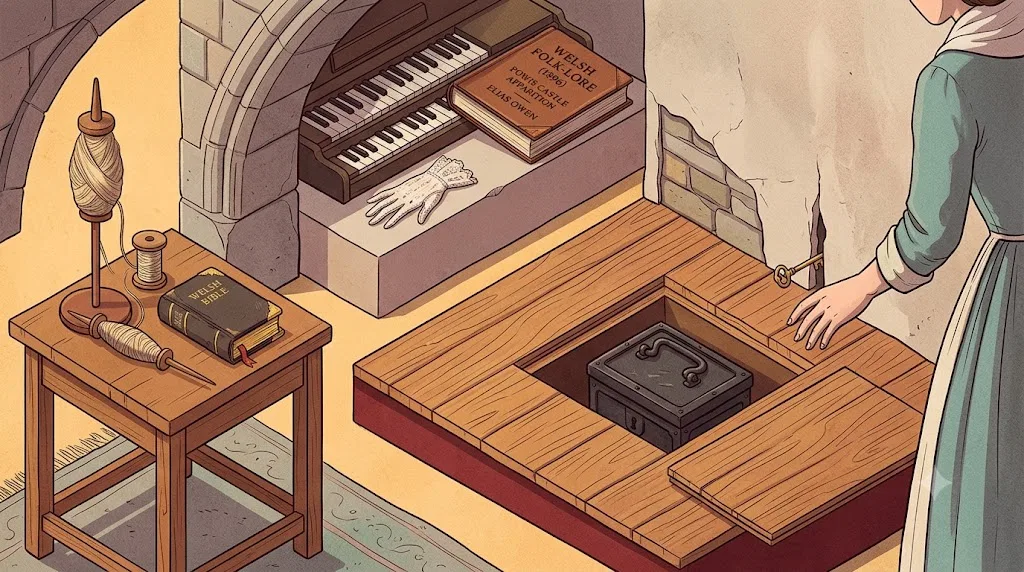
The old Powis Castle ghost story begins not with an aristocrat, but with a working woman. In Owen’s version, she is poor, unmarried, a member of the Methodist Society, and employed in spinning hemp and flax. She travels from house to house looking for work and comes to the Earl of Powis’s country seat, which the narrative calls “Redcastle”. The family are away in London, leaving the steward, his wife and other servants in charge. She is asked to stay overnight because there is more work for her the next day.[Project Gutenberg]gutenberg.orgProject Gutenberg Welsh Folk-LoreProject Gutenberg Welsh Folk-Lore
The servants then put her in a grand ground-floor room with a boarded floor, two sash windows, a good fire, a candle, a chair, a table and a well-furnished bed. The detail is important because the woman immediately suspects something is odd. Why would a poor spinner be placed in so fine a room? Why did several servants escort her there with candles? Owen’s narrative answers the question shortly afterwards: the room had long been “disturbed”, nobody could sleep there peacefully, and the servants had deliberately put the serious Methodist woman into the haunted room to see what would happen.[Project Gutenberg]gutenberg.orgProject Gutenberg Welsh Folk-LoreProject Gutenberg Welsh Folk-Lore
While reading from her small Welsh Bible before bed, she hears the door open and sees a gentleman enter, dressed in a gold-laced hat and waistcoat. He walks to the sash window, leans there for a while, then leaves. He returns while she is praying, circles the room, and comes close behind her. Only on the third appearance does she manage to speak, asking who he is and what he wants. The figure tells her to take up the candle and follow him.[Project Gutenberg]gutenberg.orgProject Gutenberg Welsh Folk-LoreProject Gutenberg Welsh Folk-Lore
The apparition leads her along a boarded passage into a small room or closet. There, he tears up a floorboard and reveals a box with an iron handle in the lid. He then shows her a crevice in the wall where the key is hidden. The instruction is precise: the box and key must be taken out and sent to the Earl in London. In return, the spirit says he will trouble the house no more. The woman calls the servants, who had apparently been waiting with lights to see what would happen. The steward is afraid to touch the box, but his wife and the other servants help remove it. According to the story, the box is heavy, though the woman does not see it opened and does not know whether it contains money, papers, or both.[Project Gutenberg]gutenberg.orgProject Gutenberg Welsh Folk-LoreProject Gutenberg Welsh Folk-Lore
The ending gives the tale its moral shape. The box is said to have been sent to the Earl in London, together with an account of its discovery. The Earl then offers the woman either a place in his household for life or continuing financial assistance whenever she needs it. Hampson is reported as saying that it was known locally that she had been supplied from the Earl’s family from the time of the incident and was still being helped when she gave him the account.[Project Gutenberg]gutenberg.orgProject Gutenberg Welsh Folk-LoreProject Gutenberg Welsh Folk-Lore
What makes the old story more than a simple scare
The 1780 tale is not structured like a modern jump-scare. Its ghost is not malevolent, and the woman is not punished for entering a forbidden room. Instead, the apparition behaves almost like a messenger. Owen even remarks, with dry humour, that the spirit seems “very civil” and careful not to frighten her more than necessary. The emotional tension comes from whether she will have enough courage and religious steadiness to speak to him.[Project Gutenberg]gutenberg.orgProject Gutenberg Welsh Folk-LoreProject Gutenberg Welsh Folk-Lore
This places the Powis story in a familiar Welsh and British folklore pattern: a spirit cannot rest until concealed property, a hidden debt, or a buried secret is brought to light. Owen prints the Powis tale directly after another story in which a ghost reveals hidden treasure at Ffynnon Wen, and he explicitly introduces this part of his book as a phase of spirit folklore in which ghosts reveal hidden treasures. That context matters because it shows that Owen did not treat Powis as an isolated marvel. He saw it as part of a wider family of stories about troubled spirits, concealed valuables and moral restitution.[Project Gutenberg]gutenberg.orgProject Gutenberg Welsh Folk-LoreProject Gutenberg Welsh Folk-Lore
The Powis version, however, is more socially detailed than many treasure-ghost tales. It has a class contrast between the poor spinner and the aristocratic household; a religious contrast between Methodist seriousness and servants’ mischief; and a domestic contrast between grand rooms and hidden floorboards. The ghost’s request is not “dig up treasure and keep it”, but “send this to the Earl”. That detail makes the story feel less like a fantasy of sudden wealth and more like a household-secret legend attached to family property.
For modern readers, the most striking feature may be the servants’ behaviour. They are not passive witnesses; they set the test in motion. The woman’s experience begins because the household staff believe the room is disturbed and decide to use her as the person most likely to confront it. That gives the story a slightly uncomfortable edge. The woman is both the heroine of the tale and the subject of an experiment by people who know more about the room than she does.

Later ghost traditions
The later Powis Castle haunting tradition is broader, more atmospheric and harder to trace to early documentary sources. Visit Wales, in a haunted Wales itinerary, describes reports of a lady in black by the fireside in the Duke’s Room and a grand piano in the Ballroom Wing heard playing when the room is locked and empty. The Welsh tourism project Land of Legends similarly lists self-playing pianos, unexplained knocks on doors, and invisible hands grabbing at people on stairs as part of the castle’s spooky reputation.[Travel Trade Wales]traveltrade.visitwales.comOpen source on visitwales.com.
These later motifs are now part of the public-facing Powis Castle legend. They are the kind of details visitors remember because they attach the haunting to spaces that feel imaginable: a fireside, a ballroom, a staircase, a locked room after closing. They also fit common country-house ghost patterns. A woman in black suggests mourning or aristocratic memory; music from an empty room suggests lingering social life; knocks on doors and windows turn the building itself into something restless.
The difficulty is that these stories are usually reported in brief modern summaries rather than in long first-hand accounts with names, dates and witness statements. That does not make them worthless as folklore. Repeated tourism summaries can preserve the shape of local tradition, especially where staff stories and visitor talk circulate orally. But they should not be weighed in the same way as the older Owen account, which at least gives a transmission chain, a claimed date, a social setting and a narrative sequence.[Travel Trade Wales]traveltrade.visitwales.comOpen source on visitwales.com.
There is also a small tension between the traditions. In Owen’s version, the spirit promises to stop troubling the house once the box and key are sent to the Earl, and the story implies that this was done. Later retellings sometimes preserve the old tale while also saying that ghostly activity continues in other forms. That is not unusual in haunted-house folklore. A strong old story often becomes the foundation on which later sightings, sounds and sensations are layered, even if the original narrative appears to resolve the haunting.
Folklore or historical evidence?
The strongest answer is that Powis Castle has good evidence for a historic ghost tradition, not good evidence for a ghost. The distinction matters. There is reliable evidence that the 1780 apparition story was circulating by the time Elias Owen printed Welsh Folk-Lore in 1896, and Owen gives a source chain that reaches back to John Hampson’s alleged interview with the woman. There is also reliable evidence that modern Welsh tourism and legend sources continue to present Powis as haunted. What is not demonstrated is that the apparition itself appeared, that the box still existed in a verifiable archive trail, or that the later lady-in-black and piano traditions derive from named contemporary witnesses.[Project Gutenberg]gutenberg.orgProject Gutenberg Welsh Folk-LoreProject Gutenberg Welsh Folk-Lore
Several features strengthen the old story as folklore evidence. It contains specific material details: the Welsh Bible, the sash windows, the boarded passage, the floorboard, the iron-handled box, the key in the wall crevice, and the Earl’s London residence. It also preserves social circumstances that feel rooted in an eighteenth-century household: seasonal absence of the “quality”, servants managing the house, domestic textile work, and a poor woman moving between homes for employment. These are not proof of the supernatural, but they are the sort of texture that helps a story survive.
Several features weaken it as historical proof. The woman is unnamed in Owen’s printed version. The box’s contents are unknown. The narrative reaches print more than a century after the claimed event. The chain of transmission is indirect. Owen himself places the tale among “many similar stories” and makes no attempt to prove the apparition as fact. That restraint is worth respecting: the story is valuable because it shows what people said, feared, believed and repeated, not because it can be treated as a verified incident.[Project Gutenberg]gutenberg.orgProject Gutenberg Welsh Folk-LoreProject Gutenberg Welsh Folk-Lore
A sceptical reading does not have to flatten the tale into fraud. The servants already believed the room was disturbed and put the woman there deliberately; the woman was alone, anxious, socially out of place and primed by the strangeness of the room; the later discovery of a hidden box, if there was one, could have been misunderstood, staged, embellished, or folded into a pre-existing household rumour. Equally, a folkloric reading can acknowledge that the story’s power lies in its moral and social drama: a marginal woman succeeds where the household fails, and the hidden matter is restored to its proper owner.

Why the sources still matter to visitors
For visitors, Powis Castle’s ghosts are best approached as layered history. The building itself is real and richly documented: a medieval Welsh castle rebuilt and remodelled over centuries, associated with the Herbert family from the late sixteenth century and cared for by the National Trust since 1952. Heritage records and archaeological summaries show a complex site with medieval phases, later alterations and long scholarly attention, which helps explain why stories of hidden spaces and lingering presences feel plausible in the imagination even when they are not provable as events.[nationaltrust.org.uk]nationaltrust.org.ukNational Trust History of Powis Castle | Wales | National TrustNational Trust History of Powis Castle | Wales | National Trust
The ghost lore then adds a second layer. The 1780 apparition story gives Powis a rare old narrative with a beginning, middle and end: the haunted room, the repeated apparition, the hidden box, the frightened servants, and the woman’s reward. The later stories give the castle its modern haunted atmosphere: the lady in black, the locked-room piano, the knocks, the stairs. Together, they explain why Powis is repeatedly singled out in haunted Wales itineraries and legend guides, even though Montgomeryshire as a whole has a quieter ghost-tour profile than some larger tourist regions.[Travel Trade Wales]traveltrade.visitwales.comOpen source on visitwales.com.
The most careful way to tell the story is therefore neither to debunk it out of existence nor to present it as established fact. Powis Castle’s haunting is a historically traceable legend attached to a real Montgomeryshire landmark. Its oldest source shows how a ghost story could travel through Methodist testimony, antiquarian memory and folklore publication; its later forms show how a heritage site can continue to gather rumours, sounds, figures and sensations long after the first tale has supposedly been resolved.
Reading the Powis haunting in Montgomeryshire’s wider ghost map
Within Montgomeryshire, Powis Castle stands apart because it links aristocratic space with popular belief. The story does not come from a battlefield, a lonely road or a ruined chapel, but from inside a great house at night, when the family are absent and the servants hold the keys. That makes it especially useful for understanding how haunted history works in a rural Welsh county: the supernatural is not separate from ordinary social life, but woven through work, class, religion, architecture and memory.
It also shows why historic county framing is useful. Modern “haunted Powys” coverage can range across several old Welsh counties, including areas that historically belonged to Brecknockshire or Radnorshire. Powis Castle, by contrast, belongs firmly to the Montgomeryshire branch: it is near Welshpool, tied to the old county’s best-known great house, and preserved in sources that connect local tradition with wider Welsh folklore. DataMapWales records Montgomeryshire as one of the historic Welsh counties created after the Laws in Wales Acts, while Powys Archives now holds records for the modern county area, including material useful for researching older Montgomeryshire communities.[Data Map Wales]datamap.gov.walesData Map Wales Historic County Boundaries of Wales | Data Map WalesData Map Wales Historic County Boundaries of Wales | Data Map Wales
The result is a haunting with two kinds of value. As a ghost story, it has memorable images: the candle, the gold-laced visitor, the floorboard, the hidden key. As a historical source, it reveals how people made sense of disturbed rooms, family secrets and unexplained noises in a great Welsh house. That combination is why Powis Castle remains Montgomeryshire’s most important haunted place: not because its ghosts can be proved, but because its stories can be followed, questioned and understood.
Amazon book picks
Further Reading
Books and field guides related to Why is Powis Castle Montgomeryshire's most famous haunting?. Use these as the next step if you want deeper reading beyond the article.
Welsh folk-lore: a collection of the folk-tales and legends o...
Preserves the early Powis Castle apparition tradition.
The Penguin Book of Ghost Stories
Appeals to readers interested in classic haunting narratives.

eBay marketplace picks
Marketplace Samples
Live-tested eBay searches with available results related to this page.

Endnotes
1.
Source: gutenberg.org
Title: Project Gutenberg Welsh Folk-Lore
Link:https://www.gutenberg.org/files/20096/20096-h/20096-h.htm
2.
Source: gutenberg.org
Link:https://www.gutenberg.org/ebooks/20096.epub.images
3.
Source: gutenberg.org
Link:https://www.gutenberg.org/files/53915/53915-h/53915-h.htm
4.
Source: gutenberg.org
Link:https://www.gutenberg.org/ebooks/45362.txt.utf-8
5.
Source: archive.org
Link:https://archive.org/details/cu31924029911520
6.
Source: archive.org
Link:https://archive.org/download/cu31924029911520/cu31924029911520.pdf
7.
Source: archive.org
Link:https://archive.org/download/folkloreofwestmi00daviuoft/folkloreofwestmi00daviuoft.pdf
8.
Source: archives.wales
Title: Powys Archives
Link:https://archives.wales/organisation/powys-archives/
9.
Source: traveltrade.visitwales.com
Link:https://traveltrade.visitwales.com/itineraries/heritage-and-culture/haunted-wales
10.
Source: nationaltrust.org.uk
Title: National Trust Powis Castle and Garden | Wales | National Trust
Link:https://www.nationaltrust.org.uk/visit/wales/powis-castle-and-garden
11.
Source: nationaltrust.org.uk
Title: National Trust History of Powis Castle | Wales | National Trust
Link:https://www.nationaltrust.org.uk/visit/wales/powis-castle-and-garden/history-of-powis-castle
12.
Source: datamap.gov.wales
Title: Data Map Wales Historic County Boundaries of Wales | Data Map Wales
Link:https://datamap.gov.wales/layers/geonode%3Ahistoric_counties_bng_rcahmw_ply
13.
Source: archwilio.org.uk
Title: Archwilio Heneb Historic Environment Record: CPAT123
Link:https://www.archwilio.org.uk/arch/query/page.php?dbname=cpat&tbname=core&watprn=CPAT123
14.
Source: en.powys.gov.uk
Title: Powys County Council Archives and Family History
Link:https://en.powys.gov.uk/article/1869/Archives-and-Family-History
15.
Source: nationaltrust.org.uk
Title: The Clive Museum collection at Powis Castle
Link:https://www.nationaltrust.org.uk/visit/wales/powis-castle-and-garden/the-clive-museum-collection-at-powis-castle
16.
Source: nationaltrust.org.uk
Link:https://www.nationaltrust.org.uk/visit/wales/powis-castle-and-garden/powis-castle-state-rooms
17.
Source: nationaltrust.org.uk
Title: history of the garden at powis castle
Link:https://www.nationaltrust.org.uk/visit/wales/powis-castle-and-garden/history-of-the-garden-at-powis-castle
18.
Source: cadw.gov.wales
Title: wales Open Doors
Link:https://cadw.gov.wales/open-doors-powis-castle-and-gardens
19.
Source: Wikipedia
Title: Powis Castle
Link:https://en.wikipedia.org/wiki/Powis_Castle
20.
Source: britishlistedbuildings.co.uk
Title: Powis Castle
Link:https://britishlistedbuildings.co.uk/300007746-powis-castle-welshpool
21.
Source: visitwales.com
Link:https://www.visitwales.com/attraction/castle/powis-castle-garden-556571
22.
Source: welshhistories.co.uk
Title: powis castle
Link:https://welshhistories.co.uk/powis-castle/
23.
Source: discovery.nationalarchives.gov.uk
Link:https://discovery.nationalarchives.gov.uk/details/a/A13532862
24.
Source: historyhit.com
Title: Powis Castle
Link:https://www.historyhit.com/locations/powis-castle/
25.
Source: directory.shropshire.gov.uk
Title: shropshire.gov.uk Powis Castle
Link:https://directory.shropshire.gov.uk/service/40b2c688-264d-49f0-83b5-feba291fc2ec/
26.
Source: nationaltrustscones.com
Title: powis castle
Link:https://www.nationaltrustscones.com/2015/10/powis-castle.html
27.
Source: castlecrawlcymru.co.uk
Link:https://www.castlecrawlcymru.co.uk/castles/powis-castle
Additional References
28.
Source: youtube.com
Title: Powis Castle & Gardens – Welsh Fortress, Imperial Treasures and Clive of India
Link:https://www.youtube.com/watch?v=4kiMUyBZZlA
Source snippet
3 Exploring The Historic Castle Powis in Welshpool | Stately Rooms & Beautiful Gardens...
29.
Source: youtube.com
Link:https://www.youtube.com/watch?v=tZDY33iHCEM
Source snippet
4 Is This One of Wales BEST Days Out? - We Explored Powis Castle & Gardens...
30.
Source: youtube.com
Title: Is This One of Wales BEST Days Out?
Link:https://www.youtube.com/watch?v=gXzykubH-fQ
Source snippet
5 A jaunt around Montgomery Castle in Wales...
31.
Source: facebook.com
Link:https://www.facebook.com/groups/281886105961506/posts/1991798031636963/
32.
Source: facebook.com
Link:https://www.facebook.com/BBCCymruWales/posts/archive-is-llyn-dulyn-in-snowdonia-haunted/3782561795138546/
33.
Source: facebook.com
Link:https://www.facebook.com/groups/snapshotsoftheworld/posts/2195020727666877/
34.
Source: slideshare.net
Link:https://www.slideshare.net/slideshow/critical-teaching-behaviors-defining-documenting-and-discussing-good-teaching-1st-edition-lauren-barbeau/279607769
35.
Source: instagram.com
Link:https://www.instagram.com/reel/DFPeJ1cNW7n/
36.
Source: castlesandmanorhouses.com
Link:https://www.castlesandmanorhouses.com/ghosts.php?SelectCountry=Wales&SelectQuality=ALL&SelectType=Ghost+Haunting&Sort=Name&submit=
37.
Source: castlesandmanorhouses.com
Link:https://www.castlesandmanorhouses.com/ghosts.php?Sort=Country
Topic Tree