Why Does Caithness Feel So Haunted?
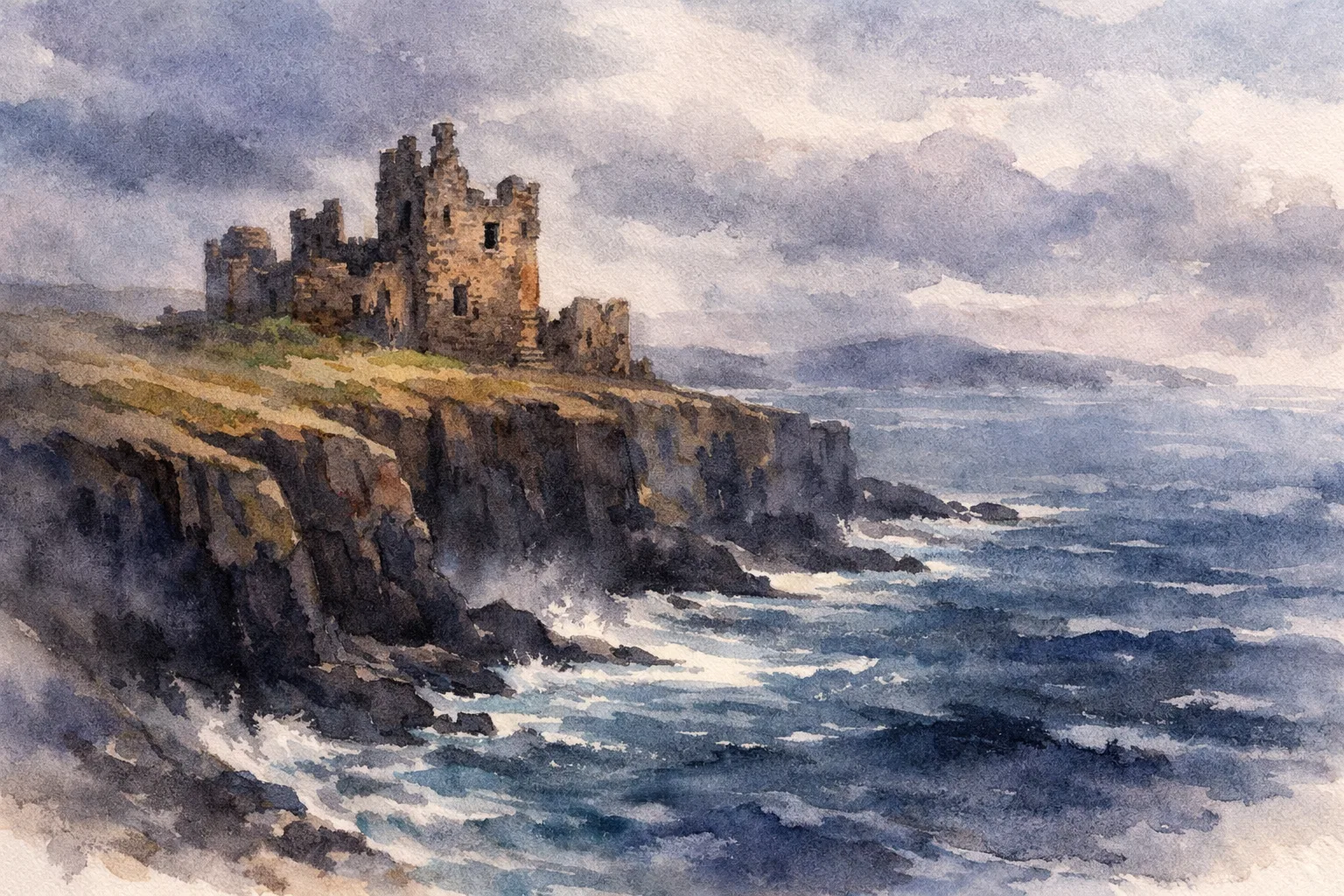
Caithness is one of Scotland’s most atmospheric haunted-history landscapes: a far northern historic county of sea-cliffs, ruined castles, brochs, graveyards, old inns and Norse-influenced place lore.
Page outline Jump by section
Introduction
Geographically, this page treats Caithness as the historic county at the north-eastern tip of mainland Scotland. Wikishire describes it as a triangular shire bounded by sea to the north and east and by Sutherland to the west, while modern administration places the area within Highland Council. That distinction matters because ghost stories often follow historic estates, parishes and travel routes rather than present-day council boundaries.[Wikishire]wikishire.co.ukOpen source on wikishire.co.uk.
Why Caithness feels so haunted
Caithness has the right ingredients for a haunted reputation: exposed coast, low open land, isolated towers, old burial grounds and a long record of conflict between powerful families. The historic environment is unusually visible. Castle ruins stand on promontories, brochs survive as ancient mounds, and medieval churchyards remain inside living towns. These are places where ordinary visitors can still see the physical setting that gives the story its force.[Historic Environment Scotland]portal.historicenvironment.scotOpen source on historicenvironment.scot.
The county’s history also gives local legends a particular texture. Caithness had strong Norse connections; its older name is often given as Katanes, and the region’s place-names preserve a northern seaboard world connected to Orkney, Shetland and Scandinavia. That background helps explain why Caithness folklore does not always fit the familiar “haunted manor” pattern. Alongside castle ghosts, there are fairy mounds, broch stories, shore legends, witches, old roads and traditions attached to ruined churches.[electricscotland.com]electricscotland.comOpen source on electricscotland.com.
For readers looking for the “most haunted places in Caithness”, the strongest answer is therefore not a ranked list but a map of recurring story-types:
- Castle ghosts, especially women said to have been confined, betrayed or lost through family authority.
- Clan-feud hauntings, where apparitions are attached to violence between Sinclairs, Keiths, Gunns and other local powers.
- Burial-ground and parish legends, especially around old churches and places with long community memory.
- Broch and fairy lore, where ancient structures become entrances to hidden worlds rather than conventional ghost sites.
- Tourism-era hauntings, where hotels, road trips and local storytelling keep older motifs alive for visitors.[mackayshotel.co.uk]mackayshotel.co.ukMackays Hotel5 Haunted Places in Caithness, ScotlandMackays Hotel5 Haunted Places in Caithness, Scotland
The Green Lady of the Castle of Mey
The Castle of Mey, formerly Barrogill Castle, is the most famous haunted-house story in Caithness because it combines royal associations, Sinclair family history and the classic Scottish “Green Lady” motif. Historic Environment Scotland records the Castle of Mey and its garden walls as a Category A listed building, probably dating from 1566–72 with later additions. Its designed landscape is also separately recognised for its outstanding historical and scenic value, with associations both with the Earls of Caithness and Queen Elizabeth The Queen Mother.[Historic Environment Scotland]portal.historicenvironment.scotOpen source on historicenvironment.scot.
The haunting tradition usually says that a daughter of an Earl of Caithness fell in love with a socially unsuitable man — variously described as a servant, stable hand, farmer or local lad — and was confined in the upper part of the castle. In the tragic ending, she dies by falling or jumping from a window, and her spirit is said to remain as the Green Lady. Modern retellings disagree over her name: some call her Lady Fanny Sinclair, while others identify her as Elizabeth Sinclair, daughter of the 5th Earl of Caithness. That variation is important. It suggests a living legend rather than a settled historical account.[royalcentral.co.uk]royalcentral.co.ukRoyal Central Queen Mother's Scottish retreat haunted by The Green LadyRoyal Central Queen Mother's Scottish retreat haunted by The Green Lady
The reported phenomena are familiar in castle-haunting traditions: a presence on the upper floors, doors closing, lights switching off, and staff or visitors feeling uneasy. These claims should be read as folklore and visitor testimony, not as verified evidence of a ghost. What can be verified is the setting: a high-status Sinclair castle on the exposed north coast, later altered and preserved, with a family history long enough to support stories of forbidden love, control and grief.[Historic Environment Scotland]portal.historicenvironment.scotArchaeological. Level of interest: Not Assessed. Scenic. Level of…Read more…
The Green Lady of Mey also fits a wider Scottish pattern. Many Scottish castles have female apparitions known by a colour — Green Lady, Grey Lady, White Lady — often linked to betrayal, hidden rooms, childbirth, confinement or socially forbidden romance. Caithness gives that broad motif a local frame by attaching it to the Sinclair earls, the Pentland Firth landscape and a named visitor attraction rather than to an anonymous ruin.[National Trust for Scotland]nts.org.ukOpen source on nts.org.uk.
Ackergill Tower and Helen Gunn
Ackergill Tower, near Wick on Sinclair’s Bay, has one of the county’s strongest ghost legends: the story of Helen Gunn, often called the Beauty of Braemore. Historic Environment Scotland identifies Ackergill Tower as a late 15th- or early 16th-century five-storey tower, with later additions and 19th-century remodelling by David Bryce. The official listing also notes that the lands passed to the Keiths around 1350 and that the castle is mentioned by 1538.[Historic Environment Scotland]portal.historicenvironment.scotLate 15th/early 16th century tall rectangular 5-storey tower. with 1851-52 cap-house by David Bryce, early 18th century.Read more…
The legend says that Helen Gunn was abducted by a Keith during the feud between the Gunns and Keiths. Taken to Ackergill against her will, she either fell or threw herself from the tower while trying to escape. Her apparition is usually described in one of two ways: as a Green Lady, or as a woman in a long red gown with dark hair. As with the Castle of Mey, the core story is stable but the details vary between retellings.[jahernandez.com]jahernandez.comhaunting of ackergill tower in scotlandhaunting of ackergill tower in scotland
This is more than a “lady in a tower” tale. It is attached to the wider memory of clan feud in Caithness. Several modern accounts connect Helen’s abduction with the long hostility between the Gunns and Keiths and with later violent episodes such as the Battle of Champions, although the exact chronology is not always consistent. That inconsistency is a warning against treating the tale as straightforward history, but it also shows why the legend endured: it gives a human face to a remembered cycle of local violence.[Echoes of the Past]blosslynspage.wordpress.comEchoes of the Past Ackergill Castle & The Haunting of 'The Beauty of BraemoreEchoes of the Past Ackergill Castle & The Haunting of 'The Beauty of Braemore
Ackergill is now usually discussed as a private residence rather than a public haunted hotel. That matters for visitors. The legend can still be understood from the coast and surrounding landscape, but it should not be treated as an invitation to trespass. Its value in a Caithness haunted-history page lies in how neatly it joins architecture, family rivalry, gendered tragedy and repeated local storytelling.[Caithness and Sutherland]caithnessandsutherland.comOpen source on caithnessandsutherland.com.
Castle Sinclair Girnigoe and the darker Sinclair memory
Castle Sinclair Girnigoe is one of the most dramatic ruins in Caithness, standing on the coast north of Wick. Canmore identifies Castle Girnigoe as a 15th-century castle also known as Castle Sinclair or Girnigoe-Sinclair, while Historic Environment Scotland records Castle Girnigoe and Castle Sinclair as a scheduled monument made up of ruinous castle remains and defensive ditches.[Canmore]canmore.org.ukOpen source on canmore.org.uk.
Its haunting reputation is less tidy than the Green Lady tales, but the historical material behind it is grim enough to explain why ghost stories collect there. The strongest story concerns John Sinclair, Master of Caithness, son of George Sinclair, 4th Earl of Caithness. Later historical summaries say John was imprisoned by his father after making peace with enemies of the family and died at Castle Girnigoe in 1576, traditionally “of famine and vermin”. Some retellings add the horrific detail that he was given salted beef and denied water.[Wikipedia]WikipediaJohn Sinclair, Master of CaithnessJohn Sinclair, Master of Caithness
Modern ghost accounts sometimes turn that episode into a male apparition or a feeling of oppression in the ruins. The leap from documented family cruelty to an actual haunting is, of course, interpretive. The safer reading is that Castle Sinclair Girnigoe is haunted in the cultural sense: its ruins preserve the memory of aristocratic violence, imprisonment, dynastic anxiety and coastal isolation. In a place like this, the ghost story is a way of making political brutality emotionally legible.[The Castles of Scotland]thecastlesofscotland.co.ukgirnigoe castlegirnigoe castle
The site also shows why Caithness hauntings often overlap with clan history. The Sinclairs were not merely picturesque castle owners. Their struggles over land, succession and debt shaped several local strongholds, including Castle Sinclair Girnigoe, the Castle of Mey and Keiss. When later writers describe Caithness castles as haunted, they are often reworking memories of real power struggles rather than inventing fear from nothing.[historicenvironment.scot]portal.historicenvironment.scotArchaeological. Level of interest: Not Assessed. Scenic. Level of…Read more…
John O’Groats, old inns and visitor folklore
Not every Caithness haunting belongs to a ruin. The John O’Groats Hotel has a more intimate kind of ghost story preserved through Wick Voices, a local oral-history project. In Walter Mowat’s account, the hotel is said to be haunted by a figure known either as the Green Lady or the Grey Lady. Maggie Mowat, who lived in the Last House and worked in the hotel, reportedly called it the Grey Lady. The apparition is associated with the hotel’s eight-sided tower, though its origin is uncertain and is sometimes speculatively linked back to the time of Jan de Groot.[wickvoices.co.uk]wickvoices.co.ukOpen source on wickvoices.co.uk.
This is valuable because it is not just a tourism blurb. It preserves a named local memory about who used the story and how the colour of the ghost varied in retelling. That small uncertainty — Green Lady or Grey Lady — makes the account feel more like oral tradition than polished marketing. It also shows how Caithness ghost-lore travels through workplaces, families and hospitality venues, not only through castles.[wickvoices.co.uk]wickvoices.co.ukOpen source on wickvoices.co.uk.
The John O’Groats story also belongs to a wider visitor route. The North Coast 500 has brought renewed attention to Caithness as a landscape of cliffs, lighthouses, castles and old roads, and tourism writing now packages some of these local tales as “ghosts and ghouls” of the route. That can keep folklore alive, but it can also flatten complicated local traditions into a quick spooky stop. The best way to read these stories is to notice both layers: the modern travel frame and the older local memory beneath it.[North Coast 500]northcoast500.comtake a walk through history in caithnesstake a walk through history in caithness
Churches, graveyards and Olrig’s quieter reputation
Caithness also has haunted places where the attraction is not a single named apparition but a dense sense of age. Old St Peter’s Kirk in Thurso is a good example. Historic Environment Scotland describes it as the remains of the old parish church of Thurso, originating in the 13th century at the latest and unroofed since its abandonment for worship in 1832. The record highlights its national importance for medieval ecclesiastical architecture, burial practice and Norse influence in early medieval Scotland.[Historic Environment Scotland]portal.historicenvironment.scotOpen source on historicenvironment.scot.
That kind of site naturally attracts eerie feeling, even when specific ghost claims are thin. A roofless medieval church, old burial ground, carved stones and long parish memory create the setting in which stories can attach themselves. The responsible approach is not to invent apparitions where sources do not support them, but to recognise why such places become part of a haunted county map. They are spaces where death, worship, punishment, local identity and visible ruins meet.[Historic Environment Scotland]portal.historicenvironment.scotOpen source on historicenvironment.scot.
Olrig, near Castletown, is often described in local tourism writing as one of the most haunted areas of Caithness. The claims are broad rather than tightly evidenced: cemeteries, old stone walls, a Green Lady at Olrig House, a mysterious piper on Windy Ha’, a lost kirk and a tunnel tradition all appear in summary form. Because the publicly available evidence is fragmentary, Olrig is best treated as a folklore cluster rather than as a single documented case.[Mackays Hotel]mackayshotel.co.ukMackays Hotel5 Haunted Places in Caithness, ScotlandMackays Hotel5 Haunted Places in Caithness, Scotland
That distinction matters. Some readers want “the real ghost”. Folklore often works differently. A place becomes haunted because several half-remembered or locally repeated motifs settle there: old cemeteries, old names, vanished buildings, music heard where no musician is visible, and a house-spirit attached to gentry history. Olrig’s importance is therefore cumulative rather than evidentially precise.[Mackays Hotel]mackayshotel.co.ukMackays Hotel5 Haunted Places in Caithness, ScotlandMackays Hotel5 Haunted Places in Caithness, Scotland
Brochs, fairies and older supernatural Caithness
Caithness is especially rich in broch archaeology, and this gives its supernatural traditions a deep pre-castle layer. The Caithness Broch Project describes itself as a volunteer group working to conserve the archaeology of Caithness and bring its prehistory to life; other archaeology writing notes that Caithness has more broch sites than anywhere else in Scotland. Brochs are Iron Age structures, but later communities often reimagined them as fairy places, hidden dwellings or dangerous entrances to another world.[thebrochproject.co.uk]thebrochproject.co.ukOpen source on thebrochproject.co.uk.
Bruan Broch, near Clyth, is the clearest example. The Caithness Broch Project notes that Bruan Broch is linked to a fairy-abduction story reported in local lore. Folklore Scotland gives a fuller version: on Hogmanay, two men carrying a keg of whisky hear music near Bruan, discover fairy dancing, and one of them is drawn inside. Other modern folklore summaries connect the site to the “fairy mound” tradition and to time-lapse motifs, where time passes differently inside the hidden place.[thebrochproject.co.uk]thebrochproject.co.ukon brochs and storieson brochs and stories
This is not a ghost story in the narrow sense, but it belongs firmly within haunted Caithness. In older Scottish tradition, the boundaries between ghosts, fairies, witches and the dead were often porous. The supernatural was not always imagined as a transparent human figure; it might be music under a mound, small people in green, lost time, a dangerous invitation, or a warning not to cross from the human world into another one.[jstor.org]jstor.orgOpen source on jstor.org.
The broch stories also change how the county should be mapped. A haunted Caithness page that only lists castles would miss a major part of the local imagination. Brochs connect the eerie landscape to prehistory, later crofting communities and the way ordinary people explained ancient stone structures long before modern archaeology.[Caithness Broch Project]thebrochproject.co.ukon brochs and storieson brochs and stories
How credible are the Caithness ghost stories?
The credibility picture is mixed, and that is the honest answer. The buildings are real, many of the family histories are well attested, and several sites have strong official heritage records. Ackergill Tower, the Castle of Mey, Old St Peter’s Kirk and Castle Sinclair Girnigoe can all be grounded in Historic Environment Scotland or Canmore records. The reported apparitions, by contrast, are mostly preserved through local tradition, oral history, hotel blogs, folklore sites and heritage tourism.[Historic Environment Scotland]portal.historicenvironment.scotLate 15th/early 16th century tall rectangular 5-storey tower. with 1851-52 cap-house by David Bryce, early 18th century.Read more…
That does not mean every story should be dismissed. Folklore is evidence of what communities remember, fear, repeat and attach to place. The Green Lady of Mey expresses a story of forbidden love and patriarchal control. Helen Gunn at Ackergill gives emotional form to clan violence and abduction. John Sinclair at Girnigoe turns a record of imprisonment and death into a lingering presence. Bruan Broch preserves an older way of reading prehistoric remains as inhabited and dangerous.[mackayshotel.co.uk]mackayshotel.co.ukMackays Hotel5 Haunted Places in Caithness, ScotlandMackays Hotel5 Haunted Places in Caithness, Scotland
At the same time, several caution flags are worth keeping in view. Names shift: the Castle of Mey ghost is variously Lady Fanny or Elizabeth Sinclair. Colours shift: John O’Groats has both a Green Lady and a Grey Lady. Dates are often vague, especially in the Helen Gunn tradition. Some claims are repeated across commercial haunted-place websites without clear original witnesses. These are signs of active folklore, not of settled documentation.[royalcentral.co.uk]royalcentral.co.ukRoyal Central Queen Mother's Scottish retreat haunted by The Green LadyRoyal Central Queen Mother's Scottish retreat haunted by The Green Lady
A sceptical explanation does not have to be crude. Exposed buildings creak, old wiring fails, tourism encourages dramatic retelling, and ruins on cliffs make people feel watched or vulnerable. But the persistence of the stories also comes from meaning. Caithness hauntings tend to gather where the landscape already carries loss: towers, graveyards, feuding castles, empty churches and ancient mounds.[historicenvironment.scot]portal.historicenvironment.scotOpen source on historicenvironment.scot.
Visiting haunted Caithness with care
For an atmospheric Caithness route, the most rewarding approach is to treat the ghost stories as part of the historic landscape rather than as guaranteed paranormal attractions. Castle Sinclair Girnigoe gives the strongest ruin experience; the Castle of Mey offers the best-known public-facing Green Lady tradition; Ackergill Tower is powerful from the wider coastal setting but should be respected as private property; Old St Peter’s Kirk brings the churchyard and medieval-town layer into the story; John O’Groats adds oral-history inn folklore; and Bruan Broch represents the older fairy-haunted landscape.[historicenvironment.scot]portal.historicenvironment.scotLate 15th/early 16th century tall rectangular 5-storey tower. with 1851-52 cap-house by David Bryce, early 18th century.Read more…
The practical rule is simple: check access before visiting, keep to public paths, avoid entering unsafe ruins, and remember that many “haunted” places are also burial grounds, private homes or fragile scheduled monuments. Heritage designations are not just bureaucratic labels; they mark places where the fabric itself is historically important and easily damaged.[Historic Environment Scotland]portal.historicenvironment.scotOpen source on historicenvironment.scot.
The reward for that care is a richer reading of the county. Caithness does not need exaggerated claims to feel uncanny. Its haunted history comes from the meeting of real stone and repeated story: a tower on the bay, a castle facing Orkney, a roofless kirk in Thurso, a broch imagined as a fairy mound, and an inn where the colour of the lady-ghost still depends on who tells the tale.

Amazon book picks
Further Reading
Books and field guides related to Why Does Caithness Feel So Haunted?. Use these as the next step if you want deeper reading beyond the article.
The Lore of Scotland
Covers ghost traditions, fairy lore and regional legends including northern Scotland.
eBay marketplace picks
Marketplace Samples
Live-tested eBay searches with available results related to this page.


Endnotes
1.
Source: wickvoices.co.uk
Link:https://www.wickvoices.co.uk/voices_listen.php?id=1310202319225163902
2.
Source: northcoast500.com
Title: take a walk through history in caithness
Link:https://www.northcoast500.com/2022/02/take-a-walk-through-history-in-caithness/
3.
Source: jahernandez.com
Title: haunting of ackergill tower in scotland
Link:https://www.jahernandez.com/posts/haunting-of-ackergill-tower-in-scotland
4.
Source: spottinghistory.com
Link:https://www.spottinghistory.com/view/5221/ackergill-tower/
5.
Source: Wikipedia
Title: John Sinclair, Master of Caithness
Link:https://en.wikipedia.org/wiki/John_Sinclair%2C_Master_of_Caithness
6.
Source: Wikipedia
Title: Castle Sinclair Girnigoe
Link:https://en.wikipedia.org/wiki/Castle_Sinclair_Girnigoe
7.
Source: Wikipedia
Title: Earl of Caithness
Link:https://en.wikipedia.org/wiki/Earl_of_Caithness
8.
Source: bajr.org
Title: Caithness Broch Project
Link:https://www.bajr.org/caithness-broch-project-build-it/
9.
Source: jstor.org
Link:https://www.jstor.org/stable/1255201
10.
Source: Wikipedia
Title: Ackergill Tower
Link:https://en.wikipedia.org/wiki/Ackergill_Tower
11.
Source: Wikipedia
Title: Datei:Caithness Shire 1822 parish map.jpg
Link:https://de.wikipedia.org/wiki/Datei%3ACaithness_Shire_1822_parish_map.jpg
12.
Source: Wikipedia
Title: Datei:CAITHNESS SHIRE Civil Parish map.jpg
Link:https://de.wikipedia.org/wiki/Datei%3ACAITHNESS_SHIRE_Civil_Parish_map.jpg
13.
Source: Wikipedia
Link:https://en.wikipedia.org/wiki/Caithness
14.
Source: portal.historicenvironment.scot
Link:https://portal.historicenvironment.scot/apex/f?p=1505%3A300%3A%3A%3A%3A%3AVIEWTYPE%2CVIEWREF%3Adesignation%2CLB14072
Source snippet
Late 15th/early 16th century tall rectangular 5-storey tower. with 1851-52 cap-house by David Bryce, early 18th century.Read more...
15.
Source: portal.historicenvironment.scot
Link:https://portal.historicenvironment.scot/apex/f?p=1505%3A300%3A%3A%3A%3A%3AVIEWTYPE%2CVIEWREF%3Adesignation%2CGDL00096
Source snippet
Archaeological. Level of interest: Not Assessed. Scenic. Level of...Read more...
16.
Source: thebrochproject.co.uk
Title: on brochs and stories
Link:https://www.thebrochproject.co.uk/blog/on-brochs-and-stories
17.
Source: wikishire.co.uk
Link:https://wikishire.co.uk/wiki/Caithness
18.
Source: wikishire.co.uk
Title: Wikishire Great Britain and Ireland
Link:https://wikishire.co.uk/map/
19.
Source: portal.historicenvironment.scot
Link:https://portal.historicenvironment.scot/apex/f?p=1505%3A300%3A%3A%3A%3A%3AVIEWTYPE%2CVIEWREF%3Adesignation%2CSM618
20.
Source: portal.historicenvironment.scot
Link:https://portal.historicenvironment.scot/apex/f?p=1505%3A300%3A%3A%3A%3A%3AVIEWTYPE%2CVIEWREF%3Adesignation%2CSM622
21.
Source: thebrochproject.co.uk
Link:https://www.thebrochproject.co.uk/
22.
Source: electricscotland.com
Link:https://electricscotland.com/history/caithness/chapter1.htm
23.
Source: ssns.org.uk
Link:https://www.ssns.org.uk/wp-content/uploads/2019/10/05_Nicolaisen_Caithness_1982_pp_75-85.pdf
24.
Source: mackayshotel.co.uk
Title: legends of caithness
Link:https://www.mackayshotel.co.uk/blog/legends-of-caithness/
25.
Source: mackayshotel.co.uk
Title: Mackays Hotel5 Haunted Places in Caithness, Scotland
Link:https://www.mackayshotel.co.uk/blog/haunted-places-in-caithness/
26.
Source: folklorescotland.com
Link:https://folklorescotland.com/the-fairies-of-bruan-broch/
27.
Source: portal.historicenvironment.scot
Link:https://portal.historicenvironment.scot/apex/f?p=1505%3A300%3A%3A%3A%3A%3AVIEWTYPE%2CVIEWREF%3Adesignation%2CLB1797
28.
Source: royalcentral.co.uk
Title: Royal Central Queen Mother’s Scottish retreat haunted by The Green Lady
Link:https://royalcentral.co.uk/interests/residences/queen-mothers-scottish-retreat-haunted-by-the-green-lady-55314/
29.
Source: thecastlesofscotland.co.uk
Link:https://www.thecastlesofscotland.co.uk/the-best-castles/grand-castles/castle-of-mey/
30.
Source: britainirelandcastles.com
Link:https://www.britainirelandcastles.com/Scotland/Caithness/Castle-of-Mey.html
31.
Source: nts.org.uk
Link:https://www.nts.org.uk/stories/ghosts-of-the-trust
32.
Source: blosslynspage.wordpress.com
Title: Echoes of the Past Ackergill Castle & The Haunting of ‘The Beauty of Braemore’
Link:https://blosslynspage.wordpress.com/2016/01/13/ackergill-castle-haunting-of-the-beauty-of-braemore/
33.
Source: scotland.org.uk
Title: Ackergill Tower
Link:https://www.scotland.org.uk/guide/castles/ackergill-tower
34.
Source: caithnessandsutherland.com
Link:https://www.caithnessandsutherland.com/haunted-scotland-houses-and-castles/index.html
35.
Source: canmore.org.uk
Link:https://canmore.org.uk/site/9144/castle-girnigoe
36.
Source: thecastlesofscotland.co.uk
Title: girnigoe castle
Link:https://www.thecastlesofscotland.co.uk/the-best-castles/magnificent-ruins/girnigoe-castle/
37.
Source: wmf.org
Link:https://www.wmf.org/monuments/castle-sinclair-girnigoe
38.
Source: themodernantiquarian.com
Link:https://www.themodernantiquarian.com/post/185979/folklore/bruan
39.
Source: britishfairies.wordpress.com
Title: British Fairiessith | British Fairies
Link:https://britishfairies.wordpress.com/tag/sith/
40.
Source: scotlandshop.com
Link:https://www.scotlandshop.com/tartan-finder/sinclair
41.
Source: canmore.org.uk
Link:https://canmore.org.uk/site/373750/noss-head-hvdc-switching-station
42.
Source: canmore.org.uk
Link:https://canmore.org.uk/site/2525/kirkwall-castle
43.
Source: canmore.org.uk
Link:https://canmore.org.uk/site/371605/noss-farm
44.
Source: canmore.org.uk
Link:https://canmore.org.uk/site/8864/castle-of-mey
45.
Source: canmore.org.uk
Link:https://canmore.org.uk/site/9136/wick-high-street-old-st-fergus-church-and-graveyard
46.
Source: canmore.org.uk
Link:https://canmore.org.uk/site/105937/noss-head
47.
Source: canmore.org.uk
Link:https://canmore.org.uk/site/52902/ravenscraig-castle
48.
Source: canmore.org.uk
Link:https://canmore.org.uk/site/221951
49.
Source: canmore.org.uk
Link:https://canmore.org.uk/site/378310/shorelands-sttears-quadrant-observation-tower?display=collection
50.
Source: canmore.org.uk
Link:https://canmore.org.uk/site/8944/gunns-castle-bulnacraig
51.
Source: canmore.org.uk
Link:https://canmore.org.uk/site/51812/roslin-roslin-chapel
52.
Source: canmore.org.uk
Link:https://canmore.org.uk/site/14646/skibo-castle
53.
Source: portal.historicenvironment.scot
Link:https://portal.historicenvironment.scot/apex/f?p=1505%3A300%3A%3A%3A%3A%3AVIEWTYPE%2CVIEWREF%3Adesignation%2CLB14073
54.
Source: facebook.com
Link:https://www.facebook.com/CaithnessBrochProject/photos/-blue-skies-at-bruan-broch-a-scene-of-serenity-but-reputedly-the-site-of-a-sithe/1291801962987436/
55.
Source: folklorescotland.com
Link:https://folklorescotland.com/the-ghosts-of-castle-fraser/
56.
Source: thenorthernantiquarian.org
Title: bruan broch
Link:https://www.thenorthernantiquarian.org/2010/08/10/bruan-broch/
57.
Source: nts.org.uk
Link:https://www.nts.org.uk/stories/scottish-ghost-stories-witches-murder-and-folklore
58.
Source: trove.scot
Link:https://www.trove.scot/place/9144
59.
Source: venture-north.co.uk
Title: Castle Sinclair Girnigoe
Link:https://www.venture-north.co.uk/listing/castle-sinclair-girnigoe/
60.
Source: bricktothepastuk.weebly.com
Title: caithness broch
Link:https://bricktothepastuk.weebly.com/caithness-broch.html
61.
Source: kids.kiddle.co
Title: John Sinclair, Master of Caithness
Link:https://kids.kiddle.co/John_Sinclair%2C_Master_of_Caithness
62.
Source: livebreathescotland.com
Title: castle sinclair girnigoe
Link:https://www.livebreathescotland.com/castle-sinclair-girnigoe/
63.
Source: thebrochproject.co.uk
Link:https://www.thebrochproject.co.uk/locations/castle-sinclair-girnigoe
Additional References
64.
Source: youtube.com
Title: Inside The Queen Mother’s Ancestral Mansions: Glamis Castle and Mey Castle
Link:https://www.youtube.com/watch?v=iHFcHMcM57o
Source snippet
BBC Landward - Caithness Broch, Castles and Cairns...
65.
Source: visitscotland.com
Link:https://www.visitscotland.com/nl-nl/things-to-do/attractions/castles/haunted
66.
Source: wildaboutargyll.co.uk
Link:https://www.wildaboutargyll.co.uk/blogs/7-enchanted-locations-filled-with-stories-in-argyll-the-isles/
67.
Source: paranormaldatabase.com
Link:https://www.paranormaldatabase.com/highlands/aberdata.php?pageNum_paradata=2
68.
Source: thecastleguide.co.uk
Link:https://thecastleguide.co.uk/castle/ackergill-tower/
69.
Source: facebook.com
Link:https://www.facebook.com/groups/archeologyandcivilizations/posts/25041051948894993/
70.
Source: gazetteer.org.uk
Link:https://gazetteer.org.uk/place/Bay_of_Sannick%2C_Caithness_260762
71.
Source: vsnrweb-publications.org.uk
Link:https://www.vsnrweb-publications.org.uk/Caithness%20%26%20Sutherland%20records.pdf
72.
Source: scarf.scot
Link:https://scarf.scot/regional/higharf/highland-archaeological-research-framework-case-studies/sinclair-girnigoe-castle/
73.
Source: facebook.com
Link:https://www.facebook.com/castlesofscotland1/posts/castle-sinclair-girnigoe-located-in-the-county-of-caithness-in-the-scottish-high/122107440747323632/
Topic Tree
Follow this branch
Related pages 91
- Haunted Clackmannanshire
- Haunted Antrim
- Haunted Armagh
- Haunted Durham
- Haunted Londonderry
- +86 more in sidebar