Within Haunted Morayshire
Do Spynie and Elgin Share One Haunted Landscape?
Spynie Palace and Elgin Cathedral form a haunted ecclesiastical landscape of bishops, tunnels, ruins and medieval violence.
On this page
- Bishops, lochs and vanished authority
- The Black Monk and tunnel folklore
- Elgin Cathedral and the Wolf of Badenoch
Page outline Jump by section
Introduction
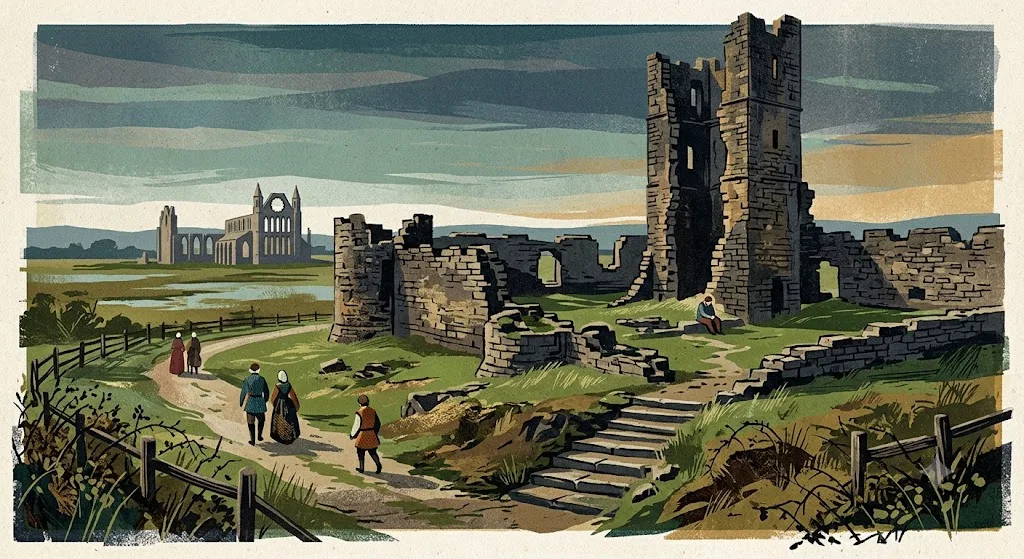
Spynie Palace and Elgin Cathedral are best understood as a single haunted ecclesiastical landscape rather than two isolated ruins. The folklore gathers around a lost bishop’s world: Spynie as the fortified residence beside the vanished sea loch, Elgin as the “Lantern of the North”, and the road between them as the imagined route of tunnels, monks, witches, bishops, phantom music and medieval vengeance. The strongest historical anchor is real: in 1390 Alexander Stewart, the Wolf of Badenoch, attacked and burned Elgin Cathedral after conflict with Bishop Alexander Bur. The ghost stories are much less secure as evidence, but they are valuable as Morayshire folklore because they turn church authority, ruined architecture and remembered violence into a walkable haunted map.[Historic Environment Scotland]historicenvironment.scotOpen source on historicenvironment.scot.
The result is not a case where one well-documented apparition dominates. Instead, Spynie and Elgin work as a cluster: the Black Monk of the supposed tunnel, Spynie’s phantom piper and spectral lion, rumours of bishops dabbling in dark arts, and the still-powerful memory of the Wolf’s fire at Elgin Cathedral. These are stories to treat carefully: atmospheric, locally persistent and often repeated, but mostly folkloric rather than strongly witnessed or archived.[Spooky Scotland]spookyscotland.netOpen source on spookyscotland.net.
Bishops, Lochs and Vanished Authority
Spynie Palace sits a little north of Elgin, and its haunted reputation depends on understanding what has vanished around it. Historic Environment Scotland describes Spynie as the seat of the bishops of Moray for 500 years, once standing on the edge of Spynie Loch, a sea loch that offered safe anchorage for fishing boats and merchant vessels. Today the loch and the medieval settlement have largely disappeared, leaving the palace as a stranded ruin in a quieter inland landscape. That absence is part of its eerie force: the building looks like a remnant of authority after the world that justified it has drained away.[Historic Environment Scotland]historicenvironment.scotOpen source on historicenvironment.scot.
The ecclesiastical link with Elgin is direct. Bishop Brice chose Spynie as the cathedral site around 1207, but his successor, Bishop Andrew, established the new cathedral at Elgin around 1224 while the bishops continued to live at Spynie. Elgin Cathedral therefore became the public spiritual centre, while Spynie remained the episcopal residence, administrative stronghold and domestic seat of power. This split between cathedral and palace helps explain why later folklore joins them together with a tunnel: the story imagines a hidden passage because, historically, the two places really did function as connected parts of the same church regime.[Historic Environment Scotland]historicenvironment.scotOpen source on historicenvironment.scot.
Spynie’s architecture also feeds the mood. David’s Tower rises 22 metres and is described by Historic Environment Scotland as one of the largest tower houses ever built in Scotland. Later defences, including gun holes added under Bishop Patrick Hepburn, remind visitors that this was never only a peaceful religious retreat; it was a fortified residence built for a church that held land, money and political power. In folklore, that kind of building easily becomes a place where bishops are imagined as secretive, corrupt, magical or damned.[Historic Environment Scotland]historicenvironment.scotOpen source on historicenvironment.scot.
That is the background to the Spynie ghost cluster. The stories are not simply “a haunted castle” pasted onto a ruin. They grow from the tension between sacred office and worldly power: bishops who lived like lords, a palace that looks like a castle, a cathedral ruined by violence, and a landscape where the old loch, port and settlement have vanished from everyday sight.

The Black Monk and Tunnel Folklore
The best-known Spynie-Elgin legend is the supposed tunnel running from Elgin Cathedral to Spynie Palace, haunted by the Black Monk. A local folklore account on Spooky Scotland presents the tunnel as a childhood Elgin story: a passageway imagined between the cathedral and the bishops’ residence, complete with the monk as its ghostly inhabitant. The same writer is careful to say that the tunnel story turned out to be “little more than” local myth, while still treating Spynie as one of the most haunted-feeling places in the area.[Spooky Scotland]spookyscotland.netOpen source on spookyscotland.net.
That distinction matters. There is no strong architectural or archaeological evidence in the public heritage accounts for a functioning medieval tunnel between the two ruins. The folklore is better read as a narrative bridge. It takes a real institutional link — cathedral at Elgin, residence at Spynie — and makes it physical, secret and frightening. In other words, the tunnel is probably not a lost piece of engineering; it is a story-form that lets people picture the hidden workings of medieval church power.[Historic Environment Scotland]historicenvironment.scotOpen source on historicenvironment.scot.
The Black Monk also fits a wider British ruin motif. Monks, friars and hooded figures often appear in stories where religious buildings have been dissolved, damaged or abandoned. At Spynie and Elgin, the figure is especially effective because the two sites are bound to the bishops of Moray rather than to a simple parish church. The monk becomes a mobile symbol: not necessarily a named historical person, but a shape moving through the imagined underworld between public cathedral and private palace.
For a reader visiting the ruins, the useful way to handle this legend is to separate three layers:
- The historical layer: Spynie and Elgin were genuinely connected through the bishops of Moray, with Spynie as residence and Elgin as cathedral after 1224.[Historic Environment Scotland]historicenvironment.scotOpen source on historicenvironment.scot.
- The landscape layer: Spynie’s lost loch and settlement make the area feel incomplete, encouraging stories about hidden passages and buried routes.[Historic Environment Scotland]historicenvironment.scotOpen source on historicenvironment.scot.
- The folklore layer: the Black Monk and tunnel are locally repeated traditions, but not well-supported as literal medieval infrastructure.[Spooky Scotland]spookyscotland.netOpen source on spookyscotland.net.
That makes the Black Monk story weaker as evidence for a haunting, but stronger as folklore. It shows how local imagination repairs a broken landscape by giving it a secret route and a watcher in the dark.
Spynie’s Other Apparitions
Spynie Palace has accumulated a surprisingly varied set of haunting claims. Martin Coventry’s castle guide, as quoted and echoed by later haunted-place writers, records stories of bishops being in league with the Devil, witches flying to the castle at Halloween, unexplained lights, unearthly music, a phantom piper and a ghostly lion. The Castles of Scotland site repeats the core cluster: devilish bishops, Halloween witches, lights, music, phantom piper and lion.[Spooky Scotland]spookyscotland.netOpen source on spookyscotland.net.
These details are vivid, but their evidential weight varies. “Unexplained lights” and “unearthly music” are classic ruin-haunting claims, easy to retell and difficult to verify. The phantom piper is another familiar Scottish motif, often attached to castles, caves and underground passages. At Spynie, it harmonises with the tunnel legend: if a hidden route exists in story, a lost musician can be imagined moving through it.
The ghostly lion is stranger and more memorable. Spooky Scotland reports a local account, said to have appeared in The Northern Scot in 2011, in which a group allegedly encountered a spectral lion and one person was left scratched and bruised. The same account links the lion to a tradition that one of the bishops once kept such an animal as an exotic pet. This is exactly the kind of claim that should be handled as reported folklore, not established fact: striking, locally useful and atmospheric, but not independently proven by the heritage record.[Spooky Scotland]spookyscotland.netOpen source on spookyscotland.net.
The alleged apparition of Bishop Patrick Hepburn is easier to explain as moral folklore. Hepburn was the last pre-Reformation bishop associated with Spynie, and Historic Environment Scotland notes that he added gun holes to the palace defences in anticipation of trouble. Later hostile tradition remembered him as corrupt, worldly and morally suspect; even sober historical summaries describe his reputation for immorality and his deprivation of ecclesiastical titles before his death in 1573. It is not surprising that ghost lore would attach to him: he stands at the point where medieval Catholic authority, Reformation conflict and the decline of the old bishop’s palace meet.[Historic Environment Scotland]historicenvironment.scotOpen source on historicenvironment.scot.
The charge that Hepburn studied dark arts belongs to a more doubtful zone. It fits the same pattern as the tales of bishops being in league with the Devil, but it also reflects the religious polemic of the Reformation era, when accusations of corruption, sorcery or devilish behaviour could be used to blacken opponents. The safer reading is that Hepburn’s ghostly reputation grew from a real historical image of a controversial bishop, then hardened into supernatural tradition.[Spooky Scotland]spookyscotland.netOpen source on spookyscotland.net.

Elgin Cathedral and the Wolf of Badenoch
Elgin Cathedral gives the Spynie folklore its darkest historical centre. Founded in the 1200s after the bishop’s seat moved from Spynie, it became the spiritual heart of the diocese of Moray and one of Scotland’s most ambitious medieval churches. Historic Environment Scotland notes that Bishop Alexander Bur called it “the ornament of the realm, the glory of the kingdom”, while its later nickname, the “Lantern of the North”, captures its symbolic importance even in ruin.[Historic Environment Scotland]historicenvironment.scotOpen source on historicenvironment.scot.
The catastrophic episode came in 1390. Alexander Stewart, Earl of Buchan, better known as the Wolf of Badenoch, was in conflict with Bishop Alexander Bur. Historic Environment Scotland’s account says the Wolf’s men sacked Forres, destroyed Pluscarden Abbey, then attacked and burned Elgin Cathedral, the canons’ manses and the parish church of St Giles. The Register of the Bishopric of Moray lamented the burning of the cathedral along with its books, charters and stored goods.[Historic Environment Scotland Blog]blog.historicenvironment.scotOpen source on historicenvironment.scot.
This is not merely picturesque medieval violence. For a haunted-history page, it explains why Elgin’s ruins carry more than architectural melancholy. The burning was an assault on memory, record-keeping and sacred authority. When a cathedral’s books and charters burn, the community loses documents as well as stone and timber. That kind of destruction is exactly the sort of event that later folklore turns into a lingering presence.
The Wolf himself became a semi-legendary villain. Historic Environment Scotland notes both his notorious reputation and the later story that he died after playing chess with the Devil at Ruthven Castle in 1405. The same source also warns that much of what survives about him was written from the Church’s perspective, so his “wicked” image should be read with care. This is important for Spynie and Elgin: the haunting atmosphere depends on the Wolf as a dramatic destroyer, but the historical man was also a political actor remembered through hostile ecclesiastical sources.[Historic Environment Scotland Blog]blog.historicenvironment.scotOpen source on historicenvironment.scot.
At Elgin, then, the folklore is less about a single named cathedral ghost and more about a wound in the landscape. The cathedral’s broken nave, carved faces, tombs and chapter house are not proof of haunting, but they provide a setting where the story of fire, excommunication and revenge remains unusually legible.
Do Spynie and Elgin Share One Haunted Landscape?
Yes, in folklore terms they do. Spynie and Elgin are connected by office, road, memory and story. Spynie was where the bishops lived; Elgin was where their cathedral stood. Spynie’s vanished loch and fortified tower suggest secrecy and lost authority; Elgin’s roofless cathedral suggests sacred splendour violently interrupted. The Black Monk tunnel legend simply makes that relationship visible in the most ghost-story-friendly way possible.[Historic Environment Scotland]historicenvironment.scotOpen source on historicenvironment.scot.
The two ruins also divide the emotional work of the haunted landscape. Spynie supplies the apparitions: phantom piper, ghostly lady, spectral lion, uncanny music, witches and the allegedly restless bishop. Elgin supplies the historical trauma: the Wolf of Badenoch, the burning of 1390, the loss of books and charters, and the long afterlife of a cathedral admired even in ruin. Together, they create one of Morayshire’s richest church-and-castle folklore clusters.[paullee.com]paullee.comGhost entry for this locationGhost entry for this location
The credibility assessment should be balanced. The architecture, bishops, loch, cathedral move and 1390 burning are well-grounded in heritage sources. The tunnel, Black Monk, piper, lion, witches and diabolical bishops are traditions: some preserved in castle guides and local haunted writing, but not established as historical events or verified paranormal evidence. That does not make them worthless. It tells us what kind of material they are: Morayshire ruin folklore, shaped by memory, religious conflict, tourism, childhood storytelling and the suggestive power of abandoned stone.
For visitors and readers, the best way to experience Spynie and Elgin is as a paired story. Elgin Cathedral asks what happens when sacred authority is publicly destroyed. Spynie Palace asks what remains when that authority retreats into a fortified residence and then falls silent. The ghosts, whether monks, bishops, pipers or stranger beasts, are the figures later imagination has placed in the gap between those two questions.

Amazon book picks
Further Reading
Books and field guides related to Do Spynie and Elgin Share One Haunted Landscape?. Use these as the next step if you want deeper reading beyond the article.


The Lore of Scotland: A Guide to Scottish Legends
Matches ecclesiastical legends and local ghost traditions.
eBay marketplace picks
Marketplace Samples
Live-tested eBay searches with available results related to this page.




Endnotes
1.
Source: historicenvironment.scot
Link:https://www.historicenvironment.scot/visit/all/spynie-palace/history-and-stories/
2.
Source: historicenvironment.scot
Link:https://www.historicenvironment.scot/visit/all/elgin-cathedral/history-and-stories/
3.
Source: blog.historicenvironment.scot
Link:https://blog.historicenvironment.scot/2025/07/who-was-the-wolf-of-badenoch/
4.
Source: spookyscotland.net
Link:https://spookyscotland.net/spynie-palace/
5.
Source: thecastlesofscotland.co.uk
Link:https://www.thecastlesofscotland.co.uk/the-best-castles/magnificent-ruins/spynie-palace/
6.
Source: portal.historicenvironment.scot
Link:https://portal.historicenvironment.scot/apex/f?p=1505%3A300%3A%3A%3A%3A%3AVIEWTYPE%2CVIEWREF%3Adesignation%2CSM90282
7.
Source: historicenvironment.scot
Title: Historic Environment Scotland Elgin Cathedral | Historic Scotland
Link:https://www.historicenvironment.scot/visit/all/elgin-cathedral/
8.
Source: paullee.com
Title: Ghost entry for this location
Link:https://www.paullee.com/ghosts/ghostgeo/index.php?location=57o676111_-3o291389_Spynie+Palace.txt&x=-3.291389&y=57.676111
9.
Source: spookyscotland.net
Title: the wolf of badenoch
Link:https://spookyscotland.net/the-wolf-of-badenoch/
10.
Source: Wikipedia
Title: Elgin Cathedral
Link:https://en.wikipedia.org/wiki/Elgin_Cathedral
11.
Source: Wikipedia
Title: Alexander Stewart, Earl of Buchan
Link:https://en.wikipedia.org/wiki/Alexander_Stewart%2C_Earl_of_Buchan
12.
Source: Wikipedia
Title: Spynie Palace
Link:https://en.wikipedia.org/wiki/Spynie_Palace
13.
Source: wikishire.co.uk
Link:https://wikishire.co.uk/wiki/Spynie
14.
Source: wikishire.co.uk
Link:https://wikishire.co.uk/wiki/Morayshire
15.
Source: wikishire.co.uk
Link:https://wikishire.co.uk/wiki/Elgin
16.
Source: historicenvironment.scot
Link:https://www.historicenvironment.scot/visit-a-place/places/spynie-palace/
17.
Source: historicenvironment.scot
Link:https://www.historicenvironment.scot/visit/all/spynie-palace/
18.
Source: genuki.org.uk
Link:https://www.genuki.org.uk/big/sct/MOR/Spynie
19.
Source: tripadvisor.com
Title: Spynie Palace
Link:https://www.tripadvisor.com/Attraction_Review-g186558-d3139632-Reviews-Spynie_Palace-Elgin_Moray_Scotland.html
20.
Source: realcounties.com
Link:https://realcounties.com/county/morayshire/
21.
Source: books.google.com
Title: The Wolf of Badenoch
Link:https://books.google.com/books/about/The_Wolf_of_Badenoch.html?id=HYPTbwAACAAJ
22.
Source: dictionary.cambridge.org
Link:https://dictionary.cambridge.org/dictionary/english/historic
23.
Source: livebreathescotland.com
Title: spynie palace
Link:https://www.livebreathescotland.com/spynie-palace/
24.
Source: vexillology.fandom.com
Link:https://vexillology.fandom.com/wiki/Morayshire
25.
Source: secret-scotland.com
Title: spynie palace
Link:https://www.secret-scotland.com/place/spynie-palace
26.
Source: britainexpress.com
Title: Spynie Palace
Link:https://www.britainexpress.com/attractions.htm?attraction=4441
27.
Source: relevantsearchscotland.co.uk
Title: spynie palace
Link:https://www.relevantsearchscotland.co.uk/spynie-palace.html
28.
Source: murrayfoote.com
Title: Spynie Palace and Elgin Cathedral
Link:https://murrayfoote.com/2013/11/24/spynie-palace-and-elgin-cathedral/
29.
Source: youtube.com
Title: Spynie Palace
Link:https://www.youtube.com/watch?v=Z9H8c1ZlCXU
Source snippet
The dark story of Auchindoun Castle...
Additional References
30.
Source: youtube.com
Title: Exploring Elgin Cathedral and a quick history of ‘The Lantern of the North’
Link:https://www.youtube.com/watch?v=OqScoROjpEI
Source snippet
Elgin Cathedral & the Wolf of Badenoch - Stories of Scotland Podcast - Episode 33...
31.
Source: youtube.com
Title: The Story of Elgin Cathedral | Scotland’s History
Link:https://www.youtube.com/watch?v=xtsxSBc-AxE
Source snippet
Exploring Elgin Cathedral and a quick history of 'The Lantern of the North'...
32.
Source: dunkeldcathedral.org
Link:https://dunkeldcathedral.org/audio-tour-map/7-the-wolf-of-badenoch-and-absolution/
33.
Source: undiscoveredscotland.co.uk
Link:https://www.undiscoveredscotland.co.uk/elgin/bishopshouse/index.html
34.
Source: facebook.com
Link:https://www.facebook.com/groups/919313281577810/posts/1110735382435598/
35.
Source: facebook.com
Link:https://www.facebook.com/groups/lovetovisitscotland/posts/25545888145110778/
36.
Source: facebook.com
Link:https://www.facebook.com/ScotwebCLAN/posts/here-at-scotweb-were-looking-at-scottish-myths-legends-and-folk-tales-for-this-w/10154847729047676/
37.
Source: stewartsociety.org
Link:https://www.stewartsociety.org/history-of-the-stewarts.cfm?histid=38§ion=castles-and-buildings&subcatid=5
38.
Source: instagram.com
Link:https://www.instagram.com/reel/DXMty2MDP4o/
39.
Source: facebook.com
Link:https://www.facebook.com/groups/lovetovisitscotland/posts/8284489645010563/
Topic Tree