Within Haunted Anglesey
Who Knocks at South Stack Lighthouse?
South Stack's knocking ghost legend gives Anglesey a maritime haunting shaped by storms, isolation and the fear of help arriving too late.
On this page
- A lighthouse reached by cliffs and rough sea
- The Jack Jones knocking legend
- Storm sounds, danger and death omen folklore
Page outline Jump by section
Introduction
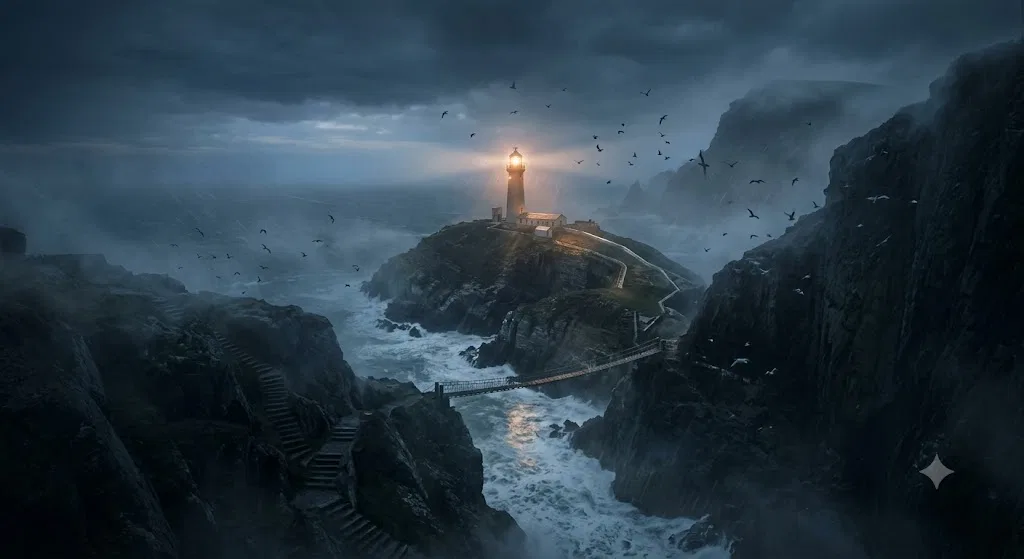
South Stack Lighthouse is one of Anglesey’s most atmospheric haunted-place traditions because its ghost story grows directly out of the site’s real hazards: a rock islet off Holy Island, a steep descent of about 400 steps, a bridge over turbulent sea, and a working light built to save ships from the north-west Welsh coast. The best-known legend says that a keeper named Jack Jones was fatally injured during the great storm of October 1859 and that his desperate knocking can still be heard at the lighthouse door or windows. The story is not strong evidence for a haunting, but it is powerful folklore: a maritime death omen built from isolation, weather, delayed rescue, and the fear that a cry for help can be swallowed by the storm. Trinity House dates the lighthouse to 1809 and links its history to the Royal Charter gale, one of the defining disasters of Anglesey’s sea memory.[Trinity House]trinityhouse.co.ukTrinity House South Stack Lighthouse | Trinity HouseTrinity House South Stack Lighthouse | Trinity House
A Lighthouse Reached by Cliffs and Rough Sea
South Stack Lighthouse stands on a small islet off the north-west tip of Anglesey, beside Holy Island and close to Holyhead. Trinity House records that it was built in 1809, with a 28-metre tower and a light 60 metres above mean high water; the present light has a range of 24 nautical miles. The setting matters to the haunting as much as the building does. South Stack Rock is separated from Holy Island by about 30 metres of turbulent water, and the nearby coastline rises in sheer cliffs to around 60 metres.[Trinity House]trinityhouse.co.ukTrinity House South Stack Lighthouse | Trinity HouseTrinity House South Stack Lighthouse | Trinity House
For visitors today, South Stack is a dramatic attraction rather than a working household of keepers. Visit Anglesey describes the approach as the “keeper’s journey” down 400 steps to the island, and warns that variable weather can restrict access. That physical route is central to the legend: the story is not about a ghost in a cosy room, but about someone trying to reach the light through rain, wind, stone steps, bridge, rock and spray.[Visit Anglesey]visitanglesey.co.ukVisit Anglesey South Stack LighthouseVisit Anglesey South Stack Lighthouse
The surrounding reserve reinforces the same feeling of exposure. RSPB South Stack describes a landscape where heathland and farmland meet rugged sea cliffs facing the Irish Sea, with Ellin’s Tower looking down towards the lighthouse and the cliffs used by guillemots, razorbills and puffins in spring. By day, that makes South Stack spectacular. In a storm or mist, the same features help explain why the place has attracted a story of phantom knocking and unheard appeals for help.[RSPB]rspb.org.ukRSPBSouth Stack Nature Reserve, AngleseyRSPBSouth Stack Nature Reserve, Anglesey
There is also a practical acoustic background to the folklore. Coflein, the Royal Commission on the Ancient and Historical Monuments of Wales database, notes that the lighthouse complex once included a large fog bell and an unusual system by which a small clockwork lantern could be lowered down an incline when fog or low cloud obscured the main light. A later compressed-air horn and then an electronic fog signal replaced earlier arrangements. In other words, South Stack was always a place of warning sounds: bells, horns, wind, water, machinery, doors and bridgework all belonged to the ordinary soundscape before any ghost story was added.[Coflein]coflein.gov.ukCoflein English – CofleinCoflein English – Coflein

The Jack Jones Knocking Legend
The core South Stack haunting is usually told like this: during a violent storm, assistant keeper Jack Jones was trying to reach the lighthouse when falling rock struck him. In some versions he crawled or staggered towards the building, but his cries were lost in the gale. Later retellings say he died from his injuries and that his ghost is still heard knocking at the door, banging at the windows, rattling the entrance, or making anxious footsteps as if still trying to get inside. A haunted-lighthouse roundup gives the familiar modern form of the tale: Jack Jones is “said to be heard knocking on the door at night or banging on the window.”[Lighthouse Accommodation]lighthouseaccommodation.co.ukOpen source on lighthouseaccommodation.co.uk.
The date is sometimes muddled in popular accounts. One modern haunted-lighthouse page gives October 1853 for the storm, while stronger historical context points to 25 October 1859, the date of the Royal Charter gale. Trinity House places the Royal Charter gale in South Stack’s official history on 25 October 1859, and the Met Office identifies that storm as the most severe to hit the Irish Sea in the nineteenth century. This matters because the ghost story becomes more intelligible when attached to the 1859 disaster rather than to a vague “stormy night”.[lighthouseaccommodation.co.uk]lighthouseaccommodation.co.ukOpen source on lighthouseaccommodation.co.uk.
A local-history style account of South Stack’s keepers also places the tragedy on 25 October 1859, stating that the storm wrecked vessels including the Royal Charter and that Jones was killed when rocks fell from the cliff face as he returned to the lighthouse. The same account places Jones within a keeper family tradition at South Stack: John Jones became assistant keeper, his widow Ann later served as assistant keeper, and her son Jack became keeper in the mid-1840s. That kind of keeper-history frame gives the legend more substance than a free-floating ghost anecdote, even though the haunting itself remains a tradition rather than a verified event.[Lighthouse Accommodation]lighthouseaccommodation.co.ukLighthouse Accommodation South Stack Lighthouse, AngleseyLighthouse Accommodation South Stack Lighthouse, Anglesey
The most striking feature of the haunting is that it is auditory. South Stack is not primarily famous for a full-bodied apparition standing at the lamp room. It is remembered for knocks, bangs, rattles and footsteps. That makes sense for a lighthouse story: the building’s purpose was communication across danger. Its light said “rock here”; its fog signals said “keep clear”; the ghostly knock says “open the door”. The supernatural action repeats the moment of failure in the legend: warning and rescue arrive too late.
The Storm Behind the Story
The Royal Charter gale gives the South Stack legend its darker historical weather. The Met Office describes the October 1859 storm as a severe, slow-moving system that struck the Irish Sea on the night of 25 October. It killed around 800 people, destroyed 133 ships and badly damaged 90 more. The steam clipper Royal Charter, returning from Melbourne to Liverpool, was driven onto the Anglesey coast, where around 460 people died; the Met Office calls it the highest death toll of any shipwreck on the Welsh coast.[Met Office]metoffice.gov.ukMet Office The storm that shaped the Shipping ForecastMet Office The storm that shaped the Shipping Forecast
Although the Royal Charter was wrecked on Anglesey’s north-east coast rather than at South Stack itself, the lighthouse story belongs to the same island-wide disaster memory. A keeper at South Stack, a ship breaking up near Moelfre, wreckage, bodies, storm warnings and the limits of nineteenth-century maritime rescue all sit within one terrible weather event. Trinity House’s own South Stack history mentions the gale and the loss of the Royal Charter in the lighthouse’s timeline, which helps explain why later storytellers link Jones’s death with the wider catastrophe.[Trinity House]trinityhouse.co.ukTrinity House South Stack Lighthouse | Trinity HouseTrinity House South Stack Lighthouse | Trinity House
The storm also changed British maritime life. According to the Met Office, the Royal Charter disaster inspired Robert FitzRoy to develop a national storm warning system, one of the beginnings of the modern Shipping Forecast. That gives the South Stack legend an unusual double edge. On the folkloric level, the ghost keeps knocking because no one came in time. On the historical level, the same storm helped create systems intended to make future warnings arrive sooner.[Met Office]metoffice.gov.ukMet Office The storm that shaped the Shipping ForecastMet Office The storm that shaped the Shipping Forecast
This is why South Stack’s haunting feels different from a generic “old building” ghost story. It is not just a tale about a dead man lingering. It is a story about the threshold between signal and silence: light seen or not seen, a warning heard or missed, a keeper able or unable to reach his post, a ship close to shore but still beyond help.

Why Knocking Works as a Death Omen
Knocking is one of the simplest and most unnerving ghost motifs because it needs no apparition. A sound at a door normally means someone wants entry. At South Stack, that ordinary meaning becomes tragic. The legend asks the listener to imagine Jack Jones outside in the storm, injured, close to safety, but unable to make himself heard. The later phantom knock is therefore not random noise; it is the moment of mortal need replayed.
Welsh death-omen folklore gives this motif a wider cultural setting. In an interview about Welsh death omens, folklorist Delyth Badder explains that Wales has a particularly rich tradition of portents, including sounds that seem to act out death before it happens. She notes that one form, sometimes discussed under the term tolaeth, can involve “death knocking” or the phantom sounds of preparations connected with a coming death. South Stack’s legend is not simply an example of that older category, but it resonates strongly with it: the meaningful sound comes first, and death gives it its dreadful interpretation afterwards.[Podpage]podpage.comWelsh Death Omens and Apparitions: Unveiling the Haunting Legend…Welsh Death Omens and Apparitions: Unveiling the Haunting Legend…
The story also fits a broader Welsh habit of reading uncanny lights and sounds as warnings. Museum Wales preserves an oral account recorded in 1979 in which Mary Thomas described a “corpse candle” going before a funeral and appearing before deaths in her family. The account is valuable because it shows the belief as remembered in lived family storytelling, not merely as a literary decoration. In such traditions, the supernatural sign is not there to attack; it announces, marks a route, or confirms that death is near.[Museum Wales]museum.walesWales Folk Tales from Wales | Museum WalesWales Folk Tales from Wales | Museum Wales
Victorian folklore collector Wirt Sikes also recorded Welsh death-portent traditions in British Goblins. His work has to be used carefully because nineteenth-century folklore collections often mixed oral report, antiquarian interpretation and literary shaping. Even so, his description of the cyhyraeth is highly relevant to coastal omen traditions: he presents it as a groaning spirit heard before death, and records a coastal version in which moans and “dismal lights” foretold wrecks, with bodies later washed ashore.[Project Gutenberg]gutenberg.orgThe Project Gutenberg eBook of British Goblins: Welsh Folk-lore, Fairy Mythology, Legends and Traditions, by Wirt Sikes…
South Stack’s knocking ghost is more local and specific than those older Welsh omen types. It has a named keeper, a named lighthouse and a named storm. But the mechanism is similar: a sound on the edge of human explanation becomes meaningful because the community already knows that the coast kills, that storms hide danger, and that warning signs may come too late.
Storm Sounds, Stone and Sceptical Readings
A careful reading does not need to dismiss the South Stack haunting in order to explain why it took hold. Lighthouses are ideal ghost-story engines. They are isolated but mechanical, inhabited but exposed, protective but surrounded by death. South Stack adds a steep stairway, cliff fall risk, a bridge over surging water, fog signals and a history of keepers working in conditions that modern visitors usually encounter only as scenery.[Trinity House]trinityhouse.co.ukTrinity House South Stack Lighthouse | Trinity HouseTrinity House South Stack Lighthouse | Trinity House
Many reported phenomena in the legend are exactly the kinds of sounds a storm-battered lighthouse could produce naturally: wind striking doors, bridge vibrations, spray hitting glass, loose fittings, seabirds, fog-signal equipment, or the expansion and contraction of old materials. Coflein’s record of fog bells, lowered lights, compressed-air horns and later electronic signals is a reminder that South Stack has never been a silent monument. It was a working warning machine in a violent coastal environment.[Coflein]coflein.gov.ukCoflein English – CofleinCoflein English – Coflein
That does not make the legend worthless. Folklore often begins where a real hazard needs a memorable shape. The Jack Jones story turns an abstract danger — cliffs, storms, unseen rocks, delayed rescue — into a human scene. It gives the listener a person to imagine at the door. The repeated knocking is a compact moral drama: if you hear someone in distress, open; if you ignore the warning, death may already be on the threshold.
The weakest part of the tradition is evidential. Modern ghost accounts often repeat the same details without naming an original witness, keeper log, inquest record or contemporary newspaper report for the haunting itself. The historical lighthouse, the 1859 storm and the maritime losses are well supported; the continued knocking is preserved mainly as local legend, tourism folklore and paranormal retelling. That makes South Stack a strong haunted-history subject, but not a proven ghost case.

Why South Stack Became One of Anglesey’s Eerie Landmarks
South Stack’s haunted reputation has endured because the place already looks and feels like the story people tell about it. The lighthouse is visually isolated, reached by a descent rather than an ascent, and separated from the mainland by a narrow but dramatic chasm. It is both close and unreachable, which is exactly the emotional logic of the Jack Jones legend: safety is visible, but not quite attainable.[Trinity House]trinityhouse.co.ukTrinity House South Stack Lighthouse | Trinity HouseTrinity House South Stack Lighthouse | Trinity House
It also sits within Anglesey’s wider haunted geography without needing much embellishment. Beaumaris Gaol carries stories of punishment and execution; Beaumaris Castle carries the atmosphere of conquest and unfinished stone; South Stack carries the sea’s version of the same memory-work. Its ghost is not a prisoner or soldier, but a working man caught between duty and weather. That gives the page a distinct place in Anglesey’s haunted map.
The tourism layer has helped keep the legend visible. Modern visitor material presents South Stack as a lighthouse tour, wildlife viewpoint and coastal walk, while haunted roundups and local-interest articles circulate the Jack Jones story as part of the site’s darker appeal. The danger is that retellings can blur dates and details, especially when 1853 and 1859 are confused. The stronger version anchors the haunting to the Royal Charter gale of 25 October 1859, because that date is supported by Trinity House and Met Office context.[lighthouseaccommodation.co.uk]lighthouseaccommodation.co.ukOpen source on lighthouseaccommodation.co.uk.
What remains is a compact and memorable Anglesey legend: a lighthouse built to warn ships, a storm that overwhelmed warning, a keeper injured before he could reach safety, and a knocking that later generations hear as both ghost and omen. South Stack’s power lies in that overlap. It is a haunted-place story, but it is also a coastal death-omen story about what happens when light, sound and human help fail at the edge of the sea.

eBay marketplace picks
Marketplace Samples
Live-tested eBay searches with available results related to this page.


Endnotes
1.
Source: rspb.org.uk
Title: RSPBSouth Stack Nature Reserve, Anglesey
Link:https://www.rspb.org.uk/days-out/reserves/south-stack
2.
Source: podpage.com
Title: Welsh Death Omens and Apparitions: Unveiling the Haunting Legend…
Link:https://www.podpage.com/haunted-history-chronicles/welsh-death-omens-and-apparitions-unveiling-the-haunting-legends-with-dr-delyth-badder/
3.
Source: museum.wales
Title: Wales Folk Tales from Wales | Museum Wales
Link:https://museum.wales/collections/folktales/?story=15
4.
Source: gutenberg.org
Title: Project Gutenberg
Link:https://www.gutenberg.org/files/34704/34704-h/34704-h.htm
Source snippet
The Project Gutenberg eBook of British Goblins: Welsh Folk-lore, Fairy Mythology, Legends and Traditions, by Wirt Sikes...
5.
Source: trinityhouse.co.uk
Title: Trinity House South Stack Lighthouse | Trinity House
Link:https://www.trinityhouse.co.uk/lighthouses-and-lightvessels/south-stack-lighthouse
6.
Source: metoffice.gov.uk
Title: Met Office The storm that shaped the Shipping Forecast
Link:https://www.metoffice.gov.uk/about-us/who-we-are/our-history/the-royal-charter-gale
7.
Source: visitanglesey.co.uk
Title: Visit Anglesey South Stack Lighthouse
Link:https://www.visitanglesey.co.uk/en-gb/explore/south-stack-lighthouse
8.
Source: coflein.gov.uk
Title: Coflein English – Coflein
Link:https://coflein.gov.uk/en/site/41288/details/SOUTH%2BSTACK%2BLIGHTHOUSE/
9.
Source: lighthouseaccommodation.co.uk
Link:https://lighthouseaccommodation.co.uk/haunted-lighthouses/
10.
Source: lighthouseaccommodation.co.uk
Title: Lighthouse Accommodation South Stack Lighthouse, Anglesey
Link:https://lighthouseaccommodation.co.uk/listings/south-stack-lighthouse/
11.
Source: trinityhouse.co.uk
Title: south stack lighthouse visitor centre
Link:https://www.trinityhouse.co.uk/lighthouse-visitor-centres/south-stack-lighthouse-visitor-centre
12.
Source: rspb.org.uk
Link:https://www.rspb.org.uk/days-out/reserves/south-stack/opening-times
13.
Source: rspb.org.uk
Title: South Stack Cliffs Nature Reserve
Link:https://www.rspb.org.uk/days-out/reserves/south-stack/facilities
14.
Source: rspb.org.uk
Title: Getting Here
Link:https://www.rspb.org.uk/days-out/reserves/south-stack/location
15.
Source: Wikipedia
Title: South Stack Lighthouse
Link:https://en.wikipedia.org/wiki/South_Stack_Lighthouse
16.
Source: Wikipedia
Title: South Stack Lighthouse
Link:https://de.wikipedia.org/wiki/South_Stack_Lighthouse
17.
Source: Wikipedia
Link:https://en.wikipedia.org/wiki/Cyhyraeth
18.
Source: Wikipedia
Title: South Stack
Link:https://en.wikipedia.org/wiki/South_Stack
19.
Source: metoffice.gov.uk
Link:https://www.metoffice.gov.uk/research/library-and-archive/archive-hidden-treasures/royal-charter
20.
Source: metoffice.gov.uk
Link:https://www.metoffice.gov.uk/about-us/who-we-are/our-history/tragedy-and-warnings-the-origins-of-the-shipping-forecast
21.
Source: myend.com
Link:https://myend.com/country/wales-united-kingdom/
22.
Source: bridgemeister.com
Link:https://www.bridgemeister.com/bridge.php?bid=1212
23.
Source: heritage.iala.int
Title: south stack lighthouse
Link:https://heritage.iala.int/lighthouses/south-stack-lighthouse/
24.
Source: conwyvalleynorthwalescoast.com
Link:https://www.conwyvalleynorthwalescoast.com/inspire-me/october-halloween/
25.
Source: rcahmw.gov.uk
Title: otd 25th october 1859 the devastating royal charter gale
Link:https://rcahmw.gov.uk/otd-25th-october-1859-the-devastating-royal-charter-gale/
Published: october 1859
26.
Source: wizzley.com
Title: welsh death omens
Link:https://wizzley.com/welsh-death-omens/
27.
Source: celticlifeintl.com
Title: the cyhyraeth
Link:https://celticlifeintl.com/the-cyhyraeth/
28.
Source: books.google.com
Title: British Goblins
Link:https://books.google.com/books/about/British_Goblins.html?id=_iXaAAAAMAAJ
29.
Source: sites.rootsweb.com
Link:https://sites.rootsweb.com/~nzwlsfhs/royal.html
30.
Source: scribd.com
Link:https://www.scribd.com/document/771787745/British-Goblins
31.
Source: anglesey-history.co.uk
Title: royal charter
Link:https://www.anglesey-history.co.uk/places/royal-charter/
32.
Source: menaiholidays.co.uk
Title: south stack lighthouse
Link:https://www.menaiholidays.co.uk/blog/south-stack-lighthouse/
Additional References
33.
Source: youtube.com
Link:https://www.youtube.com/watch?v=y8LMLMhYJTs
Source snippet
South Stack Lighthouse // Aerial Adventure // Episode 5 // Anglesey // Drone 4K...
34.
Source: youtube.com
Title: The Keeper, the Old Woman and the other Spirits of South Stack Lighthouse
Link:https://www.youtube.com/watch?v=M2gQfsE3sEA
Source snippet
SOUTH STACK LIGHTHOUSE ANGLESEY North Wales + PREHISTORIC Hut Circles. Welsh History With Anna...
35.
Source: youtube.com
Title: South Stack Lighthouse // Aerial Adventure // Episode 5 // Anglesey // Drone 4K
Link:https://www.youtube.com/watch?v=CipDbFEifX8
Source snippet
South Stack Lighthouse, Holyhead, Wales...
36.
Source: youtube.com
Title: South Stack Lighthouse, Holyhead, Wales
Link:https://www.youtube.com/watch?v=YO80Kky9VLU
Source snippet
Exploring South Stack Lighthouse | Tickets needed and worth it | Anglesey Wales...
37.
Source: instagram.com
Link:https://www.instagram.com/p/DTFImMckqVq/
38.
Source: amazon.de
Link:https://www.amazon.de/British-Goblins-Folklore-Mythology-Traditions/dp/1592248160?tag=searcht-20
39.
Source: globalgreyebooks.com
Link:https://www.globalgreyebooks.com/british-goblins-ebook.html
40.
Source: facebook.com
Link:https://www.facebook.com/groups/709133788381450/posts/891584830136344/
41.
Source: branawen.blogspot.com
Link:https://branawen.blogspot.com/2012/02/goddesses-of-otherworld-cyhiraeth.html
42.
Source: archivesportaleurope.net
Link:https://www.archivesportaleurope.net/advanced-search/search-in-archives/results-%28archives%29/?levelName=archdesc&recordId=gb221-wm2589&repositoryCode=GB-221&t=fa
Topic Tree