Within Haunted Suffolk
Can You Hear Dunwich's Lost Bells?
Dunwich's sunken-town legends turn real coastal loss into stories of ghostly bells, vanished churches and haunted shorelines.
On this page
- The vanished medieval port
- Bells beneath the sea
- Coastal loss as haunting
Page outline Jump by section
Introduction
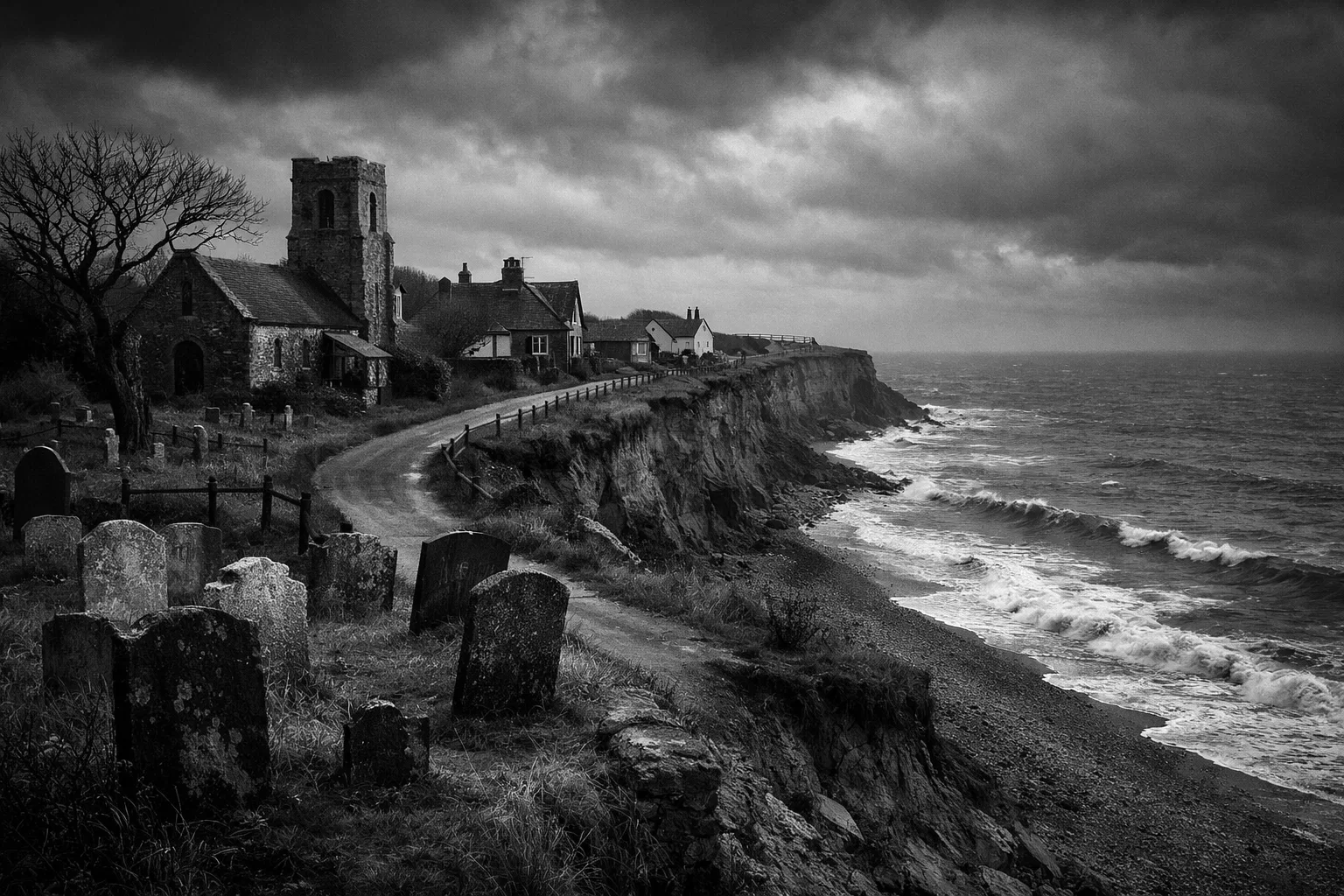
Dunwich’s drowned-church folklore is one of Suffolk’s clearest examples of a haunting rooted in real landscape loss. The story is simple and powerful: a once-important medieval port was eaten away by the North Sea, its churches and streets went over the cliff or under the sand, and people later said that, in storms or at certain tides, bells could still be heard ringing beneath the waves. The legend is not evidence that supernatural bells exist, but it is unusually well anchored in fact: Dunwich really did lose churches, chapels, friaries, houses, streets and civic buildings to coastal erosion, and modern sonar and archaeological work has identified submerged ruins offshore.[Historic England]historicengland.org.ukHistoric England Greyfriars, Dunwich, DunwichHistoric EnglandGreyfriars, Dunwich, Dunwich - 1006039 | Historic England…
That is why Dunwich feels different from a generic coastal ghost story. Its “haunting” is less about a named apparition than about a vanished town that remains half-visible in records, ruins, maps, museum displays, cliff-edge fragments and local memory. The shore north and south of the village has become a place where history, sound, weather and imagination meet: the sea is not merely the setting of the legend, but the force that created it.[The Suffolk Coast]thesuffolkcoast.co.ukGuide to visiting the lost city of Dunwich in Suffolk…
The vanished medieval port
Dunwich is now a small village on the Suffolk coast, but medieval sources and later historical work preserve the memory of a much larger place. Historic England’s scheduling record for Greyfriars describes medieval Dunwich as a substantial seaport that had eight churches, three chapels, five religious houses, two hospitals and probably a mint and guildhall. The same record notes that Domesday Book recorded three churches and 236 burgesses in 1086, even though some land had already been lost to coastal erosion by then.[Historic England]historicengland.org.ukHistoric England Greyfriars, Dunwich, DunwichHistoric EnglandGreyfriars, Dunwich, Dunwich - 1006039 | Historic England…
The important point for the folklore is that Dunwich was not imagined as lost only after the fact. It was visibly disappearing over centuries. Historic England records that 13th- and 14th-century storms silted the harbour and flooded the quays, damaging Dunwich’s economic reason for existing as a port. As the sea continued to erode the coast, the shoreline reached the market place by 1540; a late 16th-century survey associated with Ralph Agas showed that roughly half the town had already gone.[Historic England]historicengland.org.ukHistoric England Greyfriars, Dunwich, DunwichHistoric EnglandGreyfriars, Dunwich, Dunwich - 1006039 | Historic England…
This slow disaster gave Dunwich a rare kind of haunted geography. In many ghost traditions, the original event is uncertain, symbolic or only faintly documented. At Dunwich, the loss was practical, repeated and public. Parish churches were stripped as the cliff came closer; buildings were abandoned, dismantled or left to collapse; graveyards moved from being safe inland places to exposed cliff-edge memories. That long process matters because the folklore is not built on a single night of catastrophe. It is built on generations of watching a town become absence.
The surviving medieval ruins at Greyfriars make the loss more tangible. Historic England describes the Franciscan friary as one of the best-preserved medieval friaries in England, with upstanding remains, buried archaeology and a monastic cemetery of high archaeological potential. Yet even Greyfriars, now one of the most visible remnants of old Dunwich, stands in a landscape defined by retreat: it is close to the cliff, near the east side of the present village, beside remains of the medieval town and its defences.[Historic England]historicengland.org.ukHistoric England Greyfriars, Dunwich, DunwichHistoric EnglandGreyfriars, Dunwich, Dunwich - 1006039 | Historic England…

Why the lost bells became Dunwich’s signature ghost story
The best-known Dunwich legend says that the bells of the lost churches can still be heard from under the sea, especially during storms or in particular tidal conditions. Modern Suffolk tourism repeats the tradition in this form, telling visitors that “many people say” the bells of the lost churches ring from below the waves during storms.[The Suffolk Coast]thesuffolkcoast.co.ukGuide to visiting the lost city of Dunwich in Suffolk…
The story works because bells were the soundscape of medieval parish life. They marked services, deaths, alarms, festivals, curfews and communal time. A drowned church without its bell would be sad; a drowned church whose bell still sounds is uncanny. The legend turns coastal erosion into an acoustic haunting: instead of seeing the vanished town, the listener imagines hearing it.
Dunwich’s bell tradition also has a stronger historical base than many similar legends. There really were churches to lose. The University of Southampton reported in 2008 that sonar and diver work had located the remains of one, and probably two, churches offshore. One was identified by comparison with historical maps as St Peter’s, lost in the 1690s; the other was probably St Nicholas’, lost in the mid-15th century. The ruins lay in less than ten metres of water, with flints, large chunks of walling and worked stone on the seabed.[University of Southampton]southampton.ac.ukLost Churches Discovered At Site Of Britains Underwater Atlantis | University of Southampton…
That does not make the bells literally audible. It does make the legend unusually place-specific. A listener standing on Dunwich beach is not hearing a story attached to a random bay; they are standing beside a documented submerged townscape. The sea off the present coast contains mapped debris fields, buried remains and the known or suspected sites of medieval churches. Historic England’s 2013 project summary says the Dunwich survey used mapping, survey data and interpretation to support understanding of the submerged town site.[Historic England]historicengland.org.ukOpen source on historicengland.org.uk.
The bell story is therefore best read as folklore with a historical engine. It condenses a complicated history of storms, sandbanks, harbour failure, parish decline and cliff recession into one memorable experience: stand by the Suffolk sea in rough weather, listen hard, and the lost town seems to answer.
Which churches were drowned?
Dunwich’s “drowned churches” are sometimes treated as a vague poetic image, but the historical record gives the tradition specific names and dates. Historic England’s Greyfriars entry states that medieval Dunwich had eight churches and three chapels, alongside several religious houses. It also records that the last medieval parish church to fall to coastal recession was All Saints, lost between 1904 and 1919.[Historic England]historicengland.org.ukHistoric England Greyfriars, Dunwich, DunwichHistoric EnglandGreyfriars, Dunwich, Dunwich - 1006039 | Historic England…
St Peter’s is especially important because it is both part of the old written story and part of the modern underwater evidence. Southampton’s 2008 report says historical-map comparison confirmed one offshore ruin as St Peter’s Church, lost to the sea in the 1690s. Divers confirmed masonry at the site despite very poor visibility, including large blocks and flat slab-like pieces.[University of Southampton]southampton.ac.ukLost Churches Discovered At Site Of Britains Underwater Atlantis | University of Southampton…
St Nicholas’ is another key church in the submerged landscape. The same 2008 survey found a second ruin, probably St Nicholas’, which was lost in the mid-15th century. The discovery mattered because it showed that large medieval buildings could survive as distinct debris fields on the seabed, even after cliff collapse and centuries of marine action.[University of Southampton]southampton.ac.ukLost Churches Discovered At Site Of Britains Underwater Atlantis | University of Southampton…
All Saints gives the story its most haunting landward remnant. Unlike churches lost in the medieval or early modern period, All Saints survived long enough to be photographed, painted, remembered and watched in its final decline. Historic England records its loss between 1904 and 1919, while local and visitor accounts continue to point to the remaining graveyard memory, especially the surviving gravestone of Jacob Forster, who died in 1796.[Historic England]historicengland.org.ukHistoric England Greyfriars, Dunwich, DunwichHistoric EnglandGreyfriars, Dunwich, Dunwich - 1006039 | Historic England…
That surviving grave marker matters because it brings the drowned-town legend back to a human scale. Eight churches and a lost port are large abstractions; one named person’s stone at the cliff edge is immediate. It reminds the visitor that Dunwich’s ghost folklore is also burial-ground folklore: not only bells and walls went into the sea, but parish dead, churchyards and family memory.
Coastal loss as haunting
Dunwich’s ghostliness comes from a mechanism rather than from a single spectre. Coastal erosion repeatedly converts familiar places into invisible ones. A street becomes a line on an old map; a church becomes a scatter of flint underwater; a graveyard becomes a warning fence and a story; a working harbour becomes a phrase in a museum display.
The physical process is well understood. The Royal Geographical Society explains that Dunwich’s cliffs are made of sands and gravels, making them vulnerable to erosion and weathering. Erosion rates vary: a major storm can strip away the beach and trigger a short period of intense cliff retreat, while the beach may later build back and slow the process.[Royal Geographical Society]rgs.orgRoyal Geographical Society Coastal erosion | RGSRoyal Geographical Society Coastal erosion | RGS
This helps explain why the folklore clusters around storms. Storms are not just atmospheric decoration; they are the moments when Dunwich’s historical danger becomes audible and visible. Waves, shingle movement, wind, cliff falls and the roar of the North Sea all provide natural sounds that can be interpreted as bells, voices or warnings. The legend does not need the sea to be silent. It needs the sea to be suggestive.
The RGS also notes that around 1920 the Dunwich and Sizewell underwater banks grew and joined together, reducing offshore wave energy and helping stabilise the cliffs. That timing is striking because it follows the final loss of All Saints. The town’s best-known modern ruin disappeared just before the coast entered a slower phase of erosion.[Royal Geographical Society]rgs.orgRoyal Geographical Society Coastal erosion | RGSRoyal Geographical Society Coastal erosion | RGS
For a folklore reader, that creates a poignant pattern. Dunwich is haunted not because the whole place vanished overnight, but because it vanished unevenly. Some buildings fell centuries ago; some were mapped by sonar; some fragments survive on land; some losses are still expected. The “ghost” is the continuing conversion of presence into memory.

The beach, the maiden and the darker shoreline
Although the bells dominate Dunwich’s coastal folklore, they are not the only eerie story attached to the beach. The Suffolk Coast’s visitor guide also preserves the “dark heart of Dunwich” tale: a broken-hearted local maiden is said to haunt the beach area, searching for her lost love.[The Suffolk Coast]thesuffolkcoast.co.ukGuide to visiting the lost city of Dunwich in Suffolk…
This story belongs to a different mode of folklore from the drowned bells. The bells turn civic and religious loss into sound; the maiden story turns the shoreline into a place of emotional return. It is less strongly anchored in archaeology, and its details vary in retellings, but it fits the same landscape logic. Dunwich beach is where things are taken away, where the boundary between land and sea shifts, and where the past is imagined as restless.
The “dark heart” motif also shows how coastal ghost stories often personalise environmental loss. A collapsing town is too large to mourn easily. A betrayed or grieving figure walking the shore gives that loss a human face. In that sense, the maiden is not a rival to the bell legend but a companion tradition: both make the same landscape feel inhabited by what it has lost.
Still, the credibility of the two traditions is different. The drowned churches are historically and archaeologically grounded, even if the supernatural bells are folkloric. The maiden story is best treated as local legend preserved through tourism and retelling rather than as a claim supported by early documentary evidence. That distinction matters on a haunted-history page: Dunwich’s power lies in not needing to pretend all stories are equally documented.
What archaeology changed about the legend
Modern underwater survey did not prove the ghost story, but it changed the way the legend feels. Before sonar mapping, the drowned town could be dismissed as romantic exaggeration by those unfamiliar with the historical record. After survey work, readers and visitors can understand that Dunwich’s lost churches are not merely metaphorical. Some remains are physically present offshore, though often buried, scattered, difficult to see and hard to interpret.
The 2008 Southampton project located church remains and showed that major buildings could survive as discrete seabed debris fields. It also reported that more than two-thirds of the city lay buried beneath sandbanks, which helps explain why Dunwich can feel both discovered and hidden at the same time.[University of Southampton]southampton.ac.ukLost Churches Discovered At Site Of Britains Underwater Atlantis | University of Southampton…
Historic England’s 2013 publication summary frames the later project as a mapping and assessment exercise for the inundated medieval town. It brought together mapping, survey data and interpretation, with collaboration involving English Heritage, the Geodata Institute, the National Oceanography Centre and Wessex Archaeology.[Historic England]historicengland.org.ukOpen source on historicengland.org.uk.
For folklore, the key change is interpretive. The underwater evidence does not say, “the bells are real.” It says, “the vanished churches were real enough for the legend to cling to.” That makes Dunwich one of Suffolk’s strongest examples of historical haunting: a place where the material record deepens the ghost story without confirming its supernatural claim.

How credible is the haunting?
The most credible part of the Dunwich story is the historical loss. Multiple institutional and archaeological sources support the broad outline: Dunwich was a major medieval settlement; it had numerous churches and religious houses; storms, harbour silting and erosion ruined the port; buildings and church sites were lost to the sea; and offshore remains have been mapped or identified.[historicengland.org.uk]historicengland.org.ukHistoric England Greyfriars, Dunwich, DunwichHistoric EnglandGreyfriars, Dunwich, Dunwich - 1006039 | Historic England…
The least provable part is the haunting itself. The sound of bells beneath the waves is a legend, not a documented acoustic phenomenon. Natural explanations are easy to imagine: wind through rigging or buildings, wave action on shingle, distant church bells carried by weather, offshore vessels, buoy sounds, or the mind’s tendency to find pattern in storm noise. Dunwich’s atmosphere encourages listening, and listening can become interpretation.
But “not proven” does not mean “not meaningful”. The bell legend has survived because it expresses something accurate about Dunwich: the town is gone but not culturally silent. Its churches still shape local identity, visitor imagination and Suffolk’s haunted map. The story is a way of hearing history where there is no longer much to see.
A fair reading, then, is neither credulous nor dismissive. Dunwich is not a confirmed haunted town beneath the sea. It is a real drowned medieval landscape whose loss generated one of England’s most memorable coastal ghost traditions.
Why Dunwich matters on Suffolk’s ghost map
Within Suffolk’s haunted geography, Dunwich occupies a different role from Black Shuck at Bungay and Blythburgh, the Grey Lady traditions of Bury St Edmunds, or haunted inns and theatres. Those stories often centre on apparitions, animals, rooms or named witnesses. Dunwich centres on absence. Its main “ghost” is a place that used to be there.
That makes it especially useful for understanding coastal ghost folklore. The legend shows how a community can turn environmental change into supernatural memory. A storm is not only weather; it becomes a bell-ringer. A submerged church is not only archaeology; it becomes a voice. A cliff-edge grave is not only a heritage problem; it becomes a reminder that the dead, too, were drawn into the sea’s history.
Dunwich also connects naturally with other British drowned-land traditions, such as lost bells and sunken settlements elsewhere on the coast, but its Suffolk identity remains central. The story belongs to this particular shore: to the North Sea, the soft cliffs, the medieval port records, the visible Greyfriars ruins, the All Saints memory, the museum culture of the “lost city”, and the long local habit of imagining what lies beneath the waves.
Visiting the legend today
For modern visitors, Dunwich’s drowned-church folklore is best approached as an atmospheric walk through layered evidence. The beach supplies the soundscape; Greyfriars supplies the surviving medieval ruin; the cliff-edge churchyard memory supplies the human sting; the museum and local interpretation supply the lost-town model; the underwater archaeology supplies the knowledge that some of what vanished is still offshore. The Suffolk Coast guide points visitors towards Dunwich Museum, the beach, Dunwich Heath and the wider historic landscape as part of the village’s appeal.[The Suffolk Coast]thesuffolkcoast.co.ukGuide to visiting the lost city of Dunwich in Suffolk…
The most evocative way to understand the legend is not to look for a guaranteed ghostly experience, but to notice how little separates history from haunting here. A stormy sea can sound like bells because the mind already knows churches were lost. A quiet beach can feel watched because graves, streets and ruins have gone before it. A fragment on land can seem more powerful than a complete monument because it is visibly waiting its turn.
Dunwich’s lost bells endure because they give Suffolk’s coastal loss a voice. Whether heard as folklore, metaphor, warning or ghost story, they ask the same question every generation has asked on this shore: when a town disappears, what remains of it in the places, sounds and stories left behind?
Amazon book picks
Further Reading
Books and field guides related to Can You Hear Dunwich's Lost Bells?. Use these as the next step if you want deeper reading beyond the article.

The Penguin Guide to the Superstitions of Britain and Ireland
Covers traditional beliefs that underpin stories like the lost bells of Dunwich.

Ghostland
Explores coastal landscapes, memory and ghost traditions relevant to Dunwich.

Ruin of All Witches
Provides rich historical context for supernatural belief in East Anglia.
eBay marketplace picks
Marketplace Samples
Live-tested eBay searches with available results related to this page.




Endnotes
1.
Source: southampton.ac.uk
Title: University of Southampton
Link:https://www.southampton.ac.uk/news/2008/09/lost-churches-discovered-at-site-of-britains-underwater-atlantis.page
Source snippet
Lost Churches Discovered At Site Of Britains Underwater Atlantis | University of Southampton...
2.
Source: thesuffolkcoast.co.uk
Title: The Suffolk Coast
Link:https://www.thesuffolkcoast.co.uk/suffolk-coast-towns-and-villages/dunwich
Source snippet
Guide to visiting the lost city of Dunwich in Suffolk...
3.
Source: rgs.org
Title: Royal Geographical Society Coastal erosion | RGS
Link:https://www.rgs.org/schools/resources-for-schools/coastal-erosion
4.
Source: historicengland.org.uk
Title: Historic England Greyfriars, Dunwich, Dunwich
Link:https://historicengland.org.uk/listing/the-list/list-entry/1006039
Source snippet
Historic EnglandGreyfriars, Dunwich, Dunwich - 1006039 | Historic England...
5.
Source: historicengland.org.uk
Link:https://historicengland.org.uk/images-books/publications/dunwich-mapping-assessing-inundated-medieval-town/
6.
Source: historicengland.org.uk
Link:https://historicengland.org.uk/research/results/reports/4884/ASSESSMENTOFIRONWORKINGSLAGSANDLEADWASTEFROMDUNWICHGREYFRIARSSUFFOLK
7.
Source: historicengland.org.uk
Link:https://historicengland.org.uk/campaigns/100-places/loss-destruction/bronze-age-time-capsule-haunting-seaside-abbeys/
8.
Source: historicengland.org.uk
Link:https://historicengland.org.uk/listing/the-list/list-entry/1005995
9.
Source: historicengland.org.uk
Link:https://historicengland.org.uk/campaigns/100-places/loss-destruction/
10.
Source: historicengland.org.uk
Title: hc ee hc08 eastofengland acc pdf
Link:https://historicengland.org.uk/content/heritage-counts/pub/previous/ee/hc_ee_hc08_eastofengland_acc-pdf/
11.
Source: historicengland.org.uk
Title: loss and destruction 100 places
Link:https://historicengland.org.uk/whats-new/news/loss-and-destruction-100-places/
12.
Source: historicengland.org.uk
Link:https://historicengland.org.uk/content/docs/advice/building-stones-england/bse-excel-suffolk/
13.
Source: historicengland.org.uk
Title: list entry
Link:https://historicengland.org.uk/listing/the-list/list-entry/1006032
14.
Source: historicengland.org.uk
Link:https://historicengland.org.uk/research/results/reports/8604/TheArchaeologyofNorfolksCoastalZoneResultsoftheNationalMappingProgrammeMainReport
15.
Source: Wikipedia
Link:https://en.wikipedia.org/wiki/Dunwich
16.
Source: eafa.org.uk
Link:https://eafa.org.uk/work/?id=1025626
Additional References
17.
Source: youtube.com
Title: Dunwich: 700 Years Underwater — England’s Forgotten City | History for Sleep
Link:https://www.youtube.com/watch?v=0by3NmnNgQI
Source snippet
The Drowned Town (Full Episode) | S19 EP3 | Time Team (Dunwich, Suffolk)...
18.
Source: youtube.com
Title: The Drowned Town (Full Episode) | S19 EP3 | Time Team (Dunwich, Suffolk)
Link:https://www.youtube.com/watch?v=aSGBOjUxwFM
Source snippet
Digging At Dunwich Before It's Lost To Sea | Timeline | PostalPast...
19.
Source: youtube.com
Title: England’s Lost City! Exploring Dunwich’s Forgotten History
Link:https://www.youtube.com/watch?v=MrWM_90FPhw
Source snippet
Dunwich: 700 Years Underwater — England's Forgotten City | History for Sleep...
20.
Source: youtube.com
Title: The Lost City of England: Exploring Dunwich, Suffolk
Link:https://www.youtube.com/watch?v=1nMd3_vcnrM
Source snippet
England's Lost City! Exploring Dunwich's Forgotten History...
21.
Source: tadshistory.com
Link:https://www.tadshistory.com/TADS/books/A_Dictionary_of_English_Folklore_ABEE.pdf
22.
Source: gutenberg.org
Link:https://www.gutenberg.org/ebooks/47019.epub.noimages
23.
Source: en-academic.com
Link:https://en-academic.com/dic.nsf/enwiki/11614402
24.
Source: suffolkchurches.co.uk
Link:https://www.suffolkchurches.co.uk/dunwichas.html
25.
Source: dunwichmuseum.org.uk
Link:https://www.dunwichmuseum.org.uk/news/dunwich-artefacts-a-series-of-little-stories/
26.
Source: reddit.com
Link:https://www.reddit.com/r/Lost_Architecture/comments/19eqqts/dunwich_lost_city_of_england/
Topic Tree