Within Haunted Lancashire
What Lurks on Lancashire's Haunted Roads?
Lancashire's folklore creatures make lanes, cloughs and moorland feel haunted even when no single building owns the story.
On this page
- Boggarts in farms, cloughs and old tales
- Black dogs and roadside apparitions
- How folk landscape differs from house ghosts
Page outline Jump by section
Introduction
Lancashire’s haunted roads are not only the setting for people in white, phantom coaches or late-night footsteps. Much of the county’s most distinctive road folklore belongs to older, slipperier beings: boggarts that live in cloughs, lanes, bridges, farms and sharp bends, and black dogs that appear as omens, familiars or deathly roadside apparitions. These stories matter because they make the landscape itself feel haunted. A ruined hall may have one named ghost, but a boggart can belong to a hollow, a stream crossing, a farm track or a bend in the road that generations of children were warned not to pass after dark.
The strongest evidence is folkloric rather than evidential in the modern paranormal sense. It comes from nineteenth-century collections such as John Harland and T. T. Wilkinson’s Lancashire Folk-lore, James Bowker’s Goblin Tales of Lancashire, later place-name research, and local retellings around Preston, Burnley, Pendle and the Ribble Valley. The result is a Lancashire map where the eerie is not locked inside buildings, but spread across cloughs, gates, bridges, moor roads and old parish routes.[gutenberg.org]gutenberg.orgProject GutenbergThe Project Gutenberg eBook of Lancashire Folk-lore, by John Harland and T. T. Wilkinson…
Why Lancashire Roads Feel Haunted Differently
Lancashire’s road folklore works by attaching fear to movement. A traveller is going home from an inn; a child is crossing a bridge; a farmer is passing a clough; a rider is on a lane at midnight; someone is coming over a steep wooded bend and remembers they must greet the boggart. These are stories about thresholds. A road is neither home nor destination. A bridge is neither one bank nor the other. A clough is neither open field nor enclosed building. That in-between quality is exactly where boggarts and black dogs thrive.
This is one reason the historic county frame matters. Older Lancashire ran from the Mersey north to Morecambe Bay, with Furness “north of the sands”, and its folklore follows older parishes, market routes, estates and oral geographies rather than modern council boundaries. Manchester, Preston, Burnley, Pendle, the Fylde and Furness can all appear in Lancashire folklore even when present-day administrative maps divide them differently. The Association of British Counties describes historic Lancashire as running up the west coast from the Mersey to Morecambe Bay with Furness beyond, while Wikishire similarly defines the County Palatine of Lancaster as stretching from the Mersey to the Furness Fells.[Association of British Counties]abcounties.comAssociation of British Counties LancashireAssociation of British Counties Lancashire
The key point for haunted history is that these beings do not behave like a house ghost tied to one murder room or staircase. A boggart may be a local nuisance, a place-spirit, a death omen, a household helper, a shape-shifter, or simply the frightening name adults used for whatever waited outside the lamplight. Harland and Wilkinson opened their 1867 section on “Boggarts, Ghosts, and Haunted Places” by treating the boggart as a kind of ghost or sprite and discussing its connection with the northern “bar-ghaist”, a gate-ghost or town-spirit that might appear as a mastiff-like dog.[Project Gutenberg]gutenberg.orgThe Project Gutenberg eBook of Lancashire Folk-lore, by John Harland and T. T. Wilkinson…

Boggarts in Farms, Cloughs and Old Tales
The classic Lancashire boggart is hard to pin down because that is almost the point of it. In one tale it is a ghost. In another, a goblin. In another, a household labourer who does farm work at night. In another, a threatening thing under a bridge or in a hollow. Simon Young’s modern Boggart Sourcebook calls “boggart” a generic term for solitary supernatural creatures that frightened the English North and parts of the Midlands, and it gathers evidence from ephemera, place-names and modern memory.[OAPEN Library]library.oapen.orgOpen source on oapen.org.
Harland and Wilkinson’s account of Boggart Hole Clough, now in Manchester but historically part of Lancashire, is useful because it shows how a place could keep the name even when the exact local tale had faded. The clough is described as a deep, wooded dell near Blackley, with the boggart imagined beneath a mossy projecting stone in a dark corner. Yet the collectors admit that tradition had preserved the name more firmly than the creature’s individual pranks. That is typical of landscape folklore: the place-name survives after the story has thinned.[Project Gutenberg]gutenberg.orgThe Project Gutenberg eBook of Lancashire Folk-lore, by John Harland and T. T. Wilkinson…
The “house boggart” tradition shows the other side of the creature. At Syke Lumb Farm near Blackburn, Harland and Wilkinson record a boggart said to milk cows, pull hay, fodder cattle, harness horses, load carts and stack crops when in a good humour. In the Fylde, the Rev. William Thornber’s examples included wandering ghosts, house-boggarts, horse-boggarts, lubber-fiends and death-warning family boggarts. These are not neat modern monster categories. They are working rural explanations for noise, luck, mischief, labour, fear and misfortune around farms and old halls.[Project Gutenberg]gutenberg.orgThe Project Gutenberg eBook of Lancashire Folk-lore, by John Harland and T. T. Wilkinson…
Place-name evidence shows how widespread the boggart idea was across historic Lancashire. Young’s sourcebook lists Lancashire examples including Boggart Lane at Didsbury, Droylsden, Eccleston, Leigh, Rochdale and Whiston; Boggart Clough at Lumb; Boggart’s Clough at Sabden; Boggart Corner at Longridge; Boggart Stile at Preesall; Boggart Holes at Ribchester; Boggart House names from Galgate to Wigan; and many others. Such names do not prove that anyone saw a creature at each site, but they do prove that the boggart was a normal enough Lancashire idea to become embedded in roads, fields, farms and local speech.[OAPEN Library]library.oapen.orgOpen source on oapen.org.
Bridges, Bends and the Rule of Respect
Many Lancashire boggart stories belong to small danger points: bridges, hollows, tight bends, wooded slopes and water crossings. These are exactly the places where a pre-modern traveller might slip, lose a horse, meet a stranger, or feel exposed in darkness. Folklore turns practical unease into a memorable rule: do not mock the place, do not linger, do not cross carelessly, and sometimes greet the spirit as you pass.
The modern boggart survey preserved in Young’s sourcebook includes striking Burnley and Pendle memories. One informant recalled Boggart Bridge on Todmorden Road near Towneley, where the boggart lived under the bridge and had to be greeted as people passed. The same account mentions the Devil’s Elbow on the road from Whalley to Read, where travellers said “hello Mr Boggart” at the tight bend or risked trouble. The informant remembered the boggart as a malevolent spirit of water or woods, but also noted that respect could keep it from causing harm.[OAPEN Library]library.oapen.orgOpen source on oapen.org.
That detail is valuable because it shows how folklore became a behavioural code. The boggart is not just a creature to believe in or disbelieve. It is a way of teaching attentiveness to a risky piece of road. A bridge needs care. A steep bend needs caution. A wooded hollow at night feels different from a town street. In that sense, the boggart is both supernatural story and folk road sign.
There is also a social use. “The boggart’ll get you” was remembered as a threat to misbehaving children, much like a bogeyman warning. Yet the same Burnley-Pendle material also recalls friendlier or more ambivalent boggarts, including a Barcroft Hall household spirit that worked at night until it was given clothes and vanished. That mixture of menace and usefulness is one of the reasons boggarts feel more deeply rooted in local life than a simple “monster” would.[OAPEN Library]library.oapen.orgOpen source on oapen.org.
Black Dogs and Roadside Apparitions
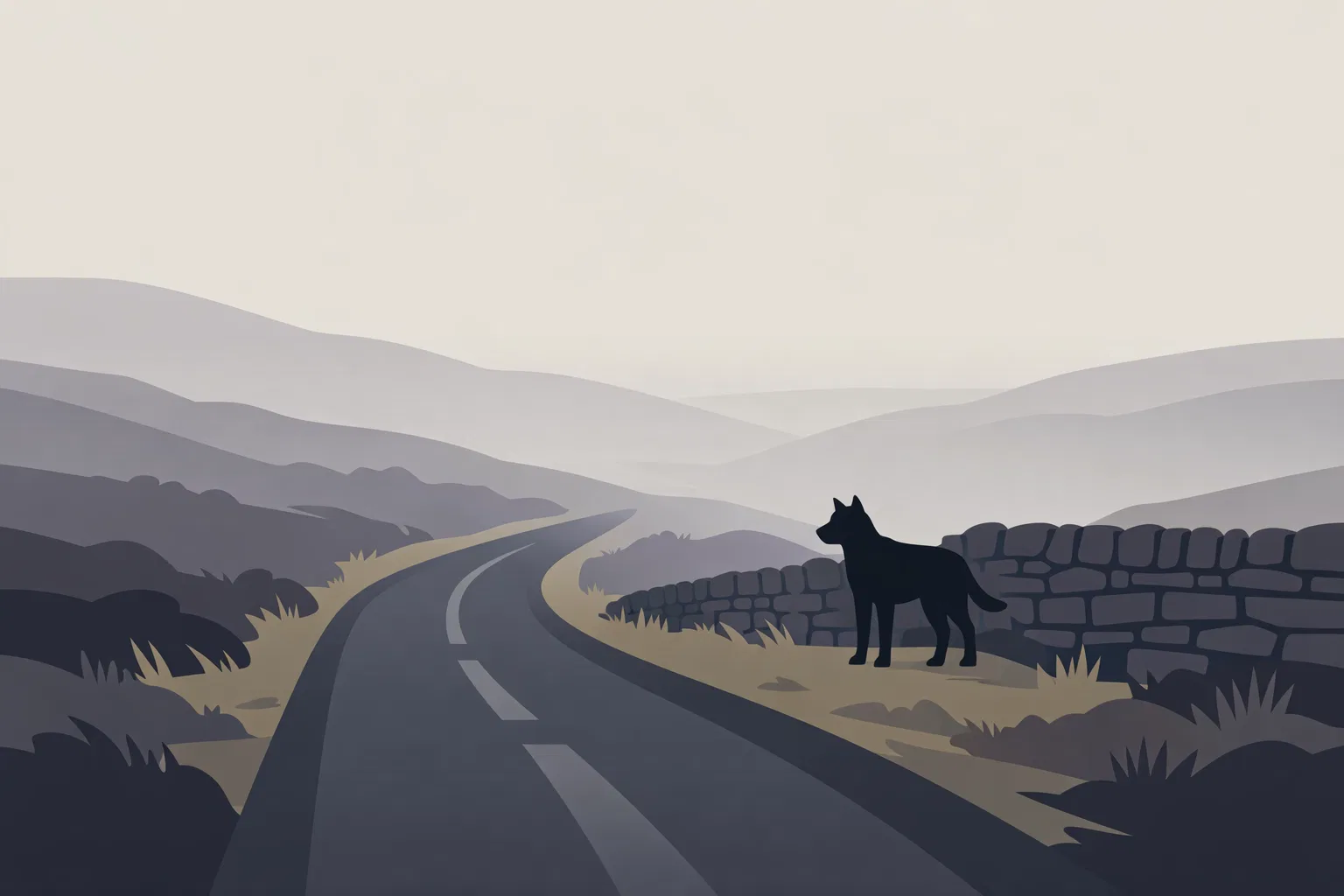
Lancashire’s black dogs overlap with boggarts, death omens and witchcraft lore. They are not always the same being, but the traditions blur. A black dog may be a familiar spirit, a spectral hound, a headless boggart, a guardian of a boundary, or an omen heard before a death. Harland and Wilkinson describe the “Trash” or “Skriker” as a form of the barguest: a death-sign that most often appears as a huge dog with broad feet, shaggy hair, drooping ears and saucer-like eyes. Its feet make a splashing sound like old shoes on a miry road, and its screams may be heard even when the creature is invisible.[Project Gutenberg]gutenberg.orgThe Project Gutenberg eBook of Lancashire Folk-lore, by John Harland and T. T. Wilkinson…
James Bowker’s tale “Th’ Skriker”, published in Goblin Tales of Lancashire, places the creature in a memorably road-bound setting. A man leaves Chipping for a cottage near the Hodder on a snowy December night. He approaches a bridge, hears unearthly cries, sees a black shaggy figure with fiery eyes, and is drawn into a terrifying journey along lanes, bridges and wooded bends. The notes to the tale describe the Skriker, Trash or Padfoot as a Lancashire and Yorkshire death omen, usually seen by the doomed person or their relatives.[The Supernatural Fox Sisters]thesupernaturalfoxsisters.comOpen source on thesupernaturalfoxsisters.com.
The bridge detail matters. In the story, crossing water is imagined as protection: the traveller thinks the “Greenies, Boggarts, and Feorin” have no power over someone who has passed over the water. That small belief turns the road into a supernatural map. Safety is not simply indoors; it lies across the stream, past the bridge, beyond the place where the creature’s power is thought to stop.[The Supernatural Fox Sisters]thesupernaturalfoxsisters.comOpen source on thesupernaturalfoxsisters.com.
The Preston black dog is another strong example. Lorna Smithers’ study of the legend traces a headless black dog or headless boggart around Maudlands, Marsh Lane and Preston’s older town-edge geography. She cites Charles Hardwick’s 1872 recollection of a headless boggart haunting Preston streets and neighbouring lanes, sometimes appearing as a woman and sometimes as a black dog, always headless and accompanied by rattling chains. Another Hardwick passage remembered the Preston black dog’s howl as a death omen.[Collective Ink]collectiveinkbooks.comCollective Ink The Black Dog of Preston | Collective InkCollective Ink The Black Dog of Preston | Collective Ink
Preston’s tradition also shows how roadside folklore can absorb history. A serialised 1878 Preston Guardian story set around the 1715 Jacobite rising presents the Black Dog of Preston as a headless boggart whose howl foretells death and which guards the dead on Gallows Hill after Jacobite executions. Smithers is careful to distinguish fiction from earlier belief, but the layering is revealing: a spectral dog, town gates, gallows, streets, marshy edges and political violence become one local legend-complex.[Collective Ink]collectiveinkbooks.comCollective Ink The Black Dog of Preston | Collective InkCollective Ink The Black Dog of Preston | Collective Ink
Pendle’s Dog Familiars and the Witch-Trial Shadow
No Lancashire black dog tradition is more famous than the dog-shaped familiars in the Pendle witch-trial material. This is not simply “haunted road” folklore in the later ghost-story sense, but it strongly shaped how Lancashire imagined dark canine presences on paths, lanes and moorland. Lancaster Castle’s account of the 1612 trials says Alizon Device was out begging on the road to Colne when she met the Halifax pedlar John Law; after he refused her request for pins, her familiar spirit in the shape of a dog allegedly appeared and asked whether she wanted him harmed. Law’s sudden paralysis, interpreted in the trial story as witchcraft, helped set the prosecutions in motion.[Lancaster Castle]lancastercastle.comLancaster Castle The Pendle Witches | Lancaster Castle: Lancaster CastleLancaster Castle The Pendle Witches | Lancaster Castle: Lancaster Castle
James Device’s “Dandy” belongs to the same family of stories. The modern Dandy sculpture in Clitheroe is based on James Device’s confession that he had a familiar spirit in dog form. The Ribble Valley arts listing explains that James spoke of a black dog that offered revenge when he felt wronged, while Lancashire Past’s summary of the case says the black dog named Dandy told James to make a clay image of Mistress Towneley so that she could be killed.[RVArts]rvarts.co.ukRVArts DandyRVArts Dandy
These accounts should be handled carefully. The Pendle material comes chiefly through Thomas Potts’s The Wonderfull Discoverie of Witches in the Countie of Lancaster, a prosecution-shaped 1613 account. Lancaster Castle’s article explicitly notes that Potts is a full but biased source, written for an audience ready to believe in witchcraft and in a period of anti-Catholic tension after the Gunpowder Plot. The dog familiars therefore tell us less about literal animals on Lancashire roads than about how fear, poverty, illness, begging, grudges and legal power were interpreted through demonological belief.[Lancaster Castle]lancastercastle.comLancaster Castle The Pendle Witches | Lancaster Castle: Lancaster CastleLancaster Castle The Pendle Witches | Lancaster Castle: Lancaster Castle
Yet the road setting remains important. Alizon’s encounter begins on the road to Colne. James’s stories move through Newchurch, Carre Hall and local households. Dandy is now public art in Clitheroe, connecting the Pendle story to a modern townscape in the shadow of the hill. The black dog has travelled from legal accusation to folklore landmark, becoming one of the county’s most recognisable supernatural images.[RVArts]rvarts.co.ukRVArts DandyRVArts Dandy
How Folk Landscape Differs from House Ghosts
A house ghost usually asks: who died here, who saw the apparition, and which room or staircase is haunted? Lancashire’s boggarts and black dogs ask different questions: what kind of place is this, how did people move through it, what danger or memory did the route hold, and what rule did the story teach?
The difference can be seen in three ways.
First, the haunting belongs to a route rather than a room. The Skriker appears on roads, at bridges and near water. The Preston black dog haunts streets, lanes, town edges and Gallows Hill. Burnley and Pendle boggarts attach to Boggart Bridge and the Devil’s Elbow. These are mobile stories for mobile people.[gutenberg.org]gutenberg.orgProject GutenbergThe Project Gutenberg eBook of Lancashire Folk-lore, by John Harland and T. T. Wilkinson…
Second, the creature is often a warning rather than a personality. A White Lady may have a name, costume and backstory. A boggart may have none of these. It may be a noise, a threat, a place-name, a shape, a rule, or a presence that explains why a lane feels wrong after dark. This makes the folklore less tidy but more atmospheric.
Third, the story often preserves local memory indirectly. Preston’s black dog gathers together leper-hospital memory, friary geography, town gates, gallows and Jacobite executions. Pendle’s dog familiars preserve the language of witchcraft accusation and social conflict. Boggart place-names preserve vanished local fears in the names of lanes and hollows. None of this proves supernatural events, but it does show how fear sticks to landscapes.[collectiveinkbooks.com]collectiveinkbooks.comCollective Ink The Black Dog of Preston | Collective InkCollective Ink The Black Dog of Preston | Collective Ink
This is why Lancashire’s folk spirits deserve their own place in the county’s haunted history. They are not lesser versions of castle ghosts or hall legends. They are the mechanism by which ordinary countryside becomes uncanny: a bend that expects a greeting, a bridge that should not be crossed carelessly, a clough whose name outlives its story, and a black dog whose howl turns a road into an omen.
What the Sources Can and Cannot Prove
The evidence for Lancashire boggarts and black dogs is strong as folklore, but weak as proof of literal apparitions. The best sources are collections, reminiscences, place-name studies, trial narratives, local-history essays and later retellings. They show that people told, recorded and remembered these stories; they do not establish that the beings existed.
Some accounts are especially early or influential. Harland and Wilkinson’s 1867 Lancashire Folk-lore is a foundational county collection. Bowker’s Goblin Tales of Lancashire gives literary form to tales such as the Skriker. Hardwick’s material, as discussed in Smithers’ Preston study, preserves nineteenth-century memories of a headless black dog or boggart. Young’s Boggart Sourcebook adds modern survey evidence and a large place-name corpus, showing how widely the boggart name was distributed.[gutenberg.org]gutenberg.orgProject GutenbergThe Project Gutenberg eBook of Lancashire Folk-lore, by John Harland and T. T. Wilkinson…
There are also reasons for caution. Some tales are localised versions of older migratory stories: Harland and Wilkinson themselves note that the Boggart Hole Clough “flitting” tale resembles Irish sprite and Scottish brownie stories. Trial evidence from Pendle is filtered through interrogation, social fear and a prosecution narrative. Newspaper fiction, such as the Preston black dog in the Jacobite setting, may preserve older motifs while also inventing scenes for dramatic effect.[gutenberg.org]gutenberg.orgProject GutenbergThe Project Gutenberg eBook of Lancashire Folk-lore, by John Harland and T. T. Wilkinson…
That uncertainty is not a weakness if the page is read as haunted folklore rather than proof-hunting. Lancashire’s boggarts and black dogs are most valuable because they reveal how people made sense of unsafe roads, lonely farms, illness, death, water crossings, old boundaries and childhood fear. The stories turn the county’s lanes and cloughs into a second haunted architecture: not built from stone, but from warnings, names, footsteps, howls and the memory of places best treated with respect.
Amazon book picks
Further Reading
Books and field guides related to What Lurks on Lancashire's Haunted Roads?. Use these as the next step if you want deeper reading beyond the article.
The Penguin Guide to the Superstitions of Britain and Ireland
Explains supernatural beliefs behind roadside traditions.

British Goblins
Provides broader context for supernatural creatures in British folklore.
eBay marketplace picks
Marketplace Samples
Live-tested eBay searches with available results related to this page.


Endnotes
1.
Source: gutenberg.org
Title: Project Gutenberg
Link:https://www.gutenberg.org/files/41148/41148-h/41148-h.htm
Source snippet
The Project Gutenberg eBook of Lancashire Folk-lore, by John Harland and T. T. Wilkinson...
2.
Source: library.oapen.org
Link:https://library.oapen.org/bitstream/id/3ef41182-edc4-4526-9c42-7388d12c6290/9781905816958.pdf
3.
Source: gutenberg.org
Link:https://www.gutenberg.org/ebooks/41148
4.
Source: gutenberg.org
Link:https://www.gutenberg.org/files/18253/18253-h/18253-h.htm
5.
Source: gutenberg.org
Link:https://www.gutenberg.org/ebooks/18253
6.
Source: gutenberg.org
Link:https://www.gutenberg.org/ebooks/32176.epub.images
7.
Source: gutenberg.org
Link:https://www.gutenberg.org/ebooks/author/7904
8.
Source: gutenberg.org
Link:https://www.gutenberg.org/ebooks/bookshelf/78?sort_order=title
9.
Source: thesupernaturalfoxsisters.com
Link:https://thesupernaturalfoxsisters.com/fairy-tales/the-skriker-a-black-dog-tale/
10.
Source: abcounties.com
Title: Association of British Counties Lancashire
Link:https://abcounties.com/counties/county-profiles/lancashire/
11.
Source: wikishire.co.uk
Link:https://wikishire.co.uk/wiki/Lancashire
12.
Source: collectiveinkbooks.com
Title: Collective Ink The Black Dog of Preston | Collective Ink
Link:https://www.collectiveinkbooks.com/blogs/moon-books/the-black-dog-of-preston/
13.
Source: lancastercastle.com
Title: Lancaster Castle The Pendle Witches | Lancaster Castle: Lancaster Castle
Link:https://www.lancastercastle.com/history-heritage/further-articles/the-pendle-witches/
14.
Source: rvarts.co.uk
Title: RVArts Dandy
Link:https://rvarts.co.uk/dandy/
15.
Source: Wikipedia
Link:https://en.wikipedia.org/wiki/Boggart
16.
Source: Wikipedia
Link:https://en.wikipedia.org/wiki/Lancashire
17.
Source: books.google.com
Title: Lancashire Folklore
Link:https://books.google.com/books/about/Lancashire_Folklore.html?id=Q6DzoAEACAAJ
18.
Source: en.wikisource.org
Link:https://en.wikisource.org/wiki/1911_Encyclop%C3%A6dia_Britannica/Lancashire
19.
Source: mythus.fandom.com
Link:https://mythus.fandom.com/wiki/Boggart
20.
Source: mythical-beasts.fandom.com
Link:https://mythical-beasts.fandom.com/wiki/Skriker
21.
Source: catalog.hathitrust.org
Link:https://catalog.hathitrust.org/Record/006522967
22.
Source: genuki.org.uk
Link:https://www.genuki.org.uk/big/eng/Gazetteers/NatGaz1868/Lancashire/Lancashire
23.
Source: kulturkaufhaus.de
Title: Lancashire folk-lore
Link:https://www.kulturkaufhaus.de/de/detail/ISBN-9789354018855/Harland-John/Lancashire-folk-lore
Additional References
24.
Source: youtube.com
Link:https://www.youtube.com/watch?v=EKoADRI8JmQ
Source snippet
The Terror of the Baum Rabbit. The Phantom Bunny of Rochdale...
25.
Source: youtube.com
Title: Local Legends #10: Graeme Cooke
Link:https://www.youtube.com/watch?v=vHtiaMuJJ6w
Source snippet
SCARIEST SHORT FILM on the A666 Road – DEVIL'S HIGHWAY (2025) | True Story Horror...
26.
Source: academia.edu
Link:https://www.academia.edu/28026366/McKay_The_Evolution_of_East_Lancashire_Boggarts
27.
Source: facebook.com
Link:https://www.facebook.com/ThisIsSianEllis/posts/an-old-lancashire-folk-tale-from-the-bonus-tales-zine-headed-online-tonight-at-8/1674591473585065/
28.
Source: incredible-creations.com
Link:https://incredible-creations.com/black-dog/
29.
Source: archive.org
Link:https://archive.org/download/englishfolklore00dyeruoft/englishfolklore00dyeruoft.pdf
30.
Source: manchestersfinest.com
Link:https://www.manchestersfinest.com/articles/haunted-manchester-boggart-hole-clough/
31.
Source: facebook.com
Link:https://www.facebook.com/groups/1972797013478749/posts/2028318644593252/
32.
Source: facebook.com
Link:https://www.facebook.com/groups/502317166638370/posts/1632520610284681/
33.
Source: gazetteer.org.uk
Link:https://gazetteer.org.uk/place/Lancashire
Topic Tree