Within Haunted Antrim
Why North Antrim's Landscape Feels Haunted
North Antrim's eerie ruins and roads turn dangerous landscapes into stories of collapse, white ladies and road ghosts.
On this page
- Dunluce Castle, sea cliffs and collapse folklore
- The Dark Hedges and the Grey Lady road story
- How scenery turns history into ghost tradition
Page outline Jump by section
Introduction
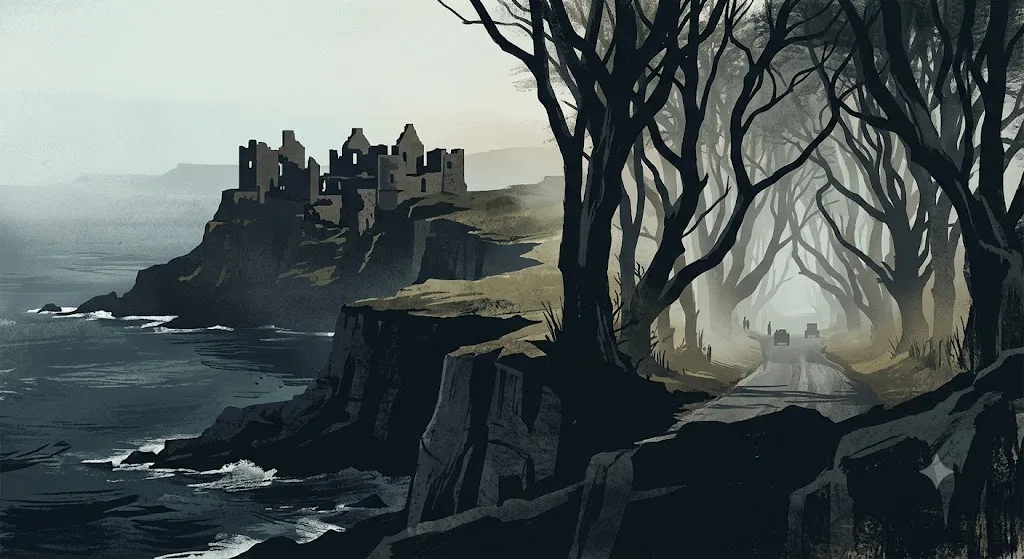
Dunluce Castle and the Dark Hedges show how north Antrim turns scenery into ghost tradition. At Dunluce, the ruin’s cliff-edge setting has gathered stories of a banshee, a doomed lover, and the famous tale that the castle kitchens plunged into the sea during a storm. At the Dark Hedges, an eighteenth-century estate avenue on Bregagh Road has become the stage for the Grey Lady, a roadside apparition said to move among the beech trees at dusk. Neither place offers proof of ghosts; what they do offer is a clear view of how dangerous landscapes, old family estates and modern tourism preserve eerie stories. The result is one of County Antrim’s most recognisable haunted pairings: a castle where the land seems to fall away beneath history, and a road where trees turn an ordinary lane into a corridor of legend.
Why these north Antrim places feel haunted
The north Antrim coast is unusually good at producing haunted-place stories because its landscape already looks dramatic before any legend is added. Dunluce Castle stands on a basalt outcrop between Portrush and Portballintrae, divided from the mainland by steep drops and reached by a bridge. The Department for Communities describes it as an iconic ruin on “dramatic coastal cliffs”, first built by the MacQuillans around 1500, with its earliest written record in 1513, and later seized by the MacDonnells in the 1550s.[Department for Communities]communities-ni.gov.ukDepartment for Communities Dunluce CastleDepartment for Communities Dunluce Castle
That history matters because Dunluce is not just a picturesque shell. It was a defensive stronghold, a seat of power and part of a wider north-coast world of clan conflict, sea routes and seventeenth-century estate ambition. Archaeological work beside the castle has also shown that Dunluce was attached to a significant seventeenth-century town, with excavations revealing a cobbled market or meeting place, houses, industrial buildings and administrative offices.[The National Lottery Heritage Fund]heritagefund.org.ukThe National Lottery Heritage Fund Uncovering the lost town of DunluceThe National Lottery Heritage Fund Uncovering the lost town of Dunluce The haunted feeling of the site is therefore not only about ruins; it is about a once-busy settlement reduced to fragments beside the sea.
The Dark Hedges work differently. They are not a ruin, a battlefield or a castle, but a designed approach to Gracehill House. James Stuart built Gracehill House around 1775 and named it after his wife, Grace Lynd; the family planted more than 150 beech trees along the entrance to impress visitors approaching the Georgian estate.[CCGHT]ccght.orgthe dark hedgesthe dark hedges The former estate avenue is now a public road, Bregagh Road, between Armoy and Stranocum, and the mature trees have bent into the interlaced tunnel that makes the place feel theatrical even in daylight.[Causeway Coast & Glens Borough Council]causewaycoastandglens.gov.ukgracehill housegracehill house
In both cases, the “haunting” begins with a physical effect. Dunluce makes the visitor look down towards rock, waves and collapse. The Dark Hedges make the visitor look along a narrowing road where light, branches and distance distort the view. The ghost stories did not create the atmosphere from nothing; they gave names and figures to places that already invited unease.

Dunluce Castle, sea cliffs and collapse folklore
The best-known Dunluce legend says that, one stormy night in 1639, part of the castle kitchen fell into the sea, taking cooks and servants with it. Tourism Ireland presents the story as a legend of a storm hurling parts of the kitchen into the waves and marking a turning point in the castle’s fortunes, while Discover Northern Ireland links the castle’s “dramatic history” with tales of a banshee and kitchens falling into the sea.[Ireland.com]ireland.comDunluce CastleDunluce Castle[Discover Northern Ireland]discovernorthernireland.comOpen source on discovernorthernireland.com.
The story has the right ingredients for a durable ghost tradition. It is sudden, domestic and horrifying: not warriors dying in battle, but servants at work in a castle kitchen, lost because the very ground gave way. Retellings often add that one kitchen boy survived because he was away from the doomed room or in a safe corner. That small survivor detail gives the story a witness-like shape, making it easier to remember and repeat, even when the evidence is uncertain.[TripSavvy]tripsavvy.comdunluce castle complete guide 4570912dunluce castle complete guide 4570912
The problem is that the collapse story is much stronger as folklore than as confirmed history. A Belfast Telegraph feature on Dunluce reported that the kitchens-falling-into-the-sea story “seems a myth”, partly because late eighteenth- and nineteenth-century images still show the castle section in question standing.[Belfast Telegraph]belfasttelegraph.co.ukOpen source on belfasttelegraph.co.uk. A local site guide also points out the obvious archaeological difficulty: the kitchen remains can still be seen, so the familiar version in which the kitchen itself vanished whole into the sea cannot be treated literally.[Irish Stones]irishstones.orgOpen source on irishstones.org.
This does not make the legend worthless. It makes it revealing. Dunluce really is a cliff-edge ruin. Parts of the complex have been lost or damaged over time. The site’s position makes collapse feel plausible to the eye, even where the famous 1639 kitchen version is doubtful. The tale compresses several truths — danger, ruin, abandonment, sea erosion and aristocratic decline — into one memorable night.
Dunluce also carries a more openly supernatural tradition: the banshee or female spirit associated with the castle. Modern visitor material often names this as part of the castle’s legend cycle rather than as a documented witness case.[Discover Northern Ireland]discovernorthernireland.comOpen source on discovernorthernireland.com. Some secondary accounts call the figure Maeve Roe and link her to a doomed-love story, in which a young woman tries to escape or elope and is lost to the sea.[History Hit]historyhit.comHistory Hit Dunluce CastleHistory Hit Dunluce Castle As with many castle hauntings, the story turns family control, confinement and coastal danger into a female apparition whose cry belongs as much to folklore as to the building itself.
What Dunluce’s legends remember
The most convincing way to read Dunluce is not as a single haunted claim, but as a place where several kinds of memory have fused.
First, the castle preserves a memory of danger. Its cliffs are not decorative; they were part of the site’s defensive strength and part of its later romance. A fortress built for protection becomes, in ghost tradition, a place where protection fails. The kitchen-collapse legend is powerful because it reverses the promise of a castle: the walls stand, but the ground disappears.
Second, Dunluce preserves a memory of political instability. The castle passed from the MacQuillans to the MacDonnells in the sixteenth century, during a period of violence and rebellion on the north coast.[Department for Communities]communities-ni.gov.ukDepartment for Communities Dunluce CastleDepartment for Communities Dunluce Castle That does not prove any haunting, but it explains why the ruin feels historically charged. Ghost stories often cling to places where power changed hands, families rose and fell, and a once-important household became an empty shell.
Third, Dunluce preserves a memory of a lost settlement, not just a lost room. Excavations beside the castle were begun to investigate the castle, its associated seventeenth-century town and the surrounding landscape.[Excavations]excavations.ieOpen source on excavations.ie. The Heritage Fund account of the lost town emphasises that archaeologists found planned settlement remains, including houses, industrial buildings and abandoned artefacts.[The National Lottery Heritage Fund]heritagefund.org.ukThe National Lottery Heritage Fund Uncovering the lost town of DunluceThe National Lottery Heritage Fund Uncovering the lost town of Dunluce For a visitor, this changes the ghostly texture of the place. Dunluce was not merely a lonely castle above the water; it was once attached to a working community.
That community context makes the kitchen legend more emotionally legible, even if the literal version is doubtful. It turns a grand ruin into a servants’ story. Instead of focusing only on earls, clans and architecture, it imagines ordinary people caught in the castle’s fall. That may be why the tale has lasted: it gives the ruin a human cry.
The Dark Hedges and the Grey Lady road story
The Dark Hedges’ ghost tradition centres on the Grey Lady, a figure said to pass along Bregagh Road, moving between the trees or vanishing near the end of the avenue. The road’s original purpose was not supernatural at all. It was a designed estate entrance, planted by the Stuart family in the eighteenth century to create an impressive approach to Gracehill House.[Discover Northern Ireland]discovernorthernireland.comOpen source on discovernorthernireland.com. Over time, the beech trees matured into a tunnel of bent, interlaced branches, turning a private landscape gesture into one of Northern Ireland’s most photographed roads.[CCGHT]ccght.orgthe dark hedgesthe dark hedges
The Grey Lady has several proposed identities, which is a sign that this is a flexible road legend rather than a tightly documented case. Some versions identify her as Margaret Stuart, known as “Cross Peggy”, a daughter of the Gracehill family. Others suggest a servant girl from the house, or a spirit linked to a forgotten graveyard in nearby fields.[Travel in Thin Places]thinplaces.netTravel in Thin Placesdark hedgesTravel in Thin Placesdark hedges The versions differ, but the movement stays the same: a female figure appears in the avenue, passes among the trees, and disappears.
This kind of ghost story belongs naturally to roads. Road ghosts are often seen briefly, at dusk or night, by people in motion. They do not need a locked room, a named bedroom or a full house history. Their power comes from uncertainty: the eye catches a figure, a shadow, a pale shape, and the road’s setting does the rest. At the Dark Hedges, the beech tunnel creates exactly the conditions such a story needs — repeated vertical shapes, shifting light, long sightlines and a strong sense of enclosure.
The Dark Hedges also show how modern fame can strengthen an older eerie reputation. The avenue was used as the King’s Road in Game of Thrones, which greatly widened its tourist audience. The Northern Ireland Archive notes that fallen trees from Storm Gertrude in 2016 were later transformed into carved Game of Thrones doors, including one at Gracehill House that references the Dark Hedges.[NI Community Heritage Archive]niarchive.org5 the dark hedges5 the dark hedges The television connection does not create the Grey Lady, but it increases the number of visitors arriving already primed to see the road as cinematic, strange and story-filled.
Why the Dark Hedges legend feels modern as well as old
The Dark Hedges story is often presented as if it were an old local haunting, and it may well draw on long-standing Gracehill and Bregagh Road talk. But its current fame is unmistakably modern. The site’s image circulates through tourism, photography, screen tourism and paranormal travel writing. That matters because a road ghost becomes stronger when more people photograph the road, walk it at dusk and retell the same figure in captions, tours and visitor guides.
The legend’s uncertainty is part of its appeal. “The Grey Lady” is not pinned to one verified death record in the way a careful historian would want. Instead, she functions as a container for several possible memories: a difficult daughter, a wronged servant, an unremembered burial place, or simply the unsettling effect of the avenue itself.[Amy's Crypt]amyscrypt.comAmy's Crypt Does the Grey Lady haunt the Dark Hedges?Amy's Crypt Does the Grey Lady haunt the Dark Hedges? That makes the story less credible as a factual haunting, but more interesting as folklore. It shows how a place can keep generating explanations for the same felt presence.
There is also a conservation angle. The Dark Hedges are old living trees, not a purpose-built attraction. Heritage material stresses that the avenue once contained more than 150 beeches and was designed as a landscape feature for Gracehill House.[CCGHT]ccght.orgthe dark hedgesthe dark hedges Modern visitors often encounter the road as a famous photograph, but the ghost story depends on the survival of the physical tunnel. If storms, disease, traffic or visitor pressure change the avenue, the legend’s stage changes too.
That gives the Grey Lady a different character from Dunluce’s banshee or kitchen cries. Dunluce is already a ruin; loss is built into the view. The Dark Hedges are still living, ageing and vulnerable. Its haunting is less about a destroyed building than about a road whose atmosphere could slowly disappear.

How scenery turns history into ghost tradition
Dunluce and the Dark Hedges are useful because they show two different mechanisms by which haunted landscapes form in County Antrim.
At Dunluce, the mechanism is ruin plus danger. The castle’s cliffs make collapse imaginable; its clan history gives the ruin weight; its lost town adds the sense of vanished life; and the kitchen story turns architectural decay into a single human disaster. Even when the literal kitchen-collapse tale is challenged, the story still expresses something true about the place: Dunluce looks as though history is always on the edge of falling into the sea.
At the Dark Hedges, the mechanism is repetition plus perception. A long avenue of similar trees creates a visual rhythm. Dusk, mist, headlights and shadows can make the eye misread movement. A named female figure gives that experience a story-form, and tourism gives the story a wider audience. The Grey Lady may be described as a ghost, but she also works as an explanation for why the road feels watched, enclosed and oddly ceremonial.
Both traditions depend on named places that ordinary readers can visit or picture clearly. That is why they are more durable than vague claims of “paranormal activity”. Dunluce has the cliff, the bridge, the ruin and the sea below. The Dark Hedges have the narrowing road, the old beeches, Gracehill House and the dusk apparition. The stories remain memorable because the setting keeps retelling them without words.
How credible are the stories?
The strongest evidence at Dunluce is historical and archaeological, not paranormal. The castle’s cliff-edge location, MacQuillan and MacDonnell history, and the excavated remains of the associated seventeenth-century town are well supported by official heritage and archaeological sources.[Department for Communities]communities-ni.gov.ukDepartment for Communities Dunluce CastleDepartment for Communities Dunluce Castle[The National Lottery Heritage Fund]heritagefund.org.ukThe National Lottery Heritage Fund Uncovering the lost town of DunluceThe National Lottery Heritage Fund Uncovering the lost town of Dunluce The banshee and kitchen-collapse stories are best treated as legends attached to that real setting. The kitchen tale in particular is widely repeated, but good reasons exist to doubt the popular version in which the kitchen itself vanished in 1639.[Belfast Telegraph]belfasttelegraph.co.ukOpen source on belfasttelegraph.co.uk.[Irish Stones]irishstones.orgOpen source on irishstones.org.
At the Dark Hedges, the physical and estate history is clearer than the ghost identity. Gracehill House, James Stuart, Grace Lynd and the eighteenth-century planting of the beech avenue are consistently supported by tourism and heritage sources.[Causeway Coast & Glens Borough Council]causewaycoastandglens.gov.ukgracehill housegracehill house[CCGHT]ccght.orgthe dark hedgesthe dark hedges The Grey Lady, by contrast, is a local road legend with competing explanations. Her identity changes from Cross Peggy to a servant to a graveyard spirit, which makes the story harder to verify but easier to recognise as living folklore.[Travel in Thin Places]thinplaces.netTravel in Thin Placesdark hedgesTravel in Thin Placesdark hedges
For a haunted-history page, that distinction is the point. These stories should not be flattened into either “true ghost” or “false story”. Dunluce and the Dark Hedges are best understood as places where landscape, memory and visitor imagination meet. The cliffs make collapse believable. The road makes apparition believable. The historical record gives each place depth, while folklore gives each place a figure the public can remember.
Where this fits in County Antrim’s haunted map
Within County Antrim’s wider haunted history, Dunluce and the Dark Hedges form the county’s strongest ruins-and-roads pairing. They are different from Ballygally Castle’s hotel ghost, Crumlin Road Gaol’s institutional hauntings or Belfast’s urban ghost-tour traditions. Here, the main actor is the landscape itself: cliff, sea, avenue, tree and road.
That makes them especially important for readers following Antrim’s haunted geography along the Causeway coast and inland estate routes. Dunluce turns a medieval and early modern power site into a cliff legend of collapse, banshee cries and lost domestic life. The Dark Hedges turn an eighteenth-century designed approach into a roadside apparition story shaped by trees, dusk and modern screen tourism.
Together, they explain why north Antrim so often feels haunted even before a ghost is named. The stories are not strongest because they prove the supernatural. They endure because they make visible what the landscape already suggests: that roads remember who passed along them, ruins remember who left them, and some places in County Antrim seem built for stories to gather after dark.
Amazon book picks
Further Reading
Books and field guides related to Why North Antrim's Landscape Feels Haunted. Use these as the next step if you want deeper reading beyond the article.
The Mammoth Book of Haunted House Stories
Suitable for readers drawn to haunted castles and estates.
eBay marketplace picks
Marketplace Samples
Live-tested eBay searches with available results related to this page.


Endnotes
1.
Source: ccght.org
Title: the dark hedges
Link:https://ccght.org/project/the-dark-hedges/
2.
Source: ireland.com
Title: Dunluce Castle
Link:https://www.ireland.com/en-us/things-to-do/attractions/dunluce-castle/
3.
Source: tripsavvy.com
Title: dunluce castle complete guide 4570912
Link:https://www.tripsavvy.com/dunluce-castle-complete-guide-4570912
4.
Source: excavations.ie
Link:https://excavations.ie/report/2009/Antrim/0020371/
5.
Source: youtube.com
Title: EXPOSING THE GREY LADY’S DISTURBING TRUTH | Dark Hedges Haunting
Link:https://www.youtube.com/watch?v=No2wGbE0lY0
Source snippet
The Dark Hedges - Ireland's Spookiest Forest...
6.
Source: youtube.com
Title: The Dark Hedges
Link:https://www.youtube.com/watch?v=j6WSZuwc9Tg
Source snippet
Halloween in the Causeway Coast & Glens - Myths & Legends: Grey Lady of the Dark Hedges...
7.
Source: communities-ni.gov.uk
Title: Department for Communities Dunluce Castle
Link:https://www.communities-ni.gov.uk/heritage-sites/dunluce-castle
8.
Source: heritagefund.org.uk
Title: The National Lottery Heritage Fund Uncovering the lost town of Dunluce
Link:https://www.heritagefund.org.uk/news/uncovering-lost-town-dunluce
9.
Source: causewaycoastandglens.gov.uk
Title: gracehill house
Link:https://causewaycoastandglens.gov.uk/see-do/arts_museums/museums-services/ballymoney-museum/ballymoney-heritage/estates-and-stately-homes/gracehill-house
10.
Source: discovernorthernireland.com
Link:https://discovernorthernireland.com/listing/dunluce-castle/67501101/
11.
Source: belfasttelegraph.co.uk
Link:https://www.belfasttelegraph.co.uk/news/environment/50-things-you-probably-never-knew-about-dunluce-castle/a/118296437.html
12.
Source: irishstones.org
Link:https://www.irishstones.org/place.aspx?i=19&p=952
13.
Source: historyhit.com
Title: History Hit Dunluce Castle
Link:https://www.historyhit.com/locations/dunluce-castle/
14.
Source: discovernorthernireland.com
Link:https://discovernorthernireland.com/listing/the-dark-hedges/70329101/
15.
Source: thinplaces.net
Title: Travel in Thin Placesdark hedges
Link:https://thinplaces.net/tag/dark-hedges/
16.
Source: niarchive.org
Title: 5 the dark hedges
Link:https://niarchive.org/projectitems/5-the-dark-hedges/
17.
Source: amyscrypt.com
Title: Amy’s Crypt Does the Grey Lady haunt the Dark Hedges?
Link:https://amyscrypt.com/hauned-dark-hedges/
18.
Source: youtube.com
Link:https://www.youtube.com/watch?v=03S7j5SeRk8
19.
Source: castles.nl
Title: dunluce castle
Link:https://www.castles.nl/dunluce-castle
20.
Source: samsflags.blogspot.com
Title: Dunluce Castle
Link:https://samsflags.blogspot.com/2020/10/dunluce-castle-romanticism-legend.html
21.
Source: niarchive.org
Title: 2010 excavation at dunluce castle
Link:https://niarchive.org/archiveitems/2010-excavation-at-dunluce-castle/
22.
Source: irelandexplore.com
Title: dunluce castle
Link:https://irelandexplore.com/destinations/dunluce-castle/
23.
Source: wildernessireland.com
Title: dunluce castle
Link:https://www.wildernessireland.com/blog/dunluce-castle/
24.
Source: Wikipedia
Title: Dark Hedges
Link:https://en.wikipedia.org/wiki/Dark_Hedges
25.
Source: Wikipedia
Title: Dunluce Castle
Link:https://en.wikipedia.org/wiki/Dunluce_Castle
26.
Source: communities-ni.gov.uk
Link:https://www.communities-ni.gov.uk/articles/state-care-monuments
Additional References
27.
Source: instagram.com
Link:https://www.instagram.com/p/DZS8vuYOGbX/
28.
Source: constructionireland.ie
Link:https://www.constructionireland.ie/construction-news/128164/lost-city-of-dunluce-revealed
29.
Source: academia.edu
Link:https://www.academia.edu/5240954/A_History_of_Dunluce
30.
Source: facebook.com
Link:https://www.facebook.com/yourlocalcruiseexpert/posts/step-into-the-mystery-of-dunluce-castle-where-legends-of-ghostly-banshees-and-cl/1339057705071699/
31.
Source: documentingireland.com
Link:https://documentingireland.com/northern-ireland/dunluce-castle/
32.
Source: facebook.com
Link:https://www.facebook.com/groups/LoveIrelandGroup/posts/1704828196721004/
33.
Source: instagram.com
Link:https://www.instagram.com/p/DZpVW9Vlmi3/
34.
Source: lefttotime.com
Link:https://lefttotime.com/abandoned/dunluce-castle/
35.
Source: facebook.com
Link:https://www.facebook.com/groups/964935275062398/posts/1262328098656446/
36.
Source: causewaycoastalroute.com
Link:https://www.causewaycoastalroute.com/dunluce-castle-history
Topic Tree