Within Haunted Angus
The Airman Said To Haunt Montrose
The Montrose Ghost links a named 1913 air crash, early military aviation, and later apparition reports into Angus's most modern haunting.
On this page
- Desmond Arthur and the 1913 crash
- How the apparition story was preserved
- Why aviation hauntings feel different
Page outline Jump by section
Introduction
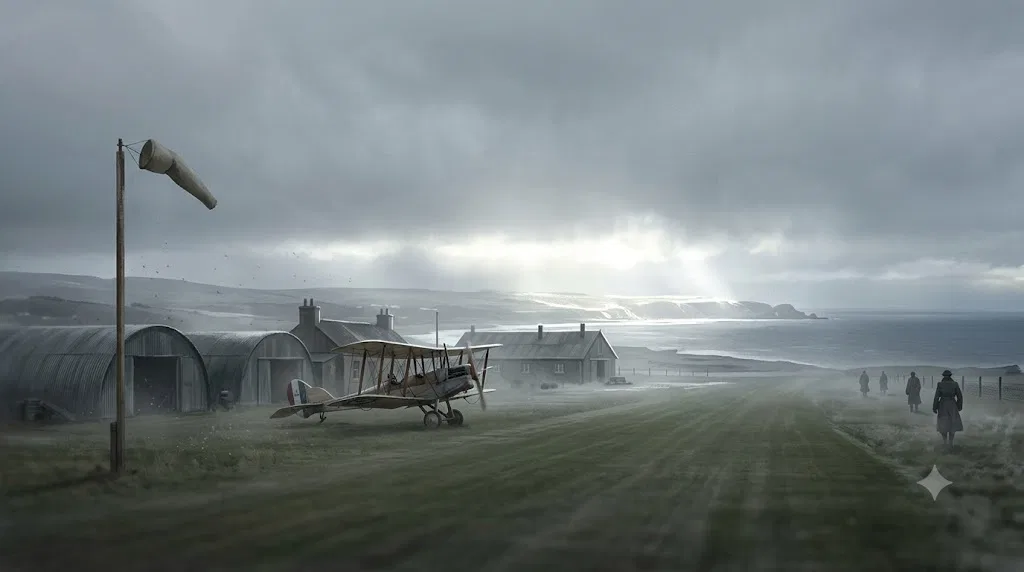
The Montrose Air Station ghost is one of Angus’s most unusual hauntings because its trail begins with a named man, a dated crash and a real early-aviation site rather than with a medieval castle or vague fireside legend. The figure usually identified as the “Montrose Ghost” is Lieutenant Desmond Arthur of No. 2 Squadron, Royal Flying Corps, who died on 27 May 1913 when his B.E.2 biplane broke up during a training flight near Lunan Bay. The later apparition story says that Arthur’s ghost was seen at the air station, particularly around the officers’ mess, after arguments over the cause of the crash and his personal responsibility for it. The haunting remains a claim rather than a proved event, but the aviation evidence around it is unusually concrete: a pioneering airfield, preserved buildings, museum interpretation, accident records, cemetery memory and later retellings that show how a technical disaster became a modern Angus ghost story.[aviation-safety.net]aviation-safety.netOpen source on aviation-safety.net.
Why Montrose Gives Angus A Modern Haunting
Montrose Air Station sits on the Angus coast, on the northern edge of Montrose, and is now interpreted through Montrose Air Station Museum. The museum describes the site as Great Britain’s first operational military air station, established in February 1913, and places its story within service from 1913 until the station finally closed in 1952. That matters for the haunting: this is not a story attached to a ruined tower or aristocratic curse, but to the dangerous first years of military flying, when aircraft were fragile, pilots were celebrated, and training itself could be lethal.[Montrose Air Station Museum]rafmontrose.org.ukOpen source on rafmontrose.org.uk.
The physical setting also gives the legend a stronger “evidence trail” than many ghost stories. Montrose still has historic air-station buildings and hangars, including Burke’s Sheds, built in 1913–14 for the Royal Flying Corps. Historic Environment Scotland describes the hangars as part of the former Montrose Air Station, while the museum notes that the sheds were built to house No. 2 Squadron aircraft and that Burke’s Shed 1b is now used for aircraft displays. For visitors, the ghost story therefore sits among surviving aviation fabric rather than on an entirely vanished site.[Historic Environment Scotland]portal.historicenvironment.scotOpen source on historicenvironment.scot.
In the wider haunted map of Angus, Montrose performs a different role from Glamis Castle or coastal ruin stories. Glamis offers aristocratic secrecy and ancient rooms; Montrose offers hangars, training flights, crash investigation and military memory. The atmosphere is still eerie, but its emotional charge comes from early technology failing in public view, and from the idea that a dead pilot’s reputation remained unsettled after his body was buried.

Desmond Arthur And The 1913 Crash
Desmond Lucius Studdert P. P. Arthur was an Irish aviator serving with No. 2 Squadron, Royal Flying Corps. The aviation record places him at Montrose in spring 1913, only months after the new air station had been established. On the morning of Tuesday 27 May 1913, Arthur was flying B.E.2 biplane No. 205 on a routine training flight from Upper Dysart towards Lunan Bay when the aircraft collapsed in the air. Accounts of the accident consistently describe the right wing breaking away at about 2,500 feet, the machine plunging to the ground, and Arthur being thrown from it and killed.[Aviation Safety Network]aviation-safety.netOpen source on aviation-safety.net.
The crash was historically important as well as tragic. It is often described as Scotland’s first fatal aircraft accident and one of the earliest fatal accidents in the Royal Flying Corps. Arthur was buried at Sleepyhillock Cemetery in Montrose, giving the story a local memorial point as well as an airfield and crash landscape. A Wikimedia Commons record of his grave identifies it as the grave of Desmond L. Arthur at Sleepyhillock Cemetery, Montrose, Angus, photographed on the centenary date in 2013.[Wikipedia]WikipediaDesmond ArthurDesmond Arthur
The controversy began because Arthur was not simply remembered as an inexperienced airman who made an obvious mistake. Aviation Safety Network’s summary states that a Royal Aero Club accident committee report dated 21 June 1913 found the accident had occurred because of an incompetent repair to a broken spar by an unknown mechanic. The same trail of later reporting records that the question did not rest there: a government inquiry followed, political criticism emerged, and later accounts disagreed over whether Arthur had been exonerated or blamed. That disputed paper trail is central to why the ghost story took hold.[Aviation Safety Network]aviation-safety.netOpen source on aviation-safety.net.
The aircraft type adds to the atmosphere. The B.E.2 belonged to the frail-looking world of wood, wire and fabric aviation. Montrose Air Station Museum now displays a full-size replica B.E.2a representing the aircraft flown by No. 2 Squadron, helping modern visitors understand how exposed early pilots were compared with later military aircraft. The museum explicitly invites visitors to compare that fragile early aircraft with a much later Tornado GR4, a contrast that makes the 1913 crash easier to imagine without turning it into melodrama.[Montrose Air Station Museum]rafmontrose.org.ukOpen source on rafmontrose.org.uk.
How The Apparition Story Was Preserved
The ghost story seems to have grown out of three linked elements: the death, the dispute over blame, and the air station’s own culture of risk. Later summaries describe the main apparition as a figure seen in or near the officers’ mess, often identified as Desmond Arthur and sometimes called the “Irish Apparition” or the “Montrose Ghost”. The claim was that sightings increased after official handling of the crash appeared to leave Arthur’s honour unresolved, and that the figure was linked to his desire to clear his name.[Wikipedia]WikipediaDesmond ArthurDesmond Arthur
This is where the story becomes folkloric rather than straightforwardly documentary. The crash is documented; the ghost is not documented in the same way. Reports of Major Cyril Foggin seeing a ghostly figure, guards deserting posts, pilots asking for transfers, and instructors witnessing the apparition are usually preserved through later ghost and aviation retellings rather than through a clean set of contemporary witness statements. The value of these accounts is therefore not that they prove a haunting, but that they show how early RAF and Royal Flying Corps memory turned a technical controversy into a moral story about blame, honour and the dead returning.[Wikipedia]WikipediaDesmond ArthurDesmond Arthur
The legend did not end with the First World War setting. Undiscovered Scotland notes that after the start of the Second World War, ghost stories at Montrose grew in number and variety, including figures in flying clothes from both world wars and mysterious biplanes circling the airfield at night. This broadening is typical of haunted military sites: one named death becomes the centre of gravity, and later generations attach their own sights, sounds and anxieties to the same place.[Undiscovered Scotland]undiscoveredscotland.co.ukOpen source on undiscoveredscotland.co.uk.
A later aviation retelling gave the Montrose Ghost new life. Sir Peter Masefield’s story, published in Flight International in December 1972 according to later summaries, described an uncanny encounter on 27 May 1963, fifty years to the day after Arthur’s fatal crash. In that version, Masefield sees what appears to be an old biplane over Montrose, watches it break up, and later finds no crash or aircraft to account for the sighting. It is one of the strongest pieces of the legend as a story, but it remains a reported experience rather than independently verified evidence of an apparition.[angusfolklore.blogspot.com]angusfolklore.blogspot.comthe first operational military air basethe first operational military air base

The Evidence Trail A Visitor Can Actually Follow
The strongest evidence at Montrose is not paranormal proof; it is the layered historical trail that explains why this ghost story is unusually durable. A reader or visitor can separate the trail into firmer and weaker parts.
The air station is real and nationally significant. Montrose Air Station Museum identifies the site as Great Britain’s first operational military air station, established in February 1913, and still presents aviation history from the Royal Flying Corps through later RAF service. The Scottish Aviation and STEM Trail also frames Scotland’s aviation heritage through locations, stories, crash sites and STEM education, placing Montrose within a wider national aviation-memory network.[Montrose Air Station Museum]rafmontrose.org.ukOpen source on rafmontrose.org.uk.
The surviving buildings are part of the case. Historic Environment Scotland’s listing records describe Burke’s Sheds as early military aircraft sheds or hangars built in 1913–14 for the Royal Flying Corps. The museum’s exhibits page identifies the HQ building, MT Hut, Burke’s Sheds and the Robertson Building, and notes that its library and research centre holds a major private aviation book collection and archives. These buildings give the haunting a recognisable geography: mess, HQ, hangars, flight line, cemetery and nearby Lunan Bay.[Historic Environment Scotland]portal.historicenvironment.scotOpen source on historicenvironment.scot.
The fatal crash is documented, but the ghost reports are uneven. Aviation Safety Network’s accident entry and other aviation summaries give a consistent account of Arthur’s B.E.2 breaking up on 27 May 1913, including the wing failure, altitude and burial at Sleepyhillock. By contrast, the apparition reports survive mainly through later aviation folklore, paranormal writing, heritage retellings and local features. That difference should shape how the story is read: the tragedy is historical; the haunting is a tradition built around it.[aviation-safety.net]aviation-safety.netOpen source on aviation-safety.net.
Local preservation keeps the ghost from becoming detached from history. The Courier reported in 2020 on renewed interest in Arthur’s biography and described his tale as one of the famous ghost stories of the First World War after he became Scotland’s first aircraft accident fatality. Separate reporting on commemorative work at Montrose has noted the museum’s attention to airmen and war dead connected with the station. This kind of local preservation matters because it keeps Arthur from becoming merely “a ghost”; he remains a named aviator whose life, death and reputation can be traced.[The Courier]thecourier.co.ukOpen source on thecourier.co.uk.
Why Aviation Hauntings Feel Different
Aviation hauntings feel different from castle hauntings because they turn modern machinery into something strangely fragile. A castle ghost usually asks the reader to imagine old stone, hidden rooms and centuries of rumour. The Montrose Ghost asks a different question: what happens when a new technology arrives with heroic confidence, then kills one of its pioneers in front of witnesses and paperwork?
That tension is visible in the timing. Montrose was established less than ten years after the Wright brothers’ first powered flight, and the museum reminds visitors that in 1913 aircraft were rare enough to draw crowds and pilots could be treated almost like film stars. Arthur’s death therefore belongs to a brief period when flying was both glamorous and visibly unsafe. The ghost story preserves the shock of that contradiction: the sky was becoming military space, but the machines were still perilous experiments.[Montrose Air Station Museum]rafmontrose.org.ukOpen source on rafmontrose.org.uk.
Aviation ghosts also carry the soundscape of modern haunting. The Montrose stories are not only about a pale figure in a corridor. They include phantom aircraft, flying clothing, footsteps, voices and the imagined sight of an old biplane failing in the air. Undiscovered Scotland’s account of later Montrose stories notes apparitions in First and Second World War flying dress and mysterious biplanes around the airfield, showing how the legend absorbed the sights and sounds of an operational military station.[Undiscovered Scotland]undiscoveredscotland.co.ukOpen source on undiscoveredscotland.co.uk.
There is also a moral difference. Many old ghost stories revolve around murder, betrayal, inheritance or religious fear. The Montrose Ghost revolves around inquiry and accountability. The question is not simply “Who is the ghost?” but “Was the dead pilot blamed unfairly?” That makes the haunting unusually close to an evidence case: spar repairs, official findings, political criticism, later retellings and the emotional need to restore a man’s name.
How Credible Is The Montrose Ghost Story?
The most careful answer is that Montrose has a credible historical tragedy and a culturally important ghost tradition, but not proof of a ghost. The fatal accident, Arthur’s identity, the air station’s early role and the survival of related buildings are well supported. The apparition accounts are more variable, often transmitted through later summaries, ghost books, local pieces and heritage storytelling rather than through a robust archive of contemporary signed testimony.[aviation-safety.net]aviation-safety.netOpen source on aviation-safety.net.
That does not make the story worthless. For haunted-history readers, the Montrose case is valuable precisely because it shows how folklore can attach itself to modern evidence. The haunting did not need a nameless monk or a hidden dungeon. It needed a dangerous flight, a dead officer, a disputed inquiry and a close-knit military setting where rumour could travel quickly. In that sense, Montrose is one of the best Angus examples of a ghost story forming in the age of newspapers, aircraft records and official investigations.
A sceptical reading can explain much of the tradition without dismissing the emotional force of it. Early airfields were noisy, stressful places; pilots and mechanics worked under the shadow of sudden death; fog, low light and unfamiliar aircraft silhouettes could produce mistakes; and later anniversaries can sharpen coincidence into legend. The Masefield anniversary story is memorable partly because the date is so perfect: 27 May 1963, fifty years after Arthur’s crash. That timing makes it powerful folklore, but also a reminder that stories become stronger when memory supplies a pattern.[angusfolklore.blogspot.com]angusfolklore.blogspot.comthe first operational military air basethe first operational military air base
What The Montrose Ghost Adds To Haunted Angus
The Montrose Ghost gives Angus a haunting that belongs to the twentieth century without losing the emotional shape of older folklore. Like castle legends, it has a named figure, a contested death, a place of repeated telling and an atmosphere visitors can still feel. Unlike castle legends, it is tied to aviation engineering, military training, official inquiry and the earliest years of British air power.
For a county haunted-history route, Montrose works best as a counterpoint to Glamis Castle and Angus’s older ruin traditions. It shows that ghost stories did not stop being made when Scotland entered the modern age. They changed setting: from tower rooms to officers’ messes, from family curses to accident reports, from hoofbeats to phantom engines over a grass airfield.
The most honest way to remember the airman said to haunt Montrose is to keep both halves of the story visible. Desmond Arthur was a real pilot who died in a real crash near Lunan Bay on 27 May 1913. The ghost that later took his name belongs to tradition, testimony and retelling. Between those two points lies the reason the Montrose Ghost still matters: it is an Angus haunting where the supernatural claim is inseparable from the aviation evidence trail that made people keep asking what really happened.
Amazon book picks
Further Reading
Books and field guides related to The Airman Said To Haunt Montrose. Use these as the next step if you want deeper reading beyond the article.
The Mammoth Book of Haunted House Stories
Appeals to readers interested in haunting narratives.

eBay marketplace picks
Marketplace Samples
Live-tested eBay searches with available results related to this page.




Endnotes
1.
Source: aviation-safety.net
Link:https://aviation-safety.net/wikibase/218027
2.
Source: Wikipedia
Title: Desmond Arthur
Link:https://en.wikipedia.org/wiki/Desmond_Arthur
3.
Source: commons.wikimedia.org
Title: File:Grave of Desmond L Arthur at Sleepyhillock Cemetery Montrose.png
Link:https://commons.wikimedia.org/wiki/File%3AGrave_of_Desmond_L_Arthur_at_Sleepyhillock_Cemetery_Montrose.png
4.
Source: angusfolklore.blogspot.com
Title: the first operational military air base
Link:https://angusfolklore.blogspot.com/2017/01/the-first-operational-military-air-base.html
5.
Source: summers1.co.uk
Title: Montrose Air Station Ghosts
Link:https://summers1.co.uk/odds/montrose.shtml
6.
Source: Wikipedia
Title: Montrose, Victoria
Link:https://en.wikipedia.org/wiki/Montrose%2C_Victoria
7.
Source: Wikipedia
Title: Montrose Air Station Museum
Link:https://en.wikipedia.org/wiki/Montrose_Air_Station_Museum
8.
Source: Wikipedia
Title: RAF Montrose
Link:https://en.wikipedia.org/wiki/RAF_Montrose
9.
Source: Wikipedia
Title: No. 2 Squadron RAF
Link:https://en.wikipedia.org/wiki/No._2_Squadron_RAF
10.
Source: summers1.co.uk
Title: Montrose Ghosts
Link:https://www.summers1.co.uk/kaviation/montrose.html
11.
Source: hauntedearthghostvideos.blogspot.com
Link:https://hauntedearthghostvideos.blogspot.com/2013/05/a-ghost-of-ww1-pilot-and-lost-love.html
12.
Source: rafmontrose.org.uk
Link:https://rafmontrose.org.uk/
13.
Source: undiscoveredscotland.co.uk
Link:https://www.undiscoveredscotland.co.uk/montrose/airstation/index.html
14.
Source: portal.historicenvironment.scot
Link:https://portal.historicenvironment.scot/apex/f?p=1505%3A300%3A%3A%3A%3A%3AVIEWTYPE%2CVIEWREF%3Adesignation%2CLB38227
15.
Source: portal.historicenvironment.scot
Link:https://portal.historicenvironment.scot/apex/f?p=1505%3A300%3A%3A%3A%3A%3AVIEWTYPE%2CVIEWREF%3Adesignation%2CLB38228
16.
Source: rafmontrose.org.uk
Title: Montrose Air Station Museum Exhibits
Link:https://rafmontrose.org.uk/exhibits-2/
17.
Source: portal.historicenvironment.scot
Link:https://portal.historicenvironment.scot/apex/f?p=1505%3A300%3A%3A%3A%3A%3AVIEWTYPE%2CVIEWREF%3Adesignation%2CLB38229
18.
Source: thecourier.co.uk
Link:https://www.thecourier.co.uk/fp/news/angus-mearns/1646206/biography-of-tragic-airman-behind-angus-ghost-which-has-haunted-history-for-107-years/
19.
Source: thecourier.co.uk
Title: montrose project to honour the war dead who never came home
Link:https://www.thecourier.co.uk/fp/past-times/1710238/montrose-project-to-honour-the-war-dead-who-never-came-home/
20.
Source: thecourier.co.uk
Title: montrose air station heritage centre solves ghostly tale of true love
Link:https://www.thecourier.co.uk/news/angus-mearns/79197/montrose-air-station-heritage-centre-solves-ghostly-tale-of-true-love/
21.
Source: thecourier.co.uk
Title: agreement over a listed major burke shed will put angus on the aviation map
Link:https://www.thecourier.co.uk/fp/news/angus-mearns/807253/agreement-over-a-listed-major-burke-shed-will-put-angus-on-the-aviation-map/
22.
Source: abct.org.uk
Link:https://www.abct.org.uk/airfields/montrose/
23.
Source: rafmontrose.org.uk
Link:https://rafmontrose.org.uk/heritage_centre/
24.
Source: visityarravalley.com.au
Link:https://www.visityarravalley.com.au/discover/dandenong-ranges/montrose
25.
Source: facebook.com
Link:https://www.facebook.com/MontroseAirStation/photos/before-and-after-images-of-lieutenant-desmond-arthurs-grave/3367715119973266/
26.
Source: facebook.com
Link:https://www.facebook.com/MontroseAirStation/posts/we-recently-were-visited-by-radio-scotland-who-wished-to-feature-montrose-air-st/1073714312706703/
27.
Source: facebook.com
Link:https://www.facebook.com/MontroseAirStation/photos/
28.
Source: jaquo.com
Title: desmond arthur
Link:https://jaquo.com/desmond-arthur/
29.
Source: military-history.fandom.com
Title: Desmond Arthur
Link:https://military-history.fandom.com/wiki/Desmond_Arthur
Additional References
30.
Source: youtube.com
Title: Montrose: A Ghost Story (Part Two)
Link:https://www.youtube.com/watch?v=JZWarVxnMzY
Source snippet
RAF Montrose ghost Desmond Arthur aviation The Ghost Pilot Who Refuses to Die | RAF Montrose's Century-Long Haunting Wartime Mystery Stories...
31.
Source: youtube.com
Title: An ANGRY WW2 Pilot Haunts This RAF Air Station
Link:https://www.youtube.com/watch?v=FcoDNGcG-MQ
Source snippet
Exploring Scotland's Forgotten Airfield. But Will We Last The Night At The Old RAF Montrose?...
32.
Source: youtube.com
Link:https://www.youtube.com/watch?v=X5mJEXVAeFo
Source snippet
Montrose: A Ghost Story (Part Two)...
33.
Source: cwgc.org
Link:https://www.cwgc.org/find-records/find-war-dead/casualty-details/2080623/desmond-arthur-john-william-ball/
34.
Source: facebook.com
Link:https://www.facebook.com/groups/154354674654326/posts/25695787976750978/
35.
Source: artuk.org
Link:https://artuk.org/visit/venues/montrose-air-station-heritage-centre-5904
36.
Source: vcm-photography.co.uk
Link:https://www.vcm-photography.co.uk/gallerys/aviation_other/montrose_air_museum.html
37.
Source: yarraranges.vic.gov.au
Link:https://www.yarraranges.vic.gov.au/Explore-Yarra-Ranges/Arts-and-our-creative-community/Cultural-venues/Montrose-Town-Centre
38.
Source: facebook.com
Link:https://www.facebook.com/groups/scotlandfromtheroadside/posts/10164827837452280/
39.
Source: scottishaviation.org.uk
Link:https://www.scottishaviation.org.uk/
Topic Tree