Within Haunted Mearns
Who Is the Green Lady of Crathes?
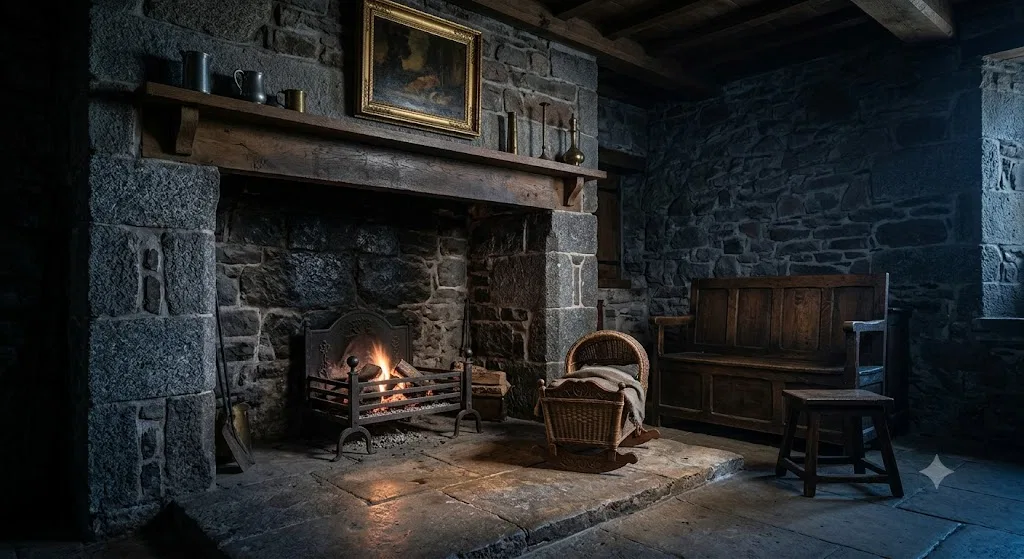
Crathes preserves one of Scotland's most memorable Green Lady traditions, centred on a fireplace, an infant and discovered bones.
On this page
- The Green Lady's Room and the fireplace story
- The child remains found beneath the hearthstone
- Why Trust preservation changes the legend's authority
Page outline Jump by section
Introduction
The Green Lady of Crathes is one of Kincardineshire’s most memorable castle hauntings because it is attached to a precise room, a precise object and a disturbing discovery: a fireplace in the Green Lady’s Room where a young woman is said to appear in a green dress, sometimes cradling an infant, and where bones were reportedly found beneath the hearthstone during nineteenth-century renovation work. The National Trust for Scotland, which cares for Crathes Castle, repeats the core tradition in its own visitor-facing material, making this more than a loose internet ghost story: it has become part of how the preserved tower house presents its past to the public.[National Trust for Scotland]nts.org.ukNational Trust for ScotlandGhosts of the TrustThe Green Lady's Room at Crathes is named after the spirit of a young woman who has often b…
Crathes Castle stands near Banchory in the historic county of Kincardineshire, though modern tourism sources usually place it in Aberdeenshire. Historic-county indexes and heritage records still connect the site to Kincardineshire, while the Trust describes the castle as a classic Scottish tower house built by the Burnett family, whose roots in the area go back to land granted by Robert the Bruce in 1323.[wikishire.co.uk]wikishire.co.ukCrathes CastleCrathes Castle11 Aug 2019 — Crathes Castle is a 16th-century castle near Banchory in Kincardineshire. It is a harled castle was… The haunting matters because it sits at the meeting point of family legend, visitor storytelling, architectural preservation and a very old social fear: the hidden child whose fate was concealed inside the fabric of a great house.
Where the Green Lady belongs at Crathes
The Crathes story is not a vague report of “something seen in the castle”. Its centre is the Green Lady’s Room, a named chamber associated with a fireplace. National Trust for Scotland accounts say the room takes its name from the spirit of a young woman who has often been seen by the fireplace wearing a green dress and holding an infant.[National Trust for Scotland]nts.org.ukNational Trust for ScotlandGhosts of the TrustThe Green Lady's Room at Crathes is named after the spirit of a young woman who has often b… Other castle-haunting summaries keep the same basic route: the apparition crosses the room and disappears at, beside or into the fireplace.[Great Castles]great-castles.comOpen source on great-castles.com.
That fixed geography gives the legend unusual force. Many haunted-castle traditions drift between corridors, staircases and battlements; Crathes narrows the fear to a hearth. A fireplace is a domestic centre rather than a dungeon or battlefield, so the story feels intimate. It suggests a secret in the household rather than an attack from outside. The woman is not usually described as a threatening spectre but as a sorrowful figure with a baby, and the room’s name turns a reported apparition into a regular feature of the visitor route.
Crathes itself strengthens that effect because it is a lived-in family house as well as a fortress. Historic Environment Scotland describes it as a modified L-plan tower house, four storeys with a vaulted basement, stair-turret, turrets and dates including 1553 and 1596; its garden and castle designation identifies Alexander Burnett as the builder in the second half of the sixteenth century.[Historic Environment Scotland]portal.historicenvironment.scotOpen source on historicenvironment.scot. The National Trust presents it as an intricate house of turrets, towers, oak panels and painted ceilings, many of which survive.[National Trust for Scotland]nts.org.ukOpen source on nts.org.uk. The Green Lady therefore appears not in a ruin open to the sky, but inside a preserved interior where room names, furniture, ceilings and family memory still shape the visitor’s imagination.
The fireplace story and the hidden child
The most important element in the Crathes legend is the reported discovery under the hearthstone. The National Trust for Scotland’s “Ghosts of the Trust” account states that when the castle was renovated in the 1800s, the bones of a child, presumed murdered, were discovered beneath the hearthstone of the fireplace in the Green Lady’s Room.[National Trust for Scotland]nts.org.ukNational Trust for ScotlandGhosts of the TrustThe Green Lady's Room at Crathes is named after the spirit of a young woman who has often b… A second Trust story repeats the same essentials: the young woman is seen by the fireplace with an infant, and bones of a child were found beneath the hearthstone during nineteenth-century renovation work.[National Trust for Scotland]nts.org.ukOpen source on nts.org.uk. The Trust’s “Spooky stories” version varies the detail, saying visitors often ask about the Green Lady and that bones of a woman and child were found under the hearthstone “centuries ago”; it also says that after the bones were removed, a greenish figure carrying a baby floated across the room and disappeared into the fireplace.[National Trust for Scotland]nts.org.ukOpen source on nts.org.uk.
That variation is important. In one version, the remains are those of a child. In another, they are those of a woman and child. Some secondary castle guides also note the uncertainty, describing either “a skeleton of a young woman and baby” or “just the infant itself” as reportedly found during nineteenth-century renovations.[The Castles of Scotland]thecastlesofscotland.co.ukOpen source on thecastlesofscotland.co.uk. The core tradition is stable — a Green Lady, a baby, a fireplace, hidden remains — but the forensic detail is not. For a careful haunted-history page, that means the story should be treated as a preserved tradition rather than as a documented murder case with settled evidence.
The suspected crime behind the story is usually framed as infanticide or concealment after an illicit birth. The National Trust’s Love Scotland podcast transcript presents the child under the hearth as possibly connected to infanticide, or some other murder, while keeping the language deliberately cautious: “supposedly”, “allegedly” and “possibly” are doing real work there.[National Trust for Scotland]nts.org.ukOpen source on nts.org.uk. Later popular tellings often make the woman a daughter of the Burnett household who fell in love beneath her social rank, bore a child and vanished, but that romantic plot is much harder to verify than the existence of the public-facing castle tradition.[Bitesized Folklore]bitesizedfolklore.comspirits of scotland the mystery of the green ladyspirits of scotland the mystery of the green lady
The fireplace gives the story its symbolism. A hearth is where a household gathers, cooks, warms itself and displays continuity. Concealing a child beneath it turns the safest place in the room into a sealed wound. Whether the discovery was recorded in a now-obscure estate account, remembered through staff tradition, or reshaped by later storytelling, the legend’s emotional logic is clear: the Green Lady returns to the place where the child was hidden because the house itself is imagined as keeping the secret.

Why the National Trust changes the story’s authority
Crathes is not merely a private castle with a rumour attached. It is a National Trust for Scotland property, open to visitors and presented through official heritage interpretation. The Trust says the Burnett family lived at Crathes for more than 350 years and that the castle is now one of its visitor properties; historic-county sources similarly note that the castle and grounds are owned and managed by the Trust.[National Trust for Scotland]nts.org.ukOpen source on nts.org.uk. This matters because institutional preservation changes how a ghost story circulates.
When a preservation body repeats a legend, it does not prove the apparition is real. It does, however, show that the story has become part of the site’s recognised cultural identity. The Green Lady is not an anonymous online addition but a named strand of the visitor experience. The National Trust includes her among its ghost stories, Crathes appears on its North East Castle Trail with the Green Lady’s Room highlighted, and the Trust’s own material acknowledges that visitors commonly ask whether anyone has seen her.[National Trust for Scotland]nts.org.ukOpen source on nts.org.uk.
This gives the Crathes tradition a different status from a purely sensational haunting list. A sceptical reader can still say, reasonably, that no public source proves a supernatural event. But the legend is anchored in an identifiable room, carried by the organisation that manages the castle, and attached to a reported physical discovery beneath the hearth. That combination helps explain why the story is locally famous: it feels both atmospheric and site-specific.
Trust preservation also affects the tone of the tale. Crathes is marketed as a family day out, a garden estate, an architectural treasure and a house of painted ceilings as much as a haunted castle.[National Trust for Scotland]nts.org.ukOpen source on nts.org.uk. The Green Lady therefore has to coexist with conservation, education and tourism. She is spooky, but she is also curated. Her room is not treated as a paranormal laboratory; it is part of a historic interior whose ghost story adds emotional texture to the building.
The room, the ceiling and the power of a preserved interior
The Green Lady’s Room is not only interesting because of the haunting. Crathes is known for its rare Scottish Renaissance painted ceilings, and the Green Lady’s Room is among the interiors associated with that survival. A National Trust castle page describes Crathes as rich in oak panels and painted ceilings, while other heritage summaries note that painted ceilings survive in several rooms, including the Green Lady’s Room.[National Trust for Scotland]nts.org.ukOpen source on nts.org.uk.
This matters for the haunting because preservation makes the room feel legible as a historic space. A ghost story in a heavily modernised room can feel detached from the past; at Crathes, the interior still invites the visitor to imagine the Burnett household moving through narrow chambers, staircases and heated rooms. The architecture does not prove the apparition, but it gives the legend a stage that looks old enough to carry it.
Historic Environment Scotland’s garden and designed landscape record also helps frame Crathes as a long-lived family seat rather than a decorative shell. It traces the Burnetts’ local roots to the fourteenth century, the castle’s construction in the late sixteenth century, later additions, nineteenth-century modernisation and the garden’s development.[Historic Environment Scotland]portal.historicenvironment.scotOpen source on historicenvironment.scot. That long continuity is exactly the kind of setting in which family secrets, servants’ stories and visitor rumours can become layered over one another until the difference between memory and performance is hard to untangle.
For a visitor, the most atmospheric detail is the movement of the apparition. Accounts usually describe the Green Lady as appearing near the fireplace, crossing the chamber and vanishing at the hearth or wall.[Great Castles]great-castles.comOpen source on great-castles.com. The route is short, almost repetitive, like a memory caught in a loop. That is a classic feature of many castle ghost stories: the figure does not explain itself, but repeats an action that later storytellers interpret through tragedy.
How old is the account?
The safest answer is that the main public form of the story is modern heritage folklore built around a reported nineteenth-century discovery, with some sources claiming earlier sightings. The National Trust’s central version places the bone discovery during renovations in the 1800s.[National Trust for Scotland]nts.org.ukNational Trust for ScotlandGhosts of the TrustThe Green Lady's Room at Crathes is named after the spirit of a young woman who has often b… A specialist castle guide says the ghost reportedly first appeared in the eighteenth century, but that detail is not as strongly supported in the accessible official material as the nineteenth-century hearthstone tradition.[The Castles of Scotland]thecastlesofscotland.co.ukOpen source on thecastlesofscotland.co.uk.
The often-repeated claim that Queen Victoria saw the Green Lady also needs careful handling. Several secondary and popular accounts say Victoria witnessed the apparition, sometimes describing a green mist or a figure carrying a child.[nts.org.uk]nts.org.ukautumn highlights in scotlandautumn highlights in scotland The Trust’s autumn highlights page uses cautious phrasing: Queen Victoria is “said to have seen” the Green Lady during her stay.[National Trust for Scotland]nts.org.ukautumn highlights in scotlandautumn highlights in scotland That wording is significant. It marks the story as part of the tradition rather than as a directly quoted diary entry in the sources available here.
The chronology therefore has three layers:
- The sixteenth-century house: Crathes was built for the Burnetts in the later 1500s, with dates including 1553 and 1596 still associated with the building.[Historic Environment Scotland]portal.historicenvironment.scotOpen source on historicenvironment.scot.
- The nineteenth-century discovery: the hearthstone story places hidden child remains during renovation work in the 1800s.[National Trust for Scotland]nts.org.ukNational Trust for ScotlandGhosts of the TrustThe Green Lady's Room at Crathes is named after the spirit of a young woman who has often b…
- The modern visitor legend: the Green Lady is now part of National Trust storytelling, tourist articles and haunted-castle culture.[National Trust for Scotland]nts.org.ukOpen source on nts.org.uk.
That layered chronology is part of the reason the legend endures. It is old enough to feel rooted, recent enough to be actively interpreted, and uncertain enough to invite retelling.

Who was the Green Lady supposed to be?
No source settles the Green Lady’s identity. The strongest responsible answer is that she is an unnamed young woman in local tradition, later connected by storytellers to a hidden or murdered infant. The National Trust material describes the figure rather than naming her: a young woman in green, cradling an infant, seen by the fireplace.[National Trust for Scotland]nts.org.ukNational Trust for ScotlandGhosts of the TrustThe Green Lady's Room at Crathes is named after the spirit of a young woman who has often b…
Popular versions add a fuller tragedy. One recurring version says she was a daughter of a Burnett laird who became pregnant after a forbidden relationship, sometimes with a stable boy or servant; after the birth, mother and child disappeared.[Bitesized Folklore]bitesizedfolklore.comspirits of scotland the mystery of the green ladyspirits of scotland the mystery of the green lady This has the shape of a familiar landed-house legend: class boundaries, sexual shame, patriarchal punishment, a concealed pregnancy and a restless mother. It is emotionally persuasive, but it should not be mistaken for verified biography unless supported by names, dates and documents.
There is also some confusion caused by other “lady” traditions at Crathes and in Scotland more widely. Some articles refer to two lady ghosts of Crathes, and one local folklore summary separates the famous Green Lady of the room from another female apparition sometimes linked to Bertha de Bernard.[Hidden Scotland]hiddenscotland.comOpen source on hiddenscotland.com. For this page, the relevant figure is the Green Lady of the room and fireplace, not every female spectre attached to the estate.
The colour green also connects Crathes to a wider Scottish and British ghost pattern. “Green Lady” apparitions are reported at several castles, including other Scottish sites.[Wikipedia]WikipediaGreen LadyGreen Lady That does not make the Crathes story generic, but it does show that later audiences already knew how to read a green-clad female apparition: sorrowful, liminal, often bound to a house, a family or a death secret.
What makes the hidden child motif so powerful?
The hidden child is the reason Crathes stands out among Scottish Green Lady stories. A woman in a coloured dress is common in ghost lore; a woman and infant tied to bones beneath a hearthstone is much more specific. The discovery gives the haunting a physical pivot, even though the available sources do not provide enough detail to verify exactly whose remains were found, when, by whom, or how they were identified.
The motif speaks to real historical fears. In earlier centuries, pregnancy outside marriage could bring severe social shame, especially in households obsessed with inheritance, reputation and rank. An infant hidden in a house’s fabric suggests not just death but concealment by people with something to lose. The Green Lady’s repeated movement to the fireplace then becomes a story about exposure: what was buried under the hearth returns above it.
At the same time, the story’s very neatness should make readers cautious. Folklore often takes an ambiguous discovery and supplies the emotionally satisfying explanation. Bones under a hearthstone could generate many possibilities, from criminal concealment to misremembered renovation lore, disturbed burials, animal remains misidentified in retelling, or later embellishment. The National Trust’s own variations — child bones in one version, woman and child in another — show how oral tradition can preserve a powerful image while shifting its details.[National Trust for Scotland]nts.org.ukNational Trust for ScotlandGhosts of the TrustThe Green Lady's Room at Crathes is named after the spirit of a young woman who has often b…
That uncertainty does not weaken the legend as folklore. It is exactly what makes it useful haunted history. The Crathes story reveals how a historic house absorbs unresolved questions: who was she, whose child was hidden, why the hearth, and why does the apparition keep returning to the same domestic point?
How credible is the haunting?
The credible part is the existence of the tradition, not the proof of a ghost. Crathes Castle is real, the Green Lady’s Room is a recognised part of the castle’s visitor identity, the National Trust for Scotland repeats the apparition-and-hearthstone story, and heritage records firmly establish the castle’s age, family associations and preserved status.[National Trust for Scotland]nts.org.ukNational Trust for ScotlandGhosts of the TrustThe Green Lady's Room at Crathes is named after the spirit of a young woman who has often b… Those are strong anchors for a public folklore page.
The uncertain part is everything that turns the tradition into a solved supernatural case. The available public sources do not establish a named woman, a named child, a coroner-like record, a precise renovation date, or an unbroken chain from the alleged discovery to the modern ghost account. The Queen Victoria sighting is also usually phrased as “said to have” rather than presented with a primary citation.[National Trust for Scotland]nts.org.ukautumn highlights in scotlandautumn highlights in scotland
A balanced reading is therefore:
- As heritage folklore, the story is strong. It is site-specific, institutionally preserved and known to visitors.
- As family history, it is suggestive but unresolved. The Burnett connection gives the story a social world, but not a confirmed identity for the woman.
- As evidence of a supernatural apparition, it remains a claim. The reports are meaningful as testimony and tradition, not proof.
Sceptical explanations do not need to be dismissive. A dim historic room, a famous name, a fireplace already linked to bones and repeated visitor expectation can all shape what people notice or remember. Yet the legend’s survival is not just a mistake of perception. It is a cultural fact at Crathes: a story people ask about, guides retell, and heritage bodies preserve because it has become part of the castle’s meaning.[National Trust for Scotland]nts.org.ukOpen source on nts.org.uk.
Why Crathes matters in Kincardineshire’s haunted map
Within Kincardineshire’s haunted geography, Crathes plays a different role from Dunnottar or other dramatic coastal sites. Dunnottar’s ghost stories draw strength from cliffs, siege, imprisonment and ruin. Crathes is more domestic: a family seat, a room, a hearth, a mother and a hidden child. That makes it one of the county’s most intimate hauntings.
The modern boundary label can confuse readers. Crathes is commonly marketed in Aberdeenshire and Royal Deeside contexts, and the National Trust gives its visitor address as Banchory, Aberdeenshire.[National Trust for Scotland]nts.org.ukOpen source on nts.org.uk. Historic-county sources, however, place Crathes Castle near Banchory in Kincardineshire, and Trove’s place record lists its former county as Kincardineshire.[Wikishire]wikishire.co.ukCrathes CastleCrathes Castle11 Aug 2019 — Crathes Castle is a 16th-century castle near Banchory in Kincardineshire. It is a harled castle was… For a historic-county haunted-history project, it belongs naturally in the Kincardineshire branch while acknowledging the modern Aberdeenshire label used by visitors today.
The Green Lady also shows how preservation can make a ghost more durable. Ruins often leave stories exposed to weather and speculation; Crathes keeps the story indoors, attached to a named room in a maintained castle. The result is a haunting that feels almost curated but not defanged. The visitor is not merely told that a ghost exists somewhere on the estate. They are directed, imaginatively, to a fireplace where a woman in green is said to have appeared with a baby in her arms — and to a hearthstone beneath which a child was reportedly hidden.
Amazon book picks
Further Reading
Books and field guides related to Who Is the Green Lady of Crathes?. Use these as the next step if you want deeper reading beyond the article.
Scottish Ghost Stories
Strong fit for readers interested in famous Scottish castle ghosts.
The world's most haunted places
Broadens interest from one castle to famous hauntings worldwide.
eBay marketplace picks
Marketplace Samples
Live-tested eBay searches with available results related to this page.
Endnotes
1.
Source: trove.scot
Link:https://www.trove.scot/place/36693
2.
Source: great-castles.com
Link:https://great-castles.com/crathesghost.html
3.
Source: Wikipedia
Title: Crathes Castle
Link:https://en.wikipedia.org/wiki/Crathes_Castle
4.
Source: Wikipedia
Title: Green Lady
Link:https://en.wikipedia.org/wiki/Green_Lady
5.
Source: trove.scot
Link:https://www.trove.scot/designation/GDL00119
6.
Source: trove.scot
Link:https://www.trove.scot/place/339702
7.
Source: youtube.com
Title: The Green Lady of Crathes Castle
Link:https://www.youtube.com/watch?v=Xy4feYY7zcA
Source snippet
Crathes Castle - The Green Lady...
8.
Source: youtube.com
Title: Crathes Castle
Link:https://www.youtube.com/watch?v=D3ujAeZ_Fgw
Source snippet
Generally Spooky History - Crathes Castle...
9.
Source: nts.org.uk
Link:https://www.nts.org.uk/stories/ghosts-of-the-trust
Source snippet
National Trust for ScotlandGhosts of the TrustThe Green Lady's Room at Crathes is named after the spirit of a young woman who has often b...
10.
Source: wikishire.co.uk
Title: Crathes Castle
Link:https://wikishire.co.uk/wiki/Crathes_Castle
Source snippet
Crathes Castle11 Aug 2019 — Crathes Castle is a 16th-century castle near Banchory in Kincardineshire. It is a harled castle was...
11.
Source: nts.org.uk
Link:https://www.nts.org.uk/visit/places/crathes-castle
12.
Source: thecastlesofscotland.co.uk
Link:https://www.thecastlesofscotland.co.uk/the-best-castles/grand-castles/crathes-castle/
13.
Source: portal.historicenvironment.scot
Link:https://portal.historicenvironment.scot/apex/f?p=1505%3A300%3A%3A%3A%3A%3AVIEWTYPE%2CVIEWREF%3Adesignation%2CLB3262
14.
Source: portal.historicenvironment.scot
Link:https://portal.historicenvironment.scot/apex/f?p=1505%3A300%3A%3A%3A%3A%3AVIEWTYPE%2CVIEWREF%3Adesignation%2CGDL00119
15.
Source: nts.org.uk
Link:https://www.nts.org.uk/visit/places/crathes-castle/highlights/castle
16.
Source: nts.org.uk
Link:https://www.nts.org.uk/stories/scottish-ghost-stories-witches-murder-and-folklore-part-2
17.
Source: nts.org.uk
Link:https://www.nts.org.uk/stories/spooky-stories
18.
Source: nts.org.uk
Link:https://www.nts.org.uk/stories/love-scotland-podcast-season-4
19.
Source: bitesizedfolklore.com
Title: spirits of scotland the mystery of the green lady
Link:https://bitesizedfolklore.com/episode/spirits-of-scotland-the-mystery-of-the-green-lady
20.
Source: hiddenscotland.com
Link:https://hiddenscotland.com/stories/the-green-lady-of-crathes-castle
21.
Source: nts.org.uk
Link:https://www.nts.org.uk/visit/things-to-do/north-east-castle-trail
22.
Source: nts.org.uk
Link:https://www.nts.org.uk/visit/places/crathes-castle/planning-your-visit
23.
Source: nts.org.uk
Title: autumn highlights in scotland
Link:https://www.nts.org.uk/stories/autumn-highlights-in-scotland
24.
Source: icysedgwick.com
Title: green lady
Link:https://www.icysedgwick.com/green-lady/
25.
Source: hiddenscotland.com
Link:https://hiddenscotland.com/journal/the-two-lady-ghosts-of-crathes-castle
26.
Source: facebook.com
Link:https://www.facebook.com/CrathesNTS/photos/the-castles-nursery-also-known-as-the-green-ladys-room-is-said-to-be-haunted-by-/2158320877590823/
27.
Source: nts.org.uk
Link:https://www.nts.org.uk/stories/love-scotland-podcast-season-6
28.
Source: nts.org.uk
Link:https://www.nts.org.uk/visit/places/crathes-castle/overview
29.
Source: nts.org.uk
Title: a tale of two tower houses crathes castle
Link:https://www.nts.org.uk/stories/a-tale-of-two-tower-houses-crathes-castle
30.
Source: crathescastle.weebly.com
Title: crathes castle
Link:https://crathescastle.weebly.com/crathes-castle.html
31.
Source: wikishire.co.uk
Link:https://wikishire.co.uk/wiki/Kincardineshire
32.
Source: catherinecavendish.com
Title: the green lady of crathes
Link:https://www.catherinecavendish.com/2019/04/the-green-lady-of-crathes.html
33.
Source: catherinecavendish.com
Title: the green lady of crathes
Link:https://www.catherinecavendish.com/2026/05/the-green-lady-of-crathes.html?m=1
34.
Source: scottish6days.com
Title: crathes castle
Link:https://scottish6days.com/2017/crathes-castle.html
Additional References
35.
Source: reddit.com
Link:https://www.reddit.com/r/Ghosts/comments/18drv7a/a_closer_look_at_the_green_of_crathes_castle/
36.
Source: facebook.com
Link:https://www.facebook.com/NationalTrustforScotland/posts/are-these-the-most-haunted-places-in-our-care-crathes-castle-the-green-lady-is-o/1246451790843901/
37.
Source: instagram.com
Link:https://www.instagram.com/p/DQbJyLBjJWO/
38.
Source: gazetteer.org.uk
Link:https://gazetteer.org.uk/place/Banchory%2C_Kincardineshire_2224
39.
Source: lacf.ca
Link:https://lacf.ca/sites/default/files/documents/portfolio/crathes_castle_final.pdf
40.
Source: nationalgalleries.org
Link:https://www.nationalgalleries.org/art-and-artists/27752
41.
Source: facebook.com
Link:https://www.facebook.com/groups/190361953307423/posts/1232267029116905/
42.
Source: instagram.com
Link:https://www.instagram.com/p/DI8G75-C1_R/
43.
Source: instagram.com
Link:https://www.instagram.com/reel/DO2n0DJkSr5/
44.
Source: facebook.com
Link:https://www.facebook.com/100083218874573/posts/crathes-castle-in-aberdeenshire-scotland/940133688770585/
Topic Tree