Within Haunted Nairnshire
Why Does Auldearn Feel So Eerily Remembered?
Auldearn's supernatural reputation rests less on castle legend than on Isobel Gowdie's 1662 witchcraft confessions and their afterlife.
On this page
- Isobel Gowdie and the 1662 confessions
- Witch trial records and disputed meanings
- Auldearn's wider haunted landscape
Page outline Jump by section
Introduction
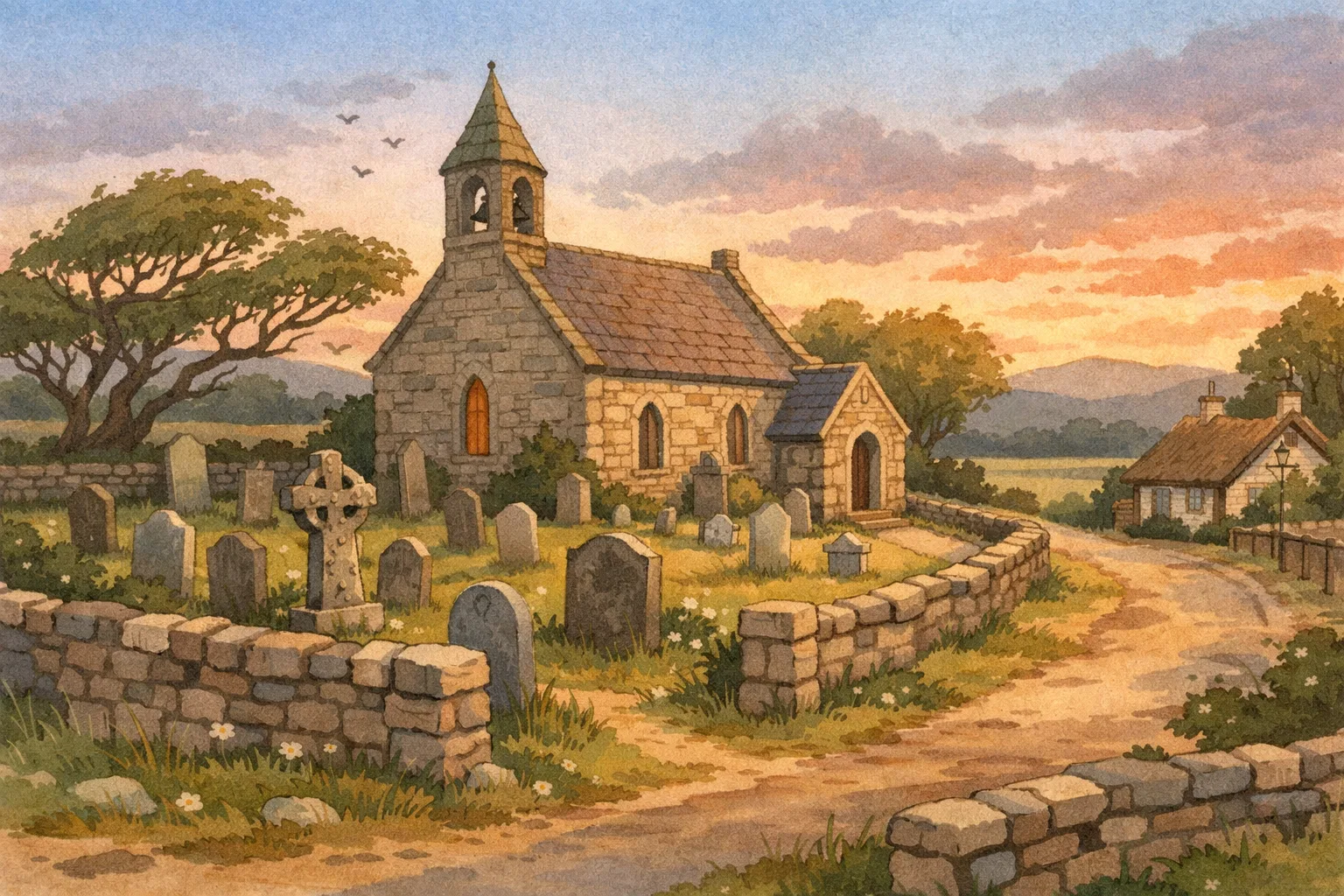
Auldearn feels eerily remembered because its most famous supernatural story is not a tidy castle ghost, but the afterlife of a real witch-trial record. In 1662, Isobel Gowdie of the Lochloy area near Auldearn gave a series of extraordinary witchcraft confessions involving the Auldearn kirk, fairy beings, hare-shifting, elf arrows, charms, covens, the Devil, neighbours, ministers, and local places around Nairnshire. The University of Edinburgh’s Survey of Scottish Witchcraft records her case under Auldearn and notes details such as the kirk meeting, the named spirits, the claim of a thirteen-person coven, and the unusual richness of the testimony.[Witches]witches.hca.ed.ac.ukWitchesthe case of Issobell GowdieHe was at the reader's desk with a black book in his hand. He baptised her with blood he sucked out of her Devil's…
That makes Auldearn’s haunted reputation unusually complicated. The “Green Lady” or restless Isobel sometimes said to haunt Auldearn and Nairn belongs to later folklore and dark-tourism memory, not to a securely documented apparition tradition. The stronger evidence is the historical record itself: a frightening glimpse of how local belief, pressure, storytelling, fear of witchcraft, and social power could turn a Nairnshire parish into one of Scotland’s most memorable witch-trial landscapes.[Nairn Scotland]nairnscotland.co.ukNairn Scotland Isobel GowdieNairn ScotlandIsobel Gowdie - the Green Witch of Auldearn - NairnSeptember 8, 2024 — A short article about Isobel Gowdie, giving details…
Isobel Gowdie and the 1662 confessions
Isobel Gowdie was a farm labourer’s wife from the Lochloy area, a few miles from Auldearn, and her life before the trial is obscure. The Survey of Scottish Witchcraft identifies her as “Issobell Gowdie” and places the case in 1662; local heritage accounts place her within the Nairnshire parish of Auldearn and describe her as one of at least seven people tried there during the Scottish witch-hunting period.[Witches]witches.hca.ed.ac.ukOpen source on ed.ac.uk.
What made her famous was not a later ghost sighting but four confessions made over several weeks. Robert Pitcairn printed the confessions in Ancient Criminal Trials in Scotland in 1833, after which they became a major source for historians and folklorists. The texts were remarkable because they were so detailed, so place-specific, and so thick with supernatural imagery compared with many other Scottish witch-trial records.[Internet Archive]archive.orgOpen source on archive.org.
The first confession is especially important for Auldearn’s haunted geography. It opens in the parish setting, with the minister Harry Forbes and local witnesses present, and it places a central supernatural encounter in the kirk at Auldearn. A later transcription of Pitcairn’s text gives the setting as Auldearn on 13 April 1662, in the presence of the minister, the sheriff depute, local lairds and witnesses, before Gowdie’s confession begins.[Stuart McHardy]stuartmchardy.wordpress.comStuart Mc Hardy Isobel GowdieStuart Mc Hardy Isobel Gowdie
The story she gave her interrogators is now part of the village’s eerie memory. She described meeting the Devil in the Auldearn kirk, renouncing her baptism, being marked, and joining others in witchcraft. The University of Edinburgh case summary records the kirk scene, the blood-marking, the named spirit “The read reiver”, and other spirit descriptions.[Witches]witches.hca.ed.ac.ukWitchesthe case of Issobell GowdieHe was at the reader's desk with a black book in his hand. He baptised her with blood he sucked out of her Devil's…
For a haunted-history reader, the crucial point is this: Auldearn’s supernatural reputation comes from a documented confession culture, not from a simple “someone saw a ghost in the churchyard” tradition. The kirk, the village, Lochloy, Inshoch, Nairn and neighbouring farms became memorable because they were named inside a legal and religious crisis. The uncanny landscape was written into the record by interrogation, fear and storytelling.
Why the records feel more folkloric than ordinary court evidence
Gowdie’s confessions are unsettling because they read partly like prosecution evidence and partly like a dense folktale. She spoke of covens, meetings, charms, spirits, shape-changing and attacks by magical means. The Survey of Scottish Witchcraft notes that she claimed a coven of thirteen, described dancing with another coven, and gave unusually elaborate accounts of supernatural actions.[Witches]witches.hca.ed.ac.ukWitchesthe case of Issobell GowdieHe was at the reader's desk with a black book in his hand. He baptised her with blood he sucked out of her Devil's…
Several motifs have made the Auldearn case famous far beyond Nairnshire. One is hare-shifting: Gowdie described being sent on an errand in the shape of a hare, pursued by dogs, and then returning to human form. Another is the idea of “elf arrows”, supernatural missiles used to harm people or livestock. Folklore discussions of the case connect these arrows with a wider British and Irish belief in fairy-shot or elf-shot, often associated in later antiquarian explanation with prehistoric flint arrowheads.[stevepattersonantiquarian.com]stevepattersonantiquarian.comOpen source on stevepattersonantiquarian.com.
This is why the case matters to haunted folklore. Gowdie’s testimony does not simply repeat official demonology; it blends church-centred fears of the Devil with older fairy and spirit material. Her story contains the frightening authority of a courtroom, but also the imagery of local belief: hills, animals, night journeys, hidden meetings, named spirits and invisible harms. That mixture is what gives Auldearn its peculiar atmosphere.
It is also why the records must be handled carefully. A confession in a witch trial is not neutral autobiography. It was produced in a world where witchcraft was a capital offence, ministers and lairds had strong expectations about what witches were supposed to do, and accused people could be isolated, pressured, deprived of sleep, searched, humiliated or worse. Historic Environment Scotland summarises the wider legal setting: Scotland’s 1563 Witchcraft Act brought a century and a half of witch hunts, with the death penalty attached to witchcraft offences.[Historic Environment Scotland Blog]blog.historicenvironment.scotthe witchcraft act and its impact in scotlandthe witchcraft act and its impact in scotland
The safest reading is not that Gowdie’s supernatural claims “really happened”, nor that they are worthless inventions. They preserve, in distorted and dangerous form, the fears, images and social tensions of a 17th-century Nairnshire community.
Witch-trial records and disputed meanings
The meaning of Gowdie’s confessions has been disputed for nearly two centuries. Pitcairn’s 1833 publication made the material accessible to later readers; modern databases and studies have made it easier to place the case within Scotland’s broader witch-hunting history. The Survey of Scottish Witchcraft was created to catalogue people accused between 1563 and 1736, and its data remains one of the most useful starting points for checking names, places, accusations and trial patterns.[Witches]witches.hca.ed.ac.ukOpen source on ed.ac.uk.
One dispute concerns coercion. Some accounts stress that the confessions claimed to be voluntary, but that does not settle the matter for modern readers. A person could be legally described as confessing without “compulsion” while still being under intense psychological, social and custodial pressure. Local and popular accounts often suggest solitary confinement, fear, sleep deprivation or other pressure; the more cautious position is that the surviving record cannot prove every detail of what happened to her in custody.[Spooky Scotland]spookyscotland.netSpooky Scotland The trial of Isobel Gowdie Scotland's 'Queen of WitchesSpooky Scotland The trial of Isobel Gowdie Scotland's 'Queen of Witches
Another dispute concerns Gowdie’s voice. Was she mentally distressed, repeating what interrogators wanted, drawing on remembered tales, or shaping a powerful narrative from the beliefs around her? The answer may not be a single choice. Women’s History Scotland, discussing Kirsty McGrory’s analysis, treats the testimony as a “subversive fantasy” that can be read for power, gender and imagination as well as for prosecution history.[womenshistoryscotland.org]womenshistoryscotland.orgguest blog kirsty mcgrory the subversive fantasy of isobel gowdieguest blog kirsty mcgrory the subversive fantasy of isobel gowdie
A further dispute concerns later romanticisation. Gowdie is sometimes called Scotland’s “Queen of Witches” or imagined as a healer, midwife, pagan survivor or green-clad spirit. Some of those ideas are modern interpretations rather than facts securely demonstrated by the trial record. Spooky Scotland, while written for a popular audience, usefully warns that details from later fiction have often been mistaken for biography, including claims about her appearance, class background and marriage that are not actually known from the records.[Spooky Scotland]spookyscotland.netSpooky Scotland The trial of Isobel Gowdie Scotland's 'Queen of WitchesSpooky Scotland The trial of Isobel Gowdie Scotland's 'Queen of Witches
For haunted-history purposes, that distinction is essential. Auldearn’s story is powerful enough without turning Isobel Gowdie into whatever modern readers want her to be. The historical Isobel is faintly visible: a woman from Lochloy, married to John Gilbert, caught in a deadly legal process. The folkloric Isobel is much larger: hare, witch, victim, narrator, ghost, green woman, local emblem and warning.
The “Green Lady” and the making of a haunted Auldearn
The ghost tradition attached to Gowdie is comparatively thin but persistent. Local tourism material says some people speak of her ghost as a “green lady” haunting the area around Auldearn and Nairn. Nairn-focused visitor writing similarly describes sightings of a green lady or restless soul roaming Auldearn and Nairn, while also linking the story to uncertainty over Gowdie’s fate.[Discover Highlands and Islands]discoverhighlandsandislands.scotDiscover Highlands and Islands Isobel GowdieDiscover Highlands and Islands Isobel Gowdie
This is not the same as a well-documented series of dated witness reports. The Green Lady belongs more to commemorative folklore: a way of giving emotional shape to an unresolved injustice. The trial record does not clearly preserve her execution, and the absence of a known burial or final scene leaves a gap into which ghost tradition can easily move. Where a castle ghost may be tied to a room, window or staircase, Gowdie’s ghost is tied to memory itself: the kirk, the village, the imagined road to execution, the old parish landscape and the discomfort of not knowing exactly what became of her.
The colour green also matters symbolically, even where the evidence is folkloric rather than documentary. It fits a later image of the “green witch”, the land, healing, fairy association and the uncanny natural world. But readers should treat that as interpretive afterlife, not as a proven 17th-century identity. The historical documents show an accused woman and a web of claims; the Green Lady tradition shows how later people tried to feel, mourn and retell that history.
That is why Auldearn’s haunting is different from the handless apparition at Rait Castle or the theatrical ghostly traditions around Cawdor. The eerie force here is not a single repeated apparition. It is the transformation of a court document into local legend.

Auldearn’s wider haunted landscape
Auldearn’s supernatural memory sits beside another dark historical layer: the Battle of Auldearn, fought on 9 May 1645 during the Civil Wars. Historic Environment Scotland describes the battle as a major Royalist victory over a Covenanter army and notes that the battlefield inventory includes Auldearn village itself, Boath House parkland, ground west of the village, and the area around Dooket Hill.[Historic Environment Scotland]portal.historicenvironment.scotHistoric Environment Scotland Battle of Auldearn (BTL3Historic Environment Scotland Battle of Auldearn (BTL3
The Battlefields Trust places the battlefield in the western part of the village and the land to the west and south, including Garlic Hill and Dead Wood, and describes the Royalist victory over a superior Covenanter force. Highland Council’s historic environment record also locates decisive action between Garlic Hill and the village.[Battlefields Trust]battlefieldstrust.comBattlefields Trust Battle of AuldearnBattlefields Trust Battle of Auldearn
This matters because Gowdie’s confessions came only seventeen years after the battle. The page should not turn into a battlefield-haunting article, but the proximity is important. Auldearn was not an abstract “witch village”; it was a place that had recently experienced war, fear, religious division and political violence. Later readers have understandably sensed a connection between the battle-scarred landscape and the witch-trial atmosphere, even though the sources do not prove a direct line from battlefield trauma to Gowdie’s testimony.[Ailish Sinclair]ailishsinclair.comAilish Sinclair The Battle of Auldearn and Dead Man's WoodAilish Sinclair The Battle of Auldearn and Dead Man's Wood
Several Auldearn places therefore carry overlapping meanings:
- The Auld Kirk is remembered through Gowdie’s confession of a night meeting and renunciation.
- Lochloy anchors her ordinary life before the trial, making the story local rather than legendary in the abstract.
- Inshoch appears in the wider trial network, including the detention of Janet Breadhead in some accounts.
- Gallowhill, outside Auldearn, is locally associated with execution tradition, though Gowdie’s final fate is not securely recorded.
- Garlic Hill, Dead Wood and the village battlefield connect Auldearn to the violence of 1645, giving the area a second layer of remembered unease.[nairnscotland.co.uk]nairnscotland.co.ukNairn Scotland Isobel GowdieNairn ScotlandIsobel Gowdie - the Green Witch of Auldearn - NairnSeptember 8, 2024 — A short article about Isobel Gowdie, giving details…
The result is a Nairnshire landscape where haunting is less about one haunted building than about compression: kirk, battlefield, trial, village square, mural, local museum memory and old rural routes all close together.
How credible is the haunting tradition?
The credible core of the Auldearn story is strong: Isobel Gowdie was a real accused woman; her case is recorded in the Survey of Scottish Witchcraft; Pitcairn printed the confessions in the 19th century; and the Auldearn kirk, local witnesses, Lochloy, Nairnshire and named supernatural motifs belong to the historical record.[ed.ac.uk]witches.hca.ed.ac.ukOpen source on ed.ac.uk.
The ghost element is weaker as evidence but meaningful as folklore. Claims that Gowdie’s Green Lady haunts Auldearn and Nairn are best treated as local tradition and modern memory, not as verified paranormal fact. They show how a community and its visitors have turned a disturbing trial into a haunting narrative, especially because her fate remains uncertain and because Scotland has increasingly re-examined the injustice of witchcraft prosecutions.[Discover Highlands and Islands]discoverhighlandsandislands.scotDiscover Highlands and Islands Isobel GowdieDiscover Highlands and Islands Isobel Gowdie
A careful reader should separate four layers:
The documented layer: the 1662 case, the confessions, named officials, trial process and Scottish witch-law context.
The folkloric layer: hares, elf arrows, fairy encounters, spirits, charms and shape-changing motifs preserved inside the testimony.
The commemorative layer: murals, museum interpretation, local tourism, musical and literary afterlives, and national conversations about remembering accused witches.
The ghost layer: the Green Lady or restless Isobel tradition, which is atmospheric and locally resonant but not strongly evidenced by dated witness testimony.
This layered reading makes Auldearn more interesting, not less. It allows the place to be eerie without being credulous, and historically grounded without losing the chill of the story.

Why Auldearn still feels so eerily remembered
Auldearn’s haunted folklore endures because the story has no clean ending. Isobel Gowdie’s confessions survive; her inner life does not. The law that made witchcraft a capital offence is gone; the documents remain. The kirk and landscape can still be visited; the events that gave them their eerie charge are morally distant and emotionally close.
Modern Scotland has also been rethinking witch-trial memory more broadly. Historic Environment Scotland has highlighted the destructive impact of the 1563 Witchcraft Act, and recent Scottish Government material refers to petitions seeking to pardon and memorialise those convicted under it.[Historic Environment Scotland Blog]blog.historicenvironment.scotthe witchcraft act and its impact in scotlandthe witchcraft act and its impact in scotland
In that setting, Auldearn’s ghost story is not merely a spooky add-on. It is a sign of unfinished remembrance. The Green Lady matters less as proof of a haunting than as a figure for unease: a woman made famous by a system that could turn fear, doctrine and local grievance into a death sentence.
For Nairnshire’s haunted map, Auldearn therefore occupies a distinctive place. Rait Castle offers a blood-soaked legend; Cawdor offers literary and castle-haunting associations; the Auldearn battlefield offers civil-war memory. Auldearn’s witch-trial folklore offers something sharper: a documented encounter between ordinary local life and the supernatural imagination of a dangerous age. Its haunting is the sound of a record that still will not lie quietly.
Amazon book picks
Further Reading
Books and field guides related to Why Does Auldearn Feel So Eerily Remembered?. Use these as the next step if you want deeper reading beyond the article.


Scottish Witches and Witch-Hunters
Explores Scottish witchcraft beliefs that shaped Gowdie's case.

Scottish Myths and Legends
First published 2009. Subjects: Tales, Legends, Folklore, Legends, scotland.
eBay marketplace picks
Marketplace Samples
Live-tested eBay searches with available results related to this page.
Endnotes
1.
Source: archive.org
Link:https://archive.org/stream/ancientcrim43pt203pitcuoft/ancientcrim43pt203pitcuoft_djvu.txt
2.
Source: stevepattersonantiquarian.com
Link:https://www.stevepattersonantiquarian.com/scottish-witchcraft.html
3.
Source: womenshistoryscotland.org
Title: guest blog kirsty mcgrory the subversive fantasy of isobel gowdie
Link:https://womenshistoryscotland.org/2019/05/10/guest-blog-kirsty-mcgrory-the-subversive-fantasy-of-isobel-gowdie/
4.
Source: youtube.com
Title: Tales Along The Old Corpse Road
Link:https://www.youtube.com/watch?v=feBQSrcENRE
Source snippet
Witches, Magic, Murder, & Mystery Podcast, Ep. 81: Isobel Gowdie, Most Imaginative Witch...
5.
Source: youtube.com
Link:https://www.youtube.com/watch?v=vyi0BKvqaQ8
Source snippet
Scottish Witch Danced With Fairy Queen...
6.
Source: witches.hca.ed.ac.uk
Title: Witchesthe case of Issobell Gowdie
Link:https://witches.hca.ed.ac.uk/case/C/EGD/1558
Source snippet
He was at the reader's desk with a black book in his hand. He baptised her with blood he sucked out of her Devil's...
7.
Source: nairnscotland.co.uk
Title: Nairn Scotland Isobel Gowdie
Link:https://nairnscotland.co.uk/dark-tourism-isobel-gowdie-cloned-9191/
Source snippet
Nairn ScotlandIsobel Gowdie - the Green Witch of Auldearn - NairnSeptember 8, 2024 — A short article about Isobel Gowdie, giving details...
Published: September 8, 2024
8.
Source: discoverhighlandsandislands.scot
Title: Discover Highlands and Islands Isobel Gowdie
Link:https://discoverhighlandsandislands.scot/en/story/isobel-gowdie-witch-of-auldearn
9.
Source: witches.hca.ed.ac.uk
Link:https://witches.hca.ed.ac.uk/trial/T/JO/1001
10.
Source: stuartmchardy.wordpress.com
Title: Stuart Mc Hardy Isobel Gowdie
Link:https://stuartmchardy.wordpress.com/2013/04/02/isobel-gowdie/
11.
Source: blog.historicenvironment.scot
Title: the witchcraft act and its impact in scotland
Link:https://blog.historicenvironment.scot/2022/06/the-witchcraft-act-and-its-impact-in-scotland/
12.
Source: witches.hca.ed.ac.uk
Link:https://witches.hca.ed.ac.uk/
13.
Source: spookyscotland.net
Title: Spooky Scotland The trial of Isobel Gowdie Scotland’s ‘Queen of Witches’
Link:https://spookyscotland.net/isobel-gowdie/
14.
Source: portal.historicenvironment.scot
Title: Historic Environment Scotland Battle of Auldearn (BTL3)
Link:https://portal.historicenvironment.scot/apex/f?p=1505%3A300%3A%3A%3A%3A%3AVIEWTYPE%2CVIEWREF%3Adesignation%2CBTL3
15.
Source: battlefieldstrust.com
Title: Battlefields Trust Battle of Auldearn
Link:https://www.battlefieldstrust.com/resource-centre/battleview.asp?BattleFieldId=54
16.
Source: ailishsinclair.com
Title: Ailish Sinclair The Battle of Auldearn and Dead Man’s Wood
Link:https://ailishsinclair.com/2026/06/the-battle-of-auldearn-and-dead-mans-wood/
17.
Source: Wikipedia
Title: Isobel Gowdie
Link:https://en.wikipedia.org/wiki/Isobel_Gowdie
18.
Source: Wikipedia
Title: Battle of Auldearn
Link:https://en.wikipedia.org/wiki/Battle_of_Auldearn
19.
Source: Wikipedia
Title: Survey of Scottish Witchcraft
Link:https://en.wikipedia.org/wiki/Survey_of_Scottish_Witchcraft
20.
Source: Wikipedia
Title: Witches of Scotland
Link:https://en.wikipedia.org/wiki/Witches_of_Scotland
21.
Source: witches.hca.ed.ac.uk
Link:https://witches.hca.ed.ac.uk/faq/
22.
Source: battlefieldstrust.com
Link:https://www.battlefieldstrust.com/media/590.pdf
23.
Source: battlefieldstrust.com
Link:https://www.battlefieldstrust.com/resource-centre/printer/battleview.asp?BattleFieldId=54&Trail=Home+%26gt%3BThe+Civil+Wars%26nbsp%3B%26gt%3BThe+Battle+of+Battle+of+Auldearn
24.
Source: witchesofscotland.com
Link:https://www.witchesofscotland.com/about
25.
Source: witchesofscotland.com
Link:https://www.witchesofscotland.com/
26.
Source: scottishwitches.com
Title: Isobel Gowdie
Link:https://www.scottishwitches.com/post/isobel-gowdie
27.
Source: historic-uk.com
Title: The Battle of Auldearn
Link:https://www.historic-uk.com/HistoryMagazine/DestinationsUK/The-Battle-of-Auldearn/
28.
Source: spookyscotland.net
Title: haunted highlands
Link:https://spookyscotland.net/haunted-highlands/
29.
Source: atlasobscura.com
Title: witches scotland pardon apology
Link:https://www.atlasobscura.com/articles/witches-scotland-pardon-apology
30.
Source: rse.org.uk
Title: witches of scotland
Link:https://rse.org.uk/resource/witches-of-scotland/
31.
Source: ideals.illinois.edu
Link:https://www.ideals.illinois.edu/items/137961/bitstreams/448835/data.pdf
32.
Source: ailishsinclair.com
Title: writing a coherent novel among blue flowers
Link:https://ailishsinclair.com/2026/05/writing-a-coherent-novel-among-blue-flowers/
33.
Source: rowanmorrison.co.uk
Title: Isobel Gowdie
Link:https://www.rowanmorrison.co.uk/post/isobel-gowdie-a-witch-s-narration
34.
Source: metacast.app
Title: WITCHE S
Link:https://metacast.app/podcast/unexplained-realms/lD7UKgS9/witches—isobel-gowdie-s-confessions/FVcYhPAW
Additional References
35.
Source: youtube.com
Title: SCOTTISH WITCHCRAFT MINI-SERIES
Link:https://www.youtube.com/watch?v=eXLM7w41l-k
Source snippet
RAWS Presents A Talk With Artist Helen Wright...
36.
Source: youtube.com
Title: Isobel Gowdie the Green Witch of Auldearn
Link:https://www.youtube.com/watch?v=6LaAC-UyJ6I
Source snippet
SCOTTISH WITCHCRAFT MINI-SERIES - ISOBEL GOWDIE - Generally Spooky Ep 2/3...
37.
Source: youtube.com
Title: RAWS Presents A Talk With Artist Helen Wright
Link:https://www.youtube.com/watch?v=Jzpsh0G2lvk
Source snippet
Tales Along The Old Corpse Road - Episode 5: The Celtic Lands...
38.
Source: alarichall.org.uk
Link:https://www.alarichall.org.uk/gettingshotpreprint.pdf
39.
Source: facebook.com
Link:https://www.facebook.com/groups/lovescotland/posts/1129772650756888/
40.
Source: mandyerush.me
Link:https://www.mandyerush.me/tag/isobel-gowdie/
41.
Source: bg3.wiki
Link:https://bg3.wiki/wiki/Isobel
42.
Source: gutenberg.org
Link:https://www.gutenberg.org/ebooks/20411.txt.utf-8
43.
Source: raws.scot
Link:https://www.raws.scot/
44.
Source: shopisobel.com
Link:https://www.shopisobel.com/
Topic Tree