Within Haunted Stirlingshire
Is Bannockburn Haunted by Ghosts or Memory?
Bannockburn is haunted less by one famous apparition than by battlefield memory, commemoration and the violence of 1314.
On this page
- The battle landscape and Scotland's national story
- Why battlefields gather phantom soldiers and eerie atmospheres
- Commemoration, development disputes and haunted memory
Page outline Jump by section
Introduction
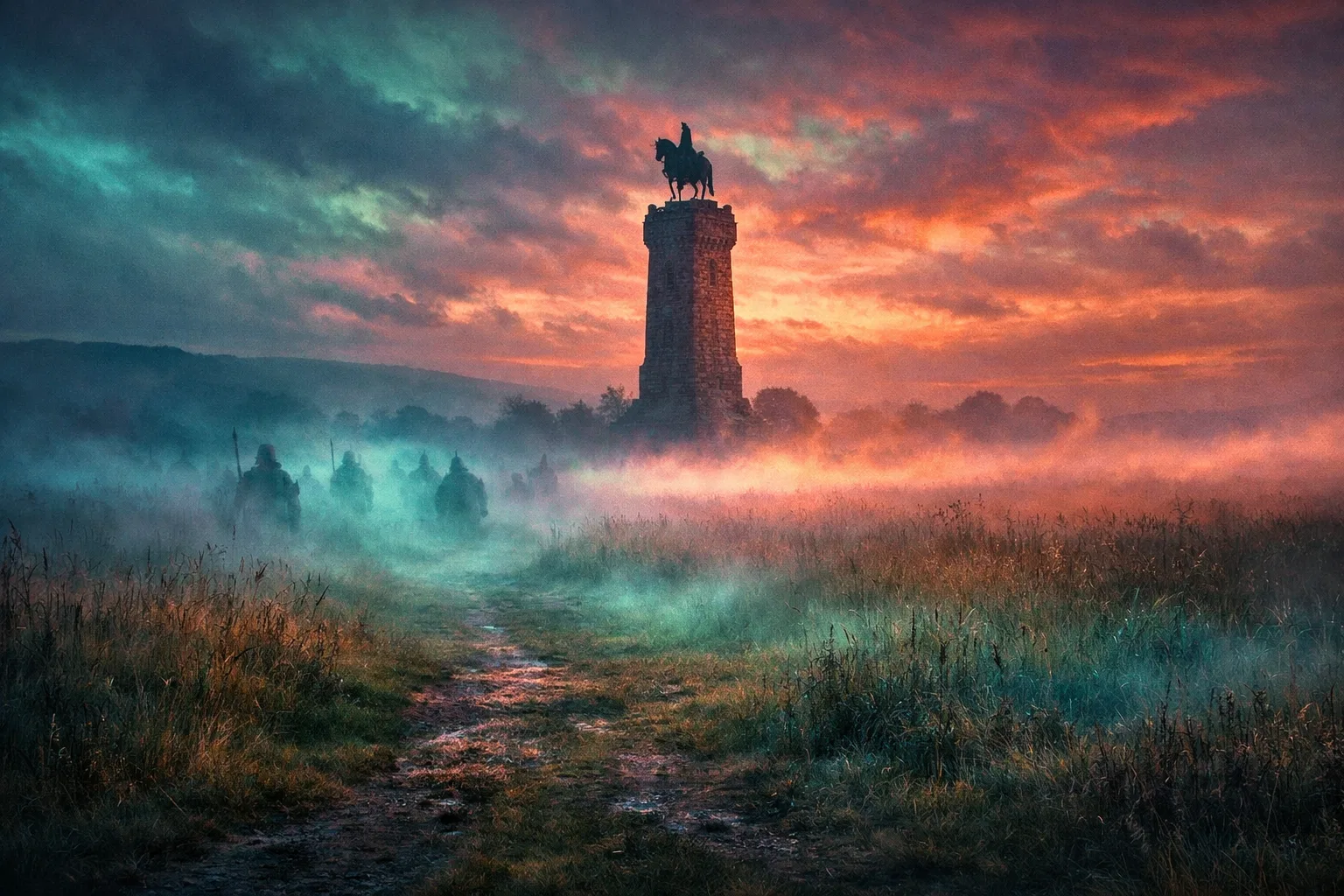
Bannockburn is not one of Stirlingshire’s haunted places because it has a single famous ghost with a fixed name, costume and doorway. It is eerie because the battlefield itself has become a national memory landscape: a place where the violence of 23–24 June 1314, the story of Robert the Bruce’s victory, later commemoration, tourism and modern planning disputes all press on the same ground. Local and visitor folklore sometimes speaks of phantom soldiers, battle sounds or a charged atmosphere at dusk, but the better-attested “haunting” is cultural rather than evidential: Bannockburn is haunted by what Scotland has chosen to remember there, and by what has been lost, built over, preserved or argued about since.
That distinction matters. Bannockburn sits just south of Stirling in historic Stirlingshire, close to the castle whose relief was the military trigger for the battle. Historic Environment Scotland treats the battlefield as nationally important, while the National Trust for Scotland presents the site through a visitor centre, memorial park, monuments and immersive battle interpretation. The result is a haunted-history landscape where folklore, patriotic memory and heritage management overlap, but should not be mistaken for proof of ghosts.[Historic Environment Scotland]portal.historicenvironment.scotHistoric Environment Scotland Battle of Bannockburn (BTL4Historic Environment Scotland Battle of Bannockburn (BTL4
The battle landscape and Scotland’s national story
Bannockburn’s atmosphere begins with its geography. This was not a vague medieval clash somewhere near Stirling; it was a battle shaped by routes, ridges, burns, boggy ground, open views and the pressure of Stirling Castle. Historic Environment Scotland’s battlefield record places the first day’s action around the New Park, south-west of St Ninians, where Bruce’s forces occupied a naturally defended position and improved it with pits against cavalry. It also notes that Edward II’s larger English army advanced from Falkirk towards Stirling along the line of the Roman road.[Historic Environment Scotland]portal.historicenvironment.scotHistoric Environment Scotland Battle of Bannockburn (BTL4Historic Environment Scotland Battle of Bannockburn (BTL4
The official inventory boundary is broad because Bannockburn was not confined to one neat field. It includes St Ninian’s ridge, Borestone, Whins of Milton, Coxet Hill, Gillies Hill, Milton Bog, Halbert Bog, the Carse of Stirling, the Dryfield, Bannockburn village, Balquhidderock Wood, Cambuskenneth Abbey and Bannockburn Wood. One especially grim place-name, Bloody Fould in Bannockburn Wood, is identified as a possible location of a massacre of English troops, with potential for human remains associated with the aftermath.[Historic Environment Scotland]portal.historicenvironment.scotHistoric Environment Scotland Battle of Bannockburn (BTL4Historic Environment Scotland Battle of Bannockburn (BTL4
This helps explain why ghost stories at Bannockburn tend to be diffuse. A castle ghost can attach itself to a chamber. A roadside ghost can be placed at a bend. Bannockburn’s story spreads across a landscape whose exact second-day deployments remain debated. Historic Environment Scotland says the general area of the first day is widely acknowledged, roughly around the National Trust for Scotland visitor centre, but the precise site of the main fighting on the second day is still a matter of considerable debate, with no location yet confirmed by artefactual evidence.[Historic Environment Scotland]portal.historicenvironment.scotHistoric Environment Scotland Battle of Bannockburn (BTL4Historic Environment Scotland Battle of Bannockburn (BTL4
For a haunted-history reader, that uncertainty is important. It means the emotional force of Bannockburn does not depend on standing on a single marked spot and saying “this is where it happened”. The haunting is more like a field of pressure. Modern housing, roads, drained land and heritage landscaping sit over places where armies moved, waited, panicked and fled. Historic Environment Scotland notes that although the landscape has changed, key terrain characteristics can still be read, and open areas remain important for understanding the battle and for possible archaeological survival.[Historic Environment Scotland]portal.historicenvironment.scotHistoric Environment Scotland Battle of Bannockburn (BTL4Historic Environment Scotland Battle of Bannockburn (BTL4
Bannockburn’s national meaning is equally hard to separate from the place. Historic Environment Scotland describes the battle as a resounding victory for Bruce over a larger English army, with many English killed, significant nobles taken prisoner, and Edward II forced to flee Scotland by boat. The battle was part of Bruce’s campaign to secure the kingdom he had claimed in 1306, and it followed the siege arrangement by which Stirling Castle would surrender if not relieved by midsummer 1314.[Historic Environment Scotland]portal.historicenvironment.scotHistoric Environment Scotland Battle of Bannockburn (BTL4Historic Environment Scotland Battle of Bannockburn (BTL4
That is why Bannockburn is remembered as more than an old killing ground. It is one of the sites where Scotland tells a story about survival, sovereignty and the small army overcoming the large one. The National Trust for Scotland’s visitor material invites people to “follow in the footsteps of Robert the Bruce”, see where he raised his royal standard, and experience the battle as a crucial event in Scottish history.[National Trust for Scotland]nts.org.ukNational Trust for Scotland Bannockburn | National Trust for ScotlandNational Trust for Scotland Bannockburn | National Trust for Scotland
Why battlefields gather phantom soldiers and eerie atmospheres
Battlefield hauntings often form where three things meet: violent death, uncertain ground and repeated remembrance. Bannockburn has all three. There were deaths in combat, killings during flight, drownings and capture; there is still debate about where exactly the second day’s battle unfolded; and the place has been revisited, interpreted, commemorated and argued over for generations. In that setting, stories of phantom soldiers or ghostly battle sounds do not need one original witness to become believable to visitors. The landscape already asks people to imagine bodies moving across it.
Modern ghost-tour and local-attraction writing sometimes presents Bannockburn in familiar battlefield-haunting terms: soldiers seen at dusk, the sound of swords or cries, and a sense that the violence has never quite left the fields. These accounts are best treated as folklore and tourism tradition rather than documented psychical evidence. They are not supported in the same way as the battlefield’s official historical record, and they are often repeated without named witnesses, dates or archival references.[coopercottages.com]coopercottages.comGhost stories and haunted places of StirlingGhost stories and haunted places of Stirling
That does not make the stories meaningless. Folklore can preserve emotional truth even when it cannot prove literal apparitions. At Bannockburn, the common image of phantom warriors wandering the fields reflects what visitors are already invited to contemplate: men in armour, spear formations, cavalry charges, trapped movement, panic and slaughter. The National Trust for Scotland’s Battle of Bannockburn Experience deliberately uses films, exhibits, sights and sounds to place visitors inside medieval warfare, while also exploring the people who fought and correcting myths.[National Trust for Scotland]nts.org.ukOpen source on nts.org.uk.
There is a useful caution here. The visitor centre’s immersive interpretation is not the same thing as a haunting, but it may shape how people feel the site. When a landscape is presented through sound, movement, weapons, tactics and individual combatants, a quiet walk afterwards can feel charged. A visitor who has just been asked to imagine the battle may find the surrounding fields strangely alive with absence.
Bannockburn also carries one of the classic ingredients of battlefield folklore: uncertainty about the dead. Historic Environment Scotland’s record refers to English troops being caught in a great ditch and slaughtered, and notes that the ditch has played a role in controversy over the battle’s location. It also records Bloody Fould as a possible site connected with a massacre and potential human remains.[Historic Environment Scotland]portal.historicenvironment.scotHistoric Environment Scotland Battle of Bannockburn (BTL4Historic Environment Scotland Battle of Bannockburn (BTL4
For ghost stories, that kind of uncertainty is fertile. Where were the worst deaths? Where did men try to escape? Where might bodies have lain? Where has later development erased the visible field? The less completely a landscape answers those questions, the easier it is for imagination, memory and unease to fill the gaps.
What is actually reported as haunting Bannockburn?
The reported haunting tradition is broad rather than precise. The most common modern claims are of ghostly soldiers, distant battle noise, cries, clashing weapons, sudden chills and an oppressive or solemn atmosphere around the battlefield. These are not usually tied to a named medieval figure, unlike the Green Lady at Stirling Castle or other personality-led ghost legends elsewhere in Stirlingshire. Bannockburn’s “ghosts” are usually collective: armies, the dead, the defeated, the memory of violence.
That collective quality fits the site. Bannockburn is commemorated through a memorial landscape rather than a domestic room or ruin. The National Trust for Scotland describes the outdoor area as parkland arranged to help visitors appreciate the surrounding landscape and restored monuments, including the Robert the Bruce statue by Pilkington Jackson.[National Trust for Scotland]nts.org.ukNational Trust for Scotland Bannockburn | National Trust for ScotlandNational Trust for Scotland Bannockburn | National Trust for Scotland
The commemorative monuments reinforce a tone of solemn visitation. The Trust says people have journeyed to the site for centuries “in honour and curiosity”, and that the monuments are a tribute to the thousands who fought and died. The grounds include a memorial cairn, a commemorative area, the rotunda, the flagpole and the equestrian statue of Bruce.[National Trust for Scotland]nts.org.ukOpen source on nts.org.uk.
This is why Bannockburn’s haunted reputation should be read as a case family rather than a single case. The stories gather around a set of repeated motifs:
- Phantom armies: not one ghost, but a sense of medieval soldiers moving across open land.
- Auditory haunting: battle cries, weapons or indistinct noise imagined or reported in a now-quiet landscape.
- Emotional residue: feelings of sadness, tension or watchfulness at dusk, especially after engaging with the battle story.
- Memorial unease: the unsettling contrast between landscaped commemoration and the messy uncertainty of where men died.
- Vanished terrain: old woods, bogs, roads and open fields partly hidden under modern change.
The credibility of these claims varies sharply. The battlefield, battle date, historical importance, landscape debate and commemorative history are well evidenced. The ghost reports are much thinner: atmospheric, often anonymous, and usually preserved in local-tourism or paranormal retellings rather than in early folklore collections or named newspaper witness accounts. For a careful haunted-history page, Bannockburn is therefore better described as a place with ghostly traditions than as a place with strong documented apparition evidence.
Memory is the main ghost at Bannockburn
Bannockburn’s deepest haunting is national memory. The site has been repeatedly used to ask what Scotland is, what freedom means, and how the past should be carried into the present. That process began long before modern heritage tourism.
Robert Burns helped give Bannockburn a voice in “Scots Wha Hae, or, Robert Bruce’s Address to His Troops at Bannockburn”. The Scottish Poetry Library presents the poem under that Bannockburn title, and the National Trust for Scotland notes that Burns visited Bannockburn in 1787 and later wrote the famous poem about the battle.[scottishpoetrylibrary.org.uk]scottishpoetrylibrary.org.ukOpen source on scottishpoetrylibrary.org.uk.
The poem is not a battlefield ghost story, but it behaves like a voice from the dead: Bruce imagined speaking to his troops, the past made present through patriotic address. In haunted-history terms, it is a literary haunting. It turns a medieval battle into a recurring national performance, remembered at suppers, ceremonies, schools and public culture.
The monuments do something similar in stone, bronze and space. The Bruce statue, rotunda and flagpole do not simply mark a location. They instruct the visitor how to feel: look outward, imagine the armies, connect Stirling Castle to the south-western ground, and place yourself inside a national story. The Trust’s restoration work for the 700th anniversary in 2014 returned the Bruce statue to its bronze finish and replaced the rotunda flagpole topmast with a battleaxe weathervane.[National Trust for Scotland]nts.org.ukOpen source on nts.org.uk.
A striking detail from the rotunda restoration is the addition of a new poem by Kathleen Jamie on the replacement ring beam. The Trust says the poem was commissioned because the original 1960s rotunda design had intended an inscription. That matters because Bannockburn’s memory is not fixed in 1314 or even 1964. Each generation adds a layer: medieval chronicle, Burns poem, preservation campaign, monument, visitor centre, anniversary restoration, new inscription.[National Trust for Scotland]nts.org.ukOpen source on nts.org.uk.
This is where Bannockburn differs from many haunted buildings in Stirlingshire. At Stirling Castle, ghost stories often seek a missing person behind a legend. At Bannockburn, the “missing person” is collective: the dead soldier, the camp follower, the fleeing knight, the drowned man, the anonymous body. The site invites remembrance without giving every death a name.
Development disputes show how haunted memory becomes political
The strongest recent evidence that Bannockburn remains a charged landscape is not a ghost sighting but a planning dispute. In June 2025, the National Trust for Scotland welcomed the decision of Scottish Ministers to overturn planning permission for a horse-trotting track on the historic Bannockburn battlefield. The proposed track, car parking, fencing and buildings would have stood in green fields beside the battlefield centre and Trust-managed parkland, directly visible from the Rotunda, which the Trust describes as a national monument commemorating the 1314 battle.[National Trust for Scotland]nts.org.ukOpen source on nts.org.uk.
This is haunted memory in a practical form. The question was not whether the ground contained proven ghosts. It was whether a surviving open part of the battle landscape should remain legible as a place of national commemoration. The Trust argued that Stirling Council should not have approved the scheme because of its visual and other impacts on the battlefield setting. Scottish Ministers ultimately overturned the permission.[National Trust for Scotland]nts.org.ukOpen source on nts.org.uk.
The dispute also shows why landscape matters at Bannockburn. Historic Environment Scotland’s battlefield record says that the remaining open ground and views are part of how the battle can still be understood. It identifies surviving open areas, spatial relationships between the Carse, Stirling Castle and hill terraces, and undeveloped ground as important for interpretation and archaeological potential.[Historic Environment Scotland]portal.historicenvironment.scotHistoric Environment Scotland Battle of Bannockburn (BTL4Historic Environment Scotland Battle of Bannockburn (BTL4
The Society of Antiquaries of Scotland also objected to the trotting-track proposal, saying the development would be within the battlefield inventory boundary, near the visitor centre and listed buildings, and in an area that provides one of the only remaining open views from the Category A listed rotunda, flagpole and monument. Its letter quoted Historic Environment Scotland’s view that southern views are integrated into the rotunda’s design and help create a space for commemoration on Monument Hill.[SocantScot]socantscot.orgSocant Scotscottish.ministers@gov.scot cc. planning.decisions@Socant Scotscottish.ministers@gov.scot cc. planning.decisions@
That phrase, “space for commemoration”, is central to Bannockburn’s haunted-history value. A battlefield can be damaged not only by digging up bones or destroying artefacts, but by breaking the view that allows visitors to imagine what happened. If a place is haunted by memory, then noise, fencing, car parks and visual interruption can feel like an intrusion into the haunting itself.
How credible is Bannockburn as a haunted place?
Bannockburn is highly credible as a place of historic violence, national commemoration and emotionally charged landscape memory. It is much less credible as a source of well-documented apparition cases. The difference should be made clear rather than blurred.
The strongest evidence supports these points: the battle took place over two days in June 1314; it was a major Scottish victory over a larger English army; its landscape remains nationally important; the exact second-day location is debated; parts of the battlefield have been altered or developed; and the memorial park, visitor centre and monuments are major instruments of public memory.[Historic Environment Scotland]portal.historicenvironment.scotHistoric Environment Scotland Battle of Bannockburn (BTL4Historic Environment Scotland Battle of Bannockburn (BTL4
The weaker evidence concerns literal hauntings. Modern references to ghostly soldiers and battle sounds are usually general and late. They may be based on local storytelling, visitor feeling, paranormal tourism, imaginative interpretation or the familiar pattern by which battlefields across Britain attract phantom-army traditions. They should be described as claims, not facts.
A sensible reading is that Bannockburn is haunted in three overlapping ways:
- Historically haunted: by the documented violence of the Wars of Scottish Independence and the deaths attached to the battle and its aftermath.
- Folklorically haunted: by modern traditions of phantom soldiers, battle noises and eerie atmospheres, though these are thinly documented.
- Memorially haunted: by centuries of national storytelling, poetry, monuments, school visits, tourism and public arguments over how the ground should be protected.
For Stirlingshire’s haunted-history map, that makes Bannockburn essential. It widens the county’s supernatural landscape beyond castle apparitions and old prison tours. It shows how a place can feel haunted even when its ghost lore is less substantial than its memory lore.

Visiting the haunted landscape today
A visit to Bannockburn today is not a search for a named spectre. It is a walk through a carefully managed memorial landscape on the edge of modern Stirling. The National Trust for Scotland site includes the visitor centre, the Battle of Bannockburn Experience, parkland, restored monuments, the Bruce statue, the rotunda and views towards Stirling Castle. The outdoor site is open daily all year, while the visitor centre and battle experience operate with set opening arrangements and pre-booked time slots.[National Trust for Scotland]nts.org.ukNational Trust for Scotland Bannockburn | National Trust for ScotlandNational Trust for Scotland Bannockburn | National Trust for Scotland
The most atmospheric way to understand the place is to notice the contrast between interpretation and uncertainty. The visitor centre gives shape to the battle through research, films, exhibits and guided explanation. Outside, the landscape remains quieter and more ambiguous. Some areas are commemorative; some are practical visitor spaces; some key parts of the wider battlefield lie beyond the Trust’s immediate memorial park; some have been changed by housing, roads, drainage and development.[National Trust for Scotland]nts.org.ukOpen source on nts.org.uk.
For readers interested in hauntings, the best approach is not to expect a theatrical ghost. Bannockburn’s atmosphere is slower and heavier than that. Look south and west from the monument area, think about why the open views mattered in the recent planning dispute, and remember that the exact geography of the second day’s slaughter remains contested. The unease comes from standing in a place where national certainty and historical uncertainty meet.
In the wider Stirlingshire haunted landscape, Bannockburn pairs naturally with Stirling Castle and the old town’s prison and execution stories. The castle represents royal power and named apparitions; the jail represents punishment and civic fear; Bannockburn represents collective violence, national myth and disputed ground. Its ghosts, whether believed in literally or understood as memory, are not confined to one chamber. They belong to the fields, views and absences south of Stirling.
Amazon book picks
Further Reading
Books and field guides related to Is Bannockburn Haunted by Ghosts or Memory?. Use these as the next step if you want deeper reading beyond the article.

Bannockburn
Directly explains the battlefield that underpins the page's haunted memory.

The Bruce Trilogy
Brings Robert the Bruce and Bannockburn to life for general readers.
The Lore of Scotland
Adds the legendary and supernatural dimension to battlefield history.

Scottish Myths and Legends
First published 2009. Subjects: Tales, Legends, Folklore, Legends, scotland.
eBay marketplace picks
Marketplace Samples
Live-tested eBay searches with available results related to this page.
Endnotes
1.
Source: coopercottages.com
Title: Ghost stories and haunted places of Stirling
Link:https://coopercottages.com/2025/07/27/ghosts-of-stirling/
2.
Source: scottishpoetrylibrary.org.uk
Link:https://www.scottishpoetrylibrary.org.uk/poem/scots-wha-hae-or-robert-bruces-address-his-troops-bannockburn/
3.
Source: socantscot.org
Title: Socant Scotscottish.ministers@gov.scot cc. planning.decisions@
Link:https://www.socantscot.org/wp-content/uploads/2024/08/SoAoS-Letter-to-Scottish-Ministers-regarding-Bannockburn.pdf
4.
Source: open.edu
Link:https://www.open.edu/openlearn/ocw/mod/oucontent/view.php?id=1633&printable=1
5.
Source: portal.historicenvironment.scot
Title: Historic Environment Scotland Battle of Bannockburn (BTL4)
Link:https://portal.historicenvironment.scot/apex/f?p=1505%3A300%3A%3A%3A%3A%3AVIEWTYPE%2CVIEWREF%3Adesignation%2CBTL4
6.
Source: nts.org.uk
Title: National Trust for Scotland Bannockburn | National Trust for Scotland
Link:https://www.nts.org.uk/visit/places/bannockburn
7.
Source: nts.org.uk
Link:https://www.nts.org.uk/visit/places/bannockburn/highlights/battle-of-bannockburn-experience
8.
Source: nts.org.uk
Link:https://www.nts.org.uk/visit/places/bannockburn/highlights/commemorative-monuments
9.
Source: nts.org.uk
Link:https://www.nts.org.uk/stories/trust-welcomes-decision-on-bannockburn
10.
Source: historicenvironment.scot
Link:https://www.historicenvironment.scot/protect-and-care/protected-historic-places/historic-battlefields/
11.
Source: historicenvironment.scot
Link:https://www.historicenvironment.scot/publications/all/publication/?publicationId=80a8b434-e44d-4c53-a339-b0d6009211e8
12.
Source: nts.org.uk
Link:https://www.nts.org.uk/campaigns/our-battle-for-bannockburn
13.
Source: nts.org.uk
Title: Visitor centre
Link:https://www.nts.org.uk/visit/places/bannockburn/highlights/visitor-centre
14.
Source: nts.org.uk
Link:https://www.nts.org.uk/maps/filming-locations/the-battle-of-bannockburn
15.
Source: nts.org.uk
Link:https://www.nts.org.uk/visit/places/bannockburn/getting-here
16.
Source: nts.org.uk
Link:https://www.nts.org.uk/learning/learning-at-bannockburn/locations
17.
Source: nts.org.uk
Title: were in a battle about bannockburn and we need your support
Link:https://www.nts.org.uk/stories/were-in-a-battle-about-bannockburn-and-we-need-your-support
18.
Source: Wikipedia
Title: Battle of Bannockburn
Link:https://en.wikipedia.org/wiki/Battle_of_Bannockburn
19.
Source: Wikipedia
Title: Scots Wha Hae
Link:https://en.wikipedia.org/wiki/Scots_Wha_Hae
20.
Source: nl.wikisource.org
Title: Scots Wha Hae
Link:https://nl.wikisource.org/wiki/Scots_Wha_Hae
21.
Source: tripadvisor.com
Title: Robert the Bruce Statue
Link:https://www.tripadvisor.com/Attraction_Review-g191266-d10229457-Reviews-Robert_the_Bruce_Statue-Stirling_Scotland.html
22.
Source: participedia.net
Link:https://participedia.net/case/5108
Additional References
23.
Source: facebook.com
Link:https://www.facebook.com/RobertBurnsBirthplaceMuseum/posts/lay-the-proud-usurpers-lowtyrants-fall-in-every-foelibertys-in-every-blowlet-us-/1131509669002053/
24.
Source: scottish-paranormal.co.uk
Link:https://www.scottish-paranormal.co.uk/post/6-years-of-paranormal-investigation-at-bannockburn-house-ghosts-mysteries-and-haunting-history
25.
Source: facebook.com
Link:https://www.facebook.com/NationalTrustforScotland/posts/breaking-news-victory-for-bannockburn-battlefieldwe-welcome-the-announcement-tha/1120483700107378/
26.
Source: indefiniteadventure.com
Link:https://www.indefiniteadventure.com/bannockburn-battlefield-tour-outdoor-tour-operated-by-freedom-tour-today/
27.
Source: tripadvisor.co.uk
Link:https://www.tripadvisor.co.uk/AttractionProductReview-g191266-d16702332-Bannockburn_Battlefield_Tour-Stirling_Scotland.html
28.
Source: undiscoveredscotland.co.uk
Link:https://www.undiscoveredscotland.co.uk/stirling/bannockburn/index.html
29.
Source: reiachandhall.co.uk
Link:https://www.reiachandhall.co.uk/public/bannockburn
30.
Source: poetry-archive.com
Link:https://www.poetry-archive.com/b/bannockburn/
31.
Source: viator.com
Link:https://www.viator.com/en-ZA/tours/Stirling/Battle-of-Bannockburn-Visitor-Centre-Entrance-Ticket/d22938-6454BANNOCK
32.
Source: electrosonic.com
Link:https://www.electrosonic.com/projects/battle-of-bannockburn-visitor-centre
Topic Tree