What Haunts Buteshire's Island Castles?
Buteshire’s haunted history is best understood as an island folklore map rather than a single “most haunted county” story.
Page outline Jump by section
Introduction
Buteshire’s haunted history is best understood as an island folklore map rather than a single “most haunted county” story. The historic county covered the Isle of Bute, Arran, Great Cumbrae, Little Cumbrae and smaller Firth of Clyde islands; modern local government now splits that old county, with Bute in Argyll and Bute and Arran and the Cumbraes in North Ayrshire.[Wikishire]wikishire.co.ukWikishire ButeshireWikishire Buteshire Its strongest ghost traditions cluster around two castles: Brodick Castle on Arran, with the Grey Lady and ominous White Stag, and Rothesay Castle on Bute, where a “Green Lady” legend is attached to the so-called Bloody Stairs.[National Trust for Scotland]nts.org.ukOpen source on nts.org.uk.
The evidence is uneven. Brodick’s haunting is preserved by the National Trust for Scotland and local-history writers, while Rothesay’s ghost is recorded by Bute Museum in connection with a 19th-century photograph and castle tradition. Beyond those headline sites, Buteshire’s eerier material is often closer to folk belief than “ghost sighting”: witchcraft accusations, fairy-blast cures, second sight, evil-eye charms, plague memories, Norse violence and island isolation. That makes the county less a parade of famous spectres and more a compact case study in how Scottish island communities turned danger, illness, family tragedy and old ruins into supernatural memory.
Where Buteshire’s haunted map begins
Historic Buteshire was a county of islands in the Firth of Clyde, lying between Ayrshire and Argyll. Wikishire describes it as including Bute, Arran, Great Cumbrae and Little Cumbrae, with Rothesay as the county town and only a handful of inhabited islands among its many skerries and smaller isles.[Wikishire]wikishire.co.ukWikishire ButeshireWikishire Buteshire Undiscovered Scotland likewise notes that the County of Bute remained a traditional Scottish county until the 1975 reorganisation, after which the old county’s islands were divided between different modern authorities.[Undiscovered Scotland]undiscoveredscotland.co.ukOpen source on undiscoveredscotland.co.uk.
That boundary matters for a hauntings page because many modern “Argyll and Bute” ghost lists mix Bute with mainland Argyll, Cowal, Lorn, Kintyre and the Inner Hebrides. For Buteshire proper, the centre of gravity should stay on the Clyde islands: Bute, Arran and the Cumbraes. Stories from Oban, Inveraray, Barcaldine or Mull may be culturally nearby, but they belong to different county and island traditions.
The landscape helps explain the tone of the folklore. Buteshire’s islands sit in a seaway that was fought over by Norse, Gaelic, Scottish and later dynastic powers. Wikishire notes Norse incursions, the 1263 occupation of the islands by warriors under Haakon IV, and the Treaty of Perth in 1266, after which Norwegian claims in the region passed to Scotland.[Wikishire]wikishire.co.ukWikishire ButeshireWikishire Buteshire Old castles, sea approaches, ferry routes, ruined religious sites and isolated farms gave local stories ready-made settings for apparitions, fairy encounters and warnings from the otherworld.
Brodick Castle: Grey Lady, White Stag and a castle that sells its ghosts carefully
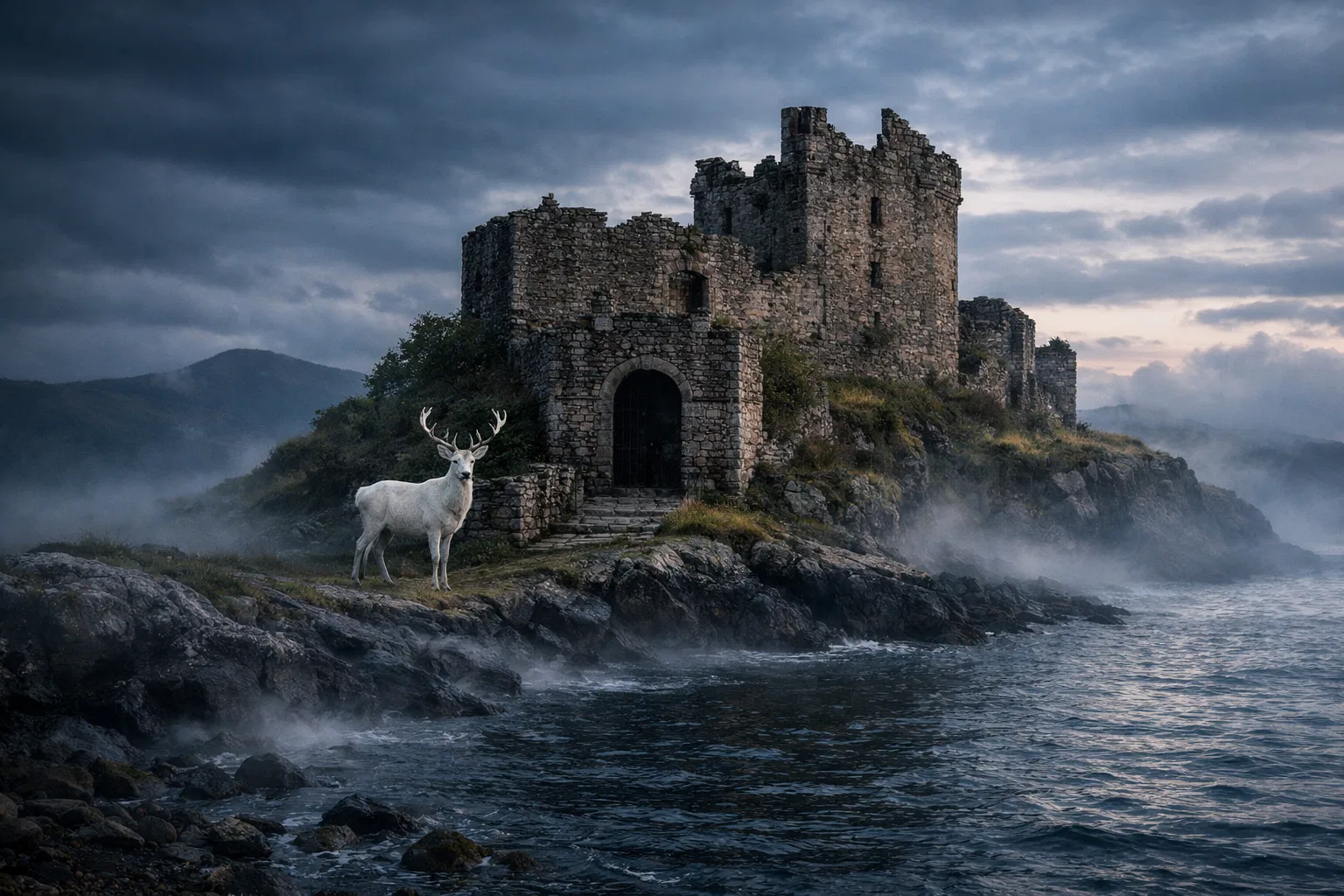
Brodick Castle is the clearest haunted-place anchor in historic Buteshire. It stands above Brodick Bay on Arran, beneath Goatfell, and developed over centuries from a defensive site into the grand house now associated with the Hamilton family and the National Trust for Scotland. Undiscovered Scotland describes it as a strategically important castle shaped between the 1200s and 1600s, later wrapped in an 1800s stately home.[Undiscovered Scotland]undiscoveredscotland.co.ukOpen source on undiscoveredscotland.co.uk.
The National Trust for Scotland explicitly includes Brodick in its Scottish ghost-story coverage, saying the castle has “800 years of ghost stories and paranormal activities” and citing accounts of the Grey Lady, the White Stag, murder, clairvoyants, a hanging tree and plague victims supposedly entombed at the portcullis.[National Trust for Scotland]nts.org.ukOpen source on nts.org.uk. That does not prove a haunting; it shows that the ghost lore is now part of the site’s public storytelling.
The Grey Lady is usually the most repeated apparition. In one version, she is one of three women shut in the dungeon because they were believed to have plague and left to starve. In another, she is a servant from Cromwellian times who became pregnant after a relationship with a captain of the guard, was dismissed and drowned herself near Wine Port Quay. Undiscovered Scotland records the plague-dungeon version and also mentions two other alleged apparitions: a man seen in the library and a white deer that appears, according to tradition, when the Hamilton clan chief is near death.[Undiscovered Scotland]undiscoveredscotland.co.ukOpen source on undiscoveredscotland.co.uk.
That variety is important. When a ghost has two incompatible origin stories, the safest reading is folkloric rather than evidential. The Grey Lady works because she gives the castle’s harsher histories a human face: military occupation, servants’ lives, disease fears, confinement and shame. The White Stag belongs to a different register: not a ghost of a person, but an omen. Tangent Graphic, discussing a commissioned artwork inspired by the Brodick stag legend, notes that white deer are rare but real, with their ghostly colouring caused by leucism, a genetic reduction of pigment.[Tangent Design Agency]tangentgraphic.co.ukTangent Design Agency The Brodick StagTangent Design Agency The Brodick Stag That makes the legend especially interesting: a natural animal, seen rarely, becomes a supernatural warning because of when people remember seeing it.
Rothesay Castle: the Green Lady and the Bloody Stairs
Rothesay Castle gives Bute its strongest castle ghost. Historic Environment Scotland describes the site as a castle enclosed by a circular sandstone wall, famous for its long association with the Stewart kings of Scotland, and notes that it has Scotland’s only circular curtain wall, with four projecting towers added after the Norse siege of 1263.[Historic Environment Scotland]historicenvironment.scotHistoric Environment Scotland Rothesay Castle | Historic ScotlandHistoric Environment Scotland Rothesay Castle | Historic Scotland The castle’s real history is already atmospheric: moat, siege, royal ownership and ruin in the middle of Rothesay.
The ghost tradition centres on the “Bloody Stairs”. Bute Museum and Natural History Society records a local legend that Lady Isabel threw herself down the open stairway to escape a marauding Viking invader; her ghost is said to haunt the castle as the “Green Lady”.[butemuseum.org.uk]butemuseum.org.ukRothesay Castle | Bute Museum & Natural History SocietyRothesay Castle | Bute Museum & Natural History Society The museum presents the story alongside a 19th-century photograph and restoration history, not as verified fact, but as part of the castle’s remembered narrative.
The legend attaches itself neatly to the castle’s Norse-war setting. Rothesay was attacked in the 13th century, and Historic Environment Scotland notes the Norse siege of 1263 as a key moment in the castle’s fabric.[Historic Environment Scotland]historicenvironment.scotHistoric Environment Scotland Rothesay Castle | Historic ScotlandHistoric Environment Scotland Rothesay Castle | Historic Scotland A story of a woman fleeing a Viking attacker therefore feels historically plausible in mood, even if the named incident itself is not documented as a recoverable event.
As folklore, the Green Lady has a familiar Scottish pattern: a female apparition, often linked to sexual danger, family honour, violence or a fall from a height, haunts a named architectural feature. The value of the story is not that it confirms a ghost, but that it shows how Rothesay’s medieval violence was localised into a single memorable place inside the ruin.
Mount Stuart: Gothic grandeur, hidden stairs and a modern ghostly glimpse
Mount Stuart is not as firmly established in Buteshire ghost lore as Brodick or Rothesay, but it has the right architecture for eerie storytelling. The Mount Stuart Trust describes the house as a spectacular Neo-Gothic mansion on the Isle of Bute, set in 300 acres of historic gardens and grounds, with “300 years of history and storytelling”.[Mount Stuart]mountstuart.comOpen source on mountstuart.com. It is more palace than ruin: red sandstone, symbolic interiors, chapel, marble and aristocratic memory.
A 2001 TES Magazine feature gives one of the more concrete modern ghost anecdotes. During a school visit, the head guide reportedly told pupils that two weeks earlier an elderly lady in a long dress had been seen sitting in a chair in the marble hall, before vanishing.[Tes]tes.comSecrets of the big red house | Tes MagazineSecrets of the big red house | Tes Magazine The same article describes the house’s hidden staircase, 117 rooms, chapel and marble swimming pool, all details that make Mount Stuart a natural incubator for ghost stories even when sightings are sparse.[Tes]tes.comSecrets of the big red house | Tes MagazineSecrets of the big red house | Tes Magazine
This is the kind of account that should be treated cautiously. It is a reported anecdote in a feature article, not a formal investigation or archival case. Still, it matters because it shows how ghost stories can develop in grand houses open to visitors: guides, schoolchildren, hidden rooms and a striking setting turn a single vanishing-lady tale into part of the visitor experience.
The Bute witches: when “haunting” becomes social memory
Bute’s darkest supernatural history is not a ghost story in the simple sense. It is the 1662 witch-hunt on the island, a real episode of accusation, interrogation and execution later surrounded by fairy belief, charming, illness and demonic language. Lizanne Henderson’s chapter on the witches of Bute states that Bute did not suffer the full brunt of the Scottish witch-hunts, but it produced one of the most compelling episodes in Scottish witch-trial history during the winter of 1662, in the context of the Great Scottish Witch-Hunt of 1661–62.[Scottish Society for Northern Studies]ssns.org.ukScottish Society for Northern Studies
Henderson’s account is especially useful because it does not romanticise the material. She places Bute on the edge of Gaelic- and Scots-speaking cultural zones, where Highland and Lowland beliefs could overlap. She notes that Bute witch beliefs involved common Scottish motifs: dairy trouble, disease, infant death, evil-eye charms, elf-shot, fairy-blast cures, animal transformation, cursing and healing rituals.[Scottish Society for Northern Studies]ssns.org.ukScottish Society for Northern Studies
The numbers are sobering. Search-result text from Henderson’s published chapter states that Bute’s 1662 witch-hunt involved 51 accused people, 24 trials and four executions, with Jonet McNicol found guilty and escaping in 1662 before being executed after her return to Rothesay in 1673.[Scottish Society for Northern Studies]ssns.org.ukScottish Society for Northern Studies The University of Edinburgh’s Survey of Scottish Witchcraft records Janet McNicol’s case as initially accused in 1662 and includes details of alleged meetings at Bute Quay Shore, demonic figures and a confession of pact.[witches.hca.ed.ac.uk]witches.hca.ed.ac.ukthe case of Janet Mc Nicolthe case of Janet Mc Nicol
For a haunted-history reader, this material matters because it explains the emotional ground from which many later ghost stories grow. Fear of hidden harm, unexplained illness, childbirth danger, neighbour disputes and the supposed border between fairies and demons were not harmless entertainment in 17th-century Bute. They could become legal accusations with fatal outcomes. The “haunting” here is historical memory: Rothesay and Bute carry the trace of real people harmed by supernatural belief.
Fairies, charms and the older island imagination
Buteshire’s supernatural tradition is not limited to ghosts of the dead. Henderson’s work on Bute shows how fairy and witch beliefs overlapped in early modern island life. She records references to fairy blast, charms against the evil eye, possible changeling belief and Gaelic healing practices in the Bute witch material.[Scottish Society for Northern Studies]ssns.org.ukScottish Society for Northern Studies These are not castle apparitions, but they are crucial to the county’s eerie folklore.
This helps explain why some Buteshire stories feel different from the better-known English haunted inn or headless-coachman tradition. In island Scotland, the unseen world was often practical and dangerous: a cow stopped giving milk, a child became sick, a neighbour cursed another, a healer used a charm, someone was believed to have been away with the fairies. Henderson notes that alleged Bute witches were blamed for agricultural problems, disease, death and misfortune, while some accused people were also associated with cures.[Scottish Society for Northern Studies]ssns.org.ukScottish Society for Northern Studies
Arran’s wider folklore also sits naturally beside this. Modern folklore writers describe Arran as rich in fairy traditions, with beings ranging from small fairies to rougher supernatural figures, though such sources are more interpretive and less authoritative than Henderson’s archival witchcraft work.[faeryfolklorist.blogspot.com]faeryfolklorist.blogspot.comfairy folklore of isle of arranfairy folklore of isle of arran For a careful Buteshire page, fairy lore should therefore be presented as a living interpretive strand rather than a fully documented catalogue of named hauntings.
The Cumbraes: quieter islands with thinner ghost evidence
Great Cumbrae and Little Cumbrae belong inside historic Buteshire, but the available ghost evidence is much thinner than for Bute or Arran. Wikishire includes Great Cumbrae and Little Cumbrae within Buteshire’s island list, and Undiscovered Scotland confirms their place in the old County of Bute.[Wikishire]wikishire.co.ukWikishire ButeshireWikishire Buteshire Millport on Great Cumbrae has its own maritime and ecclesiastical atmosphere, including the Cathedral of the Isles, while Little Cumbrae has lighthouse and island-seclusion associations, but those do not automatically amount to substantiated hauntings.
This absence is worth saying plainly. A good haunted-county map should not inflate every old church, lighthouse or graveyard into a ghost site. For the Cumbraes, the stronger public record is historical and topographical: Millport’s growth, ferry link, seafaring past and island identity, rather than a widely preserved named apparition.[Undiscovered Scotland]undiscoveredscotland.co.ukOpen source on undiscoveredscotland.co.uk.
That does not mean local oral stories do not exist. It means that, compared with Brodick Castle’s Grey Lady or Rothesay Castle’s Green Lady, the Cumbraes have not produced a well-sourced, widely repeated ghost tradition in the accessible record. For readers planning eerie travel, they are better treated as atmospheric extensions of the Buteshire island setting than as headline haunted destinations.
How credible are Buteshire’s ghost stories?
The most credible claim is not “these places are haunted”; it is “these places have well-attested haunting traditions”. Brodick Castle’s ghost lore is the strongest because it is repeated by the National Trust for Scotland and by local-history sources that connect the stories to specific locations: the dungeon, library, stairs, grounds and Hamilton family omen.[National Trust for Scotland]nts.org.ukOpen source on nts.org.uk. Rothesay’s Green Lady is also locally anchored, but the evidence is a museum-recorded legend rather than a developed body of witness accounts.[butemuseum.org.uk]butemuseum.org.ukRothesay Castle | Bute Museum & Natural History SocietyRothesay Castle | Bute Museum & Natural History Society
Mount Stuart’s vanishing elderly lady is more anecdotal, preserved in a journalistic feature about school visits rather than in a formal house history.[Tes]tes.comSecrets of the big red house | Tes MagazineSecrets of the big red house | Tes Magazine It is still useful, but should sit below Brodick and Rothesay in confidence. The Bute witches are different again: the prosecutions are historical, but the supernatural claims made in those trials reflect belief, fear, interrogation and legal culture, not proof of witchcraft. Henderson’s analysis is valuable precisely because it separates the historical reality of accusations and executions from the beliefs that produced them.[Scottish Society for Northern Studies]ssns.org.ukScottish Society for Northern Studies
Sceptically, several mechanisms are likely at work. Ruined castles invite narrative; old staircases and hidden rooms give visitors a physical focus for fear; rare wildlife such as a white stag can be remembered as an omen; and stories of plague, pregnancy, suicide or invasion explain why a ghost would remain. Buteshire’s hauntings are therefore best read as layered traditions: part tourism, part local memory, part family legend and part older Scottish supernatural belief.
What to remember about haunted Buteshire
Buteshire’s haunted identity rests on a small number of strong stories rather than a long list of famous ghost sites. Brodick Castle gives Arran its best-known haunting cluster: the Grey Lady, the White Stag, the library figure and plague-dungeon memories. Rothesay Castle gives Bute its signature apparition, the Green Lady of the Bloody Stairs. Mount Stuart adds a modern vanishing-lady anecdote inside a grand Gothic house, while the Bute witch trials reveal the harsher side of supernatural belief in a close island community.
The most interesting thing about Buteshire is how compact the supernatural geography is. Within one historic county, the reader moves from Norse siege to Stewart castle, from Hamilton family omen to Victorian Gothic mansion, from fairy-blast cures to fatal witchcraft accusations. The result is not the loudest haunted county in Britain, but one of the most quietly suggestive: a Firth of Clyde island world where history, weather, sea crossings and old fear make the past feel close.
Amazon book picks
Further Reading
Books and field guides related to What Haunts Buteshire's Island Castles?. Use these as the next step if you want deeper reading beyond the article.
The Penguin Book of Ghost Stories
Appeals to readers wanting classic ghost literature.
The Lore of Scotland
Excellent overview of Scottish supernatural traditions including island lore.
eBay marketplace picks
Marketplace Samples
Live-tested eBay searches with available results related to this page.
Endnotes
1.
Source: butemuseum.org.uk
Title: Rothesay Castle | Bute Museum & Natural History Society
Link:https://www.butemuseum.org.uk/project/rothesay-castle/
2.
Source: tes.com
Title: Secrets of the big red house | Tes Magazine
Link:https://www.tes.com/magazine/archive/secrets-big-red-house
3.
Source: ssns.org.uk
Title: Scottish Society for Northern Studies
Link:https://www.ssns.org.uk/wp-content/uploads/2021/11/11_Henderson_Bute_2012_pp_150-161.pdf
4.
Source: witches.hca.ed.ac.uk
Title: the case of Janet Mc Nicol
Link:https://witches.hca.ed.ac.uk/case/C/EGD/604
5.
Source: faeryfolklorist.blogspot.com
Title: fairy folklore of isle of arran
Link:https://faeryfolklorist.blogspot.com/2017/05/fairy-folklore-of-isle-of-arran.html
6.
Source: witches.hca.ed.ac.uk
Link:https://witches.hca.ed.ac.uk/
7.
Source: millport.org
Link:https://millport.org/discover-millport/
8.
Source: butemuseum.org.uk
Link:https://www.butemuseum.org.uk/rothesay-castle/
9.
Source: youtube.com
Title: Glenrickard cairn & haunted house, Brodick, Isle of Arran
Link:https://www.youtube.com/watch?v=kCgFdInnGVU
Source snippet
ROTHESAY - Voyage to the Tomb of a King...
10.
Source: youtube.com
Link:https://www.youtube.com/watch?v=UcztbXcUW9g
11.
Source: wikishire.co.uk
Title: Wikishire Buteshire
Link:https://wikishire.co.uk/wiki/Buteshire
12.
Source: undiscoveredscotland.co.uk
Link:https://www.undiscoveredscotland.co.uk/usfeatures/areas/countyofbute.html
13.
Source: nts.org.uk
Link:https://www.nts.org.uk/stories/scottish-ghost-stories-witches-murder-and-folklore
14.
Source: undiscoveredscotland.co.uk
Link:https://www.undiscoveredscotland.co.uk/arran/brodickcastle/index.html
15.
Source: tangentgraphic.co.uk
Title: Tangent Design Agency The Brodick Stag
Link:https://tangentgraphic.co.uk/journal/the-brodick-stag
16.
Source: historicenvironment.scot
Title: Historic Environment Scotland Rothesay Castle | Historic Scotland
Link:https://www.historicenvironment.scot/visit-a-place/places/rothesay-castle/
17.
Source: mountstuart.com
Link:https://www.mountstuart.com/
18.
Source: undiscoveredscotland.co.uk
Link:https://www.undiscoveredscotland.co.uk/cumbrae/millport/index.html
19.
Source: Wikipedia
Title: County of Bute
Link:https://en.wikipedia.org/wiki/County_of_Bute
20.
Source: Wikipedia
Title: Bute witches
Link:https://en.wikipedia.org/wiki/Bute_witches
21.
Source: Wikipedia
Title: Bute witches
Link:https://sco.wikipedia.org/wiki/Bute_witches
22.
Source: Wikipedia
Title: Great Cumbrae
Link:https://en.wikipedia.org/wiki/Great_Cumbrae
23.
Source: archive.org
Link:https://archive.org/details/isleofbuteinolde02hewiuoft
24.
Source: archive.org
Title: A Source Book of Scottish Witchcraft (1977) djvu.txt
Link:https://archive.org/stream/a-source-book-of-scottish-witchcraft-1977/A%20Source-Book%20of%20Scottish%20Witchcraft%20%281977%29_djvu.txt
25.
Source: discoverbritain.com
Title: mount stuart
Link:https://www.discoverbritain.com/heritage/stately-homes/mount-stuart/
26.
Source: facebook.com
Link:https://www.facebook.com/groups/424158421972977/posts/790212925367523/
27.
Source: hebrideanconnections.com
Link:https://hebrideanconnections.com/record/locations/103737/
28.
Source: academia.edu
Title: The Witches of Bute
Link:https://www.academia.edu/11137605/The_Witches_of_Bute
29.
Source: blog.historicenvironment.scot
Title: five minute folklore
Link:https://blog.historicenvironment.scot/2023/01/five-minute-folklore/
30.
Source: thegpi.co.uk
Title: brodick castle
Link:https://www.thegpi.co.uk/brodick-castle/
31.
Source: nts.org.uk
Link:https://www.nts.org.uk/stories/scottish-ghost-stories-witches-murder-and-folklore-part-2
32.
Source: nts.org.uk
Link:https://www.nts.org.uk/stories/ghosts-of-the-trust
33.
Source: tripadvisor.co.uk
Title: MOUN T STUART
Link:https://www.tripadvisor.co.uk/Attraction_Review-g551924-d1510298-Reviews-Mount_Stuart-Rothesay_Isle_of_Bute_Argyll_and_Bute_Scotland.html
34.
Source: kids.kiddle.co
Title: County of Bute
Link:https://kids.kiddle.co/County_of_Bute
35.
Source: seaviewcottageholiday.co.uk
Link:https://www.seaviewcottageholiday.co.uk/blog/castle
36.
Source: romhc.org.uk
Title: a ghost story
Link:https://romhc.org.uk/discover-the-ross/folklore-of-the-ross/a-ghost-story/
Additional References
37.
Source: youtube.com
Link:https://www.youtube.com/watch?v=8M0jgiP26hs
Source snippet
Old Photographs Brodick Isle Of Arran Scotland...
38.
Source: wildaboutargyll.co.uk
Link:https://www.wildaboutargyll.co.uk/blogs/7-enchanted-locations-filled-with-stories-in-argyll-the-isles/
39.
Source: instagram.com
Link:https://www.instagram.com/p/DSIO2W-jFTh/
40.
Source: folklorescotland.com
Link:https://folklorescotland.com/argyll-bute/
41.
Source: afhs.co.uk
Link:https://afhs.co.uk/ayrshires-most-haunted-ten-top-ayrshire-ghost-encounters/
42.
Source: paullee.com
Link:https://www.paullee.com/ghosts/ghostgeo/extractghostdata.php?location=55o593858_-5o150879_Brodick+Castle.txt
43.
Source: abcounties.com
Link:https://abcounties.com/counties/county-profiles/buteshire/
44.
Source: facebook.com
Link:https://www.facebook.com/groups/scotlanditinerary/posts/29130850913227797/
45.
Source: gazetteer.org.uk
Link:https://gazetteer.org.uk/place/Buteshire
46.
Source: deadlive.co.uk
Link:https://www.deadlive.co.uk/rothesay-castle-isle-of-bute-haunted/
Topic Tree
Follow this branch
Related pages 91
- Haunted Clackmannanshire
- Haunted Antrim
- Haunted Armagh
- Haunted Durham
- Haunted Londonderry
- +86 more in sidebar