Within Haunted Shetland
Why Is Windhouse Called Shetland's Most Haunted House?
Windhouse on Yell brings together apparitions, ruined architecture and disturbed burials in Shetland's most famous haunting.
On this page
- The ruin on Yell and its layered site
- The Lady in Silk, black coated man and other apparitions
- Burials, archaeology and legend making
Page outline Jump by section
Introduction
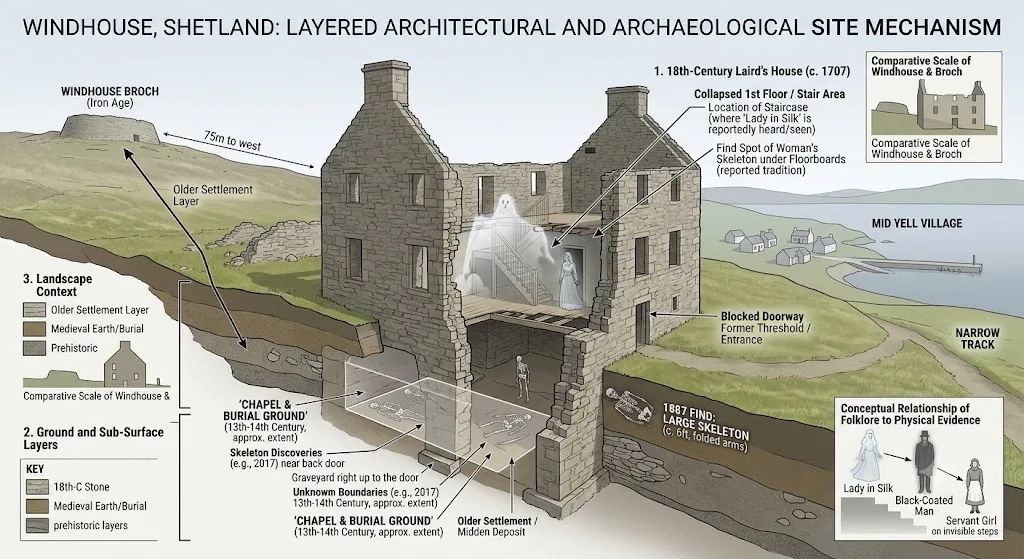
Windhouse, the roofless laird’s house on the island of Yell, is called Shetland’s most haunted house because its ghost stories are unusually tightly bound to physical evidence: a ruined 18th-century house, older settlement remains, a nearby broch, a recorded chapel and graveyard site, and repeated discoveries of human bones. The haunting is not one neat legend but a cluster of claims — the Lady in Silk on the stairs, a tall black-coated man, a servant girl, a ghost dog and stories of bodies found under floors, walls and shallow ground. None of this proves that Windhouse is haunted. What makes the place powerful is that folklore, local memory and archaeology keep meeting at the same hillside site near Mid Yell.[trove.scot]trove.scotScot Yell, Windhouse | Place | trove.scotScot Yell, Windhouse | Place | trove.scot
For readers interested in Shetland’s haunted history, Windhouse matters because it is not simply a “spooky ruin” added to a tourist list. Historic Environment Scotland’s Trove record places Windhouse in Yell parish, in the former county of Shetland, and identifies it as an 18th-century laird’s house with garden walls and nearby designations, including a broch 75 metres west and a separate chapel-and-graveyard record. That layered setting gives the haunting its distinctive character: a house story built over a burial-ground story, set within a much older Shetland landscape.[Trove Scot]trove.scotScot Yell, Windhouse | Place | trove.scotScot Yell, Windhouse | Place | trove.scot
The ruin on Yell and its layered site
Windhouse stands near Mid Yell, not in a town centre or beside a grand visitor attraction, but on a hillside where the ruin’s isolation does much of the imaginative work. NorthLink Ferries describes it as perched above Mid Yell, once a laird’s grand home and now a derelict 18th-century structure, while Trove gives the site’s formal record as “Yell, Windhouse”, with the Ordnance Survey grid reference HU 48878 91910 and coordinates at about 60.60762, -1.10912.[NorthLink Ferries]northlinkferries.co.ukNorth Link Ferries The haunting history of Windhouse | North Link FerriesNorth Link Ferries The haunting history of Windhouse | North Link Ferries
The building seen today is not a medieval castle, although its reputation often has the feel of an old castle haunting. Trove classifies the place as an 18th-century laird’s house and garden wall site, while popular accounts commonly state that an earlier house was built in 1707 and that the structure was later substantially rebuilt or remodelled. NorthLink places the original house in 1707 and says the current structure was largely rebuilt in 1895; Trove’s archive record also refers to standing building recording and excavation at Windhouse in 2017, published in Discovery and Excavation in Scotland in 2018.[Trove Scot]trove.scotScot Yell, Windhouse | Place | trove.scotScot Yell, Windhouse | Place | trove.scot
That long physical history helps explain why Windhouse attracts more durable stories than a purely invented haunted-house tale. A ruin with collapsed roofs, empty windows and blocked or vanished internal routes invites people to imagine former staircases, rooms and thresholds. In Windhouse’s case, that imaginative geography is reinforced by the site record: the ruin is linked in official heritage data to nearby archaeology, including a scheduled broch and a chapel-and-graveyard site.[Trove Scot]trove.scotScot Yell, Windhouse | Place | trove.scotScot Yell, Windhouse | Place | trove.scot
The broch connection matters because brochs are Iron Age towers found across northern Scotland, especially in the Northern Isles. The Windhouse broch is separately recorded by Trove as an Iron Age site, while the laird’s house record explicitly lists “windhouse, broch 75m w of” among nearby designated places. The ghost stories do not need the broch to “explain” them, but the broch adds depth to the landscape: Windhouse is not a single-period house with a single-period haunting, but a place where later domestic architecture sits beside much older occupation.[Trove Scot]trove.scotOpen source on trove.scot.
The most important layer, however, is the burial-ground tradition. Trove’s Windhouse record states that for the chapel and burial-ground at Windhouse, readers should see a separate site record, and it lists “yell, windhouse, chapel and graveyard” among nearby places. Shetland News reported in 2017 that an ancient graveyard had been found at the island’s “most haunted house”, with local archaeologist Val Turner saying the house appeared to be on top of the graveyard and that skeletons went “right up to the door”.[Trove Scot]trove.scotScot Yell, Windhouse | Place | trove.scotScot Yell, Windhouse | Place | trove.scot

The Lady in Silk, black-coated man and other apparitions
The best-known apparition at Windhouse is the Lady in Silk. In Shetland tourism writing, she is usually described as a woman whose presence is heard as much as seen: the rustle of silk, movement near the stair, a repeated circling or turning before she vanishes. Shetland.org says she is alleged to have been a mistress or housekeeper who died after falling down the stairs and breaking her neck, and that a woman’s skeleton was said to have been found under the floorboards of the main stairs during renovations.[Shetland.org]shetland.orgspooky tales from shetlandspooky tales from shetland
This is where Windhouse becomes especially revealing as folklore. The Lady in Silk is not just “a woman in white” moved from one haunted-house template to another. Her story is attached to a specific architectural feature — the stairs — and to a specific kind of reported find — bones under or near the stair. The exact historical certainty is weaker than the story’s confidence: accounts repeat the skeleton claim, but the available public versions are often secondary or local-tradition based. The result is a legend that feels anchored, even where the documentary chain is not fully visible.[ghostweather.com]ghostweather.comThe Haunting of Windhouse on YellThe Haunting of Windhouse on Yell
The second major figure is the tall man in dark clothing, often described with a long black coat and top hat. NorthLink says he is seen around the terraced area outside the house before disappearing into the walls, and links him in local lore to a tax collector who supposedly visited Windhouse and never returned. Shetland.org gives a more document-like anchor: an 1887 microfilm account of human remains found when workmen repairing the manor house removed debris behind the building. The bones were said to measure fully six feet long, to have been laid with arms folded, and to have been found without coffin evidence, prompting speculation about murder.[NorthLink Ferries]northlinkferries.co.ukNorth Link Ferries The haunting history of Windhouse | North Link FerriesNorth Link Ferries The haunting history of Windhouse | North Link Ferries
That 1887 skeleton report is one of the stronger reasons Windhouse stands apart from many haunted-house stories. It does not prove that the black-coated man was seen, nor that the body belonged to a murdered tax collector or missing workman. It does show that stories of human remains at Windhouse were not merely late internet embroidery. By the late 19th century, the house already had a material incident around which local suspicion and later ghost lore could gather.[Shetland.org]shetland.orgspooky tales from shetlandspooky tales from shetland
Other figures broaden the haunting from a single tragedy into a full household of the dead. Shetland News reports that Windhouse’s ghostly inhabitants are said to include a servant girl who climbs invisible steps and a ghost dog; NorthLink similarly mentions a Servant Girl seen climbing an invisible staircase, possibly linked to an earlier layout, and a ghost dog heard or imagined through barking and howling. These details are folklorically useful because they turn architectural loss into narrative: where a staircase has vanished, the ghost still uses it.[Shetland News]shetnews.co.ukShetland News Ancient graveyard at ‘most haunted house’ | Shetland NewsShetland News Ancient graveyard at ‘most haunted house’ | Shetland News
The child skeleton story is the most troubling and least easy to handle confidently. Shetland.org repeats a tradition that, in the early 1900s, two men repairing a window removed a nailed-up shutter and found a child’s skeleton wrapped in sheepskin. Lynn Cherny’s Windhouse essay treats the baby-skeleton report more cautiously, saying she could not find a date in newspapers to verify it. That distinction matters. The story belongs in any account of Windhouse folklore, but it should be presented as a reported tradition rather than a secure archival fact.[Shetland.org]shetland.orgspooky tales from shetlandspooky tales from shetland
Burials, archaeology and legend-making
The burial-ground evidence is the part of Windhouse that most changes how the haunting should be read. Shetland News reported in 2017 that skeletons had been discovered in shallow graves close to the back door, and quoted Val Turner as saying it was likely more human remains remained undiscovered, possibly even underneath the house. Turner also said the boundaries of the graveyard were unknown and may never have had a physical boundary.[Shetland News]shetnews.co.ukShetland News Ancient graveyard at ‘most haunted house’ | Shetland NewsShetland News Ancient graveyard at ‘most haunted house’ | Shetland News
That point is crucial. A modern visitor may imagine a graveyard as a fenced, labelled space with headstones and a clear edge. At Windhouse, the reported problem is the opposite: the older burial ground may have been partly forgotten, poorly marked, wrongly plotted or absorbed into later building and farming. Turner told Shetland News that old chapel sites are sometimes marked on Ordnance Survey maps but with the symbol in the wrong field, and that archaeologists exercise caution when development is planned nearby.[Shetland News]shetnews.co.ukShetland News Ancient graveyard at ‘most haunted house’ | Shetland NewsShetland News Ancient graveyard at ‘most haunted house’ | Shetland News
The 2017 discovery also makes sense in wider Shetland terms. Turner noted that there can be an association between brochs and medieval graveyards, citing Windhouse, Upper Scalloway and Cullingsbrough on Bressay as examples. This does not mean every broch is haunted or every medieval graveyard produces ghost stories. It means Windhouse belongs to a recognisable Shetland pattern in which prehistoric or early historic sites later attract Christian burial, memory and reuse.[Shetland News]shetnews.co.ukShetland News Ancient graveyard at ‘most haunted house’ | Shetland NewsShetland News Ancient graveyard at ‘most haunted house’ | Shetland News
The likely medieval date of the graveyard adds another layer. NorthLink says the unmarked graveyard discovered at Windhouse dates to the 13th or 14th century, while Shetland News reported that tests were due to be carried out to date the skeletons before reburial. The exact dating should be treated carefully unless a final specialist report is being cited, but the broad interpretation is clear enough: the haunting reputation sits above a much older mortuary landscape, not merely above a decayed modern house.[NorthLink Ferries]northlinkferries.co.ukNorth Link Ferries The haunting history of Windhouse | North Link FerriesNorth Link Ferries The haunting history of Windhouse | North Link Ferries
This is why Windhouse’s burial stories do not simply “debunk” the ghosts. They explain why the haunting became believable to many people. A lonely ruin is atmospheric; a lonely ruin where bodies have repeatedly been reported is more powerful; a lonely ruin on or near an old chapel graveyard, beside a broch, becomes a place where different eras of the dead seem to press upwards into one story.[trove.scot]trove.scotScot Yell, Windhouse | Place | trove.scotScot Yell, Windhouse | Place | trove.scot

Why the story became Shetland’s most famous haunting
Windhouse became locally famous because it combines three qualities that hauntings need in order to last: a memorable setting, repeatable figures and a reason for people to believe the place is troubled. The setting is obvious: a ruined laird’s house on a hill in Yell. The figures are vivid: silk, top hat, invisible steps, dog. The reason is the burial evidence: stories of skeletons under stairs, behind the house, in walls and in shallow graves.[northlinkferries.co.uk]northlinkferries.co.ukNorth Link Ferries The haunting history of Windhouse | North Link FerriesNorth Link Ferries The haunting history of Windhouse | North Link Ferries
Its fame has also been reinforced by modern retellings. Shetland.org’s “Spooky Tales from Shetland” calls Windhouse reportedly the most haunted house in Shetland, if not the country, and NorthLink describes it as one of the most haunted places in Shetland and even the UK. Shetland News used the phrase “most haunted house” in reporting the 2017 graveyard discovery, showing how the folklore label had become strong enough to frame even an archaeology news story.[shetland.org]shetland.orgspooky tales from shetlandspooky tales from shetland
That modern visibility does not make every apparition report reliable. It does, however, show how haunted reputation works. A place gains a title, the title attracts visitors and writers, visitors retell older stories, and new archaeological finds are interpreted through the existing legend. At Windhouse, the feedback loop is unusually strong because the physical discoveries are not invented for drama; human remains really have been reported at and around the site, even though the ghostly meanings attached to them remain matters of folklore.[shetland.org]shetland.orgspooky tales from shetlandspooky tales from shetland
The house’s abandoned condition adds another modern layer. NorthLink says Windhouse has been abandoned since the 1920s and warns that entering the building is forbidden because of its unstable condition, though viewing and photography from outside are possible. This matters for credibility as well as safety: ruined buildings produce strange acoustics, shifting shadows, wind noise, unstable floors and suggestive gaps where stairs and rooms used to be. Those ordinary features do not disprove personal experiences, but they do offer sensible explanations for why a place may feel intensely haunted.[NorthLink Ferries]northlinkferries.co.ukNorth Link Ferries The haunting history of Windhouse | North Link FerriesNorth Link Ferries The haunting history of Windhouse | North Link Ferries
How credible are the Windhouse haunting stories?
The most careful answer is that Windhouse is historically credible as a layered site with recorded archaeology, but its ghosts remain traditions, claims and interpretations rather than verified facts. The official heritage record confirms the location, parish, former county, 18th-century laird’s-house classification, nearby broch designation and chapel-and-graveyard association. Local journalism confirms the 2017 discovery of human remains and records a professional archaeological opinion that the house appears to stand on the graveyard.[Trove Scot]trove.scotScot Yell, Windhouse | Place | trove.scotScot Yell, Windhouse | Place | trove.scot
The apparitions have a different evidential status. The Lady in Silk, the top-hatted man, the servant girl and the ghost dog are preserved mainly in local-history writing, tourism features, ghost essays and repeated oral tradition. Some claims are attached to reported finds, especially the 1887 large skeleton and the stories of a woman’s skeleton near the stair, but the links between a body and a named apparition are interpretive rather than demonstrable.[shetland.org]shetland.orgspooky tales from shetlandspooky tales from shetland
The strongest sceptical reading is not that the stories are worthless, but that they have grown around real disturbances of the dead. Old graves found during repairs or development naturally create rumours: Was this a murder? Was someone hidden? Was the house built wrongly over a sacred place? In a small island setting, such questions can outlive the original witnesses and become sharper with each retelling.[Shetland.org]shetland.orgspooky tales from shetlandspooky tales from shetland
The strongest folkloric reading is that Windhouse preserves a social memory of unease around burial, building and inheritance. A laird’s house placed over or beside an older graveyard is already a dramatic image: authority and domestic comfort built on top of the forgotten dead. The ghosts then become narrative forms of that unease — the woman at the stair, the man behind the house, the servant using vanished steps, the dog moving through a threshold world of noise and darkness.[shetnews.co.uk]shetnews.co.ukShetland News Ancient graveyard at ‘most haunted house’ | Shetland NewsShetland News Ancient graveyard at ‘most haunted house’ | Shetland News

Visiting the story without flattening it
Windhouse is best understood as a place where Shetland’s haunted history becomes unusually concrete. It has the atmosphere expected of a famous haunted ruin, but the more interesting story is not simply “who appears after dark?” It is how a house, a graveyard, a broch and generations of local explanation have fused into one of the Northern Isles’ most memorable supernatural landscapes.[Trove Scot]trove.scotScot Yell, Windhouse | Place | trove.scotScot Yell, Windhouse | Place | trove.scot
For a visitor or reader, the important distinction is between respect and belief. It is possible to enjoy the Windhouse legends without treating them as proven ghost reports. It is also possible to be sceptical about apparitions while recognising the seriousness of the burial-ground evidence. Human remains found at historic sites are not props in a ghost story; they are traces of real people whose graves became tangled in later architecture, memory and local fear.[Shetland News]shetnews.co.ukShetland News Ancient graveyard at ‘most haunted house’ | Shetland NewsShetland News Ancient graveyard at ‘most haunted house’ | Shetland News
That balance is what makes Windhouse such a useful anchor for Shetland’s wider haunted-place tradition. It links the ruined-house ghost story to older Shetland concerns: uncertain boundaries, old chapel sites, prehistoric remains, rough weather, isolated buildings and the unease produced when the past is not quite buried where people thought it was. Windhouse is called Shetland’s most haunted house not because the evidence proves its ghosts, but because the evidence gives its legends somewhere solid — and unsettling — to stand.
Amazon book picks
Further Reading
Books and field guides related to Why Is Windhouse Called Shetland's Most Haunted House?. Use these as the next step if you want deeper reading beyond the article.

Scottish Myths and Legends
Introduces readers to the wider supernatural setting of Scottish hauntings.

The folklore of Orkney and Shetland
Provides cultural background for Shetland ghost traditions.

Ghosts
First published 2015. Subjects: Ghosts, History, BODY, MIND & SPIRIT, Parapsychology, General.
The world's most haunted places
Appeals to readers interested in famous haunted locations like Windhouse.
eBay marketplace picks
Marketplace Samples
Live-tested eBay searches with available results related to this page.
Endnotes
1.
Source: trove.scot
Title: Scot Yell, Windhouse | Place | trove.scot
Link:https://www.trove.scot/place/178922
2.
Source: shetland.org
Title: spooky tales from shetland
Link:https://www.shetland.org/blog/spooky-tales-from-shetland
3.
Source: trove.scot
Link:https://www.trove.scot/place/1256
4.
Source: ghostweather.com
Title: The Haunting of Windhouse on Yell
Link:https://ghostweather.com/essays/windhouse.html
5.
Source: trove.scot
Link:https://www.trove.scot/place/1254
6.
Source: trove.scot
Link:https://www.trove.scot/place/1255
7.
Source: archive.org
Link:https://archive.org/download/scottishantiquar189798edin/scottishantiquar189798edin.pdf
8.
Source: archive.org
Link:https://archive.org/stream/scottishnotesque21unse/scottishnotesque21unse_djvu.txt
9.
Source: shetnews.co.uk
Title: Shetland News Ancient graveyard at ‘most haunted house’ | Shetland News
Link:https://www.shetnews.co.uk/2017/09/21/ancient-graveyard-found-at-isles-most-haunted-house/
10.
Source: northlinkferries.co.uk
Title: North Link Ferries The haunting history of Windhouse | North Link Ferries
Link:https://www.northlinkferries.co.uk/shetland-blog/the-haunting-history-of-windhouse/
Additional References
11.
Source: academia.edu
Link:https://www.academia.edu/2610774/Burnt_Mounds_Transforming_Spaces_and_Places_in_Bronze_Age_Shetland
12.
Source: archaeologyscotland.org.uk
Link:https://www.archaeologyscotland.org.uk/wp-content/uploads/2022/05/1997.pdf
13.
Source: facebook.com
Link:https://www.facebook.com/groups/1475717922681828/posts/4081581812095413/
14.
Source: nuarchitectuuratelier.com
Link:https://www.nuarchitectuuratelier.com/en/story/the-house-on-the-hill/
15.
Source: scribd.com
Link:https://www.scribd.com/document/222735180/West-Over-Sea-the-Northern-World
16.
Source: brill.com
Link:https://brill.com/display/book/edcoll/9789047421214/9789047421214_webready_content_text.pdf?srsltid=AfmBOorq4uFhnQ8bA77ufSKl5Y2D6iGEVJrubNwZe7VQ3Bl6jlImJLYP
17.
Source: facebook.com
Link:https://www.facebook.com/groups/livingworkingshetland/posts/1863692277802428/
18.
Source: deadlive.co.uk
Link:https://www.deadlive.co.uk/windhouse-mid-yell-shetland-scotlands-most-haunted-house/
19.
Source: facebook.com
Link:https://www.facebook.com/groups/scotlandsscenery/posts/4534421843243820/
20.
Source: befs.org.uk
Link:https://www.befs.org.uk/resources/historic-environment-case-studies/care-protect/windhouse/
Topic Tree