Within Haunted Suffolk
Is Bury St Edmunds Suffolk's Ghost Capital?
Bury St Edmunds gathers abbey ruins, old gaols, cellars and theatre lore into Suffolk's richest walkable ghost cluster.
On this page
- The Grey Lady's route
- Moyse's Hall and gaol stories
- Theatre, inns and ghost tourism
Page outline Jump by section
Introduction
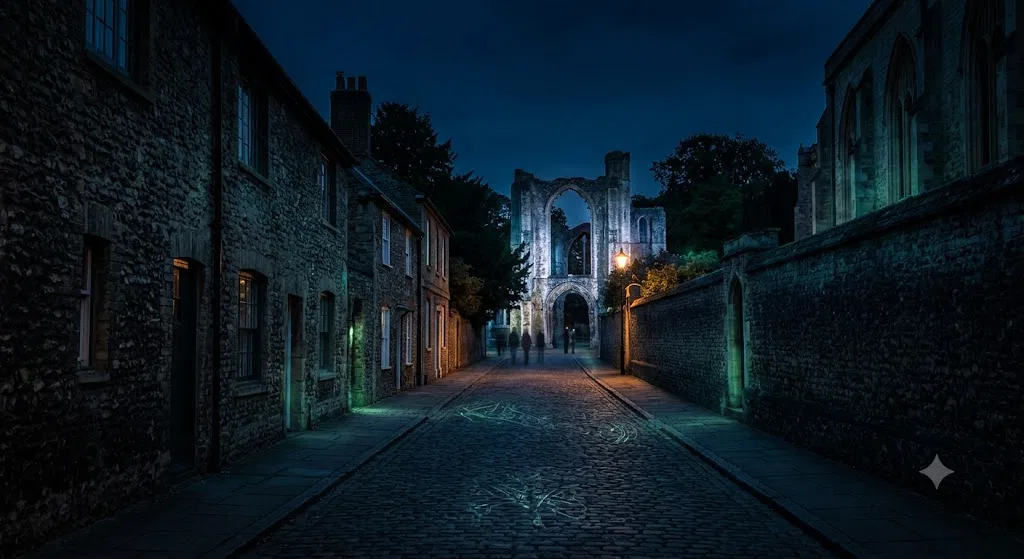
Bury St Edmunds has one of Suffolk’s strongest walkable ghost clusters because its stories are packed into a small, historically dense town centre: the Abbey ruins and Great Churchyard, Moyse’s Hall, Angel Hill, old cellars, pubs, hotels and the Theatre Royal all sit close enough to form a natural ghost-walk route. The town’s most famous apparition is the Grey Lady, usually linked with the abbey precinct and the former St Saviours Hospital site, though the best explanation is not a proven medieval haunting but a layered piece of folklore shaped by Victorian fiction, local memory and repeated retelling.[Bury St Edmunds & Beyond]visit-burystedmunds.co.ukBury St Edmunds & Beyond Haunted Bury St Edmunds | Bury St Edmunds & BeyondBury St Edmunds & Beyond Haunted Bury St Edmunds | Bury St Edmunds & Beyond
That makes Bury St Edmunds especially interesting in Suffolk’s haunted map. Unlike Black Shuck at Bungay and Blythburgh, which centres on a dramatic Elizabethan church legend, Bury’s ghosts are urban and cumulative. The stories work because the streets themselves do much of the work: ruined abbey stone, a huge churchyard, a medieval museum building, a surviving Regency theatre and narrow commercial lanes create a town where history can be walked as well as read. The result is less a single haunting than an abbey-town atmosphere.
Why Bury feels like Suffolk’s ghost capital
Bury St Edmunds’ claim to be Suffolk’s “ghost capital” rests on concentration. A visitor can move from Cornhill and Moyse’s Hall to The Nutshell, Angel Hill, the Abbey Gate, the Great Churchyard and the Theatre Royal without leaving the old town centre. Bury St Edmunds Tour Guides’ Ghostly and Macabre tours reflect that geography: their tours run seasonally from Halloween to the end of March, with advance booking, and the route is presented as a mix of ghosts, macabre history and darkened streets rather than a single-site vigil.[Bury St Edmunds Tour Guides]burystedmundstourguides.orgOpen source on burystedmundstourguides.org.
The official visitor account describes the guided walk as moving through stories of “screaming skulls”, monk-like figures in cellars, burnings and hangings, before ending in the Great Churchyard for tales of the Abbey and the Grey Lady. The tour is 90 minutes long, starts from the Cornhill area, and is restricted to older participants because of its content.[Bury St Edmunds & Beyond]visit-burystedmunds.co.ukOpen source on visit-burystedmunds.co.uk.
That practical structure matters. Bury’s ghost tourism is not just a list of spooky names; it is an interpretation of the town’s layout. Moyse’s Hall brings in imprisonment, punishment and museum objects. The Nutshell adds pub folklore and the mummified cat. Angel Hill and Abbeygate Street provide old lanes, cellars and shopfronts. The Great Churchyard supplies the ruined religious setting where the Grey Lady legend is most strongly staged. The Theatre Royal extends the route beyond medieval abbey memory into performance culture and backstage rumour.
The stronger reading is that Bury St Edmunds is not “haunted” in any demonstrable way, but it is unusually well suited to ghost-story transmission. The town has old buildings, public access, recurring tours, repeatable dates, named apparitions and stories that can be told within sight of the places they describe. That is the combination that makes a local haunting tradition durable.
The Grey Lady’s route
The Grey Lady is Bury St Edmunds’ best-known apparition. She is said to appear in St Edmundsbury Cathedral’s Great Churchyard on 24 February at 11pm, and local accounts also place sightings at the Abbey ruins, St Saviours Hospital ruins, the Priory Hotel, Theatre Royal, Abbeygate Street shops, buildings on Angel Hill and the cellars of the former Cupola House on The Traverse.[Bury St Edmunds & Beyond]visit-burystedmunds.co.ukBury St Edmunds & Beyond Haunted Bury St Edmunds | Bury St Edmunds & BeyondBury St Edmunds & Beyond Haunted Bury St Edmunds | Bury St Edmunds & Beyond
That spread is revealing. A tightly evidenced ghost report usually belongs to one witness, one room or one incident. The Grey Lady belongs to a route. She has become a figure who binds the abbey precinct to the rest of the old town, turning Bury into a haunted walking map.
The date, 24 February, points towards the legend of Maude Carew. In modern retellings, Maude is often described as a nun connected with the death of Humphrey, Duke of Gloucester, who died in Bury St Edmunds in 1447. Some versions say she murdered him; others detach her from Gloucester and make her a punished nun whose forbidden relationship with a monk led to her death. Local visitor material now notes that the Maude Carew explanation has been challenged by historian Francis Young.[Bury St Edmunds & Beyond]visit-burystedmunds.co.ukBury St Edmunds & Beyond Haunted Bury St Edmunds | Bury St Edmunds & BeyondBury St Edmunds & Beyond Haunted Bury St Edmunds | Bury St Edmunds & Beyond
The important twist is that Maude Carew appears to be a literary invention. Young’s account of the legend explains that Maude was created by Margaretta Greene for the 1861 novella The Secret Disclosed, and a later Folklore Thursday article describes how the story helped spark a crowd gathering, or “ghost riot”, in the Great Churchyard on 24 February 1862.[Francis Young]drfrancisyoung.comthe ghost of maude carew on bbc radio suffolkthe ghost of maude carew on bbc radio suffolk
This does not make the Grey Lady unimportant. It makes her more interesting. Bury’s most famous ghost seems to sit at the meeting point between local uncanny experience, Victorian print culture and older abbey-town unease. Greene’s story may have given a name and plot to something already rumoured, or it may have generated much of the modern legend itself. Either way, the Grey Lady is a good example of how a fictional ghost can become local folklore once people attach it to a real place, a precise date and a dramatic public ritual.
The setting gives the story its force. The Great Churchyard was once part of the Abbey of St Edmund, and the visitor route still takes in St Edmundsbury Cathedral, the Norman Tower, the West Front ruins, St Mary’s Church and memorials dating back to the 17th century. The same visitor account notes that the churchyard’s earliest reference comes from Jocelin of Brakelond in 1197, in a passage about conflict between the abbot’s servants and townspeople.[Bury St Edmunds & Beyond]visit-burystedmunds.co.ukOpen source on visit-burystedmunds.co.uk.
In other words, the Grey Lady is not just a woman in grey. She is a story about a place where burial, pilgrimage, monastic power, civic tension, theatrical fiction and modern tourism overlap.
Moyse’s Hall and gaol stories
Moyse’s Hall is one of the most useful anchors for Bury’s ghost walks because it is both genuinely old and publicly accessible. The Association for Suffolk Museums describes it as a 12th-century landmark that has looked over Bury St Edmunds market place for almost 900 years, and notes that it served as the town gaol, workhouse and police station before opening as a museum in 1899.[The Association for Suffolk Museums]suffolkmuseums.orgThe Association for Suffolk Museums Moyse’s Hall MuseumThe Association for Suffolk Museums Moyse’s Hall Museum
That history gives the building a different kind of atmosphere from the abbey ruins. Moyse’s Hall is not primarily a romantic ruin; it is a place of custody, poverty, policing and punishment. Its museum collections also include local history, crime-and-punishment material, witchcraft and superstition themes, which means the building now curates the very subjects that feed its haunted reputation.[Suffolk InfoLink]infolink.suffolk.gov.ukSuffolk Info Link Moyse's Hall Museum, Bury St EdmundsSuffolk Info Link Moyse's Hall Museum, Bury St Edmunds
One of the most persistent Moyse’s Hall stories reaches back to 1328, when a woman is said to have seen “a most horrible devil” in the building’s cellar. That claim appears frequently in modern haunted-Bury accounts and is valuable because it gives the building a medieval supernatural tradition rather than only a modern ghost-tour identity.[The Morbid Tourist]themorbidtourist.comThe Morbid Tourist10 Spooky Things to Do In Bury St Edmunds, SuffolkThe Morbid Tourist10 Spooky Things to Do In Bury St Edmunds, Suffolk
The other major macabre association is William Corder, executed in 1828 for the Red Barn murder. Visitor material for Bury ghost breaks notes that ghost tours begin with Moyse’s Hall and the story of Corder, whose trial, conviction and execution drew huge crowds to the town. Moyse’s Hall also holds crime-and-punishment material connected with the case, including Corder’s death mask and the notorious book bound in his skin.[Bury St Edmunds & Beyond]visit-burystedmunds.co.ukOpen source on visit-burystedmunds.co.uk.
For a careful reader, Moyse’s Hall shows how “haunting” can mean several things at once. There are claimed apparitions and cellar legends, but there is also the haunting effect of objects, punishments and public spectacle. The building’s ghostly reputation is credible as folklore because it has deep architectural age and a documented institutional past. The supernatural details themselves remain claims, not established events.

Theatre, inns and ghost tourism
The Theatre Royal gives Bury’s ghost map a different mood. It was built in 1819 by William Wilkins and is described by the National Trust as Britain’s only surviving Regency playhouse still used for performances. Its intimate auditorium, original boxes and restored Regency character make it one of the town’s most atmospheric interiors, even before ghost stories are added.[National Trust]nationaltrust.org.ukNational Trust History of Theatre Royal │ Suffolk | National TrustNational Trust History of Theatre Royal │ Suffolk | National Trust
Local haunted-Bury accounts include the Theatre Royal among the places where the Grey Lady has been sighted. That placement matters because theatre ghosts often behave differently from abbey ghosts. They are usually less about sin, punishment or burial, and more about fleeting figures, backstage presences, empty auditoria and the ambiguity of performance spaces. In Bury, the Theatre Royal helps the Grey Lady move from medieval religious ruin into the wider emotional geography of the town.[Bury St Edmunds & Beyond]visit-burystedmunds.co.ukBury St Edmunds & Beyond Haunted Bury St Edmunds | Bury St Edmunds & BeyondBury St Edmunds & Beyond Haunted Bury St Edmunds | Bury St Edmunds & Beyond
The inns and pubs add another layer. The Nutshell, often promoted as Britain’s smallest pub, is part of the town’s ghost-tour economy and has its own folklore. Local visitor material says accused witches were supposedly taken to a building on the site of The Nutshell, where nails or locks of hair were cut and stored in jars to prevent them returning whole in the next life. The same account records claims of a small boy’s ghost, poltergeist-like activity, drained batteries, broken glasses and a mummified cat called “Fluffy”, found during building work in 1935 and said to be unlucky to touch.[Bury St Edmunds & Beyond]visit-burystedmunds.co.ukBury St Edmunds & Beyond The NutshellBury St Edmunds & Beyond The Nutshell
Such stories should be treated with caution. The mummified cat fits a known early-modern and later building-folklore pattern, in which dried cats were concealed in walls or roof spaces as protective charms. The claims about witch-handling at the pub site and the boy’s ghost are harder to verify from the accessible tourist material. Their value is folkloric: they show how ghost walks blend documented objects, pub tradition, witchcraft lore and local performance.
The Angel Hotel, Abbeygate Street, Angel Hill and old cellars complete the town-centre cluster. The Grey Lady’s reported route passes through commercial and hospitality spaces as well as sacred ruins, which is one reason the story has remained useful to tourism. A visitor can have dinner, visit a museum, attend the theatre and then hear a ghost story set only a few streets away.
What is credible, and what is folklore?
The strongest evidence for Bury St Edmunds’ haunted identity is not proof of apparitions. It is evidence that ghost stories have been repeatedly attached to specific sites, retold by local tourism bodies, preserved by historians and given public form through guided walks. That is enough to make Bury one of Suffolk’s most important haunted-history towns, but it is not the same as verifying ghosts.
The historical foundations are solid. The Abbey of St Edmund was a major medieval religious house; the Great Churchyard formed part of the abbey landscape; Moyse’s Hall is a medieval building with a gaol, workhouse and police-station past; and the Theatre Royal is a rare surviving Regency playhouse.[visit-burystedmunds.co.uk]visit-burystedmunds.co.ukOpen source on visit-burystedmunds.co.uk.
The folklore foundations are also strong, but in a different way. The Grey Lady has a recognised route and date. Maude Carew has a traceable literary origin in Margaretta Greene’s The Secret Disclosed. The 1862 churchyard gathering shows that the story affected public behaviour very early in its life. Moyse’s Hall has an old devil-in-the-cellar tradition, and The Nutshell’s mummified cat gives ghost tours a tangible object around which to build a story.[folklorethursday.com]folklorethursday.coma ghost story that caused a riot the strange case of maude carewA ghost story that caused a riot: the strange case of Maude…5 Dec 2019 — Margaretta Greene, the story's author, originated an enduring…
The weaker material is the apparition evidence itself. Many sightings are summarised in modern visitor accounts without full witness names, dates, original statements or contemporary newspaper references. That does not make them worthless, but it places them in the category of local tradition rather than documented psychical casework. Bury’s ghosts are best understood as public folklore attached to real historic places.
Sceptically, the town’s haunted reputation can be explained by four forces working together:
- Dense historical scenery: ruins, churchyards, cellars, old inns and a medieval museum building create strong expectation.
- Repeatable storytelling: seasonal tours give the same stories a regular public audience.
- A named central figure: the Grey Lady turns scattered sightings into one recognisable town ghost.
- Victorian amplification: Maude Carew shows how a printed fiction can seed or reshape a local haunting.
That reading does not flatten the atmosphere. It explains why Bury St Edmunds feels so haunted to visitors: the stories are not random. They are organised around the town’s most memorable spaces.

How Bury fits Suffolk’s wider haunted map
Within Suffolk, Bury St Edmunds stands apart from the county’s coastal and rural legends. Dunwich has drowned bells and a vanished medieval town; Bungay and Blythburgh have Black Shuck and storm-lashed church folklore; Orford has stranger medieval legend; but Bury has a compact, walkable ghost economy built around abbey-town memory.
Its haunted identity is therefore urban, theatrical and tourable. The Abbey ruins supply medieval sacred power. The Great Churchyard supplies burial and spectacle. Moyse’s Hall supplies punishment and the museum of crime. The Theatre Royal supplies performance and the uncanny backstage. The Nutshell and old inns supply pub folklore. Together they make Bury St Edmunds the Suffolk town where ghost stories are easiest to follow on foot.
That is why the question “Is Bury St Edmunds Suffolk’s ghost capital?” has a useful answer. In terms of documented supernatural proof, no town can claim that title securely. In terms of density, public storytelling, named apparitions and atmospheric historic streets, Bury St Edmunds has the strongest case. Its ghosts are best approached not as facts to be accepted whole, but as stories that reveal how a town remembers its abbey, its punishments, its entertainments and its dead.
Amazon book picks
Further Reading
Books and field guides related to Is Bury St Edmunds Suffolk's Ghost Capital?. Use these as the next step if you want deeper reading beyond the article.
The Penguin Guide to the Superstitions of Britain and Ireland
Explains recurring ghost motifs found in historic towns.

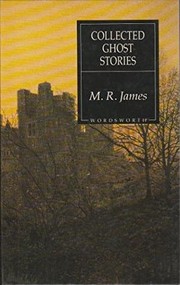
The collected ghost stories of M. R. James
First published 1931. Subjects: Fiction, ghost, Fiction, short stories (single author), English Ghost stories.
eBay marketplace picks
Marketplace Samples
Live-tested eBay searches with available results related to this page.


Endnotes
1.
Source: folklorethursday.com
Title: a ghost story that caused a riot the strange case of maude carew
Link:https://folklorethursday.com/halloween/a-ghost-story-that-caused-a-riot-the-strange-case-of-maude-carew/
Source snippet
A ghost story that caused a riot: the strange case of Maude...5 Dec 2019 — Margaretta Greene, the story's author, originated an enduring...
2.
Source: folklorethursday.com
Link:https://folklorethursday.com/author/drfrancisyoung/
3.
Source: folklorethursday.com
Title: bury st edmunds
Link:https://folklorethursday.com/tag/bury-st-edmunds/
4.
Source: visit-burystedmunds.co.uk
Title: Bury St Edmunds & Beyond Haunted Bury St Edmunds | Bury St Edmunds & Beyond
Link:https://visit-burystedmunds.co.uk/blog/ghostly-bury-st-edmunds
5.
Source: burystedmundstourguides.org
Link:https://www.burystedmundstourguides.org/our-tours/ghostly-macabre-tours/
6.
Source: visit-burystedmunds.co.uk
Link:https://visit-burystedmunds.co.uk/blog/ghost-tour-bury-st-edmunds
7.
Source: drfrancisyoung.com
Title: the ghost of maude carew on bbc radio suffolk
Link:https://drfrancisyoung.com/2021/02/11/the-ghost-of-maude-carew-on-bbc-radio-suffolk/
8.
Source: visit-burystedmunds.co.uk
Link:https://visit-burystedmunds.co.uk/blog/5-things-to-spot-in-the-great-churchyard
9.
Source: suffolkmuseums.org
Title: The Association for Suffolk Museums Moyse’s Hall Museum
Link:https://suffolkmuseums.org/museums/moyses-hall-museum/
10.
Source: infolink.suffolk.gov.uk
Title: Suffolk Info Link Moyse’s Hall Museum, Bury St Edmunds
Link:https://infolink.suffolk.gov.uk/kb5/suffolk/infolink/service.page?id=OVc6YLWrtzA
11.
Source: themorbidtourist.com
Title: The Morbid Tourist10 Spooky Things to Do In Bury St Edmunds, Suffolk
Link:https://themorbidtourist.com/spooky-things-to-do-in-bury-st-edmunds/
12.
Source: visit-burystedmunds.co.uk
Link:https://visit-burystedmunds.co.uk/blog/5-reasons-why-bury-st-edmunds-is-a-ghoulishly-good-spooky-break
13.
Source: nationaltrust.org.uk
Title: National Trust History of Theatre Royal │ Suffolk | National Trust
Link:https://www.nationaltrust.org.uk/visit/suffolk/theatre-royal-bury-st-edmunds/history-of-the-theatre-royal-bury-st-edmunds
14.
Source: visit-burystedmunds.co.uk
Title: Bury St Edmunds & Beyond The Nutshell
Link:https://visit-burystedmunds.co.uk/blog/the-nutshell-britains-spookiest-pub
15.
Source: visit-burystedmunds.co.uk
Link:https://visit-burystedmunds.co.uk/blog/discover-st-edmundsbury-cathedral-bury-st-edmunds
16.
Source: visit-burystedmunds.co.uk
Link:https://visit-burystedmunds.co.uk/blog/discover-the-myths-legends-of-bury-st-edmunds
17.
Source: visit-burystedmunds.co.uk
Link:https://visit-burystedmunds.co.uk/blog/spend-a-weekend-in-haunted-bury-st-edmunds
18.
Source: Wikipedia
Title: St Edmundsbury Cathedral
Link:https://en.wikipedia.org/wiki/St_Edmundsbury_Cathedral
19.
Source: burystedmunds.co.uk
Link:https://www.burystedmunds.co.uk/cathedral-abbey-gardens.html
Additional References
20.
Source: youtube.com
Link:https://www.youtube.com/watch?v=mMXB2sdXFN4
Source snippet
"Haunted England - Chilling Ghost Stories From East Anglia.[https://www.youtube.com/watch?v=Kcan16xXWGo..."](https://www.youtube.com/watch?v=Kcan16xXWGo...")...
21.
Source: youtube.com
Title: Unravel the SECRETS of the ruined abbey in Just 5 Minutes
Link:https://www.youtube.com/watch?v=o4DJvDcccsA
Source snippet
The GREY LADY: The Origin and Sorrowful Story | English British Mystical Tale & Folklore...
22.
Source: youtube.com
Title: Investigating the Abbey Monastery Ruins | Ghost Dimension: Flying Solo
Link:https://www.youtube.com/watch?v=uFi-J5m_biA
Source snippet
Unravel the SECRETS of the ruined abbey in Just 5 Minutes...
23.
Source: youtube.com
Title: Bury St Edmunds Abbey
Link:https://www.youtube.com/watch?v=xVstO6sfwC4
Source snippet
Investigating the Abbey Monastery Ruins | Ghost Dimension: Flying Solo...
24.
Source: facebook.com
Link:https://www.facebook.com/burystedmundsandbeyond/posts/hauntedburystedmunds-bury-st-edmunds-resident-ghost-the-grey-lady-has-been-sight/3307238709312774/
25.
Source: facebook.com
Link:https://www.facebook.com/GULLYGARMS/posts/are-they-haunted-apparently-there-is-a-lot-of-spooky-history-in-bury-st-edmunds-/1275391587942826/
26.
Source: kirstyhartsiotis.com
Link:https://www.kirstyhartsiotis.com/biography
27.
Source: yorkghostmerchants.com
Link:https://www.yorkghostmerchants.com/original-york-ghost/project-one-z2fga-7yhl2-njr7m-6j5fm-74j42-t7w6n-ax7nj-62d5c-j9r5x-95gye-lnjny-lh2yl
28.
Source: burystedmundsdirectories.co.uk
Link:https://burystedmundsdirectories.co.uk/hauntings-and-ghostly-encounters-in-bury-st-edmunds/
29.
Source: english-heritage.org.uk
Link:https://www.english-heritage.org.uk/visit/places/bury-st-edmunds-abbey/history/
Topic Tree