Within Haunted Sussex
Why Do Pevensey's Walls Attract Ghost Stories?
Pevensey Castle gathers Roman, Norman, wartime and coastal folklore into one layered haunted place of marching sounds and pale figures.
On this page
- Roman fort, Norman landing and wartime reuse
- White ladies, marching feet and castle patrol legends
- Sound, stone and sceptical explanations
Page outline Jump by section
Introduction
Pevensey Castle attracts ghost stories because it is not just a ruin: it is a place where Sussex’s invasion history is layered in stone. The Roman fort of Anderitum guarded a tidal coastal approach; William of Normandy landed at Pevensey on 28 September 1066; medieval defenders endured sieges; and in 1940 the castle was refitted against the threat of German invasion. English Heritage describes it as a site first fortified by the Romans and most famously associated with the beginning of the Norman Conquest, while Historic England stresses its unusually long sequence of Roman, Norman, medieval, Tudor and Second World War defences.[English Heritage]english-heritage.org.ukEnglish HeritageHistory of Pevensey CastleThis naturally defensible site, first fortified by the Romans, was most famously the place wher…
The hauntings attached to Pevensey follow that same pattern. The best-known stories speak of pale or white ladies on the walls, a woman linked with Lady Pelham and the siege of 1399, phantom marching feet, ghostly armies near the gate or below the walls, and a drummer or military presence still patrolling the ramparts. These should be read as traditions and reported experiences, not confirmed facts. Their real value lies in how neatly they express Pevensey’s identity: a Sussex castle repeatedly waiting for invasion, hearing armies approach, and turning old defensive architecture into local folklore.
Why Pevensey’s Walls Attract Ghost Stories
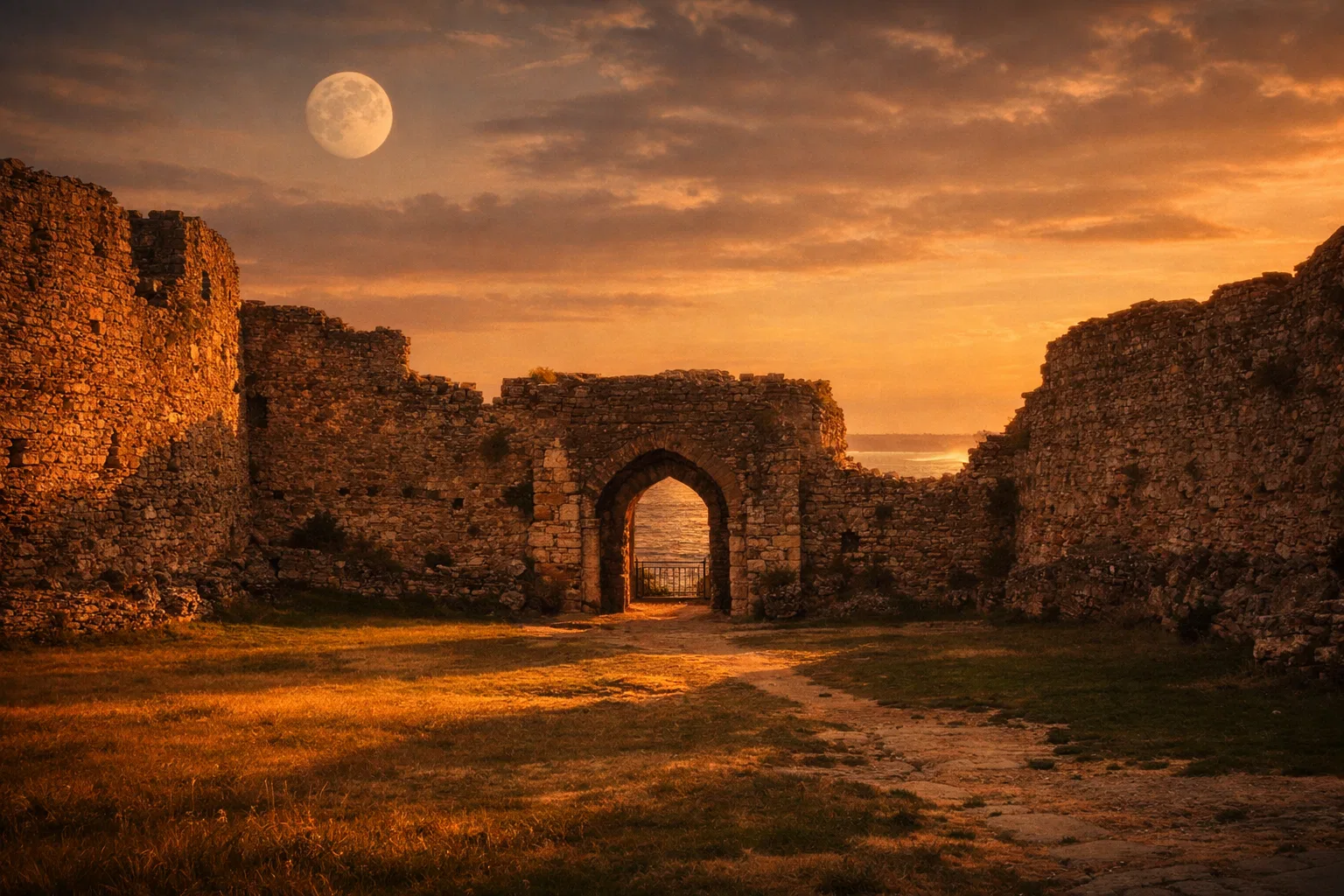
Pevensey sits in East Sussex today, but its stories belong to the older historic county of Sussex and to the invasion coast of southern England. The castle is now inland, yet its Roman builders chose a site that was once a peninsula projecting into tidal water and marsh. English Heritage notes that this made it naturally defensible, and Historic England identifies the monument as one of the best surviving Saxon Shore forts, with substantial standing remains and buried archaeological evidence still likely to survive.[English Heritage]english-heritage.org.ukEnglish HeritageHistory of Pevensey CastleThis naturally defensible site, first fortified by the Romans, was most famously the place wher…
That geography matters for the ghost stories. A castle that looks landlocked now was once a coastal watchpoint. Its high walls, wide outer enclosure and marsh-edge setting create the impression of a place still listening for something coming from the sea. For visitors, the most haunting fact may be that Pevensey has repeatedly been reused when England feared attack: Roman coastal defence, Norman invasion, Elizabethan gun positions against the Spanish threat, and Second World War anti-invasion works.[English Heritage]english-heritage.org.ukOpen source on english-heritage.org.uk.
The result is a rare kind of haunted-place narrative. Many castles have a “grey lady” or a tragic prisoner. Pevensey has those elements too, but they are set inside a broader military memory. Its alleged apparitions are not just domestic figures in corridors. They are walkers on walls, armies below the ramparts, marching sounds, patrols, drums and figures at gates. The folklore fits the architecture.
Roman Fort, Norman Landing and Wartime Reuse
Pevensey’s ghost stories make more sense when the site is read as a sequence of defensive occupations rather than as a single medieval castle. English Heritage dates the Roman Saxon Shore fortress to about AD 290 and describes it as the biggest of the Roman forts of that coastal system, with walls more than 500 metres long still standing close to their full height.[English Heritage]english-heritage.org.ukOpen source on english-heritage.org.uk.
Those Roman walls are central to the atmosphere of the place. They enclose a large open outer bailey, while the later Norman castle sits within them. In folklore terms, this gives Pevensey two overlapping haunted spaces: the older Roman perimeter, associated with marching soldiers, patrols and ancient coastal defence; and the medieval inner castle, where the stories of Lady Pelham, siege and pale women are usually placed.
The Norman layer is just as important. William the Conqueror landed at Pevensey on 28 September 1066 and built temporary defences, probably inside the Roman fort, before moving towards Hastings. English Heritage’s school material presents Pevensey as the place where pupils can “stand at the spot where history happened”, because the Norman Conquest began there in a physical, local sense before it became a national turning point.[English Heritage]english-heritage.org.ukEnglish HeritageHistory of Pevensey CastleThis naturally defensible site, first fortified by the Romans, was most famously the place wher…
Pevensey then remained strategically useful through later centuries. Historic England’s list entry says the Roman fort was reused and repaired in medieval, Tudor and Second World War phases, illustrating the site’s continuing military value. English Heritage adds that after the fall of France in 1940, Pevensey again became a possible invasion point: a command and observation post was set up, machine-gun pillboxes were built, and an anti-tank blockhouse was placed in the Roman west gate.[Historic England]historicengland.org.ukHistoric EnglandPevensey Castle: a Saxon Shore fort, Norman defences…Anderita was the last Saxon Shore fort to be built in England an…
That Second World War reuse is especially striking for a haunted-history page. It means the “invasion ghosts” at Pevensey are not attached only to remote medieval legend. The castle was still being adapted for real defensive anxiety within living memory of the twentieth century. The ghostly marching and patrol stories gain force because the place has repeatedly been asked to perform the same role: watch the coast, hold the walls, and prepare for attack.

White Ladies, Lady Pelham and the Siege Memory
The most familiar female apparition at Pevensey is usually described as a pale lady, grey lady or white lady haunting the castle walls. TimeTravel Britain’s account says a “grey or pale Lady” is reputed to haunt the inside of the castle and has been seen pacing along a parapet; it also connects the tradition with speculation around Lady Joan Pelham.[Time Travel Britain]timetravel-britain.comOpen source on timetravel-britain.com.
The historical anchor behind this story is the political crisis of 1399. English Heritage records that Sir John Pelham held Pevensey for Henry Bolingbroke, the future Henry IV, and that on 25 July 1399 Pelham wrote to Bolingbroke saying he was under heavy siege by local levies from three counties, asking him to help secure the castle.[English Heritage]english-heritage.org.ukEnglish HeritageHistory of Pevensey CastleThis naturally defensible site, first fortified by the Romans, was most famously the place wher…
The difficulty is that folklore often turns this into a more dramatic domestic story: Lady Joan Pelham left inside the castle, waiting for her husband’s return, sometimes imagined as the anxious female defender whose spirit still searches the walls. A nineteenth-century account in Sussex Archaeological Collections, now available through Wikisource, presents the older tradition that the wife of Sir John Pelham sustained a siege at Pevensey in support of the Lancastrian cause against forces from Sussex, Surrey and Kent.[Wikisource]en.wikisource.orgSussex Archaeological CollectionsSussex Archaeological Collections
Modern historical caution is needed here. A scholarly article by S. K. Walker on letters to the dukes of Lancaster notes the well-known letter attributed to “Lady Joan Pelham” from Pevensey on 25 July 1399, but the English Heritage history page identifies the letter as Pelham’s report to Bolingbroke rather than as a romantic ghost-story document from Joan herself.[JSTOR]jstor.orgOpen source on jstor.org.
This is exactly how many castle hauntings develop. A real siege, a real political crisis, a famous name and an emotionally powerful image become fused into a simpler legend: a woman on the walls, separated from her husband, endlessly watching. Whether or not the apparition reports preserve anything factual, the story has become Pevensey’s way of turning the siege of 1399 into a human scene.
Marching Feet, Phantom Armies and Castle Patrols
Pevensey’s second strong haunting pattern is military sound: marching, voices, drums and troops approaching or moving around the walls. This is where the castle’s invasion history becomes almost audible. Spooky Isles, a modern paranormal-history site, summarises reports of marching feet in and near the castle and links them imaginatively to Roman soldiers training at Anderitum, while other haunted-place directories describe a ghostly army seen or heard below the walls or at the castle gate.[Spooky Isles]spookyisles.comSpooky Isles Pevensey Castle's Haunting Melody Of Ghostly FearSpooky Isles Pevensey Castle's Haunting Melody Of Ghostly Fear
These accounts are not as historically secure as the Roman walls or the Norman landing. They are better understood as recurring motifs in the site’s folklore. The sounds are said to belong to no single confirmed episode. They may be Roman troops, Norman invaders, medieval defenders, or a more general “army” pressed into the castle’s long defensive memory. That uncertainty is part of the tradition. Pevensey has hosted so many military phases that a ghostly army can be made to fit more than one century.
The phantom drummer belongs to the same pattern. Haunted Britain describes a “Phantom Drummer” seen striding along the ramparts at night, while Spooky Isles gives a version in which a drummer boy is seen on the battlements and heard playing for an attack that has been lost to history.[haunted-britain.com]haunted-britain.comGhost Stories From East and West SussexGhost Stories From East and West Sussex
The drummer is a particularly telling figure because drums were practical military instruments before they became Gothic decoration. They regulated movement, signalled presence and gave rhythm to bodies under command. In a ruin famous for repeated military readiness, a phantom drummer is a neat piece of folklore: not a named victim, but the sound of organisation, warning and mobilisation.
Local tourism has helped keep these motifs alive. Visit 1066 Country’s listing for the Pevensey Ghost Walk advertises a lantern-led route covering “white ladies”, smugglers, monks, Romans and darker stories around the castle shadows, and says the walk had been running for 38 years.[Visit 1066 Country]visit1066country.compevensey ghost walk p2535511pevensey ghost walk p2535511
That does not prove the hauntings. It does show that the stories have become part of Pevensey’s public identity. The castle is not merely a scheduled monument with an audio guide; it is also a place where local performance, evening walking tours and Sussex coastal storytelling keep reinterpreting the same stones.
The Moat, the Pale Woman and the Problem of Repeated White Ladies
Some versions of the Pevensey haunting move away from Lady Pelham and describe a white lady associated with the moat. Haunted Britain gives a vivid account of an unfortunate girl whose wraith is said to be seen swimming desperately in the moat or standing nearby in sorrow.[haunted-britain.com]haunted-britain.comGhost Stories From East and West SussexGhost Stories From East and West Sussex
This version is more folkloric and harder to pin to a documented event. It resembles a widespread British castle motif: the woman in white or grey, often attached to water, loss, betrayal, imprisonment or waiting. That does not make it meaningless. It shows how Pevensey’s local stories borrow a familiar ghost-language and attach it to a site with suitable scenery: walls, water, night, military danger and ruined status.
The caution is that “white lady” traditions easily migrate between places. Sussex alone has several pale female apparitions attached to houses, castles, theatres and ruins. A useful Pevensey page should therefore avoid treating every white-lady version as a single stable case. At Pevensey, there are at least two overlapping strands:
- The Pelham strand: a pale woman on or within the walls, linked to the 1399 siege and the story of anxious defence.
- The moat strand: a sorrowful or drowning female figure near the water, closer to a general tragic-white-lady motif.
The first has a firmer historical setting because it points back to a recorded siege and the Pelham association. The second is more atmospheric and traditional, but weaker as a historical claim. Both belong to Pevensey’s haunted reputation because both fit the castle’s emotional landscape: waiting, enclosure, danger and the boundary between land and water.
Sound, Stone and Sceptical Explanations
The simplest sceptical reading is that Pevensey is a near-perfect generator of ghost stories. It has huge ancient walls, open grass, broken masonry, a moat, changing light, wind across the levels, and a documented history of armies, sieges and invasion fears. A visitor who already knows that William landed here, or that the castle was refortified in 1940, may be primed to interpret ambiguous sounds as military echoes.
The physical site encourages this. English Heritage stresses the scale of the Roman walls and the unusual survival of the defences, while Historic England notes that the monument preserves evidence from major episodes of English history over a very long period. In other words, the castle does not need invented atmosphere; its documented history already supplies one.[English Heritage]english-heritage.org.ukOpen source on english-heritage.org.uk.
Marching feet may be carried or distorted sound: visitors on gravel, traffic beyond the walls, footsteps on paths, wind through gaps, birds in the masonry, or distant noise reflected by the enclosure. Pale figures may be ordinary walkers glimpsed through poor light, moonlit stonework, mist from the levels, or the mind’s tendency to make human shapes out of partial forms. None of these explanations can disprove every witness report, but they show why a ruin like Pevensey is especially open to misperception.
There is also a narrative explanation. Once a site is known for a white lady, later sightings are more likely to be described in that language. Once a castle is associated with phantom soldiers, unexplained sounds are more likely to become marching. Folklore does not simply record experiences; it teaches people how to recognise and describe them.
How Credible Are the Pevensey Ghost Stories?
The historical framework is strong. Pevensey really was a Roman Saxon Shore fort, really was associated with William’s landing in 1066, really did endure medieval siege episodes, and really was reused during the Second World War. Those claims are supported by English Heritage and Historic England, the two strongest institutional sources for the site’s history and preservation.[English Heritage]english-heritage.org.ukEnglish HeritageHistory of Pevensey CastleThis naturally defensible site, first fortified by the Romans, was most famously the place wher…
The ghost evidence is much thinner. The apparition stories are mainly preserved through local folklore, haunted-place websites, ghost-walk publicity and retellings that often do not provide dated witness statements, original documents or independently checkable records. Some accounts mention specific modern sightings, including a reported appearance to four local boys and another to twelve young visitors in September 1984, but these circulate in secondary ghost-story form rather than through a clearly accessible archive of original testimony.[Great Castles]great-castles.comOpen source on great-castles.com.
That does not make the stories worthless. It means their value is cultural rather than evidential. They show what Pevensey has come to mean in Sussex imagination: a defended coastal threshold where invaders, watchers, messengers, women under pressure and military patrols can all be imagined as lingering.
The most careful judgement is this: Pevensey Castle is historically haunted in the sense that its ghost stories grow directly from real layers of invasion and defence, but the individual apparitions remain unverified traditions. The walls are documented; the white ladies and marching armies are folklore shaped by those walls.
Why Pevensey Matters in Sussex Haunted History
Pevensey is one of Sussex’s most important haunted sites because its stories do not sit beside its history; they grow out of it. Battle Abbey remembers the violence after William marched inland. Hastings Castle belongs to the same Norman invasion coast. Herstmonceux, Bodiam and other Sussex castles have their own female apparitions, drummers or water-side legends. Pevensey’s distinction is that it gathers Roman, Norman, medieval, Tudor and twentieth-century invasion anxieties into one enclosed place.
That makes the castle especially useful for understanding how haunted Sussex works. The county’s ghost stories often attach themselves to sites where history has left a strong physical trace: ruins, battlefields, old roads, abbeys, inns and coastal defences. Pevensey is a prime example because the visitor can still see the Roman walls, the medieval enclosure and the later military adaptations while hearing stories of figures who patrol, wait, march or watch.
The white ladies give the ruin a human face. The marching feet and phantom armies give it movement. The drummer gives it sound. Together, they turn Pevensey Castle from a sequence of archaeological phases into a single haunted idea: Sussex as a frontier, always remembering the next arrival from the sea.
Amazon book picks
Further Reading
Books and field guides related to Why Do Pevensey's Walls Attract Ghost Stories?. Use these as the next step if you want deeper reading beyond the article.


1066 and All That
First published 1930. Subjects: History, Humor, History, Comic, satirical, Comic books, strips, Great Britain.
eBay marketplace picks
Marketplace Samples
Live-tested eBay searches with available results related to this page.



Endnotes
1.
Source: historicengland.org.uk
Link:https://historicengland.org.uk/listing/the-list/list-entry/1013379
Source snippet
Historic EnglandPevensey Castle: a Saxon Shore fort, Norman defences...Anderita was the last Saxon Shore fort to be built in England an...
2.
Source: timetravel-britain.com
Link:https://www.timetravel-britain.com/articles/castles/pevensey2.shtml
3.
Source: en.wikisource.org
Title: Sussex Archaeological Collections
Link:https://en.wikisource.org/wiki/Sussex_Archaeological_Collections/Volume_6/On_Pevensey_Castle%2C_and_the_Recent_Excavations_there
4.
Source: jstor.org
Link:https://www.jstor.org/stable/575366
5.
Source: haunted-britain.com
Title: Ghost Stories From East and West Sussex
Link:https://www.haunted-britain.com/haunted-sussex.htm
6.
Source: visit1066country.com
Title: pevensey ghost walk p2535511
Link:https://www.visit1066country.com/whats-on/pevensey-ghost-walk-p2535511
7.
Source: great-castles.com
Link:https://great-castles.com/pevenseyghost.html
8.
Source: archive.org
Link:https://archive.org/download/richmondfamily1500rich/richmondfamily1500rich.pdf
9.
Source: visit1066country.com
Link:https://www.visit1066country.com/whats-on/pevensey-castle-the-norman-invasion-walk-and-talk-p2680741
10.
Source: youtube.com
Title: History Made Easy: The Norman. The Conquest & Pevensey Castle
Link:https://www.youtube.com/watch?v=SE543iMEftg
Source snippet
English Heritage Tour: Pevensey Castle, Battle of Hastings (1066) and Battle Abbey...
11.
Source: youtube.com
Link:https://www.youtube.com/watch?v=vrgPfEMyIw4
Source snippet
Pevensey Castle ghosts haunted Sussex THE UK'S MOST HAUNTED CASTLES - PEVENSEY CASTLE Clarke's Horrors...
12.
Source: english-heritage.org.uk
Link:https://www.english-heritage.org.uk/visit/places/pevensey-castle/history/
Source snippet
English HeritageHistory of Pevensey CastleThis naturally defensible site, first fortified by the Romans, was most famously the place wher...
13.
Source: english-heritage.org.uk
Link:https://www.english-heritage.org.uk/visit/places/pevensey-castle/
14.
Source: english-heritage.org.uk
Title: English Heritage School Visits
Link:https://www.english-heritage.org.uk/visit/places/pevensey-castle/school-visits/
15.
Source: spookyisles.com
Title: Spooky Isles Pevensey Castle’s Haunting Melody Of Ghostly Fear
Link:https://www.spookyisles.com/pevensey-castle-haunting/
16.
Source: heritagegateway.org.uk
Title: Historic England Research Records ANDERITUM
Link:https://www.heritagegateway.org.uk/Gateway/Results_Single.aspx?resourceID=19191&uid=411896
17.
Source: heritagegateway.org.uk
Title: Historic England Research Records
Link:https://www.heritagegateway.org.uk/Gateway/Results_Single.aspx?resourceID=19191&uid=83eab8c1-a220-44b3-9582-4cc68eaa68dd
18.
Source: english-heritage.org.uk
Title: 2019 resource pack norman england pevensey castle
Link:https://www.english-heritage.org.uk/siteassets/home/visit/places-to-visit/pevensey-castle/schools/2019-resource-pack-norman-england-pevensey-castle.pdf
19.
Source: english-heritage.org.uk
Link:https://www.english-heritage.org.uk/visit/places/pevensey-castle/history/collection-highlights/
20.
Source: english-heritage.org.uk
Title: prices and opening times
Link:https://www.english-heritage.org.uk/visit/places/pevensey-castle/prices-and-opening-times/
21.
Source: english-heritage.org.uk
Title: norman conquest
Link:https://www.english-heritage.org.uk/members-area/members-magazine/magazine/members-magazine-oct-2016/norman-conquest/
22.
Source: english-heritage.org.uk
Title: Pevensey Castle
Link:https://www.english-heritage.org.uk/siteassets/home/visit/places-to-visit/pevensey-castle/schools/pevensey-teachers-kit-2023.pdf
23.
Source: therelaiscoodenbeach.com
Link:https://therelaiscoodenbeach.com/exploring-the-rich-history-of-pevensey-castle/
24.
Source: Wikipedia
Title: Pevensey Castle
Link:https://en.wikipedia.org/wiki/Pevensey_Castle
25.
Source: crazyaboutcastles.com
Link:https://crazyaboutcastles.com/english-castles/pevensey-castle/
26.
Source: historyhit.com
Title: Pevensey Castle
Link:https://www.historyhit.com/locations/pevensey-castle/
27.
Source: greatbritishschooltrip.com
Title: Pevensey Castle
Link:https://greatbritishschooltrip.com/event/pevensey-castle-english-heritage/
Additional References
28.
Source: youtube.com
Title: Pevensey Castle, Tour of Pevensey Castle, English Heritage
Link:https://www.youtube.com/watch?v=odi47NE4bD8
Source snippet
History Made Easy: The Norman. The Conquest & Pevensey Castle...
29.
Source: datathistle.com
Link:https://www.datathistle.com/events/what%3AHalloween%20Ghost%20Walk/
30.
Source: datathistle.com
Link:https://www.datathistle.com/events/what%3AHalloween%20Tales/
31.
Source: sussexexclusive.com
Link:https://sussexexclusive.com/have-you-visited-pevensey-castle-in-east-sussex/
32.
Source: instagram.com
Link:https://www.instagram.com/reel/DYFZN4solSI/
33.
Source: scribd.com
Link:https://www.scribd.com/document/783259540/Agincourt-Henry-v-and-the-Battle-That-Mad-Juliet-r-v-Barker
34.
Source: facebook.com
Link:https://www.facebook.com/100083125999017/photos/did-you-know-that-smuggling-and-ghost-stories-are-intertwined-back-in-the-mid-ei/322903103823887/
35.
Source: experiencesussex.com
Link:https://www.experiencesussex.com/event/ghost-walk-pevensey/248674101/
36.
Source: ticketsource.com
Link:https://www.ticketsource.com/sussexguidedwalks/ghost-walk-pevensey/e-rxzlbj
37.
Source: ticketsource.com
Link:https://www.ticketsource.com/whats-on/pevensey/castle-car-park/ghost-walk-pevensey/e-armoqg
Topic Tree