Within Haunted Berkshire
Why Berkshire's Old Houses Keep Their Ghosts
Berkshire's manor-house legends turn private shame, inheritance and family memory into stories of searching women and restless rooms.
On this page
- Littlecote House and the Grey Lady legend
- Bisham Abbey and Lady Hoby traditions
- Family scandal, witness claims and sceptical readings
Page outline Jump by section
Introduction
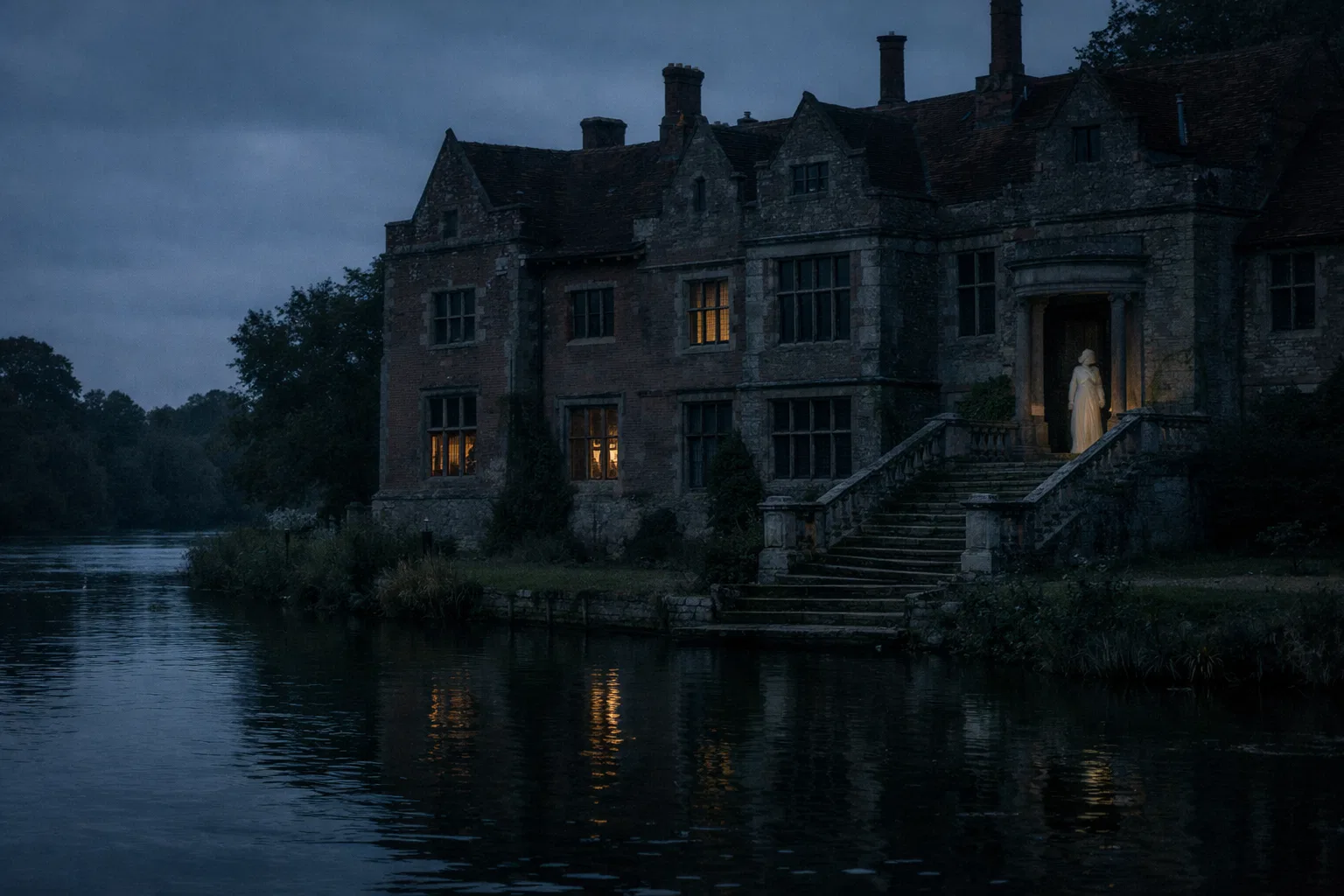
Berkshire’s old-house hauntings are at their most revealing around Littlecote and Bisham because both legends turn family scandal into a ghost story. Littlecote House, just beyond the historic Berkshire border near Hungerford, is associated with William “Wild” Darrell, an alleged infanticide, a frightened midwife and later stories of a Grey Lady searching for her child. Bisham Abbey, on the Thames near Maidenhead, centres on Lady Elizabeth Hoby, said in legend to wander the upper rooms in remorse after causing the death of a child over a blotted copybook. Neither haunting can be treated as proven fact. What makes them important to Berkshire’s haunted history is the way each story attaches guilt to a domestic room: the bedroom, the nursery, the corridor, the private chamber where rank and reputation were meant to remain protected from public judgement.
Why these houses matter to Berkshire’s ghost map
Littlecote and Bisham sit at the edge of a familiar Berkshire pattern: haunted status houses where the ghost is less a random apparition than a moral memory. Windsor’s ghosts are royal, Reading’s are monastic and ruinous, and Newbury’s are often tied to war. Littlecote and Bisham are different. Their legends are household stories. They ask what happens when private cruelty, inheritance, illegitimacy or maternal failure is imagined as something the walls remember.
The geography needs a little care. Littlecote House is officially in Wiltshire, in the parishes of Ramsbury and Chilton Foliat, and Historic England lists it as a Grade I building. Its registered parkland lies on the south bank of the River Kennet, close to the A4 route between Marlborough and Hungerford, with the Berkshire town of Hungerford acting as the natural local reference point. Historic England notes medieval fabric in the house and principal building phases from about 1500–1570, 1590–1620 and around 1810.[Historic England]historicengland.org.ukHistoric England Littlecote House, RamsburyHistoric England Littlecote House, Ramsbury That makes Littlecote a borderland case: not administratively Berkshire today, but deeply connected to the Berkshire side of the Kennet valley and to Hungerford’s local memory.
Bisham Abbey is more straightforwardly Berkshire in modern terms. Historic England places the Grade I listed abbey at Bisham, Marlow Road, in the Royal Borough of Windsor and Maidenhead, and also records the wider monastic and manorial complex as a scheduled site with surviving Templar, medieval and post-Dissolution fabric.[Historic England]historicengland.org.ukHistoric England Bisham Abbey, BishamHistoric England Bisham Abbey, Bisham Its riverside position matters. Bisham’s ghost is not a castle spectre or a battlefield figure; she belongs to a house that has been a Templar site, an abbey, a Tudor residence, a family seat and now a national sports centre. The legend has survived because the building still feels layered enough to carry it.

Littlecote House and the Grey Lady legend
The most notorious Littlecote story begins not with a ghost but with an accusation. William Darrell, later nicknamed “Wild” Darrell, was the last Darrell owner associated with the house’s great scandal. Local history accounts connect him with debt, lawsuits, quarrels with neighbours and an affair with Anne Hungerford, wife of Sir Walter Hungerford. The Hungerford Virtual Museum summarises the tradition that, in 1575, a midwife sometimes named Mother Barnes was brought to the childbed of an unnamed woman; after the birth, the gentleman present allegedly threw the newborn into the fire. The same account notes that Barnes did not identify Darrell or Littlecote, but that Darrell’s enemies soon attached the murder to him.[hungerfordvirtualmuseum.co.uk]hungerfordvirtualmuseum.co.ukOpen source on hungerfordvirtualmuseum.co.uk.
That uncertainty is central to the haunting. The legend is powerful because it has the shape of testimony: the blindfolded journey, the hidden room, the mother in labour, the man at the fire, the servant or mistress whose shame must be concealed. But the historical trail is less tidy. The same local account says Darrell came before commissioners at Newbury and that he and his servants were charged with murder, while also showing how the tale became entangled with his worsening finances, mortgages and the later transfer of Littlecote to Sir John Popham.[hungerfordvirtualmuseum.co.uk]hungerfordvirtualmuseum.co.ukOpen source on hungerfordvirtualmuseum.co.uk. In folklore terms, this is exactly the kind of muddled paper trail that helps a ghost story grow: enough names and dates to feel rooted, enough gaps for later storytellers to fill.
The haunting itself comes in several related forms. One strand says the murdered child’s ghost appeared to Darrell years later, frightening his horse and causing the riding accident from which he died. Another makes the house itself restless, with the Grey Lady wandering through Littlecote in search of her baby. Warner Hotels, which now operates Littlecote House as a hotel, retells the popular version in which the Grey Lady is seen roaming the house after the 1575 birth and murder story.[warnerhotels.co.uk]warnerhotels.co.ukspooky stories this halloween at warner hotelsspooky stories this halloween at warner hotels
The most useful sceptical detail is that Darrell’s death was probably not the clean supernatural retribution of the legend. Hungerford Virtual Museum records a more prosaic account, based on Darrell’s final journey home: he arrived at Littlecote in July 1589, fell ill soon afterwards, died on 1 October and was buried at St Lawrence’s Church, Hungerford, where the parish register simply recorded his sudden death. The museum explicitly calls the riding-accident version a myth, even while acknowledging that legend later placed the child’s ghost at Darrell’s Stile.[hungerfordvirtualmuseum.co.uk]hungerfordvirtualmuseum.co.ukOpen source on hungerfordvirtualmuseum.co.uk.
That does not make the story worthless. It changes what kind of story it is. Littlecote is best read as a haunted scandal narrative rather than a reliable murder report. The ghost supplies the justice that local memory suspected the law had failed to deliver. A powerful man, an illegitimate child, a vulnerable woman and a silenced midwife become a moral drama in which the house itself refuses to forget.
Bisham Abbey and Lady Hoby’s restless hands
Bisham Abbey’s famous ghost is Lady Elizabeth Hoby, later Lady Russell, one of the most striking women associated with the Tudor house. Westminster Abbey’s own commemoration of John and Elizabeth Russell describes her as the daughter of Sir Anthony Cooke, widow of Sir Thomas Hoby of Bisham Abbey, an accomplished linguist, sister of Lady Burghley, and a woman buried at Bisham church in 1609 beneath a magnificent monument.[Westminster Abbey]westminster-abbey.orgWestminster Abbey John and Elizabeth Russell | Westminster AbbeyWestminster Abbey John and Elizabeth Russell | Westminster Abbey This matters because the legend attaches a cruel maternal image to a historically learned, elite and commemorated woman. The ghost story is not simply about a nameless wicked mother; it is about the darkening of a real household reputation.
The common version says Lady Hoby had a son, often called William, who struggled with his writing. Furious at his blotted copybook, she beat or punished him, then left him confined while she went away, sometimes to court or to Windsor. By the time anyone realised the child was missing, he was dead. The ghostly punishment is repetitive and visual: Lady Hoby is said to walk the corridors, weeping, wringing her hands, or trying to wash blood from them in a spectral basin.
This version was already well established by the early twentieth century. John Meade Falkner’s 1902 Handbook for Berkshire links the story to Lady Hoby’s portrait, describing its pale face and hands against black widow’s dress as “spectral” and suggesting that the picture probably helped give rise to the haunting. Falkner also records the legend that she appears in a bedroom trying to wash her hands, and repeats the striking detail that children’s copybooks were supposedly found around 1840 behind a window shutter, with one blotched copybook seeming to fit the tale.[Internet Archive]archive.orgOpen source on archive.org.
Later folklore study is more cautious. The British Folklore account points out that Falkner did not say he had personally seen the alleged copybooks and that their whereabouts are not known. It also notes a serious genealogical problem: records do not support the existence of a “William Hoby” who died in the way the legend requires. Elizabeth Hoby’s sons Edward and Thomas Posthumus lived to adulthood, while a son by her second marriage died as a baby and is not a plausible blotted-copybook child.[British Folklore]britishfolklore.comBritish Folklore Bisham AbbeyBritish Folklore Bisham Abbey
This is where Bisham becomes especially interesting. The story’s factual weakness does not stop it from being locally powerful. If anything, the contradiction sharpens the question: why did this particular woman attract this particular ghost? Falkner’s clue about the portrait is persuasive. A white-faced widow in black, displayed in a house of old corridors and elite family memorials, could easily become the seed of a haunting. Add a moral tale about harsh discipline, a hidden copybook and a child’s death, and the result is a ghost who behaves like visible guilt.
Family scandal, witness claims and sceptical readings
The Littlecote and Bisham legends work because they make private rooms accountable. In both stories, the haunting is not mainly about a dramatic apparition on a lonely road. It is about the house as witness. A bedroom at Littlecote becomes the place where sexual secrecy and violence are alleged to have met. An upper corridor at Bisham becomes the route of a woman unable to wash away guilt.
There are reported sightings, but they belong to different levels of evidence. At Bisham, modern accounts include claims that photographs taken at the abbey show ghostly figures on a staircase and inside a room; the Royal Berkshire Archives highlighted such images in 2016, carefully wording them as photographs that “appear to show” a figure rather than proof of a haunting.[Royal Berkshire Archives]royalberkshirearchives.org.ukoctober 2016 lady casts ghostly figureoctober 2016 lady casts ghostly figure The British Folklore account also preserves a later anecdote in which Admiral Vansittart, owner of Bisham in the 1920s, supposedly saw Lady Hoby in the library while her portrait frame stood empty.[British Folklore]britishfolklore.comBritish Folklore Bisham AbbeyBritish Folklore Bisham Abbey These are good examples of how a legend keeps renewing itself: portrait, room, witness and family name all reinforce one another.
At Littlecote, the strongest modern caution is the gap between the dramatic legend and the more restrained records of Darrell’s death. Local history places Darrell’s burial at Hungerford and treats the riding-accident ghost story as myth, while still recording the tradition that Darrell’s ghost haunted Darrell’s Stile and Ramsbury church.[hungerfordvirtualmuseum.co.uk]hungerfordvirtualmuseum.co.ukOpen source on hungerfordvirtualmuseum.co.uk. This does not require readers to choose between “true ghost” and “nothing happened”. A better reading is that the scandal and the haunting grew together. Darrell’s reputation for lawsuits, debt and sexual scandal made him a ready-made villain; the alleged murdered child supplied the moral wound; the ghost supplied the judgement.
The two houses also show how ghost stories can punish women and men differently. Littlecote’s central villain is usually Darrell, a reckless gentleman whose social power shields him until supernatural justice catches up. Bisham’s ghost is Lady Hoby, remembered not for her learning or public standing but for a domestic cruelty that records do not securely support. That contrast is revealing. Haunted houses often preserve anxiety about inheritance, childbirth, discipline and reputation, but they may also distort it. A man’s scandal becomes a tale of retribution; a woman’s authority becomes a tale of monstrous motherhood.
What a careful visitor should take from the stories
Littlecote and Bisham are worth visiting imaginatively as haunted places, but they are best approached as folklore anchored to real buildings rather than as solved paranormal cases. The architecture is real: Littlecote’s Grade I Tudor house and registered park, Bisham’s Grade I abbey and scheduled monastic landscape.[Historic England]historicengland.org.ukHistoric England Littlecote House, RamsburyHistoric England Littlecote House, Ramsbury The people are real too: William Darrell, Sir John Popham, Lady Elizabeth Hoby and the families who shaped these estates. The hauntings sit in the space between those records and the emotional meanings later communities attached to them.
For Littlecote, the lasting question is whether a house can become notorious because scandal, debt and local enmity create the perfect conditions for a murder legend. The Grey Lady and the murdered child are not just spooky figures; they represent the hidden costs of elite male privilege in a household where servants, mistresses and infants had little voice.
For Bisham, the haunting asks how a portrait, a monument and a moral tale can reshape a woman’s memory. Lady Hoby’s ghost is compelling precisely because the evidence for the murdered schoolboy is weak. The legend has survived not because it is historically secure, but because it gives a memorable form to guilt: a pale woman in black, moving from room to room, unable to clean her hands.
Together, Littlecote and Bisham show why Berkshire’s haunted houses keep their ghosts. They are not merely old buildings with eerie corridors. They are places where family stories became public judgement, and where the most frightening room is not the dungeon or the ruin, but the chamber where respectable households were supposed to keep their secrets.

Amazon book picks
Further Reading
Books and field guides related to Why Berkshire's Old Houses Keep Their Ghosts. Use these as the next step if you want deeper reading beyond the article.
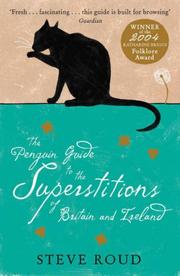
The Penguin Guide to the Superstitions of Britain and Ireland
Provides wider context for haunted-house folklore.

eBay marketplace picks
Marketplace Samples
Live-tested eBay searches with available results related to this page.

Endnotes
1.
Source: hungerfordvirtualmuseum.co.uk
Link:https://www.hungerfordvirtualmuseum.co.uk/index.php/24-places/great-estates/462-littlecote
2.
Source: warnerhotels.co.uk
Title: spooky stories this halloween at warner hotels
Link:https://www.warnerhotels.co.uk/blog/spooky-stories-this-halloween-at-warner-hotels
3.
Source: westminster-abbey.org
Title: Westminster Abbey John and Elizabeth Russell | Westminster Abbey
Link:https://www.westminster-abbey.org/abbey-commemorations/commemorations/john-and-elizabeth-russell/
4.
Source: archive.org
Link:https://archive.org/stream/handbookforberks00unse/handbookforberks00unse_djvu.txt
5.
Source: warnerhotels.co.uk
Link:https://www.warnerhotels.co.uk/hotels/littlecote-house-hotel
6.
Source: archive.org
Link:https://archive.org/stream/deep-and-dark-and-dangerous-a-ghost-story/Screaming%20Skulls-%20101%20Of%20the%20Worlds%20Greatest%20Ghost%20Stories_djvu.txt
7.
Source: archive.org
Link:https://archive.org/download/highwaysbywaysin00vinciala/highwaysbywaysin00vinciala.pdf
8.
Source: historicengland.org.uk
Title: Historic England Littlecote House, Ramsbury
Link:https://historicengland.org.uk/listing/the-list/list-entry/1300540
9.
Source: historicengland.org.uk
Title: Historic England Littlecote House, Ramsbury
Link:https://historicengland.org.uk/listing/the-list/list-entry/1000479
10.
Source: historicengland.org.uk
Title: Historic England Bisham Abbey, Bisham
Link:https://historicengland.org.uk/listing/the-list/list-entry/1303584
11.
Source: historicengland.org.uk
Title: Historic England Bisham Abbey: a monastic and manorial complex, Bisham
Link:https://historicengland.org.uk/listing/the-list/list-entry/1007934
12.
Source: britishfolklore.com
Title: British Folklore Bisham Abbey
Link:https://britishfolklore.com/bisham-abbey/
13.
Source: royalberkshirearchives.org.uk
Title: october 2016 lady casts ghostly figure
Link:https://www.royalberkshirearchives.org.uk/this-months-highlight/article/october-2016-lady-casts-ghostly-figure
Published: october 2016
14.
Source: historicengland.org.uk
Title: 19 remarkable places granted protection in 2025
Link:https://historicengland.org.uk/whats-new/news/19-remarkable-places-granted-protection-in-2025/
15.
Source: historicengland.org.uk
Title: list entry
Link:https://historicengland.org.uk/listing/the-list/list-entry/1319381
16.
Source: historicengland.org.uk
Link:https://historicengland.org.uk/listing/the-list/results/?filters%5B0%5D%5Bfield%5D=assetType&filters%5B0%5D%5Btype%5D=any&filters%5B0%5D%5Bvalues%5D%5B0%5D=Great+House&size=n_24_n
17.
Source: historicengland.org.uk
Title: Ice House, Bisham
Link:https://historicengland.org.uk/listing/the-list/list-entry/1117566
18.
Source: historicengland.org.uk
Title: list entry
Link:https://historicengland.org.uk/listing/the-list/list-entry/1034118
19.
Source: historicengland.org.uk
Title: Medieval hamlet of Littlecote, Stewkley
Link:https://historicengland.org.uk/listing/the-list/list-entry/1018008
20.
Source: historicengland.org.uk
Link:https://historicengland.org.uk/listing/the-list/results/
21.
Source: historicengland.org.uk
Link:https://historicengland.org.uk/listing/the-list/list-entry/1078383
22.
Source: historicengland.org.uk
Title: list entry
Link:https://historicengland.org.uk/listing/the-list/list-entry/1183591
23.
Source: historicengland.org.uk
Title: list entry
Link:https://historicengland.org.uk/listing/the-list/list-entry/1034120
24.
Source: historicengland.org.uk
Title: list entry
Link:https://historicengland.org.uk/listing/the-list/list-entry/1055813
25.
Source: Wikipedia
Title: Littlecote House
Link:https://en.wikipedia.org/wiki/Littlecote_House
26.
Source: marlowsociety.org.uk
Title: Bisham Abbey
Link:https://www.marlowsociety.org.uk/_webedit/uploaded-files/All%20Files/About%20us/Bisham%20Abbey.pdf
27.
Source: kintburyandbeyond.co.uk
Title: littlecote house
Link:https://kintburyandbeyond.co.uk/tag/littlecote-house/
28.
Source: hauntedwiltshire.blogspot.com
Title: littlecote house
Link:https://hauntedwiltshire.blogspot.com/2012/06/littlecote-house.html
29.
Source: the-pigs.co.uk
Title: Bisham Abbey
Link:https://www.the-pigs.co.uk/project/bisham-abbey/
30.
Source: wikishire.co.uk
Title: Littlecote House
Link:https://wikishire.co.uk/wiki/Littlecote_House
31.
Source: greyarro.ws
Title: Littlecote House
Link:https://greyarro.ws/t/littlecote-house-added-to-historic-buildings-in-south-west/64152
Additional References
32.
Source: youtube.com
Title: Strange But True Littlecote House & Pluckley
Link:https://www.youtube.com/watch?v=5m29cDgqcaM
Source snippet
3 The Haunting of Bisham Abbey | Ghosts, Guilt & a Tudor Curse...
33.
Source: academia.edu
Link:https://www.academia.edu/33736399/Long_The_Littlecote_Legend
34.
Source: scribd.com
Link:https://www.scribd.com/document/99571874/Fifty-Great-Ghost-Stories-Short-Story-Collection
35.
Source: 1066.co.nz
Link:https://www.1066.co.nz/Mosaic%20DVD/library/Battle%20Roll/Darell.html
36.
Source: faaac.nl
Link:https://www.faaac.nl/history/england-before-d-day
37.
Source: upload.wikimedia.org
Link:https://upload.wikimedia.org/wikipedia/commons/4/43/Handbook_for_Berkshire_-including_Windsor%2C_Reading%2C_Maidenhead%2C_Bray%2C_Newbury%2C_Aldworth%2C_the_Downs%2C_the_Ridgeway%2C_Abington%2C_Faringdon%2C_Buckland%2C_Cumnor%2C_etc%28IA_handbookforberks00unse%29.pdf
38.
Source: facebook.com
Link:https://www.facebook.com/groups/TavistockParish/posts/2864351610436968/
39.
Source: facebook.com
Link:https://www.facebook.com/groups/710434735172891/posts/783048801244817/
40.
Source: facebook.com
Link:https://www.facebook.com/groups/uncannyfan/posts/2371183693358248/
41.
Source: facebook.com
Link:https://www.facebook.com/groups/curiousengland/posts/1931427523991564/
Topic Tree