Within Haunted Peeblesshire
Is Merlin Buried Beside the Tweed?
Drumelzier's Merlin legend is darker than a normal ghost tale, tying prophecy, burial and river landscape to the upper Tweed.
On this page
- The Drumelzier landscape
- Merlin, Lailoken and the triple death
- Archaeology, maps and uncertain graves
Page outline Jump by section
Introduction
At Drumelzier in historic Peeblesshire, the Merlin story is not a cosy tale of a robed wizard in a castle tower. It is a darker Border tradition in which a prophetic wild man, often identified with Lailoken and later folded into the Merlin legend, is said to have been imprisoned near the upper Tweed, foretold his own strange death, and been buried close to the meeting of river and burn. The reputed grave lies near Drumelzier Church and the River Tweed, in a landscape now promoted as part of the southern Scottish Merlin tradition, but the evidence is folkloric, medieval and archaeological rather than proof of a haunting or of Merlin’s literal burial.[The Past]the-past.comThe Past Unearthing ancient Tweeddale: 'Merlin's Grave' and otherThe PastUnearthing ancient Tweeddale: 'Merlin's Grave' and other…September 5, 2024 — 5 Sept 2024 — Merlin's Grave at Drumelzier (prono…
For Peeblesshire’s haunted history, Drumelzier matters because it shows how old supernatural reputation can cling to landforms rather than buildings. The “haunting” here is not a recurring apparition in the usual ghost-story sense, but a prophetic memory attached to a haugh, a burn, a churchyard, a hillfort and a reputed grave. Its power comes from the way medieval narrative, local place-names, antiquarian testimony, old maps and recent archaeology all point back to the same small stretch of Tweeddale, while still leaving the central question unresolved: is this a preserved local legend, a distorted memory of an early medieval figure, or a later story anchored to a suggestive landscape?
The Drumelzier landscape
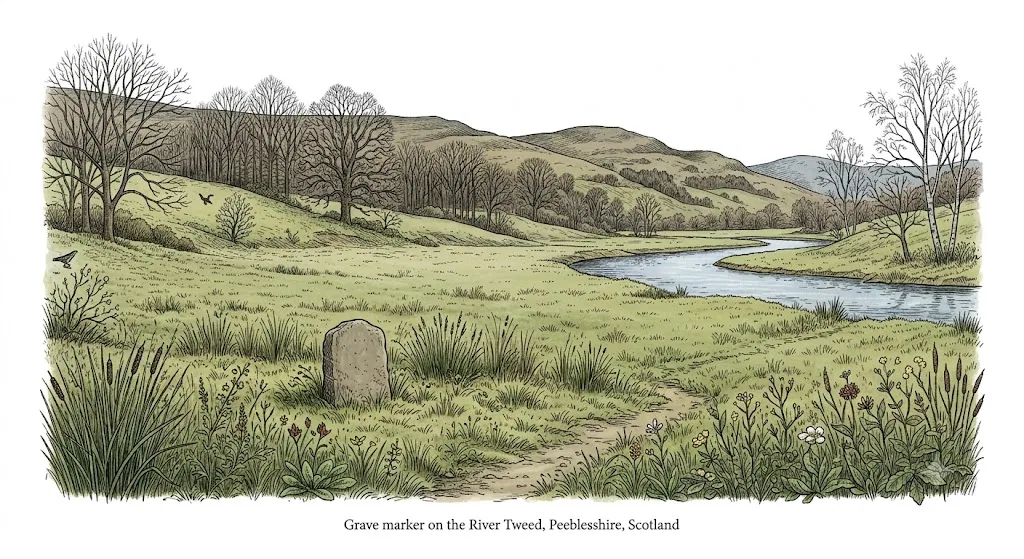
Drumelzier stands in the upper Tweed valley, within the old county of Peeblesshire, now part of the Scottish Borders. The Merlin tradition is tied especially to the ground north of Drumelzier Church, near the east bank of the Tweed and the Powsail Burn, also known as Drumelzier Burn. Modern visitor information places the reputed grave near a track by the burn, while also warning that a plaque by the present burn mouth may not mark the remembered spot, because the burn’s course has changed over time.[Scotland Starts Here]scotlandstartshere.comScotland Starts HereMerlin's Grave | History & HeritageAbout Merlin's Grave. In Merlin's day the trackway ran along the north side of the…
That detail is important. The legend is not just “Merlin was buried somewhere near Drumelzier”. It depends on a river landscape: a ford, a burn, a floodplain, a haugh and a meeting of waters. In the story, Merlin’s death is connected to a crossing-place and to water. In the prophecy tradition, the future union of Scotland and England is attached to the Tweed and Powsail meeting at his grave. The place therefore works like a natural stage-set: the river is not background scenery, but part of the mechanism by which the legend makes sense.[Destination Tweed]destinationtweed.orgDestination Tweed MerlinDestination Tweed Merlin
Above the valley, Tinnis Castle and Fort add a second layer of atmosphere. The visible ruins are later medieval, but recent work by GUARD Archaeology describes the rocky height as a site with earlier phases, including an early medieval nucleated fort overlooking the reputed grave area. That matters because the Drumelzier Merlin story involves a local ruler, Meldred, and a stronghold in this same landscape; archaeology cannot prove the legend true, but it does show that the tale is set in a valley with the right kind of early medieval power-centre nearby.[guard-archaeology.co.uk]guard-archaeology.co.ukOpen source on guard-archaeology.co.uk.
For a modern visitor, the site can feel surprisingly quiet. Unlike Neidpath Castle’s romantic ghost of the waiting woman, Drumelzier’s supernatural charge is dispersed across fields, riverbanks and names on maps. The eerie element lies in the mismatch between the modest present-day place and the scale of the tradition attached to it: a legendary prophet, a foretold death, a politically loaded prophecy and a grave that has been shown, named and argued over for centuries.
Merlin, Lailoken and the triple death
The Drumelzier tale belongs to the northern, darker side of Merlin tradition. Rather than beginning with Camelot, it centres on Lailoken, a wild prophetic figure associated with the aftermath of battle and with the forests and kingdoms of the early medieval north. Current archaeological and heritage accounts link Drumelzier’s version especially to the Vita Merlini Sylvestris, the “Life of Merlin of the Forest”, a medieval tale probably composed in Glasgow in the twelfth century, though preserved in later manuscript form.[guard-archaeology.co.uk]guard-archaeology.co.ukOpen source on guard-archaeology.co.uk.
In this tradition, Lailoken is not simply a magician. He is a traumatised, dangerous and gifted outsider whose madness or wildness is bound up with prophecy. The story places him under the power of Meldred, a local ruler associated with Dunmeller or Drumelzier. Meldred wants to profit from Lailoken’s knowledge, but the prophet’s riddling speech exposes a sexual secret involving the queen. The result is vengeance: Lailoken is attacked by shepherds, and his death fulfils his own prediction.[The Past]the-past.comThe Past Unearthing ancient Tweeddale: 'Merlin's Grave' and otherThe PastUnearthing ancient Tweeddale: 'Merlin's Grave' and other…September 5, 2024 — 5 Sept 2024 — Merlin's Grave at Drumelzier (prono…
The “triple death” is the tradition’s most memorable feature. Lailoken foretells that he will die in three ways: by stones or cudgels, by a sharp stake, and by drowning. The narrative then contrives to make all three true. He is beaten or stoned, falls or is driven into the river, is pierced by a stake associated with a fish trap or river hazard, and drowns in the Tweed. It is a grimly exact prophecy, closer to a ritualised death-legend than to a conventional ghost story.[Current Archaeology]archaeology.co.ukunearthing ancient tweeddaleunearthing ancient tweeddale
This is where Drumelzier’s Merlin tradition becomes especially valuable for Peeblesshire folklore. It does not depend on someone seeing a white figure at a window or hearing footsteps in an empty room. Instead, the supernatural claim is that a prophet foresaw the circumstances of his own killing and that the landscape still preserves the memory of where it happened. That makes the site feel less like a haunted house and more like a prophetic wound in the valley: a place where story, death and topography have fused.
There is also a strong religious edge. Some versions connect Lailoken or Merlin with St Kentigern, repentance and Christian burial. In that form, the tale becomes a conversion story as well as a death story: the wild prophet is not merely killed, but brought within Christian memory and laid near a church. This helps explain why a grave near Drumelzier Church mattered to later writers and local tradition. It gave the legend a moral and sacred geography, not just a dramatic end.[Dark Age Digs]dark-age-digs.commerlins graveDark Age DigsMerlin's Grave7 Nov 2022 — According to legend, Merlin was reputedly buried on the haugh on the east bank of the Tweed, nort…
Why the prophecy made the grave famous
The most locally famous prophecy attached to Merlin’s Grave concerns the Tweed, the Powsail and the union of the crowns. In its common form, the rhyme says that when Tweed and Powsail meet at Merlin’s grave, Scotland and England will have one monarch. The tradition then claims this was fulfilled in 1603, when James VI of Scotland became James I of England and flooding caused the waters to meet at the grave.[Destination Tweed]destinationtweed.orgDestination Tweed MerlinDestination Tweed Merlin
This is exactly the kind of story that gives a place long afterlife. It links a small local feature to a national event. A bend of river near Drumelzier becomes, in folklore terms, a witness to the Union of the Crowns. Whether the rhyme predates 1603 in the form later reported, or whether it was sharpened after the event, is difficult to prove from the surviving evidence. But its function is clear: it turns Merlin’s burial place into a prophetic landmark, not just a legendary grave.
The prophecy also depends on hydrology. If the burn once ran differently, and if floodwater could unusually connect burn, river and grave, then the physical behaviour of the landscape becomes part of the proof offered by tradition. That does not make the prophecy historically secure, but it explains why it felt persuasive to local memory. Rivers flood; channels shift; old people remember unusual water levels; and a dramatic national succession can be fitted to a dramatic local flood.
For readers of haunted and eerie history, this is one of the most interesting differences between Drumelzier and a standard apparition tale. The claim is not “someone saw Merlin’s ghost”. The claim is that the future was encoded in the place itself and revealed when water crossed a boundary it was not expected to cross. It is a supernatural tradition of landscape behaviour: the valley appears to speak through flood and confluence.
Archaeology, maps and uncertain graves
The reputed site of Merlin’s Grave has documentary depth, but not the kind that proves an individual burial. GUARD Archaeology’s recent summary notes that the place is formally documented in Scotland’s National Record of the Historic Environment, while also stressing that the visible site is essentially a nondescript field corner shaped by local tradition. The seventeenth-century Tweeddale writer Alexander Pennecuik recorded in 1689 that the grave was said to lie a little below the churchyard and that a local minister had shown him the particular place.[The Past]the-past.comThe Past Unearthing ancient Tweeddale: 'Merlin's Grave' and otherThe PastUnearthing ancient Tweeddale: 'Merlin's Grave' and other…September 5, 2024 — 5 Sept 2024 — Merlin's Grave at Drumelzier (prono…
By the eighteenth century, the grave was appearing on maps. Current Archaeology and related project material note that Merlin’s Grave is marked on Mostyn Armstrong’s 1775 map of Peeblesshire. That matters because it shows the tradition had moved beyond oral report into cartographic memory. A map label does not verify Merlin’s body, but it does verify that the place-name and story were established enough to be mapped.[Current Archaeology]archaeology.co.ukunearthing ancient tweeddaleunearthing ancient tweeddale
Older archaeological inventory added a cautious alternative explanation. The Royal Commission tradition, as quoted in later summaries, noted that no structural remains had been seen or recorded at the reputed grave and suggested the tradition could have arisen from the discovery of a Bronze Age cist, a stone-built prehistoric burial. That is a useful sceptical possibility: an ancient grave or cairn could have been found, half-remembered and gradually assigned to Merlin.[The Modern Antiquarian]themodernantiquarian.comOpen source on themodernantiquarian.com.
Recent fieldwork has made the question more interesting without settling it. The 2022 community archaeology project led by GUARD Archaeology found no buried remains at the exact mapped spot of Merlin’s Grave, but geophysical survey did identify a large pit or grave-like anomaly nearby. The published online report also states that work at Tinnis revealed early prehistoric activity, a Late Iron Age vitrified fort, an early medieval nucleated fort and a medieval castle, while the survey over Merlin’s Grave revealed a pit or grave nearby.[archaeologyreportsonline.com]archaeologyreportsonline.comOpen source on archaeologyreportsonline.com.
The strongest careful reading is this: archaeology has not found Merlin. It has, however, strengthened the case that Drumelzier was not chosen at random by a late storyteller. The nearby stronghold appears to fit the period and social setting in which a story of a petty ruler, a captive prophet and an elite valley landscape could plausibly have grown. GUARD’s public summary says Tinnis Fort was occupied around the late sixth and early seventh centuries, the period in which the legend is set, and had the hallmarks of a lordly stronghold.[guard-archaeology.co.uk]guard-archaeology.co.ukOpen source on guard-archaeology.co.uk.
That distinction matters for public-facing haunted history. A sensational version says “Merlin’s grave has been found”. A better version says: a long-lived Peeblesshire tradition identifies a grave beside the Tweed; medieval texts place Lailoken’s death and burial in this kind of landscape; antiquaries and maps preserve the local site; and recent archaeology has found early medieval power nearby and a possible grave-like feature close to, but not at, the traditional marker. The result is suggestive, not conclusive.
How credible is the Drumelzier tradition?
The Drumelzier Merlin tradition is credible as folklore, locally persistent as place-memory, and unproven as literal biography. Its strongest evidence is not a single document but the convergence of several kinds of material: medieval narrative, local topography, named sites, early modern testimony, eighteenth-century mapping, heritage records and archaeological context. Each strand has limits, but together they explain why the story has remained attached to this part of Peeblesshire.[the-past.com]the-past.comThe Past Unearthing ancient Tweeddale: 'Merlin's Grave' and otherThe PastUnearthing ancient Tweeddale: 'Merlin's Grave' and other…September 5, 2024 — 5 Sept 2024 — Merlin's Grave at Drumelzier (prono…
The medieval evidence shows that the story is old, but medieval texts are not neutral field reports. They shape moral, religious and political meaning. Lailoken’s triple death, prophetic speech and association with St Kentigern belong to a world of hagiography and legend as much as to history. The later identification of Lailoken with Merlin also complicates the picture: “Merlin” is a composite figure, and the Drumelzier story preserves one northern strand of that wider tradition rather than the full Arthurian wizard familiar from romance.[The Merlin Trail]merlintrail.comThe Merlin Trail Origins Of The Merlin Legend Unearthed In The ScottishThe Merlin Trail Origins Of The Merlin Legend Unearthed In The Scottish
The local evidence is more tangible but still ambiguous. A remembered grave below the churchyard, a thorn tree, a burn, a haugh and an old map label all show that people in Tweeddale believed, repeated or at least recognised the association. They do not show whose grave, if any, lay there. The suggestion of a Bronze Age cist is a good reminder that folklore often grows around pre-existing ancient remains. A prehistoric burial can become a giant’s grave, a saint’s grave, a witch’s grave or, in this case, Merlin’s grave, depending on the stories a community inherits.[The Past]the-past.comThe Past Unearthing ancient Tweeddale: 'Merlin's Grave' and otherThe PastUnearthing ancient Tweeddale: 'Merlin's Grave' and other…September 5, 2024 — 5 Sept 2024 — Merlin's Grave at Drumelzier (prono…
The archaeology is the newest and most valuable corrective to both scepticism and credulity. It does not reduce the story to nonsense, because the valley really does contain early medieval evidence of high-status occupation near the legendary setting. But it also does not justify treating the grave as identified or excavated. A grave-like anomaly is not a named burial; a fitting hillfort is not Meldred’s court beyond dispute; and a local legend, however old, remains a legend unless supported by firmer evidence.
For Peeblesshire’s eerie history, that uncertainty is part of the appeal. Drumelzier is not frightening because it offers a neat paranormal claim. It is compelling because it sits on the border between history and story: old enough to resist easy dismissal, strange enough to resist domestication, and rooted so firmly in the Tweed landscape that even sceptical readings have to account for why this particular place held the legend for so long.
Why Drumelzier belongs in Peeblesshire’s haunted map
Drumelzier’s Merlin grave and prophecy tradition belongs at the heart of Peeblesshire’s haunted map because it is one of the county’s clearest examples of supernatural landscape memory. It is not a castle ghost in the popular sense, but it has all the ingredients that make a place feel haunted: a violent death, a prophecy, a contested burial, old testimony, a river that seems to answer the story, and a modern site where visitors can still stand close to the supposed scene.[Scotland Starts Here]scotlandstartshere.comScotland Starts HereMerlin's Grave | History & HeritageAbout Merlin's Grave. In Merlin's day the trackway ran along the north side of the…
It also links Peeblesshire to wider Border and early British legend without losing its local focus. The story gestures towards St Kentigern, the old northern Merlin or Lailoken tradition, early medieval strongholds and the political imagination of Scotland and England. Yet its emotional centre remains small and precise: a field near Drumelzier, a burn running to the Tweed, a churchyard, and the claim that a prophet asked to be buried where the waters would one day confirm his words.
The tradition is therefore best understood as an eerie historical legend rather than a verified haunting. No responsible account can say Merlin is definitely buried beside the Tweed, and no strong evidence supports treating the place as an active ghost site in the modern witness-report sense. What can be said is more interesting: Drumelzier preserves one of the oldest and darkest supernatural traditions in Peeblesshire, where prophecy, burial and river landscape have been bound together for centuries, and where recent archaeology has made the old story harder to dismiss without making it simple to believe.
Amazon book picks
Further Reading
Books and field guides related to Is Merlin Buried Beside the Tweed?. Use these as the next step if you want deeper reading beyond the article.
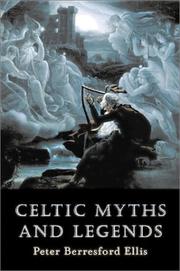
The Mammoth Book of Celtic Myths and Legends
Provides wider Celtic legendary context for Merlin traditions.
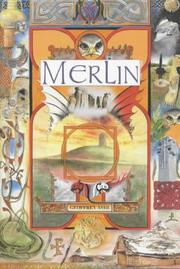
Merlin: The Prophetic Vision and His History
Explores the historical and legendary Merlin traditions including Scottish connections.
The Lore of Scotland: A Guide to Scottish Legends
Includes Scottish legendary landscapes and traditions.
eBay marketplace picks
Marketplace Samples
Live-tested eBay searches with available results related to this page.

Endnotes
1.
Source: the-past.com
Title: The Past Unearthing ancient Tweeddale: ‘Merlin’s Grave’ and other
Link:https://the-past.com/feature/unearthing-ancient-tweeddale-merlins-grave-and-other-lost-stories-embedded-in-the-landscape/
Source snippet
The PastUnearthing ancient Tweeddale: 'Merlin's Grave' and other...September 5, 2024 — 5 Sept 2024 — Merlin's Grave at Drumelzier (prono...
Published: September 5, 2024
2.
Source: dark-age-digs.com
Title: merlins grave
Link:https://dark-age-digs.com/investigations/merlins-grave/
Source snippet
Dark Age DigsMerlin's Grave7 Nov 2022 — According to legend, Merlin was reputedly buried on the haugh on the east bank of the Tweed, nort...
3.
Source: guard-archaeology.co.uk
Link:https://www.guard-archaeology.co.uk/GALNews/?p=655
4.
Source: dark-age-digs.com
Title: tinnis castle hillfort
Link:https://dark-age-digs.com/investigations/tinnis-castle-hillfort/
5.
Source: archaeology.co.uk
Title: unearthing ancient tweeddale
Link:https://archaeology.co.uk/articles/features/unearthing-ancient-tweeddale.htm
6.
Source: dark-age-digs.com
Title: Dark Age Digs Merlin’s Grave
Link:https://dark-age-digs.com/merlins-grave-drumelzier-and-the-merlin-connection/
7.
Source: archaeologyreportsonline.com
Link:https://www.archaeologyreportsonline.com/reports/2024/ARO56.html
8.
Source: dark-age-digs.com
Link:https://dark-age-digs.com/unearthing-ancient-tweeddale-published/
9.
Source: dark-age-digs.com
Link:https://dark-age-digs.com/drumelziers-hidden-heritage/
10.
Source: dark-age-digs.com
Link:https://dark-age-digs.com/
11.
Source: dark-age-digs.com
Title: 5181 PERD
Link:https://dark-age-digs.com/wp-content/uploads/2023/07/5181_PERD.pdf
12.
Source: dark-age-digs.com
Link:https://dark-age-digs.com/wp-content/uploads/2022/07/Guard-Archaeology-Volunteer-Pack.pdf
13.
Source: archaeologyreportsonline.com
Link:https://www.archaeologyreportsonline.com/PDF/ARO56_Ancient_Tweeddale.pdf
14.
Source: guard-archaeology.co.uk
Link:https://www.guard-archaeology.co.uk/GALNews/?m=202501
15.
Source: guard-archaeology.co.uk
Link:https://www.guard-archaeology.co.uk/GALNews/?p=492
16.
Source: youtube.com
Title: New Evidence Hints Merlin May Have Actually Existed | WION Podcast
Link:https://www.youtube.com/watch?v=EeY8KlwKVzQ
Source snippet
Merlin of the Forest...
17.
Source: youtube.com
Title: Merlin of the Forest
Link:https://www.youtube.com/watch?v=UN-utPgLo44
18.
Source: scotlandstartshere.com
Link:https://scotlandstartshere.com/point-of-interest/merlins-grave/
Source snippet
Scotland Starts HereMerlin's Grave | History & HeritageAbout Merlin's Grave. In Merlin's day the trackway ran along the north side of the...
19.
Source: merlintrail.com
Link:https://merlintrail.com/merlindale/
20.
Source: destinationtweed.org
Title: Destination Tweed Merlin
Link:https://destinationtweed.org/story/merlin-the-man-the-myth-the-magic/
21.
Source: themodernantiquarian.com
Link:https://www.themodernantiquarian.com/site/8685/drumelzier
22.
Source: merlintrail.com
Title: The Merlin Trail Origins Of The Merlin Legend Unearthed In The Scottish
Link:https://merlintrail.com/origins-of-the-merlin-legend-unearthed-in-the-scottish-borders/
23.
Source: merlintrail.com
Link:https://merlintrail.com/2022-archaeological-investigation-of-a-hidden-heritage-tinnis/amp/
24.
Source: merlintrail.com
Title: tinnis castle on the merlin trail
Link:https://merlintrail.com/tinnis-castle-on-the-merlin-trail/
25.
Source: Wikipedia
Title: Vita Merlini
Link:https://en.wikipedia.org/wiki/Vita_Merlini
26.
Source: Wikipedia
Link:https://en.wikipedia.org/wiki/Drumelzier
27.
Source: trove.scot
Link:https://www.trove.scot/place/49914
28.
Source: stravaiging.com
Link:https://www.stravaiging.com/history/castle/tinnis-castle/
29.
Source: themodernantiquarian.com
Link:https://www.themodernantiquarian.com/site/17832/drumelzier
30.
Source: scotlandstartshere.com
Link:https://scotlandstartshere.com/point-of-interest/tinnis-castle/
Additional References
31.
Source: youtube.com
Title: Archaeology and folklore supports evidence of Merlin legend in Scotland
Link:https://www.youtube.com/watch?v=JWA_d2wiEcQ
Source snippet
New Evidence Hints Merlin May Have Actually Existed | WION Podcast...
32.
Source: youtube.com
Title: Merlin and Kentigern: A Legend of Tweeddale Video Poem
Link:https://www.youtube.com/watch?v=gimfZfl0CiI
Source snippet
Archaeology and folklore supports evidence of Merlin legend in Scotland...
33.
Source: facebook.com
Link:https://www.facebook.com/groups/2003881253140331/posts/2463788163816302/
34.
Source: archaeologyscotland.org.uk
Link:https://www.archaeologyscotland.org.uk/learn/https-archaeologyscotland-org-uk-heritage-resources-portal-canmore/
35.
Source: facebook.com
Link:https://www.facebook.com/groups/1475717922681828/posts/3243834265870176/
36.
Source: facebook.com
Link:https://www.facebook.com/discoverscottishborders/videos/locals-whisper-of-a-standing-stone-marking-merlins-grave-once-dismissed-as-myth-/1330070548893104/
37.
Source: facebook.com
Link:https://www.facebook.com/discoverscottishborders/posts/the-borders-are-a-hidden-gem-of-mythology-near-peebles-and-drumelzier-legend-say/1417576347035392/
38.
Source: facebook.com
Link:https://www.facebook.com/discoverscottishborders/posts/the-borders-are-a-hidden-gem-of-mythology-near-peebles-and-drumelzier-legend-say/1466781728781520/
39.
Source: facebook.com
Link:https://www.facebook.com/TheTrimontiumTrust/posts/tinnis-castle-is-a-ruinous-medieval-castle-built-atop-an-iron-age-hillfort-in-th/725517346822227/
40.
Source: asnc.cam.ac.uk
Link:https://www.asnc.cam.ac.uk/research/latin-arthur/texts/text-one/
Topic Tree