Within Haunted Flintshire
Where Do Flintshire's Older Ghost Stories Gather?
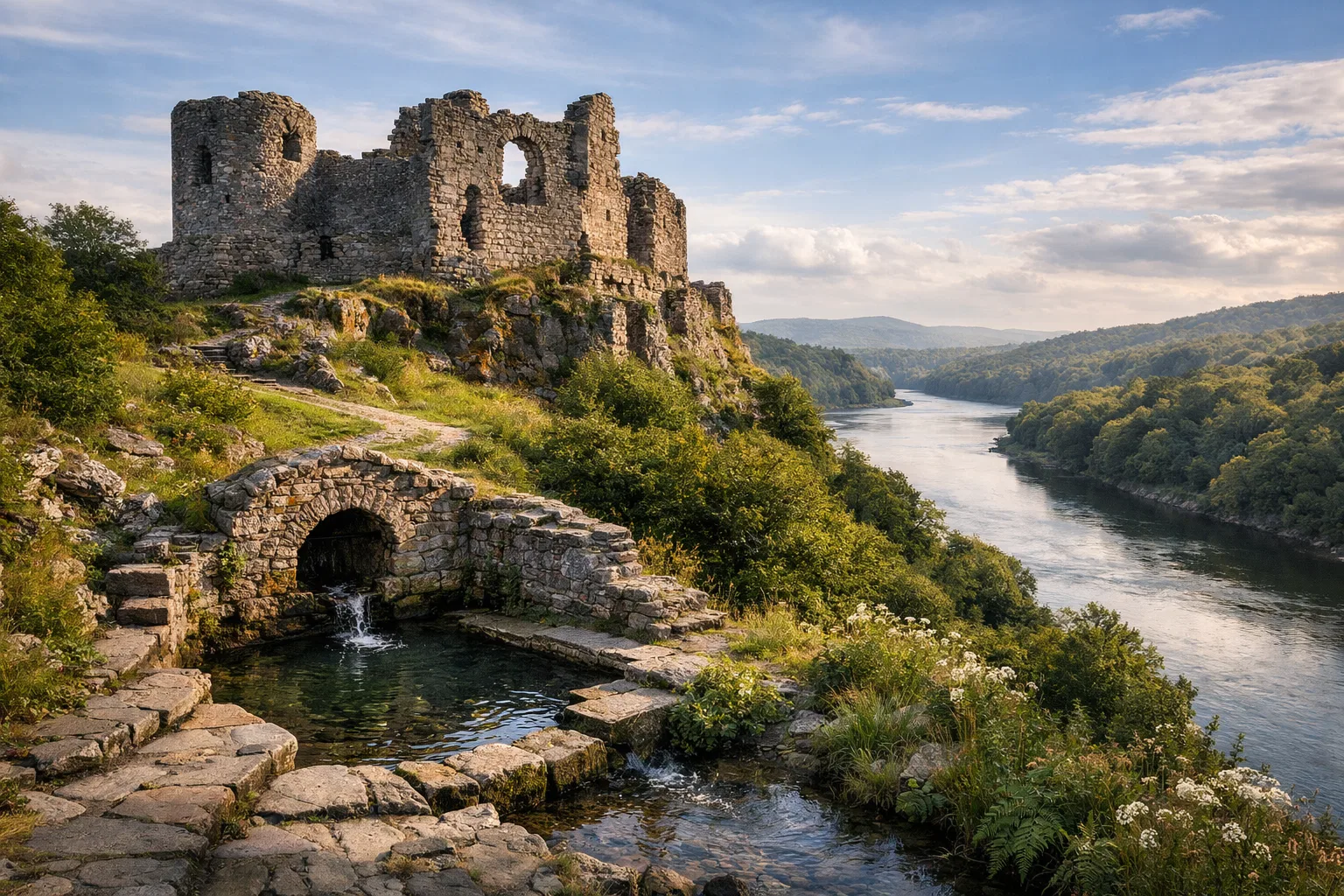
Flintshire's older eerie landscape comes from ruined castles, conquest stories, sacred wells and folklore shaped by shifting county borders.
On this page
- Flint, Hawarden and Ewloe as haunted ruins
- Holywell and sacred folklore beyond ordinary ghosts
- Historic Flintshire boundaries and borderland memory
Page outline Jump by section
Introduction
Flintshire’s older ghost stories gather where landscape, memory and border history overlap: ruined castles on the Dee frontier, a woodland fortress at Ewloe, the old castle at Hawarden, and the sacred water of St Winefride’s Well at Holywell. These are not haunted places in the same way as a single reputedly haunted house. Their eeriness comes from deeper layers: conquest, pilgrimage, disputed territory, ruined masonry, holy-water cures, Civil War damage, and local tales that turn historical pressure into atmosphere. The result is a Flintshire ghost map that is more about inherited border memory than simple apparitions.
The strongest evidence is historical and folkloric rather than paranormal. Cadw identifies Flint Castle as the first fortress founded in Edward I’s campaign against Llywelyn ap Gruffudd, while St Winefride’s Chapel and Well is presented as a pilgrimage site active since at least 1115. Ewloe, by contrast, is a native Welsh castle in a forested setting with a “murky” documentary history, and Hawarden Old Castle is tied to Norman occupation, Welsh attack and later Civil War earthworks. Around these places, later ghostly claims tend to work as emotional shorthand for conflict, survival and unfinished local memory.[gov.wales]cadw.gov.walesFlint CastleThe first castle to be founded as part Edward I's campaign against Llywelyn ap Gruffydd (Llywelyn the Last) in north Wale…
Why Flintshire’s oldest hauntings feel like border memories
Flintshire’s castle-and-well folklore is best understood through geography. Historic Flintshire was not identical to the modern council area: its older county shape included the detached Maelor Saesneg, along with places now administered by Wrexham or Denbighshire. Wikishire describes Maelor Saesneg as the main detached part of Flintshire, lying between Denbighshire, Cheshire and Shropshire, while heritage landscape work identifies it as the pre-1974 “Flintshire Detached” south-east of the Dee. That fractured geography matters because ghost stories often follow older parishes, estates, roads and county memory rather than present-day administrative lines.[Wikishire]wikishire.co.ukOpen source on wikishire.co.uk.
The deeper setting is the north-east Welsh borderland. Tegeingl, the medieval territory roughly associated with north-east Flintshire, changed hands between Welsh and English powers before Edward I’s conquest incorporated it into the new county framework. In that context, Flintshire’s castles are not just scenic ruins. They mark contested ground: places where power was built in stone, taken, damaged, abandoned, or folded into later estates and tourist routes.[Wikipedia]WikipediaOpen source on wikipedia.org.
That is why the county’s older eerie stories often feel less like “a ghost was seen in this room” and more like “the past has not settled here”. Flint’s donjon, Hawarden’s motte, Ewloe’s woodland walls and Holywell’s spring each preserve a different kind of memory. Flint speaks of conquest and royal humiliation; Hawarden of frontier violence and siege; Ewloe of native Welsh resistance in a hidden valley; Holywell of sanctity, healing and miracle. When later visitors report strange presences, marching sounds, phantom singing or a charged atmosphere, those claims usually draw their force from the documented history already attached to the place.

Flint, Hawarden and Ewloe as haunted ruins
The three castle sites most relevant to this theme are not equally well-attested as ghost locations. Flint Castle is historically powerful but has relatively thin official ghost tradition. Hawarden has modern paranormal claims attached to an old border fortress. Ewloe has some of the clearest repeated folklore motifs, though mostly in secondary and popular sources. Taken together, they show how Flintshire’s haunted-castle atmosphere is built: not from one dominant legend, but from ruins that invite people to hear the border wars in the landscape.
Flint Castle: conquest, Shakespearean memory and a thin ghost record
Flint Castle has one of the strongest historical foundations in the county. Cadw describes it as the first castle founded as part of Edward I’s campaign against Llywelyn ap Gruffudd, and its “more about” page stresses that work began in 1277 and that its isolated round donjon was unique in design. The castle also became a stage for a later national drama: in 1399 Richard II confronted Henry Bolingbroke there, a moment later absorbed into Shakespeare’s Richard II.[Cadw]cadw.gov.walesFlint CastleThe first castle to be founded as part Edward I's campaign against Llywelyn ap Gruffydd (Llywelyn the Last) in north Wale…
For a haunted-history reader, Flint’s importance lies in the way power has repeatedly been stripped from the site. It began as a statement of Edwardian control, was linked to the fall of a king, and was later damaged in the Civil War. Accounts of Flint Castle’s modern ghostliness are much weaker than its historical record: recent paranormal retellings tend to focus on atmosphere, photographs or broad claims rather than old, well-documented apparitions. One castle-travel source explicitly notes that no specific ghost legends are widely recorded in official sources, even though visitors sometimes describe eerie feelings or strange echoes.[Castle Crawl Cymru]castlecrawlcymru.co.ukCastle Crawl Cymru Flint Castle | Visit Welsh CastlesCastle Crawl Cymru Flint Castle | Visit Welsh Castles
That does not make Flint irrelevant to Flintshire’s haunted map. It makes it a good example of a place where the haunting is mainly mnemonic: the ruin feels charged because the history is so visible. The detached donjon, estuary position and surviving walls give visitors a physical route into conquest, captivity and loss. In folklore terms, Flint is less a “named ghost” site than a theatre of political memory.
Hawarden Old Castle: a frontier stronghold with later spectral claims
Hawarden Old Castle sits closer to the classic haunted-castle pattern. Cadw’s listed-building record describes an ancient site where Hugh Lupus, Earl of Chester, established a Norman castle; it says the earlier castle was destroyed by Llywelyn the Last in 1265, with the surviving late-13th-century buildings forming its successor. The same record notes attack by Dafydd, brother of Llywelyn, in 1282, and identifies Civil War earthworks to the east and south-east.[Cadw Public API]cadwpublic-api.azurewebsites.netCadw Public APIListed BuildingsCadw Public APIListed Buildings
This history gives Hawarden unusually good material for ghost tradition: Norman occupation, Welsh attack, a rebuilt stronghold, later military use, and partial destruction. Local heritage and visitor sources also stress that the old castle is now on the Hawarden estate, with access limited or occasional, which adds to its aura of distance. The castle is visible as a ruin but not experienced as a fully open everyday monument in quite the same way as Flint or Ewloe.[Hawarden Community Council]hawardencommunitycouncil.gov.ukOpen source on hawardencommunitycouncil.gov.uk.
Modern paranormal accounts attach a Grey Lady, footsteps, shadowy soldiers and cold spots to Hawarden, but these are best treated cautiously. The claims are preserved mainly through ghost-tour and paranormal-writing sources rather than through older antiquarian collections or official heritage records. Their interest is not that they prove a haunting, but that they fit the site’s historical grammar. A “Grey Lady” gives a domestic shape to loss; phantom soldiers translate frontier warfare and Civil War occupation into sound and movement; footsteps on the mound make the castle’s layered military past feel present.[DeadLive Events]deadlive.co.ukDead Live Events Hawarden Castle Ghosts North Wales HauntingsDead Live Events Hawarden Castle Ghosts North Wales Hauntings
Ewloe Castle: woodland, native Welsh memory and phantom soldiers
Ewloe is the most atmospheric of the three in landscape terms. Cadw describes Castell Ewloe as a native-built castle in an unconventional forest setting, with a D-shaped stone tower probably built by Llywelyn ap Iorwerth after 1210 and later work by Llywelyn ap Gruffydd nearly 60 years afterwards. Flintshire County Council places the castle inside Wepre Park, a 160-acre green space with woodland, brook, waterfall, Old Hall Gardens and public walking routes.[Cadw]cadw.gov.walesCadw Castell Ewloe | CadwCastell Ewloe | Cadw - gov.walesNative-built castle in an unconventional forest setting. Due to the lack of records from the period…
That setting matters. Ewloe does not dominate a town in the manner of Flint, nor does it sit as an estate ruin like Hawarden. It is found through woodland paths, tucked into a steep valley above streams. This makes its folklore feel more intimate and more ambiguous: the sounds of water, trees and weather already create a sensory environment in which “phantom” impressions can take hold.
Popular folklore sources attach several motifs to Ewloe, including phantom marching men, ghostly singing in wind and rain, and the figure sometimes called Nora the Nun in the surrounding woods. These claims should be handled as local legend rather than firm historical testimony. Yet they are useful because they show how Ewloe’s haunting tradition differs from Flint’s. Flint’s eeriness comes from royal and military history in an open ruin; Ewloe’s comes from concealment, woodland acoustics and the memory of Welsh resistance in a border valley.[abandonedspaces.com]abandonedspaces.comAn adventurous journey through nature, history and legendsAn adventurous journey through nature, history and legends

Holywell and sacred folklore beyond ordinary ghosts
Holywell adds a different kind of supernatural tradition to Flintshire. St Winefride’s Well is not primarily a ghost site. It is a holy well, shrine and pilgrimage place whose stories concern martyrdom, healing, sanctity and miracle. Cadw states that the well has been a place of pilgrimage since at least 1115 and that it is said to spring from the place where St Beuno restored his niece Winefride to life; Cadw also notes that the story may have older, pre-Christian origins.[Cadw]cadw.gov.walesCadw St Winefride's Chapel and WellIt is said to spring from the spot where 7th-century Welsh abbot St Beuno…Read more…
The official shrine account similarly presents St Winefride’s story as a legend of violence, restoration and healing. In the common version, Winefride is attacked after rejecting a local chieftain, a spring rises where her head falls, and Beuno restores her to life. The site’s importance comes not from a single apparition but from centuries of pilgrimage, cure traditions and devotional practice.[St Winefrides Shrine]stwinefridesshrine.orgOpen source on stwinefridesshrine.org.
For haunted-history purposes, Holywell matters because it shows that Flintshire’s supernatural map is not only ghostly. Many older British eerie traditions are about charged places rather than dead people returning. A holy well can hold fear, hope, illness, gratitude and social memory without needing a conventional spectre. Visit Wales describes the site as a place of pilgrimage and healing for 14 centuries, while the British Pilgrimage Trust notes that visitors can still bathe at set times, take water away, and see exhibition material including crutches associated with healed pilgrims.[Visit Wales]visitwales.comOpen source on visitwales.com.
The well also changes how the county’s “haunting” should be read. At a castle, the eerie question is usually: what violence happened here, and what is said to linger? At Holywell, the question is: why did generations believe this water mediated between suffering and restoration? That is a supernatural tradition, but not a simple ghost story. It belongs to sacred folklore: a place where the boundary between physical landscape and spiritual meaning has been maintained through ritual, story and tourism.
Why castles and wells produce different kinds of fear
Flintshire’s castles and wells do not produce the same emotional effect. Castle legends often arise from rupture: siege, betrayal, conquest, imprisonment, abandonment and ruin. Well legends often arise from contact: healing water, saintly presence, offerings, bathing, vows and cures. Both can feel uncanny, but they do so by different mechanisms.
At Flint, Hawarden and Ewloe, the ruin itself is central. Broken towers and incomplete walls make absence visible. Visitors can see where a keep once stood, where a bailey enclosed space, or where a woodland path leads to a defensive platform. The mind naturally fills gaps: with soldiers, prisoners, watchers, attackers or people who once had reason to fear the place. This is why castle hauntings so often feature footsteps, armour, marching, women in grey or white, and figures glimpsed at edges.
At Holywell, the physical focus is not the ruin but the spring. Water seems to move between worlds more easily than stone: it appears from the ground, changes the body, carries offerings, and invites touch. The legend of Winefride is violent, but the continuing tradition is restorative. The uncanny feeling is therefore not only dread. It is the sense that a place has been treated as spiritually active for so long that ordinary categories — tourist site, chapel, bath, museum, shrine — do not fully contain it.[Cadw]cadw.gov.walesCadw St Winefride's Chapel and WellIt is said to spring from the spot where 7th-century Welsh abbot St Beuno…Read more…
This distinction helps avoid a common mistake in haunted travel writing: forcing every old place into the same “ghost sighting” template. Flintshire’s older eerie landscape is more interesting than that. Some places are haunted by named legends; others by ritual memory, border violence, political humiliation or the soundscape of woods and water.

How credible are the Flintshire castle and well traditions?
The credibility of these stories depends on the type of claim being made. The historical foundations of the major sites are strong. Cadw, local authority records and heritage databases support the key facts: Flint’s Edwardian origin, Ewloe’s native Welsh construction and woodland setting, Hawarden’s Norman and late-medieval phases, and Holywell’s long pilgrimage tradition.[Cadw]cadw.gov.walesFlint CastleThe first castle to be founded as part Edward I's campaign against Llywelyn ap Gruffydd (Llywelyn the Last) in north Wale…
The ghost claims are thinner. Hawarden’s Grey Lady and soldierly echoes, Ewloe’s phantom marching and singing, and recent Flint Castle ghost-photo stories circulate largely through paranormal, travel or local-interest sources. They may preserve genuine oral tradition, but they are not the same kind of evidence as a scheduled-monument record, a listed-building description or a long-attested pilgrimage history. The right reading is therefore layered: the places are historically real, the folklore is culturally meaningful, and the apparitions remain claims rather than established facts.[deadlive.co.uk]deadlive.co.ukDead Live Events Hawarden Castle Ghosts North Wales HauntingsDead Live Events Hawarden Castle Ghosts North Wales Hauntings
A sceptical explanation does not make the stories worthless. Ruined castles amplify sound, weather and expectation. Woodland sites such as Ewloe are especially prone to acoustic ambiguity: water, wind, birds, distant walkers and shifting light can create impressions of voices or movement. At Flint, the open estuary setting and exposed masonry can make the site feel stark at dusk. At Hawarden, restricted access and estate enclosure encourage a sense of secrecy. These ordinary features help explain why such places generate ghost stories without requiring the stories to be dismissed as meaningless.
The strongest Flintshire material is therefore not “proof of ghosts”, but proof of haunted memory. People keep attaching supernatural language to these sites because the places already carry unresolved themes: conquest, sanctity, violence, healing, border identity and loss.
What this reveals about Flintshire’s haunted landscape
The older haunted geography of Flintshire is not centred on one spectacular apparition. It is a network of places where history has become atmospheric. Flint Castle gives the county a hard edge of Edwardian conquest and royal downfall. Hawarden Old Castle keeps the memory of a contested frontier and later military damage. Ewloe Castle turns native Welsh resistance into a woodland ruin where sound and legend mingle. Holywell carries a sacred tradition in which water, healing and violence belong to the same story.
Together, these places explain why Flintshire’s ghost map differs from more house-led haunted counties. Its older stories gather at thresholds: England and Wales, stone and water, ruin and shrine, history and legend, modern council area and historic county. The haunting is often less about a single dead person appearing than about a landscape that keeps asking to be read through what happened there.
That makes “Castles & Wells” a necessary branch of Flintshire’s haunted history. Without it, the county would look like a set of isolated ghost sites. With it, the pattern becomes clearer: Flintshire’s eeriness is borderland memory made visible in ruins, paths, springs and stories.
Amazon book picks
Further Reading
Books and field guides related to Where Do Flintshire's Older Ghost Stories Gather?. Use these as the next step if you want deeper reading beyond the article.
The Mammoth Book of Haunted House Stories
Complements readers interested in haunted heritage.


eBay marketplace picks
Marketplace Samples
Live-tested eBay searches with available results related to this page.

Endnotes
1.
Source: cadwpublic-api.azurewebsites.net
Title: Cadw Public APIListed Buildings
Link:https://cadwpublic-api.azurewebsites.net/reports/listedbuilding/FullReport?id=14
2.
Source: Wikipedia
Link:https://en.wikipedia.org/wiki/Tegeingl
3.
Source: abandonedspaces.com
Title: An adventurous journey through nature, history and legends
Link:https://www.abandonedspaces.com/public/ewloe-castle.html
4.
Source: holywell.wales
Link:https://holywell.wales/visit-holywell/holywell-heritage/
5.
Source: Wikipedia
Title: Ewloe Castle
Link:https://en.wikipedia.org/wiki/Ewloe_Castle
6.
Source: Wikipedia
Title: Flint Castle
Link:https://en.wikipedia.org/wiki/Flint_Castle
7.
Source: Wikipedia
Title: Wepre Park
Link:https://en.wikipedia.org/wiki/Wepre_Park
8.
Source: Wikipedia
Title: St Winefride’s Well
Link:https://en.wikipedia.org/wiki/St_Winefride%27s_Well
9.
Source: Wikipedia
Title: Basingwerk Abbey
Link:https://en.wikipedia.org/wiki/Basingwerk_Abbey
10.
Source: Wikipedia
Title: Flintshire (historic)
Link:https://en.wikipedia.org/wiki/Flintshire_%28historic%29
11.
Source: Wikipedia
Title: Welsh Marches
Link:https://en.wikipedia.org/wiki/Welsh_Marches
12.
Source: Wikipedia
Title: Hawarden Castle (medieval)
Link:https://en.wikipedia.org/wiki/Hawarden_Castle_%28medieval%29
13.
Source: Wikipedia
Title: Grade I listed buildings in Flintshire
Link:https://en.wikipedia.org/wiki/Grade_I_listed_buildings_in_Flintshire
14.
Source: Wikipedia
Title: Hawarden Castle (18th century)
Link:https://en.wikipedia.org/wiki/Hawarden_Castle_%2818th_century%29
15.
Source: museum.wales
Title: Hawarden Castle
Link:https://museum.wales/collections/online/object/7121b383-33b1-33f7-981f-38e3b47387d8/Hawarden-Castle/?field0=agent_uuid&value0=d97923c9-d011-3426-b432-1739d1d48ca8
16.
Source: youtube.com
Title: Exploring North Wales: Uncovering a Legendary Site and Hidden Valley!
Link:https://www.youtube.com/watch?v=ePwfKa4RNtM
Source snippet
HAWARDEN - a historic village in Flintshire, North Wales. See description for the story...
17.
Source: youtube.com
Link:https://www.youtube.com/watch?v=GqJAV9QamD8
18.
Source: cadw.gov.wales
Link:https://cadw.gov.wales/visit/places-to-visit/flint-castle
Source snippet
Flint CastleThe first castle to be founded as part Edward I's campaign against Llywelyn ap Gruffydd (Llywelyn the Last) in north Wale...
19.
Source: cadw.gov.wales
Title: Cadw St Winefride’s Chapel and Well
Link:https://cadw.gov.wales/visit/places-to-visit/st-winefrides-chapel-and-well
Source snippet
It is said to spring from the spot where 7th-century Welsh abbot St Beuno...Read more...
20.
Source: cadw.gov.wales
Title: Cadw Castell Ewloe | Cadw
Link:https://cadw.gov.wales/visit/places-to-visit/castell-ewloe
Source snippet
Castell Ewloe | Cadw - gov.walesNative-built castle in an unconventional forest setting. Due to the lack of records from the period...
21.
Source: wikishire.co.uk
Link:https://wikishire.co.uk/wiki/Flintshire
22.
Source: mythslegendsodditiesnorth-east-wales.co.uk
Title: flint castle
Link:https://www.mythslegendsodditiesnorth-east-wales.co.uk/flint-castle
23.
Source: cadw.gov.wales
Title: more about flint castle
Link:https://cadw.gov.wales/more-about-flint-castle
24.
Source: castlecrawlcymru.co.uk
Title: Castle Crawl Cymru Flint Castle | Visit Welsh Castles
Link:https://www.castlecrawlcymru.co.uk/castles/flint-castle
25.
Source: mysticaltimesblog.com
Title: flint castle ghost
Link:https://mysticaltimesblog.com/flint-castle-ghost/
26.
Source: hawardencommunitycouncil.gov.uk
Link:https://www.hawardencommunitycouncil.gov.uk/History_40705.aspx
27.
Source: deadlive.co.uk
Title: Dead Live Events Hawarden Castle Ghosts North Wales Hauntings
Link:https://www.deadlive.co.uk/hawarden-castle-ghosts-north-wales-hauntings/
28.
Source: flintshire.gov.uk
Link:https://www.flintshire.gov.uk/en/LeisureAndTourism/Countryside-and-Coast/Parks-and-countryside.aspx
29.
Source: castlesandmanorhouses.com
Link:https://www.castlesandmanorhouses.com/ghosts.php?SelectCountry=Wales&SelectQuality=ALL&SelectType=Ghost+Haunting&Sort=Name&submit=
30.
Source: stwinefridesshrine.org
Link:https://www.stwinefridesshrine.org/the-legend-of-st-winefride
31.
Source: visitwales.com
Link:https://www.visitwales.com/attraction/historic-site/st-winefrides-well-561001
32.
Source: visitwales.com
Link:https://www.visitwales.com/inspire-me/short-breaks/haunted-wales
33.
Source: megalithix.wordpress.com
Link:https://megalithix.wordpress.com/category/wales/flintshire/
34.
Source: castlewales.com
Link:https://www.castlewales.com/flint.html
35.
Source: heneb.org.uk
Title: Maelor Saesneg
Link:https://heneb.org.uk/hcla/maelor-saesneg/
36.
Source: coflein.gov.uk
Link:https://coflein.gov.uk/en/sites/36069/archives
37.
Source: castlecrawlcymru.co.uk
Link:https://www.castlecrawlcymru.co.uk/castles/ewloe-castle
38.
Source: committeemeetings.flintshire.gov.uk
Title: Enc. 1 for Wepre Park Management plan
Link:https://committeemeetings.flintshire.gov.uk/documents/s74402/Enc.%201%20for%20Wepre%20Park%20Management%20plan.pdf?LLL=0
39.
Source: nigel-williams.co.uk
Link:https://www.nigel-williams.co.uk/tegeingl
40.
Source: cadwpublic-api.azurewebsites.net
Title: Listed Buildings
Link:https://cadwpublic-api.azurewebsites.net/reports/listedbuilding/FullReport?id=21366
41.
Source: cadw.gov.wales
Link:https://cadw.gov.wales/learn/sites-through-centuries/medieval-wales/castles-town-walls-edward-i
42.
Source: cadw.gov.wales
Link:https://cadw.gov.wales/advice-support/cof-cymru/search-cadw-records
43.
Source: hawardenestate.co.uk
Link:https://www.hawardenestate.co.uk/about
44.
Source: medievalheritage.eu
Link:https://medievalheritage.eu/en/main-page/heritage/wales/ewloe-castle/
45.
Source: archwilio.org.uk
Link:https://archwilio.org.uk/her/chi3/report/page.php?watprn=CPAT105938
46.
Source: greatbritishghosttour.co.uk
Link:https://www.greatbritishghosttour.co.uk/Pages/Wales/Flintshire/Hawarden.html
47.
Source: deadlive.co.uk
Link:https://www.deadlive.co.uk/tag/grey-lady-apparition/
48.
Source: chester.shoutwiki.com
Link:https://chester.shoutwiki.com/wiki/Flintshire
49.
Source: williamhallandco.com
Title: Hawarden Old Castle
Link:https://www.williamhallandco.com/hawarden-old-castle-first-open-day-year-sunday-2nd-april/
50.
Source: tripadvisor.com
Title: Castell Ewloe
Link:https://www.tripadvisor.com/Attraction_Review-g804424-d3669283-Reviews-Castell_Ewloe-Hawarden_Flintshire_North_Wales_Wales.html
51.
Source: amandaragaa.com
Title: flint castle
Link:https://amandaragaa.com/2022/08/01/flint-castle/
52.
Source: alwaysonthego.co.uk
Title: Wepre Park
Link:https://www.alwaysonthego.co.uk/posts/wepre-park/
Additional References
53.
Source: youtube.com
Title: Exploring haunted Ewloe castle and woods
Link:https://www.youtube.com/watch?v=X_vvahisI20
Source snippet
Exploring North Wales: Uncovering a Legendary Site and Hidden Valley...
54.
Source: youtube.com
Title: Ewloe Castle History & Tour / Mysterious Haunted Castle In The Woods
Link:https://www.youtube.com/watch?v=QB88AIpWcHs
Source snippet
Exploring haunted Ewloe castle and woods - cooking steak in a castle...
55.
Source: youtube.com
Title: Flint Castle: Edward I’s First Castle in Wales | Full History
Link:https://www.youtube.com/watch?v=DH1Jxfehjhc
Source snippet
Ewloe Castle History & Tour / Mysterious Haunted Castle In The Woods...
56.
Source: hawardenestateholidays.co.uk
Link:https://www.hawardenestateholidays.co.uk/c/experiences/abseiling-at-the-old-castle/
57.
Source: gazetteer.org.uk
Link:https://gazetteer.org.uk/place/Bangor-on-Dee%2C_Flintshire_2238
58.
Source: mythslegendsodditiesnorth-east-wales.co.uk
Link:https://www.mythslegendsodditiesnorth-east-wales.co.uk/basingwerk-abbey
59.
Source: tripadvisor.co.uk
Link:https://www.tripadvisor.co.uk/Attraction_Review-g609080-d8454423-Reviews-Basingwerk_Abbey-Holywell_Flintshire_North_Wales_Wales.html
60.
Source: greenfieldvalley.com
Link:https://greenfieldvalley.com/wp-content/uploads/basingwerk-abbey-English-Final-print-1.pdf
61.
Source: britainexpress.com
Link:https://www.britainexpress.com/attractions.htm?attraction=476
62.
Source: britishpilgrimage.org
Link:https://www.britishpilgrimage.org/places/st-winefrides-well-holywell-treffynnon
Topic Tree