Within Haunted Ayrshire
Why Do Ayrshire Castles Have Lady Ghosts?
Ayrshire's lady apparitions link ruined castles, family memory and repeated folklore motifs from Dalquharran to Loudoun and Cassillis.
On this page
- Dalquharran's White Lady tradition
- Loudoun's Grey Lady and ruin lore
- How castle ghost motifs travel
Page outline Jump by section
Introduction
Ayrshire’s White, Grey and Green Lady castle ghosts are best understood as a cluster of related folklore motifs rather than as a single proven haunting tradition. At Dalquharran, a White Lady is said to appear in or near the ruined Kennedy estate, often framed as a sorrowful woman associated with a fall, a child, an upper window or the castle’s empty rooms. At Loudoun, a Grey Lady belongs to a wider ruin-lore that also includes a spectral dog, piper and monk. At Cassillis, the so-called Green Lady is linked to Lady Jean Hamilton and the Johnie Faa ballad, but the story is especially unstable: even castle folklore sources warn that the romantic tale behind it has no secure historical basis and has also been attached to Maybole Castle.[scottish-paranormal.co.uk]scottish-paranormal.co.ukOpen source on scottish-paranormal.co.uk.
What makes these Ayrshire stories interesting is not that they prove the castles are haunted. It is that three different colours of “lady ghost” gather around great ruined or romanticised estates, especially Kennedy and Campbell places, where family memory, ruin, tourism, ballad tradition and borrowed folklore patterns overlap.
Why Lady Ghosts Suit Ayrshire Castles
Female apparitions in white, grey or green are common in British and Scottish castle folklore. They often carry a familiar emotional charge: a betrayed wife, a servant girl, a grieving mother, a woman at a window, or a figure condemned to repeat the place of her tragedy. Ayrshire’s castle ladies fit that pattern, but they are not all equally well evidenced. Some are brief local traditions preserved by castle guides and paranormal catalogues; others are later retellings wrapped around older places and famous families.
The geography matters. These stories sit inside historic Ayrshire, but the castles now fall across modern South and East Ayrshire council areas. Dalquharran and Cassillis are in South Ayrshire; Loudoun is near Galston in East Ayrshire. The older county frame is still useful because the traditions follow estates, parishes, old family territories and local travel routes more naturally than modern administrative boundaries. Trove, Historic Environment Scotland’s public record portal, places the old Dalquharran Castle site in the former county of Ayrshire and identifies its parish as Dailly.[Trove]trove.scotDalquharran Castle | Place | trove.scotDalquharran Castle | Place | trove.scot
The stories also depend on ruinedness. A castle that is roofless, burnt, abandoned or no longer used in its original way invites a different kind of explanation from a fully inhabited house. Dalquharran’s empty shell, Loudoun’s fire-damaged remains and Cassillis’s long aristocratic history all create spaces where folklore can attach itself to visible loss. Historic records can describe walls, dates, architects and ownership; folklore then supplies a human figure who seems to embody what the ruin has forgotten.
Dalquharran’s White Lady Tradition
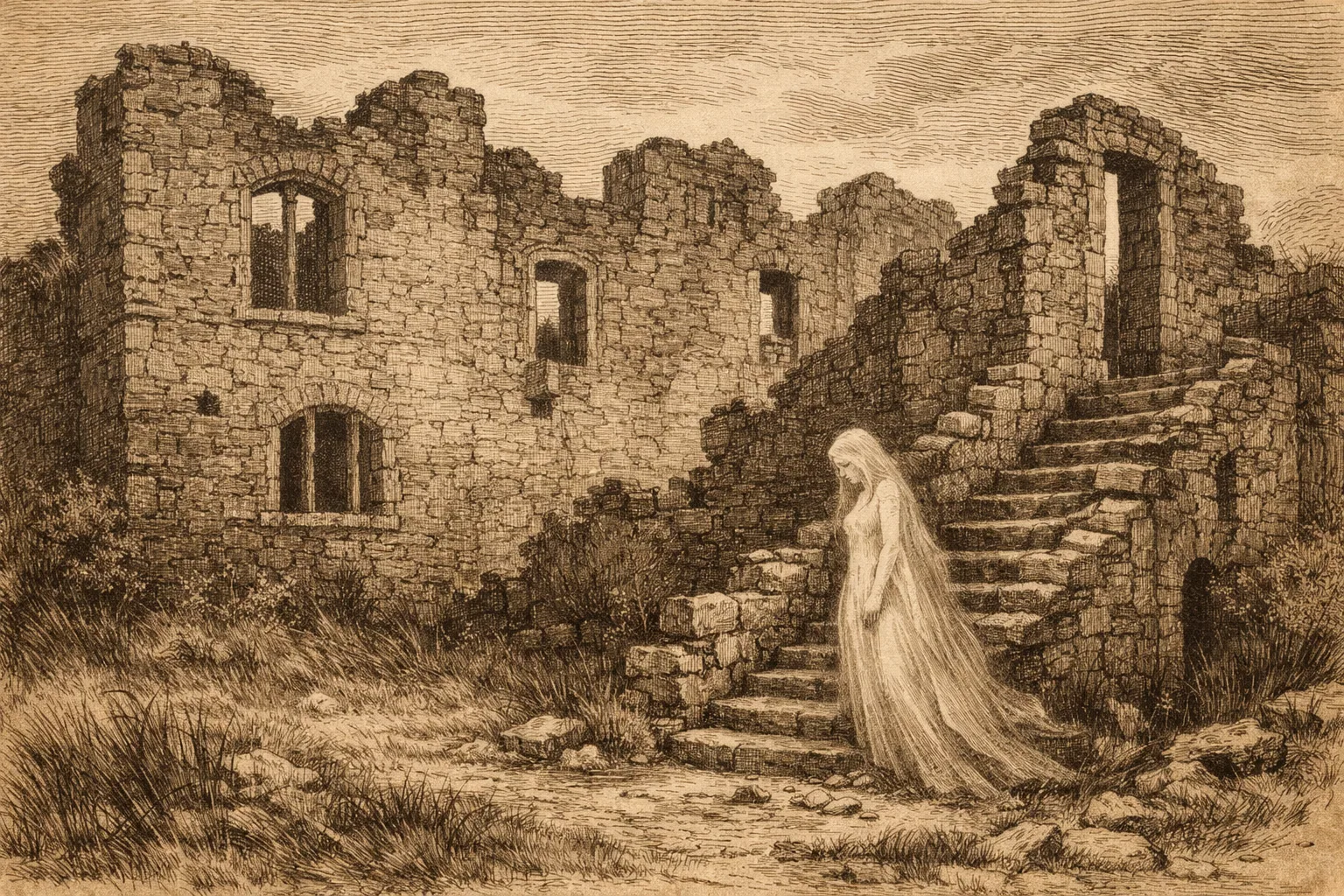
Dalquharran is the clearest Ayrshire example of a White Lady attached to a castle ruin. The historic setting is strong even where the ghost story is thin. The old castle, near Dailly, was a fortified house with 15th-century origins, later enlarged in the 17th century; Trove records its strong position, walls, vaulted ground floor, circular tower and 1670s alterations. The nearby “new” Dalquharran Castle is a Category A listed mansion designed by Robert Adam around 1790, with later 19th-century wings.[Trove]trove.scotDalquharran Castle | Place | trove.scotDalquharran Castle | Place | trove.scot
That double-site confusion is important. When people talk about “Dalquharran Castle”, they may mean the older medieval remains or the later Robert Adam mansion. The White Lady story tends to drift across the estate atmosphere rather than sitting neatly in one documented room. Modern paranormal retellings describe her as a woman in white who fell to her death while holding an infant, or as a figure glimpsed at an upper window. The same retelling mentions visitors feeling watched, childlike cries in lower rooms, and uncertain attempts to identify the apparition with either Kennedy family history or the site’s later uses.[Scottish Paranormal]scottish-paranormal.co.ukOpen source on scottish-paranormal.co.uk.
As evidence, this is fragile. The White Lady is not anchored here by a known dated witness statement from the 18th or 19th century, nor by a clear estate document naming a specific woman and incident. It is better read as a localised version of a widespread British motif: a pale female figure, a tragic death, a child, an upper-storey sighting and a castle whose fabric visibly suggests abandonment. The historical Dalquharran record supports the place; it does not independently prove the apparition.
That does not make the story worthless. It explains why Dalquharran attracts eerie attention. A designed Gothic or castle-style mansion by Robert Adam, linked to the Kennedy world and left ruinous, already looks like a ghost story waiting to be told. The White Lady gives that architectural melancholy a face.
Loudoun’s Grey Lady and Ruin Lore
Loudoun’s Grey Lady belongs to a more crowded haunted landscape. The castle, near Galston, was a major castellated mansion built around earlier structures. Historic Environment Scotland records that the extensive building was designed by Archibald Elliot for the Countess of Loudoun in 1804, with later extensions, and that it was gutted by fire in 1941 on the eve of being leased to the War Office as a military headquarters.[Historic Environment Scotland]portal.historicenvironment.scotOpen source on historicenvironment.scot.
The fire is central to the way the site now feels. Loudoun’s ghost stories are not just about an old aristocratic house; they are about a house that became a ruin in a single catastrophic event. The Castles of Scotland notes that the Grey Lady was reportedly seen often before the 1941 destruction and has also supposedly been witnessed since. The same account adds a glowing-eyed hunting dog, a ghostly piper and a monk, showing that Loudoun’s supernatural reputation is a bundle of motifs rather than a single coherent case.[The Castles of Scotland]thecastlesofscotland.co.ukOpen source on thecastlesofscotland.co.uk.
This is where the Grey Lady becomes especially revealing. In many castle traditions, a Grey Lady is less sharply plotted than a White Lady. She may not have a fixed name, a definite death date or a fully developed tragedy. Instead, she acts almost as a sign that the house has memory: she appears before damage, after disaster, near burial grounds, or in liminal places such as corridors, ruins and kirkyards.
A personal blog account from Loudoun Kirk Cemetery describes a floating female figure with a blue-grey light near the crypt, then connects it to stories of a Grey Lady seen at either Loudoun Castle or Loudoun Kirk. That is not strong evidence in a historical sense, but it is useful folklore evidence because it shows how the tradition has spread from the castle ruin into the surrounding family and burial landscape. The comment beneath the post, from someone involved in Loudoun Kirk restoration, also shows the other side of local memory: not everyone close to the place had heard the same ghost stories.[homecomingscotlandblog.blogspot.com]homecomingscotlandblog.blogspot.comhomecoming scotland ghost of loudounhomecoming scotland ghost of loudoun
For readers, the safest conclusion is that Loudoun’s Grey Lady is a persistent ruin legend, not a well-documented apparition case. Its interest lies in the way it binds together a fire-damaged mansion, an old noble family, a kirk, a crypt, and a set of familiar haunted-castle figures.

Cassillis and the Problem of the Green Lady
Cassillis is the most literary of the three lady-ghost traditions, and also the one that most clearly shows how castle folklore can attach itself to a famous story after the fact. Trove identifies Cassillis House, also known as Cassilis or Cassillis Castle, as a medieval tower-house site. The later house is deeply tied to the Kennedy family and the Earls of Cassillis, which makes it fertile ground for romantic and tragic storytelling.[Trove]trove.scotCassillis House | Place | trove.scotCassillis House | Place | trove.scot
The Green Lady is usually said to be Lady Jean Hamilton, wife of John, 6th Earl of Cassillis. The apparition is sometimes placed at a window. The story behind the haunting links her to Johnie Faa, the “gypsy laddie” of ballad tradition: she supposedly loved him, ran away with him, and was forced to watch him hanged. Yet the same castle source that preserves the ghost story states plainly that the tale appears to have no historical basis and has also been set at Maybole Castle. It adds that letters from the time suggest the married couple were on good terms.[The Castles of Scotland]thecastlesofscotland.co.ukOpen source on thecastlesofscotland.co.uk.
That warning matters. The Cassillis Green Lady should not be presented as a straightforward historical haunting. It is a ballad-haunting: a ghost story built from song, aristocratic name recognition, local place attachment and later romantic imagination. Francis James Child’s great collection of English and Scottish popular ballads records the tradition linking John, 6th Earl of Cassillis, Lady Jean Hamilton and Sir John Faa, while also showing how variable such ballad material can be. The printed tradition itself is part of the story’s afterlife.[Project Gutenberg]gutenberg.orgProject Gutenbergwww.gutenberg.orgProject Gutenbergwww.gutenberg.org
The colour green adds another layer. Scotland has a wider tradition of Green Ladies and glaistig-like figures, sometimes connected with castles, households, water, protection or danger. The National Trust for Scotland’s Crathes Castle account, for example, describes a Green Lady seen in a green dress with an infant near a fireplace, showing how strongly the colour can signal a particular kind of Scottish castle ghost. Cassillis does not need to be the same tradition as Crathes, but it belongs to the same imaginative family: a woman made memorable by colour, place and unresolved sorrow.[National Trust for Scotland]nts.org.ukNational Trust for Scotland Ghosts of the Trust | National Trust for ScotlandNational Trust for Scotland Ghosts of the Trust | National Trust for Scotland
How Castle Ghost Motifs Travel
The Ayrshire lady ghosts show three ways folklore moves.
First, a motif can be fitted to a ruin. Dalquharran’s White Lady makes emotional sense because the estate already contains the ingredients: old stone, later grandeur, abandonment, family history and unsafe empty rooms. The story does not need a strong documentary trail to be memorable; the place itself does much of the work.
Second, a motif can survive a disaster. Loudoun’s Grey Lady is said to have been seen before the castle burned and after it became a ruin. Whether or not anyone accepts that as paranormal evidence, it is a classic way of making a destroyed house feel continuous. The human figure remains when the domestic world is gone.
Third, a motif can attach to literature. Cassillis’s Green Lady is less a “witness case” than a localised afterimage of a ballad tradition. The Johnie Faa story gives the castle a ready-made drama of love, pursuit, punishment and watching from a window. Once that story is tied to Lady Jean Hamilton, the ghost becomes a way of keeping the ballad visible in the landscape.
These movements are not signs of fraud. They are how folklore normally works. Stories are borrowed, localised, corrected, contradicted and reattached. A woman in white at one castle may resemble a woman in white elsewhere; a Grey Lady may migrate between castle and kirkyard; a Green Lady may borrow colour-symbolism from Scottish fairy and ghost traditions. The risk is only when later retellings flatten this process into a false claim that every detail is ancient, fixed and historically proven.
What Can Be Believed?
The places are real. Dalquharran, Loudoun and Cassillis are historically significant Ayrshire sites, and their fabric is supported by heritage records, listings and local-history sources. Dalquharran’s old castle and Robert Adam mansion are separately documented; Loudoun’s architectural history and 1941 fire are recorded by Historic Environment Scotland; Cassillis is recognised as a medieval tower-house site with a long Kennedy association.[trove.scot]trove.scotDalquharran Castle | Place | trove.scotDalquharran Castle | Place | trove.scot
The apparitions are traditions. The White Lady, Grey Lady and Green Lady are best treated as reported or repeated stories, not verified events. Dalquharran’s White Lady is vivid but mainly preserved in modern paranormal retelling. Loudoun’s Grey Lady appears in castle-lore summaries and local anecdote, but without a robust chain of dated witness records. Cassillis’s Green Lady has the richest narrative frame, but that frame is also the most obviously literary and historically disputed.[scottish-paranormal.co.uk]scottish-paranormal.co.ukOpen source on scottish-paranormal.co.uk.
The pattern is credible as folklore even where it is not credible as evidence for ghosts. Ayrshire’s lady apparitions reveal how old estates remember women: as wives, servants, mothers, lovers, mourners or nameless figures glimpsed at thresholds. They also reveal how easily a castle can turn social history into atmosphere. A window becomes a place of watching. A ruin becomes a place of return. A family tragedy, real or imagined, becomes a woman in a coloured dress.
Why These Three Stories Belong Together
Dalquharran, Loudoun and Cassillis do not form a single legend cycle in the strict sense. They belong together because they show the same mechanism working in three Ayrshire forms. The White Lady gives Dalquharran’s ruin a tragic domestic centre. The Grey Lady gives Loudoun’s burned shell a lingering presence. The Green Lady gives Cassillis a ballad-shaped memory of aristocratic romance, punishment and disputed truth.
Together, they make Ayrshire’s haunted castle folklore more interesting than a list of spooky sightings. They show how colour-coding helps ghost stories travel. White suggests mourning, innocence, bridal tragedy or a pale apparition. Grey suggests age, uncertainty, mist, ruin and half-remembered witness. Green, in Scotland especially, can suggest fairy tradition, household haunting, jealousy, protection or a woman bound to an old house.
The value of these stories is therefore not in proving that Ayrshire castles contain ghosts. It is in noticing how the county’s ruins and great houses have attracted female figures who carry the emotional work of memory. Ayrshire’s lady ghosts are less like solved mysteries than like recurring silhouettes: shaped by old buildings, repeated by local tradition, and made powerful by the gaps that history leaves behind.
Amazon book picks
Further Reading
Books and field guides related to Why Do Ayrshire Castles Have Lady Ghosts?. Use these as the next step if you want deeper reading beyond the article.
Scottish Ghost Stories
Provides classic Scottish haunting traditions similar to Ayrshire's castles.
The castles of Scotland
Gives historical context for the castles associated with these legends.

The secret commonwealth of elves, fauns, and fairies
Provides wider folklore background behind Scottish supernatural belief.
The Penguin Book of Ghost Stories
Explores enduring ghost motifs comparable to lady apparitions.
eBay marketplace picks
Marketplace Samples
Live-tested eBay searches with available results related to this page.
Endnotes
1.
Source: trove.scot
Title: Dalquharran Castle | Place | trove.scot
Link:https://www.trove.scot/place/40887
2.
Source: homecomingscotlandblog.blogspot.com
Title: homecoming scotland ghost of loudoun
Link:https://homecomingscotlandblog.blogspot.com/2009/01/homecoming-scotland-ghost-of-loudoun.html
3.
Source: trove.scot
Title: Cassillis House | Place | trove.scot
Link:https://www.trove.scot/place/41666
4.
Source: gutenberg.org
Title: Project Gutenbergwww.gutenberg.org
Link:https://www.gutenberg.org/ebooks/63116.txt.utf-8
5.
Source: maybole.org
Link:https://www.maybole.org/history/books/carricks%20capital/countessandgypsy.htm
6.
Source: steelthistles.blogspot.com
Title: white ladies
Link:https://steelthistles.blogspot.com/2014/07/white-ladies.html
7.
Source: winsham.blogspot.com
Title: wednesday weirdness green ladies enigma
Link:https://winsham.blogspot.com/2015/08/wednesday-weirdness-green-ladies-enigma.html
8.
Source: scottish-paranormal.co.uk
Link:https://www.scottish-paranormal.co.uk/post/the-haunting-whisper-of-dalquharran-the-tale-of-the-white-lady
9.
Source: thecastlesofscotland.co.uk
Link:https://www.thecastlesofscotland.co.uk/the-best-castles/scenic-castles/loudoun-castle/
10.
Source: thecastlesofscotland.co.uk
Link:https://www.thecastlesofscotland.co.uk/the-best-castles/other-articles/cassillis-house/
11.
Source: portal.historicenvironment.scot
Title: Historic Environment Scotland DALQUHARRAN CASTLE INCLUDING STABLE RANGE (LB125)
Link:https://portal.historicenvironment.scot/apex/f?p=1505%3A300%3A%3A%3A%3A%3AVIEWTYPE%2CVIEWREF%3Adesignation%2CLB125
12.
Source: portal.historicenvironment.scot
Link:https://portal.historicenvironment.scot/apex/f?p=1505%3A300%3A%3A%3A%3A%3AVIEWTYPE%2CVIEWREF%3Adesignation%2CGDL00269
13.
Source: nts.org.uk
Title: National Trust for Scotland Ghosts of the Trust | National Trust for Scotland
Link:https://www.nts.org.uk/stories/ghosts-of-the-trust
14.
Source: Wikipedia
Title: White Lady
Link:https://en.wikipedia.org/wiki/White_Lady
15.
Source: Wikipedia
Title: Dalquharran Castle
Link:https://en.wikipedia.org/wiki/Dalquharran_Castle
16.
Source: Wikipedia
Title: Loudoun Castle
Link:https://en.wikipedia.org/wiki/Loudoun_Castle
17.
Source: Wikipedia
Link:https://en.wikipedia.org/wiki/Glaistig
18.
Source: blog.historicenvironment.scot
Title: ghost stories from stirling castle
Link:https://blog.historicenvironment.scot/2023/10/ghost-stories-from-stirling-castle/
19.
Source: historicenvironment.scot
Link:https://www.historicenvironment.scot/visit/all/kinneil-house/
20.
Source: nts.org.uk
Link:https://www.nts.org.uk/stories/scottish-ghost-stories-witches-murder-and-folklore-part-2
21.
Source: electricscotland.com
Link:https://electricscotland.com/history/nation/cassillis.htm
22.
Source: youtube.com
Link:https://www.youtube.com/watch?v=5jvHFVGdL58
23.
Source: spookyscotland.net
Link:https://spookyscotland.net/glaistig/
24.
Source: trove.nla.gov.au
Link:https://trove.nla.gov.au/newspaper/article/8220238
25.
Source: icysedgwick.com
Title: green lady
Link:https://www.icysedgwick.com/green-lady/
Additional References
26.
Source: youtube.com
Title: The Haunting of Woodhouselee: Scotland’s Forgotten White Lady
Link:https://www.youtube.com/watch?v=F04CWyh1STg
Source snippet
Alone at Night Abandoned Dalquharran Castle 🏴...
27.
Source: instagram.com
Link:https://www.instagram.com/p/DXrwwZZjP5W/
28.
Source: afhs.co.uk
Link:https://afhs.co.uk/ayrshires-most-haunted-ten-top-ayrshire-ghost-encounters/
29.
Source: electricscotland.com
Link:https://electricscotland.com/lifestyle/romanticnarrativ00fittuoft.pdf
30.
Source: facebook.com
Link:https://www.facebook.com/100094232920232/posts/dalquharran-castle-is-a-category-a-listed-building-in-south-ayrshire-scotland-de/569959069488519/
31.
Source: facebook.com
Link:https://www.facebook.com/HauntedScotlandInvestigates/posts/dalquharran-castle-is-located-in-south-ayrshire-scotland-designed-and-completed-/5108104425974198/
32.
Source: castlopedia.com
Link:https://www.castlopedia.com/castle/dalquharran-castle/4802
33.
Source: facebook.com
Link:https://www.facebook.com/groups/1091929745503434/posts/1758203652209370/
34.
Source: archive.org
Link:https://archive.org/stream/englishscottishp41chilrich/englishscottishp41chilrich_djvu.txt
35.
Source: clockworkremovals.co.uk
Link:https://www.clockworkremovals.co.uk/our-news/halloween-special-scotlands-most-haunted-locations/
Topic Tree