Where Bedfordshire's Ghost Stories Gather
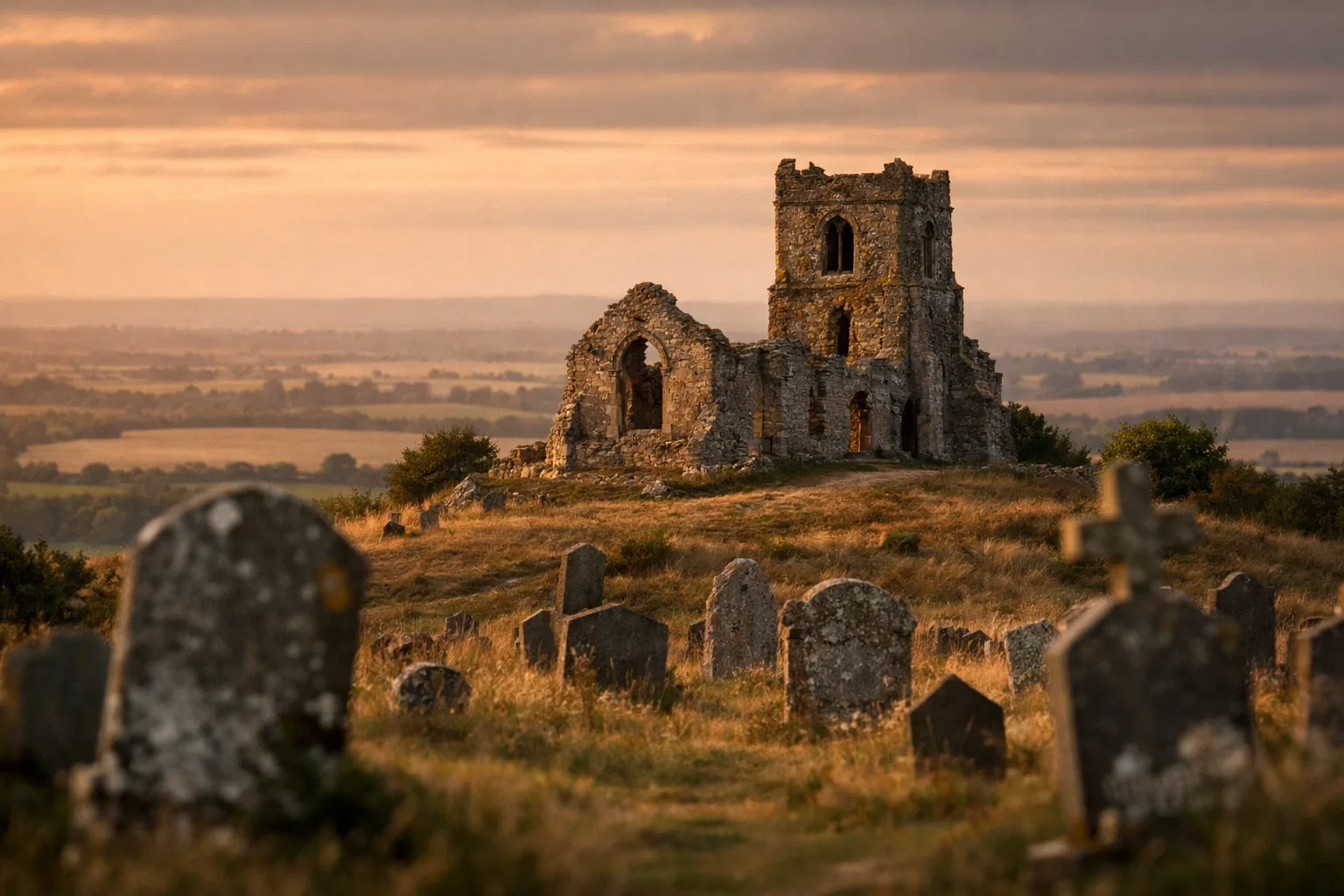
Bedfordshire’s haunted reputation is quieter than that of some larger counties, but it has a distinctive character: ruined churches on ridges, old monastic houses, airship sheds, coaching-road legends and country-house ghosts rather than one single headline “most haunted” attraction.
Page outline Jump by section
Introduction
For this project, “Bedfordshire” is best understood as the historic county shown in the Wikishire/Wikimedia historic-county mapping tradition, while recognising that modern local government divides the area between Bedford, Central Bedfordshire and Luton. The historic-county frame matters because ghost stories rarely respect council boundaries: Luton, Dunstable, Clophill, Ampthill, Cardington and the rural Greensand Ridge all sit within the same haunted Bedfordshire imagination.[wikishire.co.uk]wikishire.co.ukOpen source on wikishire.co.uk.
Where Bedfordshire’s ghost stories gather
Bedfordshire’s folklore has a strong sense of landscape. The county is not dominated by great mountains or a coastline; its eeriness often comes from edges and remains: a church abandoned on a hilltop, a dismantled mansion left as a shell, a priory folded into a military base, and huge airship hangars standing over flat fields. Wikishire describes Bedfordshire as an inland county of the south-eastern Midlands, with Bedford and Luton as its main towns and the southern part rising into the Chilterns, while the rest falls into the drainage of the Great Ouse and its tributaries.[Wikishire]wikishire.co.ukOpen source on wikishire.co.uk.
That geography helps explain the atmosphere of several legends. Old St Mary’s at Clophill sits high on the Greensand Ridge, separated from the modern parish church. Houghton House stands as a roofless shell above the surrounding countryside near Ampthill. Cardington’s giant airship sheds are not medieval ruins at all, yet they carry the same haunted quality because they are so oversized, so historically charged, and so visibly connected to catastrophe.
The county’s haunted stories also sit between official history and local retelling. Historic England and English Heritage can establish what a place is, when it was built, and why it matters; local-history pages and old newspapers preserve what people said happened there; paranormal databases and ghost walks show how those stories have been repeated, reshaped and made visitable. Bedfordshire’s best haunted places are therefore not simply “spooky locations”, but sites where the documented past and the rumoured past rub against each other.
Clophill: why one ruined church became Bedfordshire’s darkest legend
Old St Mary’s, Clophill, is probably Bedfordshire’s most notorious haunted site. The older church stands outside the village, while the present St Mary’s was built in the village centre in the mid-19th century. The old church later became a mortuary chapel, lost its roof after lead theft in the 1950s, and declined into a ruin. Its isolated hilltop position and graveyard would have been enough to attract ghost stories, but its wider reputation came from a very specific modern scandal.[Wikipedia]WikipediaSt Mary's Church, ClophillSt Mary's Church, Clophill
In March 1963, the site became the focus of press attention after human remains and ritual-looking markings were found at the ruined church. Later retellings describe bones arranged in a pattern interpreted in the newspapers as connected with a “Black Mass”, with cockerel feathers and painted crosses also reported. The story then widened through further rumours, alleged copycat incidents and national press interest. Clophill History notes that the national press helped turn Old St Mary’s into the place known as the “Haunted Church”.[Wikipedia]WikipediaSt Mary's Church, ClophillSt Mary's Church, Clophill
The Clophill case is a good example of how a haunting can be made by a mixture of real events, sensational reporting and local atmosphere. The grave desecration appears to have been real; the leap from desecration to organised occult menace is much harder to treat as solid fact. Reports also mention a student prank involving a cockerel, feathers and blood before the 1963 incident, which complicates the simple “satanic haunting” version.[Wikipedia]WikipediaSt Mary's Church, ClophillSt Mary's Church, Clophill
For readers interested in haunted Bedfordshire, Clophill matters because it shows how modern folklore forms. The church was already ancient-looking and abandoned; the graveyard desecration gave the place a shocking story; press coverage gave it a national audience; later books, podcasts, films and paranormal visits kept the reputation alive. The 2013 film The Paranormal Diaries: Clophill further blurred local history and horror entertainment by building a found-footage-style story around the site’s real reputation.[Google Books]books.google.comBooks Black Magic Church: The True Story of ClophillBooks Black Magic Church: The True Story of Clophill
The careful conclusion is that Clophill is genuinely important in Bedfordshire’s haunted history, but not because its legends are easy to verify. It is important because it shows a haunted place being manufactured in public: medieval ruin, vandalism, churchyard fear, tabloid language, occult panic, local memory and tourism all meeting on one exposed hill.

Chicksands Priory and the “naughty nun”
Chicksands Priory offers a different kind of Bedfordshire haunting: the monastic ghost story. Bedfordshire Archives describes Chicksands as a Gilbertine priory with 12th-century origins, later adapted as a country house and eventually associated with military use. The site is historically significant in its own right, quite apart from the ghost legend, because the Gilbertines were the only monastic order of English origin and Chicksands was one of their important houses.[Bedfordshire Archives]bedsarchives.bedford.gov.ukBedfordshire Archives The Priory of ChicksandsBedfordshire Archives The Priory of Chicksands
The famous legend concerns Rosata, sometimes called Berta Rosata or Rosetta. In the usual version, a nun falls in love with one of the canons, becomes pregnant, and is punished by being walled up alive after being forced to watch her lover executed. Bedfordshire Archives preserves the legend as an allegation rather than a confirmed event, while Bedford’s Virtual Library notes that the ghost is said to appear on the 17th of each month when the moon is full.[culturalservices.net]virtual-library.culturalservices.netVirtual Library Chicksands: The legend of the 'Naughty NunVirtual Library Chicksands: The legend of the 'Naughty Nun
What makes Chicksands especially interesting is that the legend may be Gothic embroidery rather than medieval memory. A British Folklore account notes discussion of an inscription associated with “Rosata” and the possibility that the supposed epitaph was an 18th-century invention, perhaps designed to add romance and antiquarian atmosphere to the site. That does not make the story worthless; it makes it more revealing. The “walled-up nun” is a classic kind of haunted-house legend, turning a religious building into a drama of forbidden love, punishment and restless return.[British Folklore]britishfolklore.comBritish Folklore Chicksands PrioryBritish Folklore Chicksands Priory
The Chicksands story also shows how Bedfordshire’s hauntings often live at the boundary between access and secrecy. A former priory inside or associated with a military estate naturally gathers rumours: restricted spaces invite speculation, and old cloisters become easier to imagine as haunted when they are not part of everyday public life. The ghost’s appeal lies in that tension between documented monastic survival and melodramatic legend.
Bedford’s Black Tom and Odell’s wicked rider
Bedford’s best-known urban ghost is Black Tom, a highwayman figure associated with the junction of Tavistock Street, Union Street and Clapham Road. In local retellings, he is said to have been buried with a stake through his heart at a spot known as Black Tom’s Grave, yet his ghost still haunted the area. BedsLife calls Black Tom Bedford’s most famous ghost, while Bedford’s Virtual Library preserves an Ampthill and Flitwick Times account from 1984 describing sightings and the older belief that people stayed indoors for fear of meeting him and another phantom.[Beds Life Magazine]bedslifemagazine.co.ukBeds Life Magazine Bedford's GhostsBeds Life Magazine Bedford's Ghosts
The Black Tom legend has all the ingredients of a strong local ghost: a named criminal, a recognisable street location, a dramatic burial detail, and a reason for the haunting to remain attached to a specific urban corner. Its credibility as literal history is much weaker than its value as folklore. The story behaves like a warning tale about violence, execution and improper burial, with the stake through the heart placing it close to older beliefs about preventing the restless dead from returning.
The same Virtual Library account also retells the legend of Sir Rowland Alston of Odell, a wicked figure whose ghost supposedly rode a phantom black charger through his ancestral home and was eventually exorcised by twelve clergymen. The tale says his spirit was confined to a pond on Odell Wold before later escaping and being chased by the Devil to the church, where five marks on the porch were explained as Satan’s fingermarks. The church of All Saints, Odell, is a real Grade I listed medieval church, and the Devil’s-marks legend has been attached to it in folklore guides.[Virtual Library]virtual-library.culturalservices.netVirtual Library Bedford Black TomVirtual Library Bedford Black Tom
Black Tom and Sir Rowland show Bedfordshire ghost lore at its most traditional. These are not modern paranormal investigations but moralised stories: bad men, violent deaths, clergymen, the Devil, church porches and periodic returns. They tell us less about individual witnesses and more about how communities once explained fear, misfortune and memorable places.
Dunstable’s bottled witch: a fake ghost story that became real folklore
Sally the Dunstable Witch is one of Bedfordshire’s most useful cautionary tales because it is openly fictional, yet still belongs to local folklore. According to the Virtual Library article by Rita Swift, Sally was created in 1875 by Alfred P. Wire, a schoolmaster, as part of a satirical ballad intended to shame the rector of Dunstable over the neglected state of the Priory churchyard. The story was revived, forgotten, lost and rediscovered, and later rumour attached a “witch’s grave” to the churchyard.[Virtual Library]virtual-library.culturalservices.netVirtual Library Sally the Dunstable WitchVirtual Library Sally the Dunstable Witch
In the ballad, Sally is accused of witchcraft, executed, curses the town, haunts the Priory, and is eventually forced into a bottle by a pilgrim-like holy man. The bottle is then buried with a warning that if it is broken, Sally will return worse than before. This is wonderfully theatrical folklore, but its origin is unusually clear: it was invented for local satire, not recovered from a medieval witch trial.[Virtual Library]virtual-library.culturalservices.netVirtual Library Sally the Dunstable WitchVirtual Library Sally the Dunstable Witch
That clarity makes Sally more, not less, valuable. Many ghost stories pretend to be older than they are. Sally shows the process in the open: a social complaint becomes a comic supernatural poem; children repeat it; the story sticks to a churchyard; later generations treat the “witch” as part of Dunstable’s eerie identity. It is a reminder that hauntings can become culturally real even when their literal origin is known to be invented.
For a Bedfordshire haunted-history page, Sally also widens the picture beyond apparitions. Not every county legend is a witnessed ghost. Some are curses, mock-antiquarian stories, invented ballads, local jokes and half-believed warnings that gain power because they are attached to a familiar place.
Ruined houses: Houghton House, Someries Castle and Wrest Park
Bedfordshire’s country-house ghosts are less lurid than Clophill, but they are highly atmospheric because their settings are so strong. Houghton House, near Ampthill, is a ruined 17th-century mansion managed by English Heritage. It was built around 1615 for Mary, Dowager Countess of Pembroke, and is reputed to have inspired the “House Beautiful” in John Bunyan’s The Pilgrim’s Progress. Historic England records it as a Grade I ruin, dismantled in the late 18th century.[english-heritage.org.uk]english-heritage.org.ukOpen source on english-heritage.org.uk.
The ghost tradition at Houghton House usually involves shadowy figures, disappearing forms and the sound of horses or a coach. The Paranormal Database records reports of shadowy figures at the ruins and the sound of several galloping horses pulling a coach. These are not strong evidential claims, but they fit the site perfectly: a roofless shell, high views, aristocratic decline and a house preserved as a romantic ruin.[Paranormal Database]paranormaldatabase.comOpen source on paranormaldatabase.com.
Someries Castle, near Luton, is even better suited to a haunting because its popular name promises a castle while the archaeology points to a fortified manor house. It is associated with Sir John Wenlock, a 15th-century soldier and politician who died at the Battle of Tewkesbury in 1471. Travel and local-history sources repeat the tradition that Wenlock’s ghost haunts the ruins, sometimes explaining the haunting through the unfinished nature of the building.[Britain Express]britainexpress.comOpen source on britainexpress.com.
Wrest Park adds a more recent institutional layer. English Heritage reported in 2025 that staff at Wrest Park in Bedfordshire had described unexplained sightings near the pavilion, including figures resembling soldiers vanishing into woodland, and the sound of a bouncing ball in the staircase hall after visitors had left. The Guardian’s coverage of English Heritage’s wider ghost-story release framed such accounts as part of a long practice of using eerie stories to connect people with historic places, rather than as confirmed supernatural evidence.[English Heritage]english-heritage.org.ukOpen source on english-heritage.org.uk.
Together, Houghton House, Someries Castle and Wrest Park show how Bedfordshire’s grand-house hauntings work. They are less about documented crimes than about absence: unfinished buildings, stripped interiors, ruined walls, vanished families and staff after closing time. The ghosts fill in what history has removed.
Cardington: the R101 disaster and a modern industrial haunting
Cardington is one of Bedfordshire’s most powerful haunted landscapes because its story is modern, public and tragic. The R101 airship was designed and built at the Royal Airship Works at Cardington as part of Britain’s interwar airship ambitions. It crashed in France on 5 October 1930, and the disaster effectively ended Britain’s pre-war airship programme. Parliament’s heritage pages and RAF Museum material both place Cardington at the centre of the R101 story.[parliament.uk]parliament.ukOpen source on parliament.uk.
The historical facts are stark enough without embellishment. The dead were returned to Britain, lay in state at Westminster Hall, and were buried at Cardington, where memorials still preserve the local connection. Bedfordshire Archives notes that after the crash, the airship project collapsed and many Royal Airship Works staff were quickly made redundant, making the disaster not only a national aviation tragedy but a local economic shock.[bedford.gov.uk]bedsarchives.bedford.gov.ukBedfordshire Archives The Royal Airship Works ShortstownBedfordshire Archives The Royal Airship Works Shortstown
The ghost tradition attached to Cardington usually concerns an airman haunting the old sheds from which R101 departed. The Paranormal Database records the Cardington Hangars as reputedly haunted by at least one airman from the doomed airship. That is a thin claim as evidence, but a powerful one as folklore: the huge hangars are among the most dramatic industrial survivals in the county, and the R101 tragedy gives them a built-in emotional charge.[Paranormal Database]paranormaldatabase.comOpen source on paranormaldatabase.com.
Cardington also shows that haunted history is not only medieval. A 20th-century technological disaster can produce ghost lore just as surely as an abbey ruin or gallows site. In this case, the “ghost” is less a single apparition than a memory of ambition, mourning and abrupt silence after an enormous project failed.
Roads, inns and everyday apparitions
Not all Bedfordshire ghosts belong to famous ruins. Some are smaller stories attached to roads, pubs, cinemas and ordinary streets. MJ Wayland’s county roundup, for example, includes the Leighton Buzzard area story of a pale-faced hitchhiker near Stanbridge in 1979, a classic vanishing-passenger motif in which a driver picks up a silent stranger who disappears from the car. The same source repeats Bedfordshire pub and town-centre stories such as the King’s Arms in Bedford and Union Street’s Black Tom associations.[MJ Wayland]mjwayland.comMJ Wayland10 Most Haunted Places in BedfordshireMJ Wayland10 Most Haunted Places in Bedfordshire
These accounts need more caution than the better-contextualised legends, because they often depend on late retellings rather than archival documentation. Yet they are important because they show how Bedfordshire participates in wider British ghost-story patterns. The phantom hitchhiker, the haunted inn, the apparition in old-fashioned dress, the disembodied footsteps in a public building: these are national motifs localised by being given a road, a pub sign, a date or a named witness.
The Paranormal Database lists many Bedfordshire entries of this kind, from Ampthill and Bedford to Cardington and Chicksands. It is useful as a gazetteer of claims and motifs, but it should not be read as a verified evidential archive. Its value is breadth: it shows what kinds of stories have circulated, where they have been placed, and whether they are described as published media, user submissions, investigations or folklore.[Paranormal Database]paranormaldatabase.comOpen source on paranormaldatabase.com.
For readers planning eerie local visits, this distinction matters. A ruined English Heritage site with a documented history and a light ghost tradition offers a different experience from a modern pub haunting or a roadside vanishing-passenger story. Both belong to Bedfordshire’s haunted map, but they do not carry the same source weight.
How credible are Bedfordshire’s hauntings?
The most reliable statement is that Bedfordshire has a rich body of haunted stories, not that Bedfordshire’s ghosts are proven. The county’s best-known cases fall into several evidence levels.
The strongest historical footing belongs to the places themselves. Clophill Old Church, Chicksands Priory, Houghton House, Someries Castle, Wrest Park, Cardington and Odell church are real sites with traceable histories in local archives, Historic England records, English Heritage pages or other institutional sources. Their dates, functions and historical importance can be discussed with confidence.[wikipedia.org]WikipediaSt Mary's Church, ClophillSt Mary's Church, Clophill
The next level is documented folklore: stories preserved in local-history articles, old newspaper pieces, folklore books and named local retellings. Black Tom, Sally the Dunstable Witch, Rosata of Chicksands and Sir Rowland Alston belong here. They may not prove apparitions, but they are well enough preserved to be studied as Bedfordshire tradition.[Virtual Library]virtual-library.culturalservices.netVirtual Library Sally the Dunstable WitchVirtual Library Sally the Dunstable Witch
The weakest level is modern paranormal claim: shadow figures, voices, lights, cold spots, vanishing figures and ghost-hunt reports. These may be sincere experiences, but they are rarely independently verifiable. They are best presented as reports, claims or local lore. English Heritage’s 2025 ghost-story release is a good model: it shares staff and visitor experiences without insisting that they prove supernatural activity.[English Heritage]english-heritage.org.ukOpen source on english-heritage.org.uk.
There are also plausible non-supernatural explanations for many stories. Ruins create odd acoustics and shadows; abandoned sites attract trespass, vandalism and rumour; churchyards carry strong emotional associations; roadside ghosts often follow familiar narrative patterns; and places linked to disaster, such as Cardington, naturally gather stories of lingering presence. None of that “disproves” the folklore in a cultural sense. It simply keeps the article honest: Bedfordshire’s hauntings are best understood as layered traditions built from history, memory, fear, storytelling and place.
The haunted Bedfordshire map in one view
A reader wanting the heart of Bedfordshire’s haunted history should begin with a few anchor sites rather than a long undifferentiated list.
Clophill Old Church is the county’s darkest modern legend: a medieval ruin made notorious by 1960s grave desecration, occult rumours and later paranormal media.
Chicksands Priory is the classic monastic haunting: Rosata, the allegedly walled-up nun, walking through a former Gilbertine house whose history is real even if the ghost story is uncertain.
Bedford and Odell preserve older moral folklore: Black Tom the highwayman, Sir Rowland Alston, phantom horses, exorcism and Devil marks on church stone.
Dunstable Priory churchyard gives the county a rare invented haunting whose origin is known: Sally the bottled witch, created in a satirical 19th-century ballad and later absorbed into local legend.
Houghton House and Someries Castle provide the romantic ruin tradition: shadowy figures, phantom coaches and the ghost of Sir John Wenlock among architectural remains.
Cardington carries the modern haunting of technological tragedy: the R101 airship disaster, memorialised in local history and echoed in reports of an airman at the old sheds.
Taken together, these stories make Bedfordshire an unusually good county for readers who like ghost lore with a visible historical setting. Its haunted places are not only “scary”; they are readable. The ruins, roads, churches, priory buildings and hangars all explain why particular stories settled where they did, and why people still repeat them.
Amazon book picks
Further Reading
Books and field guides related to Where Bedfordshire's Ghost Stories Gather. Use these as the next step if you want deeper reading beyond the article.
The lore of the land
Explores legends and haunted traditions tied to real British landscapes.
The Penguin Guide to the Superstitions of Britain and Ireland
Provides essential context for English ghost traditions including county folklore.

eBay marketplace picks
Marketplace Samples
Live-tested eBay searches with available results related to this page.

Endnotes
1.
Source: commons.wikimedia.org
Title: File:England Historic Counties Bedfordshire map.svg
Link:https://commons.wikimedia.org/wiki/File%3AEngland_Historic_Counties_Bedfordshire_map.svg
2.
Source: Wikipedia
Link:https://en.wikipedia.org/wiki/Luton
3.
Source: Wikipedia
Title: St Mary’s Church, Clophill
Link:https://en.wikipedia.org/wiki/St_Mary%27s_Church%2C_Clophill
4.
Source: books.google.com
Title: Books Black Magic Church: The True Story of Clophill
Link:https://books.google.com/books/about/Black_Magic_Church.html?id=FxvbuQAACAAJ
5.
Source: Wikipedia
Title: The Paranormal Diaries: Clophill
Link:https://en.wikipedia.org/wiki/The_Paranormal_Diaries%3A_Clophill
6.
Source: Wikipedia
Title: Chicksands Priory
Link:https://en.wikipedia.org/wiki/Chicksands_Priory
7.
Source: Wikipedia
Title: Church of All Saints, Odell, Bedfordshire
Link:https://en.wikipedia.org/wiki/Church_of_All_Saints%2C_Odell%2C_Bedfordshire
8.
Source: Wikipedia
Title: John Wenlock, 1st Baron Wenlock
Link:https://en.wikipedia.org/wiki/John_Wenlock%2C_1st_Baron_Wenlock
9.
Source: parliament.uk
Link:https://www.parliament.uk/about/living-heritage/building/palace/westminsterhall/contemporary-context/lyings-in-state/what-was-r101/
10.
Source: Wikipedia
Link:https://en.wikipedia.org/wiki/R101
11.
Source: Wikipedia
Title: Someries Castle
Link:https://en.wikipedia.org/wiki/Someries_Castle
12.
Source: Wikipedia
Title: Houghton House
Link:https://en.wikipedia.org/wiki/Houghton_House
13.
Source: Wikipedia
Link:https://en.wikipedia.org/wiki/Bedfordshire
14.
Source: Wikipedia
Title: File:Bedfordshire UK location map.svg
Link:https://sco.wikipedia.org/wiki/File%3ABedfordshire_UK_location_map.svg
15.
Source: Wikipedia
Title: Cardington Airfield
Link:https://en.wikipedia.org/wiki/Cardington_Airfield
16.
Source: youtube.com
Title: 10 Most Haunted Places in Bedfordshire
Link:https://www.youtube.com/watch?v=zghJ1QPC6EQ
Source snippet
Part 1: CLOPHILL: The Church That Horrified a Nation (Documentary)...
17.
Source: wikishire.co.uk
Link:https://wikishire.co.uk/wiki/Bedfordshire
18.
Source: bedsarchives.bedford.gov.uk
Title: Bedfordshire Archives The Priory of Chicksands
Link:https://bedsarchives.bedford.gov.uk/CommunityHistories/Chicksands/ThePrioryOfChicksands.aspx
19.
Source: virtual-library.culturalservices.net
Title: Virtual Library Chicksands: The legend of the ‘Naughty Nun’
Link:https://virtual-library.culturalservices.net/bedfordshire/vlib/0.digitised_resources/chicksands_news_ghosts_nun.htm
20.
Source: virtual-library.culturalservices.net
Title: Virtual Library Chicksands Priory
Link:https://virtual-library.culturalservices.net/bedfordshire/vlib/0.digitised_resources/chicksands_az_topics_chicksands_priory.htm
21.
Source: britishfolklore.com
Title: British Folklore Chicksands Priory
Link:https://britishfolklore.com/chicksands-priory/
22.
Source: bedslifemagazine.co.uk
Title: Beds Life Magazine Bedford’s Ghosts
Link:https://bedslifemagazine.co.uk/your-town/bedfords-ghosts
23.
Source: virtual-library.culturalservices.net
Title: Virtual Library Bedford Black Tom
Link:https://virtual-library.culturalservices.net/bedfordshire/vlib/0.digitised_resources/bedford_news_black_tom.htm
24.
Source: virtual-library.culturalservices.net
Title: Virtual Library Sally the Dunstable Witch
Link:https://virtual-library.culturalservices.net/bedfordshire/vlib/0.digitised_resources/dunstable_article_sallythewitch.htm
25.
Source: english-heritage.org.uk
Link:https://www.english-heritage.org.uk/visit/places/houghton-house/
26.
Source: historicengland.org.uk
Title: list entry
Link:https://historicengland.org.uk/listing/the-list/list-entry/1321465
27.
Source: paranormaldatabase.com
Link:https://www.paranormaldatabase.com/bedfordshire/bedforddata.php
28.
Source: britainexpress.com
Link:https://www.britainexpress.com/counties/bedfordshire/castles/someries-castle.htm
29.
Source: english-heritage.org.uk
Link:https://www.english-heritage.org.uk/about/search-news/english-heritage-unveils-mysterious-cctv-image-and-haunting-new-tales-from-historic-sites/
30.
Source: collections.rafmuseum.org.uk
Title: memorial of a disaster
Link:https://collections.rafmuseum.org.uk/story/memorial-of-a-disaster/
31.
Source: bedsarchives.bedford.gov.uk
Title: Bedfordshire Archives The Royal Airship Works Shortstown
Link:https://bedsarchives.bedford.gov.uk/CommunityHistories/Shortstown/TheRoyalAirshipWorksShortstown.aspx
32.
Source: paranormaldatabase.com
Link:https://www.paranormaldatabase.com/bedfordshire/bedforddata.php?pageNum_paradata=1
33.
Source: mjwayland.com
Title: MJ Wayland10 Most Haunted Places in Bedfordshire
Link:https://www.mjwayland.com/10-most-haunted-places-in-bedfordshire/
34.
Source: bedsarchives.bedford.gov.uk
Title: bedford.gov.uk Maps and Land Records
Link:https://bedsarchives.bedford.gov.uk/Using_Our_Collections/Collection-Guides/Maps-and-Land-Records/Maps-and-Land-Records.aspx
35.
Source: forms.bedford.gov.uk
Title: bedford.gov.uk Rosetta
Link:https://forms.bedford.gov.uk/chicksands/rosetta.htm
36.
Source: wikishire.co.uk
Link:https://wikishire.co.uk/wiki/Luton
37.
Source: gazetteer.org.uk
Link:https://gazetteer.org.uk/place/Bedfordshire
38.
Source: airshipsonline.com
Link:https://airshipsonline.com/sheds/cardington/
39.
Source: 1stairporttaxis.co.uk
Title: someries castle
Link:https://www.1stairporttaxis.co.uk/luton-attractions/someries-castle.html
Additional References
40.
Source: theguardian.com
Link:https://www.theguardian.com/uk-news/2025/oct/24/ghost-stories-english-heritage-faceless-figure-chester-castle
Source snippet
Michael Carter of English Heritage sees these stories not merely as spooky myths, but as part of a cultural practice of storytelling that...
41.
Source: youtube.com
Title: Part 1: CLOPHILL: The Church That Horrified a Nation (Documentary)
Link:https://www.youtube.com/watch?v=yDxpTvavSUM
Source snippet
Part 2: CLOPHILL The Church That HORRIFIED a Nation (Documentary)...
42.
Source: youtube.com
Title: Part 2: CLOPHILL The Church That HORRIFIED a Nation (Documentary)
Link:https://www.youtube.com/watch?v=yyy8qS1VH98
Source snippet
8 Extremely Haunted Places in Bedfordshire...
43.
Source: facebook.com
Link:https://www.facebook.com/Underwood1923/videos/the-haunted-gallery-at-chicksands-priory-clophill-bedfordshire/4225981354182900/
44.
Source: shortstown.co.uk
Link:https://shortstown.co.uk/about
45.
Source: abcounties.com
Link:https://abcounties.com/counties/county-profiles/bedfordshire/
46.
Source: gbmaps.com
Link:https://www.gbmaps.com/free-county-maps/Bedfordshire.php
47.
Source: facebook.com
Link:https://www.facebook.com/groups/Shutists/posts/10163852604178545/
48.
Source: paullee.com
Link:https://www.paullee.com/ghosts/ghostgeo/extractghostdata.php?location=52o040687_-0o366229_Chicksands+Priory.txt
49.
Source: facebook.com
Link:https://www.facebook.com/groups/307448103775/posts/10163166092578776/
Topic Tree
Follow this branch
Related pages 91
- Haunted Clackmannanshire
- Haunted Antrim
- Haunted Armagh
- Haunted Durham
- Haunted Londonderry
- +86 more in sidebar