Within Haunted Anglesey
Did Beaumaris Gaol's Clock Curse Last?
Beaumaris Gaol turns a disputed execution, a town clock and prison hardship into Anglesey's strongest haunted story.
On this page
- Richard Rowlands and the 1862 execution
- The clock curse in local tradition
- Prison ghosts, tourism and sceptical reading
Page outline Jump by section
Introduction
Beaumaris Gaol’s cursed clock legend is one of Anglesey’s most memorable haunted-place stories because it joins three things that visitors can still picture clearly: a preserved nineteenth-century prison, a public execution, and the church clock said to have disobeyed time ever since. The story centres on Richard Rowlands, hanged at Beaumaris Gaol on 4 April 1862 after being convicted of murdering his father-in-law. Local tradition says he protested his innocence and cursed the clock in the church tower opposite the scaffold, declaring that if he were innocent its faces would never again agree. Visit Anglesey and Visit Wales both preserve the tradition as part of the site’s public heritage, while more cautious crime-history accounts treat the curse as folklore rather than a proven last speech.[visitanglesey.co.uk]visitanglesey.co.ukVisit Anglesey Beaumaris GaolVisit AngleseyBeaumaris Gaol - Visit Anglesey…
The legend matters because it turns Beaumaris Gaol from a grim museum of punishment into a story about doubt, memory and wrongful-death anxiety. The haunting here is not only a report of footsteps or apparitions. It is a moral haunting: the possibility that a man may have gone to the gallows still insisting that the law had made a fatal mistake.
Why Beaumaris Gaol Became Anglesey’s Strongest Prison Haunting
Beaumaris Gaol stands in Beaumaris on the east side of Anglesey, close to the town’s medieval church and castle landscape. Cadw’s listed-building record describes the gaol and house of correction as built in 1829 by Joseph Hansom and Edward Welch, with its perimeter wall forming part of the original prison design. That same wall had a high-level doorway used for public hangings, and Cadw notes that two men were hanged there before the prison closed in 1878 and later became a museum.[Cadw Public API]cadwpublic-api.azurewebsites.netCadw Public APIListed BuildingsCadw Public APIListed Buildings
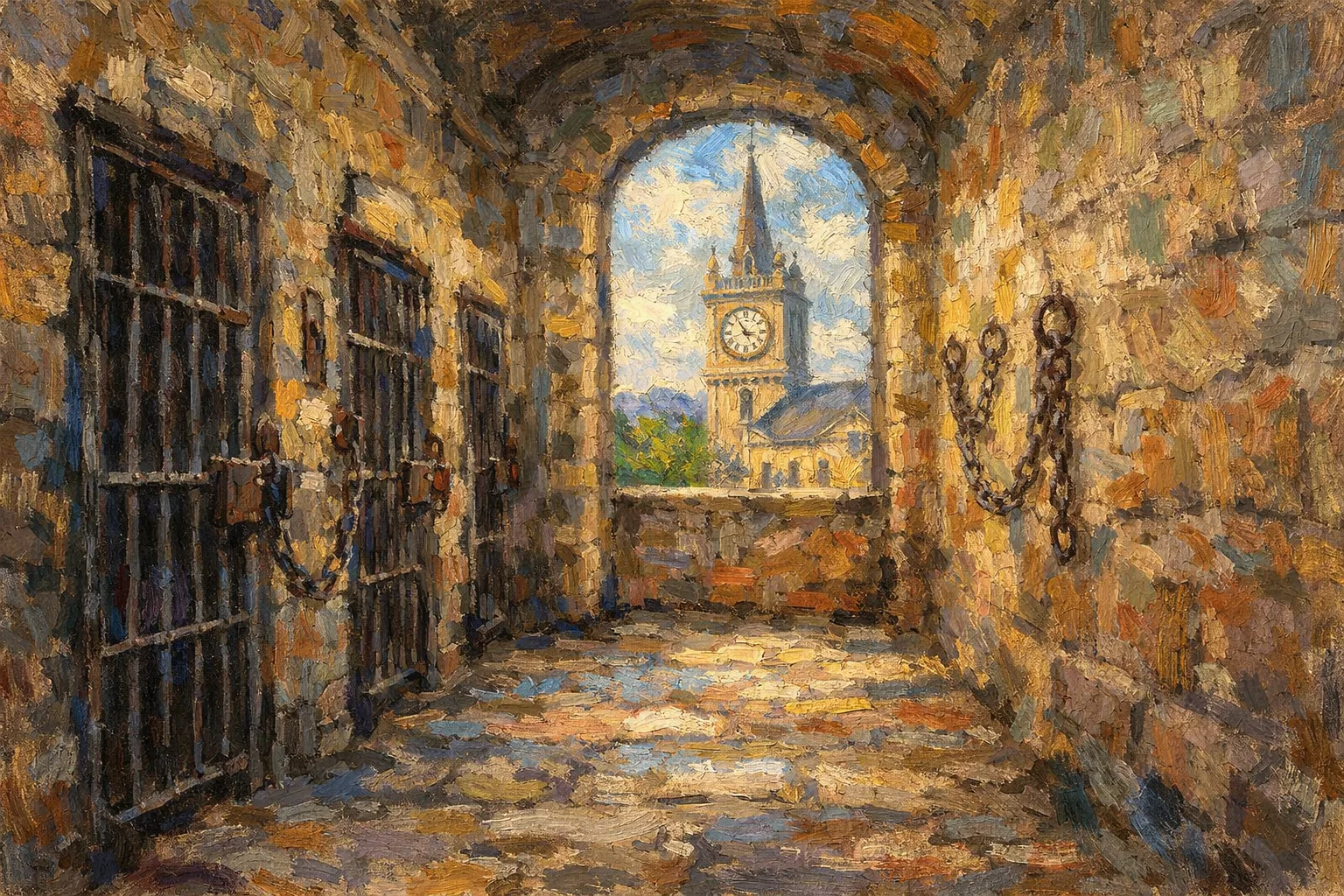
That physical survival is central to the legend’s force. Many haunted-prison stories rely on vague atmosphere, but Beaumaris gives the visitor a tight geography: cells, corridors, punishment spaces, the condemned route and the exterior wall where the scaffold was fixed. Cadw’s description even records the studded door on the east side of the perimeter wall, above which the gallows was fixed.[Cadw Public API]cadwpublic-api.azurewebsites.netCadw Public APIListed BuildingsCadw Public APIListed Buildings
The official tourism language leans into that atmosphere without presenting the haunting as fact. Visit Anglesey describes “dimly lit corridors”, spartan cells, punishment spaces and the condemned cell, then connects the site directly to Rowlands and the clock curse. Visit Wales similarly presents the gaol as a place full of “sad memories and secrets”, where visitors can stand in the court setting and encounter the “Not Guilty” memory attached to Rowlands.[Visit Anglesey]visitanglesey.co.ukVisit Anglesey Beaumaris GaolVisit AngleseyBeaumaris Gaol - Visit Anglesey…
This is why Beaumaris Gaol sits so naturally within Anglesey’s haunted-history map. The island has castles, churches, old roads and coastal legends, but the gaol’s story has a unusually clear historical anchor: a named man, a dated execution, a surviving building and a visible town clock tradition.

Richard Rowlands and the 1862 Execution
Richard Rowlands, also remembered in some accounts as Dic Rolant, was convicted of murdering his father-in-law, Richard Williams, in 1861 and was hanged outside Beaumaris Gaol on 4 April 1862. Capital Punishment UK gives the fullest accessible narrative of the case: Rowlands was a farm labourer with a complicated domestic situation, married to Elinor, daughter of the murdered man, and the prosecution argued that the motive was control of the family farm.[Capital Punishment UK]capitalpunishmentuk.orgCapital Punishment UKAnglesey’s Beaumaris Gaol – Capital Punishment UKCapital Punishment UKAnglesey’s Beaumaris Gaol – Capital Punishment UK
The same account stresses why the case became fertile ground for legend. It describes the evidence as circumstantial and contested, including claims about Rowlands’s movements and an alleged spot of blood. It also records that ministers prepared a petition for clemency after speaking with him in the condemned cell, but that the appeal failed.[Capital Punishment UK]capitalpunishmentuk.orgCapital Punishment UKAnglesey’s Beaumaris Gaol – Capital Punishment UKCapital Punishment UKAnglesey’s Beaumaris Gaol – Capital Punishment UK
At 8 o’clock on the morning of 4 April 1862, Rowlands was hanged in public by William Calcraft outside the gaol. A 2023 publication page for Nigel Thomas’s Between Heaven and Earth also frames the execution as the last public hanging in Wales and places the scaffold on the east wall of Beaumaris Gaol, with a large crowd gathered below.[Gwasg Carreg Gwalch]carreg-gwalch.cymruBetween Heaven and Earth – Gwasg Carreg Gwalch…
The public nature of the execution matters. Public hangings were not abolished across the United Kingdom until the Capital Punishment Amendment Act 1868, which required executions for murder to be carried out within prisons rather than before crowds. That places Rowlands’s death near the end of the public-execution era, when discomfort about spectacle, crowds and justice was already part of national debate.[Legislation.gov.uk]legislation.gov.ukOpen source on legislation.gov.uk.
The cursed clock legend therefore grew from more than a macabre detail. It grew from a case that later tellings remembered as controversial, a death staged in public view, and a townscape where the church clock could be read as a permanent witness.
The Clock Curse in Local Tradition
The common version of the legend says that Rowlands cursed the church clock opposite the scaffold, declaring that if he were innocent the clock’s faces would never again show the same time. Visit Anglesey gives the compact visitor-facing form of the story: Rowlands protested his innocence, put a curse on the church tower clock opposite the scaffold, and “to this day the clock has never kept the right time.”[Visit Anglesey]visitanglesey.co.ukVisit Anglesey Beaumaris GaolVisit AngleseyBeaumaris Gaol - Visit Anglesey…
Visit Wales repeats the same local-tradition structure, connecting the curse specifically to the church tower opposite the scaffold. That matters because it shows the story is not just an internet ghost-list invention; it is part of the heritage interpretation used to present Beaumaris Gaol and Court House to visitors.[Visit Wales]visitwales.comVisit Wales Llys Biwmares Beaumaris Court | Visit WalesVisit Wales Llys Biwmares Beaumaris Court | Visit Wales
The church usually associated with the story is St Mary and St Nicholas, Beaumaris. The National Churches Trust describes it as a large town church built in the early fourteenth century, with later additions and notable medieval and post-medieval furnishings. Its location in the historic town makes the clock a public, visible object rather than a hidden curiosity.[National Churches Trust]nationalchurchestrust.orgOpen source on nationalchurchestrust.org.
There are two main ways to read the curse:
As folklore, the clock becomes a supernatural verdict. The town may have hanged Rowlands, but time itself refuses to settle the matter. In this reading, the clock’s failure is not just mechanical; it is a sign that injustice leaves a mark.
As sceptical local history, the clock problem is more likely a mixture of mechanical difficulty, weather exposure and retrospective storytelling. Capital Punishment UK notes that the faces reportedly failed to agree “for a while”, but also gives a practical explanation: wind buffeting the southern face.[Capital Punishment UK]capitalpunishmentuk.orgCapital Punishment UKAnglesey’s Beaumaris Gaol – Capital Punishment UKCapital Punishment UKAnglesey’s Beaumaris Gaol – Capital Punishment UK
The tension between those two readings is what keeps the legend alive. A clock that merely breaks is maintenance trouble. A clock that breaks after a disputed execution becomes a story people retell.
Did Rowlands Really Speak the Curse?
The most important evidential caution is that the famous curse may not have been spoken at the scaffold at all. Capital Punishment UK says the popular legend claims Rowlands cursed the clock, but then adds that this is “probably untrue” because he said nothing on the scaffold after ministers persuaded him not to speak.[Capital Punishment UK]capitalpunishmentuk.orgCapital Punishment UKAnglesey’s Beaumaris Gaol – Capital Punishment UKCapital Punishment UKAnglesey’s Beaumaris Gaol – Capital Punishment UK
That does not make the legend worthless. It changes what kind of evidence it is. The curse is weak as a verbatim execution record, but strong as a piece of local memory. It shows that later tradition judged the execution morally unsettled, or at least worth questioning. The legend gives Rowlands a final voice even if the formal historical account suggests he may have stayed silent at the gallows.
This distinction is important for haunted-history writing. A ghost story does not need to be treated as literal fact to be meaningful. In Beaumaris, the legend preserves public unease about circumstantial evidence, class, legal authority and the spectacle of hanging. The supernatural detail — a clock that will not keep proper time — is a compact way of saying that the case never felt fully closed.
The same source notes that after Rowlands’s execution, press opinion was divided, with some maintaining his innocence and others agreeing with the verdict. It also argues that many people were troubled by a man being convicted and hanged on evidence later regarded as flimsy.[Capital Punishment UK]capitalpunishmentuk.orgCapital Punishment UKAnglesey’s Beaumaris Gaol – Capital Punishment UKCapital Punishment UKAnglesey’s Beaumaris Gaol – Capital Punishment UK
That is the heart of the cursed clock tradition. It is not merely “a spooky clock”. It is a folk appeal against finality.
Prison Ghosts, Tourism and Later Haunting Claims
The clock curse is the best-known supernatural tradition at Beaumaris Gaol, but modern haunted tourism has added a wider ghostly layer. Local Halloween and visitor accounts describe clanking keys, footsteps, shuffling sounds, whistling, a jailer-like presence and a general feeling of sadness in the building. These reports are best treated as contemporary folklore and visitor experience rather than verified paranormal evidence.[Beaumaris Holiday Let]beaumarisholidaylet.co.ukBeaumaris Holiday Let A creepy tale about Beaumaris GaolBeaumaris Holiday Let A creepy tale about Beaumaris Gaol
The gaol’s material history helps explain why such claims gather there. Capital Punishment UK describes chains, whippings, isolation in a dark cell for up to three days and one of Britain’s last working prison treadmills. The Beaumaris treadmill is especially memorable because it pumped water to the top of the building for use in the cells, giving a practical purpose to punishment labour.[Capital Punishment UK]capitalpunishmentuk.orgCapital Punishment UKAnglesey’s Beaumaris Gaol – Capital Punishment UKCapital Punishment UKAnglesey’s Beaumaris Gaol – Capital Punishment UK
The condemned route also gives the site a powerful dramatic structure. The condemned cell was on the top floor; on execution day, doors were opened and a bridge was placed between the prison and the perimeter wall so the prisoner could pass directly to the gallows. Capital Punishment UK notes that the metal rivets and doors associated with the gallows route can still be seen from outside the gaol walls.[Capital Punishment UK]capitalpunishmentuk.orgCapital Punishment UKAnglesey’s Beaumaris Gaol – Capital Punishment UKCapital Punishment UKAnglesey’s Beaumaris Gaol – Capital Punishment UK
For a visitor, this makes the haunting unusually place-specific. The story is not attached to a vague “old prison atmosphere” alone. It is attached to where the prisoner waited, where he walked, where the crowd watched, where the church clock stood in view, and where the town later remembered the execution.

What the Legend Reveals About Anglesey’s Haunted Memory
Beaumaris Gaol’s cursed clock legend belongs to a familiar haunted-place pattern: an execution, a protest of innocence, an unsettled public conscience and a physical object that seems to carry the story forward. In some places that object is a door, a cell, a tree, a road or a gallows stone. In Beaumaris it is a clock.
That choice is unusually effective. A clock is supposed to settle things. It orders the day, marks the hour and gives public agreement. The legend says the opposite happened after Rowlands died: the town’s clock became divided against itself. Whether or not the curse was ever spoken, the image is powerful because it turns timekeeping into judgement.
The story also fits Anglesey’s wider haunted geography without needing to borrow drama from elsewhere. Beaumaris already has a dense historic setting: castle, church, courthouse, gaol and narrow town streets. The gaol legend adds the island’s strongest execution-haunting, while nearby Beaumaris Castle and the old town provide natural internal links for readers exploring Anglesey’s darker heritage.
A careful reading therefore lands between belief and dismissal. The execution is historical. The building, wall and gallows route are historically grounded. The local tradition of the clock curse is genuinely preserved in modern heritage and tourism accounts. The claim that Rowlands literally cursed the clock from the scaffold is disputed, and the clock’s irregularity has plausible practical explanations.[azurewebsites.net]cadwpublic-api.azurewebsites.netCadw Public APIListed BuildingsCadw Public APIListed Buildings
That balance is what makes Beaumaris Gaol such a strong haunted-history site. Its power does not depend on proving a ghost. It depends on a story that still asks the question a public execution was meant to silence: what if the condemned man was telling the truth?
Amazon book picks
Further Reading
Books and field guides related to Did Beaumaris Gaol's Clock Curse Last?. Use these as the next step if you want deeper reading beyond the article.


Newgate: London's Prototype of Hell
Explains nineteenth-century prison culture relevant to Beaumaris Gaol.
eBay marketplace picks
Marketplace Samples
Live-tested eBay searches with available results related to this page.

Endnotes
1.
Source: capitalpunishmentuk.org
Title: Capital Punishment UKAnglesey’s Beaumaris Gaol – Capital Punishment UK
Link:https://capitalpunishmentuk.org/angleseys-beaumaris-gaol/
2.
Source: cadwpublic-api.azurewebsites.net
Title: Cadw Public APIListed Buildings
Link:https://cadwpublic-api.azurewebsites.net/reports/listedbuilding/FullReport?id=5580&lang=en
3.
Source: carreg-gwalch.cymru
Title: Gwasg Carreg Gwalch
Link:https://carreg-gwalch.cymru/products/between-heaven-and-earth
Source snippet
Between Heaven and Earth – Gwasg Carreg Gwalch...
4.
Source: legislation.gov.uk
Link:https://www.legislation.gov.uk/id/ukpga/Vict/31-32/24
5.
Source: cadw.gov.wales
Title: wales Beaumaris Castle | Cadw
Link:https://cadw.gov.wales/visit/places-to-visit/beaumaris-castle
6.
Source: anglesey.gov.wales
Link:https://www.anglesey.gov.wales/en/Residents/Planning-building-control-and-conservation/Built-and-natural-environment/Historic-and-listed-buildings.aspx
7.
Source: beaumaristowncouncil.gov.uk
Link:https://www.beaumaristowncouncil.gov.uk/council-services/gaol-courthouse/
8.
Source: legislation.gov.uk
Link:https://www.legislation.gov.uk/ukpga/Vict/31-32/24/contents/1991-02-01/data.html
9.
Source: historicwales.gov.uk
Link:https://www.historicwales.gov.uk/
10.
Source: visitanglesey.co.uk
Title: Visit Anglesey Beaumaris Gaol
Link:https://www.visitanglesey.co.uk/en-gb/explore/beaumaris-gaol
Source snippet
Visit AngleseyBeaumaris Gaol - Visit Anglesey...
11.
Source: visitwales.com
Title: Visit Wales Llys Biwmares Beaumaris Court | Visit Wales
Link:https://www.visitwales.com/attraction/museum/llys-biwmares-beaumaris-court-548191
12.
Source: nationalchurchestrust.org
Link:https://www.nationalchurchestrust.org/church/st-mary-st-nicholas-beaumaris
13.
Source: beaumarisholidaylet.co.uk
Title: Beaumaris Holiday Let A creepy tale about Beaumaris Gaol
Link:https://beaumarisholidaylet.co.uk/2021/10/28/a-creepy-tale-about-beaumaris-gaol-2/
14.
Source: Wikipedia
Title: Beaumaris Gaol
Link:https://en.wikipedia.org/wiki/Beaumaris_Gaol
15.
Source: Wikipedia
Title: Capital Punishment Amendment Act 1868
Link:https://en.wikipedia.org/wiki/Capital_Punishment_Amendment_Act_1868
16.
Source: cadwpublic-api.azurewebsites.net
Title: Listed Buildings
Link:https://cadwpublic-api.azurewebsites.net/reports/listedbuilding/FullReport?id=84723&lang=en
17.
Source: capcollections.org.uk
Title: Beaumaris Gaol
Link:https://www.capcollections.org.uk/business-directory/beaumaris-gaol/
18.
Source: siopypethe.cymru
Title: between heaven and earth
Link:https://siopypethe.cymru/products/between-heaven-and-earth/?srsltid=AfmBOoqKggKT0A_8OPAxw1Tw4uPm9JV0mEyXU5q-4J6QT4YLrWeck0gG
19.
Source: traveltrade.visitwales.com
Title: beaumaris castle cadw 579721
Link:https://traveltrade.visitwales.com/attraction/castle/beaumaris-castle-cadw-579721
20.
Source: croeso.cymru
Title: llys biwmares beaumaris court 548191
Link:https://www.croeso.cymru/cy/attraction/museum/llys-biwmares-beaumaris-court-548191
21.
Source: tripadvisor.com
Title: Beaumaris Gaol
Link:https://www.tripadvisor.com/Attraction_Review-g552018-d2209000-Reviews-Beaumaris_Gaol-Beaumaris_Anglesey_North_Wales_Wales.html
22.
Source: anglesey-history.co.uk
Link:https://www.anglesey-history.co.uk/places/churches_and_chapels/beaumaris-st-mary-and-st-nicholas/
Additional References
23.
Source: youtube.com
Title: Exploring a Victorian Jail | Beaumaris Gaol and Courthouse Museum
Link:https://www.youtube.com/watch?v=5bqWKtcjF0o
Source snippet
Most Haunted - Beaumaris Jail, Wales part 3...
24.
Source: facebook.com
Link:https://www.facebook.com/groups/1062698551479528/posts/1542465050169540/
25.
Source: visitmidwales.co.uk
Link:https://www.visitmidwales.co.uk/showmewales/things-to-do/beaumaris-castle-cadw-p1716231
26.
Source: castellogy.com
Link:https://castellogy.com/sites/sites-wales/beaumaris-castle
27.
Source: facebook.com
Link:https://www.facebook.com/BeaumarisGaolCourtHouse/
28.
Source: siopypentan.co.uk
Link:https://www.siopypentan.co.uk/products/between-heaven-and-earth?srsltid=AfmBOoq-CPkHjTiOP0LSds73asfQIKy2OpX1KPcdTHPiexoC3YrHW-XE
29.
Source: tripadvisor.co.uk
Link:https://www.tripadvisor.co.uk/Attraction_Review-g552018-d15849702-Reviews-Church_of_St_Mary_and_St_Nicholas_Beaumaris-Beaumaris_Anglesey_North_Wales_Wales.html
30.
Source: britishlistedbuildings.co.uk
Link:https://britishlistedbuildings.co.uk/wales/isle-of-anglesey/grade-i
31.
Source: facebook.com
Link:https://www.facebook.com/pplscollection/posts/have-you-heard-the-story-about-beaumaris-churchs-clock-faces-its-said-that-the-c/802267035233987/
32.
Source: britishlistedbuildings.co.uk
Link:https://britishlistedbuildings.co.uk/wales/beaumaris-isle-of-anglesey
Topic Tree