Why Does Argyllshire Feel So Haunted?
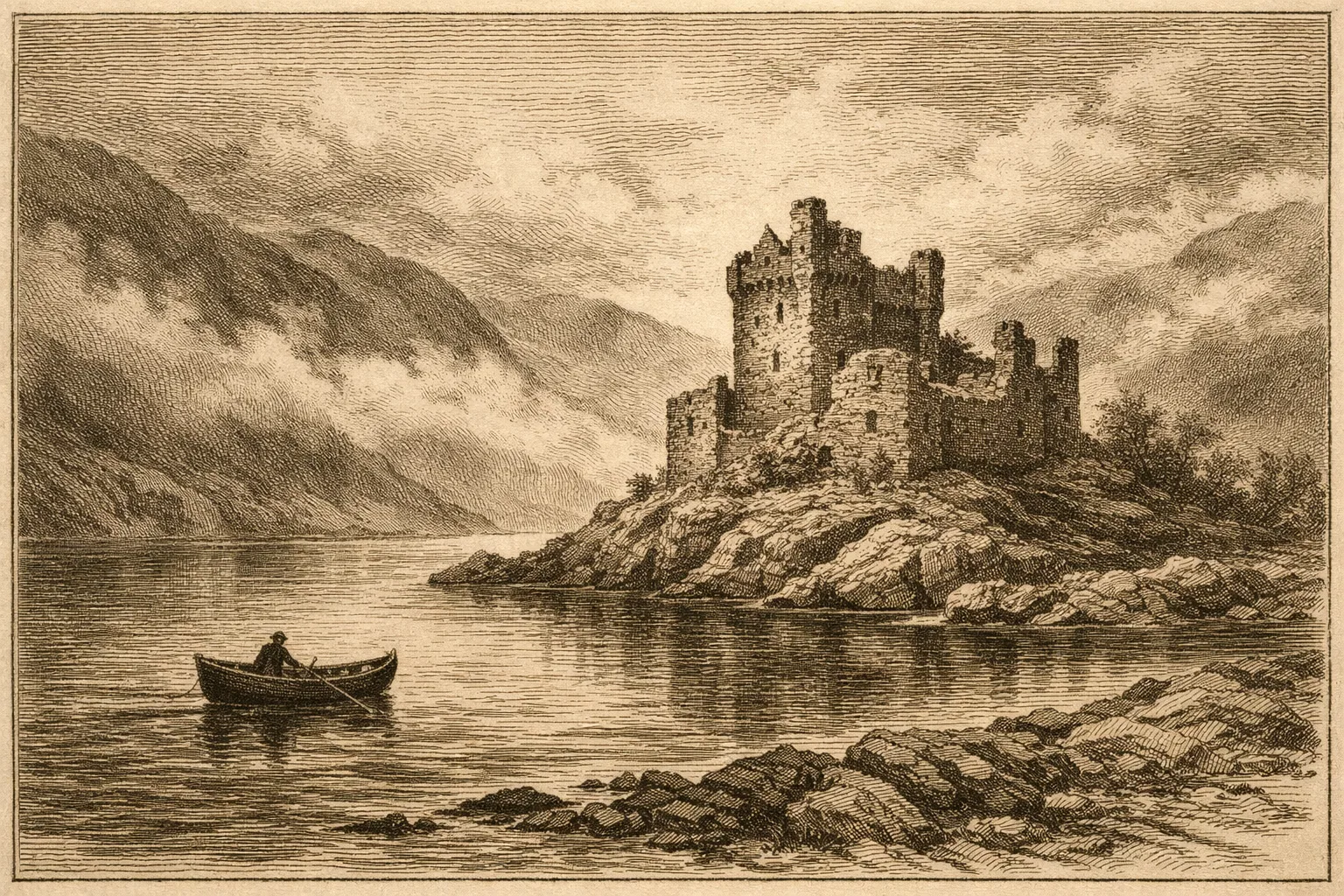
Argyllshire’s haunted history is not a single tidy trail of famous “most haunted” attractions. It is a wide coastal and island tradition: castle omens at Inveraray and Dunstaffnage, the handless piper of Duntrune, massacre-memory at Glencoe, lost pipers in sea caves, fairy dogs on Tiree, and water-spirit folklore from the Hebridean edge.
Page outline Jump by section
Where Argyllshire’s haunted geography begins
For this page, Argyllshire means the historic county of Argyll: the mainland coast, peninsulas and islands of western Scotland, including much of the Inner Hebrides. Wikishire describes it as a shire of mountains, sea lochs, peninsulas and scattered Atlantic islands, stretching from Kintyre and the Clyde approaches northwards towards Loch Leven, Loch Eil and Loch Shiel. That geography matters for ghost stories because Argyllshire is naturally broken into districts: Cowal, Kintyre, Lorn, Mid Argyll, Mull, Islay, Jura, Tiree, Coll and other island landscapes, each with its own local memory.[Wikishire]wikishire.co.ukOpen source on wikishire.co.uk.
Historic Argyllshire does not exactly match the modern council area of Argyll and Bute. Scotland’s old counties were abolished for local government in 1975, and Scotland’s People notes that Argyll county, also known as Argyllshire, had already had boundary changes in 1891. The modern Argyll and Bute council area includes Bute and Helensburgh-side territory that belonged to different historic counties, while some northern historic Argyll districts became part of Highland administration after later reforms. A haunted-history page should therefore treat modern tourism labels such as “Argyll and the Isles” as useful travel shorthand, but keep the centre of gravity on the historic county.[Wikipedia]WikipediaArgyll and ButeArgyll and Bute
This also explains why Argyllshire folklore often feels both local and border-crossing. A piper legend on Mull can resemble one on Skye or Lismore; a Green Lady at Dunstaffnage can be read beside other Scottish Green Lady traditions; Glencoe’s ghosts belong to Argyllshire memory but are also part of a national Jacobite story. The county’s haunted map is not made of neat administrative boxes. It follows ferries, clan territories, parish memory, sea routes and the places where people told stories by firelight.
The castle ghosts readers ask about first
Argyllshire’s best-known haunted places are castles, and the reason is obvious: the county’s castles are both visually dramatic and historically charged. They stand above sea lochs, guard channels, or sit on tidal islands. Their ghost stories usually do one of three things: explain a violent episode, act as an omen for a family, or attach a mysterious sound to a particular room, wall or shore.
Inveraray Castle: the harpist, the Grey Lady and family omens
Inveraray Castle is one of the clearest examples because the castle itself preserves its ghost traditions in public-facing visitor material. Its official first-floor guide names several ghosts: the Grey Lady, said to be seen only by daughters of a Duke of Argyll; a floating ship known as the Galley of Lorne, said to move away on the horizon on the death of a Duke; and a raucous kitchen maid.[Inveraray Castle]inveraray-castle.comOpen source on inveraray-castle.com.
The wider Inveraray legend also centres on a murdered young harpist. Secondary local and travel accounts usually connect him to the 17th-century violence around the old castle and say that harp music is heard as an omen of death in the ducal family. Those retellings vary in detail, so the careful reading is this: Inveraray’s official record confirms that ghost traditions are part of the castle’s interpretation, while the fuller murder narrative belongs to later legend and tourism storytelling rather than a securely documented witness file.[hiddenscotland.com]hiddenscotland.comOpen source on hiddenscotland.com.
What makes Inveraray memorable is not just the number of alleged spirits, but their social function. These are not random “jump-scare” ghosts. The Grey Lady is restricted to a family line; the Galley of Lorne appears as a death omen; the harpist’s music is treated as a warning. In other words, the haunting turns aristocratic succession, household service and inherited grief into folklore.
Duntrune Castle: the handless piper of Loch Crinan
Duntrune Castle, on the north side of Loch Crinan, has the most famous single Argyllshire ghost story: the piper who warned his clan through music and paid with his hands or his life. Historic Environment Scotland’s designation record places Duntrune on a rocky promontory above the north shore of Loch Crinan, while Canmore identifies the site as a medieval castle with a 13th-century enceinte wall and later 17th-century domestic building.[historicenvironment.scot]portal.historicenvironment.scotOpen source on historicenvironment.scot.
The legend is usually told during the 17th-century conflict between Campbells and MacDonalds. In the common version, a MacDonald piper is held at Duntrune after the castle is taken. When he sees his own side approaching, he plays a warning tune from the battlements. The defenders understand what he has done and punish him, often by cutting off his hands before killing him. Later tradition says the sound of pipes is still heard, or that physical remains found during renovation gave the tale a troubling afterlife. A Clan MacCallum/Malcolm account presents the piper legend as one of the enduring stories of the castle and links it to the belief of the modern clan chief that Duntrune is haunted.[clan-maccallum-malcolm.org]clan-maccallum-malcolm.orgOpen source on clan-maccallum-malcolm.org.
Duntrune’s story is powerful because it is built around sound. The ghost is not mainly a white figure on a stair but a warning carried across water. That makes it feel native to Argyllshire’s geography: castles look out over lochs, boats approach from the sea, and music can become a signal, a betrayal or a lament.
Dunstaffnage Castle: the Green Lady on the ramparts
Dunstaffnage Castle, near Oban, is one of Scotland’s oldest stone castles. Historic Environment Scotland says it was built before 1240 by the MacDougalls, captured by Robert the Bruce in 1308, and remained in royal hands until 1469 before its later Campbell history. Its position guarded the seaward approach from the Firth of Lorn towards the Pass of Brander, giving the site real strategic weight long before any ghost story is added.[Historic Environment Scotland]historicenvironment.scotOpen source on historicenvironment.scot.
The associated ghost is the Ell-maid or Green Lady of Dunstaffnage, reputed to appear on the ramparts at times of peril. Historic Environment Scotland’s own blog summarises the legend: if she smiles, the outcome will be good; if she weeps, trouble lies ahead for the castle’s owners. That makes her an omen spirit, not simply a wandering apparition.[Historic Environment Scotland Blog]blog.historicenvironment.scotHistoric Environment Scotland Blog Haunted Homes of History (AllegedlyHistoric Environment Scotland Blog Haunted Homes of History (Allegedly
Later writers sometimes connect the Green Lady with the wider Highland figure of the glaistig, a female supernatural being who can be protective, dangerous or water-associated depending on the tale. That interpretation is plausible as folklore comparison, but it should not be overstated. The firm point is that Dunstaffnage has an old-style family warning spirit attached to a castle whose real history is full of siege, power and custody.[Spooky Isles]spookyisles.comSpooky Isles5 Scottish Green Lady Ghost Stories, And 1 FromSpooky Isles5 Scottish Green Lady Ghost Stories, And 1 From
Glencoe: when history itself becomes the haunting
Glencoe is not primarily famous because of one named ghost. It is famous because a documented atrocity became so emotionally charged that later visitors described the whole glen as haunted. The National Trust for Scotland states that on 13 February 1692, 38 men, women and children of Clan MacDonald were murdered by government soldiers whom they had welcomed into their homes. Its visitor material stresses that the massacre still has the power to evoke strong emotion.[National Trust for Scotland]nts.org.ukOpen source on nts.org.uk.
This is important for credibility. The massacre is historical; the ghostly re-enactments, cries and shadowy fugitive figures reported in later haunted accounts are traditions built on that history. National Trust material also notes ongoing archaeological work at Glencoe, including attempts to understand the lost 17th- and 18th-century settlements associated with the massacre landscape. That research gives modern visitors something more grounded than legend alone: the places of daily life, flight and destruction can be studied materially, even where the ghost stories remain unproven.[National Trust for Scotland]nts.org.ukthe glencoe massacrethe glencoe massacre
The haunted meaning of Glencoe therefore lies in memory. Many battlefield and massacre hauntings work this way. They compress complicated politics into a place where the visitor can imagine footsteps in snow, cries in the dark and houses burning in a narrow glen. A sceptical reading does not make the place less powerful. It simply separates the documented event from the later supernatural frame.
Pipers, caves and the sound of danger
Argyllshire has a striking cluster of piper legends. Duntrune’s piper warns from a castle; Mull’s cave piper vanishes underground; Lismore has a related story of a piper and dog entering a cave system. These tales are not identical, but they share a pattern: music enters a dangerous threshold, then stops.
MacKinnon’s Cave on the west coast of Mull is the best-known Argyllshire cave example. Isle of Mull visitor material describes it as one of the deepest caves in the Hebrides and says it carries a tale of a piper who tried to outdo the fairies in a piping competition. In the common version, the piper enters with his dog; only the dog returns, crazed with fear and hairless. Some versions say the piper went through the hill and emerged near Tiroran on Loch Scridain, while others say he met fairies or a female monster and never returned.[isle-of-mull.net]isle-of-mull.netIsle of Mull Mackinnon's CaveIsle of Mull Mackinnon's Cave
A similar Lismore tradition describes a piper entering one cave and intending to emerge from another, with his pipes heard across the island until they ceased; the dog later came out sightless and hairless, while the piper was presumed lost in impassable pools. The recurrence of this motif across western Scotland suggests that the story is not best read as a single lost-person report. It is a folklore pattern attached to frightening geology: caves, underground water, darkness, echoes and the old fear that some places should not be entered.[Wikipedia]WikipediaLismore, ScotlandLismore, Scotland
For modern readers, the sensible interpretation is double-layered. The stories are supernatural tales, but they also encode practical warnings. Sea caves and coastal caves can be genuinely dangerous because of tides, loose rock, darkness and confusing acoustics. A vanished piper is a memorable way of saying: do not mistake music, bravado or curiosity for safety.
Island spirits: Tiree, fairy dogs and the old oral tradition
Argyllshire’s haunted history is not only castles and tourist sites. Some of the most valuable evidence comes from older folklore collection, especially John Gregorson Campbell, minister of Tiree, whose Superstitions of the Highlands and Islands of Scotland was published in 1900 from oral material. The editor notes that Campbell ministered on Tiree from 1861 to 1891, while Campbell’s own preface says he aimed to gather Highland and island beliefs from oral sources and compare traditions across districts.[Internet Archive]archive.orgInternet Archive Superstitions of the highlands & islands of ScotlandInternet Archive Superstitions of the highlands & islands of Scotland
That makes Tiree unusually important. Campbell records fairy and apparition traditions that do not read like modern ghost-tour copy. They are about night travel, strange noises, omens, household vulnerability and the uncanny behaviour of animals. One Tiree account describes a huge black dog seen near Kennavara Hill; another tells of a beach where a woman remembered hearing the bark of the fairy hound, a sound so dangerous that her father ran with her indoors because, if it barked three times, it would overtake them.[Internet Archive]archive.orgInternet Archive Superstitions of the highlands & islands of ScotlandInternet Archive Superstitions of the highlands & islands of Scotland
These stories matter because they preserve a different kind of haunting. There may be no named room, no ticketed attraction and no celebrity witness. Instead, the supernatural belongs to beaches, machair, dunes, byres and night roads. Campbell’s own text is also useful for sceptical reading: in one passage he observes that anxious minds may turn wind, waterfalls, surf and other unexplained night noises into omens or presences. That does not dismiss the folklore; it shows that Highland collectors themselves could recognise both belief and natural explanation.[Internet Archive]archive.orgInternet Archive Superstitions of the highlands & islands of ScotlandInternet Archive Superstitions of the highlands & islands of Scotland
Water, weather and why Argyllshire breeds uncanny stories
Argyllshire’s supernatural landscape is intensely watery. Sea lochs cut into the mainland. Islands sit in Atlantic weather. Caves open at tide level. Castles guard channels. Ferries, boats, drowning, storms and shore sounds shape the imaginative background of the county.
That helps explain why water spirits and water-adjacent beings recur in Highland and island folklore. Campbell’s collection places Argyllshire within a wider Gaelic supernatural world of fairies, omens, second sight and tutelary beings, while later summaries of the each-uisge or water horse describe a dangerous loch or sea-loch spirit often distinguished from the river kelpie. The key point for Argyllshire is not that every loch has a named monster, but that watery danger is one of the county’s oldest supernatural languages.[Internet Archive]archive.orgInternet Archive Superstitions of the highlands & islands of ScotlandInternet Archive Superstitions of the highlands & islands of Scotland
This also gives a grounded explanation for many ghostly reports. Surf on shingle, wind around stone walls, bagpipe-like echoes, animal cries, fog, low visibility and isolation can all contribute to eerie perception. In Argyllshire, the natural soundscape is not background decoration. It is part of the haunting tradition itself.
How credible are Argyllshire’s ghost stories?
The fairest answer is that Argyllshire has strong folklore, strong historic settings, and uneven ghost evidence. Its haunted reputation is credible as cultural history, but individual apparitions should be treated as traditions, claims or legends rather than proven events.
A useful way to judge each story is by asking what kind of source preserves it:
- Official heritage or site interpretation: Inveraray Castle’s own visitor material confirms that ghosts form part of the castle’s presented tradition, and Historic Environment Scotland confirms the historical importance of Dunstaffnage and Duntrune’s settings. This is strong evidence that the legends are recognised parts of place identity, though not proof that apparitions occur.[inveraray-castle.com]inveraray-castle.comOpen source on inveraray-castle.com.
- Older folklore collection: John Gregorson Campbell’s Tiree material is valuable because it was gathered from oral sources in the 19th-century Highlands and islands. It is not laboratory evidence, but it is excellent evidence for what people believed, feared and told.[Internet Archive]archive.orgInternet Archive Superstitions of the highlands & islands of ScotlandInternet Archive Superstitions of the highlands & islands of Scotland
- Tourism and local-history retellings: Duntrune’s piper, MacKinnon’s Cave and Glencoe hauntings are often repeated in travel writing and local storytelling. These sources preserve popular memory but can simplify, embellish or merge versions.[clan-maccallum-malcolm.org]clan-maccallum-malcolm.orgOpen source on clan-maccallum-malcolm.org.
- Paranormal directories and modern haunted lists: These can help locate minor traditions, such as stories around inns, islands or specific ruins, but they are best treated as pointers rather than authorities unless they name older records or verifiable witnesses.[Paranormal Database]paranormaldatabase.comOpen source on paranormaldatabase.com.
Argyllshire’s best haunted stories are therefore not the ones with the loudest claims. They are the ones where legend and landscape reinforce each other: the piper at Loch Crinan, the Green Lady above the Firth of Lorn, the harp heard in a ducal castle, the massacre remembered in Glencoe, and the hairless dog returning from a cave while the music falls silent.
The haunted Argyllshire itinerary in plain terms
For readers planning an atmospheric route, the strongest haunted-history anchors are easy to group by theme.
For castle ghosts: Inveraray Castle offers the richest cluster of named household and family omens, including the Grey Lady and Galley of Lorne. Dunstaffnage gives a more ancient, ruinous atmosphere, with the Ell-maid or Green Lady attached to a strategic medieval stronghold. Duntrune is the essential piper legend, best understood from the Loch Crinan side as a story of warning, betrayal and sound over water.[inveraray-castle.com]inveraray-castle.comOpen source on inveraray-castle.com.
For tragic landscape memory: Glencoe is the major site. Its haunted reputation should be approached through the real 1692 massacre first, then through the later claims of cries, shadows and re-enactments. The National Trust for Scotland’s historical and archaeological interpretation gives the folklore a serious frame.[National Trust for Scotland]nts.org.ukOpen source on nts.org.uk.
For island folklore: Mull’s MacKinnon’s Cave, Tiree’s fairy-dog traditions and Lismore’s piper cave story show a less formal, more oral Argyllshire: a world of dangerous thresholds, uncanny animals, fairy music and warning sounds. These stories are especially useful for understanding how island communities turned real hazards into unforgettable supernatural narratives.[isle-of-mull.net]isle-of-mull.netIsle of Mull Mackinnon's CaveIsle of Mull Mackinnon's Cave
The best way to read Argyllshire’s haunted places is not to ask, “Which ghost is real?” but “What is this story remembering?” Often the answer is a death, a feud, a dangerous shore, a family omen, a local warning or the sheer unease of living where mountains, sea and weather meet.
Why Argyllshire’s ghosts still work
Argyllshire’s ghost stories endure because they are rooted in place. Inveraray’s apparitions belong to a ducal household; Duntrune’s piper belongs to clan conflict and a sea-facing castle; Dunstaffnage’s Green Lady belongs to ramparts and inherited peril; Glencoe’s spectres belong to historical trauma; Mull and Lismore’s cave pipers belong to darkness, echoes and the risk of never returning.
They also endure because they are not all the same kind of ghost. Some are apparitions. Some are sounds. Some are omens. Some are fairy beings, water spirits or spectral animals rather than human dead. That variety is what makes Argyllshire distinctive within the wider UK haunted-counties map. It is not only a county of haunted castles; it is a county where coast, clan, cave, island and weather all become part of the supernatural record.
The careful conclusion is atmospheric but modest: Argyllshire is richly haunted in folklore and local memory, but its stories are best handled as traditions rather than facts. Their value lies in how they preserve the emotional history of the county — grief at Glencoe, warning at Duntrune, family omen at Inveraray, peril at Dunstaffnage, and the old island fear that beyond the last light of the shore, music may fade into something no one can follow.
eBay marketplace picks
Marketplace Samples
Live-tested eBay searches with available results related to this page.


Endnotes
1.
Source: inveraray-castle.com
Link:https://www.inveraray-castle.com/castle/first-floor
2.
Source: clan-maccallum-malcolm.org
Link:https://clan-maccallum-malcolm.org/wp-content/uploads/Piper-of-Duntrune.pdf
3.
Source: archive.org
Title: Internet Archive Superstitions of the highlands & islands of Scotland
Link:https://archive.org/download/cu31924029909896/cu31924029909896.pdf
4.
Source: Wikipedia
Title: Argyll and Bute
Link:https://en.wikipedia.org/wiki/Argyll_and_Bute
5.
Source: travels-with-terri.com
Title: Travels with Terri Inveraray Castle: Is it Really Haunted?
Link:https://travels-with-terri.com/2022/07/10/inveraray-castle-is-it-really-haunted/
6.
Source: trove.scot
Link:https://www.trove.scot/place/39147
7.
Source: isle-of-mull.net
Title: Isle of Mull Mackinnon’s Cave
Link:https://www.isle-of-mull.net/things-to-do/geology/mackinnons-cave/
8.
Source: Wikipedia
Title: Lismore, Scotland
Link:https://en.wikipedia.org/wiki/Lismore%2C_Scotland
9.
Source: Wikipedia
Link:https://en.wikipedia.org/wiki/Each-uisge
10.
Source: ia801308.us.archive.org
Link:https://ia801308.us.archive.org/16/items/peatfireflamefol00macg/peatfireflamefol00macg.pdf
11.
Source: archive.org
Link:https://archive.org/download/populartalesofwe22camp/populartalesofwe22camp.pdf
12.
Source: ia802807.us.archive.org
Title: besidefirecollec00hyde bw
Link:https://ia802807.us.archive.org/5/items/besidefirecollec00hyde/besidefirecollec00hyde_bw.pdf
13.
Source: archive.org
Link:https://archive.org/download/peatfireflamefol00macg/peatfireflamefol00macg.pdf
14.
Source: archive.org
Link:https://archive.org/download/memorialhistoryo00camp/memorialhistoryo00camp.pdf
15.
Source: dn790004.ca.archive.org
Link:https://dn790004.ca.archive.org/0/items/glasgowriversstr00brot/glasgowriversstr00brot.pdf
16.
Source: dn790000.ca.archive.org
Link:https://dn790000.ca.archive.org/0/items/folktalesfairylo01macd/folktalesfairylo01macd.pdf
17.
Source: ia801508.us.archive.org
Link:https://ia801508.us.archive.org/25/items/bookofdreamsghos00lang/bookofdreamsghos00lang.pdf
18.
Source: dn790009.ca.archive.org
Link:https://dn790009.ca.archive.org/0/items/scotsearlincoven00will/scotsearlincoven00will.pdf
19.
Source: Wikipedia
Title: Duntrune Castle
Link:https://en.wikipedia.org/wiki/Duntrune_Castle
20.
Source: Wikipedia
Title: Morag (lake monster)
Link:https://en.wikipedia.org/wiki/Morag_%28lake_monster%29
21.
Source: Wikipedia
Link:https://en.wikipedia.org/wiki/Argyll
22.
Source: Wikipedia
Title: Castle Stalker
Link:https://en.wikipedia.org/wiki/Castle_Stalker
23.
Source: Wikipedia
Title: Massacre of Glencoe
Link:https://en.wikipedia.org/wiki/Massacre_of_Glencoe
24.
Source: Wikipedia
Title: Dunstaffnage Castle
Link:https://en.wikipedia.org/wiki/Dunstaffnage_Castle
25.
Source: trove.scot
Link:https://www.trove.scot/designation/SM240
26.
Source: isle-of-mull.net
Title: Mac Kinnon’s Cave
Link:https://www.isle-of-mull.net/attractions/walking-mull/mackinnons-cave/
27.
Source: wikishire.co.uk
Link:https://wikishire.co.uk/wiki/Argyll
28.
Source: gazetteer.org.uk
Link:https://gazetteer.org.uk/place/Argyllshire
29.
Source: hiddenscotland.com
Link:https://hiddenscotland.com/journal/the-ghostly-harpist-of-inveraray-castle
30.
Source: portal.historicenvironment.scot
Link:https://portal.historicenvironment.scot/apex/f?p=1505%3A300%3A%3A%3A%3A%3AVIEWTYPE%2CVIEWREF%3Adesignation%2CLB11496
31.
Source: portal.historicenvironment.scot
Link:https://portal.historicenvironment.scot/apex/f?p=1505%3A300%3A%3A%3A%3A%3AVIEWTYPE%2CVIEWREF%3Adesignation%2CGDL00163
32.
Source: firesidehorror.co.uk
Link:https://www.firesidehorror.co.uk/blog-2/ghostly-folklore-the-ghostly-piper-of-duntrune-castle
33.
Source: historicenvironment.scot
Link:https://www.historicenvironment.scot/visit/all/dunstaffnage-castle-and-chapel/history-and-stories/
34.
Source: historicenvironment.scot
Link:https://www.historicenvironment.scot/visit/all/dunstaffnage-castle-and-chapel/
35.
Source: blog.historicenvironment.scot
Title: Historic Environment Scotland Blog Haunted Homes of History (Allegedly)
Link:https://blog.historicenvironment.scot/2017/10/haunted-homes-history-allegedly/
36.
Source: spookyisles.com
Title: Spooky Isles5 Scottish Green Lady Ghost Stories, And 1 From
Link:https://www.spookyisles.com/scottish-green-lady-stories/
37.
Source: nts.org.uk
Link:https://www.nts.org.uk/visit/places/glencoe
38.
Source: nts.org.uk
Title: the glencoe massacre
Link:https://www.nts.org.uk/visit/places/glencoe/the-glencoe-massacre
39.
Source: nts.org.uk
Title: uncovering the story of glencoe
Link:https://www.nts.org.uk/stories/uncovering-the-story-of-glencoe
40.
Source: argyllcruising.com
Title: legends of scotland tales from splendours wheelhouse mackinnons cave
Link:https://www.argyllcruising.com/legends-of-scotland-tales-from-splendours-wheelhouse-mackinnons-cave/
41.
Source: paranormaldatabase.com
Link:https://www.paranormaldatabase.com/highlands/Argydata.php
42.
Source: paranormaldatabase.com
Link:https://www.paranormaldatabase.com/highlands/Argydata.php?pageNum_paradata=4
43.
Source: canmore.org.uk
Link:https://canmore.org.uk/site/39147/duntrune-castle?display=image
44.
Source: facebook.com
Link:https://www.facebook.com/RealCounties/photos/welcome-to-the-county-of-argyll-a-land-of-soaring-mountains-dramatic-peninsulas-/1089843243299242/
45.
Source: nts.org.uk
Link:https://www.nts.org.uk/stories/scottish-ghost-stories-witches-murder-and-folklore
46.
Source: nts.org.uk
Link:https://www.nts.org.uk/visit/places/glencoe/highlights/turf-and-creel-house
47.
Source: nts.org.uk
Link:https://www.nts.org.uk/stories/ghosts-of-the-trust
48.
Source: hiddenscotland.com
Link:https://hiddenscotland.com/listings/castle-stalker
49.
Source: mainlymuseums.com
Title: Inveraray Castle? Yes, it’s Marvellous!
Link:https://mainlymuseums.com/post/1291/inveraray-castle-yes-its-marvellous/
50.
Source: boundaries.scot
Title: Argyll and Bute
Link:https://www.boundaries.scot/wp-content/uploads/2026/01/Argyll_and_Bute.pdf
51.
Source: historyhit.com
Title: Dunstaffnage Castle
Link:https://www.historyhit.com/locations/dunstaffnage-castle/
52.
Source: secret-scotland.com
Link:https://www.secret-scotland.com/place/inveraray-castle
53.
Source: spookyisles.com
Title: duntrune castle ghost piper
Link:https://www.spookyisles.com/duntrune-castle-ghost-piper/
Additional References
54.
Source: youtube.com
Title: The Ghosts of Inverawe House, Argyll, Exploring Scotland’s History
Link:https://www.youtube.com/watch?v=JIuu3X2nFKs
Source snippet
Loch Awe Hotel, Argyll, Exploring Scotland's History...
55.
Source: woodlands.scot
Link:https://www.woodlands.scot/blog/10-incredible-stories-from-glencoe/
56.
Source: visitscotland.com
Link:https://www.visitscotland.com/nl-nl/things-to-do/attractions/castles/haunted
57.
Source: wildaboutargyll.co.uk
Link:https://www.wildaboutargyll.co.uk/blogs/7-enchanted-locations-filled-with-stories-in-argyll-the-isles/
58.
Source: visitscotland.com
Link:https://www.visitscotland.com/things-to-do/attractions/haunted-sites
59.
Source: discoverhighlandsandislands.scot
Link:https://discoverhighlandsandislands.scot/en/visitor/journey/a-day-full-of-magic
60.
Source: gbmaps.com
Link:https://www.gbmaps.com/free-county-maps/Argyll_And_Bute.php
61.
Source: abcounties.com
Link:https://abcounties.com/counties/county-profiles/argyllshire/
62.
Source: afhs.co.uk
Link:https://afhs.co.uk/ayrshires-most-haunted-ten-top-ayrshire-ghost-encounters/
63.
Source: canmore.org.uk
Link:https://canmore.org.uk/site/39525/barsloisnoch
Topic Tree
Follow this branch
Related pages 91
- Haunted Clackmannanshire
- Haunted Antrim
- Haunted Armagh
- Haunted Durham
- Haunted Londonderry
- +86 more in sidebar